

Emotional Intelligence in Sales: Drills, Data, and the Playbook Your Team Actually Needs
Your best rep just lost a deal they should've closed. The product fit was there. Pricing worked. The champion was engaged. But somewhere between the second demo and the proposal, the prospect went cold - and your rep didn't notice the shift until it was too late.
That's not a pipeline problem. Emotional intelligence in sales isn't a soft skill - it's the skill that separates reps who close from reps who chase. Every sales article tells you to "be more empathetic" and "read the room." None of them show you how.
Let's fix that.
High-EQ reps produce 2x the revenue of average-EQ reps. Roleplay-based drills produce 43% better retention than lecture-based training. Below: five drills you can run Monday, the EQ assessments actually worth using, and the coaching mistakes quietly killing your team's performance.
What Sales EQ Actually Means
Daniel Goleman's framework breaks emotional intelligence into five components: self-awareness, self-regulation, empathy, motivation, and social skills. In a sales context, it boils down to one question - can your rep detect that a prospect's enthusiasm just shifted, and adjust in real time?
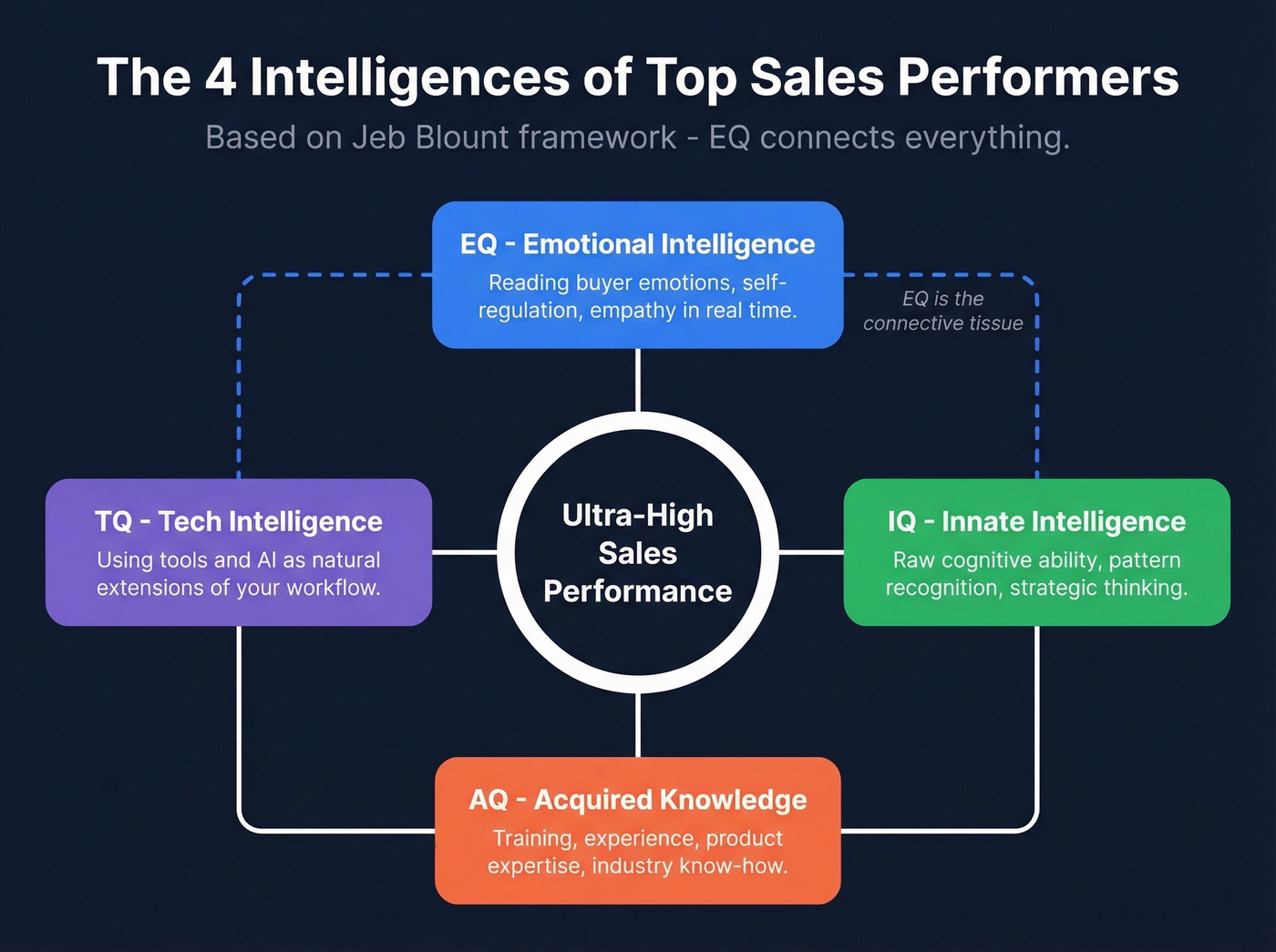
Jeb Blount takes this further with his [four intelligences model](https://www.paretolaw.com/resources/blogs/4-intelligence-styles-of-successful-sales-professionals - pareto-26). Ultra-high performers combine EQ with IQ (innate intelligence), AQ (acquired knowledge from training and experience), and TQ (technological intelligence - the ability to use tools and AI as natural extensions of their workflow). EQ is the connective tissue that makes the other three work in front of a buyer.
Picture this: a prospect pauses for three seconds after you quote the price. A high-EQ rep asks "What's on your mind?" instead of plowing into the next slide. Or a buyer's voice pitches up when they say "Yeah, we're definitely moving forward" - that higher pitch often signals false excitement, and the rep who catches it probes for the real objection underneath. No script replicates that.
Gerald Zaltman's research at Harvard found that 95% of purchasing decisions happen subconsciously. Your prospect isn't making a rational spreadsheet decision. They're making an emotional one and rationalizing it afterward. EQ is how your reps influence that process without crossing into manipulation.
The Business Case
If you need to justify EQ training to a CFO, here are the numbers that matter:
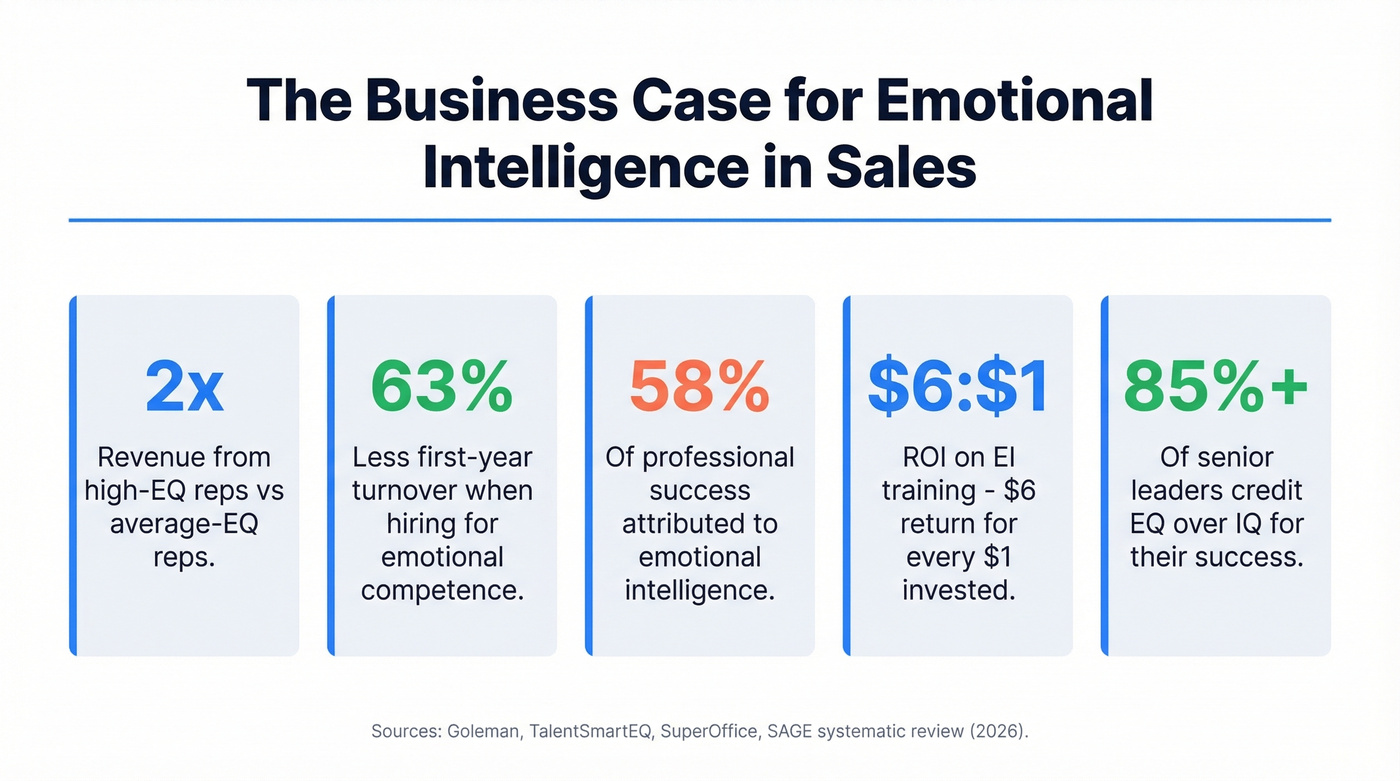
- 58% of professional success across all job types is attributed to emotional intelligence
- Hiring salespeople based on emotional competence results in 63% less first-year turnover
- High-EQ reps produce 2x the revenue of average or below-average EQ reps
- One EI training program for front-line sales managers and reps drove a 12% revenue lift - roughly $55,000 per rep - with a $6 return on every $1 invested
- Goleman's research shows more than 85% of senior leaders attribute their success to EQ over IQ
A 101-study systematic review published in a SAGE journal in 2026 confirmed the positive association between emotional intelligence and leadership outcomes. The directional evidence across a hundred studies is hard to argue with.
EQ Across Sales Roles
Here's the thing: most EQ advice feels generic because nobody breaks it down by role. An SDR who can't self-regulate after ten consecutive rejections will burn out by Thursday. An AE who can't read buyer emotions mid-demo will lose deals they should close. The skills aren't the same.
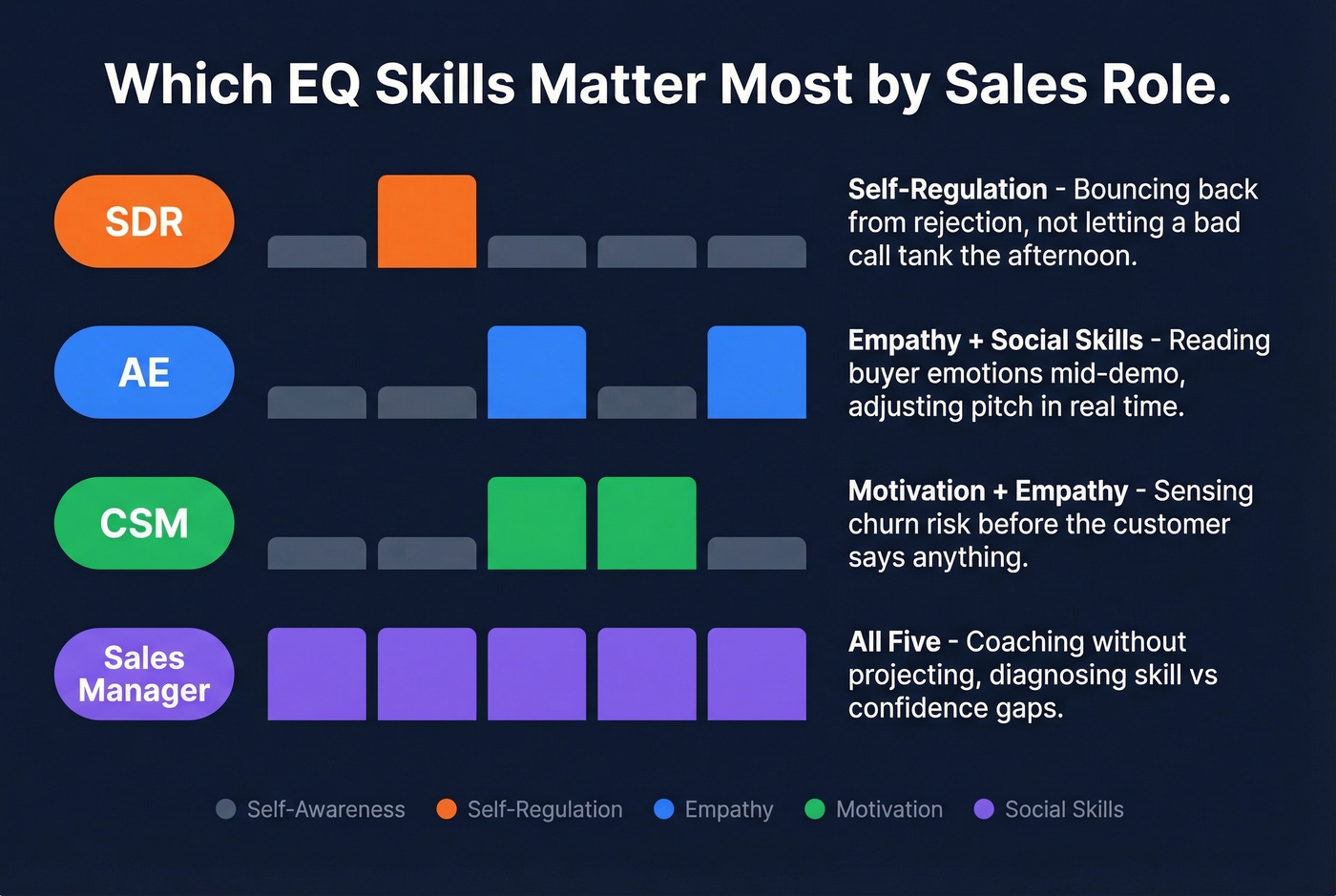
| Role | Primary EQ Skill | What It Looks Like |
|---|---|---|
| SDR | Self-regulation | Bouncing back from rejection; not letting a bad call tank the afternoon |
| AE | Empathy + social skills | Reading buyer emotions mid-demo; adjusting pitch in real time |
| CSM | Motivation + empathy | Sensing churn risk before the customer says anything |
| Sales Manager | All five | Coaching without projecting; diagnosing skill vs. confidence gaps |
Training SDRs to recognize their emotional state after a harsh "no" and reset before the next dial is the single highest-ROI EQ investment for early-career reps. BDR empathy training pays off fastest not by teaching reps to fake warmth, but by helping them genuinely understand why a prospect just snapped at them and respond without taking it personally.
For AEs, the game shifts. You're in a 45-minute demo and the VP of Operations just crossed her arms and stopped asking questions. A high-EQ rep pauses, names the shift, and saves the deal.
Sales managers need all five components, but the hardest one is self-awareness. We've seen managers who project their own selling style onto every rep, coaching everyone to sell the way they sold. That's not coaching - that's cloning.
5 EQ Drills Your Team Can Run This Week
Stop sending your team to $15K offsites. Ten minutes every Monday will outperform a quarterly workshop every time. Zero budget, zero prep.
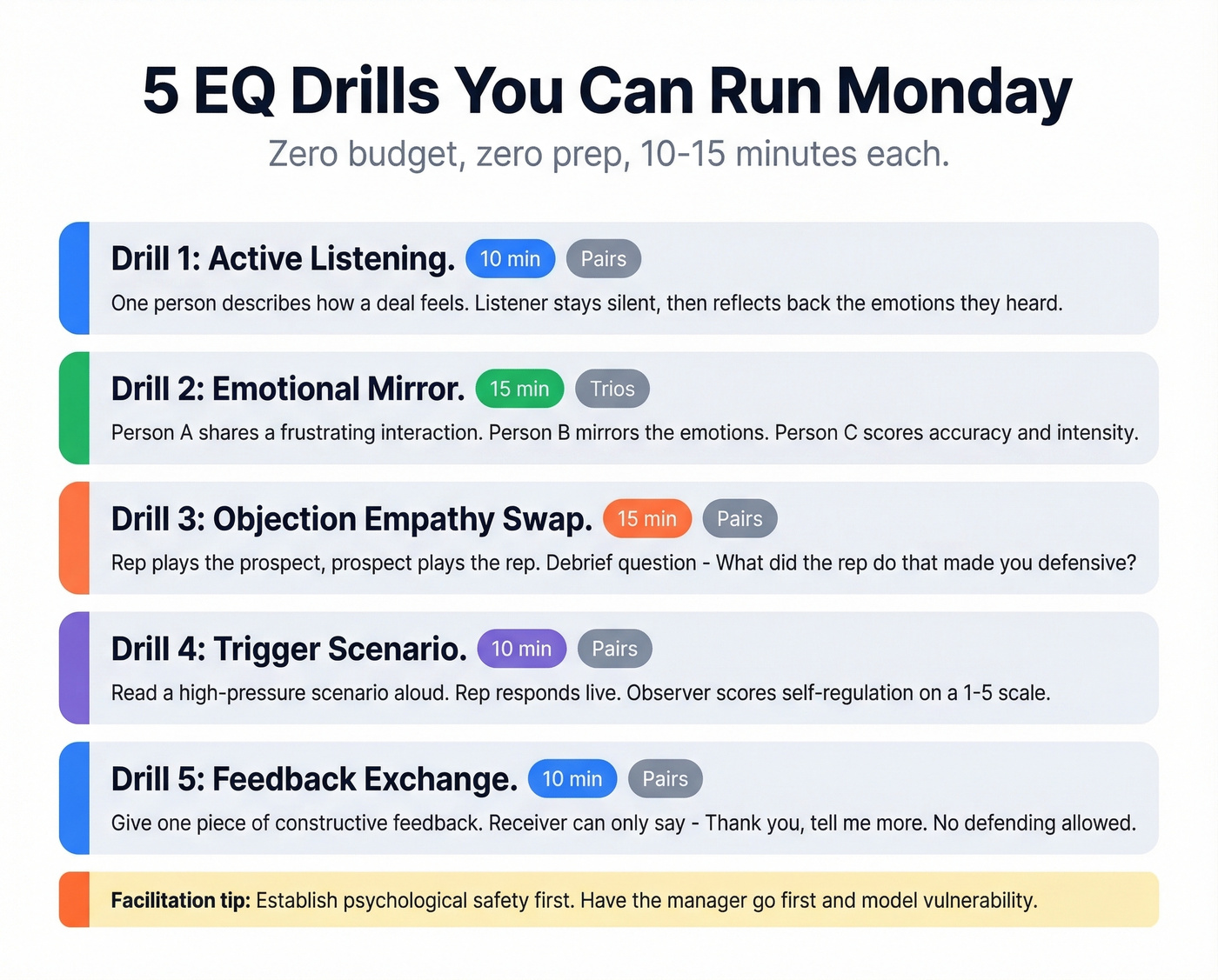
The Active Listening Drill
10 min - Pairs
One person describes a current deal challenge for five minutes - not the facts, but how it feels. Frustrating? Confusing? Exciting but fragile? The listener stays silent. No advice, no "have you tried..." After five minutes, the listener reflects back the emotions they heard. Switch roles. Debrief question: "What emotions did your partner express that you missed?"
The Emotional Mirror
This one works best in trios. Person A describes a frustrating prospect interaction. Person B mirrors the emotions back, trying to match both content and intensity. Person C observes silently and scores Person B on accuracy - did they capture the right emotions? Did they over- or under-estimate the intensity? Rotate roles. Fifteen minutes total. This drill builds the muscle of accurately reading emotional states, which is the foundation of empathy in sales.
The Objection Empathy Swap
The setup is simple - the rep plays the prospect, the prospect plays the rep. This forces sellers to feel what it's like to be on the receiving end of a pitch: the pressure, the assumptions, the moments where the "rep" bulldozes past a concern.
The debrief question that makes this drill work: "What did the rep do that made you defensive?"
In our experience, this drill consistently produces the biggest "aha" moments in EQ training.
The Trigger Scenario
Read a high-pressure scenario aloud: a deal slipping at the last minute, an aggressive competitor undercutting your price, a buyer making an unreasonable demand. The rep responds in real time - out loud, as if they're on the call. The observer scores self-regulation on a 1-5 scale. Did the rep stay composed? Get defensive? Pause before responding? Think of it as a flight simulator for emotional regulation - and a practical exercise in reframing negative emotions, turning frustration or panic into curiosity about what the buyer actually needs. Ten minutes, pairs, 3-4 written scenarios.
The Feedback Exchange
10 min - Pairs
Each person gives the other one piece of constructive feedback about their selling style. The receiver can only respond with "Thank you - tell me more." No defending, no explaining, no "but the context was..." This builds receptivity, the EQ skill most salespeople resist developing. It also cultivates the kind of humility that buyers increasingly respond to over polished confidence.
One facilitation tip that makes all of these work: establish psychological safety first. If reps feel judged, they'll perform instead of practice. Have the manager go first and model vulnerability.

EQ helps your reps read the room - but they need to be in the room first. Prospeo gives your team 98% accurate emails and 125M+ verified mobiles so every emotionally intelligent conversation actually reaches a real decision-maker.
Stop wasting high-EQ reps on bad contact data.
How to Measure EQ
Assessment Tools
You can't improve what you don't measure. Five EQ assessments worth considering:
| Tool | Best For | Format | Price |
|---|---|---|---|
| EQ-i 2.0 | Ongoing development | 15 sub-skills, self-report | Varies by provider |
| Genos EI | Hiring and selection | Includes Selection Report | Requires certified admin |
| MSCEIT | Reducing self-report bias | Ability-based testing | Varies by provider |
| ESCI | 360 feedback | 12 competencies, 4 clusters | Varies by provider |
| Six Seconds SEI | Development coaching | Growth-focused framework | Varies by provider |
Use Genos EI for hiring - the Selection Report is specifically designed for candidate evaluation. Use EQ-i 2.0 for ongoing development; its 15 sub-skill breakdown gives managers specific coaching targets. If you're worried about reps gaming a self-report assessment (and you should be), MSCEIT is the ability-based option, measuring what people can do rather than what they think they do.
Self-awareness is the hardest competency to self-report accurately. That's exactly why ability-based testing matters.
Hiring for EQ
The most reliable hiring process we've seen uses four steps:
- Administer a validated EQ assessment before the interview.
- Run a structured behavioral interview with sales-specific scenarios - "Tell me about a time a buyer got visibly frustrated during a call."
- Score responses on a standardized rubric for consistent comparison.
- Compare the candidate's self-rated EQ against their observed interview behavior.
That last step is the most revealing. A candidate who scores high on self-awareness but can't demonstrate it live has a blind spot. The mismatch between self-perception and observed behavior is where the real insights live.
EQ Coaching Mistakes That Kill Performance
Three anti-patterns we see repeatedly in sales orgs trying to build EQ:
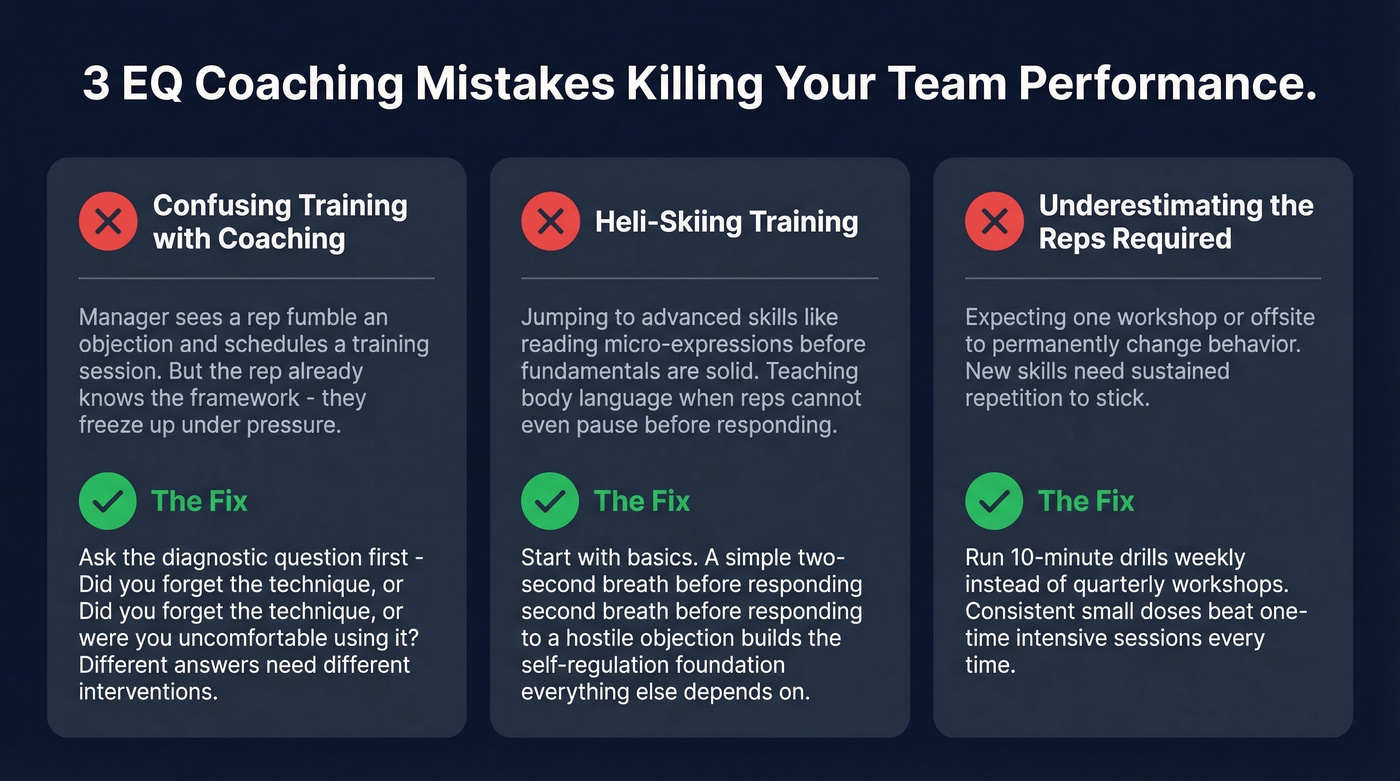
Confusing training with coaching. A manager watches a rep fumble an objection and immediately schedules a training session. But the rep already knows the framework - the real issue is they freeze up when a buyer gets aggressive. The diagnostic question: "Did you forget the technique, or were you uncomfortable using it?" Those require completely different interventions.
"Heli-skiing" training. Managers jump to advanced EQ skills - reading micro-expressions, navigating complex multi-stakeholder emotions - before the fundamentals are solid. If a rep can't pause for two seconds before responding to an objection, teaching them to read body language clusters is pointless. Start with mindfulness practices. Even a simple two-second breath before responding to a hostile objection builds the self-regulation foundation everything else depends on.
Underestimating the reps required. A new outbound skill needs at least 144 practice reps before it becomes conversational. Not a typo - 144. A one-hour workshop gives your team maybe 5-10. This is why weekly drills beat quarterly offsites every single time.
Emotion AI and Real-Time Coaching
Emotion AI - also called affective computing - uses NLP and machine learning to recognize emotions from voices, faces, and text. The market surpassed $62B in 2025 and is growing at 28.3% CAGR. This isn't niche anymore.
AI coaching platforms can track 140+ verbal and nonverbal cues during sales calls. Teams using these tools report 24% higher win rates and 37% faster onboarding. Those numbers are real.
But here's where I'll push back on the hype: AI coaching tools are EQ accelerators, not replacements. They can tell a rep "you talked for 72% of that call" or "your prospect's sentiment dropped when you mentioned pricing." They can't teach a rep to sit with uncomfortable silence or to genuinely care about a buyer's problem. For teams where the average deal size is under $15K, enterprise-grade conversation intelligence usually isn't the first budget priority - run the drills above instead and save the spend for when deal complexity warrants it.
The Data Foundation Nobody Talks About
Every EQ skill in this article assumes one thing: your rep is actually reaching the right person. You can't build rapport with a bounced email. You can't read buyer emotions on a call that goes to a disconnected number.
Bad data doesn't just waste time - it wastes the emotional energy your team has worked to develop. Prospeo keeps contact data fresh with a 7-day refresh cycle (the industry average is six weeks) and 98% email accuracy across 300M+ professional profiles. When Snyk rolled out Prospeo to 50 AEs, their bounce rate dropped from 35-40% to under 5%, meaning reps could actually use their EQ skills on real conversations instead of chasing dead leads.

You're investing in EQ drills to help reps detect buyer signals and close more deals. Don't let stale data undercut that investment. Prospeo refreshes 300M+ profiles every 7 days - so your reps always reach the right person at the right moment.
Pair emotional intelligence with data intelligence for 2x the impact.
FAQ
Can emotional intelligence be learned, or is it innate?
EQ is absolutely trainable - unlike IQ, it improves with deliberate practice. Roleplay-based training produces 43% better retention than lectures. Weekly 10-minute drills build EQ faster than annual workshops because the skill requires 144+ practice reps to become conversational.
What's the fastest way to improve EQ on a sales team?
Run 10-minute roleplay drills every Monday. Start with the Active Listening Drill - pairs, zero prep, five minutes per person. Consistency beats intensity because EQ is a muscle, not a knowledge set.
How do you measure emotional intelligence in sales hiring?
Use Genos EI (which includes a hiring-specific Selection Report), pair it with structured behavioral interviews using sales scenarios, and score on a standardized rubric. Compare self-rated EQ against observed behavior - mismatches reveal blind spots that self-report assessments alone miss.
Does EQ matter more than product knowledge?
Both matter, but EQ has a higher ceiling. Product knowledge gets you into the conversation; empathy and self-regulation keep the prospect engaged and close the deal. Research shows 85% of senior leaders attribute success to EQ over IQ, and high-EQ reps generate 2x the revenue.
What tools help sales teams build EQ at scale?
Assessments like Genos EI and EQ-i 2.0 establish baselines. AI coaching platforms provide real-time behavioral feedback on calls. And accurate prospect data - with verified emails and direct dials - ensures your team's empathy reaches a real person, not a bounced inbox.