

Examples of Objections: Court, Sales, and Debate Scripts You Can Actually Use
"Objection" means completely different things depending on whether you're standing in front of a judge, sitting on a cold call, or writing a persuasive essay. A lawyer hears "hearsay." A sales rep hears "we don't have budget." A debater hears "but what about the counterargument?" Same word, three different skill sets - and whether you need an example of objection language for court, a rebuttal for a prospect, or a counterargument for an essay, we've built the only resource that covers all three.
Quick Navigation
- In court? Jump to courtroom objections - hearsay, relevance, foundation, plus a dialogue script showing how sustained/overruled actually sounds.
- On a sales call? Jump to sales objections - organized by pipeline stage, with 2026-era objections and frameworks.
- Writing an argument? Jump to debate objections - counterarguments, neutral language, and the straw-man trap.
What Is an Objection?
An objection is a formal challenge to something being said, presented, or proposed. The specifics shift by context:
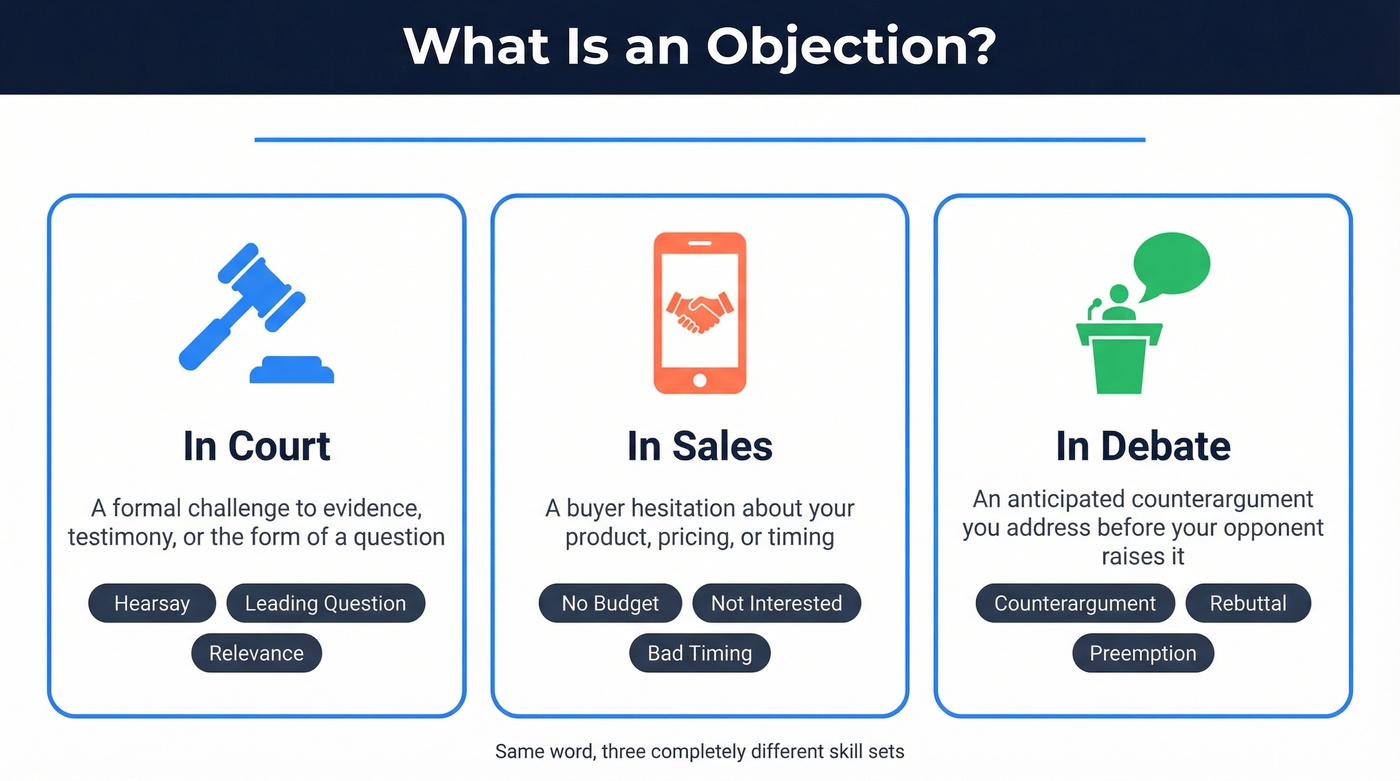
- In law: a challenge to evidence, testimony, or the form of a question.
- In sales: a buyer's hesitation about your product, pricing, or timing.
- In debate: an anticipated counterargument you address before your opponent raises it.
The examples below cover all three domains so you can find the exact language you need.
Examples of Objections in Court
New attorneys consistently struggle with making relevant, timely objections - not because they don't know the rules, but because courtroom objections happen fast and you need the right language on the tip of your tongue. Here's the cheat sheet.
Objections to Question Form
These target how a question is asked, not what it's about. You're telling the judge the question itself is improper.
| Objection | What It Means | Example Question | How to Say It |
|---|---|---|---|
| Leading | Suggests the answer | "You saw the defendant, correct?" | "Objection, leading." |
| Compound | Two questions in one | "Did you see and hear the crash?" | "Objection, compound." |
| Vague/Ambiguous | Too unclear to answer | "Did you see what happened?" | "Objection, vague." |
| Argumentative | Argues rather than asks | "Wasn't that careless?" | "Objection, argumentative." |
| Asked and Answered | Already covered | (Repeated question) | "Objection, asked and answered." |
| Assumes Facts | Presupposes unproven facts | "When did you stop lying?" | "Objection, assumes facts." |
| Narrative | Calls for a story, not an answer | "Tell us everything that happened." | "Objection, narrative." |
| Outside Scope | Beyond cross-exam limits | (New topic on redirect) | "Objection, beyond scope." |
Leading questions are the most common form objection - watch for "isn't it true," "correct," and "did/didn't you" as triggers. Compound questions are sneakier; the word "and" in a question is your signal to stand up.
Objections to Testimony and Evidence
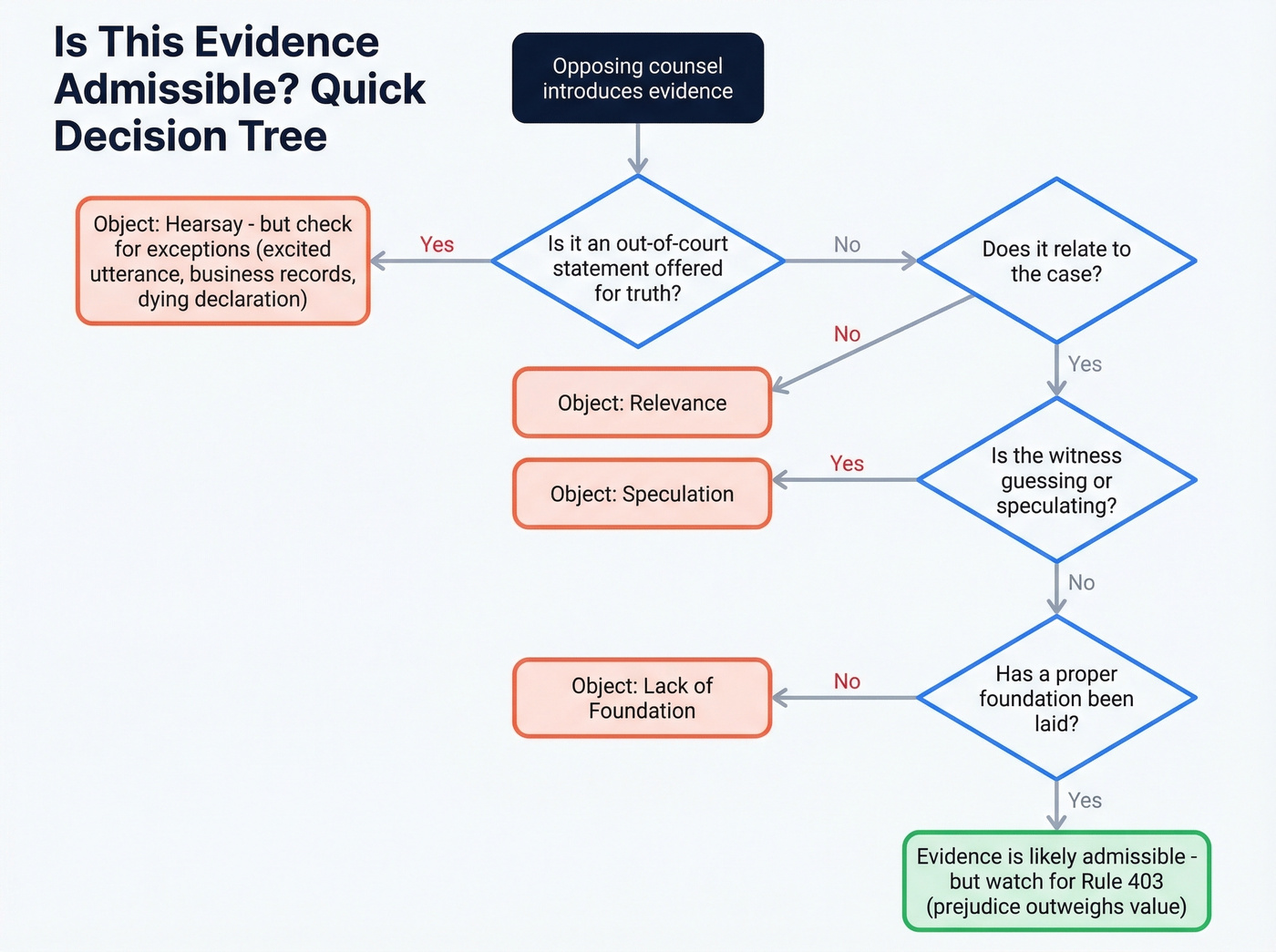
These challenge whether the evidence itself should be heard or seen by the jury.
| Objection | What It Means | Example | How to Say It |
|---|---|---|---|
| Hearsay | Out-of-court statement offered for its truth | "She told me he was speeding." | "Objection, hearsay." |
| Relevance | Doesn't relate to the case | Testimony about unrelated events | "Objection, relevance." |
| Speculation | Witness guessing | "I think he was probably drunk." | "Objection, speculation." |
| Lack of Foundation | No basis established | Opinion without a basis laid | "Objection, foundation." |
| Best Evidence | Copy instead of original | Photocopy of a contract | "Objection, best evidence." |
| Character | Improper character evidence | "He's always been dishonest." | "Objection, character." |
| Authentication | Not verified as genuine | Document offered without authentication | "Objection, authentication." |
| Improper Opinion | Lay witness giving expert opinion | "The injury was a fracture." | "Objection, improper opinion." |
| Cumulative | Repetitive evidence | Fifth witness to same fact | "Objection, cumulative." |
| Rule 403 | Probative value outweighed by unfair prejudice | Graphic photos, minimal relevance | "Objection, Rule 403." |
Hearsay deserves special attention because it has dozens of exceptions. Excited utterances, business records, statements against interest, dying declarations - each one can turn a sustained objection into an overruled one if opposing counsel knows the rules better than you do.
Pro tip: If your evidence gets excluded, request an offer of proof: "Your Honor, may I make an offer of proof?" This lets you explain relevance on the record, preserving the issue for appeal. Don't skip this step. Appellate courts can't review what isn't in the record.
What a Courtroom Objection Sounds Like
Reading a list is one thing. Knowing how objections play out in real time is another:
Prosecutor: "What did your neighbor tell you about the night of March 12th?"
Defense Counsel: "Objection, Your Honor. Hearsay."
Judge: "Counsel, response?"
Prosecutor: "Your Honor, may I be heard? The statement falls under an excited utterance exception - the neighbor made this statement immediately after witnessing the event, while still under the stress of excitement."
Judge: "I'll allow it. Overruled. The witness may answer."
Defense Counsel: "Your Honor, I'd ask for a continuing objection on this line of questioning."
Judge: "Noted. Counsel, lay a foundation before your next question."
Prosecutor: "Ms. Rivera, immediately after the incident, while you were still on the porch, what did your neighbor say to you?"
Notice the rhythm: objection, basis, argument, ruling. "Counsel, lay a foundation" is the judge telling you to establish the witness's basis for knowledge before proceeding. If the objection is sustained, the judge typically directs the jury to disregard the last answer.
Discovery and Deposition Objections
Trial objections exclude evidence. Discovery objections preserve the record - they're a different animal entirely. In depositions, most jurisdictions limit you to objections about form: leading, compound, vague. Substantive objections like relevance and hearsay are preserved for trial.
That doesn't stop lawyers from getting creative. One Reddit thread on absurd discovery objections features opposing counsel objecting on grounds of "insufficient amount of space to answer" - then providing full typed answers anyway. Another attorney repeatedly raised "proportionality" objections with zero explanation and refused to elaborate during meet-and-confer, only to produce the documents later. Discovery objections can be strategic, pedantic, or both.
For a solid deposition objections reference, Clio's guide is worth bookmarking.

The #1 sales objection is "not interested" - usually because reps reach the wrong person. Prospeo's 300M+ profiles with 30+ filters (buyer intent, job changes, funding) let you target decision-makers who are actually in-market. 98% email accuracy means your outreach lands.
Stop getting objected - start reaching buyers who want to hear from you.
Examples of Objections in Sales
Sales objections feel personal in a way courtroom objections don't. Someone's telling you - to your face, on a live call - that they don't want what you're selling. But here's the thing: most objections aren't rejections. They're requests for more information, delivered poorly.
Objection vs. Obstruction
Before you try to "handle" an objection, figure out whether it's actually one. Cognism's sales blog draws a useful distinction: an objection is uncertainty about your product ("I don't know how this helps my team"), while an obstruction is an excuse to end the conversation ("I don't have time for this"). Most real objections fall into four buckets - Budget, Authority, Need, or Timing (BANT) - and each requires a different response.
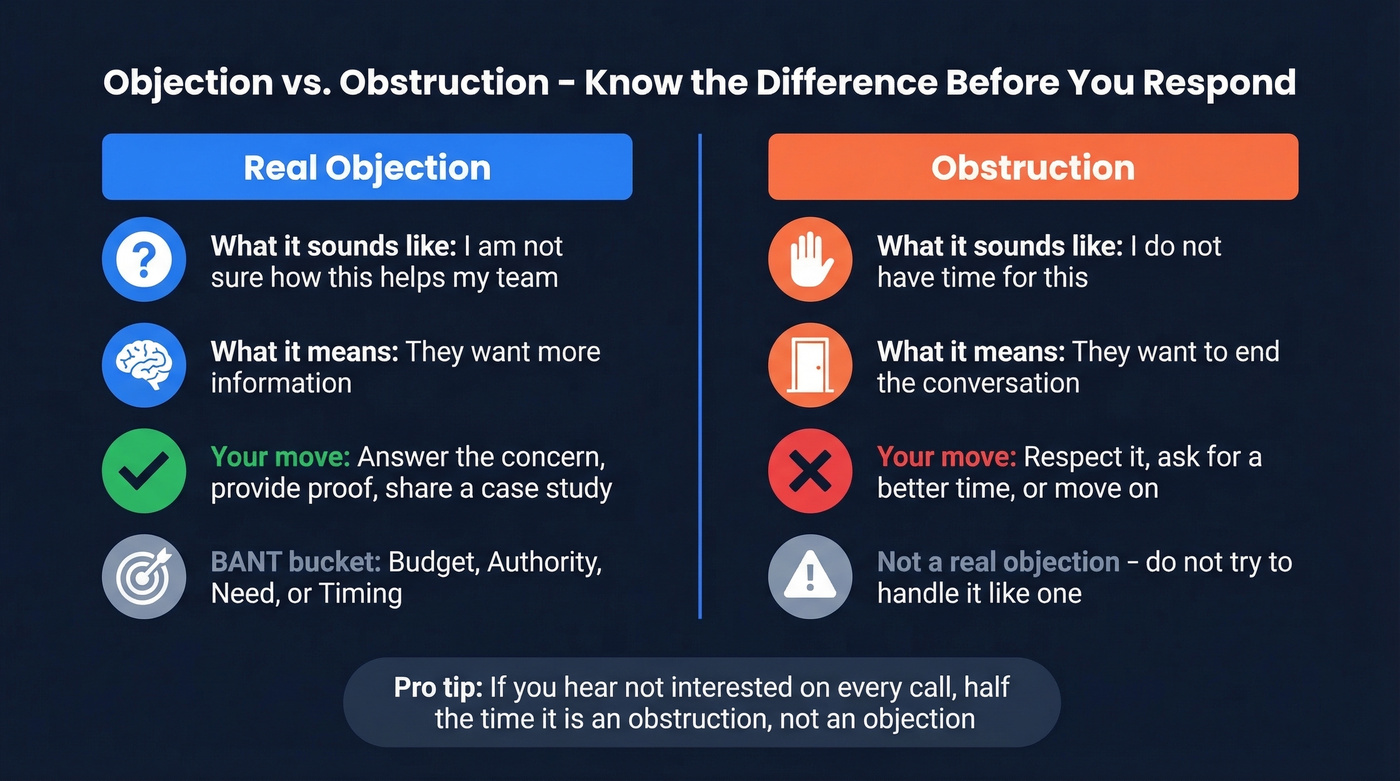
Use this test if you're hearing "not interested" on every call and can't figure out why. Half the time, "not interested" is an obstruction - the prospect doesn't want to talk, period. The other half, there's a real concern buried underneath. Your response should be completely different for each.
Skip this distinction if you're already deep in a deal. By the negotiation stage, everything is a real objection.
Common Objections by Pipeline Stage
Objections shift as deals move through your pipeline. Here's what you'll hear at each stage, with rebuttals that work.
| Stage | Objection | Rebuttal Approach |
|---|---|---|
| Lead Gen | "Not interested." | Ask what would make it relevant |
| Lead Gen | "How did you get my number?" | Acknowledge, then pivot to value |
| Lead Gen | "I'm not the right person." | Ask who handles the function |
| Nurturing | "Send me more info." | Ask what they'd need to evaluate |
| Nurturing | "We already use a competitor." | Explore what's working and what isn't |
| Closing | "Budgets are frozen." | Reframe as timing vs. priority |
| Closing | "We need team approval." | Offer to build the business case together |
| Post-Sale | "We're not seeing results." | Pull data and redefine success metrics |
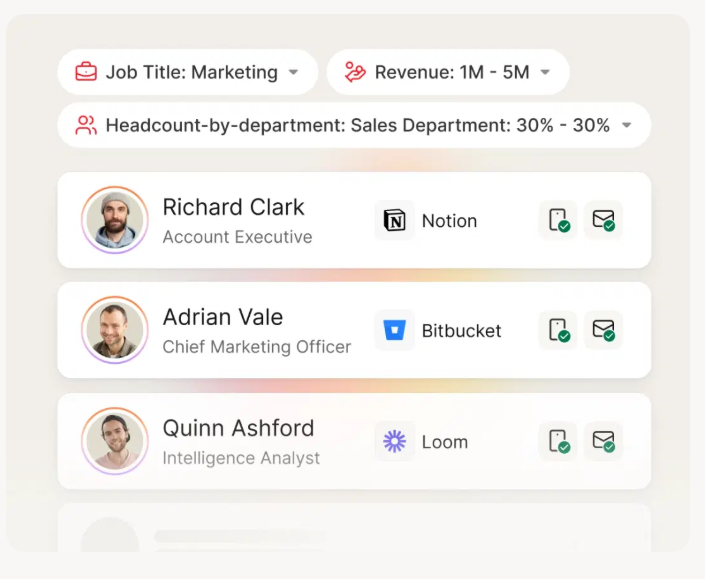
Cold calling still works - teams like Rippling SDRs have booked 650+ demos a month through cold calls, and Nooks has driven 75% of meetings from the phone. But those numbers only happen when reps call the right people with current info. Verified contact data reduces wrong-person dials and "I'm not the right person" objections so you can get to the real conversation faster.
New Objections for 2026
Sales objections have shifted. These five are increasingly common and require different playbooks than the classics:
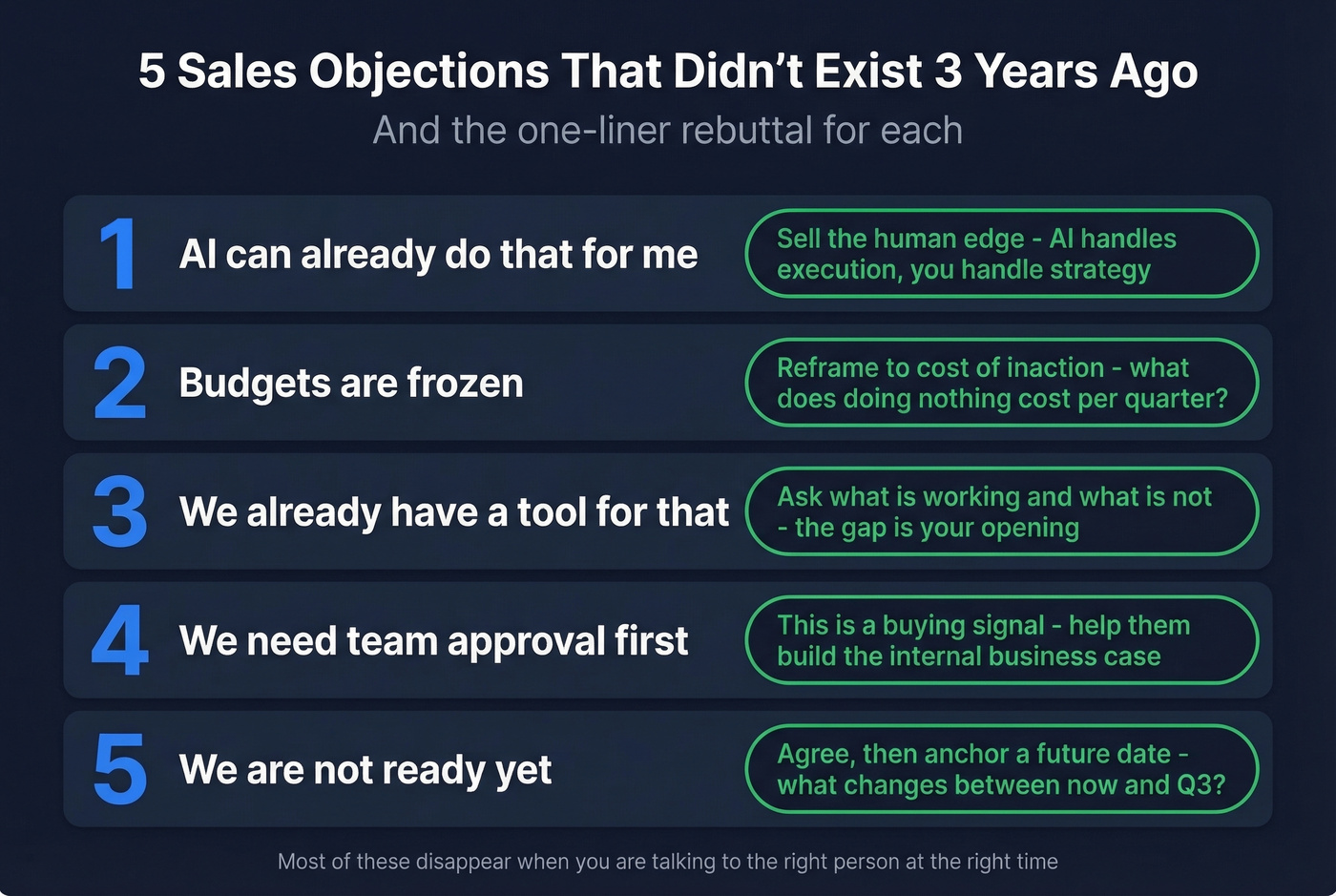
"AI can already do that for me." Sell the human edge. AI handles execution; your product handles strategy, customization, or judgment that AI can't replicate.
"Budgets are frozen." No budget rarely means no money exists. It means your solution isn't a priority. Reframe to cost of inaction - what does doing nothing cost them per quarter?
"We already have a tool/team for that." Don't attack the incumbent. Ask what's working and what isn't. The gap is your opening.
"We need the team's approval first." This is a buying signal disguised as a stall. Help them build the internal case instead of waiting for a callback that won't come.
"We're not ready yet." Agree, then anchor a future date. "Totally understand. What changes between now and Q3 that would make this the right time?"
Let's be honest: if your deal sizes sit below five figures, you probably don't need a sophisticated objection-handling framework. You need better targeting. The "AI can do that" and "budgets are frozen" pushback mostly disappears when you're talking to someone who actually has the problem you solve, at the moment they're trying to solve it.
Pick Your Framework
There are more acronyms for handling objections than there are actual objections. Here are the frameworks worth knowing:
| Framework | Stands For | Best For | How It Works |
|---|---|---|---|
| ARC | Acknowledge, Respond, Close | General use | Fastest path to next step |
| LAARC | Listen, Acknowledge, Assess, Respond, Confirm | Complex deals | Adds assessment before responding |
| LAER | Listen, Acknowledge, Explore, Respond | Discovery calls | Explores root cause first |
| LAIR | Listen, Acknowledge, Identify, Reverse | Competitive deals | Reverses objection into selling point |
| FFF | Feel, Felt, Found | Emotional objections | Empathy-first for anxious buyers |
Our recommendation: LAER for discovery calls, FFF for emotional objections, ARC for everything else. Don't overthink it. The framework matters less than actually listening before you respond. In our experience, the "send me more info" objection is almost always a soft no - and no framework saves you if you treat it like a genuine request.
If you want to go deeper on what to do after the first "no," keep a set of follow up messages ready.
"We already have a solution" hits different when you're calling someone who just switched tools. Prospeo tracks technographic signals and job changes so you reach prospects during their buying window - not after. Teams book 35% more meetings than Apollo users.
Reach prospects before competitors do - with data refreshed every 7 days.
Examples of Objections in Debate
In persuasive writing and formal debate, an "objection" is a counterargument you anticipate and address before your opponent raises it. This is the opposite of courtroom objections - instead of trying to exclude the opposing point, you're deliberately bringing it up to dismantle it.
Addressing opposing viewpoints actually strengthens your argument. It shows you've researched both sides and aren't afraid of scrutiny.
Neutral language checklist:
- ✅ "contends," "argues," "suggests," "points out"
- ✅ "According to [source]," "Research indicates"
- ❌ "Claims wrongly," "mistakenly believes," "fails to consider"
- ❌ "Obviously," "clearly," "everyone knows"
The moment you weaken the opposing argument to make it easier to knock down, you've built a straw man - and any serious reader will notice.
Two strong debate objections in action:
"Critics argue that remote work reduces collaboration. Studies on hybrid setups, however, have found that hybrid models can improve outcomes on certain cross-functional work compared to fully in-office teams."
"Opponents of minimum wage increases contend that higher labor costs lead to job losses. Yet meta-analyses of minimum wage research often find small or minimal employment effects, suggesting the relationship is more nuanced than a simple supply-demand model."
State the objection fairly, then counter with evidence. That's it.
How to Handle Any Objection
Whether you're in a courtroom, on a sales call, or writing a thesis, the same principles apply:
Listen before responding. Judges, buyers, and readers all want to feel heard. In court, cutting off a judge mid-ruling is a fast way to get sanctioned. On a sales call, talking over a prospect's concern tells them you don't care about their problem. Shut up and let them finish.
Address the underlying concern. "Not interested" isn't the real objection. "Hearsay" might have an exception. Dig one layer deeper every time.
Use specific language. "Objection, hearsay" beats "Objection, I don't think they can say that." "This saves your team 12 hours per week" beats "This is really efficient." Precision wins in every domain.
Practice under pressure. Courtroom attorneys use objection cheat sheets. Sales reps role-play. Debaters prep counterarguments. We've found that the best responses come from muscle memory, not improvisation - and studying real-world examples of objections across all three domains builds that muscle memory faster than reading theory alone. If you're training reps, a repeatable cold calling system helps make that practice consistent.
Follow up. Research shows 60% of customers say "no" four times before finally saying yes, but only 44% of reps follow up after a single rejection. Persistence isn't pushy. It's professional. (If you need a cadence, start with these sales follow-up templates.)
FAQ
What does "sustained" mean in court?
The judge agrees with the objection - the question or evidence is excluded, and the jury is typically instructed to disregard it. "Overruled" means the opposite: the judge rejects the objection and allows the question or evidence to stand.
What's the most common sales objection?
"Not interested" tops the list, but it's usually an obstruction, not a genuine concern. The real issue - wrong timing, wrong person, or no perceived need - is buried underneath. Dig one layer deeper before accepting it at face value.
Can you object during a deposition?
Yes, but only to form in most jurisdictions - leading, compound, or vague questions. Substantive objections like relevance and hearsay are preserved for trial. The witness still answers; the objection goes on the record for the judge to rule on later.
What's the difference between an objection and a rebuttal?
An objection challenges the process or validity of a statement; a rebuttal challenges its content. In court, you object to how evidence is presented and rebut what it says. In sales, you object to terms and rebut a competitor's claims.
How do you reduce "wrong person" objections on sales calls?
Use verified contact data before you dial. Tools like Prospeo with 300M+ profiles and 125M+ verified mobiles help reps reach the right decision-maker on the first attempt - no more burning through gatekeepers or outdated org charts.