

Feel Felt Found: How to Use It, When It Backfires, and How to Fix It
The prospect says "we're happy with our current vendor," and your brain goes blank. You've got three seconds before the silence gets weird. Most reps either steamroll into a pitch or mumble something about "totally understanding." Both kill the deal.
Here's the thing: effective objection handling increases close rates by as much as 64%, and the feel felt found technique is a structure salespeople have used for decades. The problem is that most people learn it as a script. That's exactly why it fails.
What Is Feel Felt Found?
This is a three-step objection-handling model popularized in legacy sales training and still taught in plenty of onboarding programs. Sometimes called the 3 Fs of handling objections, it's simple - which is both its strength and its trap.
- Feel - Acknowledge the prospect's concern. Signal that their objection is valid and heard.
- Felt - Normalize it with social proof. Other people had the same concern, so the prospect isn't alone or wrong.
- Found - Resolve with an outcome. Those other people discovered something that changed their mind.
Here's the classic version on a price objection:
"That's a fair concern - pricing matters. Some of our customers in SaaS felt the same way when they first saw the investment. What they found was that the platform paid for itself within 90 days through reduced churn, which more than covered the cost."
You didn't argue. You didn't discount. You moved the conversation from "this costs too much" to "here's what the ROI actually looks like." That pivot is the entire point. The technique isn't about the words - it's about the psychological architecture underneath them.
The Psychology Behind It
Each step triggers a distinct persuasion mechanism. The structure maps cleanly to well-known persuasion principles, and the "because" effect is backed by classic behavioral research.
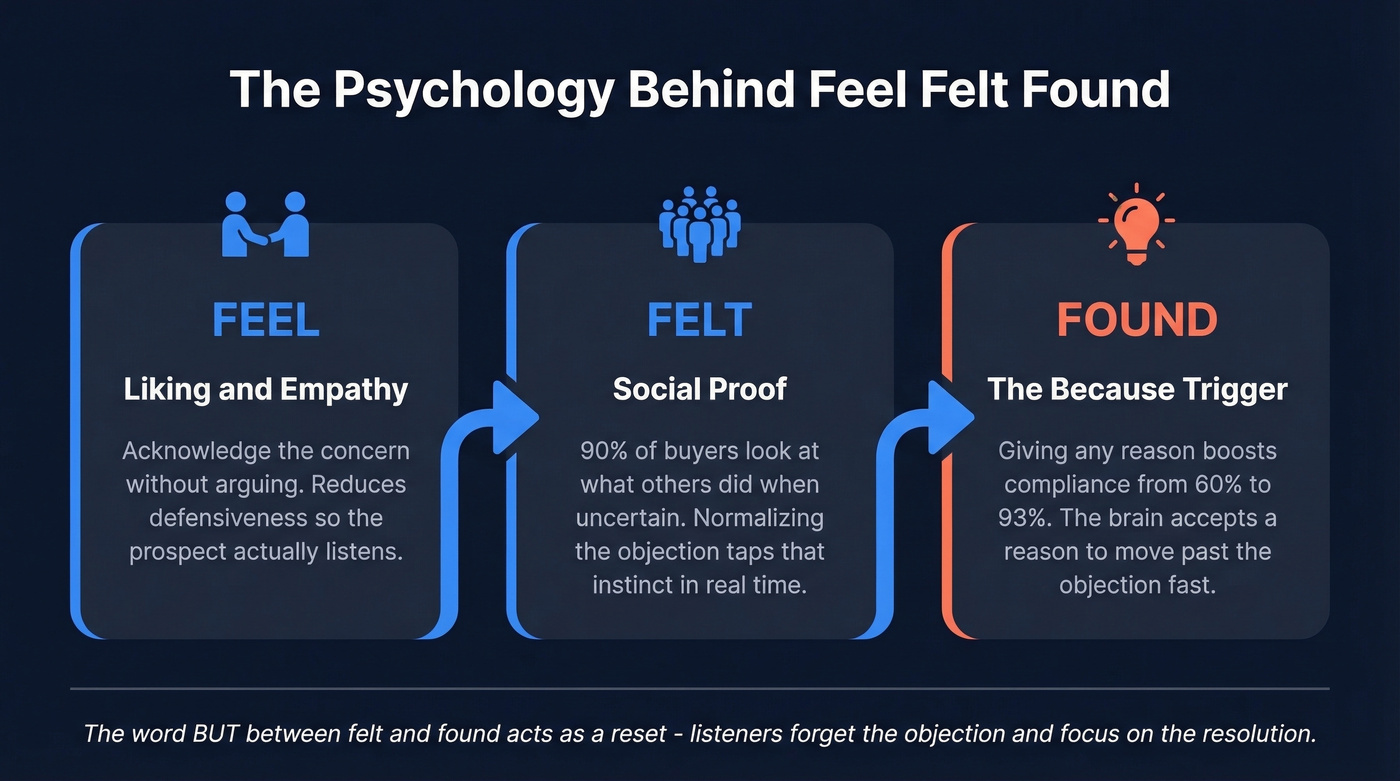
Feel = Liking and Empathy. When you acknowledge someone's concern without arguing, you activate the liking principle from Cialdini's persuasion framework. People are more receptive to those who seem to understand them. The "feel" step reduces defensiveness so the prospect actually listens to what comes next.
Felt = Social Proof. The "felt" step does the heaviest lifting. You're telling the prospect that other people - ideally people like them - had the same reaction. 90% of customers read online reviews before buying. We're wired to look at what others did when we're uncertain. The "felt" step taps that instinct in real time.
Found = The "Because" Trigger. This is where it gets interesting. Langer et al.'s 1978 copier experiment showed that simply giving a reason - even a weak one - can dramatically increase compliance. When people asked to cut in line at a Xerox machine with no reason, only 60% said yes. Adding "because I'm in a rush" jumped compliance to 94%. But here's the kicker: "because I have to make copies" - a meaningless reason - still hit 93%. The "found" step provides that "because." It gives the prospect's brain a reason to move past the objection, and the brain accepts it fast.
One more layer most people miss: the transition word between "felt" and "found" - typically "but" or "however" - acts as a reset. Listeners discount what came before "but" and focus on what follows. So the objection fades and the resolution sticks.
Three steps. Three distinct psychological triggers. That's why this approach has survived decades of changing sales methodologies.
Examples by Objection Type
Most guides give you one generic script and call it a day. Real objections fall into four distinct buckets, and each one needs a different "found" story. Every example below uses the improved "Some people feel..." variant instead of the tired "I understand how you feel" opener - more on why in the next section.
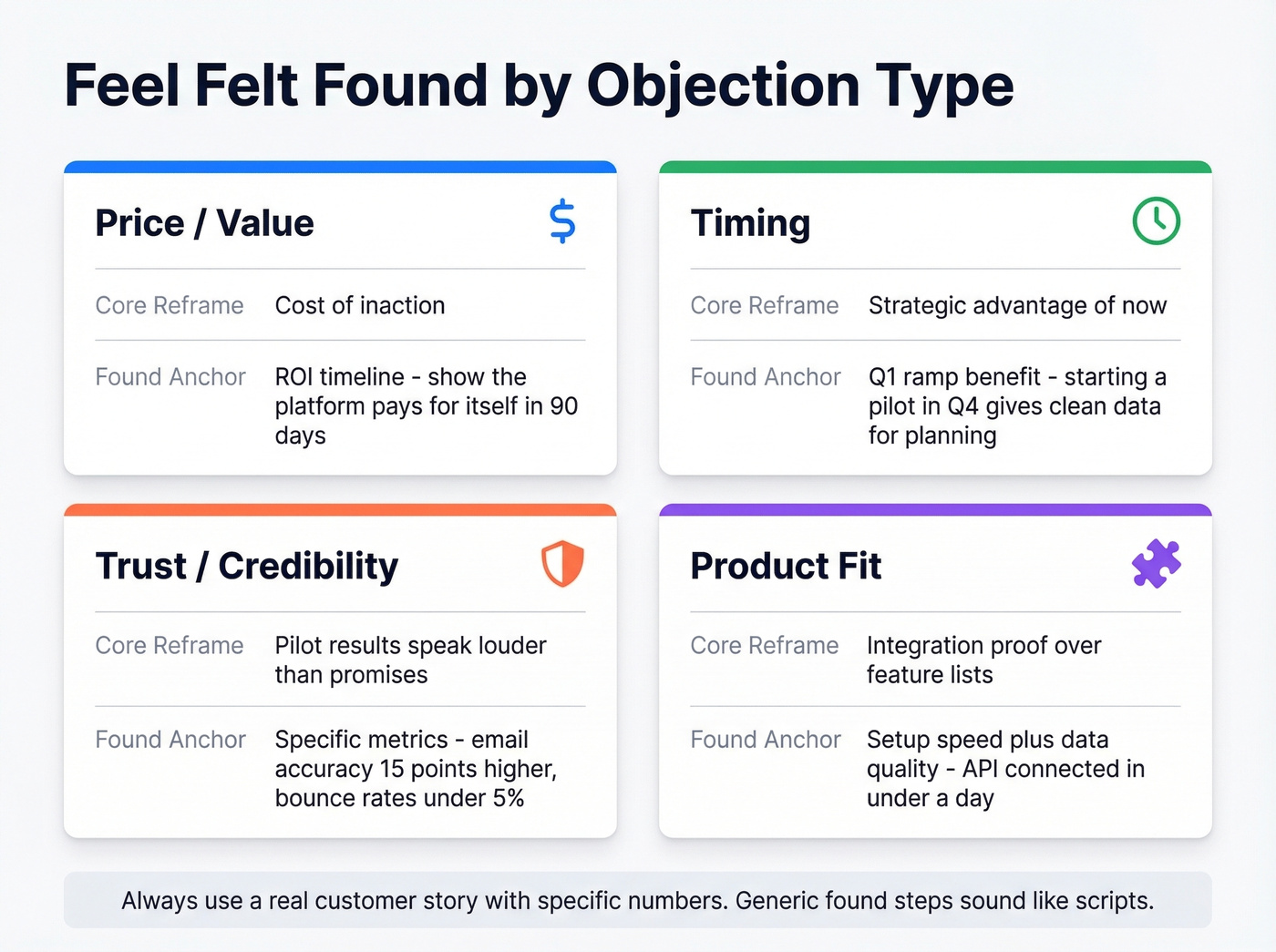
| Objection Type | Core Reframe | "Found" Anchor |
|---|---|---|
| Price/Value | Cost of inaction | ROI timeline |
| Timing | Strategic advantage of now | Q1 ramp benefit |
| Trust/Credibility | Pilot results | Specific metrics |
| Product Fit | Integration proof | Setup speed + data quality |
Price/Value Objection
Don't defend the price. Reframe the cost of inaction. We've watched reps instinctively start justifying features when a prospect pushes back on cost - it never works. Instead:
"That's a fair point - budget is real. Some teams in your space felt the same way, especially mid-market companies watching every dollar. What they found was that the cost of not having accurate pipeline data - missed forecasts, wasted rep hours - was running them 3-4x what the platform costs annually."
Timing Objection
Timing objections are rarely about timing. They're about prioritization. Your "found" story needs to show why now beats later.
"Totally get it - Q4 is brutal for launching anything new. Some revenue leaders we work with felt the same pressure around timing. What they found was that starting a pilot in Q4 actually gave them clean data heading into annual planning, which made their Q1 ramp significantly faster."
Trust/Credibility Objection
Let's be honest: vague reassurance is worthless here. Here's a before/after contrast that shows why specifics matter. Weak version: "Other companies felt the same way, but they found our support team was great." That's nothing. Strong version:
"Makes sense - you don't know us yet. Some companies in [industry] felt cautious about switching from an established vendor. What they found after a 30-day pilot was that email accuracy ran 15 points higher than what they'd been getting, and their bounce rates dropped from 30%+ to under 5%."
Numbers and pilot offers close trust gaps. Vague comfort doesn't.
Product Fit Objection
Product fit objections are the most legitimate of the four. Don't dismiss them - offer proof through a specific integration or use-case story. Skip this one if you don't have a real customer example that matches the prospect's stack; making something up will backfire harder than saying "let me check on that." When you do have the story, weave the "found" step directly into conversation rather than reciting a formula: "Yeah, a team with your exact stack - Salesforce plus Outreach - felt the same uncertainty. They had the API connected in under a day, and their enrichment match rates actually improved because the data was fresher."

The "found" step only works when you have real metrics to back it up. Prospeo's 98% email accuracy and bounce rates under 5% give your reps the exact proof points that turn objections into closed deals - no vague reassurance needed.
Give every rep a "found" story backed by data that actually converts.
When It Backfires
This technique has a reputation problem, and it's mostly execution, not the model itself. The consensus on r/sales is pretty clear: the approach works, but butchered delivery makes it sound like a used-car tactic. Here's where it goes wrong.
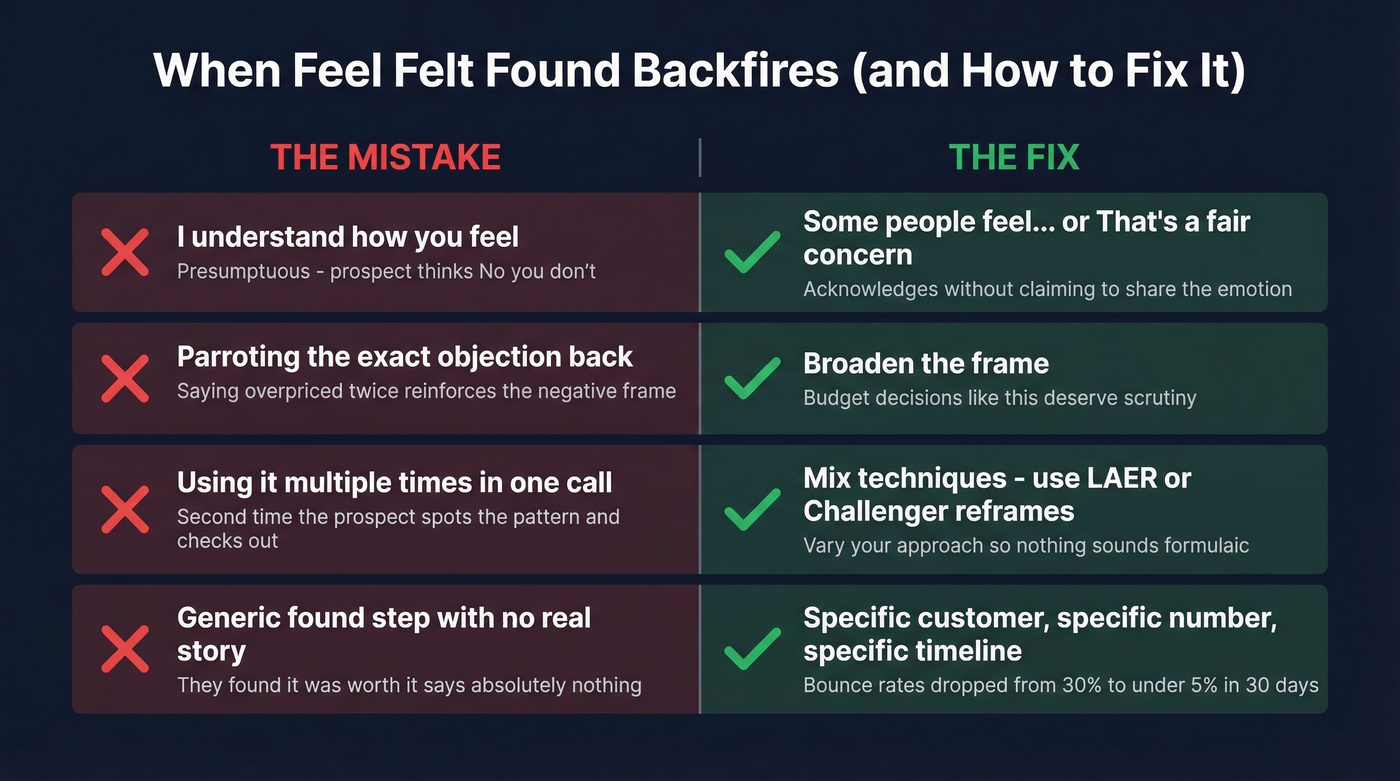
"I understand how you feel" triggers resistance. This is the single biggest mistake. NLP trainer Jonathan Altfeld points out that opening with "I understand how you feel" invites the prospect to think "No, you don't." It's presumptuous. Replace it with "Some people feel..." or "That's a fair concern." You're still acknowledging the emotion without claiming to share it.
Restating the objection too precisely reinforces it. If a prospect says "your product seems overpriced," don't parrot back "I know it feels overpriced." You've just said "overpriced" twice. Broaden the frame: "Budget decisions like this deserve scrutiny." You've acknowledged without amplifying.
Don't use the technique repeatedly in the same conversation. First time, it sounds natural. Second time, the prospect recognizes the pattern and you lose credibility.
It's also harder to pull off in email. Tone carries the "feel" step in conversation - your voice, your pacing, your facial expression. In writing, "I understand how you feel" reads as patronizing. If you're using the structure in email, skip the empathy opener entirely. Lead with social proof: "Some teams in your space found that..." and keep it to two or three sentences.
No real story behind "found." This is the silent killer. If your "found" step is generic - "they found it was worth the investment" - you've said nothing. The prospect knows you're running a script. You need a specific customer, a specific outcome, a specific number.
Building Your Story Library
Without a real third-party story, the technique is empty empathy. The "found" step is where it lives or dies.
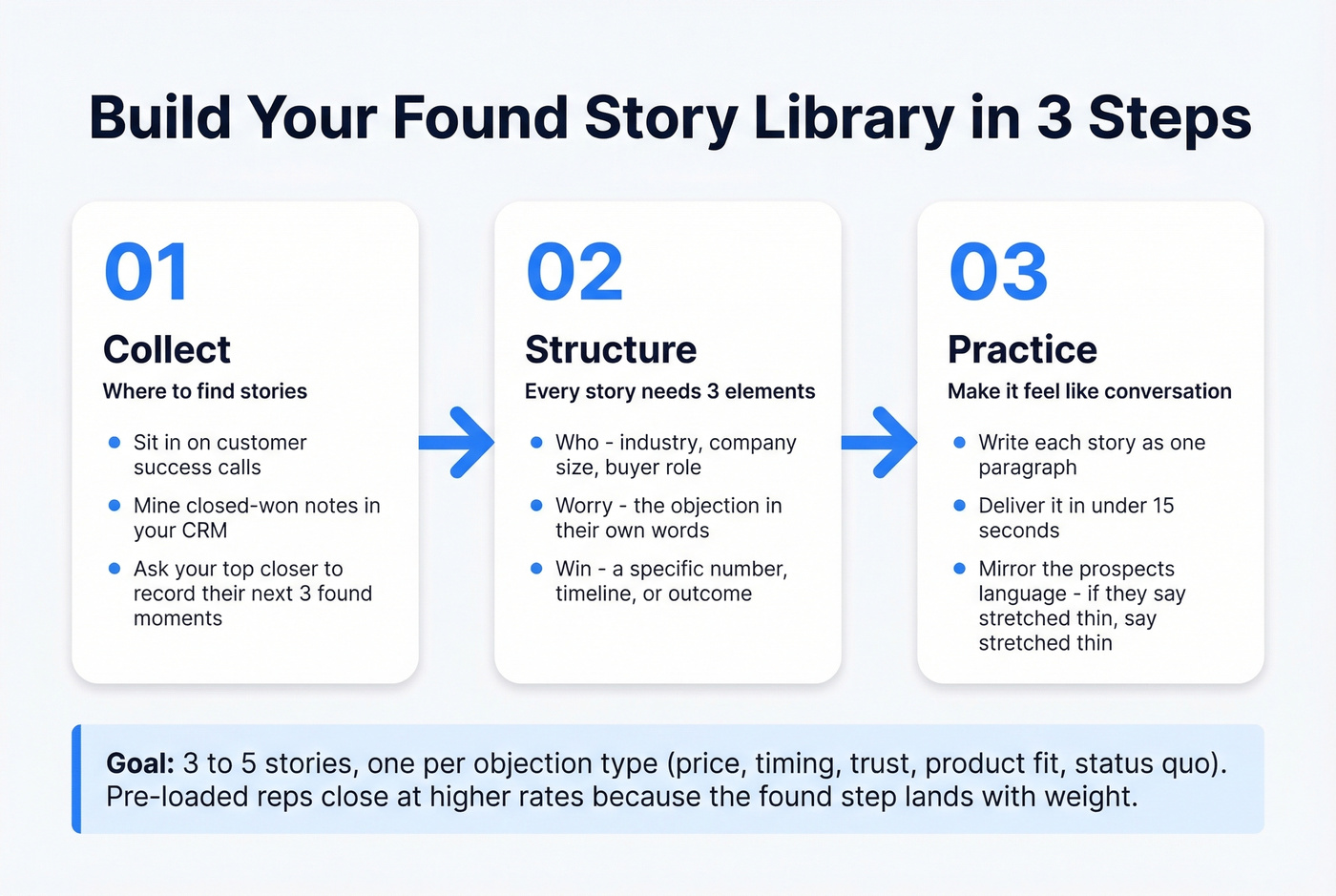
Build a library of 3-5 real customer stories, one for each objection type. Each story needs three elements: who the customer was (industry, size, role), what they were worried about in their own words, and what specifically changed after they moved forward - a number, a timeline, a concrete outcome. In our experience, reps who have these stories pre-loaded close at noticeably higher rates than those who wing it, because the "found" step actually lands with weight instead of sounding like a fortune cookie.
Where to find these stories: sit in on customer success calls, mine your CRM's closed-won notes, or ask your top closer to record their next three "found" moments. Format each one as a single paragraph you can deliver in under 15 seconds. Practice until the delivery feels like a conversation, not a recitation.
Use the prospect's own language when you deliver these. If they say "we're stretched thin," don't translate that into "resource-constrained." Mirror their words. The approach sounds scripted when you use memorized vocabulary. It sounds genuine when you use theirs.
Where It Fits in a 2026 Sales Toolkit
Hot take: this is the right first objection-handling approach to learn, but if you're still leaning on it exclusively after your first quarter, you've stalled. It's training wheels - excellent training wheels, but training wheels.
Modern objection handling has evolved. LAER (Listen, Acknowledge, Explore, Respond) gives you more diagnostic depth. Sandler's negative reverse selling flips the dynamic entirely by agreeing with the objection. Challenger-style reframes skip empathy and go straight to teaching the prospect something they didn't know. The modern approach is curiosity, diagnosis, and proof - not memorized comebacks.
But none of these approaches matter if you never reach a real person. 69% of buyers accepted calls from new vendors in the past year, and 82% took meetings that began as cold calls. The opportunity is there. The bottleneck is contact data. If your emails bounce and your phone numbers are disconnected, you never get to the conversation where objection handling actually works. We've seen teams using Prospeo cut bounce rates from 35%+ to under 4% - which means their reps actually get into the conversations where techniques like feel felt found matter.
Master the feel felt found formula first - the psychological principles underneath it power every other objection-handling model too. Then graduate to LAER or Sandler within your first quarter.
Common Mistakes
- Using it as a word-for-word script. The structure is a guide, not a recitation. Adapt it to every conversation.
- Opening with "I understand how you feel." Use "Some people feel..." or "That's a fair concern" instead.
- Deploying it on every objection in the same call. Once per conversation is usually enough.
- No real story behind "found." Generic reassurance is worse than no response at all. Have a specific customer outcome ready.
- Trying it in email without adapting. Drop the empathy opener. Lead with social proof. Keep it to 2-3 sentences.
- Never reaching the prospect in the first place. You can't handle objections if your emails bounce. Verify your contact data before you worry about your talk track.
Notice the product fit example above? Teams switching to Prospeo see bounce rates drop from 30%+ to under 4%, with enrichment match rates of 83% and a 7-day data refresh cycle. That's not a script - it's a real "found" story from 15,000+ companies.
Stop rehearsing objection scripts. Start having proof points that sell themselves.
FAQ
Is the feel felt found technique manipulative?
No - it's empathy plus social proof plus resolution, which is the structure of any good conversation. You're acknowledging a concern, showing the prospect they aren't alone, and offering evidence of a positive outcome. It becomes manipulative only when the "found" story is fabricated. If your third-party example is real, you're just communicating well.
Does it work in B2B sales?
Yes, especially for price/value and timing objections where prospects need reassurance that peers made the same leap. The critical difference in B2B: buyers need specifics, not generic comfort. "They found it was worth it" means nothing. "They found their bounce rate dropped from 35% to under 4% in the first month" closes deals.
Can I use it in cold emails?
The structure translates, but tone is harder to control in writing. Lead with social proof - "Some teams in your space found that..." - and keep it to two or three sentences. Skip the empathy opener entirely. To send those emails, you need verified addresses first; a tool with 98% email accuracy means your sequences actually land instead of bouncing into the void.
Why are the 3 Fs still relevant in 2026?
Because the underlying psychology hasn't changed. People still want to feel heard, still look to peers for validation, and still need a reason to act. The 3 Fs map directly to empathy, social proof, and the "because" trigger. Newer frameworks like LAER and Sandler build on these same principles - they just add more diagnostic steps. Master the fundamentals first, and every advanced technique becomes easier.