

How to Handle Objections in Sales: What 300M+ Calls Reveal
It's 2:30 PM on a Tuesday. You're 40 dials deep. The prospect picks up, and before you finish your second sentence: "Not interested." Click.
You're not bad at your job. You're fighting the wrong battle. An analysis of 300M+ cold calls by Gong Labs found that just five objections account for 74% of every objection you'll ever hear - and nearly half of those are dismissive brush-offs, not real concerns. Forget the 50-scenario playbook. Master five.
Below: the frameworks, scripts, and practice plan that'll help you diagnose the real issue, respond to the 15 most common objections with exact words, and build the muscle memory to execute under pressure. If you only remember one thing from this entire piece, it's this - shut up more. The optimal talk-to-listen ratio is 43/57, and the reps who hold that ratio consistently close more deals than everyone else.
What 300M+ Sales Calls Actually Show
The headline from Gong's dataset: the top 5 objections make up 74% of all objections. You don't need to prepare for 50 scenarios. You need to own five.
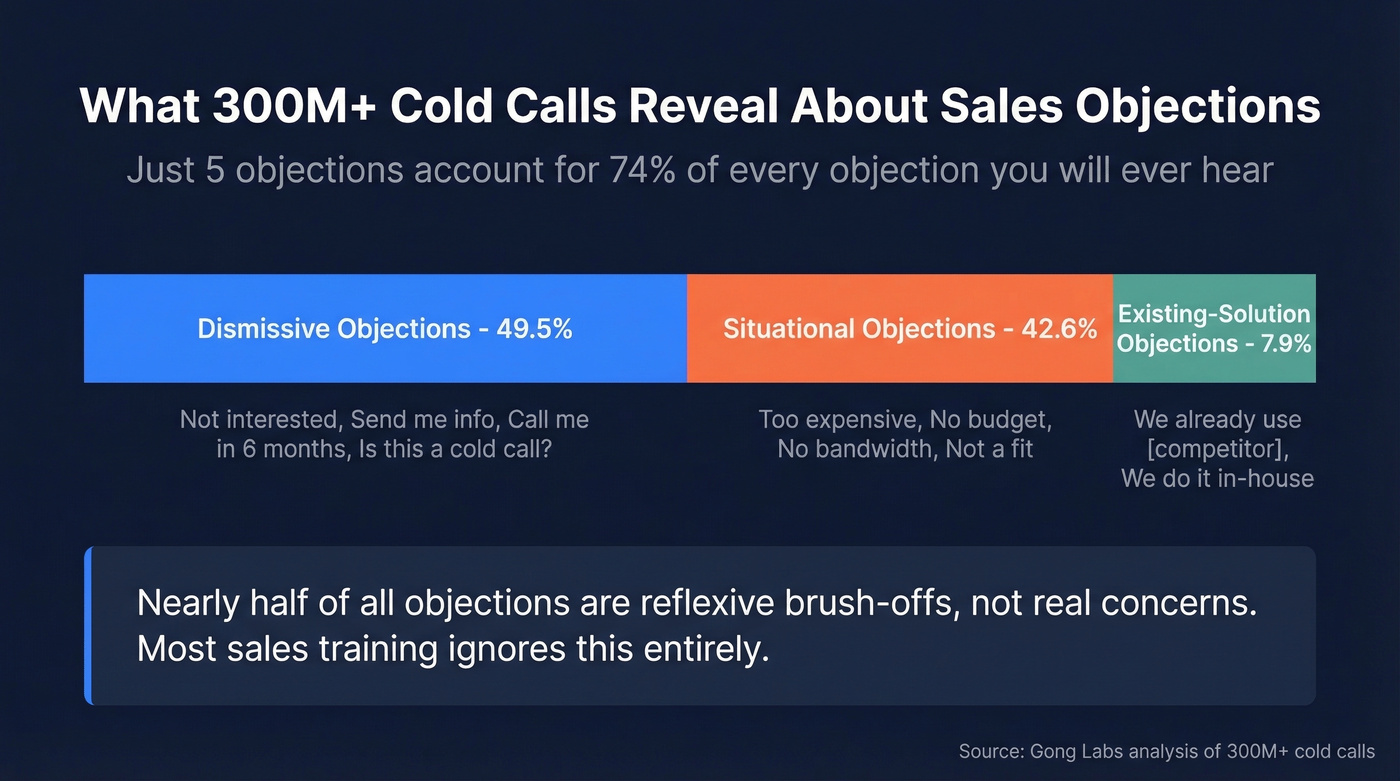
Here's how those objections break down by type:
- Dismissive objections - 49.5%: "Not interested," "Send me info," "Call me in 6 months," "Is this a cold call?"
- Situational objections - 42.6%: "Too expensive," "No budget," "No bandwidth," "Not a fit"
- Existing-solution objections - 7.9%: "We already use [competitor]," "We do it in-house"
Almost half of all objections aren't real concerns. They're reflexive brush-offs designed to end the conversation as fast as possible. Most sales training focuses on the situational bucket while ignoring the dismissive category reps encounter constantly.
That's a massive blind spot.
Why Prospects Really Object
OnePageCRM's taxonomy identifies seven root causes behind every objection: perceived lack of value, budget constraints, wrong timing, skepticism, lack of trust, wrong decision-maker, and lack of awareness. Useful checklist, but the real insight is simpler.
An objection isn't a rejection. Engaged prospects object; non-buyers just end the conversation. The first objection is rarely the real issue - a prospect who says "too expensive" often means "I can't justify this to my boss," and a prospect who says "not a good time" often means "I don't see the value yet." Every objection is a window into the prospect's real priorities, mislabeled and waiting for you to read between the lines.
Think of every objection as a locked door with the wrong label. Your job isn't to pick the lock. It's to find the right door.
5 Core Frameworks for Overcoming Objections
No single framework works for every situation. Here's when to use each:
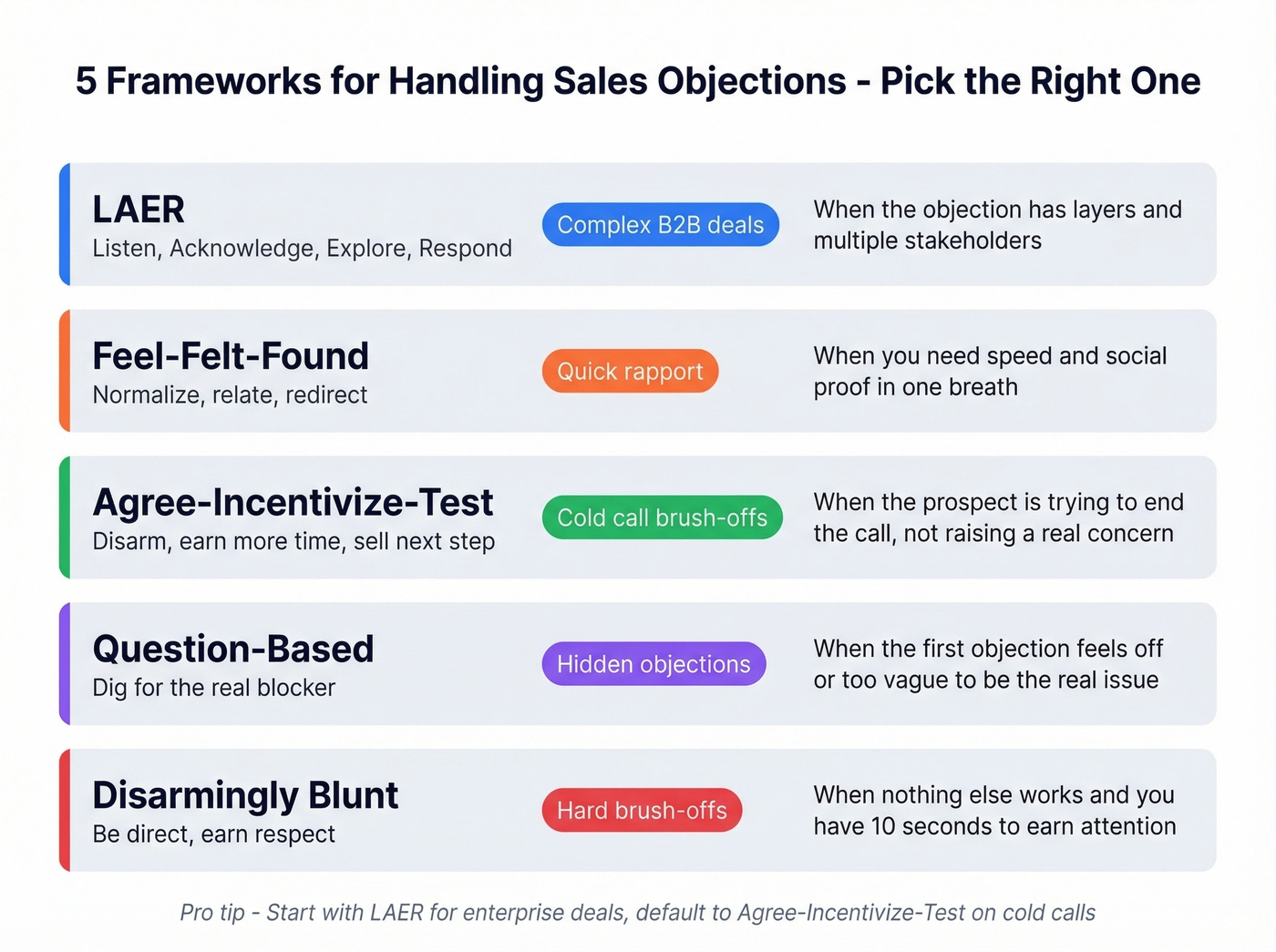
| Framework | Best For | Example Prompt |
|---|---|---|
| LAER | Complex B2B, multi-stakeholder deals | "Walk me through that?" |
| Feel-Felt-Found | Quick transactional rapport | "Other VPs of Sales felt the same..." |
| Agree-Incentivize-Test | Dismissive cold-call brush-offs | "Fair enough. Quick q..." |
| Question-Based | Hidden objections, first objection seems off | "What would change that?" |
| Disarmingly Blunt | Hard brush-offs, "not interested" | "Totally fair. Can I ask..." |
Other frameworks like LAARC and Sandler's Reverse exist, but these five cover the ground.
LAER: Listen, Acknowledge, Explore, Respond
LAER works best for complex B2B deals where the objection has layers. Chris Voss nails why: "We are willing to be influenced by those we feel understood by." We've tested these frameworks across different deal sizes, and LAER is the one we come back to when there's real depth to unpack. One rep on our team saved a high six-figure deal by replacing "Let me explain why that's not an issue" with "Walk me through why that doesn't work for you" when a CTO pushed back on implementation timeline. Same objection, completely different outcome.
Feel-Felt-Found
This is your speed framework. "I understand how you feel - other VPs of Sales felt the same way when they first saw the pricing. What they found was that faster ramp and higher output paid for itself quickly." Formulaic? Sure. But it works because it normalizes the concern and introduces social proof in one breath.
Agree, Incentivize, Sell the Test Drive
The meta-framework for cold calls. Agree with the objection to disarm, incentivize continued conversation, then sell the next step - not the product. You're not closing on a cold call. You're earning 15 more minutes.
Question-Based Response
Use this when you suspect the first objection isn't real. "What would it take to make this a priority?" or "If we could solve that concern, would that change things?" force the prospect to articulate the actual blocker. The cost-of-inaction question - "What's the cost of not addressing this problem?" - is particularly effective for budget objections because it reframes the conversation from spend to risk.
The Disarmingly Blunt Approach
For dismissive brush-offs. When someone says "Not interested," try: "Totally fair - you don't even know what I'm calling about yet. Can I have 20 seconds to tell you, and you can hang up after?" Most reps are too afraid to be this direct. That's exactly why it works.
Tactical Empathy: The Technique Most Reps Skip
The Black Swan Group - Chris Voss's firm - teaches three techniques that outperform every generic framework: labels, mirrors, and calibrated questions.
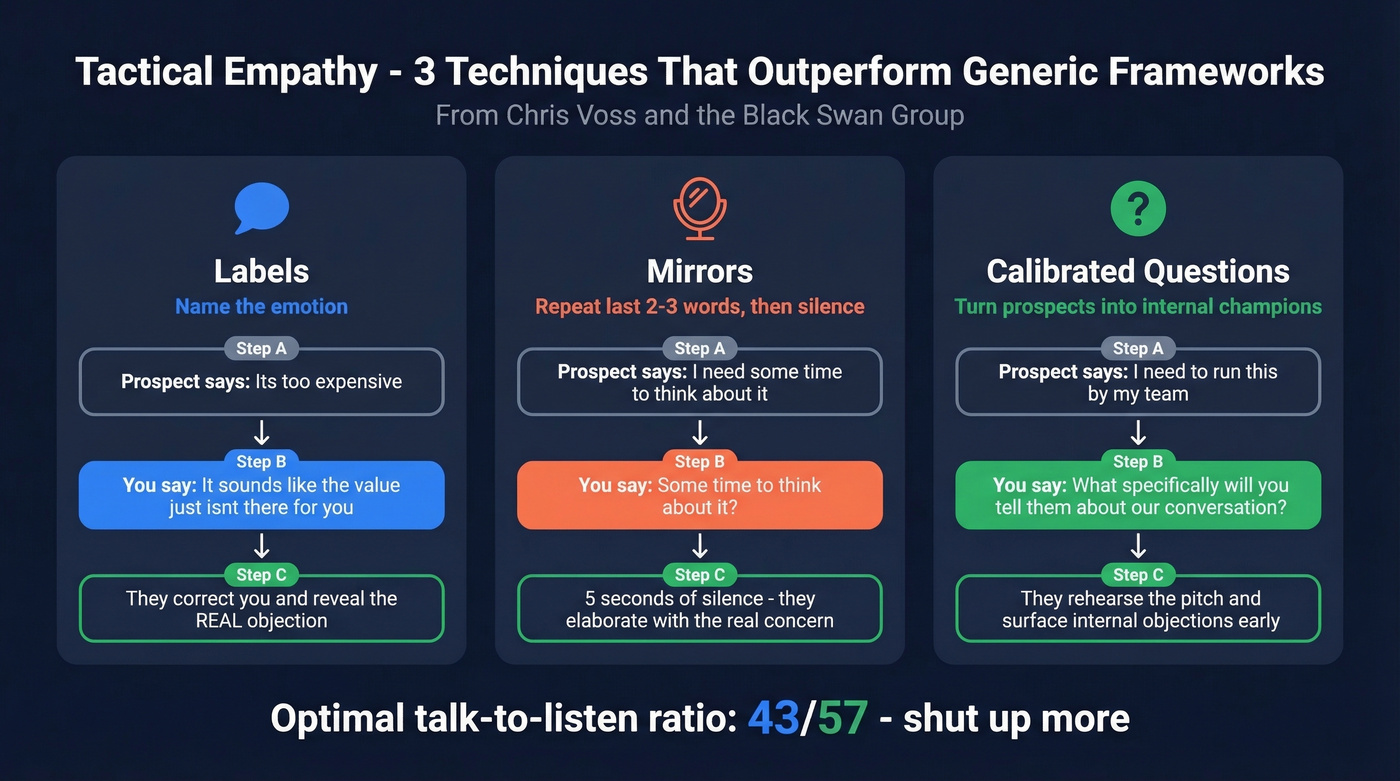
Labels name the emotion behind the objection. When a prospect says "It's too expensive," most reps justify the price. A label sounds like: "It sounds like the value just isn't there for you." That's designed to trigger a correction - "Well, it's not that, it's more that we'd need to see ROI in the first quarter." Now you're having a real conversation instead of a pricing debate.
Mirrors are even simpler. When someone says "I need some time to think about it," repeat the last few words back: "Some time to think about it?" Then shut up. The silence creates pressure to elaborate, and what comes next is almost always the real objection. We've watched reps unlock stalled deals with nothing but a three-word mirror and five seconds of uncomfortable quiet.
Calibrated questions work best for authority objections. When a prospect says "I need to run this by my team," try: "What specifically are you going to tell them about our conversation?" This surfaces potential internal objections before they happen and turns your prospect into your internal champion by making them rehearse the pitch.

Half of all objections are dismissive brush-offs - but brush-offs spike when you reach the wrong person. Prospeo's 300M+ verified profiles with 30+ filters (buyer intent, job changes, department headcount) put you in front of decision-makers who actually have the problem you solve. Fewer "not interested," more real conversations.
Stop perfecting your rebuttals. Start reaching the right buyers.
15 Common Objections With Scripts
Dismissive Objections
These represent 49.5% of all cold-call objections. They're reflexes, not decisions.
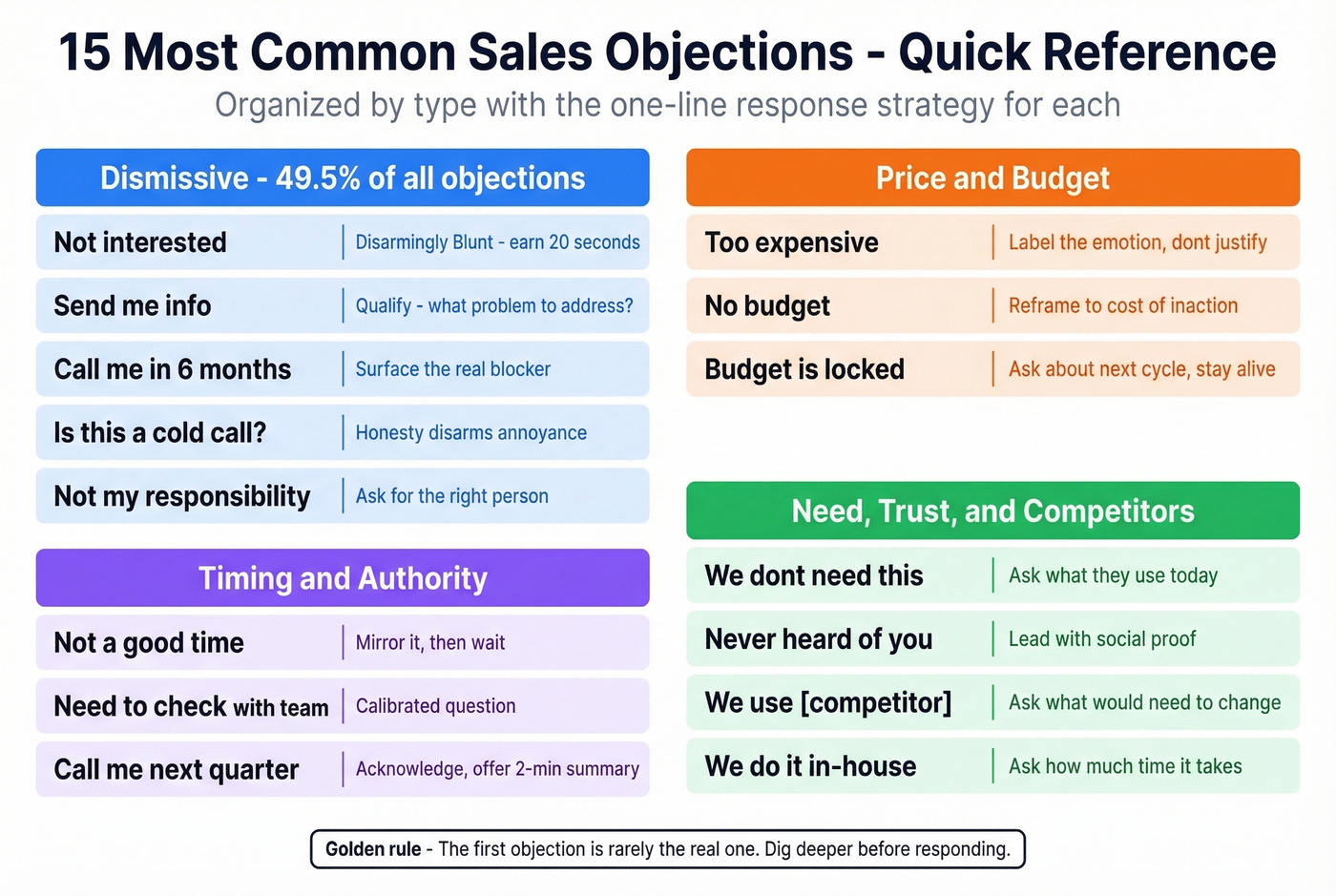
"Not interested." They haven't decided - they're trying to end the call. Say: "Totally fair - you don't know what I'm calling about. Can I have 20 seconds? If it's not relevant, I'll hang up myself." Disarmingly blunt, removes pressure, earns a window.
"Send me info." They want off the call. Say: "Happy to. So I send the right thing - what's the one problem you'd want it to address?" Turns a brush-off into a qualifying question.
"Call me in 6 months." They don't see urgency. Say: "I will. What would need to change between now and then for this to be a priority?" Surfaces the real blocker and creates a reason for follow-up.
"Is this a cold call?" They're annoyed. Say: "It is. I figured I'd be honest about it. I'm calling because [one-sentence value prop]. Worth 30 seconds?" Honesty disarms the annoyance.
"Not my responsibility." Could be true, could be deflection. Say: "Totally understand. Who on your team handles [specific function]? I want to make sure I'm not wasting anyone's time."
Price and Budget Objections
Price objections are where labels earn their keep. When someone says "too expensive," don't justify - label: "It sounds like the value just isn't there for you." Wait. The correction reveals whether it's truly price, ROI timeline, or internal justification. Never lead with a discount.
For "no budget," reframe to cost of inaction. A strong approach from r/sales: "Jordan, if this backlog compounds, you're looking at 300+ hours lost by next fiscal. Is there usually a process for surfacing that kind of operational risk, or should we map out the cost together?" It shifts the conversation from budget to business risk.
When budget is locked, ask: "When does the next cycle open, and what would we need to show between now and then to be in the plan?" This keeps the deal alive with a concrete next step instead of a vague "let's reconnect."
Timing and Authority Objections
"Not a good time" - Mirror it: "Not a good time?" Then wait. They'll either explain what's happening or admit it's a brush-off.
"I need to check with my team" - Calibrated question: "What specifically are you going to tell them about our conversation?" Turns your prospect into your internal seller.
"Call me next quarter" - Same approach as "6 months." If they're drowning in a system migration, acknowledge the timing and offer a 2-minute summary they can revisit when things calm down.
Need, Trust, and Competitor Objections
For "we don't need this," ask what they're using to handle the specific problem today. If they have a workaround, explore its limitations. If they don't, they just told you they have the problem.
For "I've never heard of you," lead with proof: "We work with [2-3 recognizable companies in their space]. Happy to share a case study from [similar company]." Social proof does the heavy lifting here - persuasion won't.
For "we already use [competitor]," don't attack the competitor. Ask: "What would need to change for you to evaluate alternatives?" This surfaces dissatisfaction without creating defensiveness. And for "we do it in-house," ask: "How much time does your team spend on that each week?" In-house solutions always cost more than people think.
Know When to Walk Away
Not every objection is worth handling. If you've addressed the real concern twice and the prospect keeps cycling back to the same objection with no new information, that's misalignment - not hesitation. Walk away. Spend your time on prospects who have a real problem you can solve.
In our experience, the reps who struggle most aren't bad at talking - they're bad at recognizing when a conversation is over. Knowing when to stop protects your pipeline from dead weight.
5 Mistakes That Kill Deals
Here's the thing: most of these are obvious in hindsight. But they show up in call recordings constantly.
1. Treating the first objection as the real one. HubSpot's research confirms what every experienced rep knows: first objections are smoke screens. Dig before you respond. Always.
2. Rushing to solution mode. LAER exists because reps skip Listen, Acknowledge, and Explore - jumping straight to Respond. When you solve a problem the prospect didn't actually have, you lose credibility instantly.
3. Getting defensive or arguing. The moment you argue, you've lost. Resistance increases, rapport evaporates, and the prospect's brain shifts from "evaluating" to "defending their position." You can't win a debate and win a deal at the same time.
4. Offering discounts too soon. The r/sales consensus is brutal on this: reps who jump to discounts are "too soft." Start with ROI and value reframing. A discount should be your last move, not your first.
5. Talking too much. Low performers' talk time swings from 54% in won deals to 64% in lost deals. That 10-point swing is the difference between listening and lecturing. The optimal ratio is 43% talk / 57% listen, and the best reps hold it consistently - not just on good days.
Prevent Objections Before They Happen
Let's be honest: half your objections are self-inflicted. Bad discovery, single-threading, stale data. The best objection-handling technique is never hearing the objection in the first place.
Run Better Discovery
That 43/57 talk-to-listen ratio isn't just a benchmark - it's a diagnostic. If you're talking more than 43% of the time in discovery, you're not learning enough to prevent objections later. The biggest separator in the data isn't talent. It's consistency. Top reps hold that ratio call after call while everyone else swings wildly.
Multi-Thread Every Deal
Analysis of 1.8M opportunities found that multi-threading boosts win rates by 130% in deals over $50K. The fuller picture: 77% of closed-won deals involve multiple contacts, and selling teams for closed-won deals are 67% larger than for lost deals. Strategic enterprise deals average 17 contacts. If you're single-threaded, you're guaranteed to hear "I need to check with my team" - because you literally haven't talked to the team. Bring in sales engineers for technical conversations and watch win rates jump by up to 30%.
Fix Your Data
Many objections stem from reaching the wrong person with stale information. You call a "VP of Marketing" who left the company four months ago. You email a prospect whose address bounces. You pitch a director who has zero buying authority. Every one of these generates an avoidable objection - or worse, silence.
This is a data quality problem, not a skills problem. The industry average data refresh cycle is six weeks. Prospeo refreshes every 7 days, with 98% email accuracy and 125M+ verified mobile numbers with a 30% pickup rate. When your data is current, you reach actual decision-makers instead of generating "not my responsibility" objections that never needed to happen.

"We already use a competitor" is the hardest objection to beat - unless your data is genuinely better. Prospeo delivers 98% email accuracy and 125M+ verified mobile numbers with a 30% pickup rate. When your connect rates triple, you spend less time handling objections and more time closing deals.
Better data means fewer objections. Try Prospeo's 75 free emails today.
How to Actually Get Better
Knowing how to handle objections in sales in theory is one thing. Executing when a prospect catches you off guard at 4:47 PM on a Friday is another. The Journal of Marketing Education found that sellers who role-played before live calls saw 20-45% higher win rates. That's not a marginal improvement - that's a different career trajectory.
Here's our hot take: AI roleplay is the most underrated training investment in 2026, and it isn't close. Sellers who frequently use AI generate 77% more revenue based on analysis of 7.1M opportunities. 43% of enablement leaders already use AI-powered roleplay platforms, and the tools have gotten dramatically better in the last year. Conversation intelligence platforms diagnose what happened on calls; roleplay tools like Hyperbound and Second Nature let you practice before the next one; enablement platforms like Mindtickle close the loop. Expect to pay ~$30-100/user/month for dedicated roleplay tools, with enterprise enablement platforms running higher.
The onboarding math makes this obvious: ramping a new rep costs roughly $152,330. If AI roleplay cuts ramp time by even 20%, the ROI is immediate.
Objection handling isn't about having the perfect comeback. It's about listening long enough to find the real problem, then solving it. Master the five frameworks above, fix your data, and practice until the responses are automatic. The reps who do this don't just handle objections better - they hear fewer of them in the first place.
FAQ
What's the most common sales objection?
Dismissive brush-offs like "not interested" and "send me info" account for 49.5% of all cold-call objections per analysis of 300M+ calls. They're the most common category and the least addressed in traditional sales training, which tends to focus on price and timing objections instead.
Which framework works best for cold-call objections?
Agree-Incentivize-Test Drive is purpose-built for cold calls where you have seconds to earn attention. LAER works better for complex B2B deals with multiple stakeholders, and Feel-Felt-Found suits quick transactional conversations. Match the framework to the conversation type.
How do you respond to "we already use a competitor"?
Don't attack the competitor. Use a calibrated question: "What would need to change for you to evaluate alternatives?" This surfaces dissatisfaction without creating defensiveness. If they're genuinely satisfied, respect it - pushing harder only damages your reputation for future conversations.
Can better data actually reduce sales objections?
Yes. Many objections - "not my responsibility," "who are you," silence - stem from reaching the wrong person with stale info. Prospeo's 7-day data refresh and 98% email accuracy ensure you're reaching current decision-makers, eliminating avoidable pushback before it starts.
Does AI roleplay improve objection handling?
Sellers who role-played before live calls saw 20-45% higher win rates, and those who frequently use AI generate 77% more revenue. Tools like Hyperbound and Second Nature now offer adaptive simulations that mirror real prospect behavior, running $30-100/user/month.