

How to Find Someone's Email by Name in 2026 (Even Without Their Company)
You found the perfect prospect. You've got their name, maybe their job title, maybe their company. But the only email on the website is contact@blackhole.com, and nobody's answering that.
Knowing how to find someone's email by name is the difference between a stalled pipeline and a booked meeting - and it's easier than most people think.
The Quick Version
- Verify the result before sending
- If no tool works, guess the format using common patterns and verify with a free checker
Three quick picks:
- Prospeo - 98% email accuracy, 7-day data refresh, 5-step verification that handles catch-all domains. Free tier: 75 emails/month.
- Hunter - The most recognized name in the space. Generous free tier at 50 credits/month and solid verification.
- RocketReach - Works well with limited info. One Reddit user on r/coldemail called it "most accurate so far" after testing multiple tools.
Best Tools for Email Lookup by Name
For most people, a tool is the fastest path. You type in a name and a company, you get a verified email back. The differences come down to accuracy, freshness, and what happens when the domain is tricky.
Two pricing models dominate this space: credit-based, where you pay per lookup, and pay-only-for-verified, where you're only charged when the tool returns a confirmed email. Credit-based is predictable for volume. Pay-only-for-verified avoids wasting spend on dead ends.
| Tool | Free Tier | Starting Price | Best For | Watch Out |
|---|---|---|---|---|
| Prospeo | 75 emails/mo | ~$39/mo | Accuracy-first teams | Smaller brand awareness |
| Hunter | 50 credits/mo | $34/mo yearly | Free tier testing | Web-crawled DB, weaker on private contacts |
| RocketReach | Slim free tier | ~$53/mo | Limited-info searches | Slim free tier |
| Apollo | Free tier available | ~$59/mo | All-in-one prospecting | Stale data on older contacts |
| Anymail Finder | 100 free credits | $14/mo | Pay-only-for-verified | Doesn't scale at volume |
| Snov.io | 50 credits/mo | ~$39/mo | International leads | Inconsistent accuracy |
Prospeo
Prospeo runs a proprietary 5-step verification process - no third-party email providers in the chain - that includes catch-all domain handling, spam-trap removal, and honeypot filtering. Catch-all domains are where most finders silently fail, and this is where the 98% accuracy rate earns its keep.
The database covers 300M+ professional profiles with 143M+ verified emails, refreshed on a 7-day cycle. The industry average refresh is around six weeks. That gap is the difference between reaching someone at their current company and bouncing off a job they left two months ago.
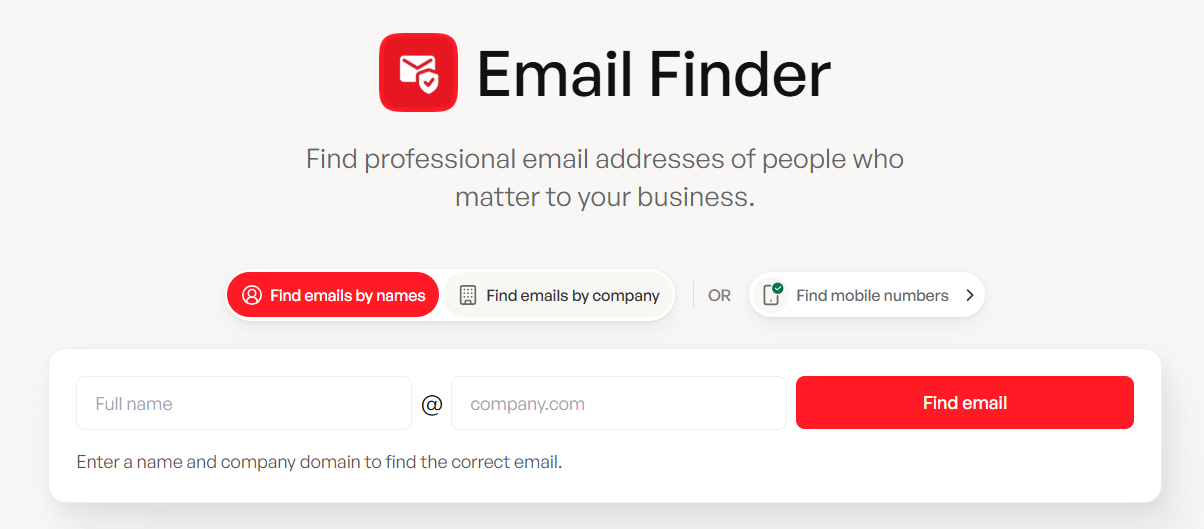
Free tier: 75 verified emails per month. Paid plans start around $39/mo with credit-based pricing at roughly $0.01 per email. No contracts, no sales calls required. We've seen teams cut bounce rates from 35% to under 4% after switching - Meritt, for example, tripled their pipeline from $100K to $300K/week after making the move.
Hunter
Hunter's the tool most people try first. The email finder is clean, fast, and the free tier lets you test without commitment. Where Hunter really shines is verification - a common take in r/agency threads is that it delivers solid verification accuracy even if the database runs smaller than competitors.
Pricing: $34/mo billed yearly for 2,000 credits on Starter, scaling to $209/mo for 25,000 on Scale. One credit per email find, half a credit per verification. If you're doing a typical 100-account/month workflow, expect ~700-800 credits/month between domain searches, lookups, and verifications - so Starter covers most individual reps.

The tradeoff: Hunter's database is web-crawled, meaning it's strong for publicly listed emails but weaker for contacts who don't appear on company websites. If you're prospecting into companies with minimal web presence, you'll hit more dead ends here.
RocketReach
Skip this if you need a generous free tier. Pick this if you've only got a name and a vague idea of where someone works.
RocketReach earned its reputation through word of mouth. One practitioner testing multiple tools reported their bounce rate "dropped a lot" after switching, specifically praising its ability to handle ambiguous inputs. Paid plans start around $53/mo.
Apollo
Apollo's database covers 250M+ contacts and the platform does far more than email finding - sequences, dialer, intent signals. But Reddit threads consistently flag data freshness as a problem. One agency buyer described it as having "lots of bounces on older contacts." If you're using Apollo as your primary email source, verify everything independently. Paid starts at ~$59/mo, and per-seat pricing compounds fast for teams.
Anymail Finder and Snov.io
Anymail Finder uses a pay-only-for-verified model: not-found results are free, and plans start at $14/month. You also get 100 free credits to test it. Good for avoiding spend on dead ends, but it doesn't scale as cleanly as credit-based tools for high-volume prospecting.
Snov.io is strong for international leads at ~$39/mo for 1,000 credits, with built-in email sequences if you don't already have a sending tool. Verify everything - accuracy is inconsistent.

You've got the name. Prospeo has the email. 300M+ profiles verified every 7 days - not 6 weeks - so you reach people at the job they have now, not the one they left. 98% accuracy, catch-all handling included.
75 free emails/month. No card, no contract, no bounces.
Guess the Email Format Manually
When tools come up empty - or when you don't want to burn credits - guessing the format works surprisingly well if you know the patterns. This is the most reliable way to find someone's email by name without paying for a subscription.
An analysis of 5M+ companies by Interseller and Greenhouse revealed that email format conventions shift predictably with company size:
| Company Size | Most Common Format | % Share | Runner-Up | % Share |
|---|---|---|---|---|
| 1-10 employees | firstname@ | ~71% | flast@ | ~13% |
| 51-200 employees | flast@ | ~42% | first.last@ | ~30% |
| 1,001-5,000 | first.last@ | ~48% | flast@ | ~35% |
| 10,001+ | first.last@ | ~56% | flast@ | ~22% |
The crossover happens around 51-200 employees, where flast@ overtakes firstname@. Knowing this saves you from generating a dozen permutations when two or three will cover 70%+ of cases.
Here's the workflow: check the company size on their website or any company database, then pick the two most likely formats from the table above. Generate your permutations - for "Jane Smith" at a 500-person company, try jane.smith@, jsmith@, and maybe jane@ as a fallback. Verify each one with a free email verification tool before sending.
Here's the thing: if your average deal size is under $5k, you probably don't need a paid email finder at all. The format-guessing method plus a free verifier will cover 70% of your lookups. Save the tool budget for when volume demands it.
Guessing formats works until it doesn't. One wrong send to a spam trap tanks your domain reputation. Prospeo's 5-step verification - with honeypot filtering and catch-all handling - lets you skip the guesswork entirely at $0.01 per verified email.
Teams using Prospeo cut bounce rates from 35% to under 4%.
Free Manual Methods
Not every email requires a paid tool. These tactics work more often than most people expect, especially for one-off lookups when you need to find an email address by name alone.
The approach changes by prospect type. Executives at large companies are best found through tools or format guessing, since their emails rarely appear publicly. Freelancers and founders often list contact info directly on social profiles or personal sites. Journalists are the hardest - BuzzStream's research found more than half of pattern-matched journalist emails were wrong, so use media databases or DM them directly.
With that context, here are the free methods worth trying:
Google search operators. Search
"jane smith" "@acmecorp.com"with quotes. Google indexes emails on conference speaker pages, press releases, SEC filings, and PDFs that never show up on the company website.Company about/team pages. Smaller companies frequently list individual emails. Check the page source if emails are obfuscated with JavaScript.
Social media bios. X/Twitter bios and Facebook about sections sometimes contain direct email addresses, especially for founders and freelancers.
Newsletter signup pages. Subscribe to the company's newsletter. The confirmation email often comes from a real person's address rather than a no-reply, revealing the email format.
Username cross-linking. Use idcrawl.com to check a username across platforms. If someone uses "jsmith" as their handle everywhere, there's a decent chance jsmith@ is their email format too.
OSINT lookup tools. Epieos.com lets you run limited free lookups to check if an email address is linked to known accounts - useful for confirming a guessed address is active.
Wayback Machine. Archived versions of company websites sometimes show team pages or contact info that's since been removed.
Contact syncing. If you have someone's phone number, syncing contacts through apps like Telegram or Venmo can surface linked email addresses. Use this for legitimate business outreach only - it's a gray area for personal contacts.
Always Verify Before You Send
"Found" and "deliverable" aren't the same thing.
One Reddit user reported 20%+ bounce rates despite using emails labeled "verified" by their finder tool. That's not an edge case - it's what happens when verification is shallow. The benchmark is clear: keep total bounces under 2% and hard bounces under 1%. Anything above that and you're actively damaging your sender reputation.
If your finder doesn't include strong verification, you'll need a standalone verifier:
| Verifier | Cost per 1,000 |
|---|---|
| MillionVerifier | ~$3.70 |
| NeverBounce | $8 |
| ZeroBounce | $10 |
| Hunter via credits | ~$24.50 |
In our experience, the cheapest option isn't always the best - MillionVerifier handles volume well, but we've found that tools with catch-all-specific logic save more headaches downstream than raw price per verification would suggest.
Mistakes That Tank Sender Reputation
Sending without verifying. Every unverified email is a coin flip. Even a 5% bounce rate will quickly degrade deliverability and inbox placement.
Trusting stale databases. Apollo's "older contacts" problem isn't unique - any database with a multi-week refresh cycle will serve you emails for people who've already changed jobs. Verify close to when you send, ideally within a month.
Mishandling catch-all domains. A catch-all server accepts every email regardless of whether the mailbox exists. Standard SMTP checks can't distinguish real from fake. You need a finder with catch-all-specific logic - this is the single most common reason "verified" emails still bounce.
Layering verifiers on top of each other. This sounds like extra safety, but different verifiers handle catch-all and risky emails differently. The overlap creates false negatives - one tool flags an email as risky, the other rejects it, and you lose valid contacts. In practice, this can shrink your usable list by up to 20%. Pick one good verification source and trust it.
Sending to role-based addresses. Emails like info@, sales@, or support@ have higher spam-filter sensitivity and lower response rates. Always target individual mailboxes.
Is It Legal to Find Someone's Email?
Yes, in most jurisdictions, with conditions.
CAN-SPAM (US): Cold email is legal without prior consent. You need truthful headers, a physical mailing address, and a working opt-out mechanism. Penalties run $51,744-$53,088 per violation.
GDPR (EU/UK): B2B cold email can fall under Article 6(1)(f) legitimate interest. You need to document a Legitimate Interest Assessment covering purpose, necessity, and balancing tests. Most B2B teams in Europe operate under this basis, but you need the paperwork. The ICO's guidance on legitimate interests is worth bookmarking.
CASL (Canada): Consent-first regime. Implied consent exists for certain business relationships, but you must honor unsubscribe requests within 10 business days and retain opt-out records for at least 3 years.
FAQ
Can I find a personal email address by name?
Most email finder tools focus on professional emails tied to company domains. Personal addresses like Gmail or Outlook aren't typically indexed by B2B data platforms and raise significant privacy concerns. For business outreach, stick to work emails.
What if I only have a first name?
A first name alone isn't enough for any tool to return reliable results. Add whatever context you have - company name, city, job title, industry - to narrow the search. Even a partial company name dramatically improves match rates across every finder we've tested.
What's a catch-all domain?
A catch-all domain is a mail server configured to accept every incoming email regardless of whether the specific mailbox exists. Standard verification tools can't confirm deliverability - the server says "accepted" for both real and fake addresses. It's the single biggest source of false positives in email finding, which is why specialized catch-all handling matters.
How accurate are email finders really?
One benchmark testing 9 tools across 5,000 identical searches per tool found accuracy ranging from around 17% to 80%. Let's be honest - that's a massive spread. The practical takeaway: never trust a single tool's "verified" label at face value. Always verify independently and target under 2% total bounce rate on your campaigns.
What's a good free option for finding emails by name?
Prospeo offers 75 verified emails per month on its free tier with full 5-step verification, including catch-all handling. Hunter provides 50 free credits monthly. For zero-cost manual methods, Google search operators combined with format guessing and a free verifier cover roughly 70% of one-off lookups.