

Business Owner Lookup: 8 Methods That Actually Work
You got a suspicious invoice from an LLC you've never heard of. You Google the name. Nothing useful. You try the state database, and it shows a registered agent in Delaware - CT Corporation System. Congratulations, you've discovered that the business exists and uses a corporate registered agent service. You're no closer to finding the actual owner.
With over 33 million small businesses in the US and no centralized federal registry, a business owner lookup is harder than it should be. We've run hundreds of these searches for due diligence, prospecting, and vendor vetting - and the advice most guides give ("just search the Secretary of State database") is incomplete to the point of being misleading.
What You Need (Quick Version)
Your approach depends on why you're looking:
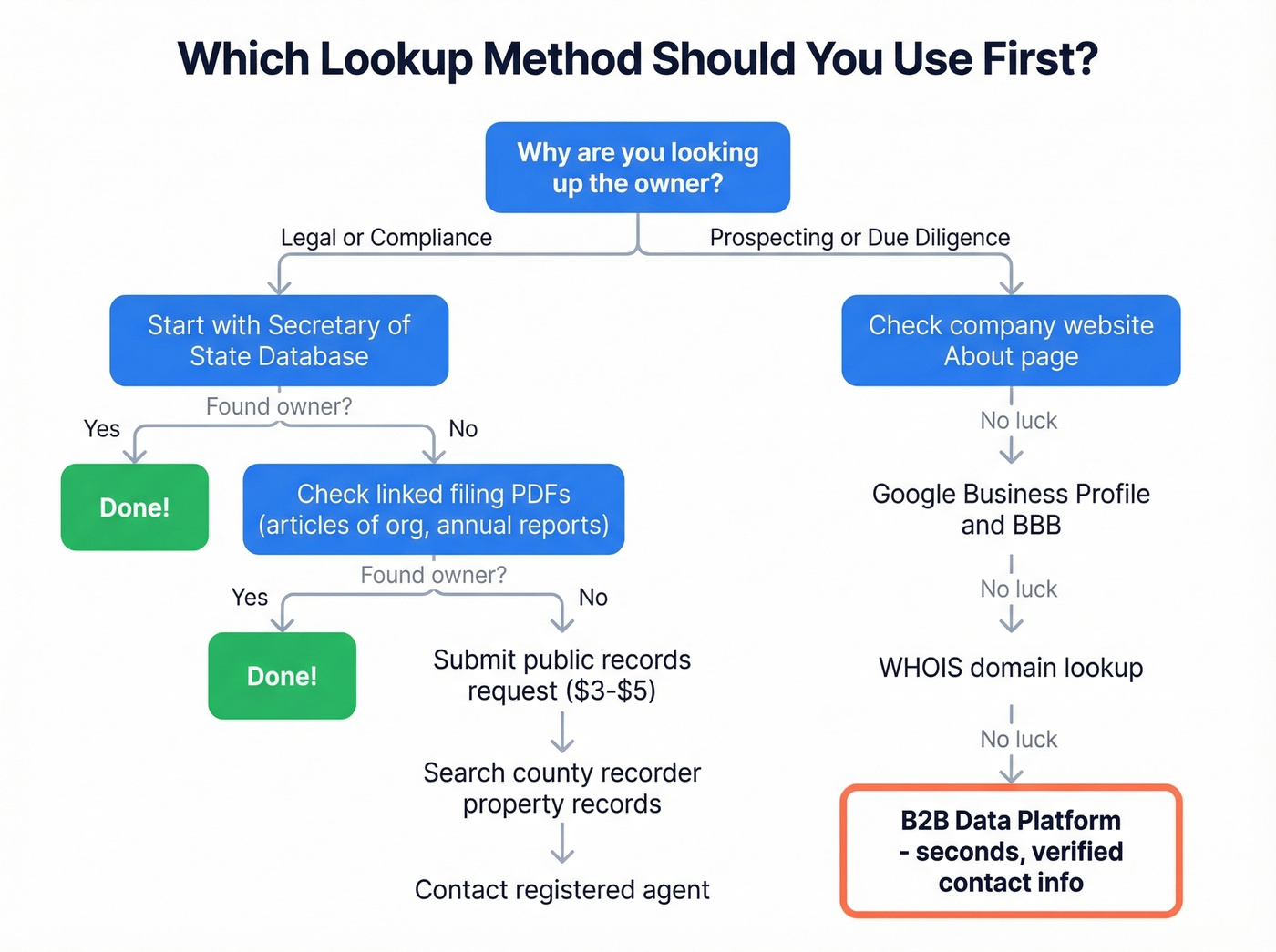
- Legal or compliance: Start with your state's Secretary of State database. Check the linked filing PDFs - articles of organization, annual reports - for member or officer names. If that fails, submit a public records request.
- General curiosity or due diligence: Work through the company website, Google Business Profile, BBB, WHOIS, and then the SOS database if you still need more.
Pick your path and jump to the relevant method below. Or read all eight - they build on each other.
Why Finding a Business Owner Is So Hard
The US has no centralized federal companies registry. Incorporation happens at the state level, across 50+ distinct official registers - every state, DC, and US territories each run their own system with their own rules, formats, and disclosure requirements. According to the Global Financial Integrity project, businesses lost over $4.7 trillion globally to financial crime in recent years, which is partly why ownership transparency matters so much.
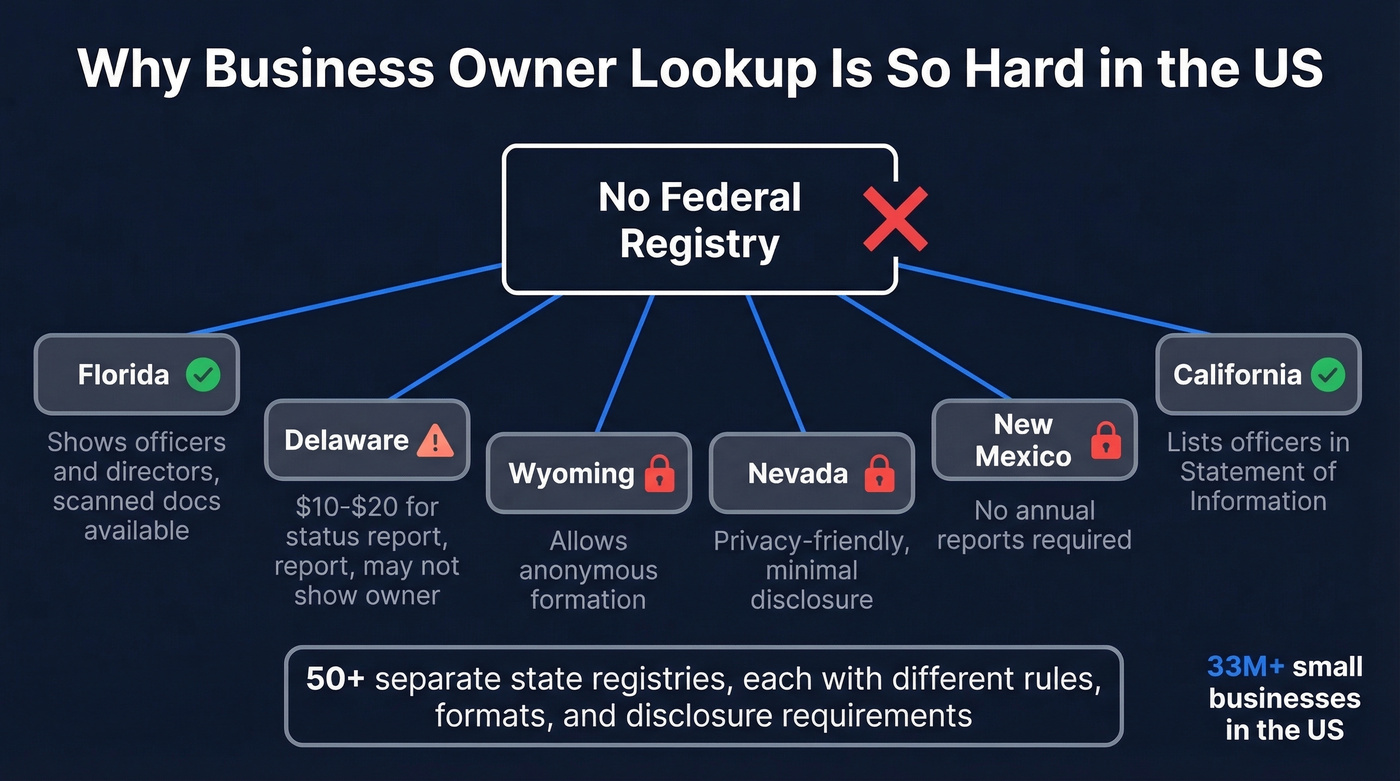
What you'll typically find in a state registry: entity name, entity type, formation date, status, registered agent, and sometimes a principal office address. Some states list officer or director names. Many don't.
Then there's the registered agent problem. You search the SOS database expecting an owner name and get "CT Corporation System" instead. A registered agent is the person or company designated to receive legal documents on behalf of the business. It's not the owner. It's often a third-party service. Seeing that name tells you nothing about who actually runs the company.
The state transparency gap is enormous. Florida shows comprehensive entity profiles with officer and director names right on the record and provides scanned formation documents quickly. Delaware charges $10-$20 for a detailed entity status report and still might not give you an owner name. The difference between states is that stark.
Privacy-friendly states make this worse. Delaware, Wyoming, New Mexico, and Nevada all allow more anonymity in formation filings. If you're trying to find the owner of a business registered in these states, you'll almost certainly need to go beyond the SOS database. Beneficial ownership is generally not part of public state records in the US, and the Corporate Transparency Act hasn't changed that (more on that below). So you're left stitching together clues from multiple sources.
Let's walk through the best ones.
8 Ways to Look Up a Business Owner
1. State Secretary of State Database
This is where everyone starts, and it's the right first step - just don't expect it to hand you the answer.
Identify the state where the business was incorporated (not necessarily where it operates). Navigate to that state's SOS business entity search portal and search by entity name. The summary page will show the entity's status, formation date, registered agent, and sometimes a principal office address. If you don't know the state of incorporation, try OpenCorporates - it aggregates 50+ state registries into a single searchable interface and saves you from guessing.
The real gold is in the linked filings. Click through to the articles of organization, annual reports, amendments, and statements of information. These PDFs often list member names, manager names, or officer names that don't appear on the summary page. Quick terminology note: LLC owners are called "members" in filings, while "managers" are day-to-day operators who may or may not be members. Look for both terms.
This typically takes 10-15 minutes. Some states charge up to about $5 for certain documents or certificates.
2. Company Website
The simplest method, and it works more often than you'd think. Check the About page, Team or Leadership page, and the footer. Press releases often name founders and principals. For smaller businesses, the owner's name is frequently right there - you just have to look past the homepage.
Don't forget to Google the company name plus "founder" or "owner." News articles and press releases often name principals who aren't listed anywhere else. Two minutes, zero cost.
3. WHOIS Domain Lookup
If the business has a website, run a WHOIS lookup on the domain using ICANN's lookup tool or whois.domaintools.com. Look for the "Registrant Name" or "Admin/Administrator" contact fields. If the domain isn't privacy-protected, you'll sometimes find the owner's actual name and contact info.
The limitation: many domains use privacy registration, which masks the registrant's identity. Still worth a 30-second check.
4. Business Directories
Local business directories are underrated for owner lookups. Check these in order:
- Google Business Profile - can surface owner/manager signals, especially in posts, Q&A, and responses
- BBB (Better Business Bureau) - often lists a principal contact for the business
- Yelp - owner responses sometimes include names
- Manta and Yellow Pages - list owner names for many small businesses
- Local Chamber of Commerce - membership directories often include owner details
These work best for local, brick-and-mortar businesses. You'll see various title formats: "business owner," "principal," "proprietor," "managing member," "sole proprietor," "president," or "founder" - all typically indicate the owner. Don't overlook your local Chamber; their directories are often more complete than the national aggregators. Budget about 5-10 minutes across all sources, all free.
5. County Recorder / Property Records
If the business owns real estate - or if it's a real estate-connected LLC, which many are - county recorder records can reveal the owner. Search the county recorder's office for deeds signed by the LLC. The deed itself will show a signatory, and the notary acknowledgment section often reveals the signer's name and title (e.g., "John Smith, Managing Member").
This is particularly useful for LLCs that hold property, which is extremely common for real estate investors who form separate entities for each property. Free to $5 for copies, 15-30 minutes.
6. UCC Lien Filings
When a business takes on secured debt, a UCC (Uniform Commercial Code) filing is recorded with the state. Search your state's UCC database for the business name. The filing lists the debtor and may include an authorized signer - sometimes the owner or a managing member.
This won't work for every business, but when it hits, it gives you a name that's hard to find elsewhere. Free, about 10 minutes.
7. Public Records Requests
When the online portal doesn't show what you need, submit a formal public records request to the state. $3-$5 is common. Turnaround ranges from a few days to several weeks depending on the state and the complexity of the request.
Some states have limited disclosure rules, so you won't always get member names even through a formal request. But it's worth trying - especially for states that keep detailed formation documents on file but don't publish them online.
8. B2B Data Platforms
Here's where we've seen the biggest time savings in our own workflow. When public records give you the entity name but not the person behind it, a B2B data platform gets you from entity name to actual person.
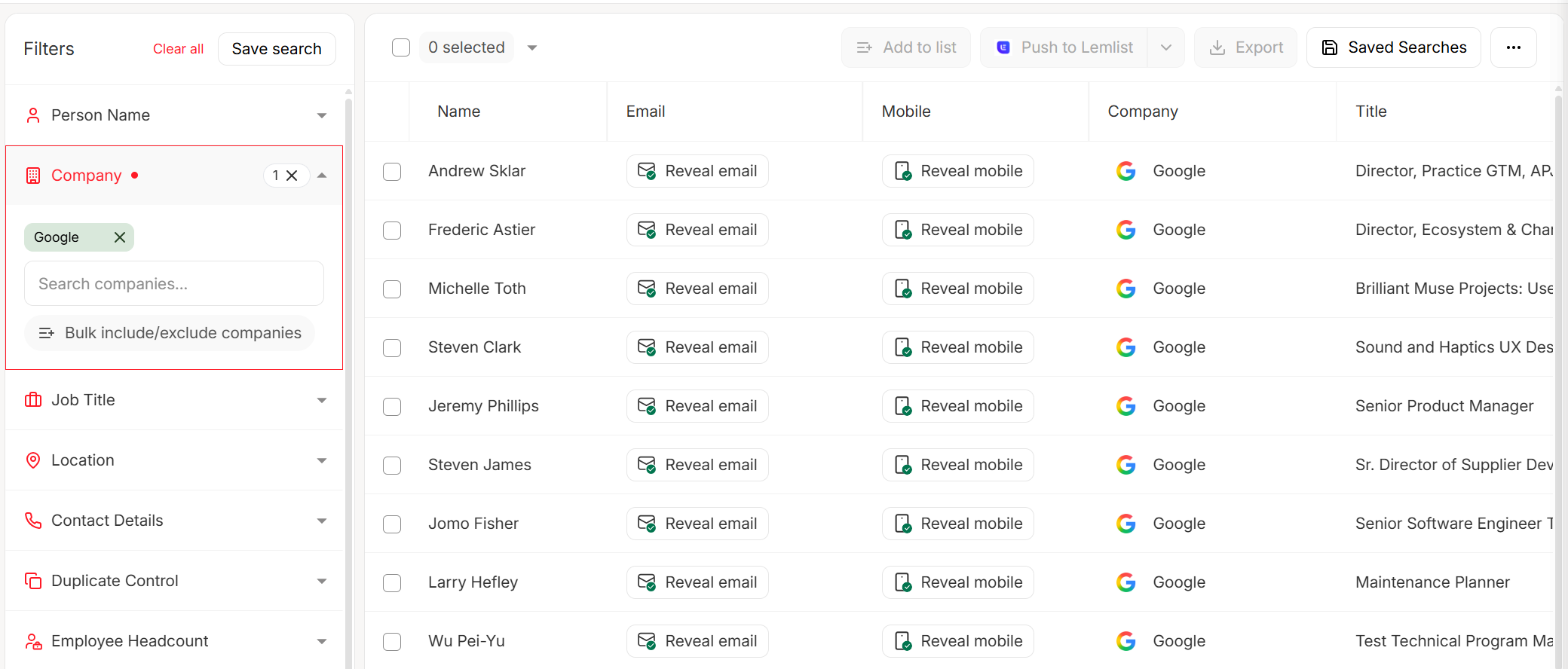
Prospeo searches 300M+ professional profiles and returns verified emails with 98% accuracy and direct mobile numbers. Enter a company name or domain, upload a CSV of business names, or use the Chrome extension on any website - and get founders, owners, and decision-makers with contact data in seconds. The free tier gives you 75 emails per month plus 100 Chrome extension credits, no contracts, no sales calls required.
Look, if your average deal is under $15k, you probably don't need to spend 45 minutes digging through state filings and county recorder offices. A B2B data platform gets you the same answer in seconds for about a penny per lookup. The public records route makes sense for legal proceedings and compliance. For everything else, it's a time sink.

You just spent 30 minutes across state registries, WHOIS lookups, and county records - and you still don't have a way to contact the owner. Prospeo's database covers 300M+ professionals with 30+ filters including company size, role, and industry. Search by company name, get the owner's verified email (98% accuracy) and direct mobile number in seconds.
Skip the scavenger hunt. Go straight from business name to owner contact.
Method Comparison
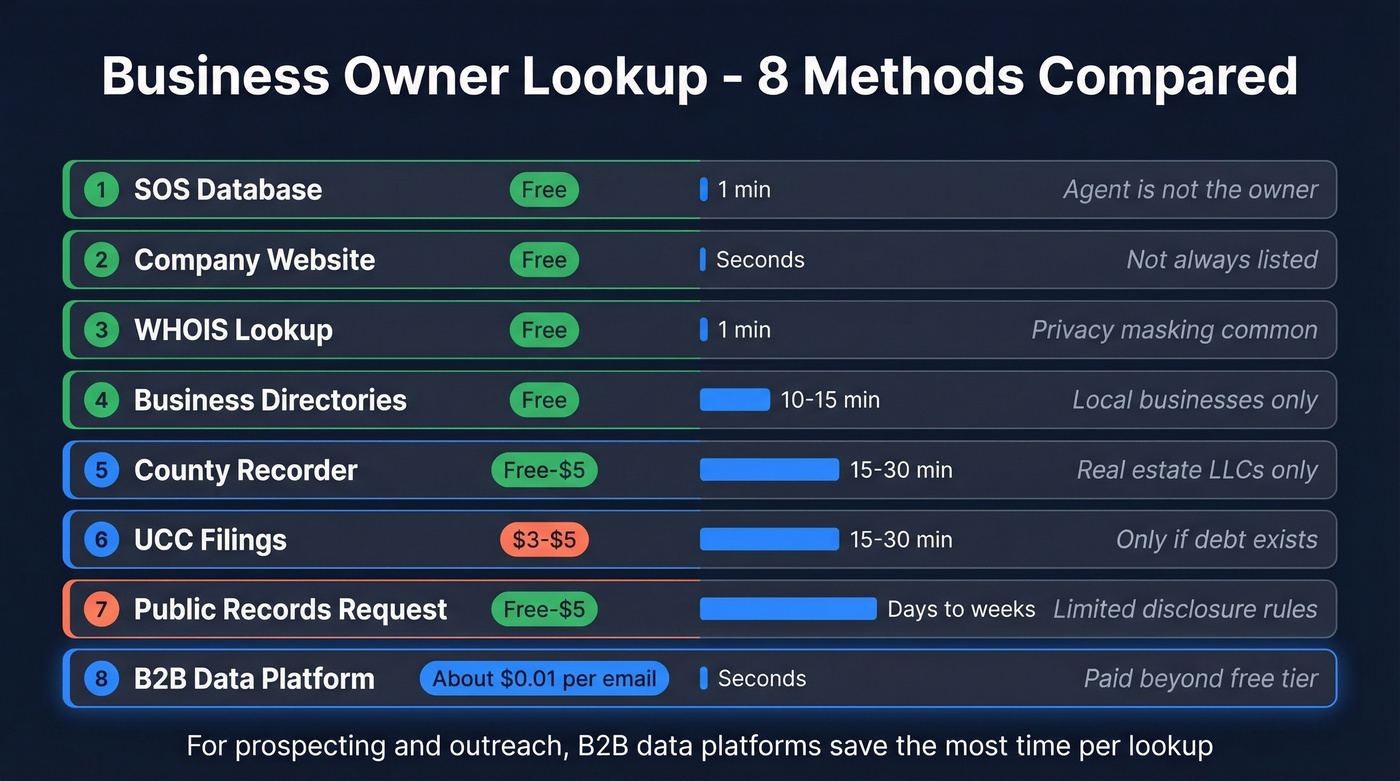
| Method | Cost | Time | What You Find | Limitation |
|---|---|---|---|---|
| SOS Database | Free-$5 | 10-15 min | Entity status, agent, filings | Agent ≠ owner |
| Company Website | Free | 2 min | Owner name, title | Not always listed |
| WHOIS Lookup | Free | 1 min | Registrant/admin contact | Privacy masking |
| Directories | Free | 5-10 min | Owner/principal name | Local businesses only |
| County Recorder | Free-$5 | 15-30 min | Deed signatories | Real estate LLCs only |
| UCC Filings | Free | 10 min | Debtor details, sometimes a signer | Only if debt exists |
| Records Request | $3-$5 | Days-weeks | Formation docs | Limited disclosure |
| B2B Data Platform | ~$0.01/email | Seconds | Owner + email + phone | Paid beyond free tier |
When the Owner Isn't Listed: The Escalation Path
You've searched the SOS database, checked the summary page, and all you see is a registered agent. This is the escalation path that actually works:
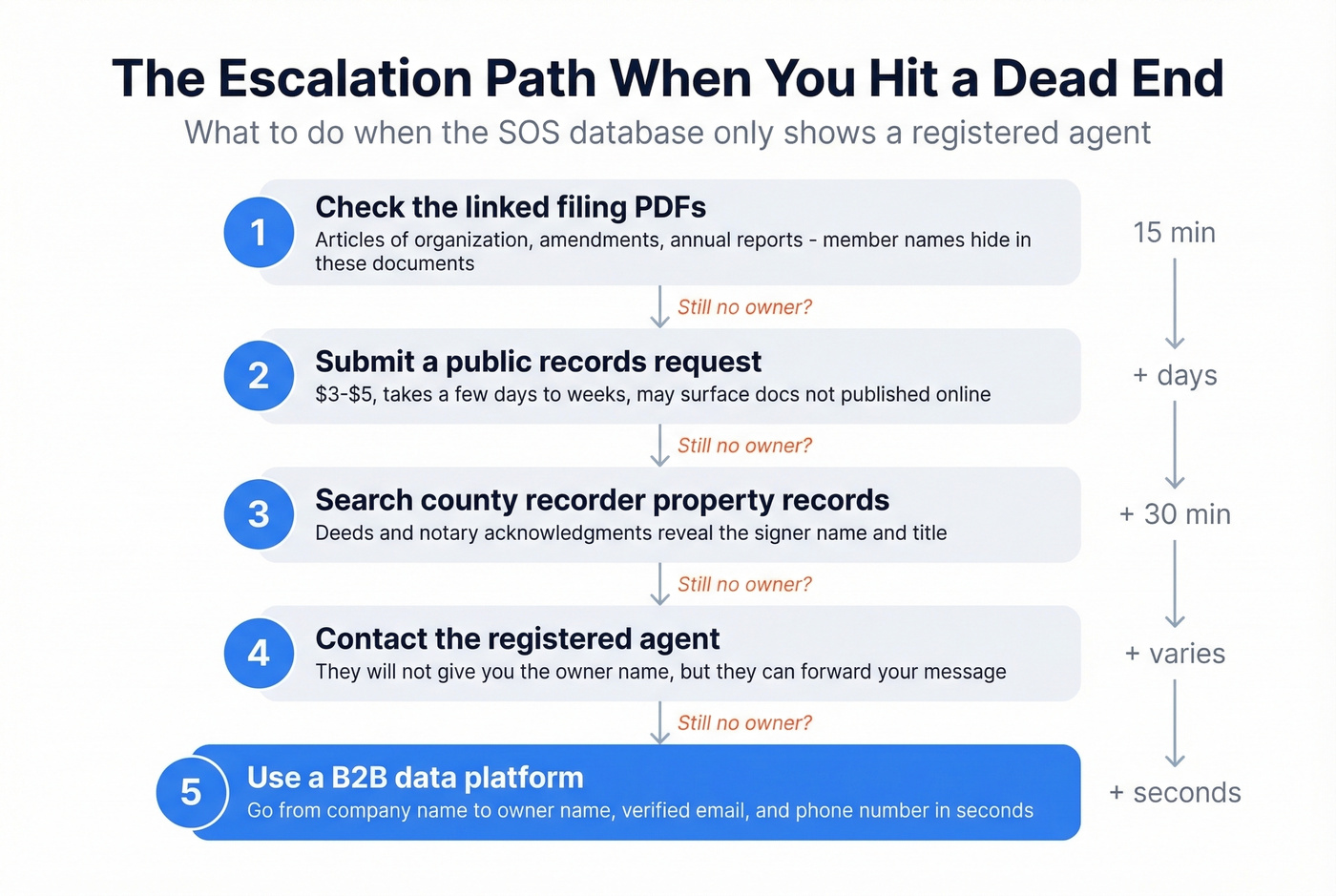
Step 1: Check the linked filing PDFs. Don't stop at the summary page. Click into the articles of organization, amendments, and annual reports. Member and manager names are buried in these documents far more often than they appear on the main listing.
Step 2: Submit a public records request. If the online filings don't include owner names, a formal request to the state may surface documents that aren't published digitally. Budget $3-$5 and a few days of patience.
Step 3: Search county recorder property records. If the LLC holds real estate, deeds and notary acknowledgments will reveal the signer's name and title. This is one of the most reliable workarounds for privacy-friendly states.
Step 4: Contact the registered agent directly. Registered agents can sometimes forward correspondence to the business owner. They won't give you the owner's name, but they can pass along your message.
Step 5: Use a B2B data platform. If you've exhausted public records and still can't find the owner, a platform like Prospeo can match the company to its decision-makers and return verified contact data in seconds - often the fastest way to end the search.
One thing to watch for: LLC members can be other entities - corporations, trusts, or other LLCs. If you find a corporate name instead of a person's name in filings, you'll need to trace ownership through that entity as well. We've seen chains three or four layers deep, especially with real estate holding structures.
For legal use cases, getting the right entity matters. In Maryland, for example, if you sue the wrong entity, you could win a judgment that's unenforceable - or lose the case entirely. The "principal office" in the registry may differ from where you did business. Confirm the exact legal entity before taking action.
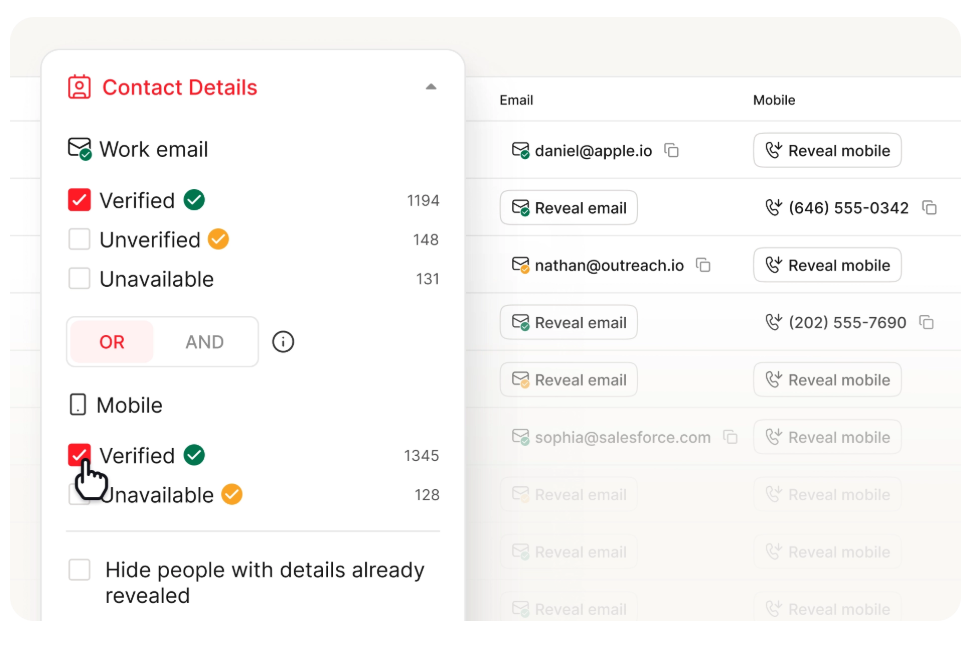
Once you've identified a business owner, you still need a way to reach them. Prospeo finds verified emails at $0.01 each and direct mobile numbers with a 30% pickup rate - no registered agents, no generic info@ addresses. Plug any company into the Chrome extension and get the decision-maker's contact data in one click.
Turn any business owner lookup into a direct conversation.
Corporate Transparency Act: Where Things Stand in 2026
The Corporate Transparency Act was supposed to fix the business owner transparency problem. It hasn't.
On March 26, 2025, FinCEN issued an interim final rule that exempted all US-formed entities from beneficial ownership information (BOI) reporting. Domestic companies no longer have to report their owners to FinCEN. The requirement now applies only to foreign entities that register to do business in a US state or tribal jurisdiction.
The Eleventh Circuit reversed a district court decision that had declared the CTA unconstitutional in December 2025, remanding for further proceedings. FinCEN didn't issue the final rule it had planned, citing delays including a lapse in appropriations. The agency's director testified in September 2025 that FinCEN was working on plans to delete the BOI data it had already collected - the "orphan information" problem.
Even if the CTA were fully enforced, the BOI database was never designed to be publicly searchable. Access is restricted to certain government agencies and financial institutions. For anyone doing a business owner lookup, the CTA changes nothing practical.
Don't hold your breath on this one. And watch out for scams - fake forms labeled "4022" or "5102" from a nonexistent "US Business Regulations Dept." are circulating. FinCEN doesn't charge a fee to file, and it doesn't send unsolicited forms.
State SOS Business Search Portals
Direct links to the business entity search portals for the highest-volume states. Bookmark the ones you use regularly.
| State | Portal |
|---|---|
| California | bizfileonline.sos.ca.gov |
| Texas | SOSDirect |
| New York | DOS Entity Search |
| Florida | Sunbiz.org |
| Delaware | ICIS Entity Search |
| Pennsylvania | BCSO Search |
| Illinois | Cyber Drive |
| Ohio | SOS Business Search |
| Georgia | GA Corporations Division |
| New Jersey | NJ Business Records |
| Massachusetts | Corporations Division |
| Virginia | SCC Clerk's Info System |
| Washington | Corporations & Charities |
| Colorado | ESOS Business Search |
| North Carolina | SOS Business Search |
A note on New Hampshire: their search portal has known compatibility issues with Chrome. Use Firefox or Edge if you're having trouble.
For a complete 50-state directory with links, LLC University maintains an updated list that covers all states, DC, and Puerto Rico.
FAQ
Can I search for a business by the owner's name?
Most state SOS databases only allow entity name searches, not owner name searches. Prospeo and similar B2B data platforms let you search by person and find linked companies with verified contact data. Some county recorder systems also allow name-based searches for property records.
How do I find the owner of a company that uses a registered agent?
A registered agent receives legal documents on behalf of the business - it's not the owner. Check the linked filing PDFs in the state registry first, since member names often appear in articles of organization and annual reports. If that fails, submit a public records request or use a B2B data platform to match the company to its decision-makers.
Are LLC owners public record?
It depends on the state. Florida and California include member or officer names in formation filings, making them publicly accessible. Privacy-friendly states like Delaware, Wyoming, New Mexico, and Nevada don't require member disclosure, making owner identification significantly harder through state records alone.
Is there a national business owner database?
No federal registry exists for US businesses. The closest free option is OpenCorporates, which aggregates data from multiple state registries into one searchable interface. For verified contact information beyond entity records, B2B data platforms fill the gap.
Is FinCEN's beneficial ownership database open to the public?
No. BOI data filed with FinCEN isn't publicly searchable. Access is restricted to certain government agencies, financial institutions, and law enforcement. Even if the CTA were fully enforced for domestic companies (it currently isn't), the database was never designed for public lookups.