

Forecast Commit: What It Means & How to Nail It
It's week 11 of the quarter and your "Commit" just turned into next quarter's pipeline. Again. The VP wants answers, the board deck needs a number, and your team's credibility is eroding one slipped deal at a time.
Let's fix the process behind the forecast commit, not just the definition.
Quick note if you're here from the Scrum world: "commit" and "forecast" mean something different in agile. The Scrum Guide shifted from "commit" to "forecast" language for Sprint Backlog items. Everything below is sales forecasting.
A forecast commit is a deal you're willing to stake your credibility on - 90-100% close probability, backed by concrete buyer actions. Not gut feel. Not a verbal "we're going with you." Terms are agreed, procurement or legal is engaged, the close date falls within the current period, and no major competitive or budget risk remains.
Three Things to Implement This Week
- Commit is evidence-backed, not vibes. If you can't point to specific buyer actions like legal review, procurement engagement, or a confirmed sign-off path, it's Best Case at most.
- Track your Deal Slip Rate. Slipped deals divided by total forecasted deals, times 100. Measure it weekly. If you don't know the number, you can't fix it.
- Run a metrics-first commit call. Start with quota, forecast, closed won, total pipeline, committed pipeline - in that order. No storytelling until the numbers are on the table.
A 2025 Xactly survey of 400 leaders found that 4 in 5 missed a quarterly forecast in the past year. Over half missed two or more times. The problem isn't math - it's definition and inspection discipline.
Forecast Commit vs Best Case vs Pipeline
Most forecast problems start here: teams don't agree on what each category means. When your sales forecasting categories lack clear definitions, every rep applies their own interpretation and accuracy collapses. Here's a framework that eliminates the ambiguity.
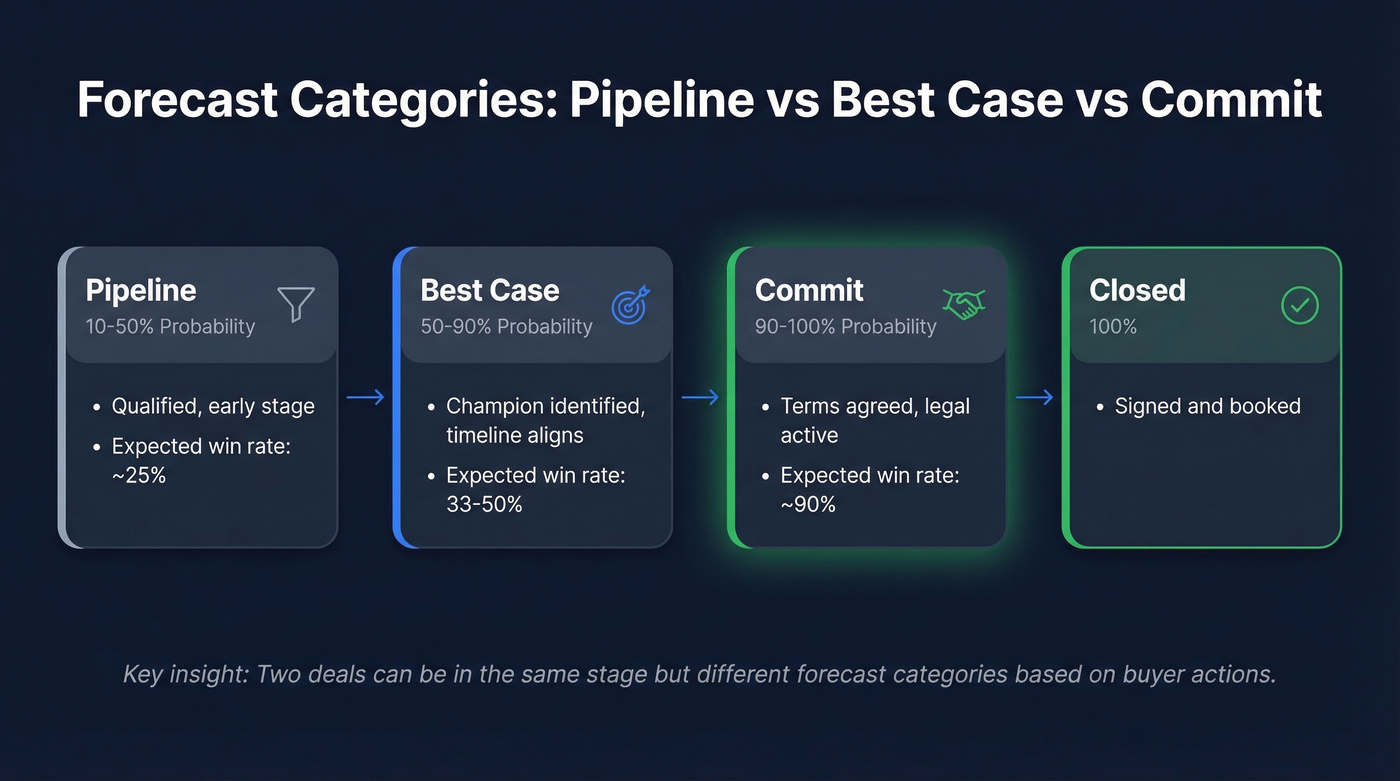
| Category | Probability | Evidence Required | Expected Win Rate |
|---|---|---|---|
| Pipeline | 10-50% | Qualified, early stage | ~25% |
| Best Case | 50-90% | Champion ID'd, timeline aligns | ~33-50% |
| Commit | 90-100% | Terms agreed, legal active | ~90% |
| Closed | 100% | Signed, booked | 100% |
| Omitted | 0% | Excluded from forecast | N/A |
Gary Smith Partnership's Salesforce guidance puts it simply: expect only a quarter of Pipeline deals to close in-quarter, a third to half of Best Case, and 90% of Commit. Those aren't aspirational targets - they're the baseline your categories should produce.
Commit isn't a vibe. It's a category with evidence. Two deals can sit in the exact same stage - say, Proposal - and belong in different forecast categories based on what the buyer has actually done. This distinction matters because in Salesforce, the opportunity owner can adjust the forecast category without changing the pipeline stage. Use that flexibility.
The Commit Checklist
Before a deal earns the Commit label, it should pass every one of these. Binary yes/no - no "sort of" allowed:
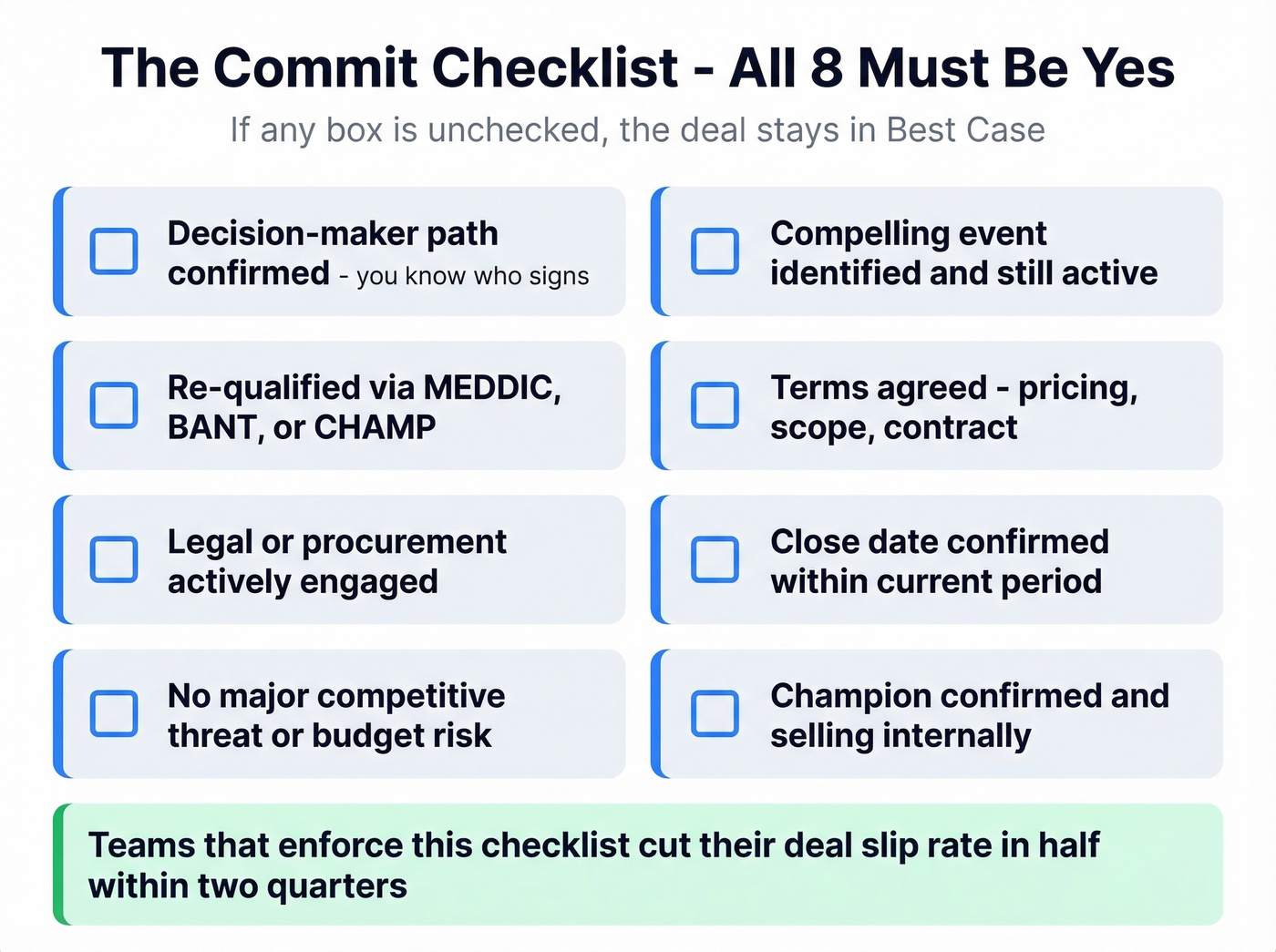
- ☐ Decision-maker path confirmed (you know who signs and they've verbally committed)
- ☐ Compelling event identified and still active (deadline, budget cycle, pain trigger)
- ☐ Re-qualified via your framework (MEDDIC, BANT, or CHAMP) - not just initial qualification
- ☐ Terms agreed (pricing, scope, contract structure)
- ☐ Legal and/or procurement actively engaged
- ☐ Close date confirmed within the current period
- ☐ No major competitive threat or unresolved budget risk
- ☐ Champion confirmed and actively selling internally
If your team can't check every box, the deal stays in Best Case until it can. We've watched teams cut their slip rate in half within two quarters just by enforcing this checklist - no new tools, no new process, just rigor applied consistently.

Deals slip from Commit when you can't reach procurement, legal, or the economic buyer. Prospeo gives you 98% accurate emails and 125M+ verified mobile numbers - refreshed every 7 days, not 6 weeks. Multi-thread into every stakeholder on your committed deals.
Stop losing committed deals to stale contact data.
Why Committed Deals Slip
Deal slippage - opportunities forecasted to close in a period that push to the next one - is the silent killer of forecast accuracy. The root causes are predictable and preventable.
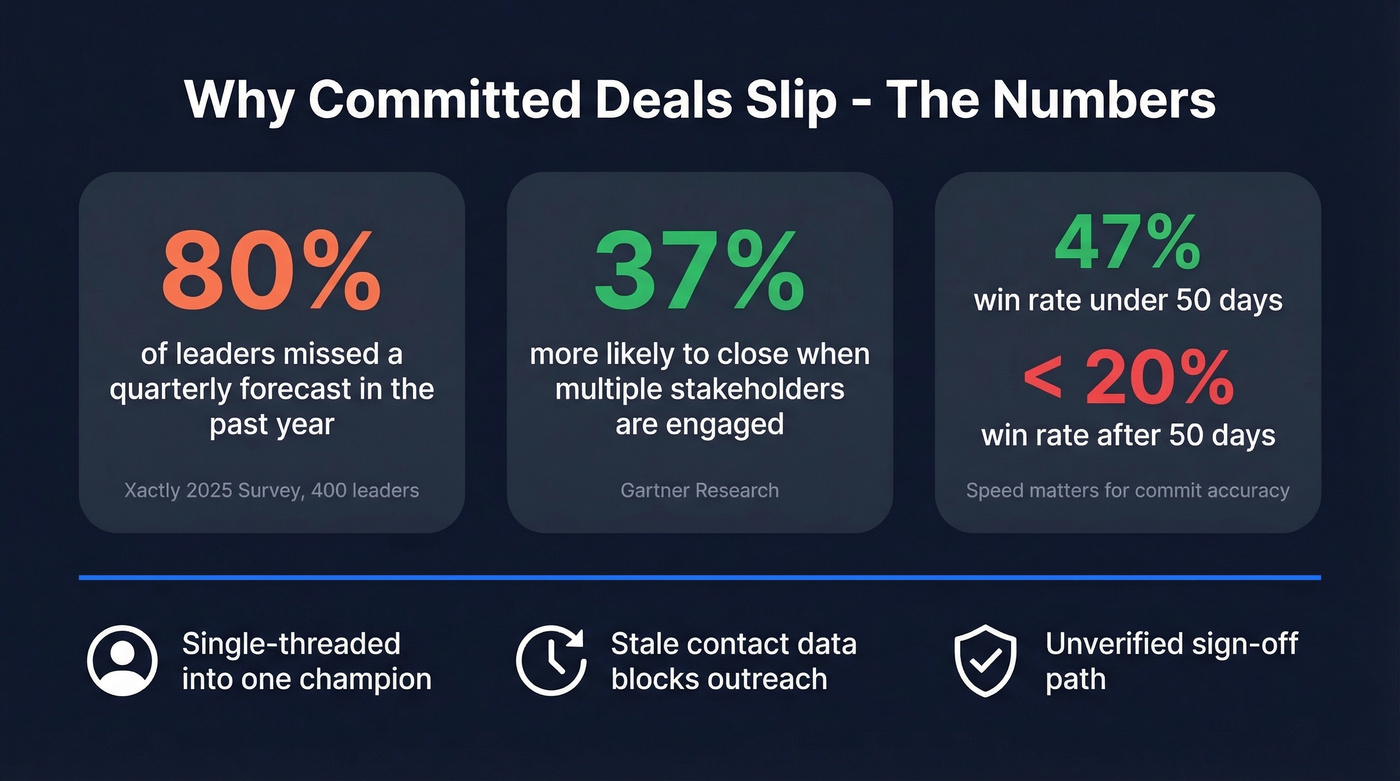
Enterprise deals involve 6-12 stakeholders. When you're single-threaded into one champion, you're one reorg, one vacation, one budget freeze away from a slip. Deals with more than one contact engaged are 37% more likely to close. And yet most reps are still running single-threaded into accounts they've labeled Commit.
Ask anyone who's watched a "committed" deal slip three months running. The problem is always the same: single-threaded, unverified sign-off path, and no real access to the economic buyer.
Stale contact data - wrong emails, outdated direct dials, contacts who've changed roles - makes multi-threading hard. When your committed deal depends on reaching three people in procurement and legal, verified contact data isn't optional. Prospeo's 98% email accuracy and 7-day refresh cycle keeps stakeholder data current instead of six weeks stale, which is the industry average.
The opposite problem, sandbagging, is just as destructive. Reps who under-commit to protect their number starve the forecast of upside visibility. Both failure modes erode trust in the same way.
Here's a stat that should sharpen your urgency: deals closed within 50 days win at 47%, but after that threshold, win rates drop below 20%. When 34% of revenue teams report cycles spanning 1-2 quarters, the window for commit accuracy is razor-thin.
What Good Accuracy Looks Like
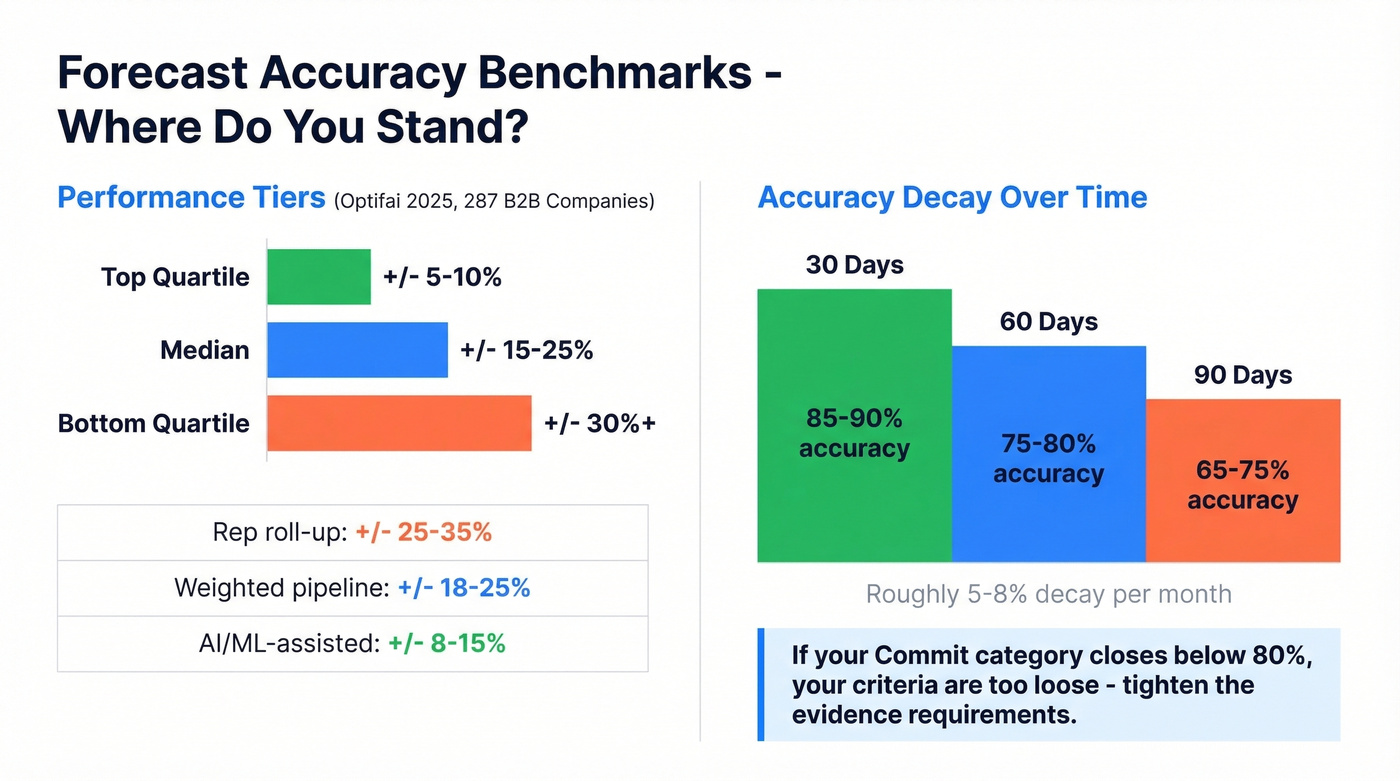
Optifai's 2025 benchmark data across 287 B2B companies breaks down like this:
| Performance Tier | Forecast Variance |
|---|---|
| Top quartile | +/-5-10% |
| Median | +/-15-25% |
| Bottom quartile | +/-30%+ |
Accuracy decays the further out you forecast. At 30 days, expect 85-90% accuracy. At 60 days, 75-80%. At 90 days, 65-75%. That's roughly 5-8% decay per month.
| Method | Typical Variance |
|---|---|
| Rep roll-up | +/-25-35% |
| Weighted pipeline | +/-18-25% |
| AI/ML-assisted | +/-8-15% |
Here's the thing - stop asking reps for a single number. Run a floor/target/ceiling range driven by categories, then measure category accuracy every quarter. If your Commit category closes below 80%, your criteria are too loose. Tighten the evidence requirements rather than blaming reps for optimism.
Most teams don't have a forecasting problem. They have a category definition problem wearing a forecasting costume. Fix the definitions, enforce the checklist, and the numbers fix themselves.
One leading indicator worth tracking: category movement velocity, meaning how fast deals move between categories. A deal that bounces from Best Case to Commit and back three times in a quarter is a coaching conversation, not a forecast input. Erratic category movement signals coaching needs, not just forecast problems.
How to Run a Commit Call
A commit call that turns into a pipeline scrub is a broken operating rhythm. In our experience, keeping them separate is the single highest-leverage change a sales org can make to forecast accuracy. Here's the structure that works:
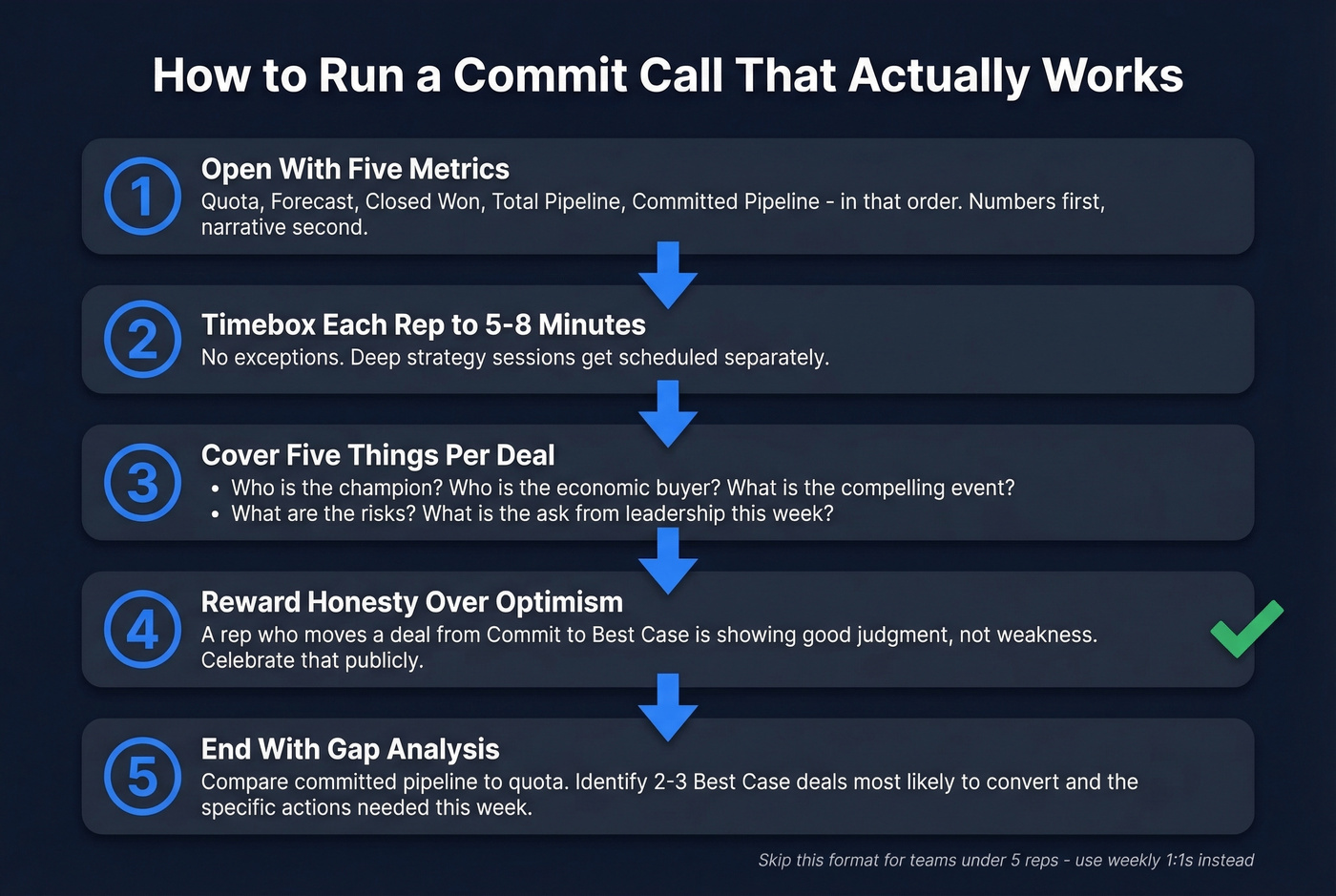
1. Open with five metrics, in order: quota, forecast, closed won, total pipeline, committed pipeline. Numbers first, narrative second.
2. Timebox each rep to 5-8 minutes. No exceptions. If a deal needs a deep strategy session, schedule it separately.
3. For each committed deal, the rep covers five things: who's the champion, who's the economic buyer, what's the compelling event, what are the risks, and what's the concrete ask from leadership this week.
4. Apply one principle above all others: honesty over optimism. A rep who moves a deal from Commit to Best Case mid-quarter is showing good judgment, not weakness. Reward that behavior publicly.
5. End with gap analysis. Compare committed pipeline to quota. If there's a gap, identify the 2-3 Best Case deals most likely to convert and the specific actions needed this week.
Skip this if your team is under five reps - at that size, a weekly 1:1 with each rep covers the same ground faster than a group call. The commit call format really pays off once you've got enough pipeline complexity that no single manager can hold every deal in their head.
Gartner says multi-threaded deals are 37% more likely to close. But you can't multi-thread with bad data. Prospeo's 300M+ profiles with 30+ filters let you map every decision-maker, champion, and blocker - so your Commit category actually closes at 90%.
Turn your commit checklist green with contacts that actually connect.
A Note for Salesforce Users
Salesforce's native forecast categories map directly to this model: Pipeline, Best Case, Commit, Closed, and Omitted. The key thing most admins miss is that the opportunity owner can adjust the forecast category independently of the pipeline stage. A deal in "Negotiation" can be Best Case or Commit depending on evidence - the category reflects your confidence, not the buyer's process step. Set expected close-rate guidance by category and review actuals quarterly to calibrate.
The consensus on r/salesforce is that most orgs never customize the default category-to-stage mapping, which means they're leaving the most useful part of Salesforce forecasting on the table.
FAQ
What's the difference between a forecast commit and a pipeline stage?
A pipeline stage tracks where the buyer is in their process. A forecast commit category reflects your confidence that the deal closes this period - 90%+ probability backed by evidence like legal engagement and agreed terms. In Salesforce, you can adjust one without changing the other.
What close rate should committed deals hit?
Around 90%. If your Commit category consistently closes below 80%, tighten the evidence requirements - specifically around decision-maker confirmation and legal/procurement engagement. Top-quartile teams hold +/-5-10% forecast variance by enforcing strict entry criteria.
How do I reduce deal slippage on committed deals?
Track Deal Slip Rate weekly, enforce the commit checklist before any deal enters the category, and multi-thread every account. Engaging more than one stakeholder makes deals 37% more likely to close. Keeping your contact data fresh - verified emails, current direct dials - ensures you can actually reach the full buying committee, not just your single-threaded champion.
Does "forecast commit" mean the same thing in Scrum?
No. In Scrum, the team forecasts sprint scope (flexible) but commits to the Sprint Goal (fixed). In sales, commit is a high-confidence forecast category meaning "this deal closes this period" with 90%+ probability backed by concrete buyer actions.
How should I set up categories like Best Case and Commit?
Start by aligning your team on what each label means using evidence-based criteria, not probability guesses. The standard progression - Pipeline, Best Case, Commit, Closed, Omitted - gives you a confidence spectrum that maps cleanly to Salesforce's native categories. Document the specific buyer actions required before a deal can move from one category to the next, then review actual close rates quarterly to recalibrate.