


GoHighLevel vs Odoo: Marketing Machine or Operations Engine?
GoHighLevel vs Odoo is a weird comparison because they aren't built to solve the same problem. GoHighLevel is a marketing + conversations system: funnels, follow-ups, calendars, SMS, and the day-to-day stuff agencies live in. Odoo is an operations system: accounting, inventory, manufacturing, HR, and the records your finance team will fight to keep clean.
We've watched agency owners spend weeks demoing both, only to realize they were trying to pick a "CRM" when what they really needed was to pick an operating model. That's why this isn't a feature fight. It's an architecture decision.
Let's break it down the way you'd actually decide in the real world.
30-second verdict
Use GoHighLevel if you're an agency or marketing-first SMB that wants to consolidate lead capture, nurture, and communications. It's rated 4.6/5 from 602 reviews on G2, and most reviewers are small businesses. https://www.g2.com/compare/highlevel-vs-odoo-crm
Use Odoo if your bottleneck is back-office operations (accounting, inventory, manufacturing, HR) and you want a unified ERP. It's rated 4.1/5 from 176 reviews on G2, with a broader company-size mix. https://www.g2.com/compare/highlevel-vs-odoo-crm
Skip both if your real problem is "we don't have enough qualified people to talk to." Neither tool fills a pipeline with verified contacts. That's a data problem, not a CRM problem.
Feature comparison at a glance
| GoHighLevel | Odoo | Edge | |
|---|---|---|---|
| Core focus | Marketing + sales automation | ERP + operations | Depends on need |
| Pricing model | Flat plan + usage | Per-user + implementation | Depends on team size + volume |
| Deployment | Cloud only | Cloud (Odoo Online), Odoo.sh, or on-prem (Custom plan) | Odoo (flexibility) |
| Best fit | Agencies, marketing SMBs | Ops-heavy businesses | - |
| White-labeling | Full agency white-label | Not available | GoHighLevel |
| Time to value | Days to weeks | Weeks to months | GoHighLevel |
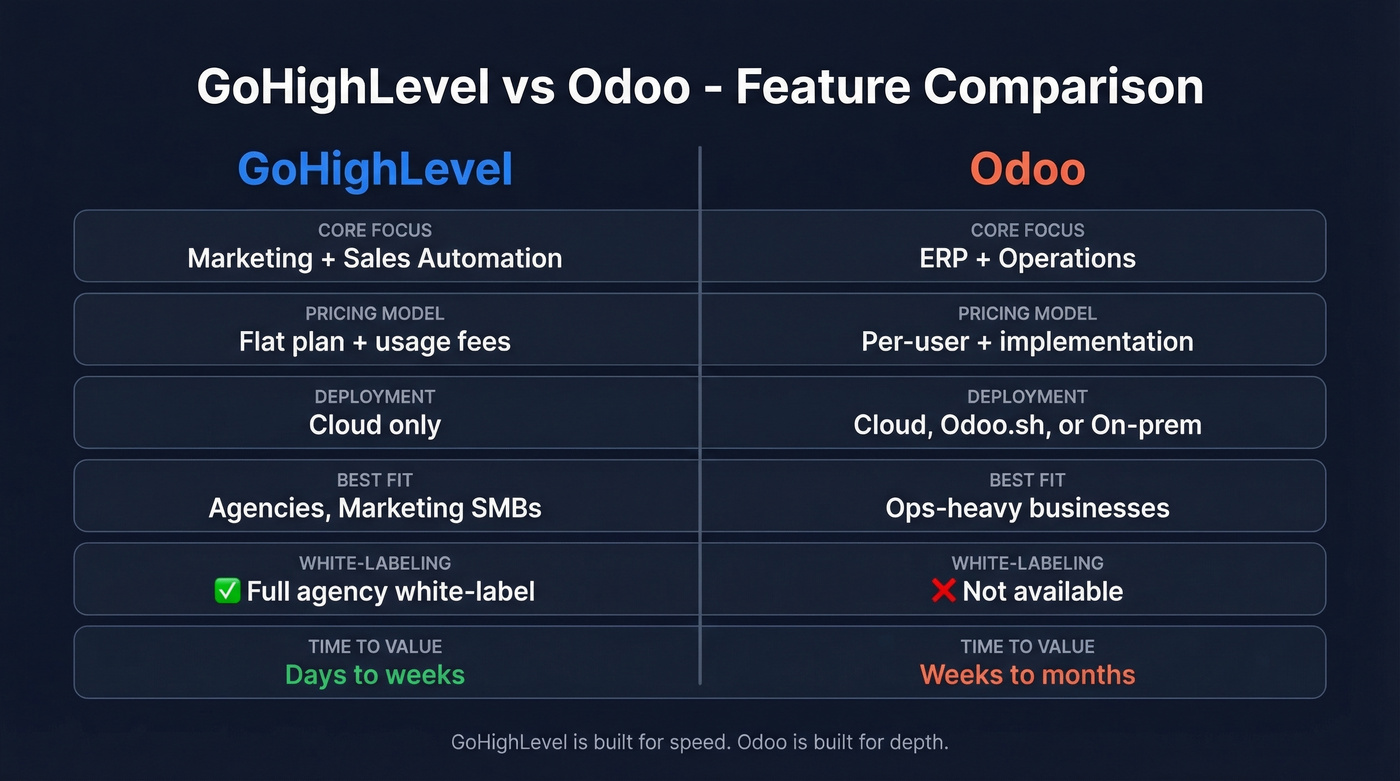
GoHighLevel is built for speed. Odoo is built for depth. Depth is great, but it comes with projects, stakeholders, and timelines that don't care about your Q2 targets.
What you'll actually pay
Neither platform's sticker price tells the truth on its own. One hides cost in usage. The other hides cost in implementation.
GoHighLevel: subscription + usage
GoHighLevel's three tiers are $97/mo (Starter), $297/mo (Unlimited), and $497/mo (Agency Pro). https://help.gohighlevel.com/support/solutions/articles/155000001156-highlevel-pricing-guide
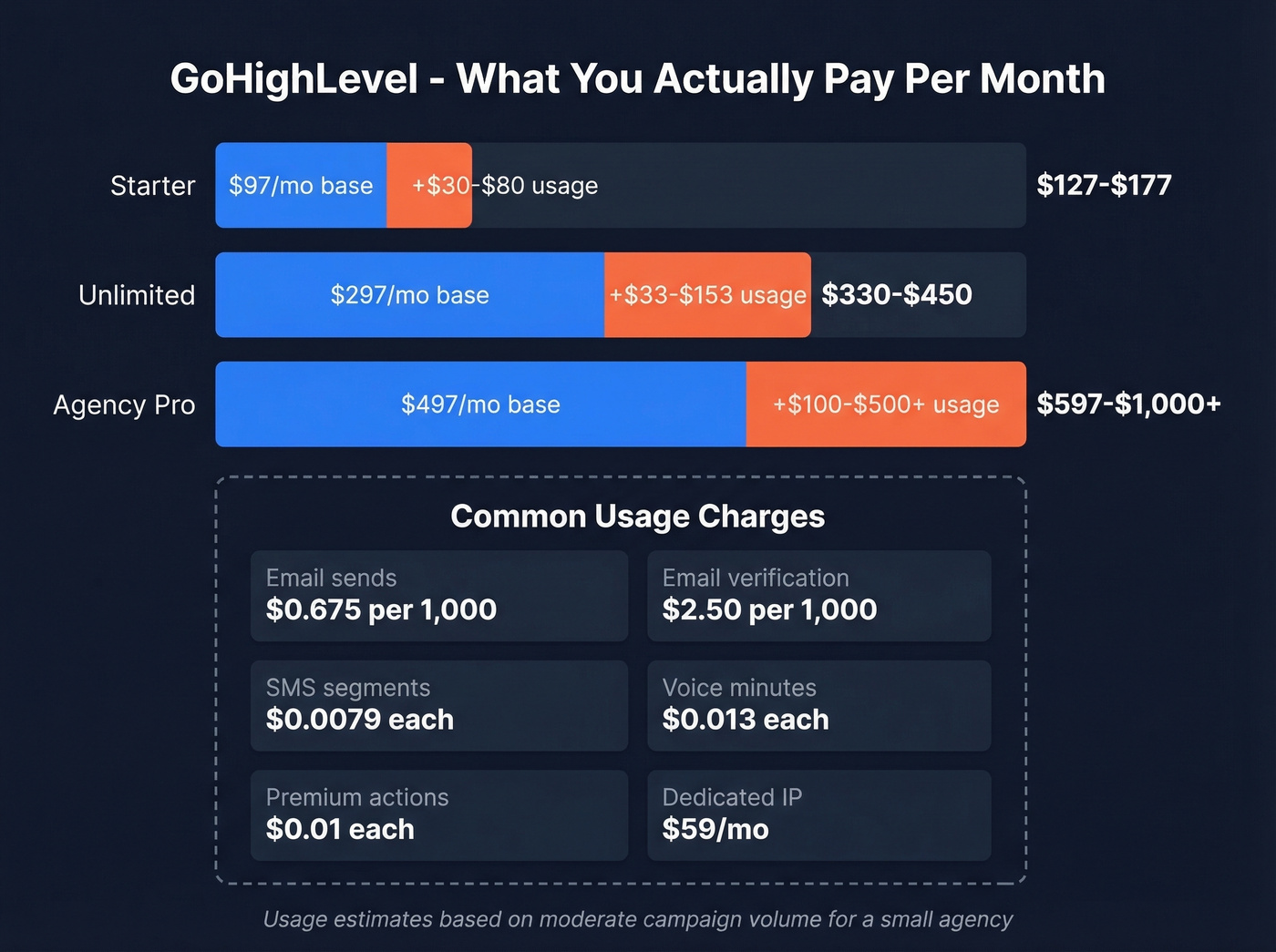
Then you add the Agency Wallet charges (email, SMS, calls, and certain workflow actions). Here's the part that annoys people: the plan feels "all-in-one" until you start sending real volume.
| Cost type | Rate |
|---|---|
| Email sends | $0.675 / 1,000 |
| Email verifications | $2.50 / 1,000 |
| SMS segments | ~$0.0079 each |
| Voice minutes | ~$0.013 each |
| Premium workflow actions | $0.01 each |
| Dedicated sending IP | $59/mo |
A light month on the $297 plan often lands in the $330-$450 range once you're actually running campaigns. If you're doing phone + heavy SMS (say 100,000 segments), you're quickly past $1,000. It's not "hidden," but it's easy to underestimate until you do the math with your real send volume and your real follow-up sequences.
Odoo: license + implementation (the real bill)
Odoo's pricing is simple on paper: a free "one app" plan (one application free with unlimited users) on Odoo Online, and paid plans priced per user/month with all apps included at one price (Standard and Custom).
For budgeting in USD, teams commonly model it at about $25/user/mo for Standard and about $37/user/mo for Custom, plus implementation.
Implementation is where Odoo gets serious. A small-business rollout often lands around $10,000-$30,000+ over 1-3 months. Mid-size deployments can run $20,000-$100,000+ once you factor in process mapping, customizations, data migration, and training. And if you want on-prem or deep customization, you're in "this is a project" territory, not "we'll set it up this weekend."
Here's the thing: Odoo can absolutely replace a stack of disconnected ops tools. But if you don't need inventory, accounting, or multi-step fulfillment, paying for an ERP implementation is like buying a forklift to move a houseplant.
Our take: If your average annual customer value is under $15k and you don't need inventory or accounting, Odoo's usually overkill. You'll spend more on implementation than you'll save for a while, and you'll still need a marketing system on top.
Where they overlap (and why it confuses people)
Both products have "CRM" in the conversation, but they mean different things by it.
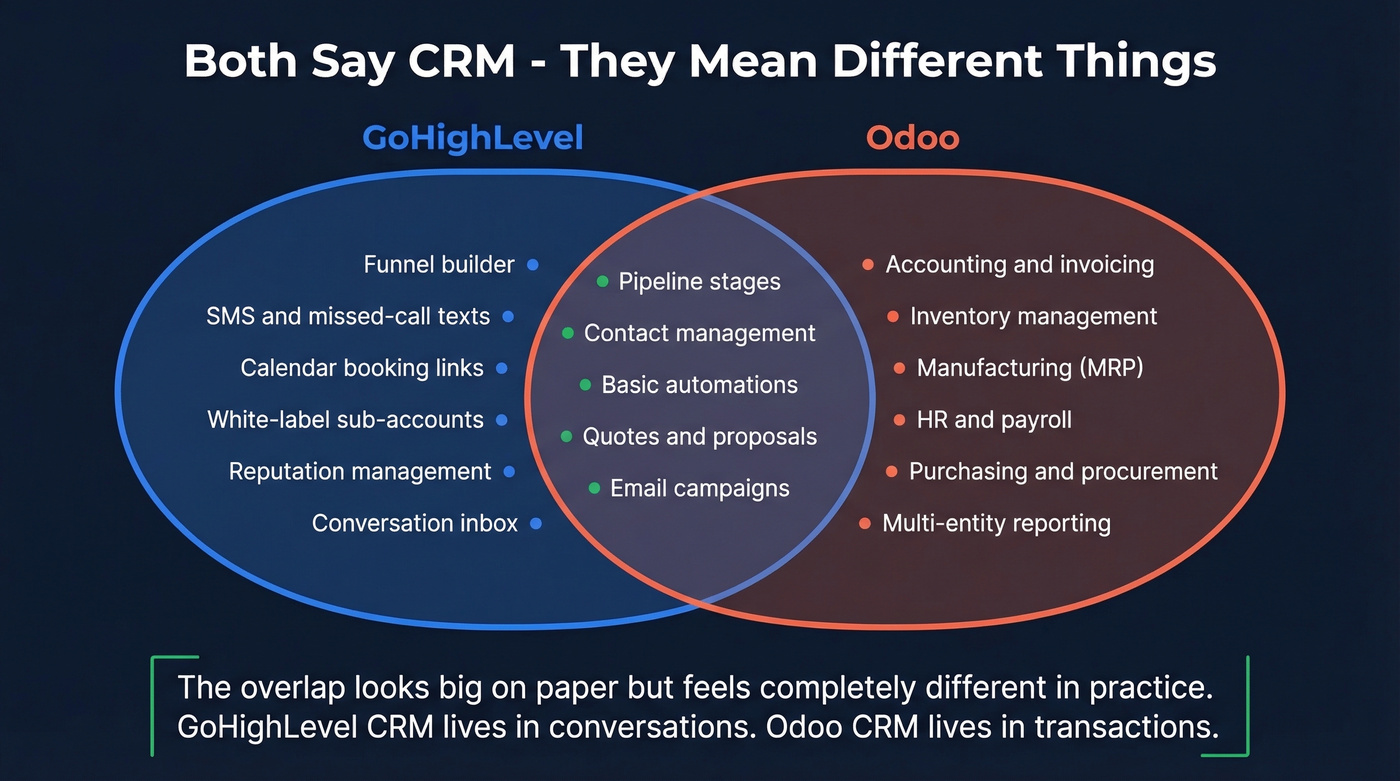
- GoHighLevel CRM is a sales-and-marketing workspace: pipeline stages, conversations, automations, appointment booking, and campaign execution.
- Odoo CRM is closer to a structured sales module inside an ERP: opportunities, quotes, and the handoff into invoicing, fulfillment, and reporting.
If your sales team lives in SMS threads, missed-call texts, and calendar links, GoHighLevel feels natural. If your sales team needs tight coupling between quotes, invoices, inventory, and delivery, Odoo starts to make sense fast.

Neither GoHighLevel nor Odoo solves the problem that comes before CRM: finding verified contacts worth putting into one. Prospeo gives you 300M+ profiles with 98% email accuracy and 125M+ verified mobiles - refreshed every 7 days, not every 6 weeks.
Pick your CRM later. Fill your pipeline now at $0.01 per email.
What real users say (G2 + Reddit reality check)
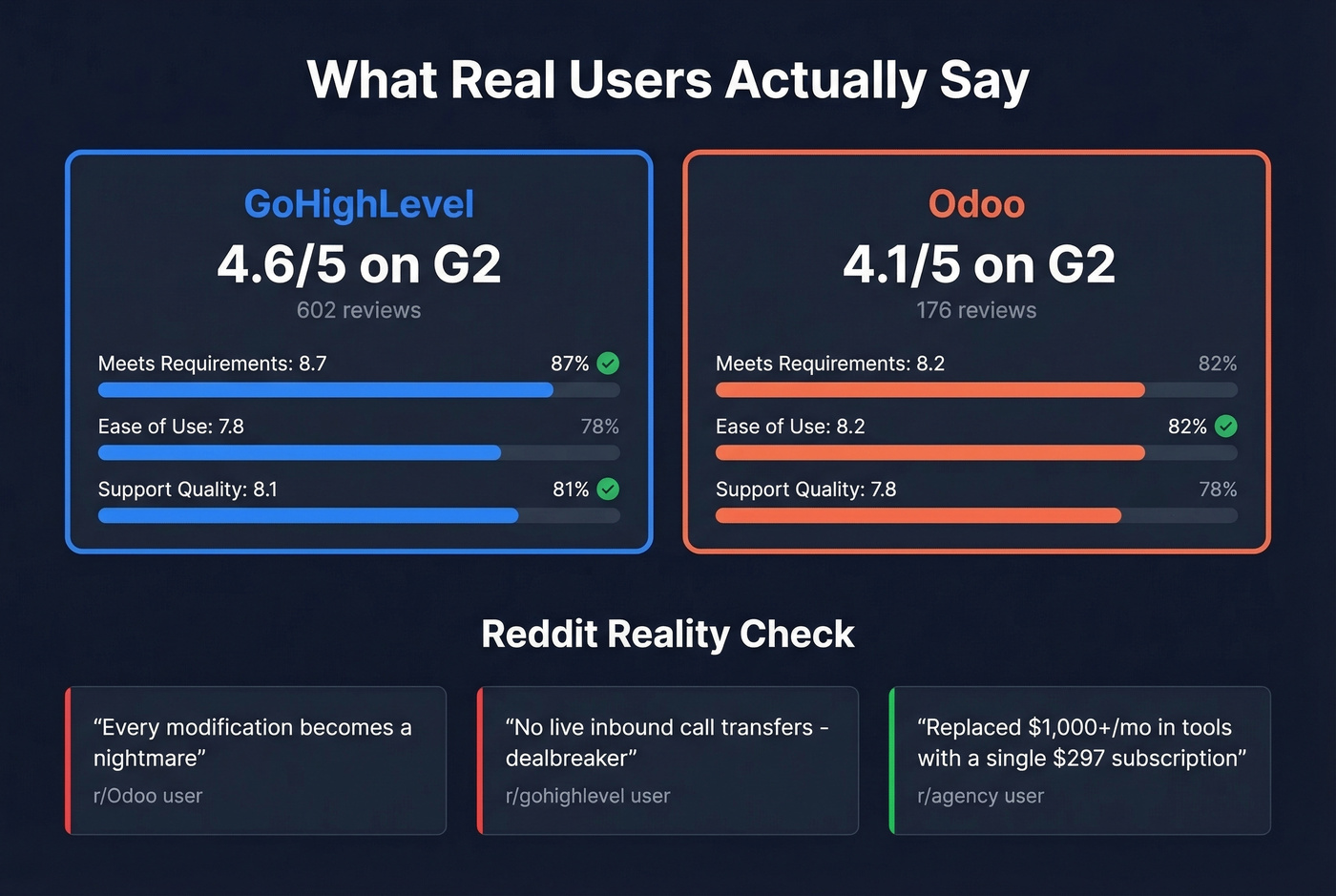
G2's sub-scores tell a more honest story than the headline rating. Odoo scores higher on ease of use (8.2 vs 7.8), which sounds backwards until you remember: reviewers rate the interface, not the rollout. GoHighLevel scores higher on meeting requirements (8.7 vs 8.2) and support quality (8.1 vs 7.8).
Reddit is less polite, and that's useful.
On r/Odoo, one user described the platform as "every modification becomes a nightmare," after an upgrade broke their website and triggered a pile of support tickets. https://www.reddit.com/r/Odoo/comments/1deb36y/using_odoo_was_an_awful_experience_i_deeply/
On r/gohighlevel, a user left because the platform couldn't do live inbound call transfers, which is a dealbreaker if your sales floor runs on phones. https://www.reddit.com/r/gohighlevel/comments/1h5jpup/leaving_gohighlevel/
And the most "real talk" thread is the agency crowd: an owner on r/agency openly disliked GoHighLevel's culture and worried about the spam-friendly reputation, but switched anyway because it replaced $1,000+/mo in tools with a single $297 subscription. That's the GoHighLevel pitch in one sentence: you don't have to love it to save money. https://www.reddit.com/r/agency/comments/1mdiyxw/am_i_seriously_considering_ghl/
The best setups we've seen (including "use both")
Some teams should pick one. Some teams should stop pretending and run both.
GoHighLevel-only setups (fastest path)
This is the classic agency play: white-labeled sub-accounts, funnels, automations, calendars, and a single place to manage client comms. If your "operations" are basically invoicing in a separate tool and a simple service delivery process, GoHighLevel gets you moving quickly.
Odoo-only setups (ops-first companies)
If you're managing inventory, purchasing, manufacturing, multi-entity accounting, or anything that makes your finance team nervous, Odoo can become the system of record. In that world, marketing tools come and go, but the ERP stays.
Running both (the "grown-up" stack)
We've seen the combo work best when the business has two different realities:
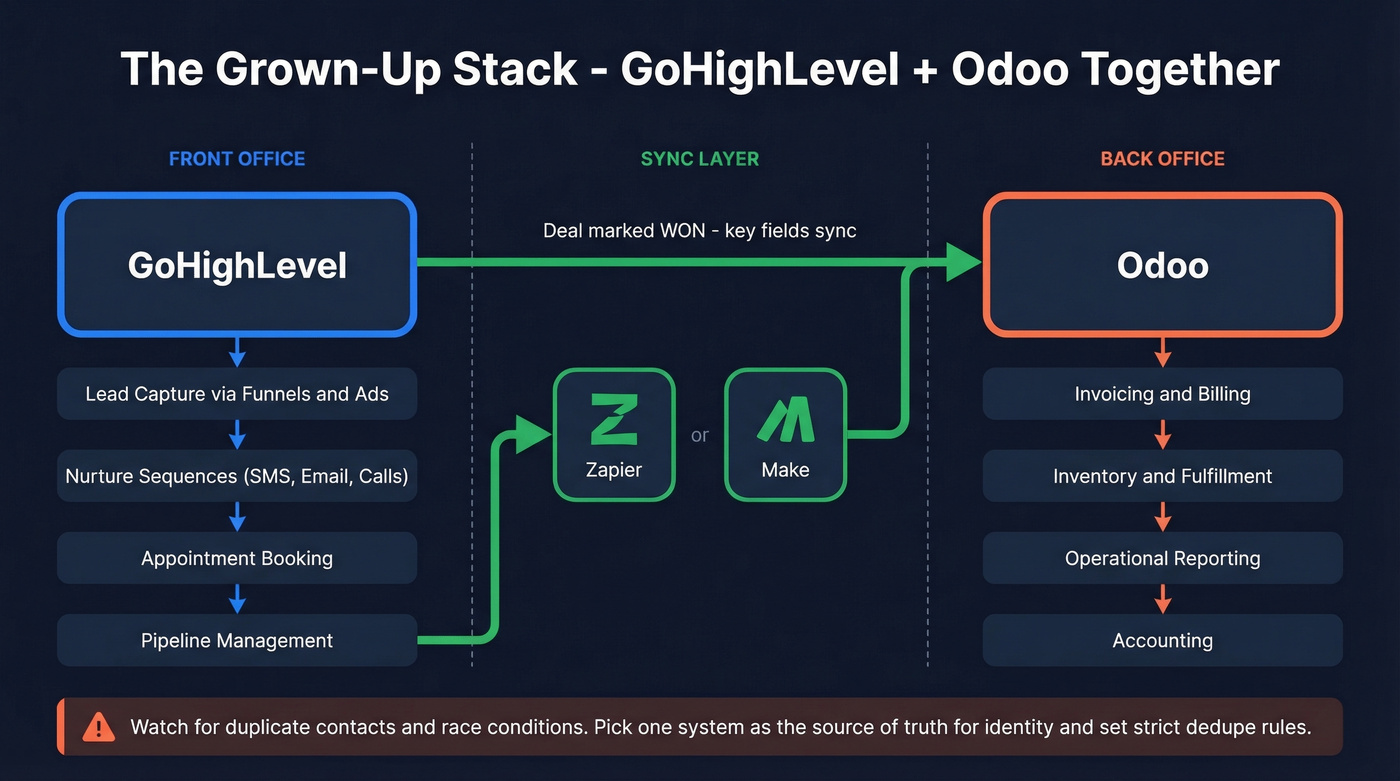
- Front office: lead capture, nurture, appointment setting, follow-up (GoHighLevel)
- Back office: invoicing, inventory/fulfillment, operational reporting (Odoo)
A common flow is: GoHighLevel captures and nurtures leads, then once a deal is marked won, key fields sync into Odoo for invoicing and fulfillment via Zapier or Make.
One practical gotcha: watch for duplicate contacts and race conditions in automations. If both systems can create a contact, they will. Decide which one is the source of truth for identity, set strict dedupe rules, and don't let "helpful" zaps create phantom records at 2 a.m.
The pipeline problem neither solves
GoHighLevel and Odoo manage a pipeline. Neither fills it with verified people to contact.
GoHighLevel assumes you're generating leads through funnels and ads. Odoo assumes the contacts already exist inside your business. If you're doing outbound (or even just cleaning up inbound leads), you need verified emails and mobile numbers before either platform becomes useful.
This is where tools like Prospeo fit naturally: it gives you 300M+ professional profiles, 143M+ verified emails, and 125M+ verified mobile numbers, with 98% email accuracy and a 7-day refresh cycle. You can enrich a CSV, enrich your CRM, or build lists with 30+ filters, then push clean contacts into whichever system you picked via Zapier or Make.
We've used this workflow when an agency had GoHighLevel running perfectly but their outreach still underperformed because the data was stale. Fixing the data fixed the reply rates. Nothing else changed.
You're comparing marketing machines and operations engines, but both run on empty without qualified contacts. Prospeo's 30+ filters - buyer intent, technographics, headcount growth, funding - let you build targeted lists before a single automation fires.
Stop automating outreach to bad data. Start with contacts that connect.
GoHighLevel vs Odoo FAQ
Can GoHighLevel replace Odoo?
No. GoHighLevel doesn't do accounting, inventory, HR, or manufacturing. If you need back-office operations, it won't cover it. If you only need marketing automation and pipeline management, Odoo's CRM won't feel like a replacement for what GoHighLevel does out of the box.
Is Odoo really free?
Odoo Community Edition is free and open source. Odoo also offers a free "one app" plan on Odoo Online with unlimited users. Most businesses that want hosting, mobile apps, upgrades, and full support end up on paid plans (often modeled around $25-$37/user/mo) plus implementation costs that can range from $10,000 to $100,000+ depending on scope.
How do I get prospect data into either platform?
Neither provides verified B2B contact data natively. Use a dedicated data platform like Prospeo (98% email accuracy across 300M+ profiles) and sync contacts via Zapier or Make into GoHighLevel or Odoo.
Which platform is better for agencies?
GoHighLevel. White-labeling, sub-accounts per client, and built-in funnels make it purpose-built for the agency model. Odoo isn't designed for white-label agency delivery, and per-user licensing doesn't map cleanly to "we manage 30 client accounts."