

How to Write a Good Sales Pitch: What 326,000 Sales Calls Reveal
You rehearsed the script, dialed the number, and launched into your pitch. A few moments in, the prospect cut you off with "not interested" and hung up. The script wasn't the problem - you pitched a product to someone who wanted a solution to a problem. That distinction is where most sales pitches die.
[73% of B2B buyers](https://www.salesforce.com/sales/state-of-sales/sales-statistics/) actively avoid sellers who send irrelevant outreach. Meanwhile, reps spend 60% of their time on non-selling tasks. When you finally get someone on the phone, a generic pitch won't cut it. Here's what actually works, backed by data from 326,000 real sales calls.
The Short Version
- Structure your pitch around the buyer's problem, not your product. Gong's analysis of 326K sales calls shows winners talk less and ask fewer, better questions. Deals that close within 50 days win at more than double the rate of those that drag past that mark.
- Pick a framework that fits your deal type. SPIN for complex consultative sales, Challenger for disrupting the status quo, BANT for fast inbound triage. Then stop memorizing and start listening.
- Verify your prospect data before you pitch. A pitch to a dead email or wrong phone number is a wasted pitch. Run your list through a verification tool so your effort actually reaches a human.
What the Data Says About Winning Pitches
Stop memorizing scripts. The largest study of sales conversations tells a different story about what separates a winning pitch from a losing one.
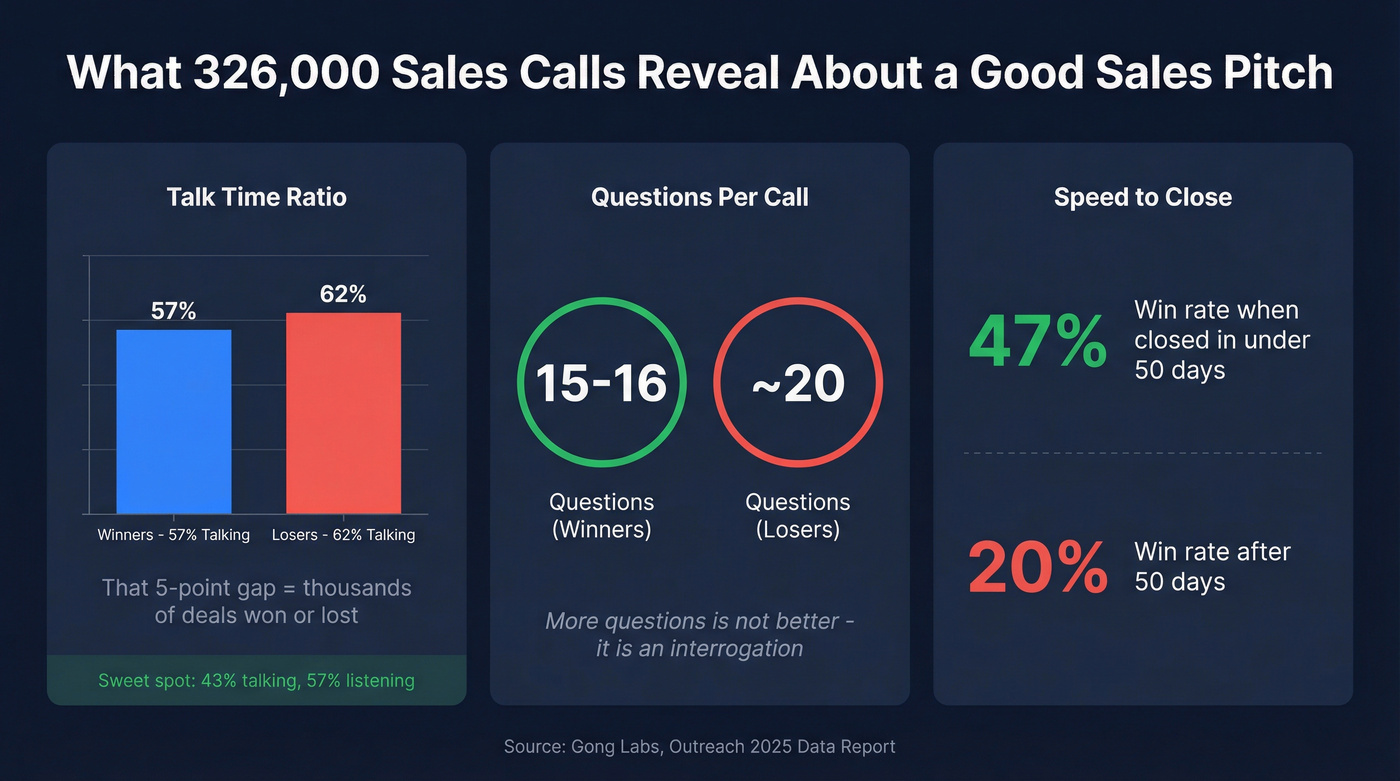
Gong Labs analyzed 326,000 sales calls of 10+ minutes each. Reps who closed deals talked 57% of the time. Reps who lost talked 62%. That five-point gap represents thousands of deals won or lost on listening discipline alone. The golden ratio is even more aggressive: 43% talking, 57% listening. Once you cross 65% talk time, conversion rates drop measurably.
Here's the question count surprise: winners asked 15-16 questions per call, while losers asked around 20. More questions isn't better - it's an interrogation. The best reps ask fewer, sharper questions that uncover real pain.
Speed matters too. Outreach's data report found that opportunities closed within 50 days have a 47% win rate. After 50 days, that drops to 20% or lower. For context, B2B SaaS teams convert just 37% of SQLs to closed-won deals, so every conversation that reaches the pitch stage carries outsized weight.
And the buyer's side? [96% of prospects](https://www.hubspot.com/marketing-statistics) research your company before they ever talk to a rep. By the time you pitch, they already know your features. They want to know if you understand their problem.
What Makes a Good Sales Pitch: 6 Essential Parts
Every compelling pitch has the same bones, regardless of channel. A cold call compresses these into 60 seconds, a deck spreads them across 10 minutes, but the structure holds. 71% of buyers prefer doing their own research over speaking with sales - by the time they talk to you, they need insight, not information.
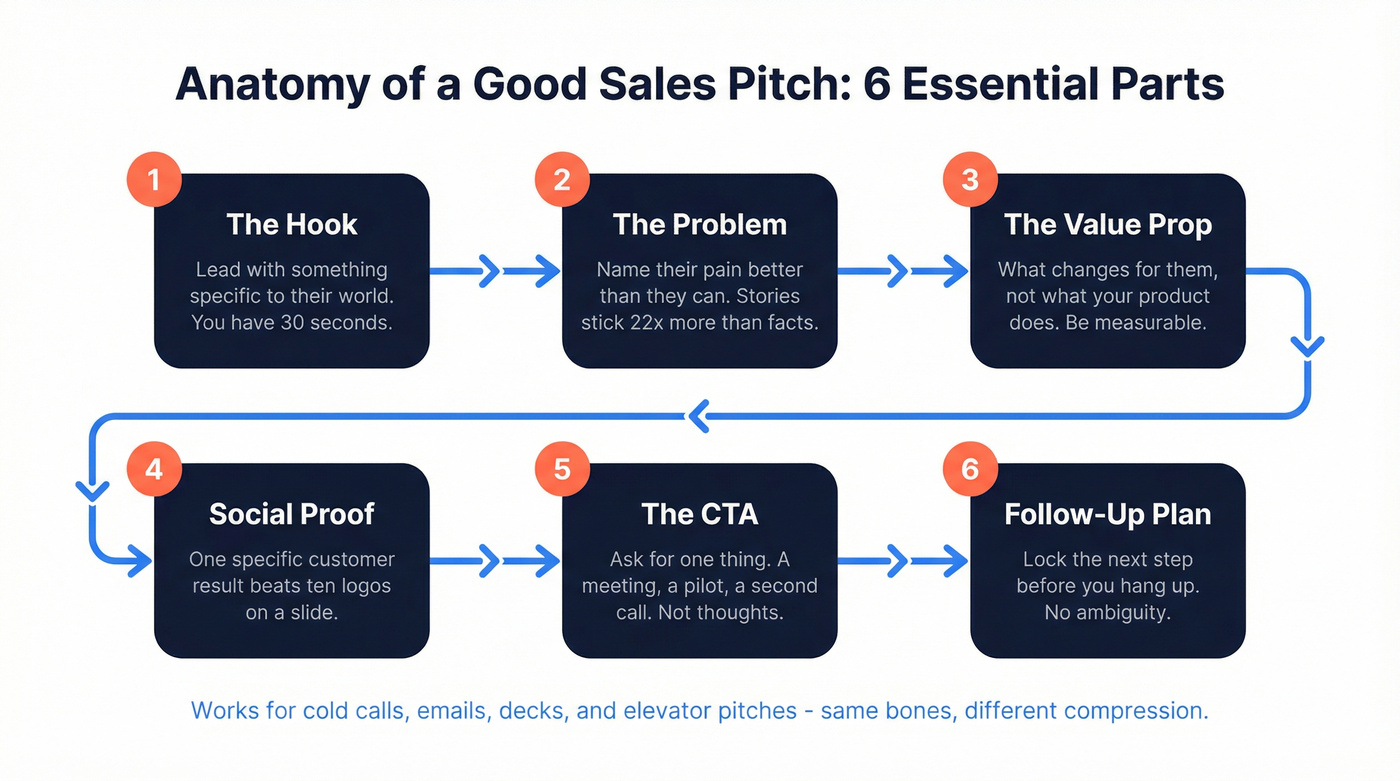
The Hook
You have about 30 seconds. Lead with something specific to the buyer's world. "I noticed your team just opened a second EMEA office" beats "We're the leading provider of..." every time. An engaging opener proves you've done your homework before asking for anything.
The Problem Statement
Name the pain they're living with. If you can articulate their problem better than they can, you've already won credibility. Dr. Jennifer Aaker's research at Stanford found that stories are remembered 22x more than facts alone - frame the problem as a narrative, not a bullet point.
The Value Proposition
Not what your product does. What changes for them. "You'll cut list-building from 15 hours to 3" is a value prop. "We have an AI-powered platform" is a feature. The most effective pitch connects every capability back to a measurable outcome the buyer cares about.
Social Proof
One specific customer result beats ten logos on a slide. "We helped a 50-person sales team cut bounce rates from 35% to under 4%" is concrete. "Trusted by thousands of companies" is wallpaper.
The CTA
Ask for one thing. A 30-minute meeting. A pilot. A second call with their VP. Not "let me know your thoughts" - that's not a CTA, it's a prayer.
The Follow-Up Plan
Have the next step locked before you hang up. "I'll send a one-pager and a calendar link for Thursday at 2" closes the loop. No ambiguity, no "I'll circle back."
Pick a Framework (Then Forget the Script)
Frameworks aren't competing religions. They're lenses. Pick the one that fits your deal type, internalize the principles, then throw away the cheat sheet.
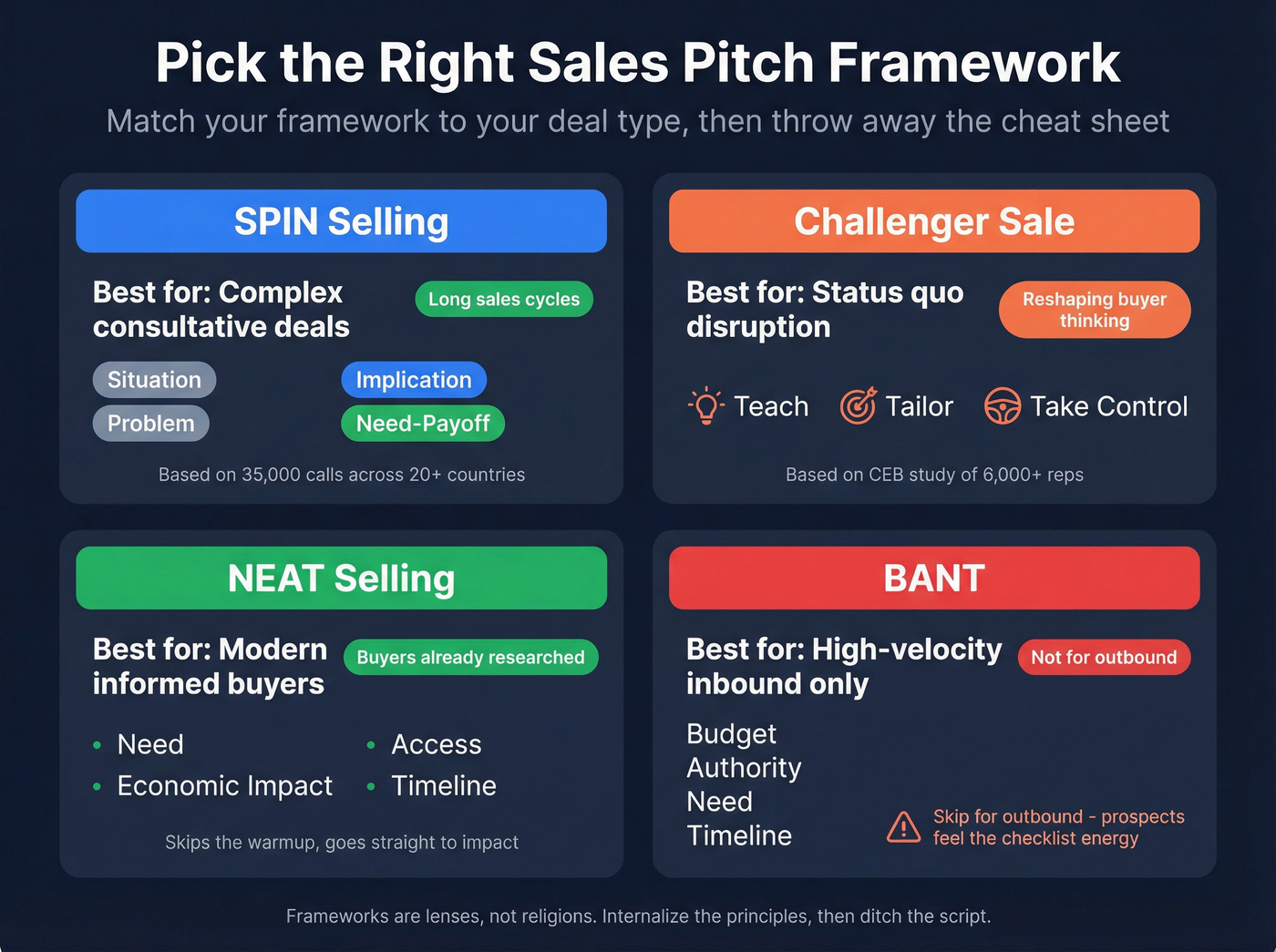
| Framework | Best For | Core Mechanic |
|---|---|---|
| SPIN | Complex consultative | Question sequence: Situation -> Problem -> Implication -> Need-payoff |
| Challenger | Status-quo disruption | Teach, tailor, take control |
| NEAT | Modern buyer context | Need, Economic Impact, Access, Timeline |
| BANT | High-velocity inbound | Budget, Authority, Need, Timeline |
SPIN Selling works best when you're selling something complex with a long cycle. The question sequence forces you to uncover implications the buyer hasn't articulated yet - it's built on 35,000 analyzed calls across 20+ countries, and it rewards patience over persuasion.
The Challenger Sale is your pick when the status quo is your biggest competitor. Based on CEB's study of 6,000+ reps, it found that the highest performers don't just respond to buyer needs - they reshape how buyers think about their problems. We've watched teams waste months trying to implement Challenger when their deal cycle was a simple BANT qualification. Skip BANT entirely for outbound - it's a qualification tool, not a discovery tool, and prospects will feel the checklist energy immediately.
NEAT Selling acknowledges that buyers show up with 90% of their research already done. It skips the "tell me about your current setup" warmup and goes straight to economic impact. Choosing the right framework is often the difference between a convincing pitch and one that falls flat.

The data is clear: a good sales pitch dies when it hits a dead email or wrong number. Prospeo's 5-step verification delivers 98% email accuracy and 125M+ verified mobiles with a 30% pickup rate - so your best pitch actually reaches a human.
Stop perfecting pitches that bounce. Verify your list first.
Sales Pitch Examples by Channel
Cold Call Script
Here's a permission-based opener adapted from a practitioner script that gets consistently praised on r/sales:
"Hi [first name], this is [your full name] from [company]. Appreciate I caught you out of the blue - you got a minute?"
Then the value pitch: "We do [your coolest feature] for other companies in your space like [their biggest competitors]."
Then the close: "The purpose of my call was actually to set aside a half hour later this week to introduce myself and my company." Pause for two full seconds. Let the silence work. Then: "Does Thursday at 2 work?"
Speak almost uncomfortably slow - aim for 120-150 words per minute. Most reps default to 170+ when nervous. Record yourself and listen back. You'll be shocked.
Cold Email Pitch
Cold email is getting harder. 69% of senders report declining performance year over year, driven by spam filtering and AI content fatigue. Only 5% personalize every email individually, while 51% use segment-based templates - that's the right balance for most teams.
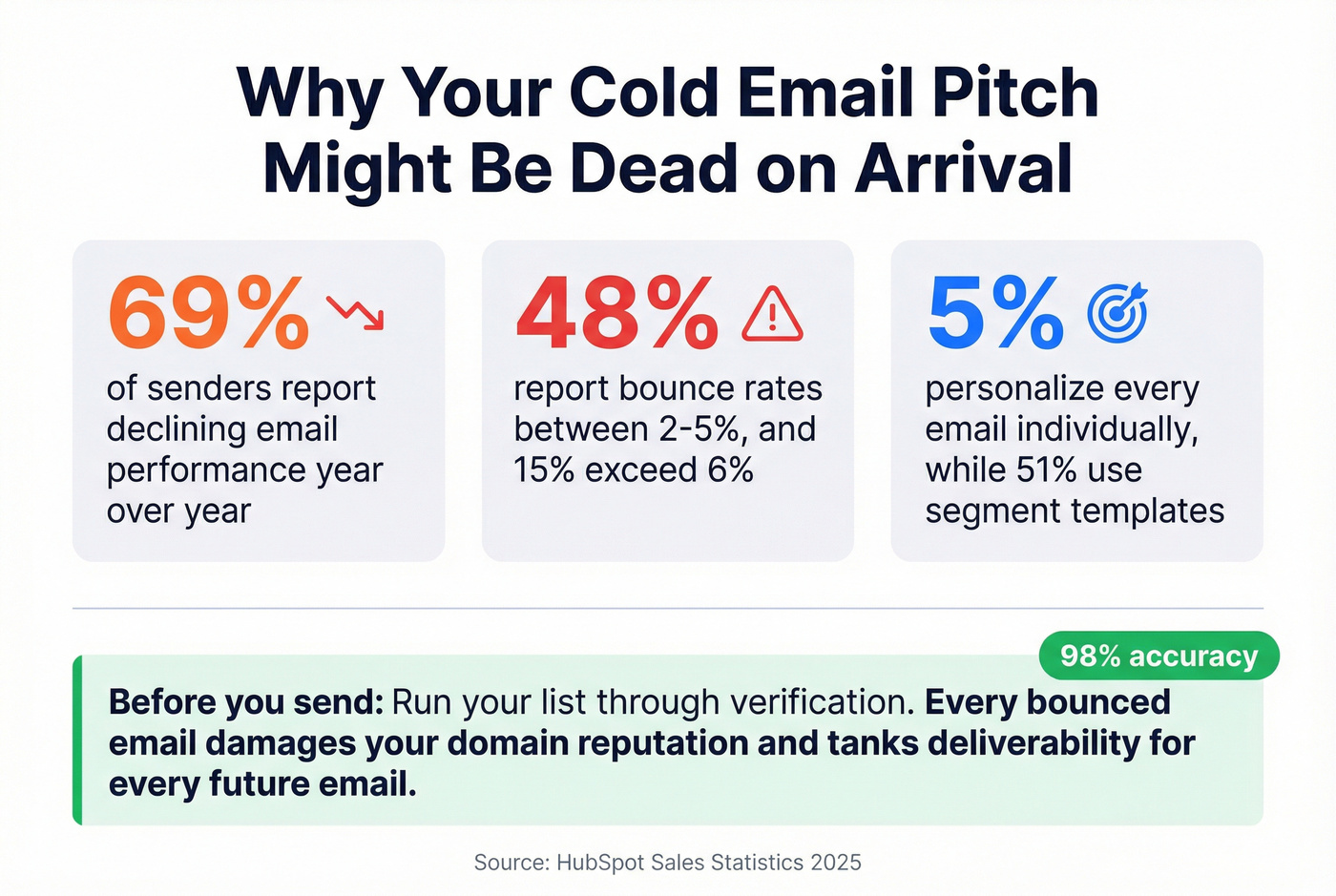
The bigger problem? 48% of senders report bounce rates between 2-5%, and 15% exceed 6%. Every bounced email damages your domain reputation, which tanks deliverability for every future email you send. Before sending any cold email pitch, run your list through a verification tool. Prospeo's real-time verification catches bounces before they happen - 98% accuracy across 143M+ verified emails.
Keep the email itself to 50-125 words. Lead with the buyer's problem in the first line. Include one specific proof point. End with a single, low-friction CTA - "Worth a 15-minute call?" beats "Please let me know if you'd be interested in scheduling a demo at your earliest convenience."
Elevator Pitch
Nobody pitches in elevators. What you actually need is a 30-second opener that earns a 30-minute conversation.
Structure it in three beats - who you help, what problem you solve, what changes: "We help mid-market finance teams close their books in 3 days instead of 12. Our platform automates the reconciliation workflow that usually takes 40 hours a month. Companies like [name] cut that to under 10."
That's 15 seconds. The other 15 are for the follow-up question you ask them.
Social and Video Pitch
A social message should be 2-3 sentences max: a personalized observation, a relevant insight, and a soft ask. "Saw your team just expanded into DACH - we helped [similar company] build their outbound list for that market in two days. Happy to share what worked."
For video pitches, keep them under 90 seconds. Show their website or a relevant data point on screen - it proves you did the research. Generic "hey, wanted to reach out" videos get deleted. Specific ones get watched.
Delivery Mechanics That Matter
Aim for the 43/57 talk-to-listen ratio. Record your calls and measure. Gong's data shows low performers' talk time swings by about 10% between won and lost deals.
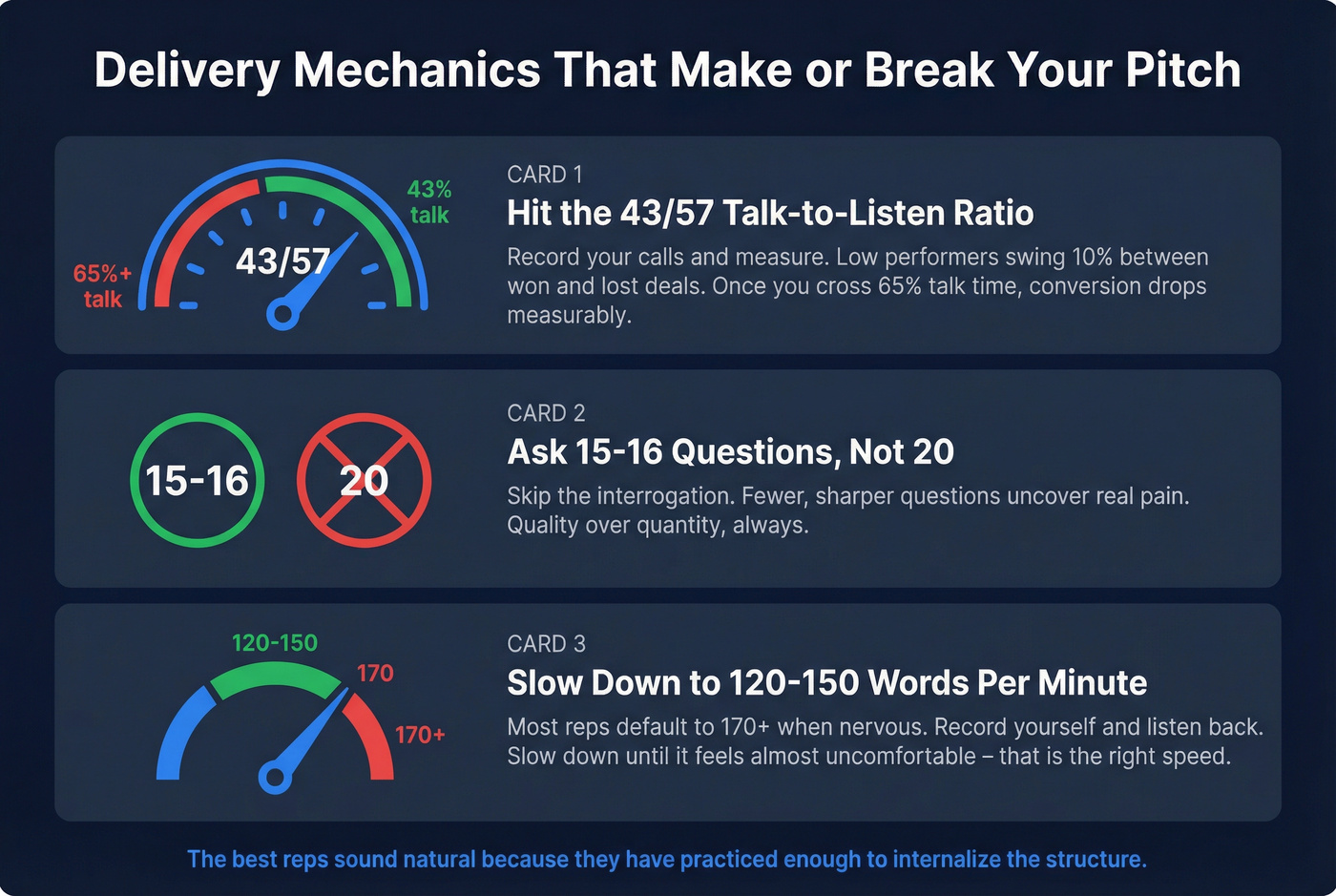
Skip the 20-question interrogation. The sweet spot is 15-16 targeted questions. Quality over quantity, always.
Practice your pace. 120-150 words per minute is ideal for phone conversations. Most reps default to 170+ when nervous. Record yourself, time it, slow down until it feels almost uncomfortable.
Let's be honest: the best reps don't sound scripted because they've practiced enough to internalize the structure. They sound natural because they've done the reps, not because they're improvising. Winging it isn't a strategy - it's the fastest way to undermine an otherwise high-impact pitch.
Pitch Mistakes That Kill Deals
The fastest way to lose a deal isn't a bad pitch - it's a manipulative one. Fake scarcity, exaggerated social proof, and aggressive urgency tactics don't just fail to close. They actively push deals to "no decision," which is worse than a clean "no." We've seen teams lose entire quarters to these habits.
Bryan Vasquez, Head of Sales at LinkBuilder.io, replaced urgency-based CTAs with data-backed proposals and tailored value maps. The result: a 20% win-rate lift over two quarters. That's the difference between hitting quota and missing it.
The second killer: pitching too early. Sending a pitch deck two minutes into a discovery call tells the prospect you don't care about their problem. Earn the right to pitch by understanding their situation first.
The third - and this one comes up constantly on Reddit - is leading with company credentials instead of buyer pain. One frustrated rep in a cybersecurity sales thread put it perfectly: every vendor sounds identical when they lead with their own resume. If you want to deliver a successful pitch, lead with the prospect's world, not yours.
Hot take: If your average deal size is under $10K, you don't need a 45-minute discovery call and a multi-touch sequence. You need a tight 60-second value prop, a clear demo, and a fast close. Over-engineering the process kills more small deals than bad messaging does.
How to Prepare Before You Pitch
96% of prospects research your company before talking to you. Return the favor. Know their tech stack, their recent hires, their funding round. A pitch that references something specific to their business earns attention that a generic template never will.
But research only works if your data is accurate. If the email bounces or the phone number's disconnected, your perfectly crafted message never lands. One of our clients, Meritt, dropped their bounce rate from 35% to under 4% and tripled their pipeline from $100K to $300K/week after switching to verified contact data. The free tier at Prospeo gives you 75 verified emails per month plus 100 Chrome extension credits - enough to test whether better data actually improves your results.

You just read that 96% of prospects research you before the call. Return the favor. Prospeo gives you 50+ data points per contact - job changes, tech stack, buyer intent across 15,000 topics - so every pitch lands with the specificity that closes deals.
Know more about your prospect than they know about you.
FAQ
What is a good sales pitch?
A good sales pitch leads with the buyer's problem, delivers a clear value proposition, includes specific social proof, and ends with a single CTA. Gong's 326K-call study shows winners talk 57% of the time and ask 15-16 targeted questions - not 20+.
How long should a sales pitch be?
For cold calls, aim for 30-60 seconds before your first question. For emails, 50-125 words. For presentations, 10 minutes max. The goal is earning the next conversation, not closing in one shot.
What's the best sales pitch framework?
SPIN Selling wins for complex consultative deals with long cycles. Challenger works best in competitive markets where the status quo is your biggest enemy. Match the framework to your deal type - there's no universal answer.
How do I personalize pitches at scale?
Use segment-based templates with 2-3 personalized variables per message. Layer in company signals like buyer intent topics, job changes, and technographics. Tools like Prospeo surface these signals across 15,000 intent topics so you can personalize without spending hours on manual research.
Why do cold emails get no replies?
Generic messaging, bounced emails from bad data, and no clear value proposition in the first line. Verify your list before sending - bounce rates above 5% actively damage your domain reputation and tank future deliverability.