

HiHello Pricing, Reviews, Pros and Cons: Is It Worth It in 2026?
You just handed out 40 business cards at a conference. Three weeks later, half the emails bounce and you can't remember who gave you which card. That's the gap digital business cards are supposed to close - and HiHello is one of the most popular options trying to do it.
Before you commit, here's a full breakdown of HiHello pricing, real user reviews, and the honest pros and cons.
What Is HiHello?
HiHello brands itself as a "Professional Presence Platform" - digital business cards, email signatures, and virtual backgrounds rolled into one app. The digital business card market is projected to exceed $6B by 2030 according to Allied Market Research, and HiHello is one of the more established players, with 20M+ cards shared annually and usage ranging from individuals up to Fortune 500 companies.
The core pitch: replace paper cards with something trackable, shareable, and always up to date. For teams, it adds CRM sync, analytics, and admin controls. It runs on iOS, Android, Apple Watch, and web, so platform coverage isn't a concern.
What Do Reviewers Actually Say?
HiHello carries a 4.6/5 on G2 (828 reviews) and a 4.7/5 on Trustpilot (267 reviews). Those are strong numbers for a category that's still maturing. The G2 distribution is telling: 79% of reviewers gave 5 stars, and zero reviewers rated it below 3. That kind of floor is rare.
Use this if: You're a solo professional who needs a polished digital card - grab the Professional plan at $6/mo on annual billing. If you're running a team of 5-50, the Business plan at $5/user/mo is the best value in the category.
Skip this if: You need deep CRM workflows, lead scoring, or outbound sequencing. HiHello captures contacts; it doesn't run your pipeline.
HiHello Pricing Breakdown
HiHello runs four tiers. Annual billing saves 25% across the board, and it's worth locking in if you're committing.
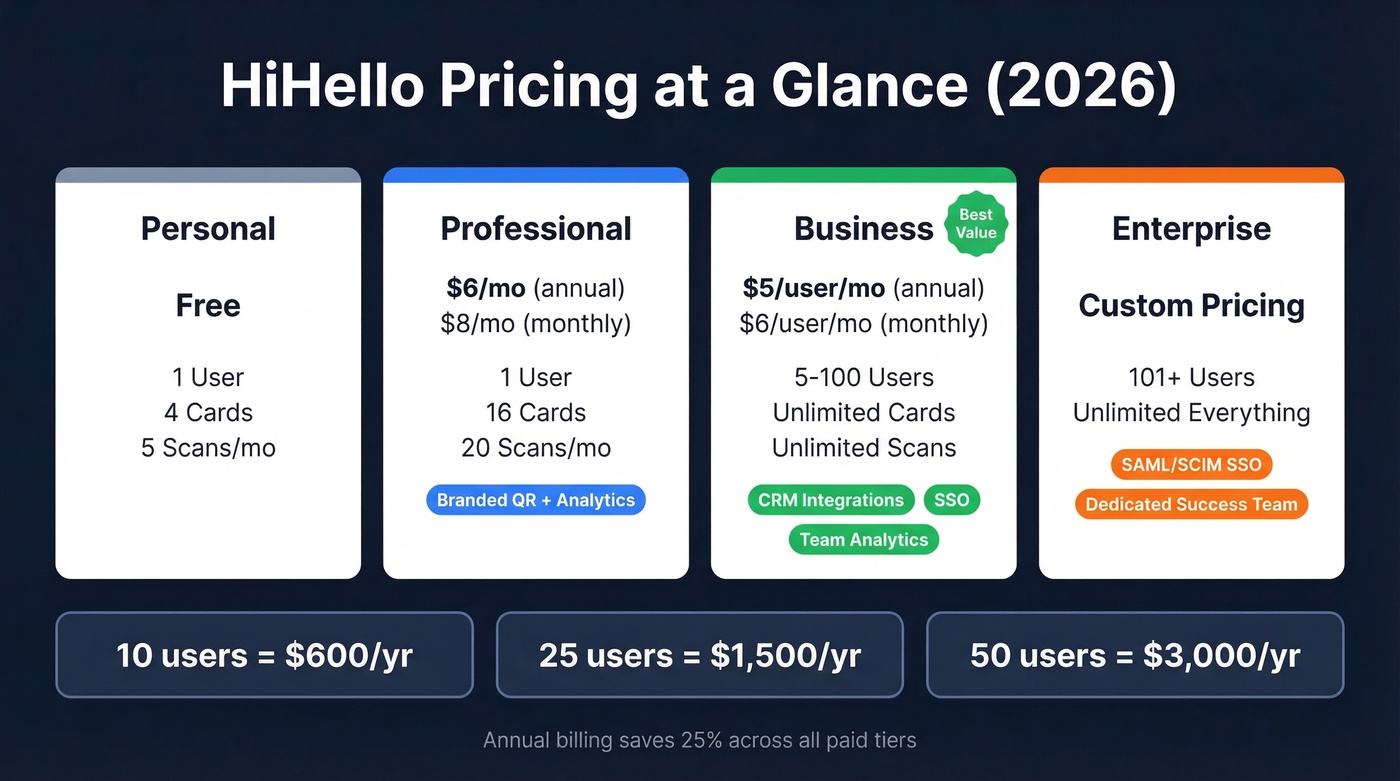
"Scans/month" below refers to the in-app card and badge scanner limits (paper cards, badges, etc.), not how many times people can view your digital card.
| Plan | Monthly | Annual | Users | Cards | Scans/Month |
|---|---|---|---|---|---|
| Personal | Free | Free | 1 | 4 | 5 |
| Professional | $8/mo | $6/mo ($72/yr) | 1 | 16 | 20 |
| Business | $6/user/mo | $5/user/mo | 5-100 | Unlimited | Unlimited |
| Enterprise | Custom | Custom | 101+ | Unlimited | Unlimited |
Professional unlocks branded QR codes, card analytics, and contact enrichment. It also offers an unlimited scans add-on at checkout - a meaningful upgrade for anyone who attends more than one event per month. Business adds integrations with HubSpot, Salesforce, Google Workspace, Outlook, Okta, and Zapier, plus SSO and directory sync, team analytics, lead capture forms, and unlimited scans baked in. Enterprise layers on advanced SSO (SAML/SCIM), a dedicated success team, and onboarding support.
Let's do the team math. Business annual billing is $60/user/year. A 10-person team runs $600/year. Scale to 25 people and you're at $1,500/year. A 50-person org pays $3,000/year. That's genuinely affordable - especially compared to competitors who hide team pricing behind a "request a quote" wall.
The free tier gives you 4 cards and 5 scans per month. Enough to see the interface, not enough to use at a single networking event. Treat it as a demo.

HiHello captures contacts. But what happens after the scan? Half those emails will be outdated within months. Prospeo enriches your exported contacts with 98% verified emails, direct dials, and 50+ data points per lead - all on a 7-day refresh cycle so your conference leads never go stale.
Stop losing deals to bounced emails from badge scans.
Pros and Cons
What Users Love
Ease of use dominates the conversation. On G2's review page, it's the top theme with 468 mentions - nearly half of all reviewers call it out.
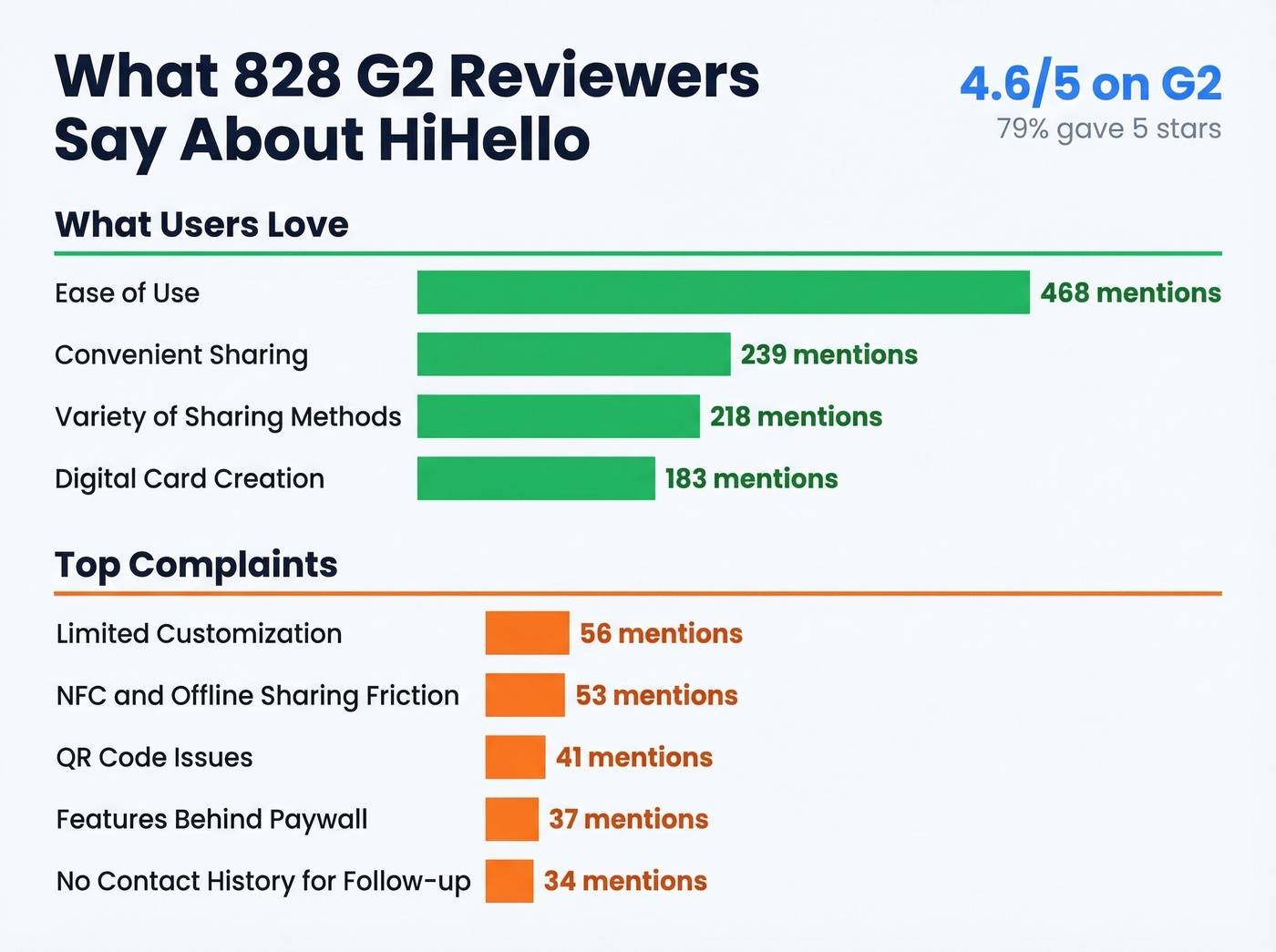
The app is clean, setup takes minutes, and sharing a card via QR, text, email, or Apple Wallet just works. We had a card created and shared within three minutes of downloading the app. Convenient sharing pulls 239 mentions, with the variety of sharing methods (218 mentions) close behind. Digital card creation itself gets 183 mentions as a positive.
For teams, the email signature standardization is a quiet win. IT and marketing teams love having one place to enforce brand consistency across every rep's inbox - no more rogue Comic Sans signatures floating around.
What Users Complain About
Limited customization is the top gripe (56 mentions). If you want pixel-perfect control over card layouts, you'll hit walls fast.
NFC and offline sharing friction comes in at 53 mentions. HiHello supports NFC compatibility, but the tap-to-share experience isn't as smooth as hardware-first competitors like Popl. QR code issues show up 41 times. We found scanning worked reliably in normal lighting but got finicky in dim conference halls and at steep angles - exactly the conditions where you need it most.
The "expensive / features behind paywall" complaint (37 mentions) reflects frustration that analytics and branded QR codes require the paid tier. And 34 mentions flag the lack of contact history for follow-up: you scan a card, but there's no built-in way to track your interaction history with that person.
One Trustpilot reviewer flagged that the Professional tier shows ads to contacts who receive your card. HiHello's official response confirmed those can't be removed. That's a rough look when you're paying $8/mo.
There's also a broader adoption reality worth acknowledging: not everyone at a networking event is comfortable scanning a QR code. Cultural preference for physical cards is still real, especially outside tech-forward industries.
Is HiHello Worth It?
For solo professionals, the Professional plan at $6/mo annual is fair. You get 16 cards, analytics, branded QR codes, and the unlimited scans add-on if you need it.
For teams of 5-50, the Business plan is the best value in the digital business card category at $5/user/mo. Unlimited cards, unlimited scans, integrations, and SSO. G2 users report an average implementation time of about 1 month for team rollouts, so plan accordingly if you're deploying before a major event.
For enterprise orgs with 100+ users, get a custom quote and compare against Uniqode before signing. HiHello's security posture is genuinely strong: SOC 2 Type II compliance with 120+ continuously monitored controls, annual third-party penetration tests, encrypted multi-region backups retained for 60 days, and multi-factor authentication options. They're hosted on Google Cloud US-Central (Iowa) and registered under the EU-US Data Privacy Framework. HiHello also says it doesn't sell user data - a claim worth verifying in your procurement review, but one that few competitors make at all.
Our take: HiHello is the best digital business card platform for teams that want transparent pricing and real CRM integrations. But most individuals don't need a paid digital business card at all - a clean email signature and a well-maintained profile page will do the same job for free. The paid tiers earn their keep only when you're scanning badges at volume and need the data to flow somewhere useful.
Here's the thing: the free tier isn't a product. It's a trial with a different name. Don't evaluate HiHello based on it.
After You Capture Contacts
You scan 50 badges at a trade show. You export them to your CRM. Then what?
People change jobs, companies get acquired, email domains go dark. The data on that business card starts decaying the moment it's printed. We've seen teams lose 15-20% of scanned contacts to bounce-backs within 90 days of a conference. That's a lot of dead leads from a stack of cards you thought were gold.
HiHello's CRM sync gets contacts into your pipeline. Prospeo makes sure those contacts are reachable. With 143M+ verified emails and 125M+ mobile numbers, you can fill in every gap HiHello leaves - at $0.01 per email with no annual contract.
Turn scanned badges into booked meetings with verified data.

Alternatives Worth Considering
Popl - the NFC-first option. If you want physical tap-to-share cards and tags, Popl is the hardware play. Individual plans typically run ~$8-15/mo depending on tier, but team pricing is hidden behind a "Request pricing" gate. If budget predictability matters, that opacity alone is a reason to stick with HiHello.
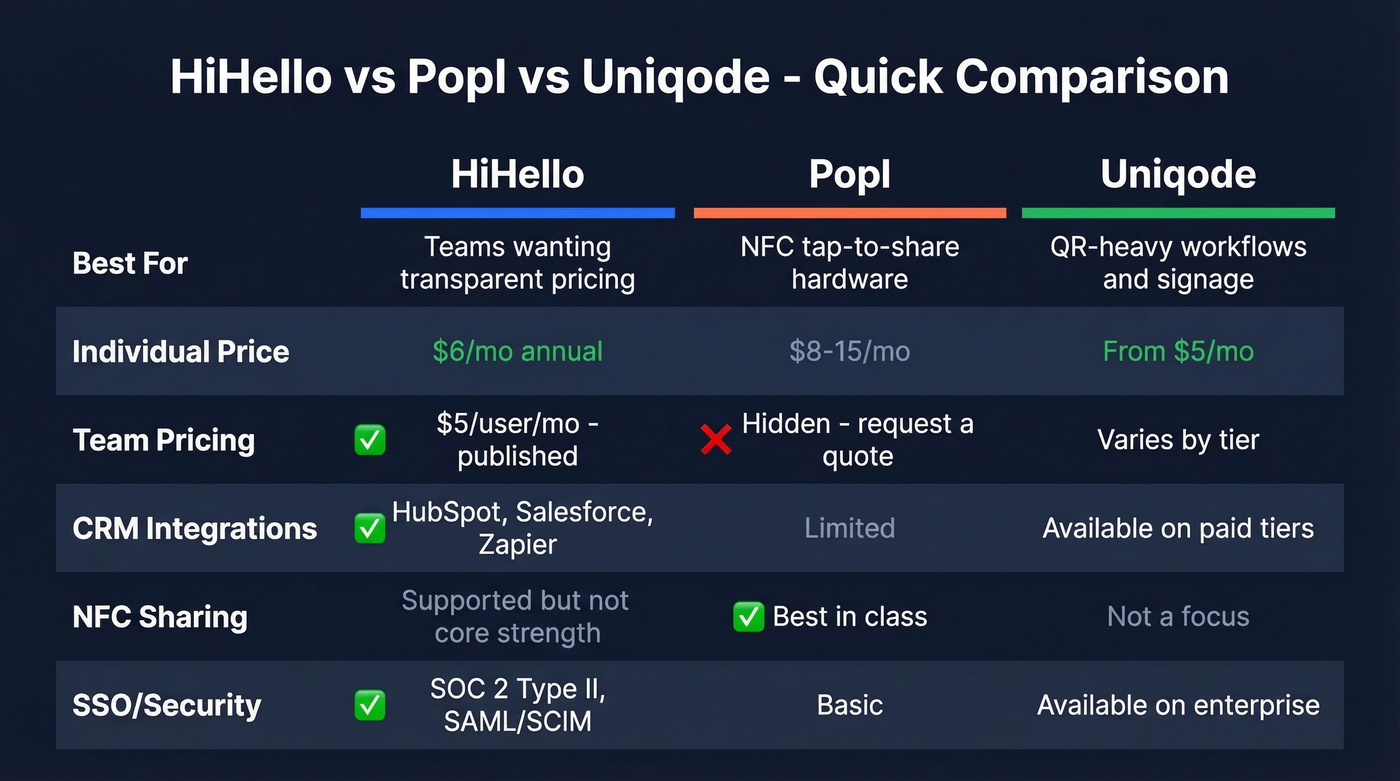
Uniqode - best for QR-heavy workflows. Event signage, printed materials, anything where a scannable code is the primary sharing method. Individual plans start around ~$5/mo. Pick this over HiHello if your workflow is more "scan this poster" than "tap my phone."
Wave Connect - worth a look. Another popular digital business card option with a clean UI and a strong free tier. Often compared against HiHello in vendor roundups.
FAQ
Is HiHello's free plan enough for real use?
No. Four cards and five scans per month won't survive a single networking event. Start at Professional ($6/mo annual) for actual use - the jump in card limits and analytics justifies the cost immediately.
How does HiHello compare to Popl?
HiHello publishes all pricing upfront; Popl hides team rates behind a sales gate. For a 10-person team, HiHello Business costs $600/year on annual billing. Popl excels at NFC tap-to-share but charges more for comparable software features.
What should I do with contacts after scanning them?
Verify the emails before you reach out. Scanned business card data goes stale fast - people change roles, domains expire. Run your list through an email verification tool to clean out bounces before your first send.
Does HiHello integrate with CRMs?
Yes, on the Business plan and above. HiHello connects natively with HubSpot, Salesforce, Google Workspace, Outlook, and Zapier. The free and Professional tiers don't include CRM integrations.