

How to Contact CEOs of Companies in 2026 (Full Playbook)
You've got the perfect solution for a company's biggest problem. You know the CEO needs to hear about it. So you write an email, hit send, and... nothing. No reply. No open. Just silence.
Here's the uncomfortable truth about contacting CEOs: 50.9% of recipients never engage with cold emails at all. The average professional gets 15+ cold emails per week, and executives get far more. But some messages do get through. This playbook covers exactly how.
Why CEOs Ignore Your Outreach
Executives don't filter on cleverness. They filter on strategic relevance. A witty subject line won't save an email that leads with product features instead of business outcomes like revenue growth, market share, or risk reduction.
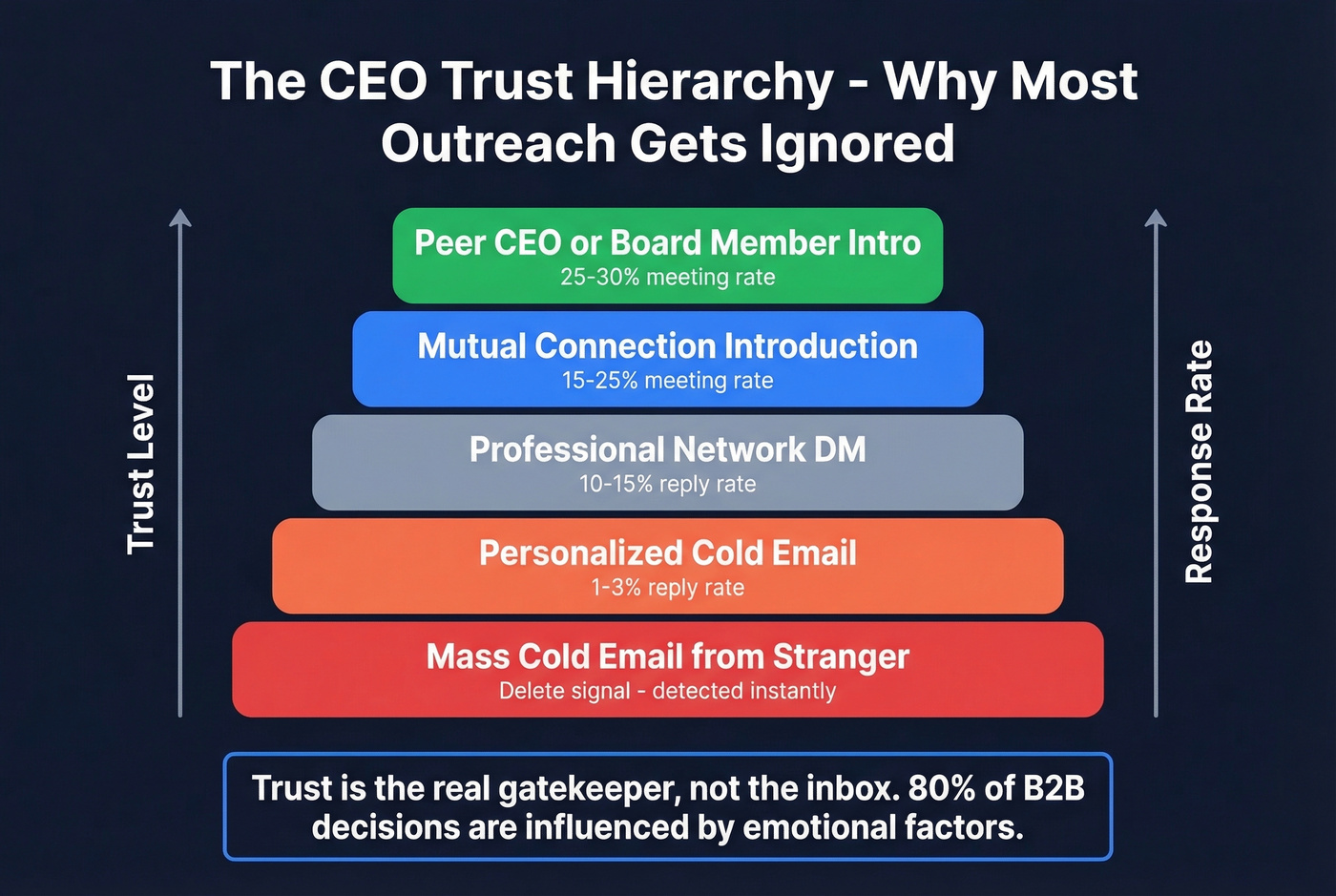
The #1 mistake we see: pitching an operational improvement without connecting it to a board-level concern. CEOs don't care that your tool "saves 4 hours per week." They care that their pipeline is stalling, their competitors just raised a round, or their churn is climbing. 80% of B2B purchase decisions are influenced by emotional factors - fear of falling behind, excitement about a new opportunity, trust in the person making the recommendation.
Mass-produced outreach gets detected instantly. AI-generated emails that open with "Hey [Name], noticed you [generic observation]..." are now so common they've become a delete signal. As one practitioner on r/coldemail put it: "Once 10,000 people copy a template, it stops working." Frameworks beat templates every time.
And then there's the trust hierarchy. A cold email from a stranger sits at the bottom. A peer introduction from a board member or investor? Top. Understanding how to contact CEOs of companies means recognizing that trust is the real gatekeeper, not the inbox.
Find Verified CEO Contact Information
Before you can reach a CEO, you need a verified way to contact them. The quality of your contact data determines whether your message arrives at all.
Use a B2B Data Platform
This is the fastest path. Prospeo's email finder covers 300M+ professional profiles with 30+ search filters - narrow by C-suite title, company size, industry, and funding stage. Email accuracy sits at 98%, backed by a proprietary 5-step verification process that handles catch-all domains, removes spam traps, and filters honeypots.

The Chrome extension pulls verified emails and phone numbers from any company website or professional profile in one click. For context, enterprise data platforms charge roughly $1 per lead. Prospeo runs about $0.01 - 100x cheaper, which makes CEO prospecting viable even for founders and small teams running lean.
One warning: never buy email lists. Beyond the obvious quality problems, purchased lists are often overused and outdated, leading to bounced emails and tanked sender reputation. They also create real compliance risk under GDPR and CCPA.
Manual Methods That Still Work
Not every CEO is in a database. For harder-to-reach targets, manual research fills the gaps.
Google search operators are underrated. Try "CEO name" "company name" email or site:company.com "CEO name". Company "About" and "Team" pages sometimes list direct emails or confirm the CEO's full name for pattern guessing. Press releases often include media contacts that route to the executive office.
Two tactics most people miss: old job postings from the company often contain direct email addresses or phone numbers for the hiring manager - sometimes the CEO themselves at smaller firms. And Google Reviews can confirm who actually runs a company when the website is vague, since owners frequently respond to reviews with their real name and title.
For public companies, SEC EDGAR filings list officers and sometimes include contact details. Don't overlook board affiliations and nonprofit involvement - a CEO who's hard to reach at their company might be accessible through a side channel like a nonprofit board where they serve. Role-based addresses like ceo@, management@, or media@ can also work as a last resort to get your message routed internally.
Email Pattern Guessing + Verification
If you know the CEO's name and company domain, you can guess the format. The most common B2B patterns are firstname.lastname@, first@, and f.lastname@.
But never send to an unverified guess. Hard bounces damage your domain reputation, and that damage compounds across every future campaign. Executive contact information changes rapidly - up to 20% annually due to job transitions and role changes. In one 10k-email benchmark, 28% of B2B emails sat on catch-all domains, which are servers that accept everything without telling you whether the mailbox actually exists. Verify before you send. Every time.
Choose the Right Outreach Channel
Not every channel works equally well for CEO outreach:
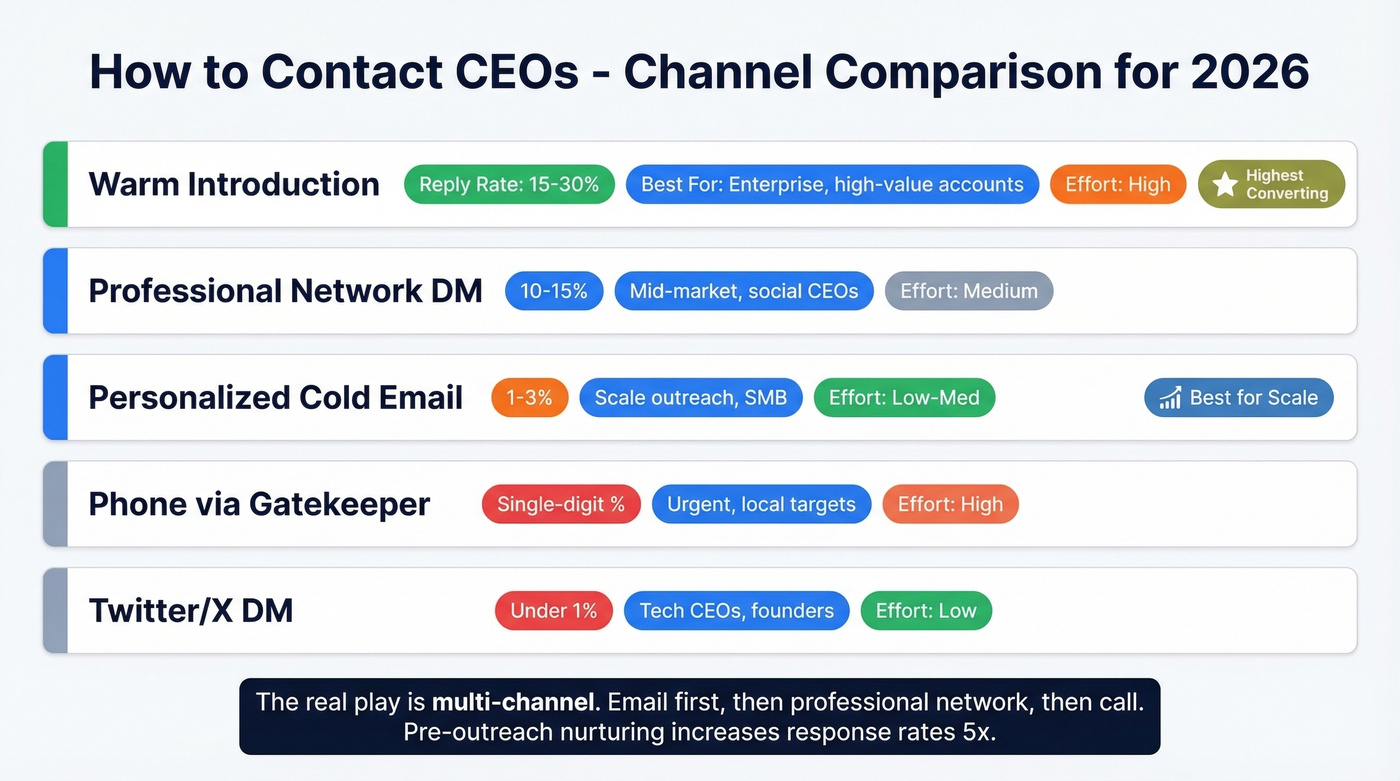
| Channel | Expected CEO Reply Rate | Best For | Effort |
|---|---|---|---|
| Warm Introduction | 15-30% meeting rate | Enterprise, high-value | High |
| Professional Network DM | 10-15% reply rate | Mid-market, social CEOs | Medium |
| Personalized Cold Email | 1-3% reply rate | Scale outreach, SMB | Low-Med |
| Phone (via Gatekeeper) | Single-digit % | Urgent, local targets | High |
| Twitter/X DM | <1% reply rate | Tech CEOs, founders | Low |
Our recommendation for most teams: start with warm intros for your top 10 accounts and cold email for everything else.
Cold email gives you scale. Professional network messages give you higher reply rates but limited volume - and InMail typically runs 3-8% unless you've warmed the relationship first. Here's the stat that changed how we think about this: pre-outreach nurturing - engaging with a CEO's posts, commenting thoughtfully, sharing their content - increases response rates 5x. That's not a marginal improvement. That's the difference between a dead channel and a productive one.
The real play is multi-channel. Email first, then a professional network touchpoint, then a call if the account is high-value enough. Each channel reinforces the others.
Warm Introductions Convert Best
Warm introductions convert 10-25x the rate of cold outreach. If you have any path to a warm intro, take it before you go cold.
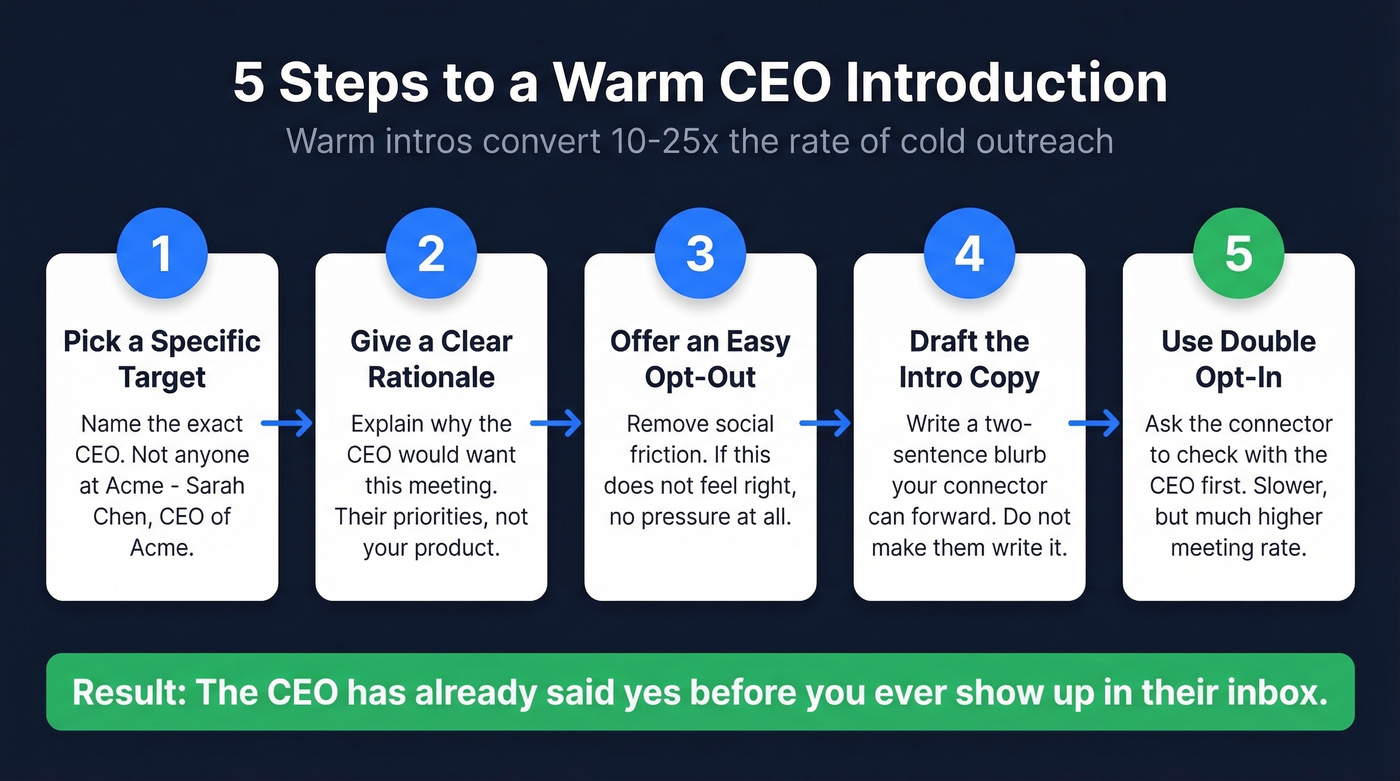
Five steps:
- Pick a specific target. "Can you introduce me to anyone at Acme?" is weak. "Can you introduce me to Sarah Chen, CEO of Acme?" is actionable.
- Give a clear rationale. Your connector needs to understand why the CEO would want this meeting. Make it about the CEO's priorities, not your product.
- Offer an easy opt-out. "If this doesn't feel right, no pressure at all" removes social friction for the person making the intro.
- Draft the intro copy. Don't make your connector write the email. Send a two-sentence blurb they can forward.
- Use double opt-in. Ask the connector to check with the CEO first. It's slower, but the meeting rate is much higher because the CEO has already said yes before you ever show up in their inbox.
CEOs trust other CEOs. An intro from a fellow founder carries more weight than any email you could write.

Stop guessing CEO email patterns and hoping for the best. Prospeo's email finder covers 300M+ profiles with 98% accuracy - filter by C-suite title, company size, and industry to surface verified CEO contacts in seconds. At $0.01 per email, you can prospect hundreds of executives for less than the cost of one InMail.
Get verified CEO emails before your competitor's message lands first.
Write a CEO Email That Gets Replies
Let's be honest: templates don't work at the CEO level. The moment one goes viral on a blog or Reddit thread, every CEO starts seeing it. Frameworks scale. Templates decay.
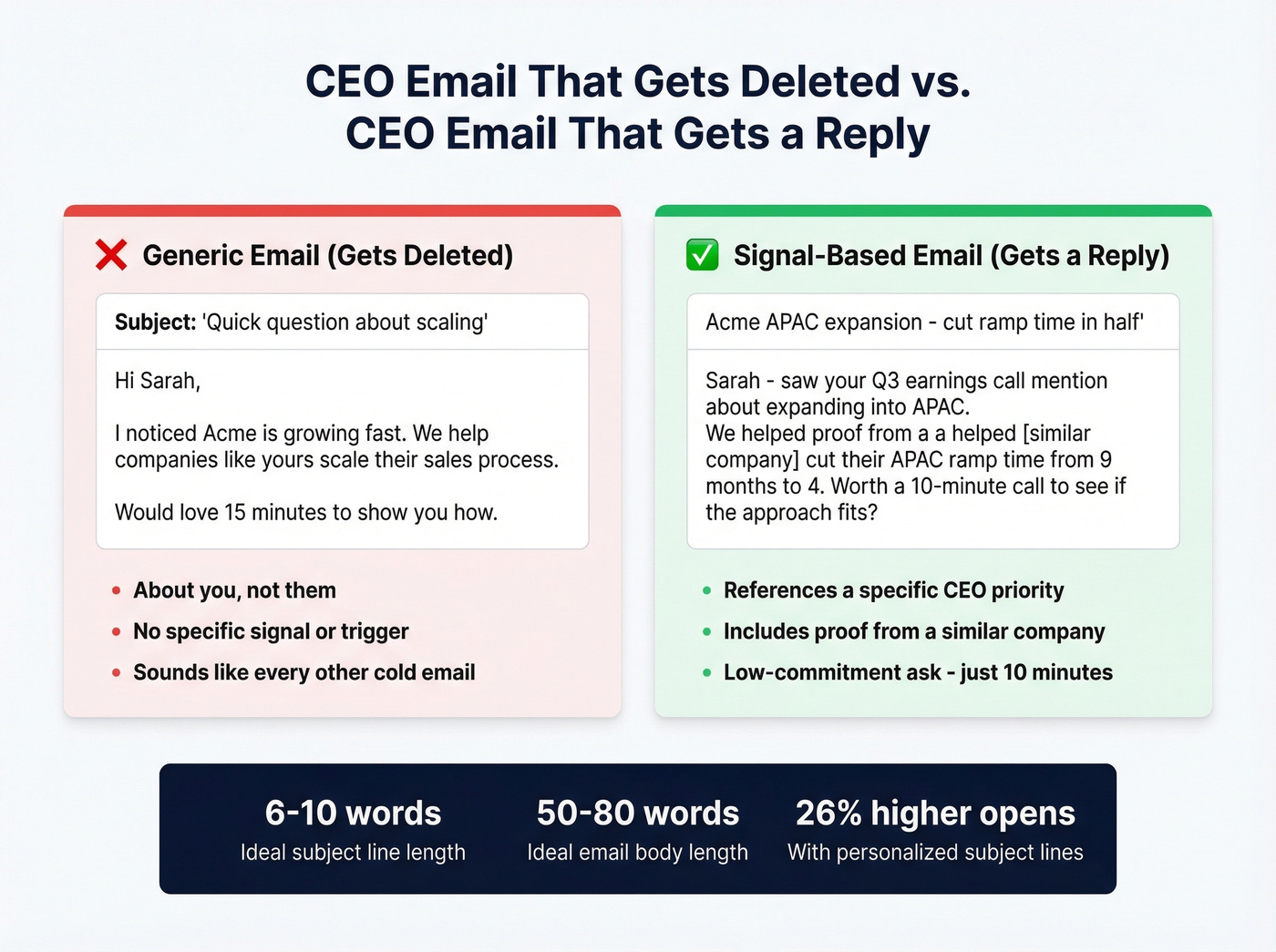
Subject lines between 6-10 words and 21-40 characters hit a 49.1% open rate. Keep the body tight - aim for 50-80 words, and stay under 125. One CTA per email. Low-commitment asks like "Would a 10-minute call make sense?" get 2x more replies than big asks.
Personalized subject lines are 26% more likely to be opened. But personalization doesn't mean "I saw your company raised a Series B - congrats!" That opener is basically spam now.
Here's what signal-based personalization looks like in practice:
Generic (gets deleted):
"Hi Sarah, I noticed Acme is growing fast. We help companies like yours scale their sales process. Would love 15 minutes to show you how."
Signal-based (gets a reply):
"Sarah - saw your Q3 earnings call mention about expanding into APAC. We helped [similar company] cut their APAC ramp time from 9 months to 4. Worth a 10-minute call to see if the approach fits?"
The difference: one is about you, the other is about a specific problem the CEO already cares about. AI-assisted personalization can help here - campaigns using AI for the first message see a 61% lift in reply rates over fully manual ones. But the signal selection still needs to be human.
Turn Gatekeepers Into Allies
Most people try to get past gatekeepers. Wrong framing.
Executive assistants and chiefs of staff are internal operators and risk managers. They decide what reaches the CEO's desk. Your job isn't to bypass them - it's to enlist them.
Respect their authority. Never say "just put me through" or pretend you already know the CEO. They've heard every trick.
Lead with context, not a pitch. "I'm reaching out because [CEO name] mentioned [specific initiative] at [event] - I have data that's relevant to that" works far better than "I'd love 15 minutes to show her what we do."
Ask for guidance, not favors. "Who would be the right person to discuss this with?" positions the gatekeeper as an expert, not an obstacle. They often route you directly to the CEO - or to someone even better.
Follow Up Without Being Annoying
42% of replies come from follow-ups, not the first email. If you're sending one email and moving on, you're leaving almost half your potential responses on the table.
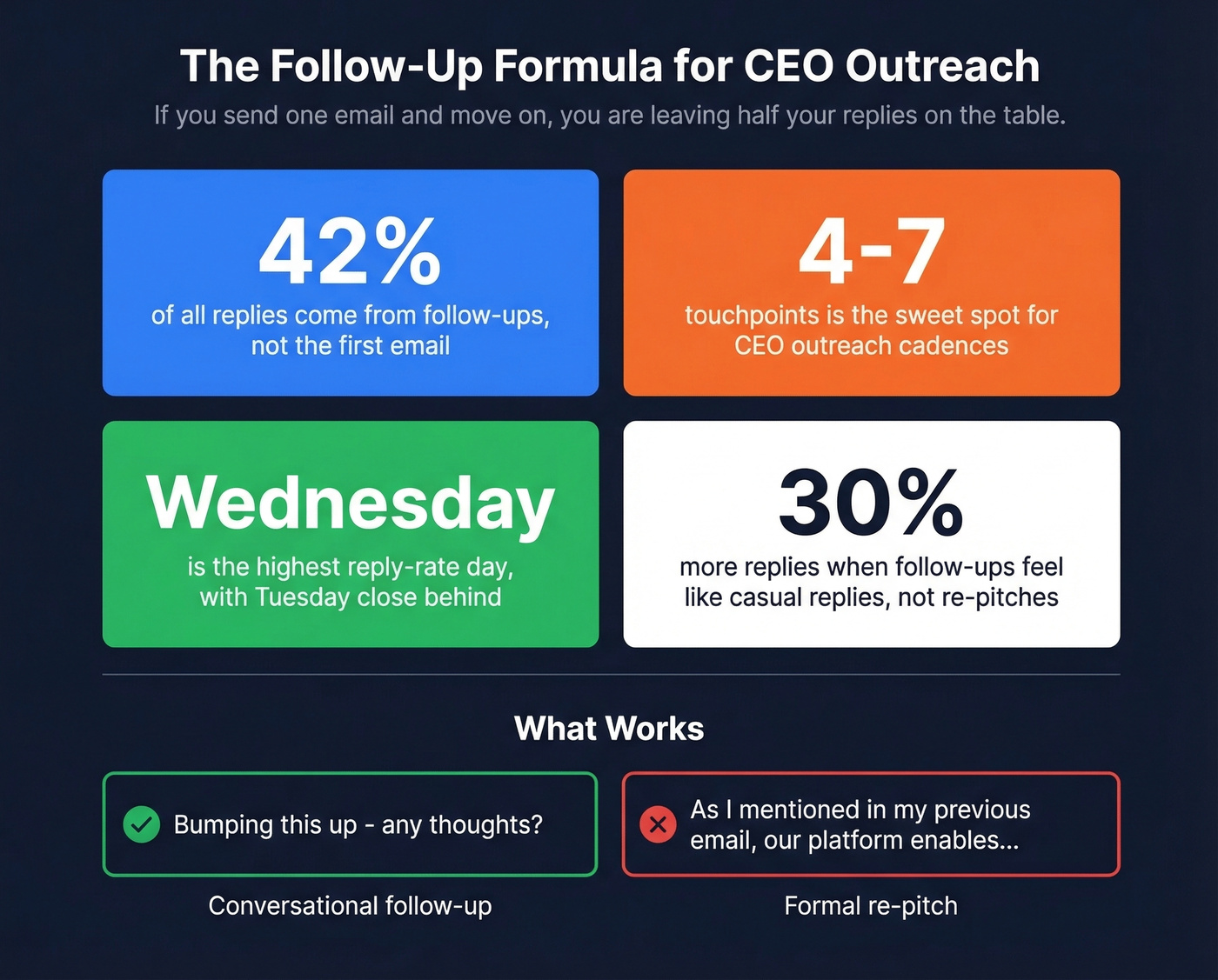
The sweet spot is 4-7 touchpoints. Wednesday is the highest reply-rate day, with Tuesday close behind. Follow-ups that feel like replies - short, conversational, no re-pitching - outperform formal follow-ups by roughly 30%. Think "Bumping this up - any thoughts?" rather than a reformatted version of your original email.
Here's the multi-channel cadence that works for us: email on day one, a professional network connection request on day three, a second email on day five, a phone call on day eight if the account justifies it. After seven touches with zero engagement, move on. Persistence has a shelf life.
Stay Legal: Compliance Checklist
Reaching CEOs aggressively is fine. Breaking the law isn't.
CAN-SPAM (US): Applies to all commercial messages - there's no B2B exemption. Penalties up to $53,088 per email in violation. You must include a valid physical postal address and a clear opt-out mechanism, and honor opt-outs within 10 business days.
GDPR (EU/UK): Lawful basis for B2B cold email is legitimate interest under Article 6(1)(f). Document a Legitimate Interest Assessment. Penalties up to EUR20M.
CASL (Canada): Consent-first jurisdiction - implied consent exists for existing business relationships within the past 24 months. Honor unsubscribe requests within 10 business days.
Most teams get compliance wrong not because they're malicious, but because they don't realize CAN-SPAM has no B2B carve-out. Include your physical address. Honor every opt-out.
Look, if your deal size is under five figures, you probably don't need an enterprise data stack or a 12-step compliance review. A self-serve tool with built-in GDPR compliance, a verified email list, and a well-crafted 3-email sequence will outperform an enterprise platform that takes six weeks to onboard.
Bad contact data doesn't just waste your time - it tanks your domain reputation and kills every future campaign. Prospeo's 5-step verification catches spam traps, honeypots, and catch-all domains so your CEO outreach actually arrives. Data refreshes every 7 days, not the 6-week industry average.
Every bounced email to a CEO is a burned opportunity. Verify first.
FAQ
What's the average reply rate when cold emailing a CEO?
General cold email averages 3.43%, but CEO-level outreach typically lands at 1-3%. Signal-based personalization can push that to 18% - the gap between generic and personalized is enormous at the executive level. Warm introductions convert 10-25x higher than any cold channel.
Is it legal to cold email a CEO?
Yes, in most jurisdictions. CAN-SPAM allows B2B cold email with a physical address, honest headers, and a working opt-out. GDPR requires documenting legitimate interest under Article 6(1)(f). None of these laws ban cold outreach - responsible CEO outreach just means following the rules.
Should I call or email a CEO?
Email first for scalability - personalized cold emails reach more executives per hour than any other channel. Warm introductions convert 10-25x better than either cold channel alone. Phone works best with a specific, time-sensitive reason. The ideal approach combines all three across 4-7 touchpoints.
How do I reach a CEO when I can't find their email?
Start with a B2B data platform that covers 300M+ profiles with C-suite filters. If the CEO isn't in any database, try Google search operators, SEC filings for public companies, team pages, and press releases. Role-based addresses like ceo@ or media@ can route your message internally, or pursue a warm introduction through mutual connections.
How many follow-ups should I send?
Four to seven touchpoints is the sweet spot. 42% of replies come from follow-ups, so stopping after one touch means leaving nearly half your potential replies behind. After seven touches with zero engagement, move on.