

How to Create a Sales Funnel That Actually Converts
You generated 200 leads last month. Marketing celebrated. Sales complained none of them were ready to buy. The CFO asked why pipeline didn't move.
If that sounds familiar, here's the uncomfortable truth: 96% of visitors aren't ready to purchase on their first visit. Without a funnel that accounts for that reality, you're just collecting names in a spreadsheet and hoping something sticks.
The fix isn't complicated, but it does require doing things in the right order. Start with buyer research before you touch any tool. Get conversion benchmarks so you know what "working" looks like. Build a lead scoring model to kill the sales-marketing blame game. Deploy a 5-email nurture sequence because most of your leads aren't ready to buy yet. And feed the whole thing with clean data - otherwise every stage leaks.
What Is a Sales Funnel?
A sales funnel maps the buyer's journey from first hearing about you to signing a contract. It's buyer-centric - tracking their decisions, not your rep's activities. If you're new to the concept, think of it as a framework that helps you understand where prospects drop off and why.
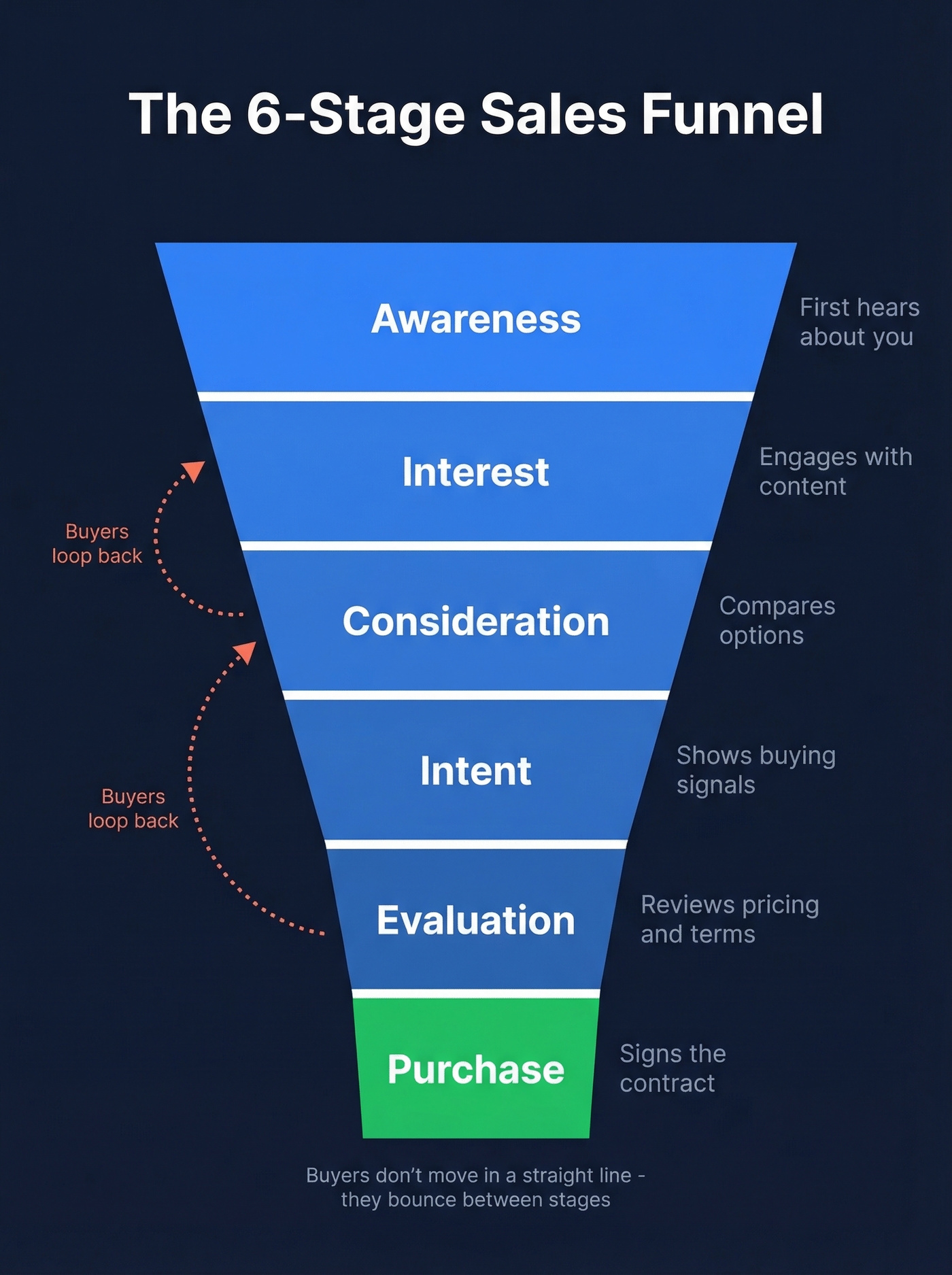
Three related concepts get confused constantly. The marketing funnel covers how you generate awareness and capture leads. The sales funnel covers how buyers move from awareness to purchase. The sales pipeline covers how reps track and advance deals. One is about the buyer. One is about the seller. One is about demand gen. They overlap, but they aren't the same thing.
The standard model runs six stages: Awareness → Interest → Consideration → Intent → Evaluation → Purchase. Buyers don't move through these steps in a neat line, though. They bounce between stages, revisit earlier ones, and sometimes skip two at once. The funnel is a mental model, not a conveyor belt.
| Concept | Perspective | Tracks |
|---|---|---|
| Marketing funnel | Demand gen | Engagement → leads |
| Sales funnel | Buyer | Awareness → purchase |
| Sales pipeline | Rep/seller | Deal stages + actions |
Why Most Funnels Break
The conventional wisdom says your funnel isn't working because you don't have enough leads at the top. That's almost never the real problem. Most funnels leak in the middle - between MQL and SQL - where leads stall because nobody's nurturing them and nobody's scoring them.
Buyer behavior has shifted. Committees are larger, often 6-10 decision-makers for enterprise deals. Research cycles are longer. Prospects bounce between channels before they ever talk to a rep. Ballistic Arts documented this shift and found that teams building funnels around their internal org chart - instead of the buyer's actual journey - are the ones that fail. When The ScoliClinic rebuilt their digital journey around how buyers actually behave, contact form submissions jumped 650% year-over-year. Companies using customer journey mapping are twice as likely to outperform competitors, and that tracks with everything we've seen firsthand.
The other pattern that shows up constantly: sales blames marketing for sending garbage leads, marketing blames sales for not following up fast enough, and nobody's looking at the handoff criteria. If you don't have a shared definition of what qualifies a lead to move from marketing to sales, your funnel is two disconnected halves pretending to be one system.
Stop obsessing over top-of-funnel volume. Fix the middle first.
Funnel Benchmarks by Stage
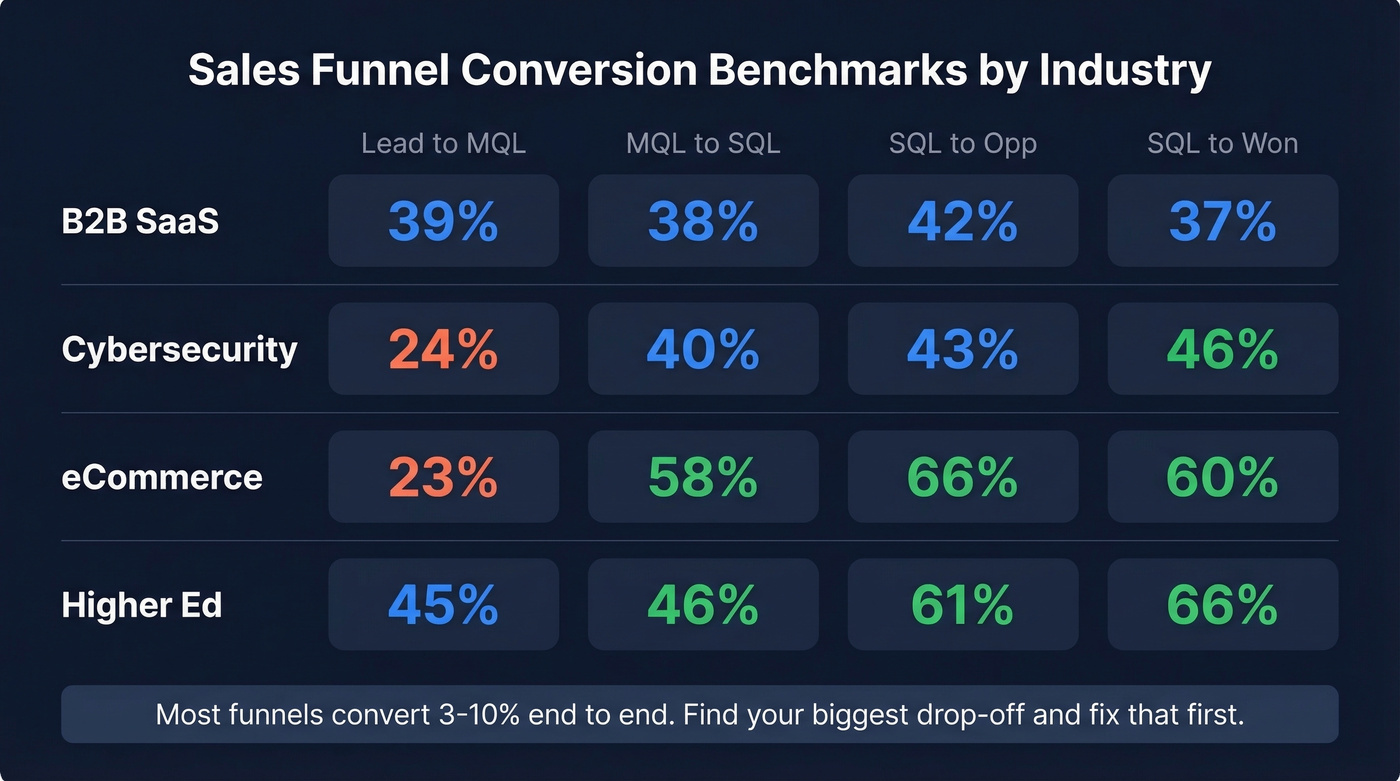
You can't optimize what you can't measure, and you can't measure without knowing what "good" looks like. Here are stage-by-stage benchmarks across four industries:
| Industry | Lead→MQL | MQL→SQL | SQL→Opp | SQL→Won |
|---|---|---|---|---|
| B2B SaaS | 39% | 38% | 42% | 37% |
| Cybersecurity | 24% | 40% | 43% | 46% |
| eCommerce | 23% | 58% | 66% | 60% |
| Higher Ed | 45% | 46% | 61% | 66% |
A few things jump out. B2B SaaS has the highest Lead→MQL rate but one of the lowest close rates - that's the long sales cycle and committee buying at work. eCommerce flips the pattern: harder to qualify leads initially, but once they're in, they convert fast. Demo→opportunity conversion averages 60-80%, with elite teams hitting 90%+.
For time-to-convert, B2B SaaS benchmarks show visitor→lead typically takes 1-3 days, MQL→SQL runs 8-15 days, and opportunity→close stretches to roughly 120 days for enterprise deals versus 30-45 days for SMB. Most funnels convert 3-10% end-to-end.
If your numbers are significantly below these ranges, you don't have a "leads problem." You have a stage-specific conversion problem. Find the biggest drop-off and fix that first.

Your benchmarks don't matter if your funnel is full of bad contact data. Prospeo delivers 98% email accuracy and refreshes every 7 days - so leads don't bounce, reps don't waste time, and your MQL→SQL conversion actually hits those benchmarks.
Stop feeding stale data into a funnel you spent weeks building.
How to Build a Sales Funnel (7 Steps)
1. Research Your Buyer First
Templates are the biggest lie in funnel building. Every tool sells them. None of them work without buyer research underneath.
Before you open a single piece of software, answer these questions: What specific pain is your buyer trying to solve? Who else is involved in the buying decision, and how many people need to sign off? What's their typical timeline from problem-aware to purchase? Where do they go for information - communities, peers, Google, events?
Get this from actual conversations. Interview five recent customers. Talk to five lost deals. The patterns will be obvious within the first three calls, and they'll look nothing like the generic persona template your marketing team downloaded last quarter.
Here's the thing: if your average deal size is under $10k, you probably don't need a six-stage funnel at all. A landing page, a three-email sequence, and a clear CTA will outperform any elaborate funnel architecture. Complexity should match deal complexity.
2. Map Stages to Buyer Behavior
Take the six-stage model and map your actual buyer's path onto it. Where do they first encounter you? What questions do they ask at each stage? Where do they stall?
A prospect might jump from awareness straight to evaluation if a trusted peer recommended you. Another might loop between consideration and interest for months. Map the real journey, not the textbook diagram. We've watched teams spend weeks building beautiful linear funnels that bear zero resemblance to how their buyers actually move - don't be that team.
3. Build Your Awareness Engine
Not all channels perform equally. Google Ads drives 3-5% visitor-to-lead conversion in B2B SaaS. LinkedIn campaigns run lower at 1.8-3.2%. Organic content converts slower but compounds over time. AI-driven personalization can lift conversion rates by roughly 10%, so if your ad platform supports dynamic creative, use it.
Whatever channel you choose, nail the message match between your ad and your landing page. This is one of the most common practitioner tips on Reddit - if your ad promises a specific outcome and your landing page talks about something else, you'll burn budget and tank conversion rates. Layer in retargeting from day one. Only about 2% of visitors convert on the first visit. Retargeting keeps you in front of the other 98%.
Interactive content is worth testing too. Quizzes, ROI calculators, and self-assessments consistently outperform static lead magnets because they give the visitor something personalized in return.
4. Capture Leads With One Clear CTA
Do this: One CTA per page. One clear action you want the visitor to take. A lead magnet that solves a specific micro-problem - think Cisco's gated whitepapers, not a generic "subscribe to our newsletter" box.
Skip this if you're tempted: Multiple CTAs competing for attention on the same page. Generic contact forms with no value exchange. "Learn more" buttons that go to your homepage. Every additional CTA dilutes the one that matters.
5. Nurture With a 5-Email Sequence
Only 27% of B2B leads are sales-ready when first generated, per Woodpecker's research. The other 73% need nurturing - and most teams either blast them with product pitches or forget about them entirely.
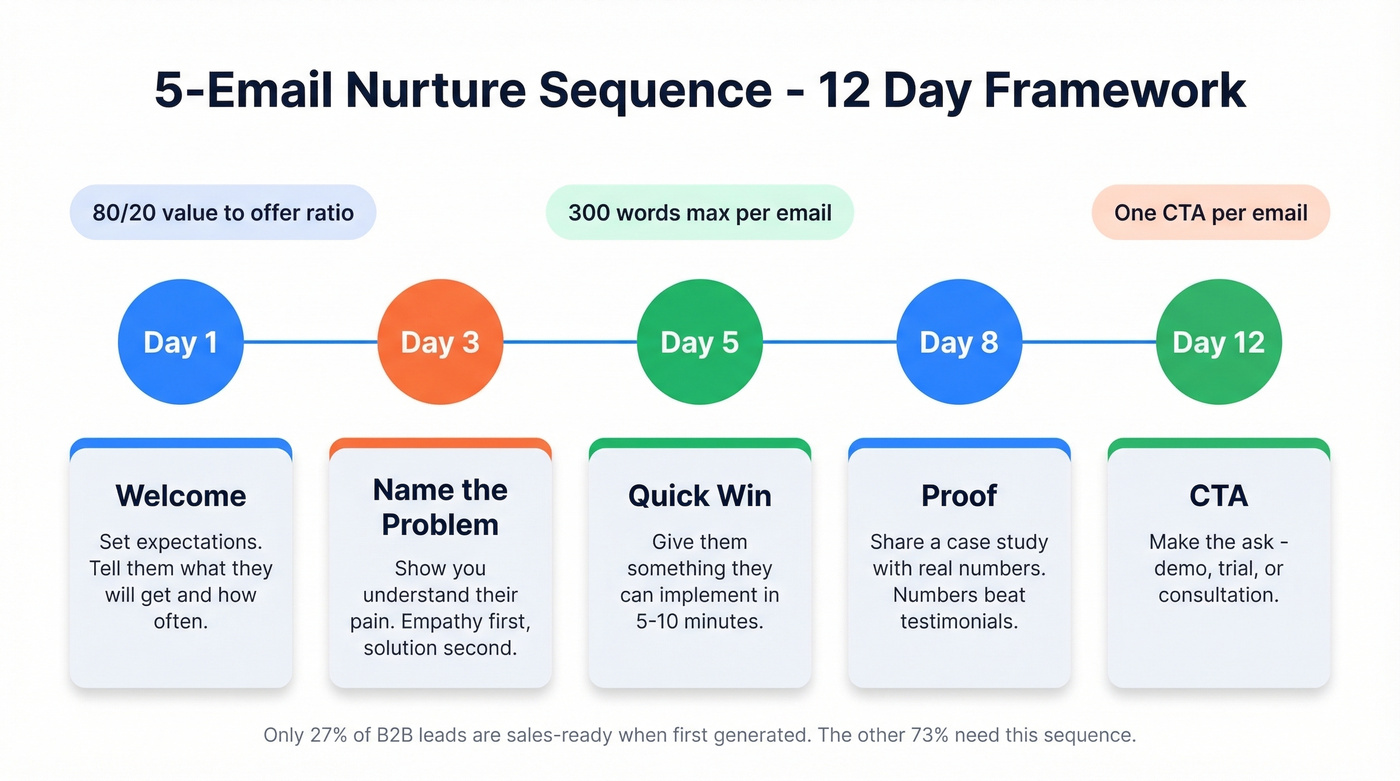
Here's a 12-day framework that works:
- Day 1 - Welcome: Set expectations. Tell them what they'll get and how often. Keep it warm, not salesy.
- Day 3 - Name the problem: Show you understand their specific pain. Empathy first, solution second. In our experience, Day 3 is where most sequences lose people - if this email doesn't resonate, the rest won't matter.
- Day 5 - Quick win: Give them something they can implement in 5-10 minutes. Immediate value builds trust.
- Day 8 - Proof: Share a case study or customer story. Numbers beat testimonials.
- Day 12 - CTA: Make the ask. Demo, trial, consultation - whatever your conversion event is.
Keep each email around 300 words. One CTA per email - never more. Maintain an 80/20 ratio of value to offer. Subject lines under 50 characters. And the most overlooked rule: deliverability is a prerequisite. The best sequence in the world doesn't work if your emails land in spam. If your bounce rate is above 5%, fix your data before you write a single word of copy.
6. Score and Qualify Leads
Lead scoring is how you stop the sales-marketing blame game. It gives both teams a shared, numeric definition of when a lead is ready for a sales conversation.
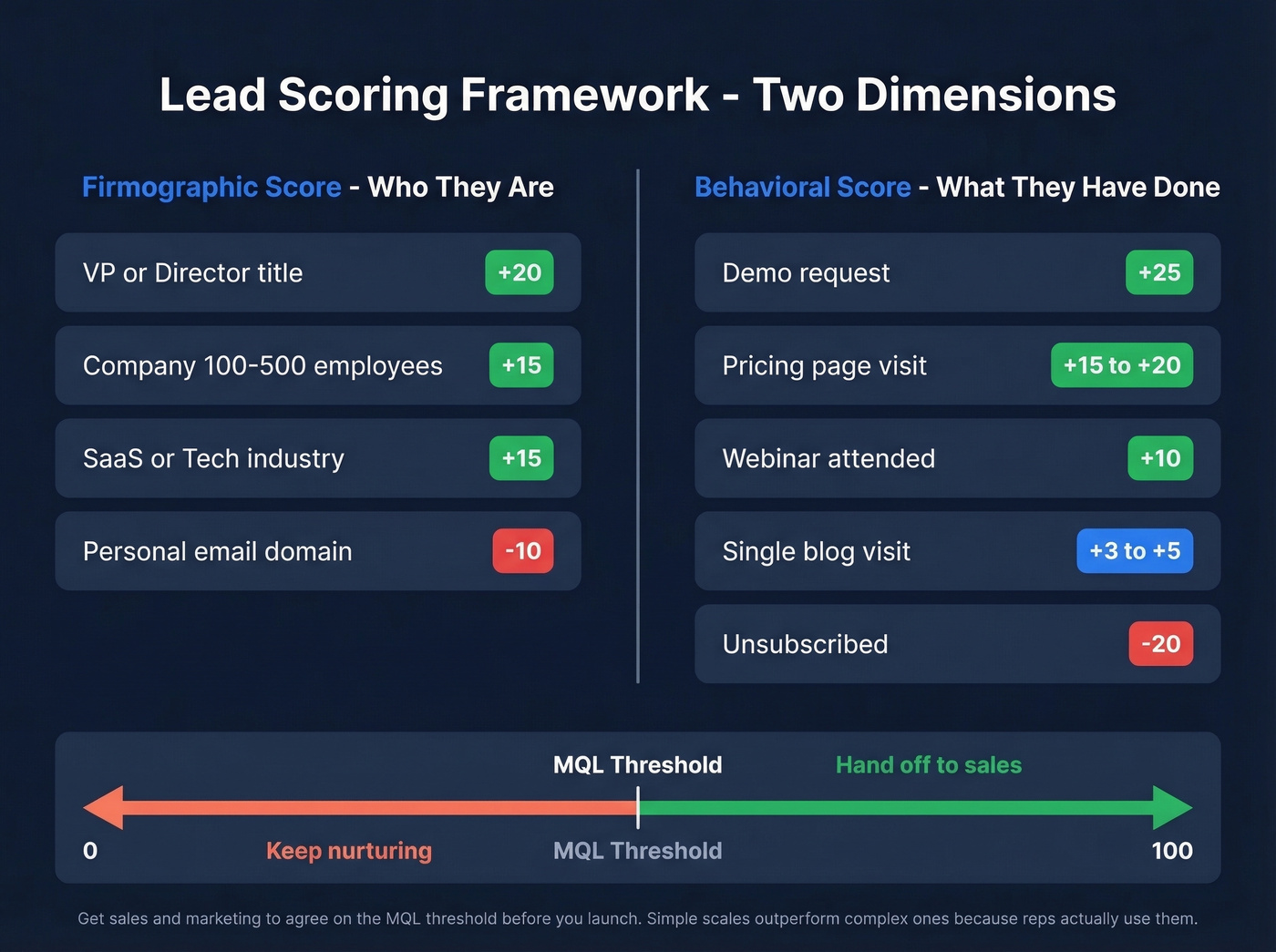
Build two scoring dimensions. First, firmographic - who they are:
| Signal | Points |
|---|---|
| VP/Director title | +20 |
| Company 100-500 employees | +15 |
| SaaS/Tech industry | +15 |
| Personal email domain | -10 |
Second, behavioral - what they've done:
| Action | Points |
|---|---|
| Pricing page visit | +15 to +20 |
| Demo request | +25 |
| Webinar attended | +10 |
| Single blog visit | +3 to +5 |
| Unsubscribed | -20 |
Start with a simple 1/5/10/15 scale. We've tested dozens of scoring models, and the simple scale outperforms complex ones every time because reps actually use it. Negative scoring is essential - it prevents a junior intern at a 5-person company from hitting your MQL threshold just because they read six blog posts.
Get sales and marketing in the same room to agree on the MQL threshold before you launch. If marketing says 50 points and sales says 80, you'll be right back to finger-pointing within a month. Let's be honest - the consensus on r/sales is that most scoring models fail not because the math is wrong, but because the two teams never agreed on the rules.
7. Convert and Retain
The funnel doesn't end at purchase. The flywheel model - Attract, Engage, Delight - treats happy customers as your growth engine through retention and referrals.
Retention is cheaper than acquisition. Amazon built an empire on this: frictionless checkout gets the first sale, then personalized upsells and cross-sells drive lifetime value. Your post-purchase stage should include onboarding sequences, check-in cadences, and expansion opportunities. Teams that treat "closed-won" as the finish line leave the most revenue on the table.
Funnel Mistakes That Kill Conversions
Strategy mistakes: Copying templates without buyer research. Chasing multiple goals per funnel instead of picking one objective. Running ads to everyone instead of targeting by persona and channel.
Execution mistakes: Automating without a strategy for all stages. Stacking multiple CTAs on one page. Abandoning leads after capture instead of nurturing with content. Ignoring UX, page speed, and mobile experience. Changing branding across assets when consistency builds trust.
Tools You Actually Need
You don't need a $50k platform. You need the right tool for each layer of the funnel.
| Tool | Category | Starting Price | Best For |
|---|---|---|---|
| Prospeo | Prospecting & data | Free (75 emails/mo) | Verified emails + mobiles |
| Systeme.io | Funnel builder | Free plan; paid from ~$27/mo | Bootstrapped teams |
| ClickFunnels | Funnel builder | $97-$297/mo | Full-featured funnels |
| Perspective | Funnel builder | $62/mo (annual) | Mobile-first funnels |
| GetResponse | Email/nurture | $59/mo (1,000 contacts) | All-in-one email + CRM |
| HubSpot | CRM | Free CRM | Startups scaling up |
| Salesforce | CRM | ~$25/user/mo | Enterprise workflows |
Prospecting & Data: The data layer feeding your entire funnel. Prospeo offers 300M+ professional profiles with 98% email accuracy, 143M+ verified emails, and 125M+ verified mobile numbers, all refreshed every 7 days so you're not emailing people who changed jobs two months ago. The free tier gives you 75 verified emails per month, and paid plans run about $0.01 per email. For teams running outbound as part of their awareness engine, this is where the funnel starts.

Funnel Builders: Systeme.io is a strong pick for bootstrapped teams because you can build landing pages and basic automations without spending much. ClickFunnels is the established player with a deep template library. Perspective is worth a look if your audience is mobile-heavy - skip it if they aren't.
Email & Nurture: GetResponse's Marketing Automation plan starts at $59/mo for 1,000 contacts and includes landing pages, webinars, and automation workflows. Solid mid-market choice.
CRM: HubSpot's free CRM handles contact management and basic pipeline tracking. You can build custom funnel reports to track stage-by-stage conversion. When you outgrow it, Salesforce Sales Cloud starts around $25/user/mo.
The article says fix the middle of your funnel first. Hard to do when 35% of your emails bounce. Prospeo's 5-step verification and 143M+ verified emails mean your nurture sequences actually reach inboxes - at $0.01 per email, no contracts.
Every stage converts better when your data connects you to real buyers.
Real Sales Funnel Examples
Cisco runs a textbook B2B funnel. Gated whitepapers and research reports capture leads at the awareness stage. Nurture sequences deliver case studies, ebooks, and webinar invitations over weeks. Sales engages only when behavioral signals indicate the buyer is ready - not before.
Amazon proves that frictionless conversion beats everything. One-click checkout removes every possible barrier at the purchase stage, and personalized recommendations drive upsell and cross-sell that most B2B companies only dream about. The lesson: reduce friction at every stage, not just the top.
Oracle blends inbound and outbound. SEO-driven content and webinars generate awareness, while live chat on high-intent pages converts visitors into conversations in real time - no form fill, no 48-hour response delay. Their enterprise sales team then runs personalized nurture sequences tailored to the buyer's specific tech stack and pain points.
Walmart shows what omnichannel funnel design looks like at scale. The app, in-store pickup, QR codes on shelves, and a unified loyalty program create a seamless loop where every touchpoint feeds the next. For B2B teams, the takeaway is the same: your funnel shouldn't live in one channel. Meet buyers wherever they already are.
Each of these companies built their funnel around how their buyers actually behave - not around a template. That's the pattern worth copying.
FAQ
What's the difference between a sales funnel and a pipeline?
A sales funnel tracks the buyer's journey from awareness to purchase - it's buyer-centric. A pipeline tracks rep activities and deal stages - it's seller-centric. Your funnel tells you where buyers drop off; your pipeline tells you where reps need to focus.
How long does it take to build one?
A basic setup with a landing page, email sequence, and single CTA takes 1-2 weeks. A fully optimized funnel with lead scoring, benchmarks, and A/B testing takes 4-8 weeks to build and months to refine. Start simple and iterate based on stage-by-stage conversion data.
What's a good funnel conversion rate?
Most funnels convert 3-10% end-to-end. B2B SaaS typically sees 39% Lead→MQL and 37% SQL→Won. eCommerce SQL→Won rates run around 60%. Measure your own baseline before chasing someone else's numbers.
Do I need expensive software?
No. Systeme.io offers a free plan for landing pages and automations. HubSpot CRM is free. Prospeo gives you 75 verified emails per month at no cost. You can build a complete funnel for $0 and upgrade individual tools as you scale.
What's the biggest mistake when building a funnel?
Copying a template without doing buyer research first. Every funnel tool sells templates, and they all look great in the demo. But templates without strategy produce zero results because they're built around a generic buyer that doesn't exist. Interview real customers, map real behavior, then build.