

How to Find Clients as a Financial Advisor: A Data-Backed 2026 Playbook
You passed every exam, hung your shingle, and now it's Monday morning with an empty calendar. Figuring out how to find clients as a financial advisor is the real challenge - credentials don't generate pipeline. Your marketing system does. Here's the playbook that actually works, built on real CAC benchmarks, referral scripts, and channel data.
The Short Version
- Build a structured referral system with scripts. 58% of HNW clients come from referrals, yet only 20% of advisors consistently ask.
- Post on LinkedIn 3-5x/week with a compliance-approved workflow and track DMs, not likes.
- Host one meal seminar per quarter on Social Security and retirement income - meal events pull about 3x the direct-mail reservation response rate of non-meal events.
If you can only measure one thing, measure your CAC. If you don't know it within $500, you don't have a marketing strategy - you have a hope.
Know Your Numbers First
Every advisor we've talked to who's "tried everything" has one thing in common: they can't tell you what a client costs to acquire. Without that number, you're guessing.
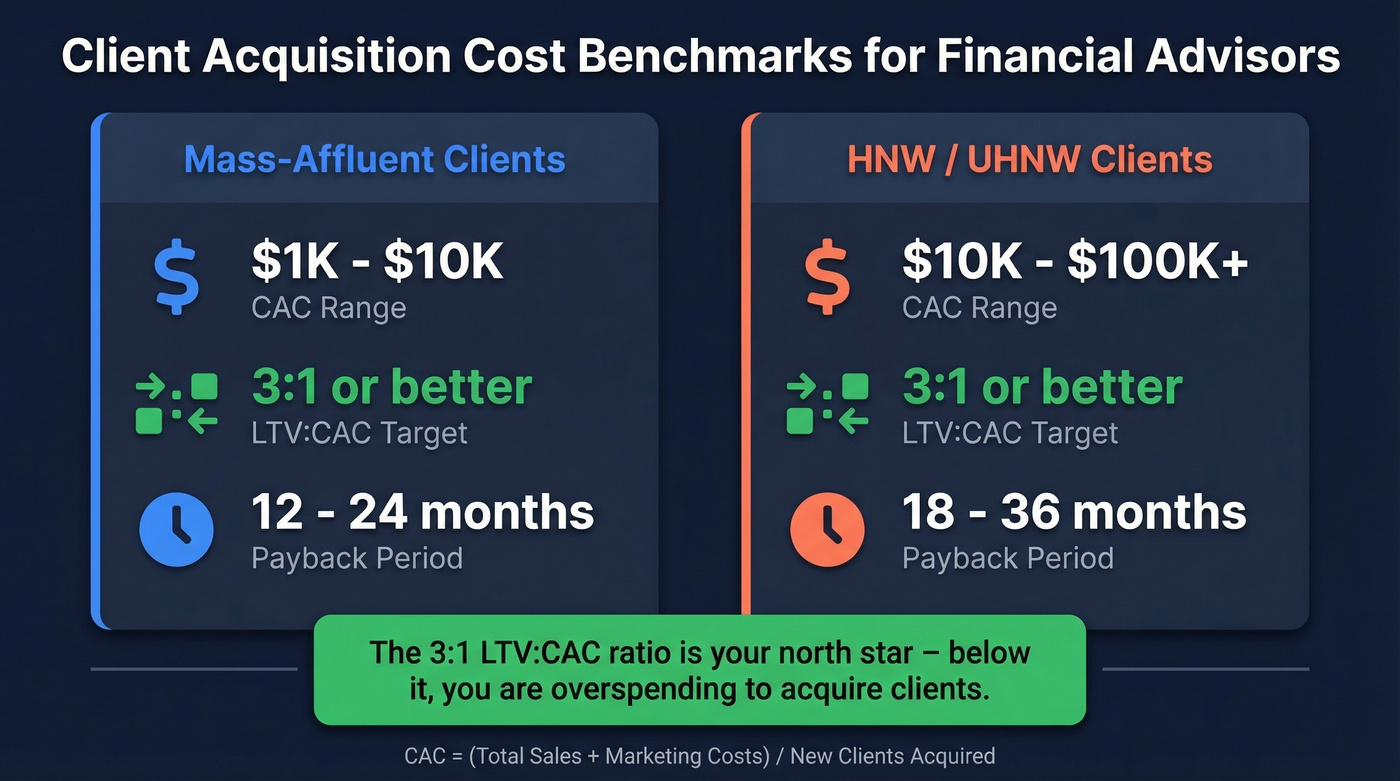
CAC = (Total Sales + Marketing Costs) / New Clients Acquired
Include everything. Events, BD salary, tech stack, compliance setup, onboarding time, outsourced services. Most advisors dramatically undercount because they forget the soft costs.
Here's what the ranges look like by segment:
| Segment | CAC Range | LTV:CAC Target | Payback Period |
|---|---|---|---|
| Mass-affluent | $1k-$10k | 3:1 or better | 12-24 months |
| HNW/UHNW | $10k-$100k+ | 3:1 or better | 18-36 months |
That 3:1 ratio is your north star. Below it, you're spending too much to acquire clients relative to what they'll generate over their lifetime.
KPIs to track weekly:
- Traffic sources and volume by channel
- Email open and click-through rates
- Event registrations vs. attendance vs. booked meetings
- Conversion rate at each funnel stage
- Cost per lead by channel
These tell you whether a channel is working or just keeping you busy.
Pick a Niche
"I work with anyone who has money" isn't a positioning statement. It's a recipe for competing on price with every other generalist in your zip code.
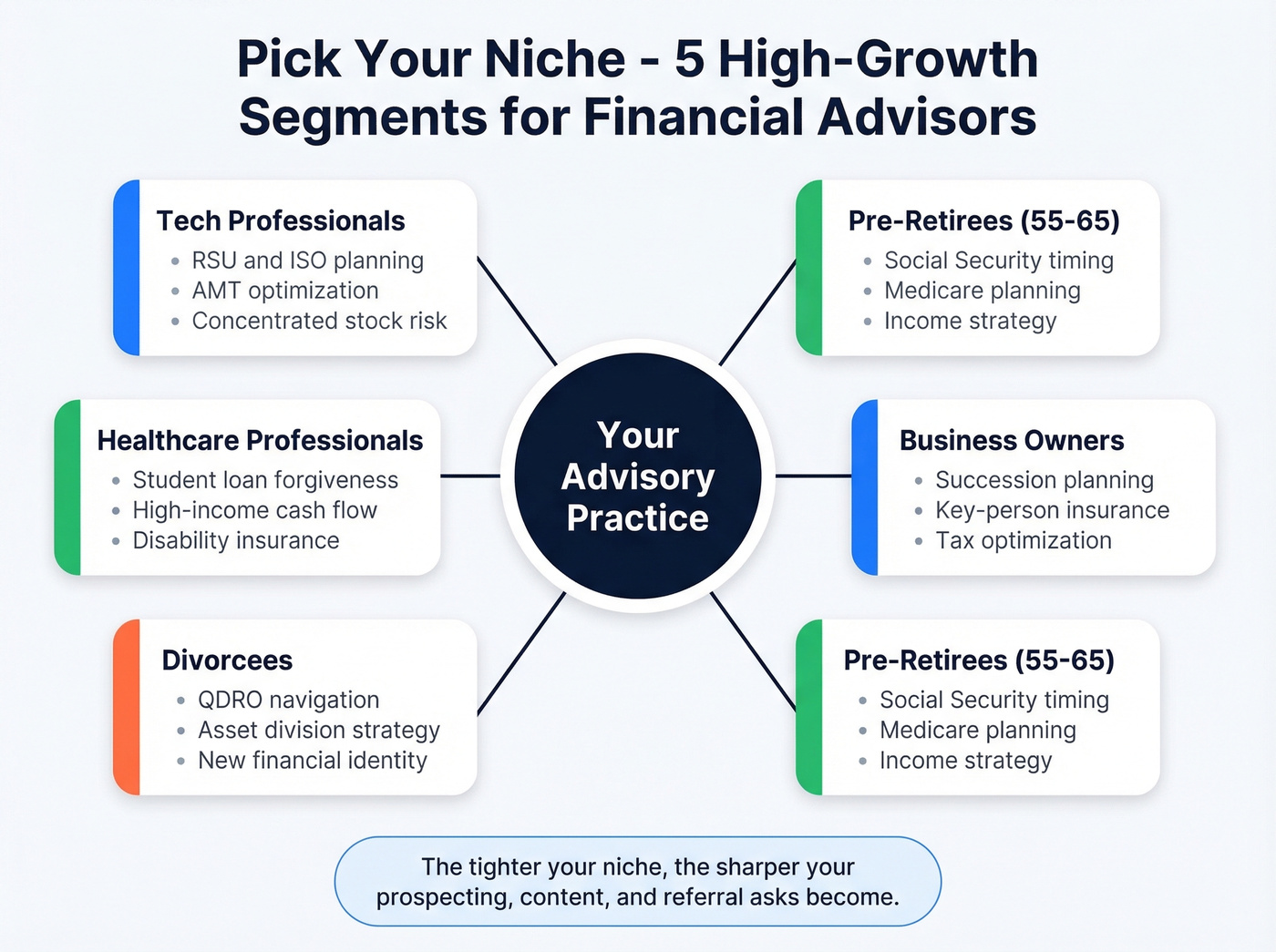
Here's a practical reality: the time cost of serving a $100K client is often close to serving a $1M client. That's why niching up matters more than adding volume. The advisors growing fastest have picked a lane and own it.
Niches worth considering:
- Tech professionals with equity comp - RSUs, ISOs, AMT planning
- Healthcare professionals with student debt - loan forgiveness strategies, high-income cash flow
- Divorcees navigating QDROs - asset division, building a new financial identity
- Business owners - succession planning, key-person insurance, tax optimization
- Pre-retirees (55-65) - Social Security timing, Medicare, income planning
Women investors, young professionals with stock options, international investors, and ESG-focused clients all represent underserved segments with high loyalty and growing wealth. The tighter your niche, the easier prospecting becomes - seminar topics, LinkedIn posts, and referral asks all get sharper when you know exactly who you're talking to.

You just defined your niche. Now you need their contact data. Prospeo's 30+ search filters let you target prospects by job title, company size, funding stage, and buyer intent - so you can build a list of tech executives with equity comp or pre-retirees at growing firms in minutes, not weeks. 98% email accuracy means your outreach actually lands.
Build your first niche prospect list in under five minutes.
7 Strategies to Attract Clients
1. Build a Referral System (With Scripts)
[58% of HNW clients](https://ir.seic.com/press-releases/detail/203/sei-study-wealth-managers-who-ask-for-referrals-double-their-chance-of-being-recommended-by-clients) found their advisor through a referral. Yet only 20% of advisors consistently ask. That gap is where your growth lives.
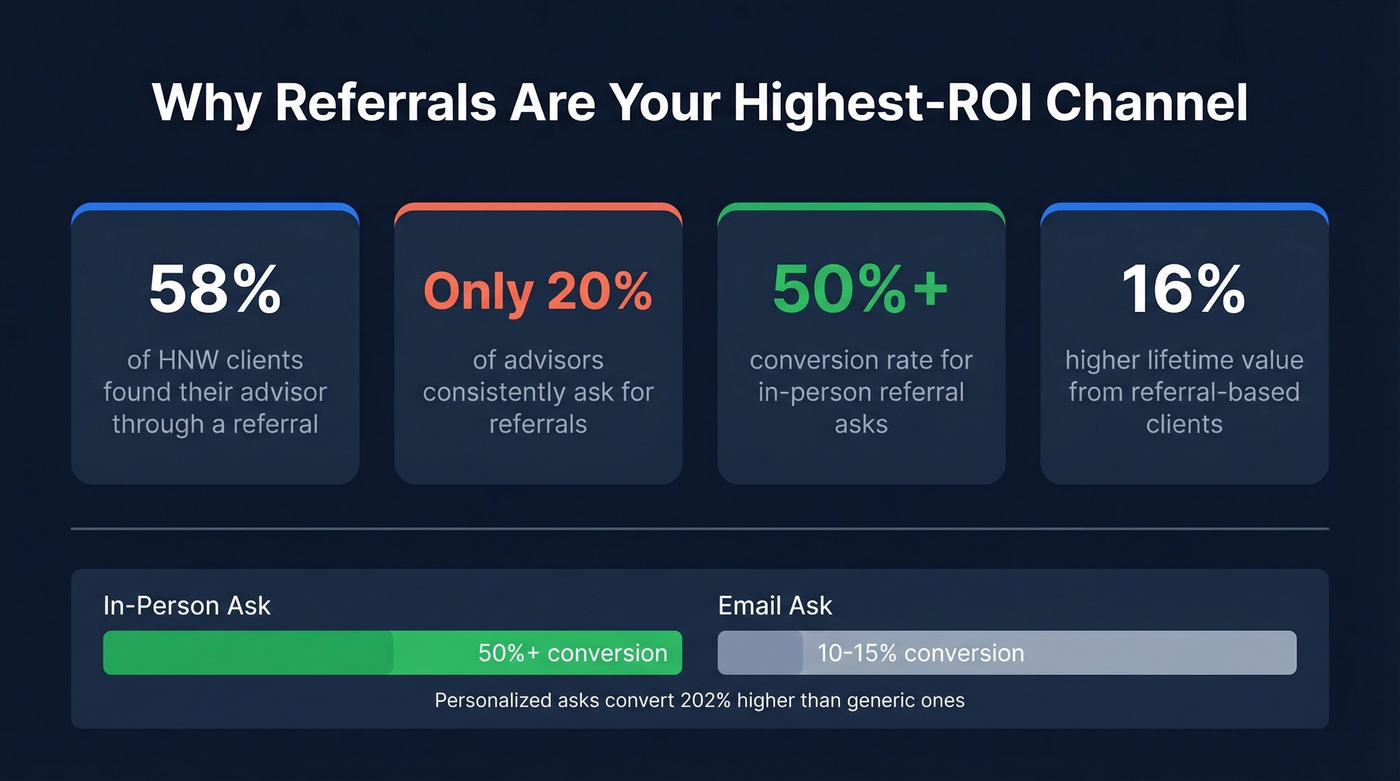
In-person referral asks convert at 50%+, while email requests land around 10-15%. Personalized asks convert 202% higher than generic ones, and referral-based clients carry 16% higher lifetime value. The math is overwhelming - referrals are the single highest-ROI activity in your practice and they cost almost nothing.
Most advisors don't ask because they don't have the words. Here are four scripts you can use this week:
After delivering value:
"I'm really glad we got this sorted for you. If you know anyone in a similar situation who could use this kind of help, I'd love an introduction."
The "second opinion" frame:
"A lot of my best clients came to me because a friend suggested they get a second opinion on their plan. If anyone in your circle mentions they're unsure about their finances, I'd be happy to chat with them."
The casual three-way intro:
"Would you be open to introducing me to [specific person] over coffee? I think I could help them with [specific issue]."
Email template:
"Hi [Name], I hope [recent value you delivered] has been helpful. If anyone in your network is dealing with [specific challenge], I'd welcome the chance to help. A quick email intro is all it takes."
Ask right after you've delivered clear value - plan completion, a problem solved, an annual review that went well. Don't ask during onboarding or when something's gone sideways. And treat this as a repeatable process, not a one-off favor. Schedule the ask into every review meeting so it becomes second nature.
2. LinkedIn Strategy That Converts
LinkedIn works for advisors, but only if you measure the right things. Likes are vanity. DMs and meeting requests are what matter.
The cadence that drives results: 3-5 posts per week, plus 1-2 longer-form videos or articles per month, plus daily micro-engagement on your target niche's posts.
| Format | Specs | Frequency |
|---|---|---|
| Text posts | 200-400 words | 2-3x/week |
| Native video | 60-120 seconds | 1-2x/month |
| Carousels | 5-10 slides | 1x/week |
| Polls / team spotlights | Single question or behind-the-scenes | 1-2x/month |
Post templates that work: market commentary with your take (not a repost), anonymized client stories showing a problem-to-solution arc, educational carousels breaking down Roth conversions or Social Security timing, 60-second Q&A videos, and event promotion posts that tease the topic rather than just announcing a date.
For compliance, pre-approve content themes, avoid specific advice or performance guarantees, anonymize or get written consent for client stories, and retain all drafts plus approvals for your audit trail. Track conversation starts - DMs, inquiries, and referral traffic to your site - not likes. One networking tip that's easy to overlook: comment on your prospects' posts before pitching. Share insights rather than selling. Always move the conversation to a call within two or three exchanges.
3. Seminars and Events
Meal seminars remain one of the highest-converting channels for advisors targeting retirees and pre-retirees. Some advisors worry that meal events feel too "salesy." The data says otherwise.
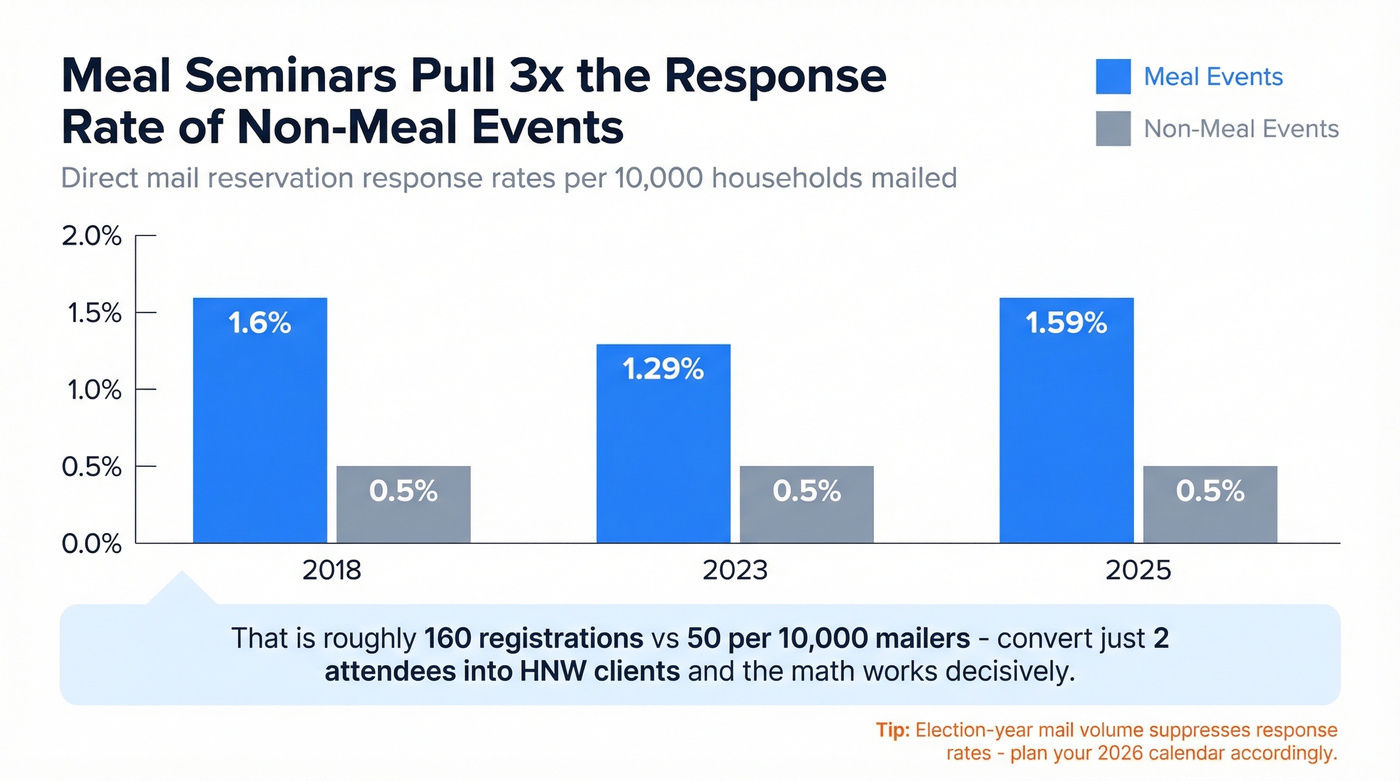
Seminar Reservation Response Rates (Direct Mail to Registrations)
| Year | Meal Response Rate | Non-Meal Rate | Notes |
|---|---|---|---|
| 2018 | 1.6% | ~0.5% | Baseline |
| 2023 | 1.29% | ~0.5% | Post-pandemic rebound |
| 2025 | 1.59% | ~0.5% | Last 10 events averaged 1.84% |
That's roughly 160 registrations per 10,000 households mailed for meal events, versus about 50 for non-meal - a 3x difference that has held consistently for years.
Top-performing seminar topics based on 2025 data: Social Security + retirement income, Social Security + taxes, and financial estate planning. Election-year mail volume suppresses response rates (2024 was rough for non-meal events), so plan your 2026 calendar accordingly. Budget $5,000-$15,000 per event including venue, catering, and direct mail for 10,000 households. Convert even two attendees into HNW clients and the math works decisively in your favor.
4. Centers of Influence
Your best referral partners aren't clients. They're the CPAs, estate attorneys, insurance agents, divorce attorneys, and HR directors who already talk to your ideal prospects every day.
Don't lead with "send me clients." Lead with "I have a client who needs a great estate attorney - can I send them your way?" Build the relationship before you ask for anything. Share relevant articles, invite them to your seminars, co-host educational events. Follow up every 30-45 days with something valuable. When a COI does make a warm introduction, treat it like gold - follow up within 24 hours and report back on the outcome. Warm introductions close at dramatically higher rates than cold outreach because the trust is already partially built.
5. Content Marketing That Builds Trust
Blog posts, video, podcasts, and educational resources compound over time. The key is producing content that doesn't read like your compliance department wrote it.
Focus on questions your niche actually asks. "Should I exercise my ISOs before IPO?" beats "The Importance of Financial Planning" every time. Optimize your Google Business Profile with reviews, accurate service descriptions, and regular posts - local SEO matters enormously when someone searches "financial advisor near me." TikTok is gaining traction even among older demographics, but for most advisors, LinkedIn and Google remain higher-ROI starting points. Master those first.
6. Outbound Prospecting Done Right
Here's the thing about outbound: the entire system breaks down if your contact data is wrong. Sending a beautifully personalized email to a dead address doesn't just waste time - it damages your domain reputation and tanks deliverability for every future email you send.
Think of prospecting as a funnel. The top is networking, social media, and direct mail. The middle is personalized emails, educational seminars, and trust-building content. The bottom is meetings, referrals, and tailored planning conversations that close. Having a reliable prospecting script for each stage keeps your messaging consistent and your team aligned.
For building targeted prospect lists, Prospeo gives you access to 300M+ professional profiles with 98% verified email accuracy and a 7-day data refresh cycle. Filter by job title, location, industry, and 30+ other criteria. The free tier includes 75 verified emails per month - enough to test whether outbound works for your practice before committing budget.

Personalize by segment. A young professional with stock options needs a completely different message than a business owner thinking about succession. Direct mail still pulls 4-9x the response rate of digital-only outreach, so pair it with email follow-up every 30-45 days.
7. Paid Advertising
Google Ads works for intent-based searches ("financial advisor for doctors near me"), while Meta works better for awareness and retargeting. Start with $500-$2,000/month and measure ruthlessly.
Retargeting is the highest-ROI play in paid. Someone visited your site, read your blog post about Roth conversions, and left. A retargeting ad that says "Still thinking about that Roth conversion? Let's talk" converts at multiples of cold traffic. Keep compliance in mind: no performance guarantees, no unsubstantiated claims, proper disclosures on testimonials.
CAC and Channel Performance Comparison
Let's be honest: most advisors don't need seven channels. They need two that they run well. This table helps you pick.
| Channel | Typical CAC Range | Conversion Benchmark | Best For |
|---|---|---|---|
| Referrals | $0-$500 | 50%+ close rate (in-person) | Every advisor - highest ROI, lowest cost |
| Meal Seminars | $1,500-$4,000/client | 1.6% mail response, 10-20% attendee-to-client | Pre-retirees and retirees (55+) |
| $200-$1,500 | 1-3% DM-to-meeting rate | Tech, healthcare, young professional niches | |
| Content / SEO | $500-$3,000 | 1-2% visitor-to-lead over 6-12 months | Advisors building long-term niche authority |
| Outbound Prospecting | $300-$2,000 | 2-5% reply rate with verified data | Targeting specific company types or titles |
| Paid Digital | $1,000-$5,000 | 2-8% landing page conversion | Intent searches and retargeting warm traffic |
| Direct Mail | $1,000-$3,000 | 4-9x response vs. digital-only | Local, mass-affluent, pre-retiree audiences |
If your average annual revenue per client is under $3,000, referrals and LinkedIn are your two channels. Targeting HNW retirees? Referrals and meal seminars. Pick two, run them for 90 days, measure CAC, and double down on what works.
Compliance Guardrails
The SEC's Marketing Rule (Rule 206(4)-1) got fresh teeth on December 16, 2025 with a Risk Alert spelling out exactly what examiners are looking for.
Testimonials and endorsements require clear, prominent disclosures at the time they're shared - whether the person is a current or former client, whether they were compensated, and any material conflicts. "Clear and prominent" means visible, not buried in a hyperlink or rendered in 8pt gray text.
Referral programs with even modest compensation trigger written agreement requirements. The de minimis threshold is $1,000 over 12 months - exceed that, and you need formal documentation. "Refer-a-friend" programs, lead-gen firms, and social media influencers all count as endorsements under the rule.
Social media archiving is non-negotiable. Retain all business-related posts, comments, DMs, and shared content for five years. In September 2024, nine advisers faced $1.2M+ in combined penalties for misleading ads, unsubstantiated claims, and improperly disclosed testimonials.
The compliance burden is real, but it's manageable with a system. Pre-approve content themes, archive everything automatically, review disclosures quarterly.
Mistakes Killing Your Pipeline
Not tracking CAC. If you don't know what a client costs to acquire, you can't optimize anything. Set up tracking this week - even a spreadsheet beats nothing.
Posting on social without tracking DMs or meetings. Likes don't pay your rent.
Using jargon prospects don't understand. I once watched an advisor pitch "alpha generation through tactical asset allocation" to a dentist who just wanted to know if she could retire at 58. The dentist's eyes glazed over in about four seconds. Write like a human talking to another human.
Failing to follow up. We've seen advisors generate solid leads and then let them die because they didn't follow up within 30-45 days. Value-based follow-up isn't pushy - it's professional.
Ignoring local SEO. Your competitors are asking every happy client for a Google review. If your profile has three reviews from 2022, you're invisible in local search.
Skipping direct mail. Physical mail can increase response rates 4-9x versus digital-only outreach. For local, pre-retiree audiences, it's still one of the best channels available.
Trying to do everything at once. Skip this impulse entirely. Pick two strategies from this article. Run them for 90 days. Measure. Double down on what works. That discipline beats a scattered approach every single time.
Referrals and seminars fill the top of your funnel. But when you need to scale beyond warm intros, you need verified direct dials and emails for decision-makers. Prospeo gives you 125M+ verified mobile numbers with a 30% pickup rate - so when you call that business owner or healthcare professional, someone actually answers.
Get direct dials that pick up, not voicemails that don't.
FAQ
How many clients does a financial advisor need?
Most solo advisors reach capacity at 100-150 clients. Revenue per client matters more than headcount - 75 HNW clients at $5,000+ annual revenue often outperforms 200 mass-market clients at $1,000 each. Focus on moving upmarket rather than adding volume.
What's the best way to get clients as a new advisor?
Start with COI relationships - CPAs, estate attorneys, divorce lawyers. Referrals come later because you need someone to refer you first. Host one educational event per quarter and post on LinkedIn 3-5x/week. These two channels build credibility fastest when you don't yet have a client base to draw from.
How much should a financial advisor spend on marketing?
Track CAC, not budget. Mass-affluent practices typically spend $1,000-$10,000 per acquired client. Target an LTV:CAC ratio of 3:1 or better with a 12-36 month payback period. If your ratio is below 3:1, you're either spending too much per client or not retaining them long enough.
Can financial advisors use client testimonials?
Yes, but the SEC Marketing Rule requires clear disclosures - whether the person is a current or former client, whether they were compensated, and any material conflicts. Disclosures must be prominent and visible at the time the testimonial is shared. Buried-in-a-hyperlink disclosures don't count and have triggered enforcement actions.