

How to Find Hidden Email Addresses: A Data-Backed Workflow
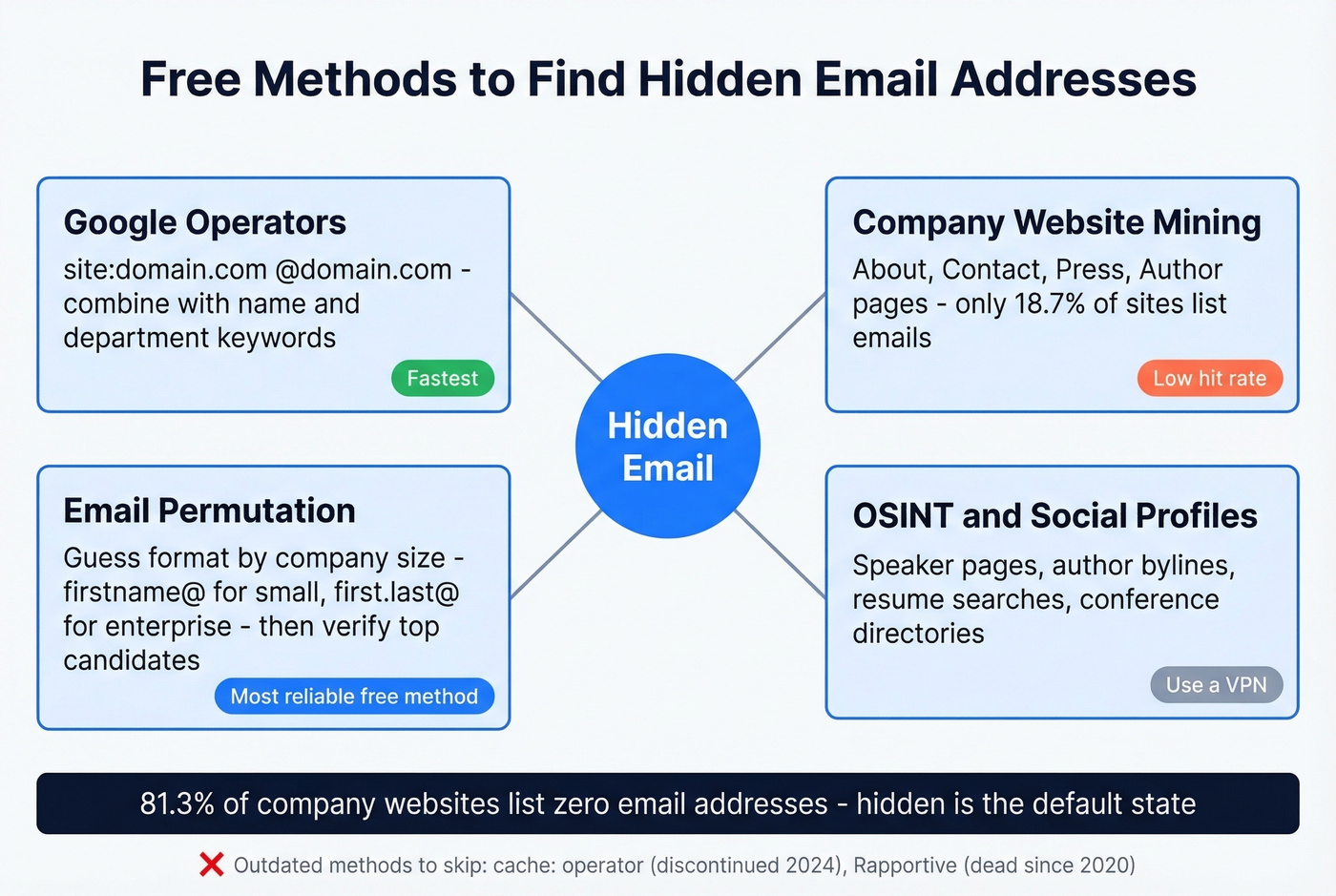
You've got a name, a company, maybe a job title - and the email still bounces at 20%+. That's not unusual. 81.3% of company websites don't list a single email address, which means "hidden" is the default state for professional emails. Learning how to find hidden email addresses starts with accepting that reality, then picking the right method for your volume.
The quick version:
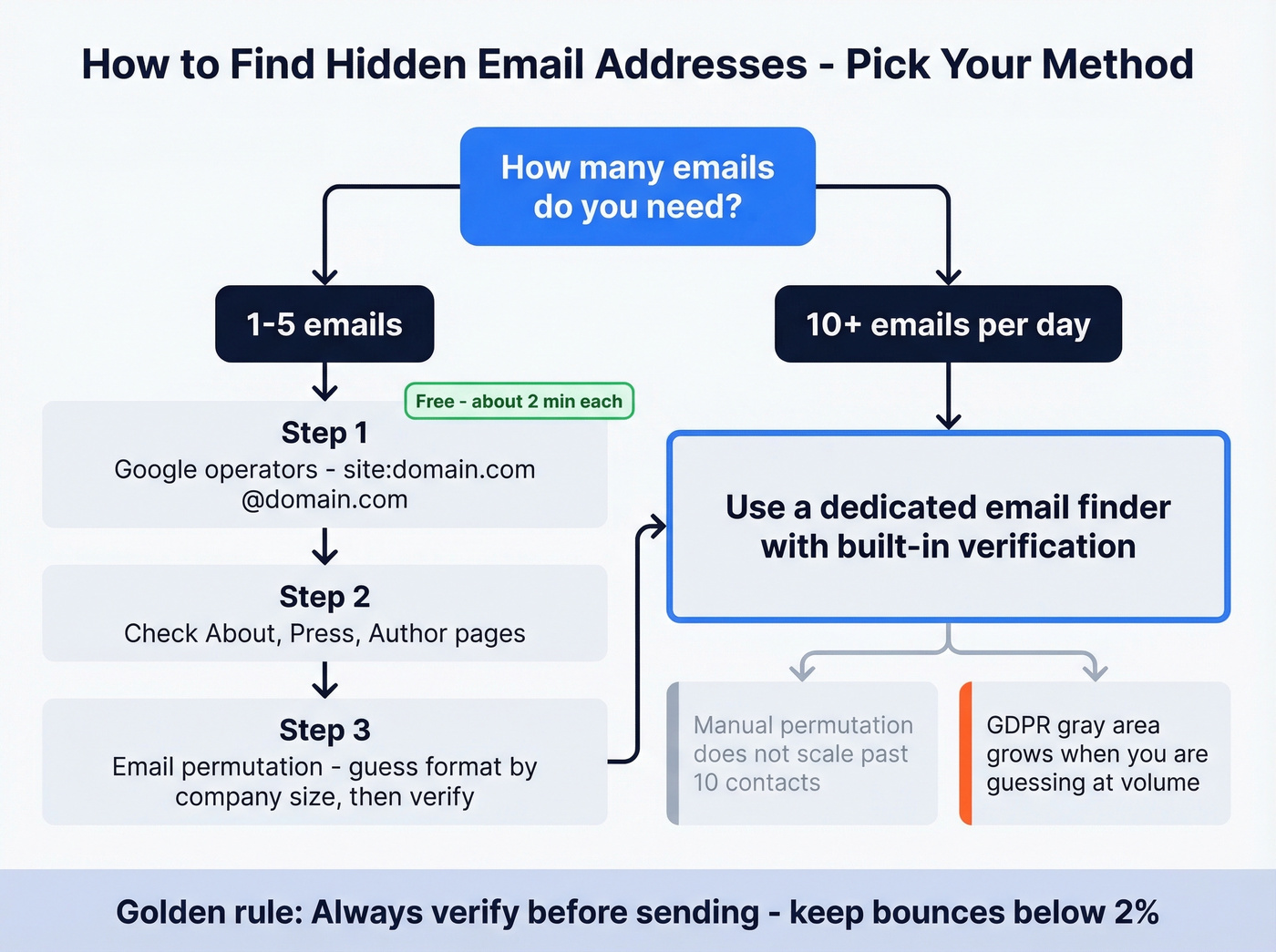
- 1-5 emails: Google operators + email permutation. Free, about 2 minutes each.
- 10+ emails/day: Use a dedicated finder - manual methods don't scale.
What "Hidden" Actually Means
In B2B, "hidden" just means the email isn't published anywhere obvious - no contact page, no footer, no author byline. There's no vault to crack. The company made a design choice not to list emails, and you need the right lookup method to work around it. This applies whether you're reaching an investor, a journalist, or a potential customer.
Free Methods That Actually Work
Google Search Operators
Google dorking is the fastest free method. Copy-paste these:
site:example.com "@example.com"
"Full Name" site:example.com ("contact" OR "email" OR "@")
Combine operators for department-specific results: add ("marketing" OR "sales") to pull pages that often list direct addresses. One thing to note - the cache: operator was discontinued in 2024, so any guide still recommending it is outdated.
Mine the Company Website
Check About, Contact, Author, and Press pages. An analysis of roughly 905,000 company websites found only 18.7% mentioned any email address, so this is quick to try but low probability.
A less obvious trick: subscribe to the company's newsletter. The sending address often reveals the email format. You can also check WHOIS records for domain-level contact info.
Email Permutation by Company Size
If you know someone's name and domain, you can guess the format - but which format you guess first matters. We've tested this workflow across hundreds of contacts, and the company-size crossover holds up consistently.
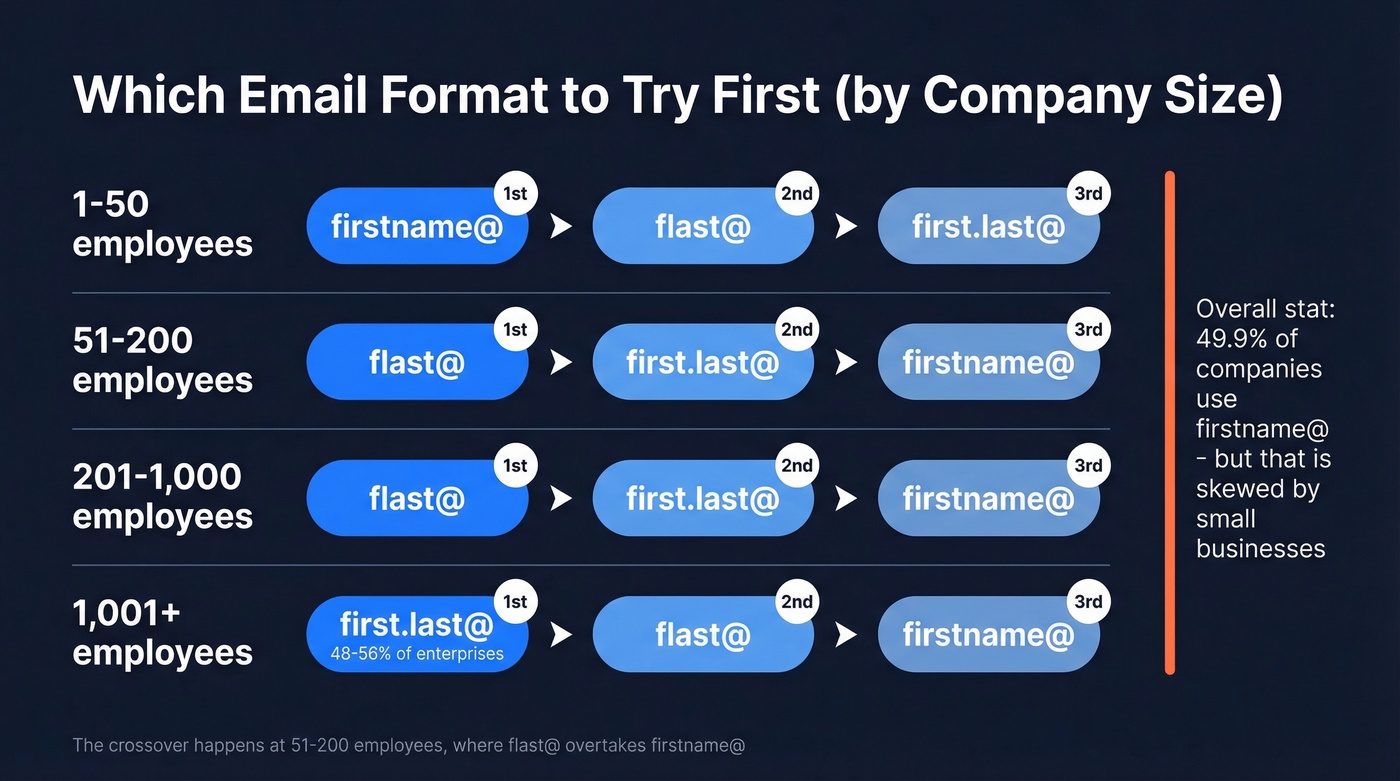
An analysis of 5M+ companies mapped format prevalence by size mapped format prevalence by size:
| Company Size | Try First | Try Second | Try Third |
|---|---|---|---|
| 1-50 employees | firstname@ |
flast@ |
first.last@ |
| 51-200 | flast@ |
first.last@ |
firstname@ |
| 201-1,000 | flast@ |
first.last@ |
firstname@ |
| 1,001+ | first.last@ |
flast@ |
firstname@ |
The crossover happens at 51-200 employees, where flast@ overtakes firstname@. At 1,000+, first.last@ dominates at 48-56%. Overall, 49.9% of companies use firstname@domain, but that stat is skewed by the sheer number of small businesses. And if you see a guide recommending Rapportive for hover-verification - it's been dead since roughly 2020.
Generate permutations with a free tool like Metric Sparrow (46 variations), then verify the top candidates. Budget about 2 minutes per contact.
OSINT and Social Profiles
Conference speaker pages, author bylines, and professional profile bios are goldmines for direct emails that aren't on the main company site. Try OSINT-specific queries like "name@example.com" AND resume OR CV to surface documents with embedded addresses.
Here's the thing: free lookup tools log your queries, IP, and device info. An OPSEC analysis from OSINT Combine breaks this down in detail. Use a VPN if discretion matters.

You just spent 2 minutes guessing one email format. Prospeo finds and verifies hidden emails in seconds - 300M+ profiles, 98% accuracy, catch-all handling built in. No list cleaning after the fact.
75 free emails/month. No credit card, no contracts, no guessing.
When to Use a Dedicated Tool
Permutation works for one or two contacts. It doesn't work for ten. There's also a compliance wrinkle - GDPR and CCPA require legitimate basis for outreach, and guessing emails sits in a gray area that gets grayer every year. The right tool collapses a 2-minute manual process into seconds with better accuracy.
Let's be honest: most teams overthink tool selection. If your average deal is under $10k and you're sending fewer than 500 emails/month, you don't need a $15k/year platform. You need accurate data and built-in verification. That's it.
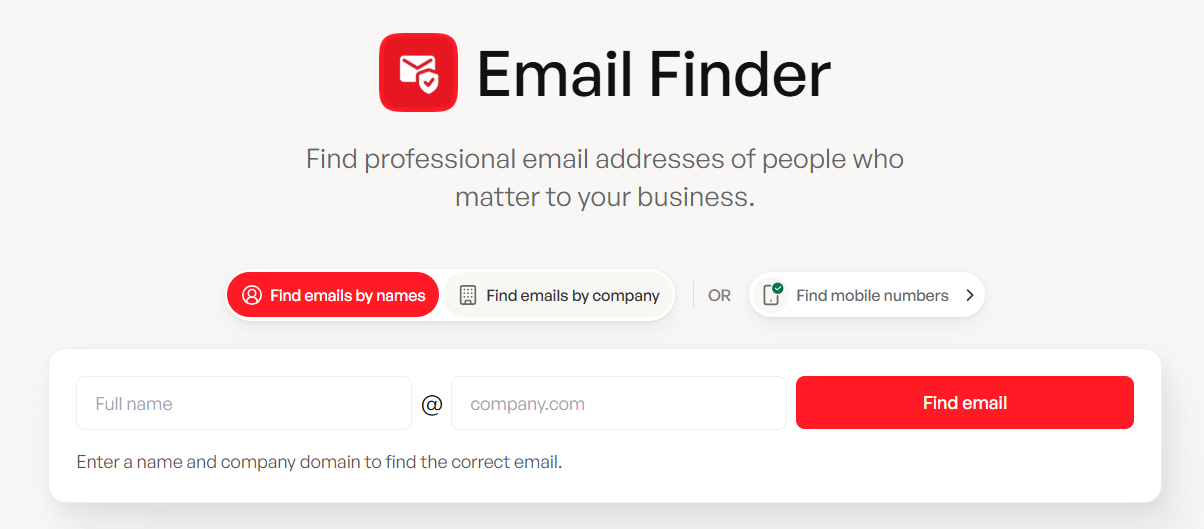
Prospeo - 300M+ profiles, 98% email accuracy, real-time verification on every lookup. The 5-step verification includes catch-all handling, spam-trap removal, and honeypot filtering, so you're not cleaning lists after the fact. Free tier: 75 emails/month + 100 Chrome extension credits/month. Credit-based pricing from roughly $0.01/email, no contracts, cancel anytime. The Chrome extension lets you find emails directly from any website.
Hunter - well-known brand with a solid verification layer. Better as a verification tool than a primary finder due to a smaller database. Free tier: 50 requests/month. Paid from $49/mo.
RocketReach - practitioners on r/coldemail report strong accuracy for mid-size SaaS targets. $49-$299/mo depending on volume.
Apollo - massive database (250M+ contacts) with a generous free tier. The tradeoff: Reddit users consistently flag bounce problems on older contacts. Great for volume, less reliable on stale records. Paid plans from $49/mo. Skip this one if your domain reputation is already fragile - a few bad bounces compound fast.
One concept worth knowing: waterfall enrichment - running a contact through multiple data sources sequentially until you get a verified hit. If your primary tool misses, the next one catches it. Some teams build this into their stack manually; others use platforms that handle it natively.
Verify Before You Send
Finding the email is half the job. Sending to an unverified address torches your domain reputation. The benchmark: keep total bounces below 2%, hard bounces under 1%. It takes three months to warm a domain and three seconds to burn it.
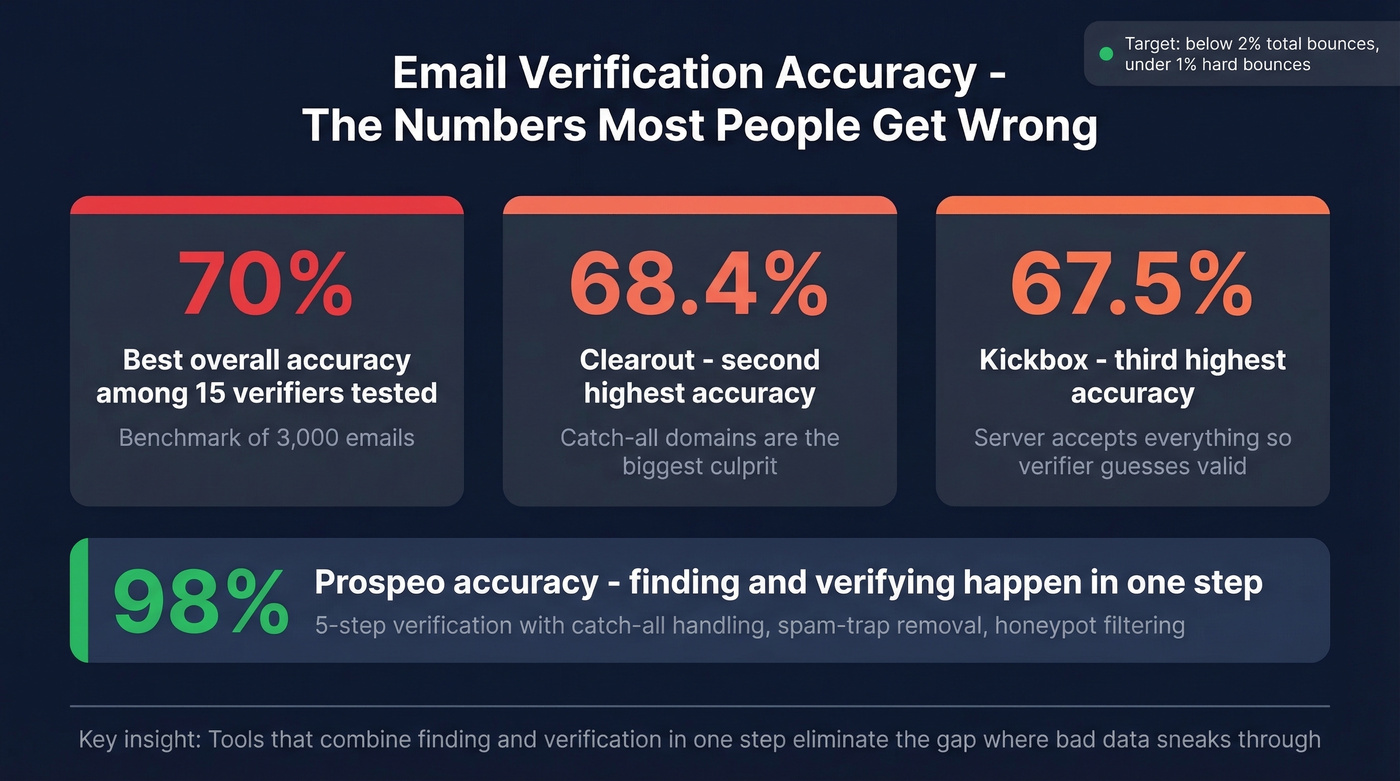
Most people assume verification tools are highly accurate. They're not. In a benchmark of 15 verifiers across 3,000 emails, the best overall accuracy was 70%, followed by Clearout at 68.37% and Kickbox at 67.53%. The catch-all domain problem is the biggest culprit - the server accepts everything, so the verifier says "valid" when it's really guessing. Tools that combine finding and verification in one step eliminate the gap where bad data sneaks through, which is why we prefer that approach for any real outbound volume.
Most verifiers top out at 70% accuracy on catch-all domains. Prospeo's 5-step verification - with spam-trap removal and honeypot filtering - hits 98% because finding and verifying happen in one step. At $0.01/email, it costs less than the domain reputation damage from one bad bounce.
Stop burning domains on unverified guesses. Verify as you find.
Quick Compliance Check
GDPR fines run up to EUR 20M, but finding a business email isn't where teams get in trouble - it's what happens next. Tracking opens and clicks without consent is where the real exposure lives. CAN-SPAM requires a functioning opt-out in every message. Honor unsubscribes promptly, and don't pretend a cold email is a "relationship" email.
FAQ
What's the most common business email format?
firstname@domain at 49.9% of companies based on 12M+ email addresses. But at enterprises with 1,000+ employees, first.last@ dominates at 48-56%. Always check company size before guessing.
Are free email finder tools accurate enough?
The best verification tools hit 67-70% accuracy in independent benchmarks. Free finders without built-in verification perform worse. Prospeo's free tier (75 emails/month) includes real-time verification at 98% accuracy - a stronger option than unverified free tools.
How do I find a journalist's hidden email?
Check author bylines, media kit pages, and press directories first. If the email isn't published, use Google operators with the publication's domain or run the journalist's name through an email finder. Most newsrooms use a consistent format like first.last@outlet.com, so permutation is especially effective here.
Can I get in legal trouble for finding someone's email?
Finding a business email is generally legal in most jurisdictions. The risk is in tracking without consent or ignoring opt-out requests, which triggers GDPR and CAN-SPAM penalties. Always include a working unsubscribe link.
What's the fastest way to find a verified business email?
Use a tool with built-in verification - searching 300M+ profiles with real-time validation takes seconds versus 2+ minutes with manual permutation. Free tiers from tools like Prospeo and Hunter let you test the workflow before committing budget.