

How to Find Out Who Owns a Business Name: 8 Methods That Actually Work
You searched the state database, found the LLC, and the only name listed is "Registered Agents Inc." Now you're stuck. If you're trying to find out who owns a business name, here's the frustrating reality: no single national database for business ownership exists in the U.S. That's absurd in 2026, and it's not changing anytime soon - FinCEN's March 2025 interim final rule exempted domestic U.S.-created entities from beneficial ownership reporting entirely.
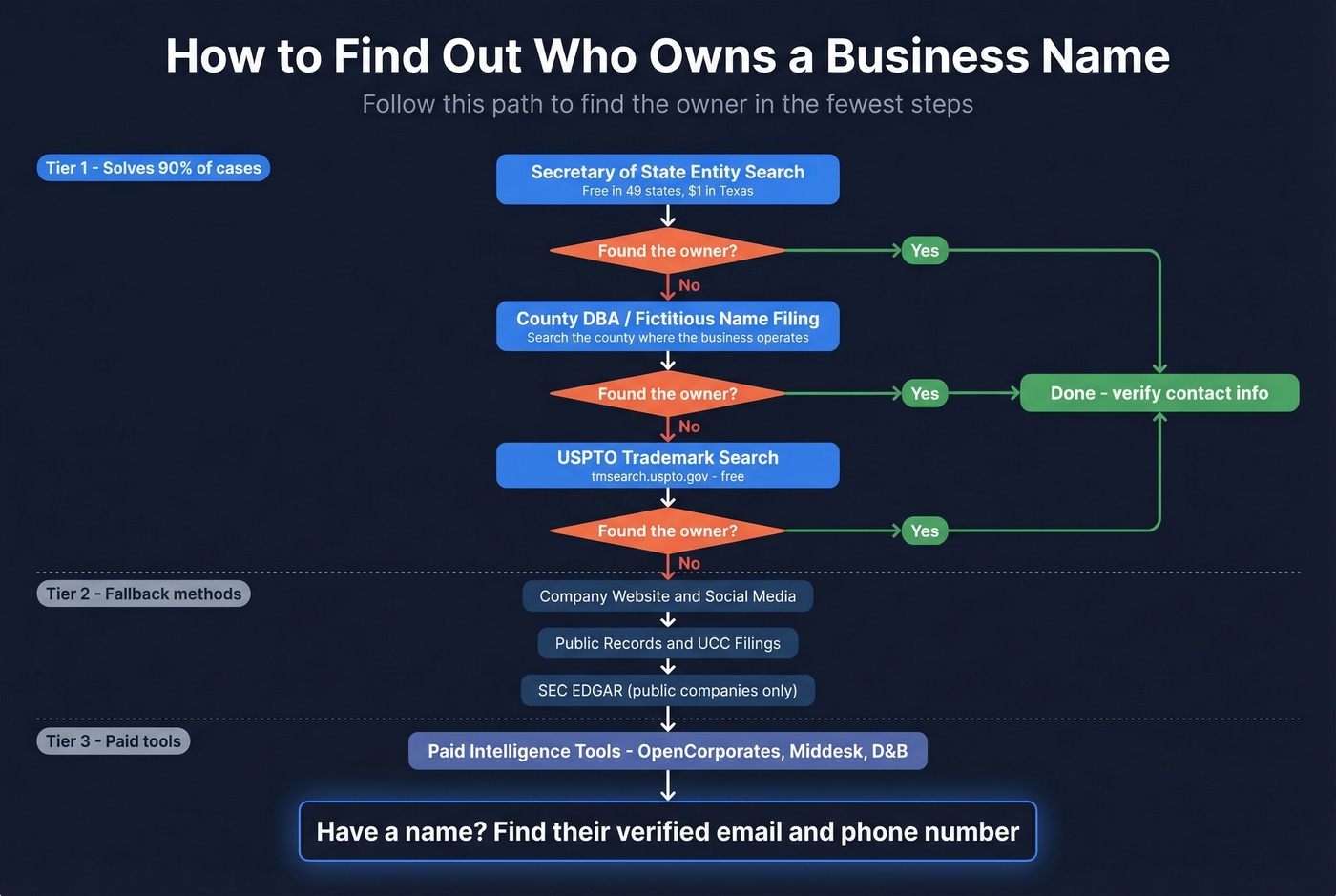
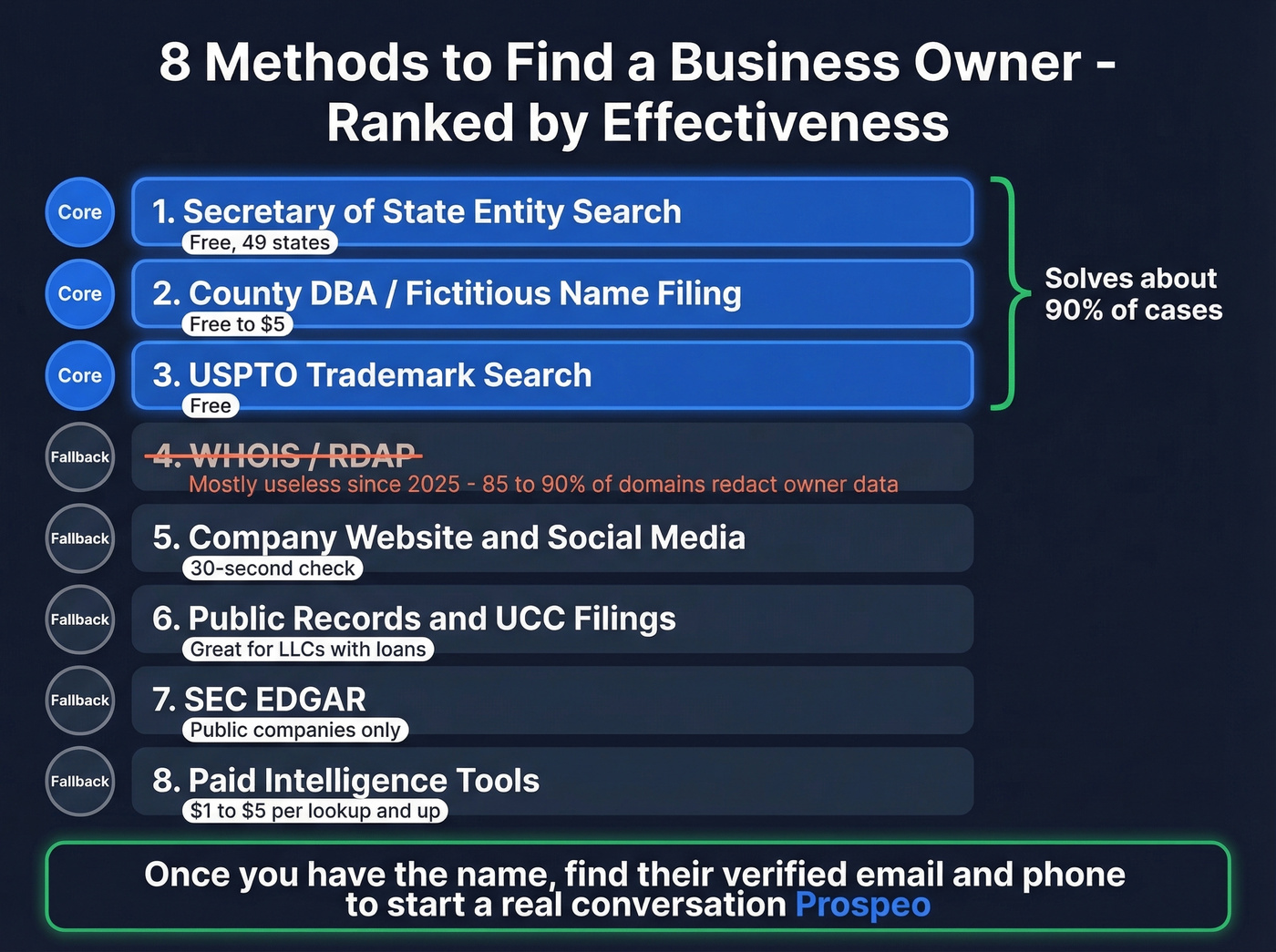
Most guides list eight or ten methods and treat them all equally, as if checking the BBB is as useful as searching the Secretary of State database. It isn't. Three methods solve about 90% of cases: your Secretary of State business entity search, county DBA filings for trade names, and a USPTO trademark search for brands. Everything else below is a fallback for tougher cases.
Eight Ways to Find a Business Owner
1. Secretary of State Entity Search
Every state plus DC offers a free online business entity search. This is your first stop, every time. Find the "Business Entity Search" tool on your state's Secretary of State website and type in the business name. You'll get the entity type, formation date, status, and registered agent.
Here's the distinction most people miss: the registered agent isn't the owner. About 70% of LLCs use professional registered agent services, so you'll often see Northwest Registered Agent or CT Corporation listed instead of a human name. Don't stop at the summary page.
Pull the actual filing documents. Click through to the articles of organization PDF or the most recent annual report - some states include member or manager names in these documents even when the summary page hides them. In our experience, recent annual filings are more useful than the original formation docs about 80% of the time because they reflect current ownership. One quirk worth knowing: Texas charges $1 per search, while every other state is free.
Use this if you know the business's legal name and state of formation. Skip this if the business operates under a trade name like "Joe's Pizza" - that's a DBA, and it won't appear here.
2. County DBA / Fictitious Name Search
When a sole proprietor or partnership operates under a name that isn't their legal name, they file a DBA - Doing Business As - statement with their county clerk. These filings reveal exactly what state databases hide: the owner's legal name and address.
Say you're trying to find who owns "Sunrise Bakery" in Los Angeles. That trade name won't appear in California's SOS database because it's not a registered entity. But LA County maintains an open data portal for Fictitious Business Name statements, with an online name search covering April 2011 to present. In New Jersey, you'd go through the county clerk's office where the business is located.
The catch: there's no national aggregator for DBA records. You search county by county, and costs range from free to $5.
3. USPTO Trademark Search
This method is genuinely underexplored. If the business name is trademarked, the federal trademark registration reveals the registrant's legal name and address - powerful for brand name lookups that most guides completely ignore.
Go to tmsearch.uspto.gov, which replaced the old TESS system on November 30, 2023. Search by "owner," enter the business name, and review the results. Each links to TSDR for full filing details including the registrant's name, address, and filing history. The tool supports wildcards, Boolean operators, and RegEx for expanded searches - use the field tag CM: to search across word, translation, and pseudo mark fields simultaneously.
This covers federal trademarks only, so state trademark registrations require separate searches. But for any business with a nationally recognized brand, it's a goldmine.
4. WHOIS and RDAP - Skip This
Look, any guide still recommending WHOIS as a primary method is giving you outdated advice.
WHOIS on port 43 is no longer mandatory for gTLDs as of January 28, 2025. Hundreds of TLDs have disabled it, and query volume dropped roughly 60%. RDAP, the Registration Data Access Protocol that replaced it, redacts registrant personal data by default to comply with GDPR. Around 85-90% of gTLD domains now show only registrar info, not the actual registrant's name or email. You can still try a lookup - occasionally older registrations or certain ccTLDs expose owner data - but don't build your strategy around it.
5. Company Website and Social Media
The fastest check, though the least reliable for formal ownership. About/Team pages often list founders and principals. Company pages on professional networks usually show key personnel. Footer links sometimes point to state business filings or parent companies, and press releases frequently name the founding team.
This won't give you legal ownership documentation, but it's a 30-second check that sometimes answers the question immediately.
6. Public Records and UCC Filings
When state databases and DBA filings come up empty, public records offer a backdoor. Property records at the county recorder's office reveal who signed deeds on behalf of a business - the signer's name and title appear below the signature.
UCC filings are the real sleeper here. If an LLC took out a loan or used assets as collateral, the UCC filing names the debtor - which can surface key individuals tied to the business even when formation documents only show a registered agent. These are public records filed with the Secretary of State, indexed by debtor name, and they last five years before lapsing. Most states have online UCC search databases through their SOS websites. Search multiple name variations: even minor differences like ampersand vs. "and" can make filings invisible.
7. SEC EDGAR for Public Companies
If the business is publicly traded, ownership data is freely available at sec.gov/edgar. The filings that matter: Schedule 13D/13G for anyone acquiring more than 5% of voting securities, DEF 14A proxy statements disclosing equity owned by directors and officers, and Forms 3, 4, and 5 for insider transactions reported within two business days. Search by company name or ticker.
8. Paid Business Intelligence Tools
When free methods hit a wall, paid tools aggregate data across jurisdictions. OpenCorporates pulls from 200M+ company records across global registries - the free tier handles basic lookups, with custom API pricing for volume. Middesk connects to all 52 U.S. state registries plus IRS tax ID records, with pricing around $1-$5 per lookup for compliance teams. Dun & Bradstreet offers deep corporate hierarchies and credit data, typically at $10K+/year for enterprise access.
These tools help you identify the owner. To actually reach them, you need verified contact data. Once you have a name, a platform like Prospeo can find their verified email at 98% accuracy and pull a direct mobile number from 125M+ verified numbers - the free tier includes 75 email lookups per month.

Identifying who owns a business is step one. Reaching them is step two. Prospeo turns owner names into verified emails (98% accuracy) and direct mobile numbers from 125M+ verified records - so you go from a Secretary of State filing to a real conversation.
Stop at the name and you've done half the work. Get the contact data.
Why You Can't Always Find the Owner
Some states are designed to keep business owners anonymous. Here's how the four "anonymous LLC" states compare:
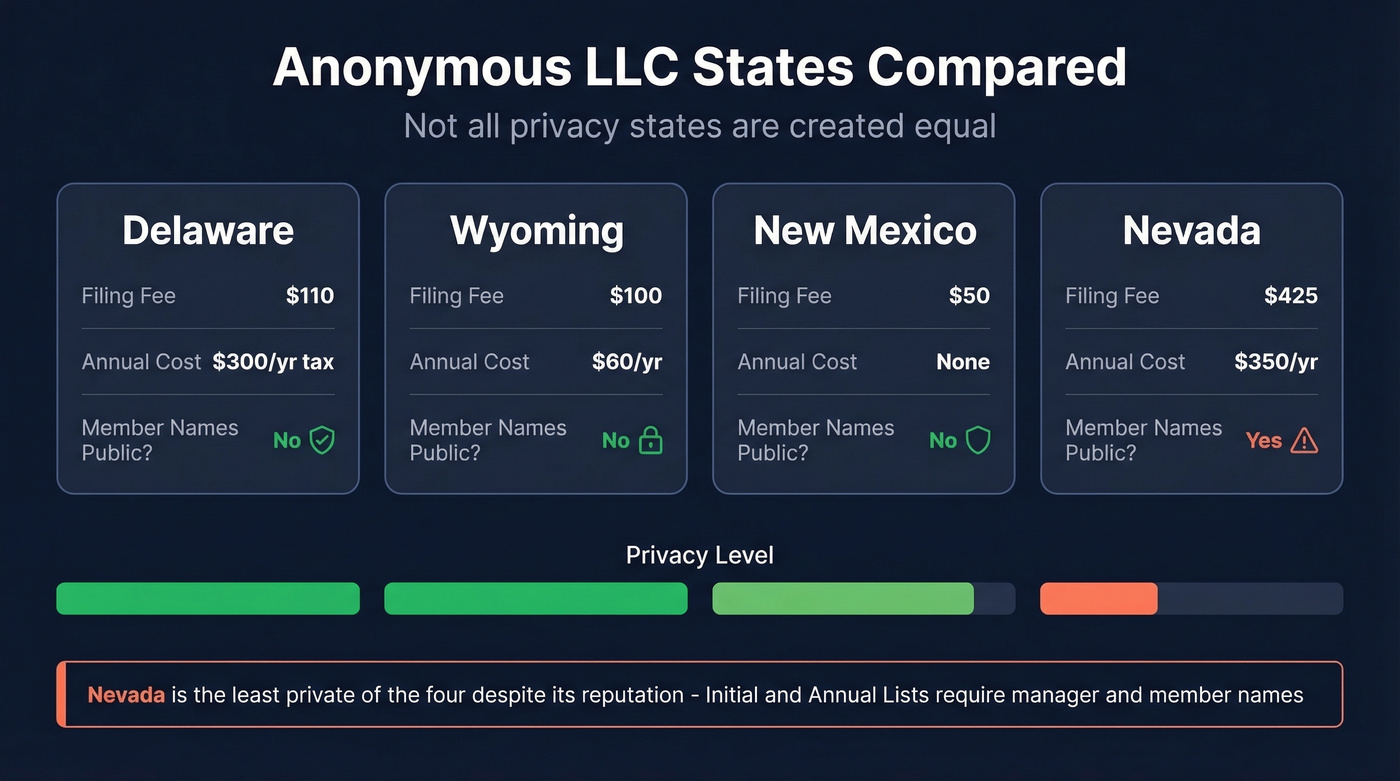
| State | Filing Fee | Annual Cost | Member Names Public? |
|---|---|---|---|
| Delaware | $110 | $300/yr tax | No |
| Wyoming | $100 | $60/yr | No |
| New Mexico | $50 | None | No |
| Nevada | $425 | $350/yr | Yes - Initial and Annual Lists require manager/member names |
Nevada's reputation as a privacy haven is a myth. Despite heavy marketing, it's the least private of the four. Delaware and Wyoming offer the strongest public-record privacy for LLCs.
The common workaround - discussed frequently on r/llc - is forming a Holdings LLC in Wyoming, then creating operating LLCs in the business state with the Holdings LLC as the registered owner. You add a professional registered agent and virtual office address, and the actual human owner's name appears nowhere in public filings. We've tested this structure across a dozen states, and it works exactly as advertised.
What about the Corporate Transparency Act? FinCEN's March 21, 2025 interim final rule removed BOI reporting requirements for all U.S.-created entities and U.S. persons. The Eleventh Circuit upheld the CTA's constitutionality on December 16, 2025, but that ruling didn't reinstate domestic reporting - and the BOI database was never intended for public searches anyway. For anyone hoping a federal database would solve this, that door is closed.
Here's my honest take: if your deal size is modest and you're just trying to reach a local business owner, you don't need to crack anonymous LLC structures. The Secretary of State search plus a DBA check will get you there 90% of the time. Save the forensic work for high-value targets.
Putting It All Together
Knowing how to find out who owns a business name comes down to working through the right sources in order. Start with the Secretary of State entity search and DBA filings - they cover the vast majority of cases. Escalate to trademark lookups, UCC filings, and paid intelligence tools only when the easy paths come up empty. And once you have a name, turn it into a conversation with verified contact data.
You just spent 30 minutes digging through state filings, DBA records, and trademark databases to find a business owner's name. Prospeo finds their verified email for $0.01 and a direct mobile number - 75 free email lookups included, no credit card required.
Turn business owner names into direct conversations today.
FAQ
How do I find who owns an LLC if the state filing only shows a registered agent?
Pull the LLC's annual report or articles of organization PDF - some states include member names there. If those are blank, try county property records or UCC filings at the Secretary of State. States like Delaware and Wyoming don't require member names in any public filing, so you'll need to work the fallback methods above.
Is there a free national database for business ownership?
No. Business registrations are handled state by state and county by county. OpenCorporates aggregates 200M+ records from global registries into one free search, but coverage varies by jurisdiction and doesn't always include owner names.
Can I look up business ownership for free?
Yes. Secretary of State entity searches are free in 49 states (Texas charges $1), and county DBA filings typically cost $0-$5. The USPTO trademark search at tmsearch.uspto.gov is also free. Combined, these three methods resolve roughly 90% of business ownership questions at zero cost.
How do I contact a business owner once I've identified them?
Use a contact data platform to find their verified email and direct phone number. Prospeo's free tier includes 75 email lookups per month at 98% accuracy - enough to verify a handful of business contacts without spending anything.