

How to Handle Sales Rejection in 2026 (Data + Frameworks)
It's 2pm on a Tuesday. You've made 47 calls. Six humans picked up. Two told you to lose their number. One asked if you could call back "sometime next quarter" - which you both know means never. The rest went to voicemail.
If you're wondering how to handle sales rejection without losing your mind, you're not alone. As one rep on r/sales put it: "I expected all the rejection, but I didn't anticipate just how poorly it would make me feel."
Rejection in sales is a math problem, a psychology problem, and sometimes a data problem. Most advice focuses on mindset alone. That's incomplete. We're covering all three.
The Rejection Math
Before you can deal with rejection, you need to understand how much of it is baked into the job.
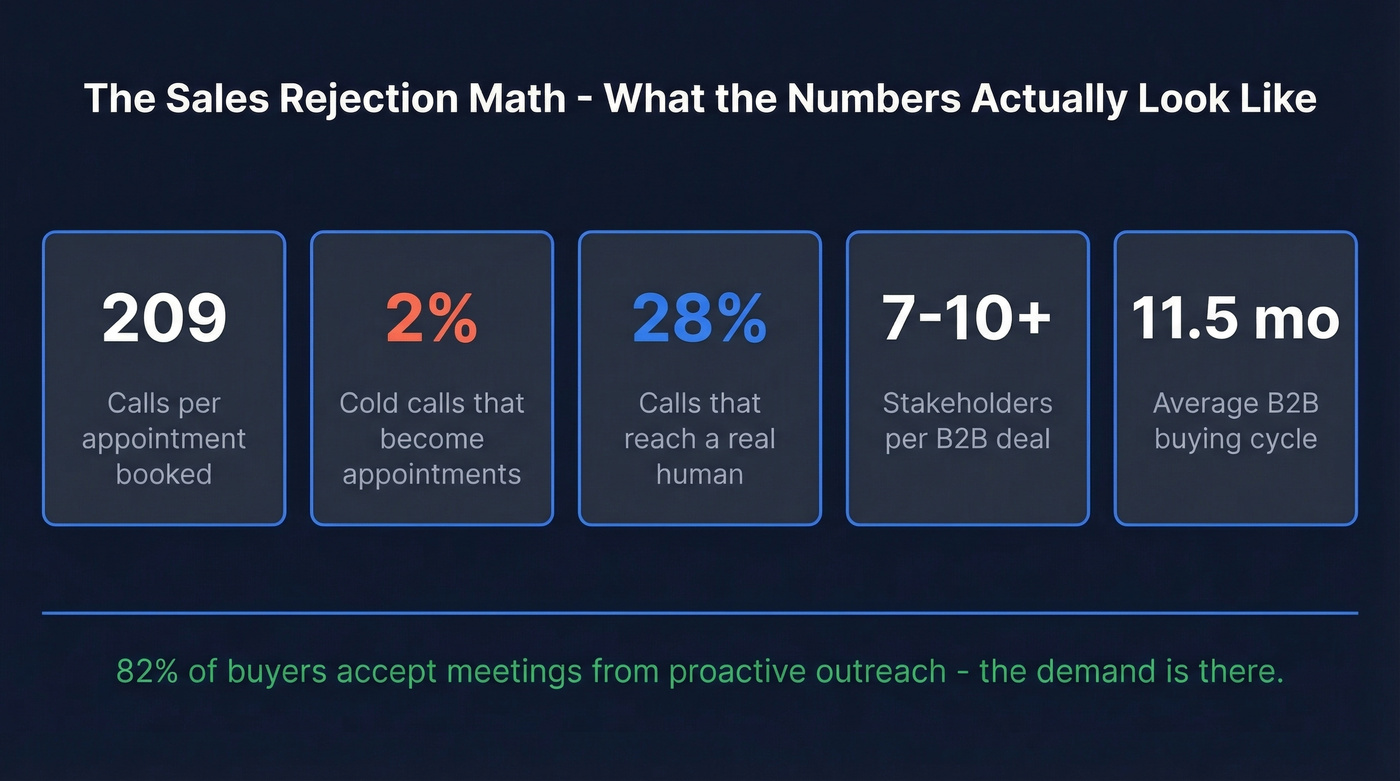
72% of cold calls don't reach a human. The average is 209 calls per appointment booked, and it takes roughly 7.5 hours of cold calling to generate a single meeting. Let that sink in.
And it's not just the phones. B2B buying decisions now involve 7+ stakeholders at mid-sized companies, with 10+ in larger orgs. Average buying cycles run 11.5 months. Even when you reach the right person and have a great conversation, the deal can stall for reasons that have nothing to do with you - budget freezes, reorgs, a new VP who wants to "re-evaluate everything."
| Metric | Benchmark |
|---|---|
| Calls per appointment | 209 |
| Cold calls to appointment | 2% |
| Calls reaching a human | 28% |
| Stakeholders per deal | 7-10+ |
| Avg B2B buying cycle | 11.5 months |
But here's the flip side that keeps the best reps dialing: 82% of buyers accept meetings from proactive outreach, and 69% accepted at least one cold call in the past year. The demand is there. The math just requires volume.
When you internalize these numbers, hearing "no" 98 times out of 100 stops feeling like a performance problem. It's the baseline. Your job isn't to eliminate rejection - it's to manage your response and improve the inputs that drive those ratios.
Why Rejection Hurts (It's Literally Pain)
You're not being dramatic. Neuroscientist Naomi Eisenberger's research at UCLA found that social rejection activates the same brain regions involved in physical pain - specifically the anterior insula and dorsal anterior cingulate cortex. When a prospect hangs up on you, your brain processes it the same way it processes stubbing your toe. Except you're doing it dozens of times a day.
The compounding effects are real. Researcher C. Nathan DeWall has documented that repeated social exclusion leads to poorer sleep quality and weaker immune function. Gallup's 2024 State of the Global Workplace report found that 20% of workers experience daily loneliness - and for outbound reps doing 50-100 dials a day in relative isolation, that number is almost certainly higher.
There's also an identity dimension that rarely gets discussed. Rejection doesn't just feel like something that happened to you - it feels like it says something about who you are. The shame and guilt that follow a bad call block aren't rational responses to a statistical outcome. They're your brain conflating professional rejection with personal worth. Reps who tie their self-worth to every prospect's response burn out faster and make worse decisions under pressure. Recognizing that distinction is the first step toward breaking the cycle.
The emotional toll is biological, not a character flaw. You don't need to "toughen up." You need a system.
The 60-Second Reset (SARA Framework)
The SARA framework gives you that system. It's a four-step emotional processing model - Shock, Anger, Reflect, Accept - designed to move you through the rejection response before you pick up the phone again.
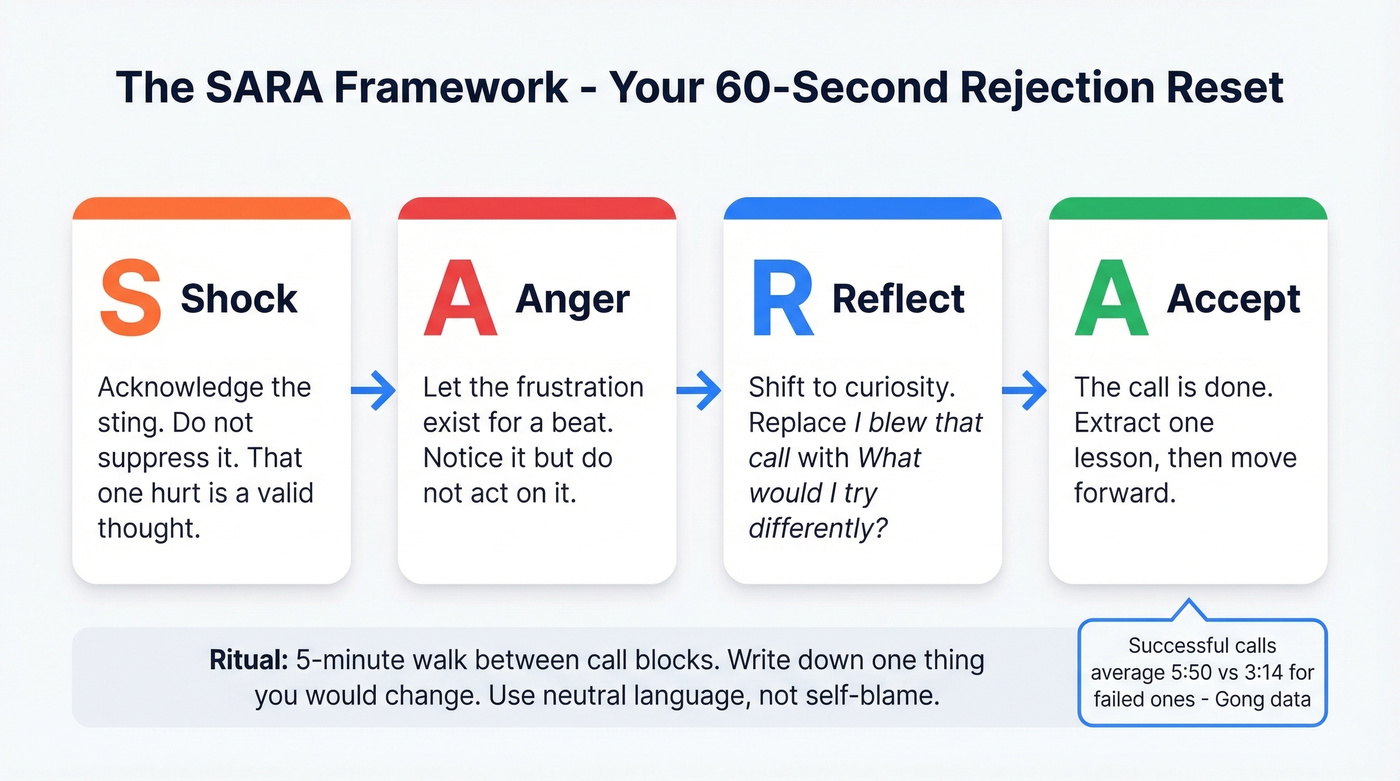
Shock: Acknowledge the sting. Don't suppress it. "That one hurt" is a valid thought.
Anger: Let the frustration exist for a beat. Don't act on it - just notice it.
Reflect: Shift to curiosity. Replace "I blew that call" with "What would I try differently?" This is where James Gross's Stanford research on cognitive reappraisal applies - people who reframe before reacting make better decisions and manage stress more effectively.
Accept: The call is done. Extract one lesson, then move forward.
The concrete ritual: take a 5-minute walk between call blocks. Write down one thing you'd change about the last call. Use neutral debrief language, not self-blame.
There's a performance payoff too. Gong's data shows that successful calls average 5:50 in duration versus 3:14 for failed ones. Reps who build reflection habits tend to ask better questions and hold attention longer - naturally extending productive conversations. The reset isn't just emotional hygiene. It's a skill-building habit.

Half of sales rejection isn't about your pitch - it's about your data. Bad emails bounce, wrong numbers waste dial time, and outdated contacts mean you're calling people who left the company months ago. Prospeo's 7-day data refresh and 98% email accuracy mean every call and email hits a real person.
Turn your 209-calls-per-meeting ratio into something worth celebrating.
When "No" Isn't Really No
Objections vs. True Rejection
9 out of 10 prospects will raise objections. That's normal. What matters is this: 40-60% of deals lost late-stage fail due to indecisiveness, not because the prospect chose a competitor. Most initial "no" responses are knee-jerk reactions to avoid commitment, not informed decisions.
Your job is to diagnose which kind of "no" you're hearing:
- Did they name a specific competing solution, or just say "we're good"?
- Is the timeline vague ("maybe next year") or specific ("not before March")?
- Did they engage with your value prop at all, or shut down immediately?
- Do they have the authority to say yes, or are they deflecting because it's not their call?
That second question deserves extra attention. "Maybe next year" is a brush-off. "Not before March - we're locked into a contract until then" is a buying signal with a timeline attached. Learning to read that difference will change your pipeline overnight.
One instinct to kill immediately: discounting after a "no." It signals desperation and tanks your perceived value. If someone says "no budget," the worst move is dropping your price. The better move is proving ROI with a case study.
Talk Tracks That Move the Needle
Two data points from Gong that should reshape your opener: saying "Is this a bad time?" decreases your chance of booking a meeting by 40%. But explaining why you're calling has a 2.1x higher success rate. Lead with the reason, not the apology.
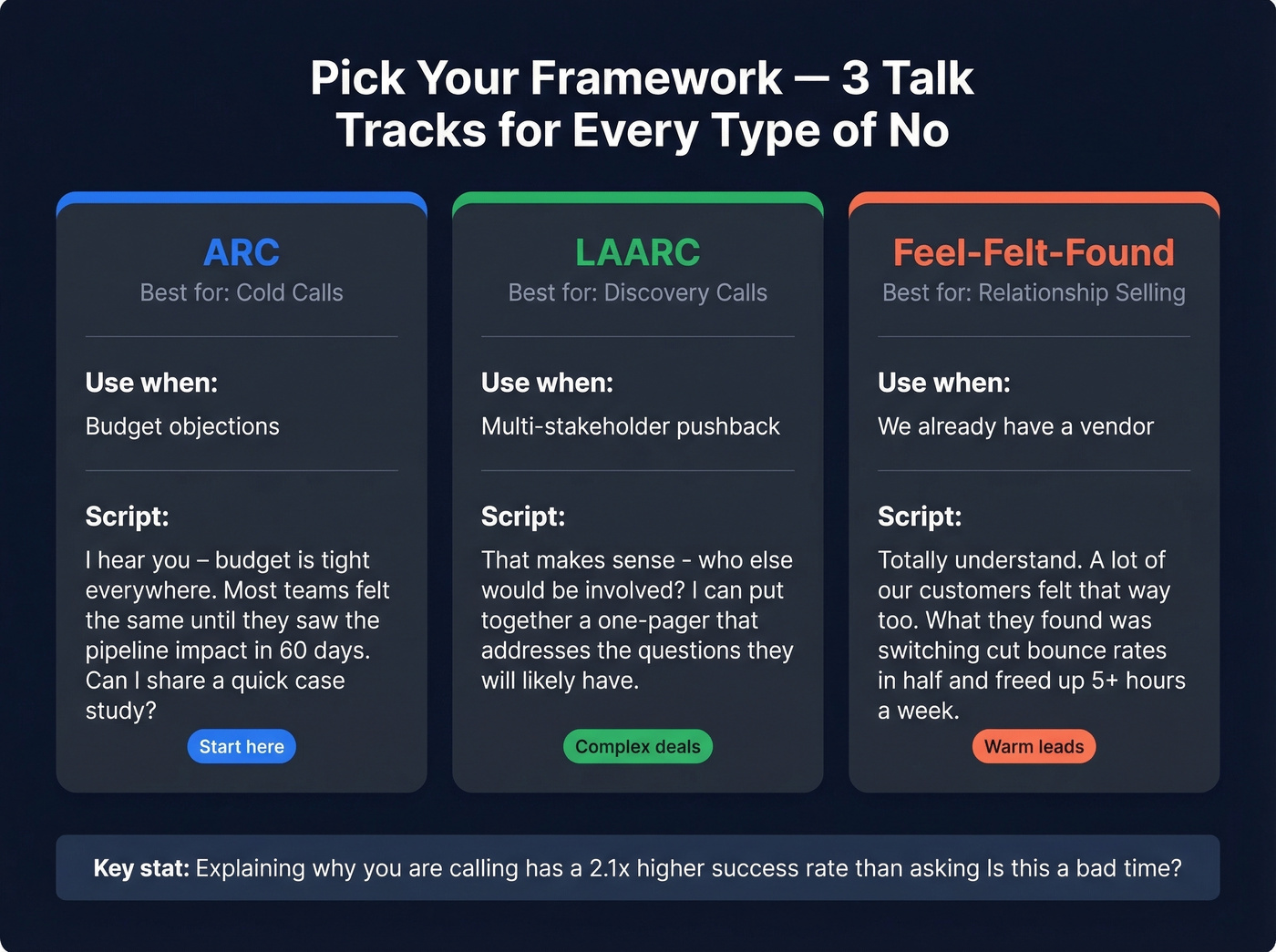
You don't need six frameworks. You need one or two you can execute under pressure.
| Framework | Best For | Example Use |
|---|---|---|
| ARC | Cold calls | Budget objection |
| LAARC | Discovery calls | Complex multi-stakeholder pushback |
| Feel-Felt-Found | Relationship selling | "We already have a vendor" |
ARC script for "no budget": "I hear you - budget's tight everywhere right now. Most teams we work with felt the same way until they saw the pipeline impact in the first 60 days. Can I share a quick case study that shows the ROI?"
Feel-Felt-Found for "we already have a vendor": "Totally understand - I'd feel the same way if I had something in place. A lot of our current customers felt that way too. What they found was that switching actually cut their bounce rates in half and freed up 5+ hours a week per rep."
LAARC for multi-stakeholder pushback ("I need to run this by my team"): "That makes sense - who else would be involved in evaluating this? I can put together a one-pager that addresses the questions they'll likely have, so you're not doing the selling internally."
If you adopt one framework, make it ARC for cold calls and LAARC for discovery calls. That covers most scenarios.
The Follow-Up Playbook
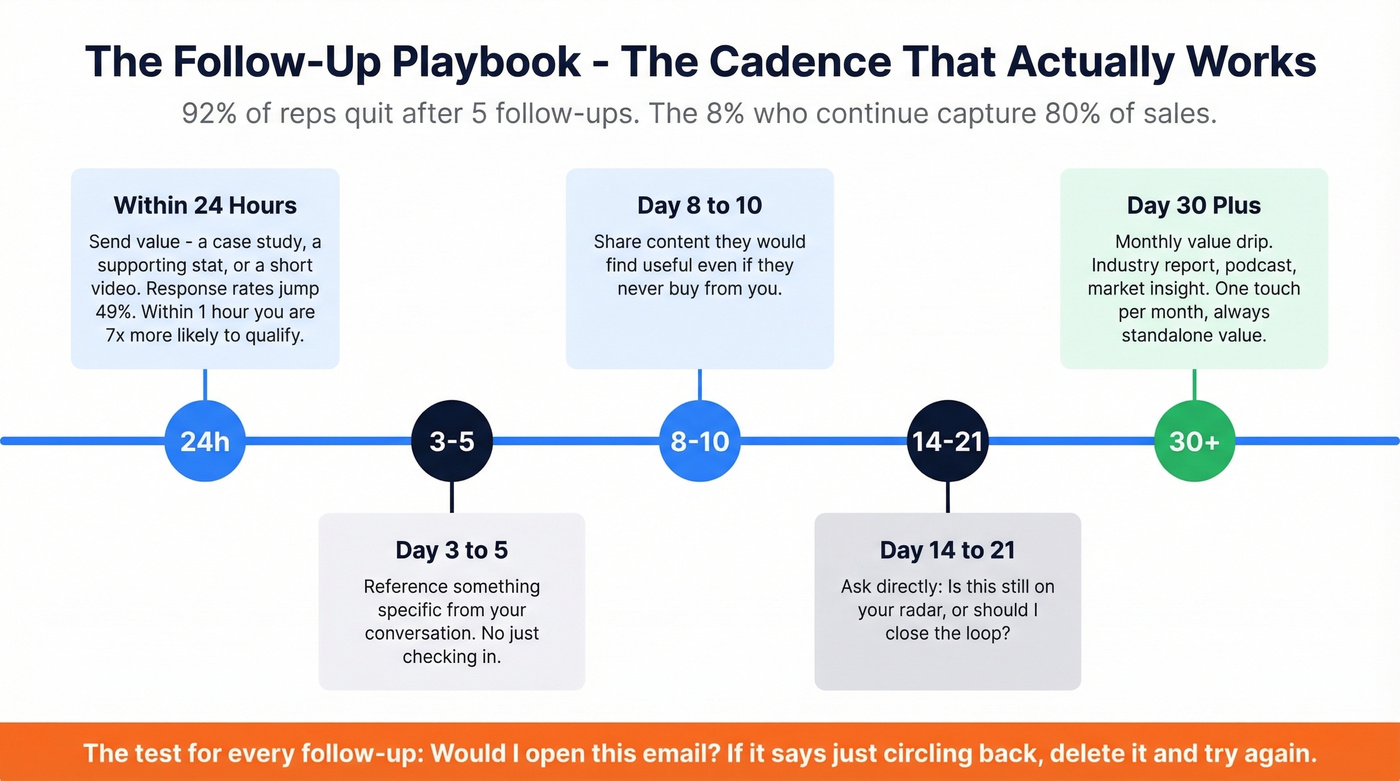
Here's the thing: this is where most reps leave money on the table. 92% of salespeople quit after the fifth follow-up. The 8% who continue capture 80% of sales. Meanwhile, 48% of reps don't follow up at all after the first attempt, and 60% of customers say no four times before buying. The gap between "gave up" and "closed the deal" is often just two or three more touches.
We've seen this pattern over and over in our own outbound: the rep who makes the sixth call beats the rep with the better script who stopped at three. For deals under five figures, persistence on follow-ups matters more than perfecting your pitch.
The cadence that works:
Within 24 hours: Send a follow-up that adds value - a relevant case study, a stat that supports your pitch, a short video walkthrough. Following up within 24 hours boosts response rates by 49%. Within one hour? You're 7x more likely to qualify the lead.
Day 3-5: Reference something specific from your conversation. No "just checking in."
Day 8-10: Share a piece of content they'd find useful even if they never buy from you.
Day 14-21: Ask a direct question: "Is this still on your radar, or should I close the loop?"
Day 30+: Monthly value drip. Share an industry report, a relevant podcast episode, or a quick market insight. One touch per month, always with standalone value.
Every follow-up should pass the "would I open this?" test. If your email says "just circling back," delete it and try again.
Fix Your Data, Fix Your Rejection Rate
Nobody talks about this in rejection-handling articles, but a meaningful percentage of your "no"s aren't real rejection. They're bad data.
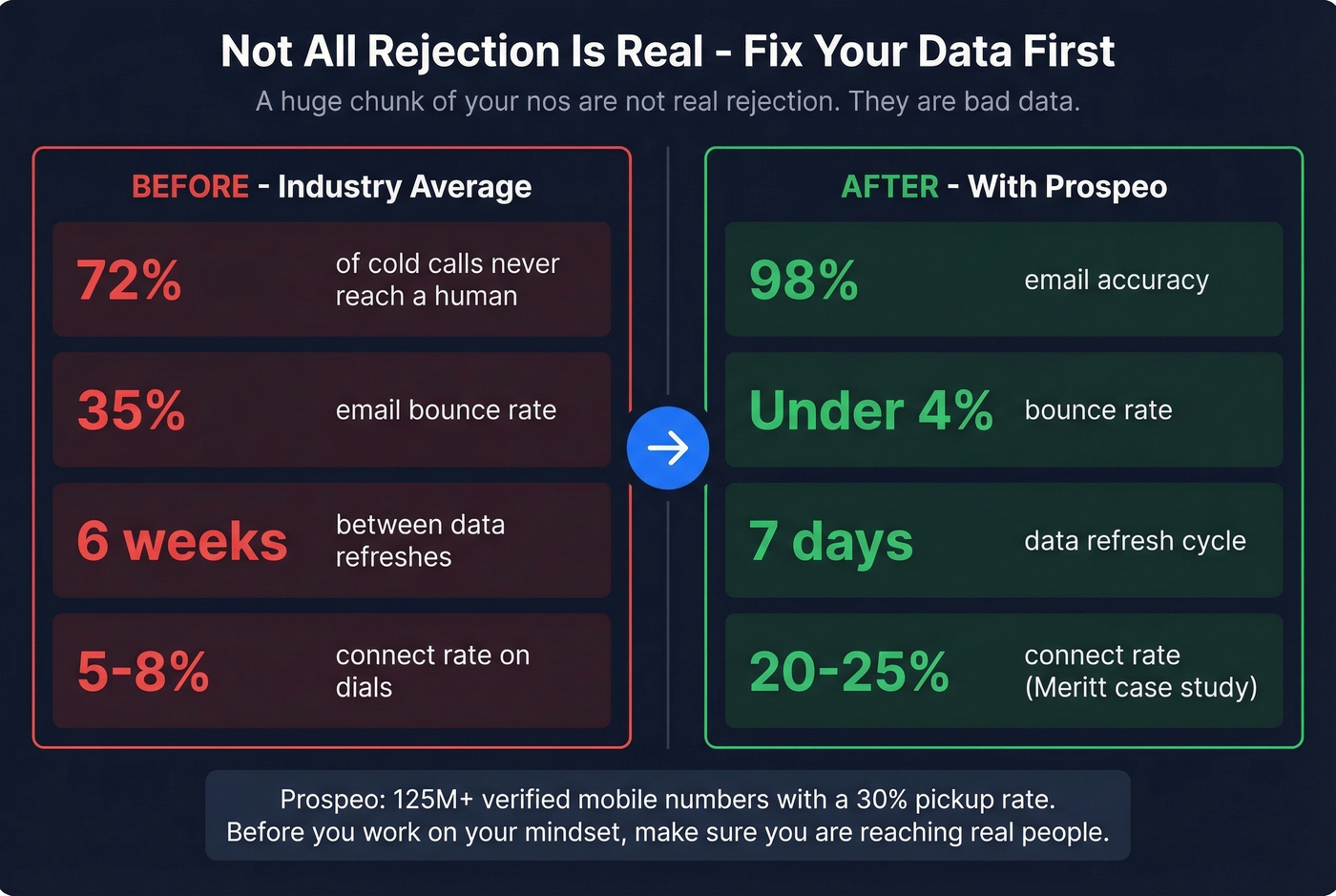
You dial a number and get a fax machine. You reach someone who left the company eight months ago. You send an email that bounces. Each of these registers emotionally as a rejection - another failed attempt, another dead end - but you were never actually rejected by a decision-maker. You were rejected by a database that hasn't been updated since last quarter.
Remember that 72% of cold calls that don't reach a human? How much of that is bad timing versus bad numbers?
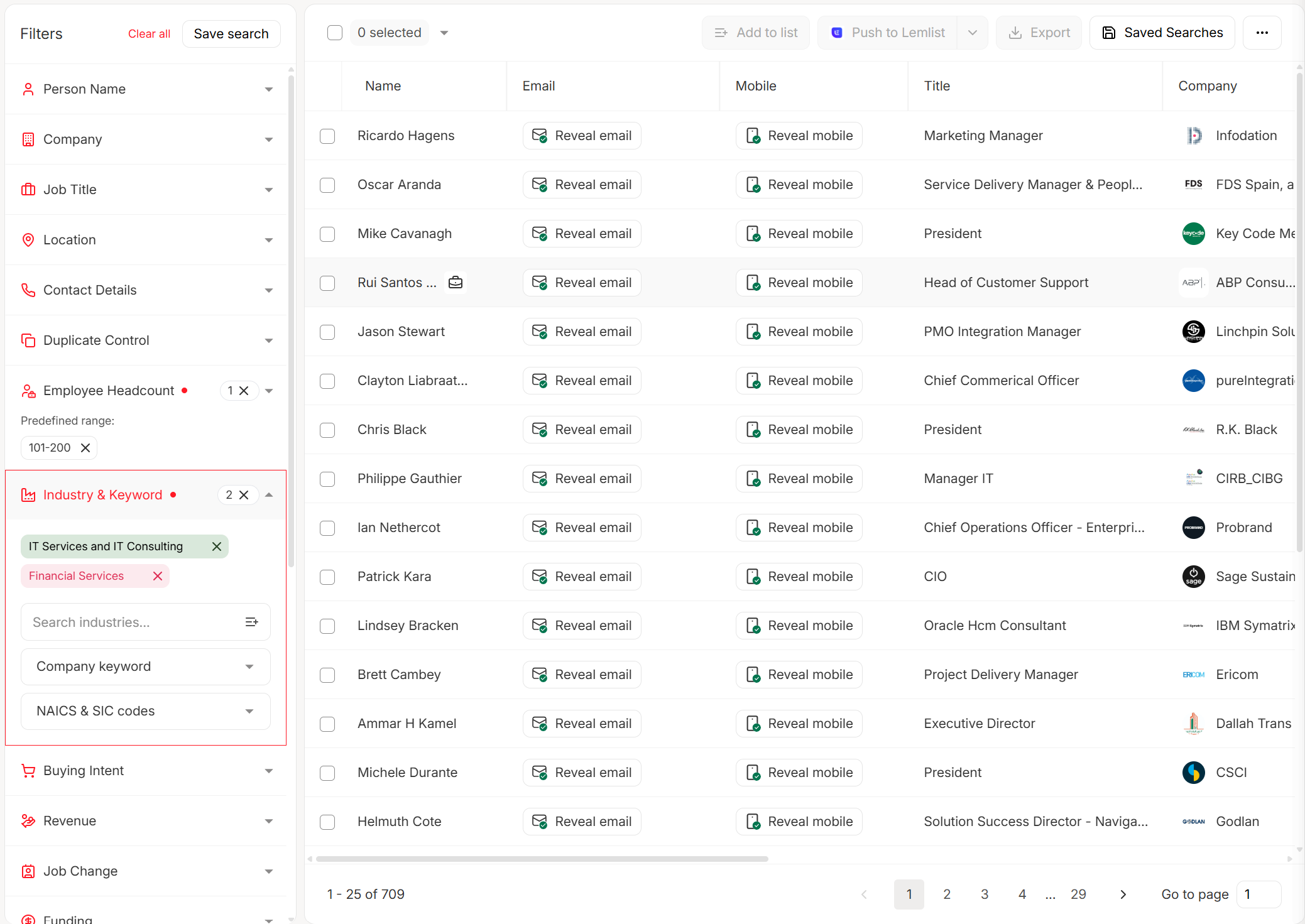
This is where data quality changes the equation. Prospeo's 98% email accuracy and 125M+ verified mobile numbers (delivering a 30% pickup rate) eliminate dead dials before they happen. The platform refreshes data every 7 days versus the 6-week industry average, so you're not calling people who changed jobs two months ago. Meritt saw their connect rate triple to 20-25% and their bounce rate drop from 35% to under 4% after switching. Before you work on your rejection mindset, make sure you're actually reaching the right people.
You read the math: 72% of cold calls never reach a human. A 30% mobile pickup rate changes that equation entirely. Prospeo gives you 125M+ verified direct dials so you skip the gatekeepers and spend your call blocks talking to decision-makers, not voicemail.
Fewer voicemails. More conversations. Less rejection that isn't even about you.
Building Resilience Long-Term
Resilience isn't a personality trait. It's a skill you build through habits, and Sandler Training has been teaching this for decades. The fear of rejection in sales is universal - even top performers feel it. The difference is they've built routines that prevent that fear from dictating their behavior.
Daily habits: Journal one win and one lesson at the end of each day. Two sentences is enough. Run a 5-minute reset ritual between call blocks: walk, breathe, write down one thing to try differently. Focus on controllables - outreach volume, research quality, follow-up discipline. You can't control whether someone picks up. You can control whether you dialed a verified number.
Weekly habits: Debrief with a peer. Pick three calls from the week - one good, one bad, one weird - and talk through what happened. Run a win/loss review focused on process, not just outcomes. Did you follow your framework? Did you ask the diagnostic questions?
For managers: If you lead a team, rejection-handling is a coaching responsibility, not just an individual mindset challenge. Normalize rejection in team meetings. Run call reviews that celebrate persistence metrics - dials made, follow-ups sent, conversations had - not just closed deals. The teams that handle rejection best are the ones where leadership treats it as a shared operational reality, not a personal weakness. Skip the "stay positive" pep talks. Build systems instead.
One scheduling tip worth noting: best call windows are 11am-12pm and 4pm-5pm, with Tuesday and Wednesday outperforming other days. Structure your heaviest dial blocks around those windows and use off-peak hours for research, follow-ups, and resets.
FAQ
How many rejections is normal in sales?
At a 2% cold call appointment rate, expect roughly 98 non-conversions per 100 dials. The Bridge Group benchmarks 209 calls per appointment booked - that's industry average, not underperformance. Top reps aren't hearing fewer "no"s. They process them faster and follow up more consistently.
Should I follow up after a prospect says no?
Almost always yes. 60% of customers say no four times before buying, yet 48% of reps never follow up after the first attempt. Send a value-add follow-up within 24 hours - a relevant case study, not "just checking in." The only exception is a hard "remove me from your list." Respect that immediately.
How do I stop taking rejection personally?
Eisenberger's UCLA research confirms social rejection activates the same brain regions as physical pain - it's neurological, not a character flaw. Use the SARA framework as a 60-second reset between calls. Also verify you're reaching the right people - if half your dials hit dead numbers, you're absorbing micro-rejections from bad data, not from actual prospects.
What should managers do to help reps handle rejection?
Stop telling reps to "stay positive" and start building systems. Run weekly call reviews focused on technique, not just outcomes. Track activity metrics alongside revenue so reps see progress during dry spells. Pair newer reps with veterans for structured debriefs. Let's be honest - the best sales floors treat rejection as a team sport, not a solo battle.