

How to Respond When Someone Says "I Don't Have Time"
Your cold call dies at second three. Your friend leaves a text on read for a week. Your direct report dodges the project you assigned yesterday. Same four words every time - "I don't have time" - but completely different meanings.
Knowing how to respond to "I don't have time" in each context is the difference between saving the conversation and killing it. The response that works on a sales call will backfire spectacularly in a relationship, and vice versa.
Here's the thing most advice gets wrong: if you're hearing these words constantly, the problem isn't your script. It's your targeting or your ask. Before you memorize a single rebuttal, figure out what's actually happening. Is this a genuine time crunch or a soft rejection? The answer changes everything.
What "I Don't Have Time" Really Means
It's rarely about time. It's about priority.
The classic reframe - "you have the same 24 hours as everyone else" - is lazy and counterproductive. Stop using it. The person already knows they have 24 hours. They're telling you something else entirely.
Psychologically, this phrase often works as self-protection. It's an easier story to tell yourself than "I'm choosing not to." Researchers call this self-handicapping - using an external barrier like time to protect your self-image if you don't follow through. But don't always assume it's an excuse. A 2023 article in the Journal of Mental Health found that time pressure can be a genuine barrier to adopting interventions people actually want, particularly internet-based mental health tools. Sometimes people really are drowning.
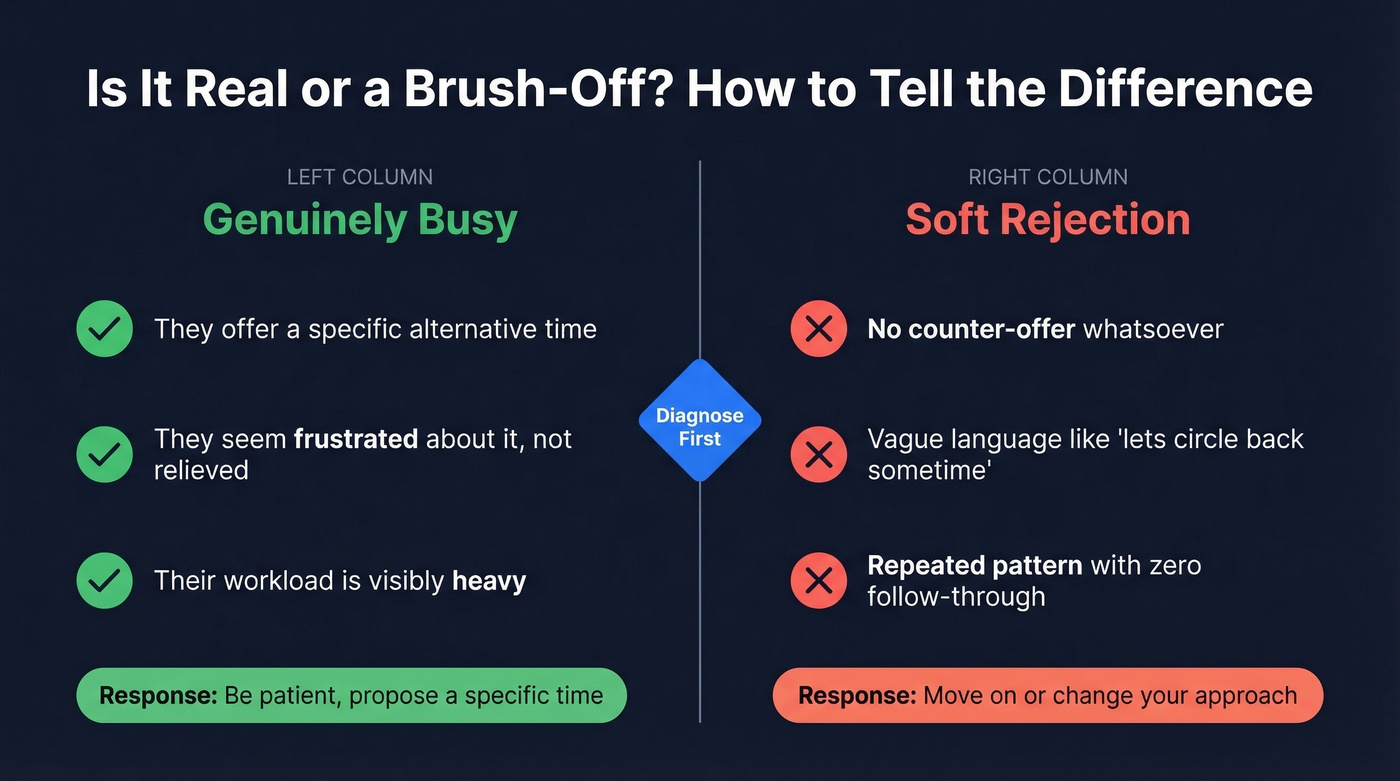
Genuine signals:
- They offer a specific alternative time
- They seem frustrated about it, not relieved
- Their workload is visibly heavy
Brush-off signals:
- No counter-offer whatsoever
- Vague language ("let's circle back sometime")
- Repeated pattern with zero follow-through
Diagnose first. Then respond.
How to Respond at Work
Power dynamics shape everything here. A peer, a manager, and an employee saying "I don't have time" are three entirely different conversations.
Peer to Peer
Don't challenge the claim. Acknowledge it and propose something specific - a day, a duration, and a narrow ask give them something concrete to say yes to. "Let's find time" is a death sentence for scheduling.
"Totally get it - this week's brutal. Could we do 15 minutes Thursday? I just need your input on [specific thing] so I can keep moving."
Manager to Employee
When your direct report says this, resist the urge to say "make time." The Manager Tools prioritization approach works better: ask them to list current work, then collaboratively reprioritize. It's priority management, not time management.
"Walk me through what's on your plate. Let's figure out together what can move."
This does two things at once. It shows you respect their workload, and it surfaces whether the real issue is capacity or avoidance. We've found that nine times out of ten, the employee just needs help deciding what to drop.
Employee to Manager
Your boss saying "I don't have time" signals "you're not a priority right now" - whether they mean it or not. HR guidance consistently warns that employees interpret this phrase as dismissal, which deters people from raising issues early and lets small problems snowball into big ones. Force a tradeoff conversation instead of accepting the brush-off.
"Understood. I'm on [X], [Y], and [Z] right now. Which should I deprioritize to take this on?"

Half of "I don't have time" objections happen because you're calling the wrong person. Prospeo gives you 125M+ verified mobile numbers with a 30% pickup rate, refreshed every 7 days - so you reach the actual decision-maker on a direct line, not a gatekeeper looking for an excuse to hang up.
Fix the data, and the objection fixes itself.
Handling the "I'm Busy" Objection in Cold Calling
This is the objection we hear about most from sales teams, and we've watched dozens of reps fumble it by either caving immediately or pushing too hard. Neither works.
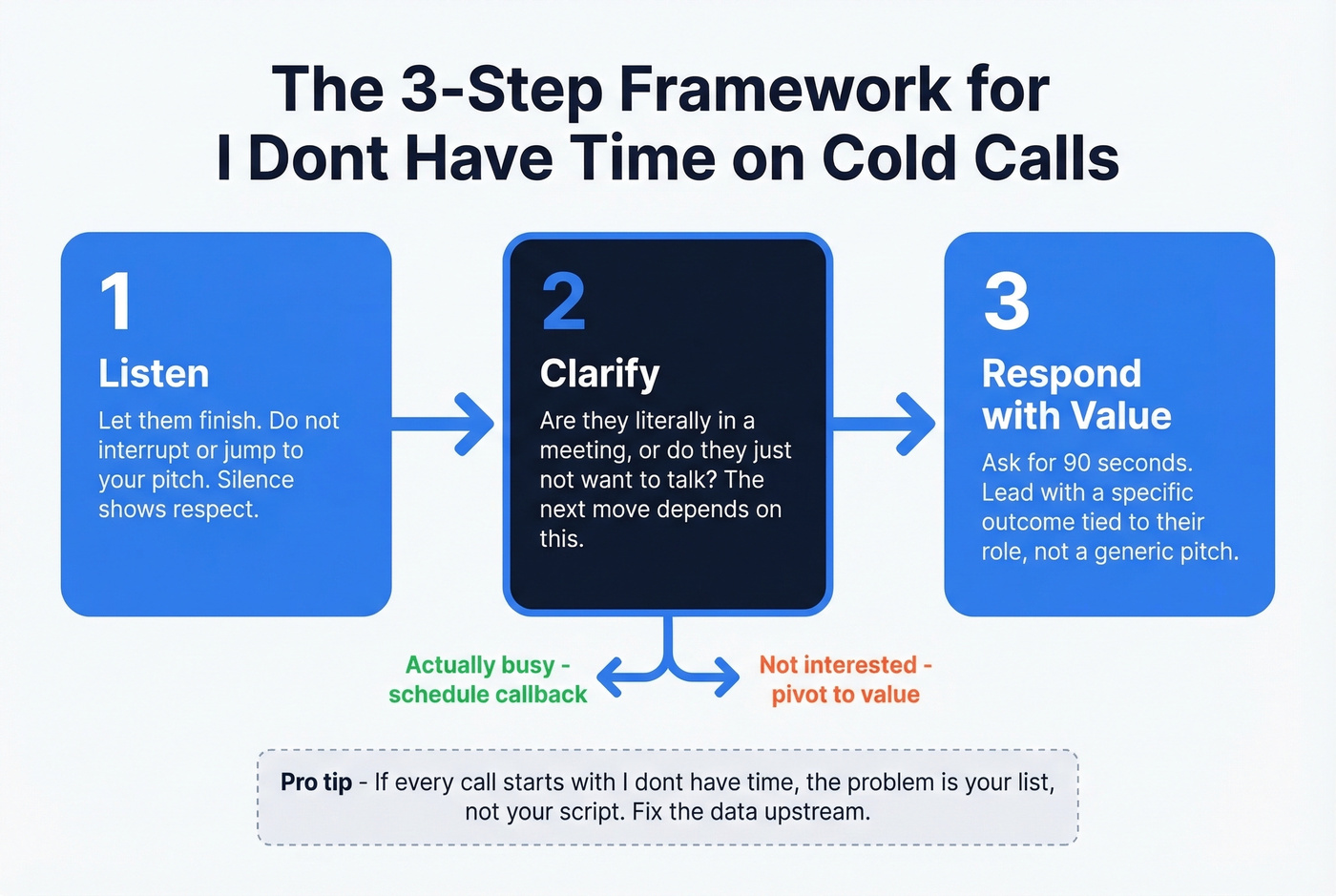
A simple framework holds up well in live calls: Listen, Clarify, Respond with Value. Listen without interrupting. Clarify whether it's "I'm literally in a meeting" or "I don't want to talk to you." Then give them a reason to stay for 90 seconds.
"I'm too busy to talk." "Totally fair - I'll be quick. This has helped [similar role] cut [specific pain] by [specific number]. Can I take 90 seconds?"
"I don't have time for this." "I hear you. If I could show you a way to [specific outcome], would two minutes be worth it?"
"Just send me an email." "Happy to. One quick question so I send something relevant instead of generic - [targeted question about their pain point]?"
Build muscle memory with what sales trainers call the Rapid-Fire Objection Drill - a teammate throws objections at you in quick succession until responding becomes reflexive. This is especially useful for newer reps who freeze when they hear "I'm busy" in the first five seconds of a call.
Let's be honest, though: if every call starts with "I don't have time," your list is broken, not your script. You're reaching gatekeepers and generic lines instead of decision-makers on direct dials. Fix the upstream data first. Prospeo refreshes contact data every 7 days and verifies emails at 98% accuracy, so you're reaching the right person on a direct line - which eliminates half these objections before they happen.
In Dating and Personal Life
This is where "I don't have time" hurts most - and where misreading it wastes the most emotional energy.
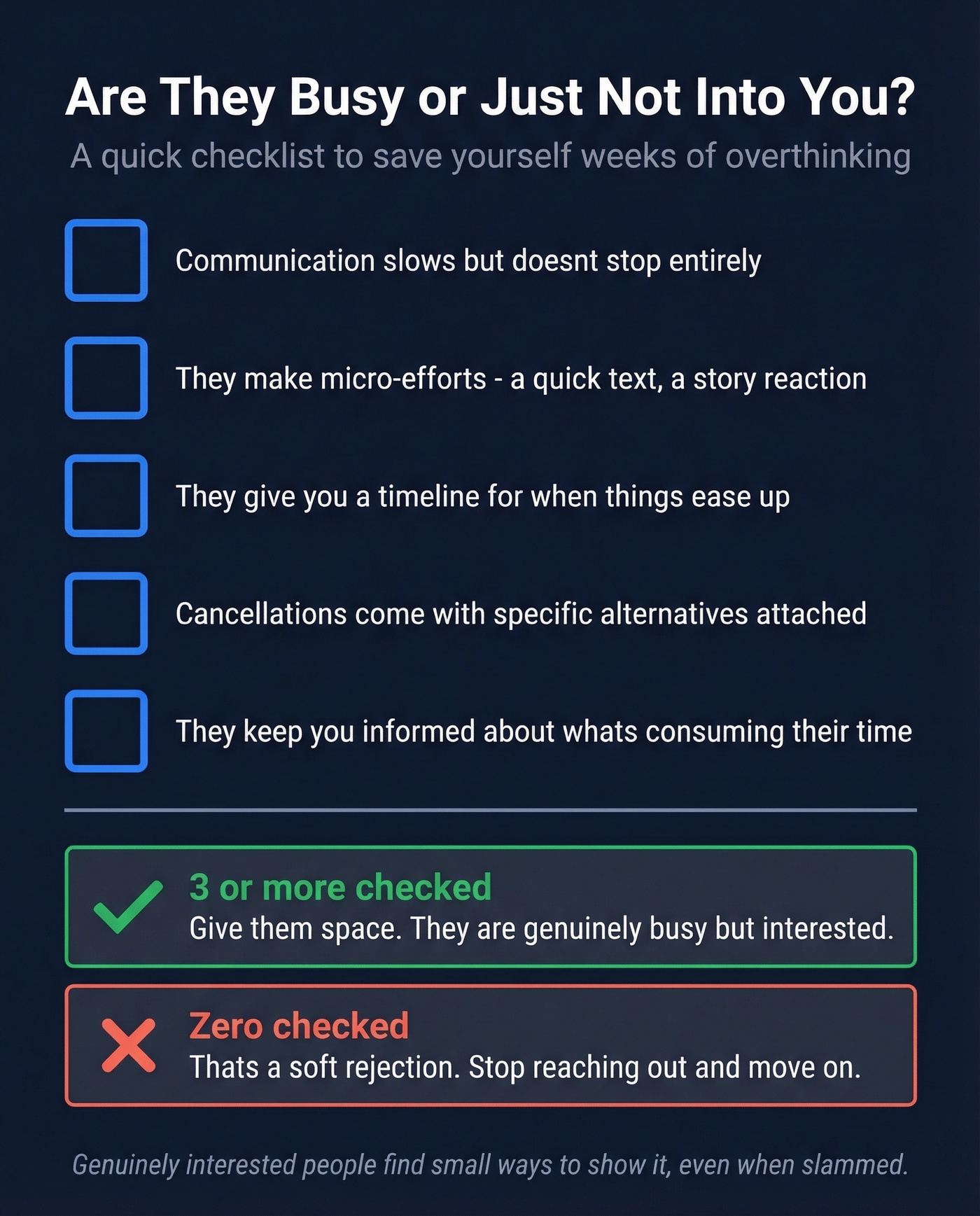
Five signals they're genuinely busy but interested:
- Communication slows but doesn't stop entirely
- They make micro-efforts - a brief text, a quick reaction to your story
- They provide a timeline for when things ease up
- Cancellations come with specific alternatives attached
- They keep you informed about what's consuming their time
Three or more of these? Give them space.
"No pressure - let me know when your schedule opens up."
Zero of these - no counter-offers, no micro-efforts, communication just drops? That's a soft rejection. Here's a clean rule of thumb from the r/dating consensus: if you've invited someone a few times and there's still no reciprocation, stop. Genuinely interested people find small ways to show it, even when they're slammed. Accepting this early saves you weeks of overthinking.
When YOU Need to Say It
"I don't have time" - even when true - tells the other person they're not a priority. It also deters people from raising issues early, letting small problems snowball into crises.
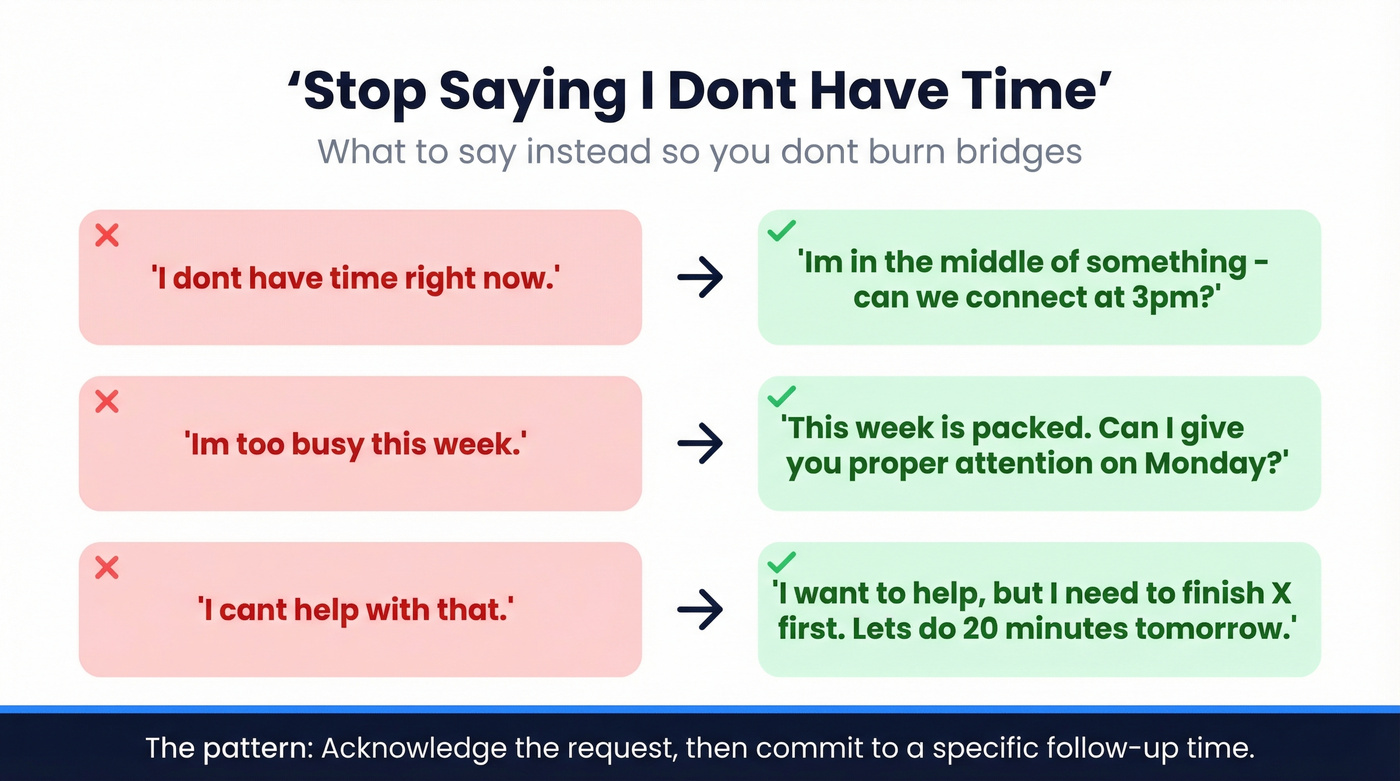
Three replacements that communicate the same thing without the damage:
- "I'm in the middle of something - can we connect at 3pm?"
- "This week is packed. Can I give you proper attention on Monday?"
- "I want to help, but I need to finish [X] first. Let's do 20 minutes tomorrow."
Each one acknowledges the request and commits to a specific follow-up. That said, sometimes a clear "no" wrapped in kind language beats an indefinite "maybe later" that strings someone along. Boundaries are healthy. Vagueness isn't.
FAQ
Is "I don't have time" always an excuse?
No. Research on time pressure confirms it can be a genuine barrier, especially for people juggling high-demand roles or caregiving responsibilities. But in most casual and sales contexts, it signals priority, not capacity. Look for counter-offers and specificity before assuming either way.
What's the best cold call response to "I'm too busy"?
Acknowledge the constraint, then ask for 90 seconds with a specific value hook tied to their role. If they still decline, schedule a callback at a specific time and follow up reliably. You're earning the right to a conversation, not demanding one.
How do you tell if someone's genuinely busy or not interested?
Busy people reschedule with specifics, make micro-efforts, and give timelines. If communication drops entirely after two or three attempts with no counter-offer, treat it as a soft rejection and move on.
How do I stop hearing "I'm busy" on every cold call?
Bad contact data is the top upstream cause. When you're dialing generic office lines instead of direct numbers, gatekeepers default to "not available." Prospeo's 125M+ verified mobile numbers with a 30% pickup rate connect you to decision-makers directly, cutting through the noise before the objection even surfaces.
Your reps don't need better rebuttals - they need better lists. When 35% of your contacts bounce or ring a front desk, every call starts with "I'm busy." Prospeo's 98% email accuracy and verified direct dials mean reps spend time selling, not fighting past gatekeepers.
Reach the right person the first time at $0.01 per lead.