

How to Run a QBR That Actually Drives Decisions
You've seen it before. Someone builds a 35-slide deck, spends two hours walking through metrics everyone already saw in Salesforce, and the VP finally interrupts: "So what's the recommendation?" The meeting ends with no decisions, no owners, and a vague promise to "circle back."
If you're figuring out how to run a QBR that doesn't waste everyone's time, the consensus on r/sales validates the frustration - QBRs feel like "all day meetings going over numbers that are easily visible." They don't have to be. Use the 8-slide deck below, spend 20% presenting and 80% discussing, and send the follow-up within 24 hours.
What Is a QBR Meeting?
A Quarterly Business Review is a structured meeting - internal or customer-facing - where stakeholders assess the last 90 days and align on what happens next. Stop calling it a "review." A QBR meeting is a decision-making meeting, and the moment you treat it as a dashboard readout, you've lost the room. Teams using OKRs can anchor metrics directly to pre-agreed Key Results, which keeps the conversation focused on outcomes rather than vanity numbers.
The higher-stakes variant is an EBR (Executive Business Review), which pulls in senior leadership and focuses on strategic direction rather than operational metrics.
Internal vs. Customer QBRs
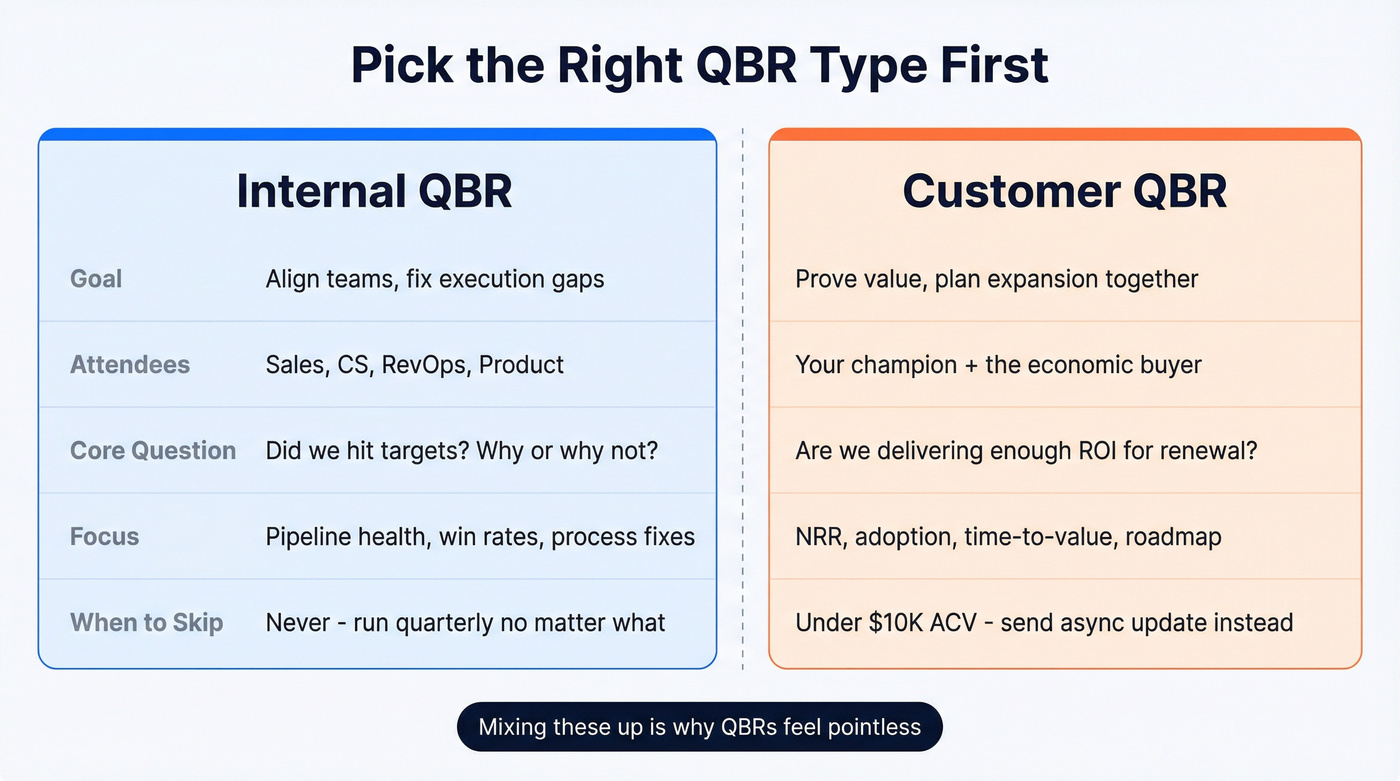
Pick the right type before you build anything.
| Dimension | Internal QBR | Customer QBR |
|---|---|---|
| Goal | Align teams, fix execution | Prove value, plan together |
| Attendees | Sales, CS, RevOps, Product | Champion + economic buyer |
| Core question | Did we hit targets? Why? | Are we delivering ROI? |
Internal QBRs answer "where did deals slip and what are customers telling us repeatedly?" Customer QBRs answer "are we delivering enough value to justify renewal and expansion?" Conflating the two is why so many QBRs feel pointless - a churning account and a thriving one need completely different conversations.
For SMB accounts, consider a digital-first async review instead of a live meeting.
The 8-Slide Deck Structure
Eight slides, no more. Anything beyond eight goes in an appendix.
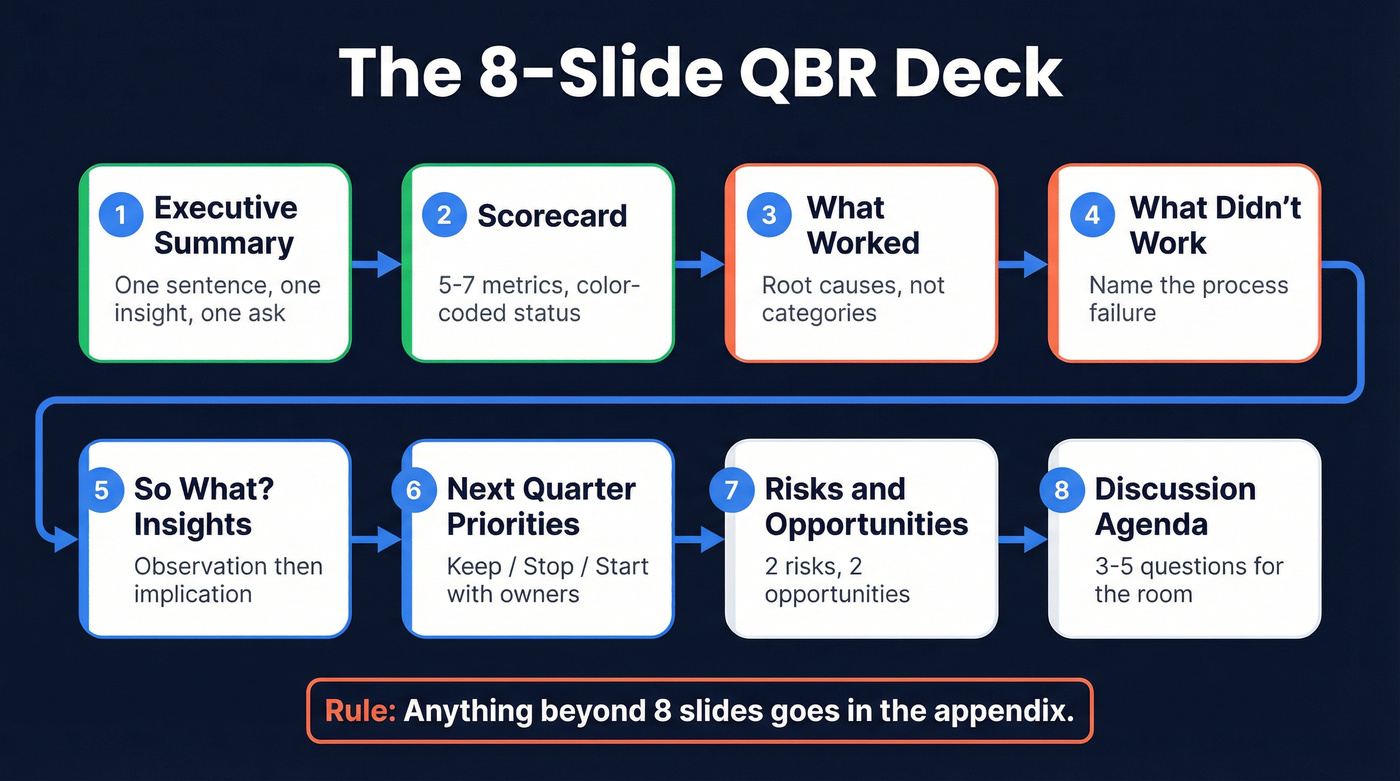
Slide 1 - Executive Summary. One sentence on quarter performance, one key insight, one recommendation, one ask. Example: "Q4 exceeded target by 12% ($2.4M vs $2.1M goal). Enterprise pipeline grew 30% but close rates dropped. Recommend reallocating two reps to mid-market. Need approval for $50K incremental spend on enablement."
Slide 2 - Scorecard. One table, five to seven metrics, color-coded.
| Metric | Target | Actual | Variance | Status |
|---|---|---|---|---|
| Revenue | $2.1M | $2.35M | +12% | 🟢 |
| Win rate | 28% | 24% | -4pp | 🔴 |
| Pipeline | $8M | $10.4M | +30% | 🟢 |
| Deal cycle | 45 days | 52 days | +7 days | 🟡 |
| NRR | 110% | 108% | -2pp | 🟡 |
SaaS teams typically track NRR, adoption rate, and time-to-value here. Agency teams swap in ROAS and CAC.
Slides 3-4 - What Worked / What Didn't. Go beyond surface metrics. "Market conditions" isn't a root cause - "enterprise deals taking 40% longer because legal review added a step" is. Name the specific process failure, not the category.
Slide 5 - "So What?" Insights. Three to four bullets structured as Observation then Implication. Example: "Mid-market close rates up 18% - shift pipeline weighting toward mid-market next quarter."
Slide 6 - Next Quarter Priorities. Use the Keep / Stop / Start framework. Three to five priorities, each with an owner and a success metric. No orphan priorities - if it doesn't have a name next to it, it won't happen.
Slide 7 - Risks & Opportunities. Two risks, two opportunities. Be specific. "Competitor launched a free tier targeting our SMB segment" is useful. "Market headwinds" is not.
Slide 8 - Discussion Agenda. Three to five questions designed to hand control to the room. "Should we double down on mid-market or fix enterprise close rates?" This slide is the whole point of the meeting.
C-suite only? Use the 3-2-1 variant. Three strategic insights, two risks, one recommendation. Six slides. Fifteen minutes. Executives want the pattern and the ask - not the full build.

The #1 QBR killer? The economic buyer never sees your invite. Prospeo's database covers 143M+ verified emails and 125M+ direct dials - refreshed every 7 days - so your calendar invite lands with the person who can actually say yes.
Stop running QBRs without the decision-maker in the room.
Prep Without the Pain
The #1 complaint on r/CustomerSuccess about QBRs? They're a production nightmare. We've seen teams cut prep time in half just by committing to a template and never building from scratch.
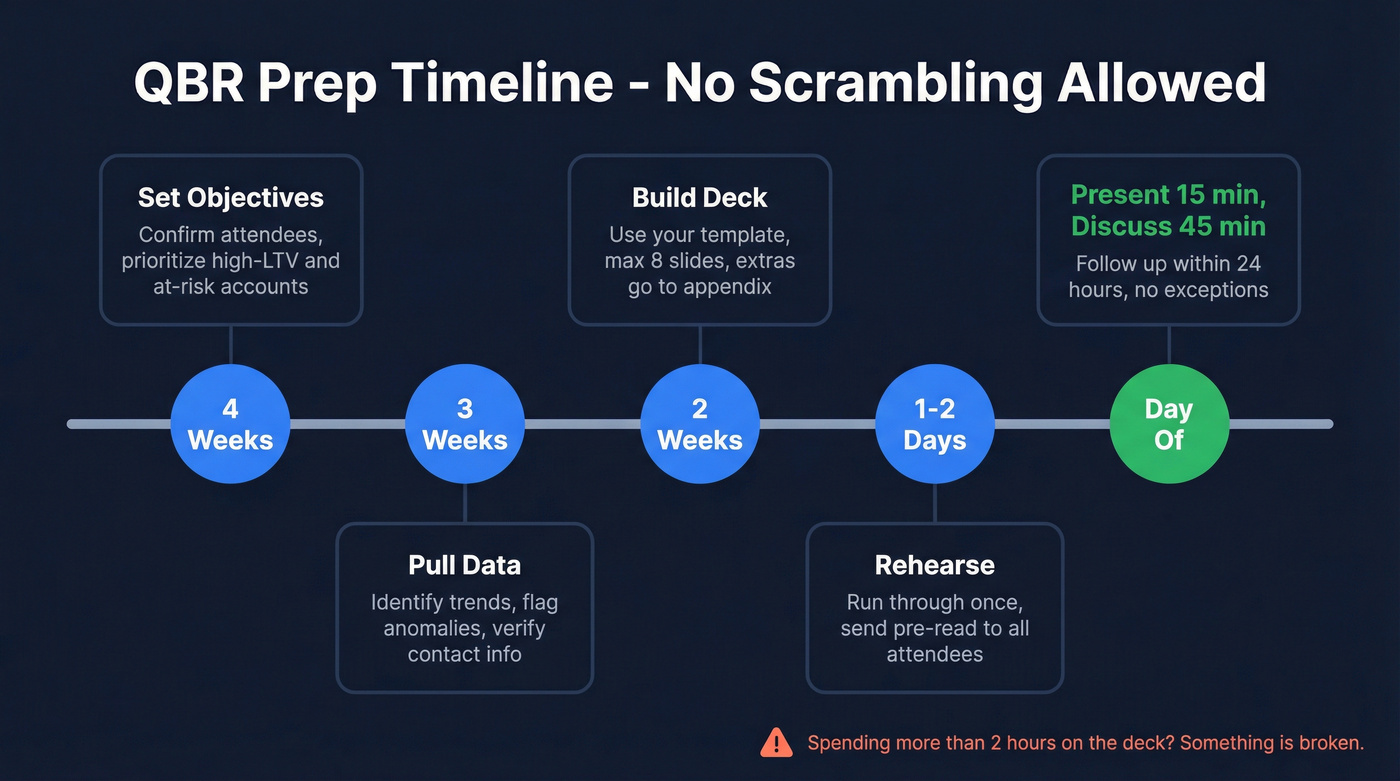
Here's the timeline that works for us:
- 4 weeks out: Set objectives, confirm attendees. Prioritize high-LTV, at-risk, and high-engagement accounts - not every customer warrants a live quarterly review.
- 3 weeks out: Pull data, identify trends, flag anomalies.
- 2 weeks out: Build the deck from your template. Push anything beyond eight slides to the appendix.
- 1-2 days before: Rehearse once. Circulate a pre-read so attendees arrive with context.
One step that's easy to overlook: verifying that your invite actually reaches the right executives. Prospeo's email finder covers 143M+ verified emails with 98% accuracy, so you're not sending calendar invites to dead inboxes.
How to Conduct the Meeting
Present for 15 minutes. Discuss for 45. That's the ratio, and it's the single biggest lever for making quarterly business reviews useful. Per McKinsey research cited by Gainsight, B2B customers with strong executive engagement are 2.5x more likely to renew - and engagement means dialogue, not a slideshow.
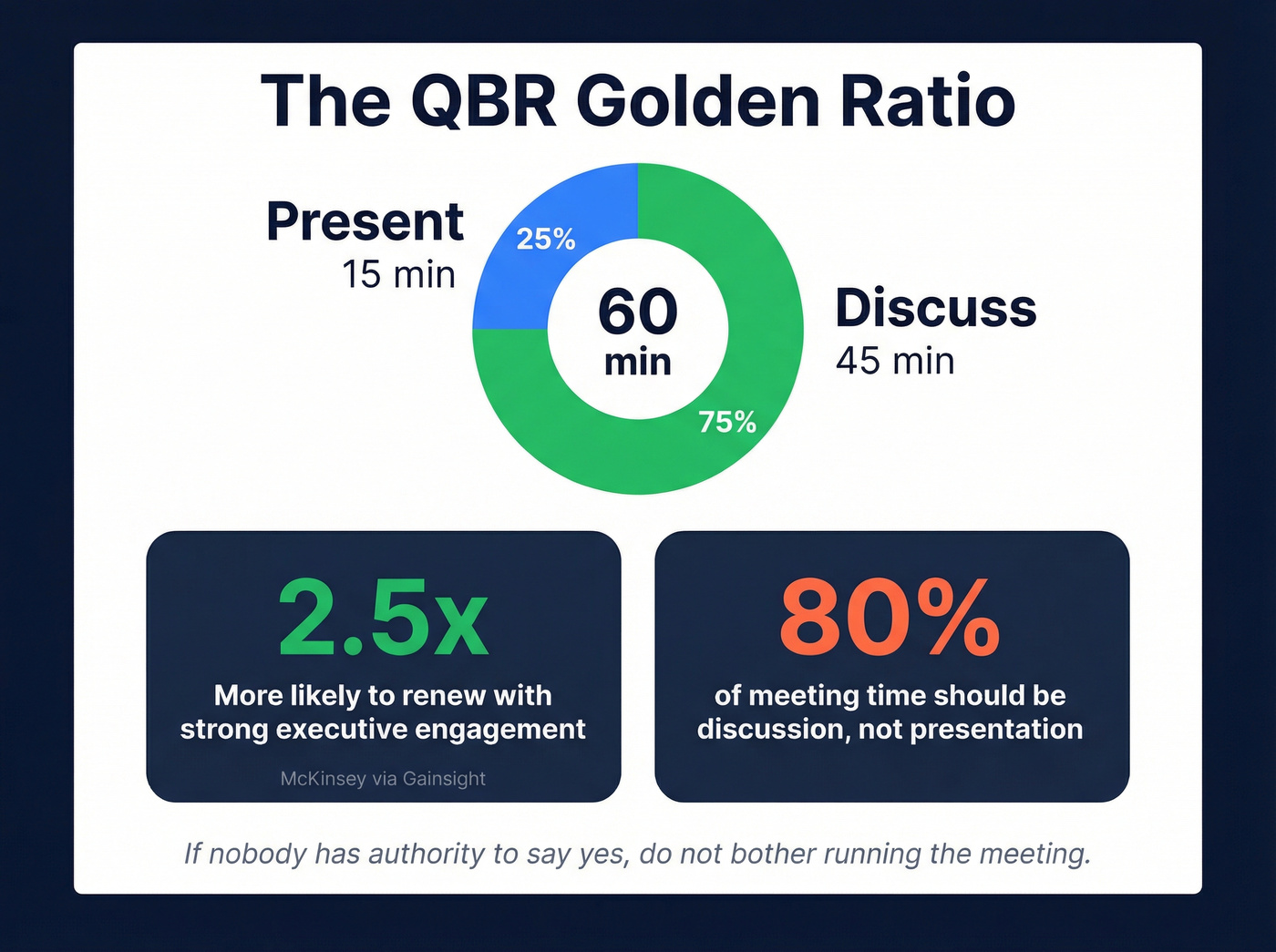
Here's the thing: most QBRs fail not because the data is wrong, but because nobody in the room has the authority to say yes. Get the economic buyer there, or don't bother running the meeting.
Open with the recommendation, not the data. Executives decide faster when you lead with the ask. At each slide transition, ask "what are we deciding here?" Close with explicit action items - owner, deadline, no ambiguity. If someone says "let's take that offline," pin them to a date before you move on.
Mistakes That Kill QBRs
In our experience, these six errors account for nearly every wasted review:
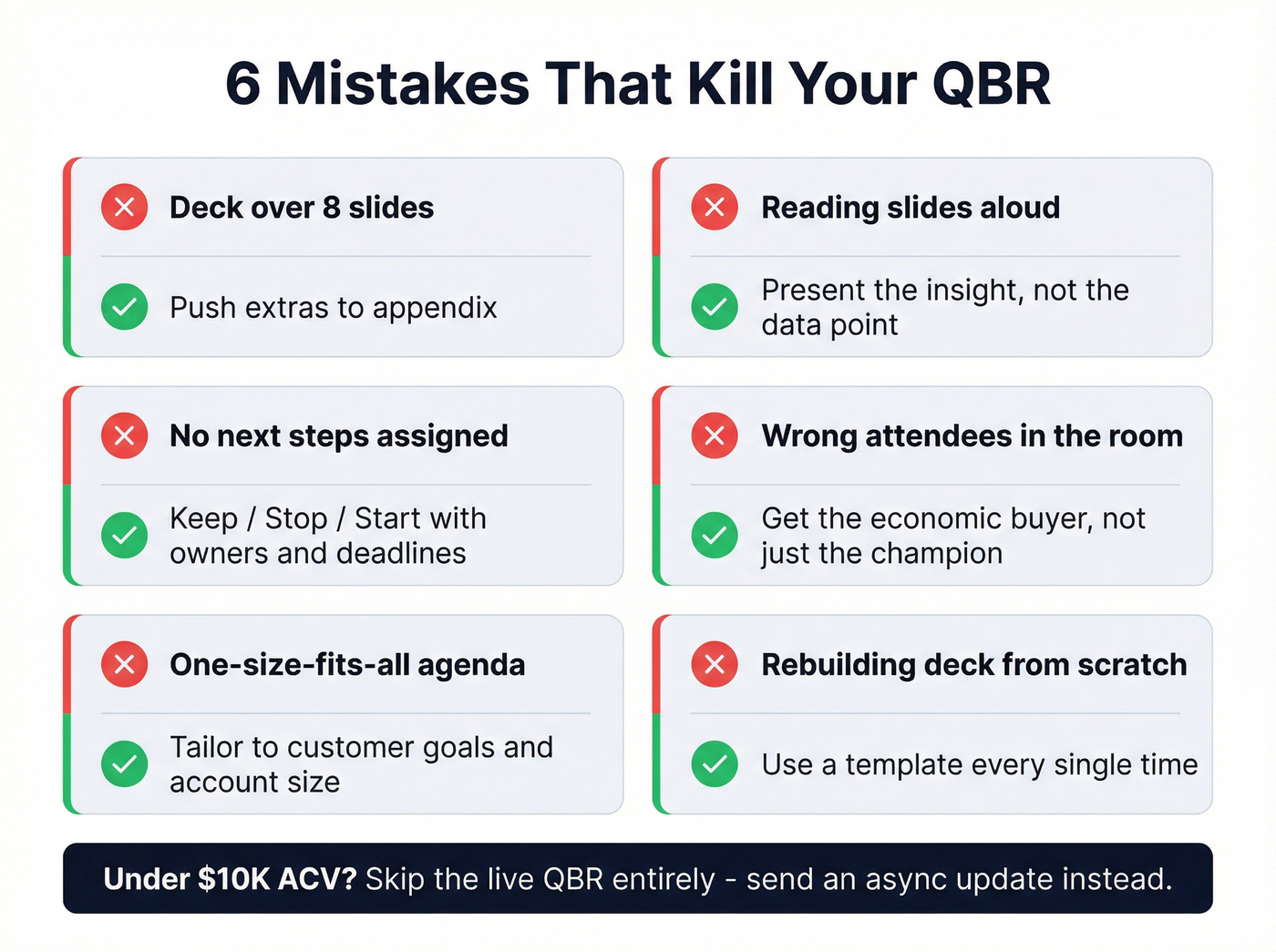
- Deck over 8 slides. Push extras to an appendix. Nobody reads them there either, but at least they won't slow down the meeting.
- Reading slides aloud. Present the insight, not the data point. They can read.
- No next steps. Use Keep/Stop/Start with owners and deadlines.
- Wrong attendees. Get the economic buyer in the room, not just the champion.
- One-size-fits-all agenda. Tailor to customer goals and segment. A $500K enterprise account and a $15K SMB account don't need the same conversation.
- Rebuilding from scratch. Use a template every single time. If you're spending more than two hours on deck creation, something's broken.
Skip the QBR entirely for accounts under $10K ACV unless there's a specific expansion or churn signal. A well-crafted async update respects everyone's time more than a forced 60-minute meeting.
The Follow-Up Email (Copy This)
Send within 24 hours. No exceptions.
Subject: Recap & Action Items from Our Q[X] Business Review
Hi [Name],
Thanks for a productive Q[X] review. Quick recap:
- Wins: [Top 2-3 achievements]
- Areas for improvement: [1-2 items with context]
- Key insight: [The "so what" driving next quarter's focus]
Action items:
- [Action] - Owner: [Name] - Due: [Date]
- [Action] - Owner: [Name] - Due: [Date]
- [Action] - Owner: [Name] - Due: [Date]
Deck attached. Happy to continue any thread async - just reply here.
Best, [Your name]
That's it. Eight slides, 15 minutes of presenting, 45 minutes of discussion, and a follow-up email before the next morning. Now you know how to run a QBR that ends with decisions instead of glazed-over stares.
Great QBR prep means knowing who to invite and how to reach them. Prospeo gives you 98% accurate emails and 30+ filters - buyer intent, job changes, seniority - so you build the right stakeholder list in minutes, not hours.
Cut your QBR prep time in half starting this quarter.
FAQ
How long should a QBR meeting be?
Sixty minutes max - 15 presenting, 45 discussing. If you need more time, your deck is too long or you're covering topics that belong in a separate working session.
How often should you run QBRs?
Every 90 days for high-value accounts, typically $50K+ ACV. For executive stakeholders, an annual or biannual EBR works well alongside quarterly check-ins. SMB accounts often do better with async digital reviews that take five minutes to consume instead of an hour to sit through.
How do you get executives to attend?
Lead with the recommendation and the specific decision you need - right in the invite, not buried in an agenda doc. Executives attend meetings where decisions get made. If you're struggling to reach the right person, verify their contact info before sending the invite so it doesn't bounce or land in a generic inbox.
What's the biggest QBR mistake teams make?
Presenting for 45 minutes and leaving 15 for discussion - the exact inverse of what works. Flip the ratio. Your slides are a conversation starter, not a script. The decisions happen in the discussion, not the presentation.