

How to Run a Sales Contest That Doesn't Fizzle Out After Day 3
The typical "top seller wins" sales contest disengages 60-70% of the team once the usual suspects pull ahead by Wednesday. By Friday, half the floor has stopped tracking. Here's the thing: a contest exists to change a behavior, not just reward whoever was already winning. Design around that principle and everything else - metrics, prizes, rules, comms - falls into place.
Pick the Behavior, Then the Metric
Every failed contest we've seen starts with a lagging indicator - revenue, closed deals - and a vague hope that dangling a prize will magically accelerate the pipeline. It won't.
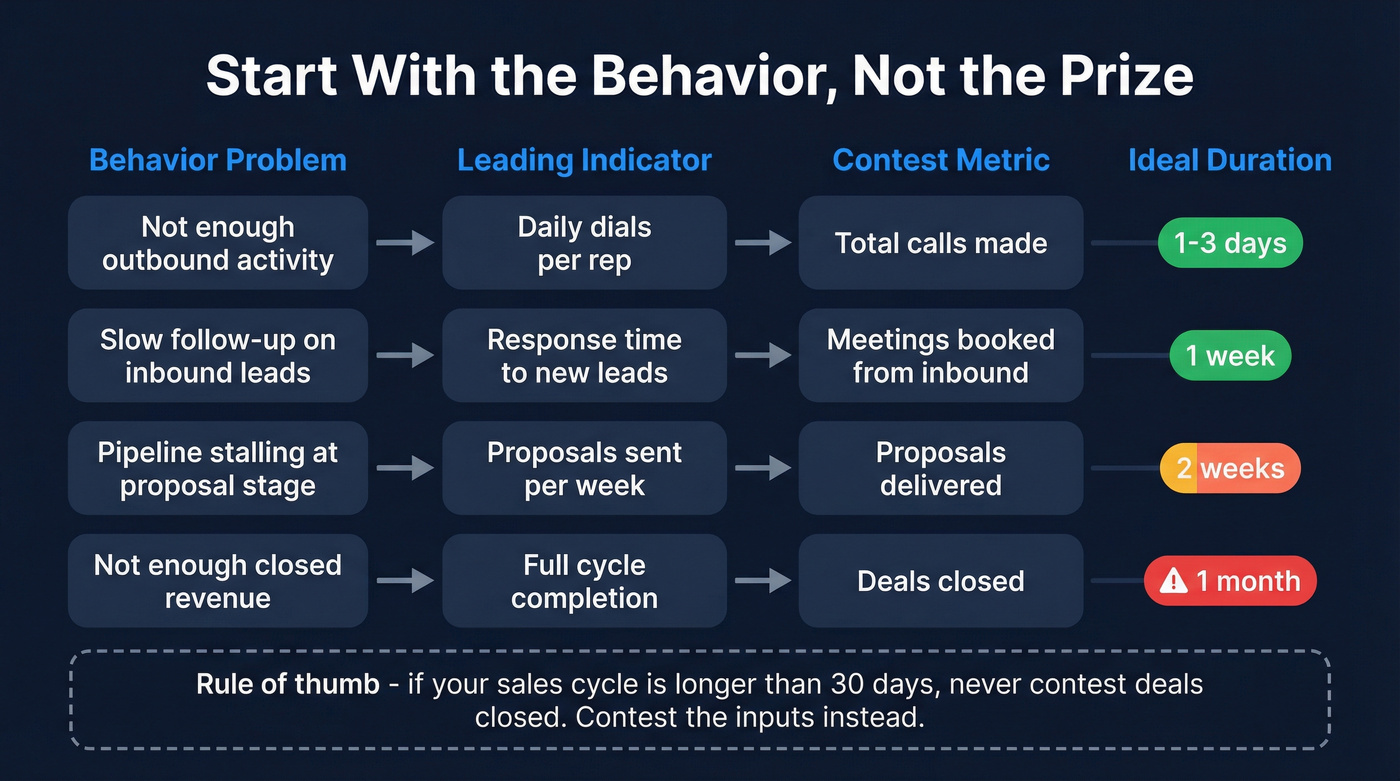
Start with the behavior you want to change. What do you want reps to start, stop, or continue doing? Not enough outbound calls? Slow follow-up on inbound leads? Not enough discovery meetings booked? That behavior maps to a leading indicator, something reps control daily. Contest a leading indicator and you'll see movement within days.
| Metric | Duration | Why |
|---|---|---|
| Calls / follow-ups | 1-3 days | Fast feedback loop |
| Meetings booked | 1 week | Needs scheduling time |
| Proposals sent | 2 weeks | Requires pipeline work |
| Deals closed | 1 month | Full sales cycle needed |
Start with a 1-week sprint, measure what happens, then scale.
If your average sales cycle is longer than 30 days, never contest "deals closed." You'll just reward whoever happened to have late-stage pipeline when the contest launched. Contest the inputs instead.
Keep Every Rep Engaged
If the same reps are going to win no matter what, everyone else stops trying. That's not a contest - it's a coronation.
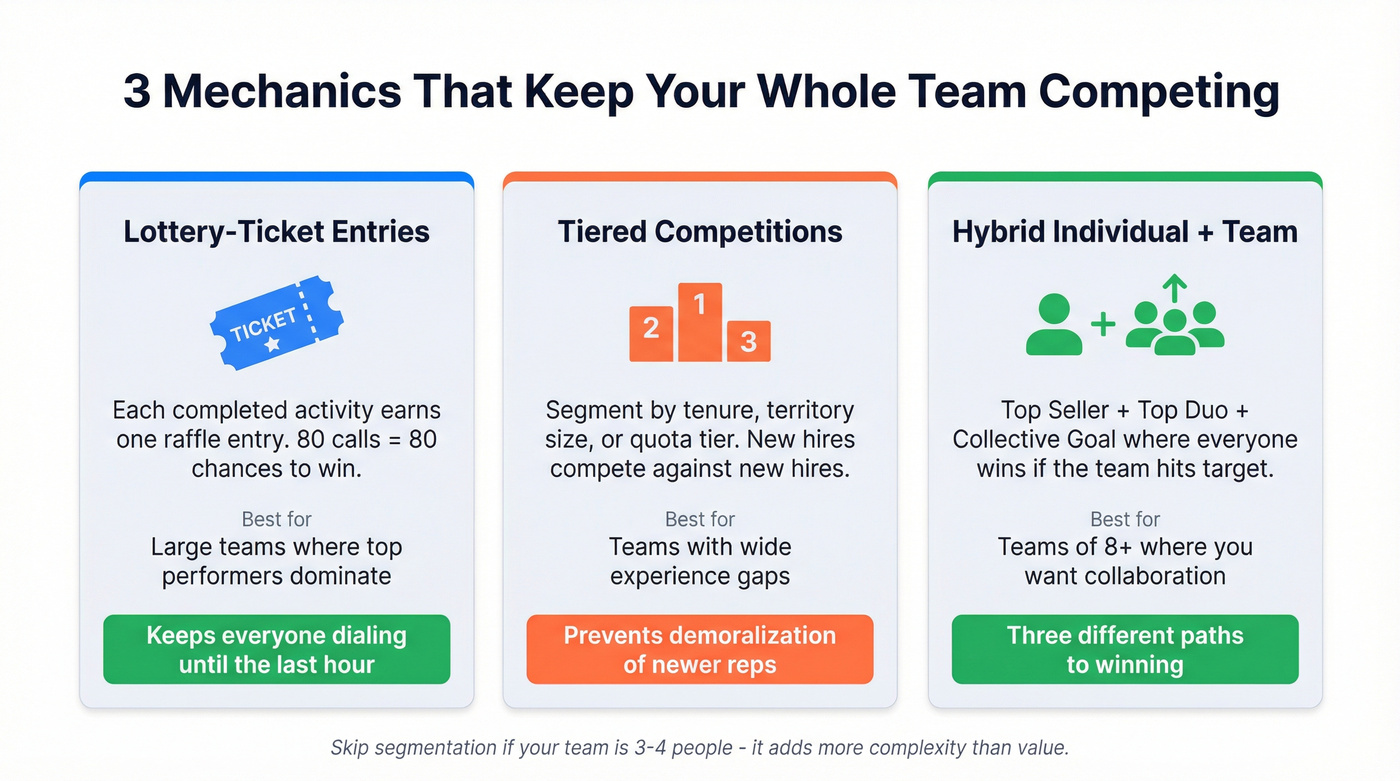
Top performers evaluate two things: "Can I win doing what I'm already doing?" and "Is this designed so I'll fail?" If the answer to either is yes, they disengage. Three mechanics fix this.
Lottery-ticket entries. Each completed activity earns one raffle entry. The rep who makes 80 calls has 80 chances - best odds, but the rep in the middle of the pack still has a real shot. Everyone keeps dialing until the last hour.
Tiered competitions. Segment by territory size, tenure, or quota tier. A new hire competing against a 10-year veteran with a built-out book isn't competition. It's demoralization.
Hybrid individual + team goals. One Reddit manager running a trade show contest on under $1,000 structured it as Top Seller + Top Weekday Duo + Collective Sales Goal where everyone wins if the team hits the target. Three different paths to winning - smart design.
Use these if the same two people always win. Skip them if your team is 3-4 people where segmentation adds more complexity than value.
Write Rules Before You Announce
Picture this: Tuesday morning, two reps arguing about whether a deal that entered the pipeline last month counts. You don't have a written answer. Now you're making a judgment call one of them will resent.
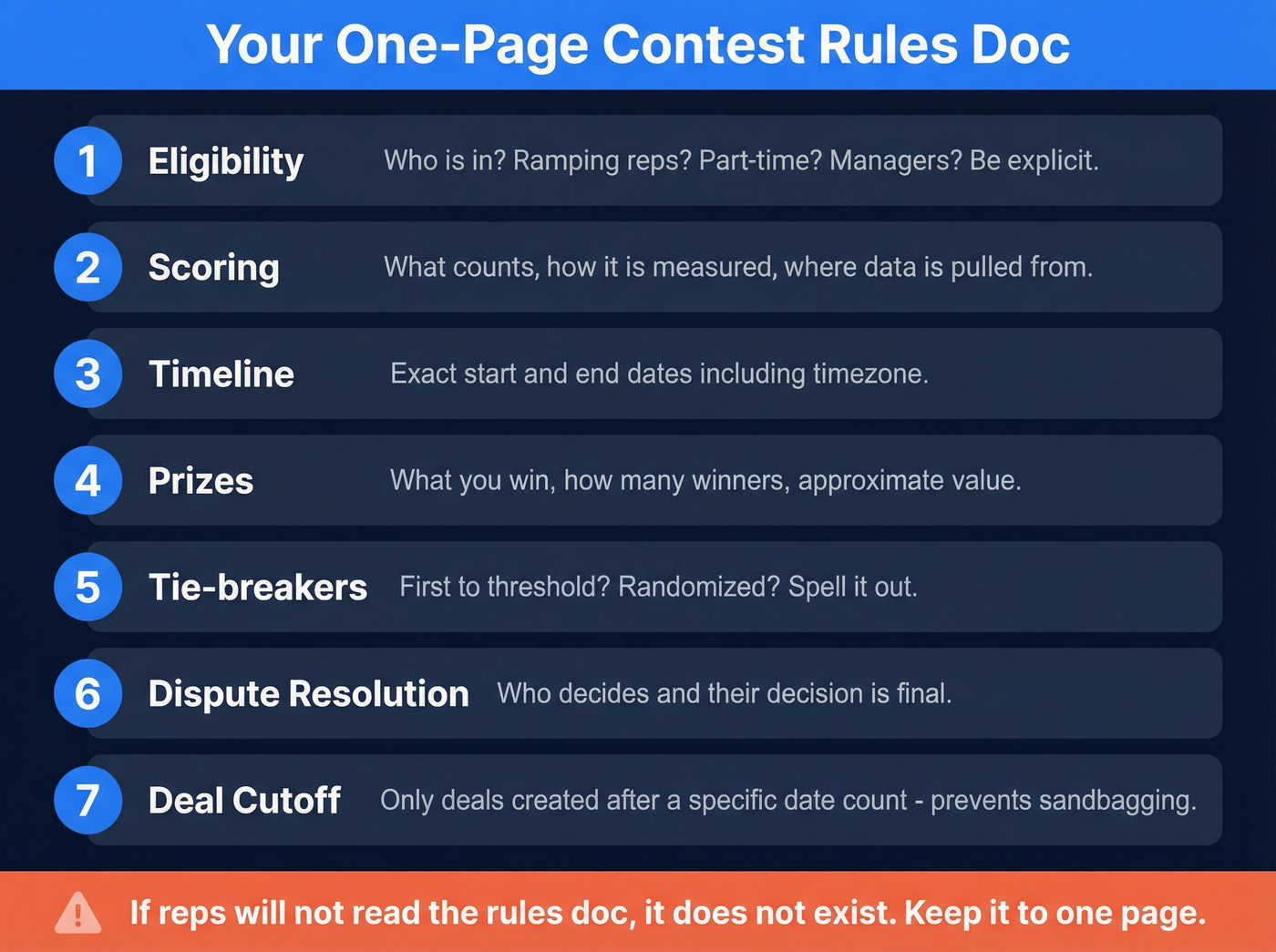
Your one-page rules doc needs these items:
- Eligibility - who's in? Ramping reps? Part-time? Managers?
- Scoring - what counts, how it's measured, where data is pulled from
- Timeline - exact start/end dates including timezone
- Prizes - what you win, how many winners, approximate value
- Tie-breakers - first to threshold? Randomized?
- Dispute resolution - who decides, decision is final
- Deal cutoff - only deals created after a specific date count, preventing reps from sandbagging pipeline into the contest window
If you're running raffle-style mechanics for global teams, be careful: in the UK, anything that looks like paying to enter plus winners chosen by chance can cross into regulated lottery territory under the Gambling Act and the Gambling Act. Skill-based or free-entry formats avoid this entirely.
If reps won't read the rules doc, it doesn't exist. Keep it to one page.
Prizes That Don't Backfire
Cash SPIFs work. In our experience, $50-$100 per rep for a weekly sprint hits the sweet spot - processed through payroll, universally valued. The downside: cash blends into the next paycheck and gets forgotten. Non-cash prizes like experiences, extra PTO, or gear are more memorable and create status, but not everyone wants a Yeti cooler.
The real trap is taxes. Incentive prizes - cash, merchandise, trips - are taxable compensation under US federal tax rules and are generally included in wages reported on Form W-2. Non-cash prizes require fair market value inclusion, and FMV often lands around 70% of point-list or catalog value in many incentive programs.
The consensus on r/sales? President's Club trips can backfire hard - a $10K trip that shows up on your W-2 creates a surprise tax bill nobody budgeted for. The fix: gross up the prize to cover the tax hit, or at minimum, tell reps about the implications upfront. Budget the total prize pool at 1-3% of expected incremental gross profit.

A calling blitz on dead numbers doesn't move pipeline - it wastes your contest budget. Prospeo's 125M+ verified mobile numbers hit a 30% pickup rate, and every record is refreshed every 7 days. Give your reps contacts that connect so your contest drives real conversations, not vanity metrics.
Stop rewarding dials to voicemail. Start rewarding conversations.
Communicate Like a Campaign
Steal the 3-wave launch structure:
- Wave 1 - Executive sponsor announces the contest, explains the "why," ties it to a team goal.
- Wave 2 - Enablement shares the rules doc, tracking dashboard, and any resources reps need to compete.
- Wave 3 - Launch day goes live with the metric, where to track progress, exact dates, the prize, and who to ask questions.
During the contest, send daily or weekly leaderboard updates. Visible leaderboards drive engagement. After it wraps, announce winners publicly with specifics - "Sarah booked 23 meetings in 5 days" hits harder than "Sarah won."
Prevent Gaming Before It Starts
Sandbagging wrecks more contests than bad prizes do.
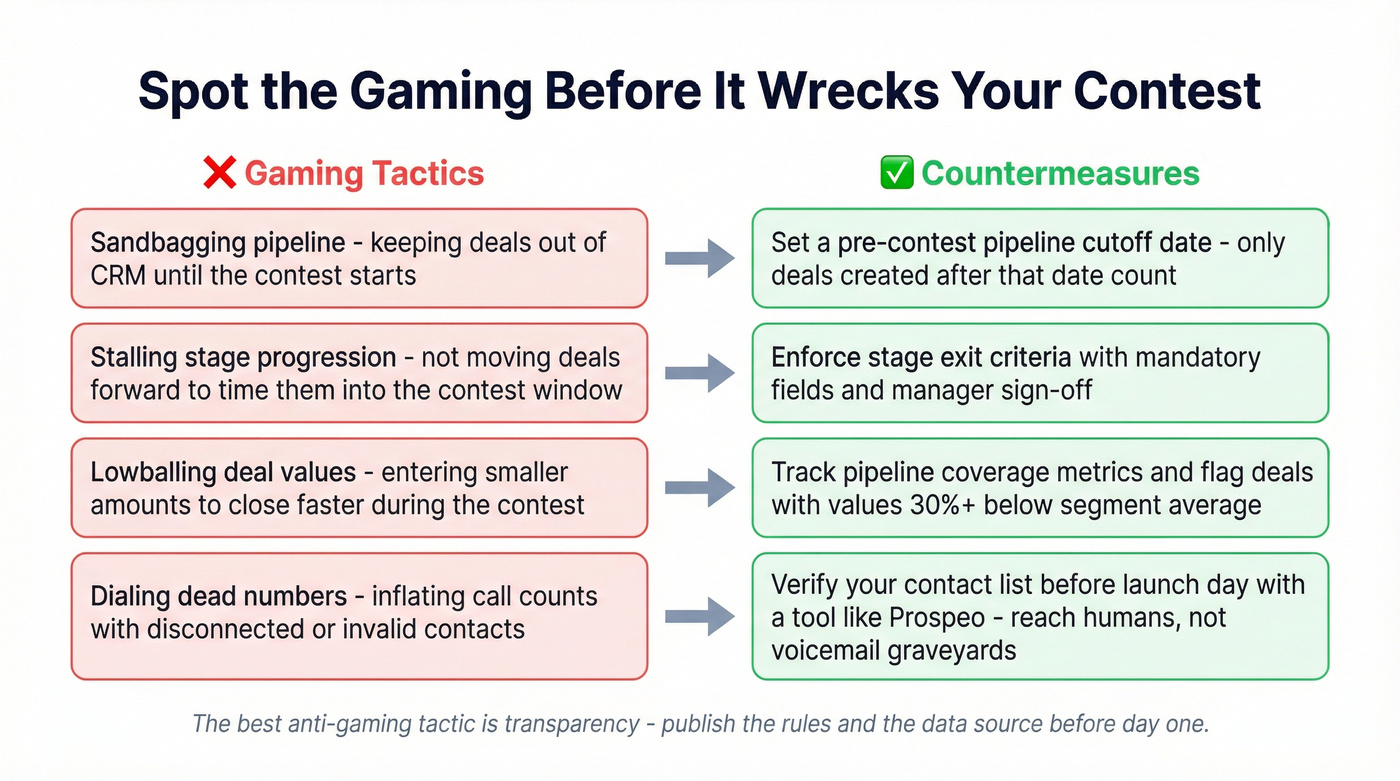
Watch for reps keeping deals out of CRM until the contest starts, not progressing pipeline stages, lowballing deal values, and delaying closes into the contest window. Countermeasures: a pre-contest pipeline cutoff date, enforced stage exit criteria, and pipeline coverage metrics that flag suspicious behavior.
There's a subtler problem too. You run a calling blitz and activity jumps 40% - until you realize half those dials hit disconnected numbers. The contest moved the metric without moving the outcome. Run your list through a verification tool like Prospeo before launch day so reps reach humans, not voicemail graveyards. With 98% email accuracy and 125M+ verified mobile numbers refreshed every 7 days, it's the difference between a contest that generates activity and one that generates pipeline.
You just designed the perfect contest mechanics - tiered competition, raffle entries, clear rules. Don't let bad data undermine all of it. Prospeo delivers 98% accurate emails and verified direct dials at $0.01/lead so every rep activity actually reaches a human buyer.
Great contest design deserves great data. Prospeo delivers both.
Measure Whether It Worked
Compare the targeted metric before and after. A well-run sprint typically lifts activity 5-15% in the short term. But don't stop there.
Measure adjacent metrics too. Did calls go up but meeting conversion drop? Did proposals spike but average deal size shrink? A sales competition that juices one number while tanking another isn't a win. You're looking for durable behavior change and clean downstream conversion, not just a temporary spike in a vanity metric.
Let's be honest - most teams skip this step entirely. They hand out the prize, pat themselves on the back, and never check whether the behavior stuck two weeks later. Build a 30-day follow-up into your contest plan from the start.
Sales Contest Ideas Worth Stealing
| Contest | Metric | Duration | Format |
|---|---|---|---|
| Calling Blitz | Calls made | 2 days | Individual |
| Meeting Marathon | Meetings booked | 1 week | Team |
| Winback Sprint | Reactivated accounts | 2 weeks | Individual |
| CRM Cleanup Sprint | Records updated/corrected | 3 days | Team |
| Most Improved | % over personal baseline | 2 weeks | Individual |
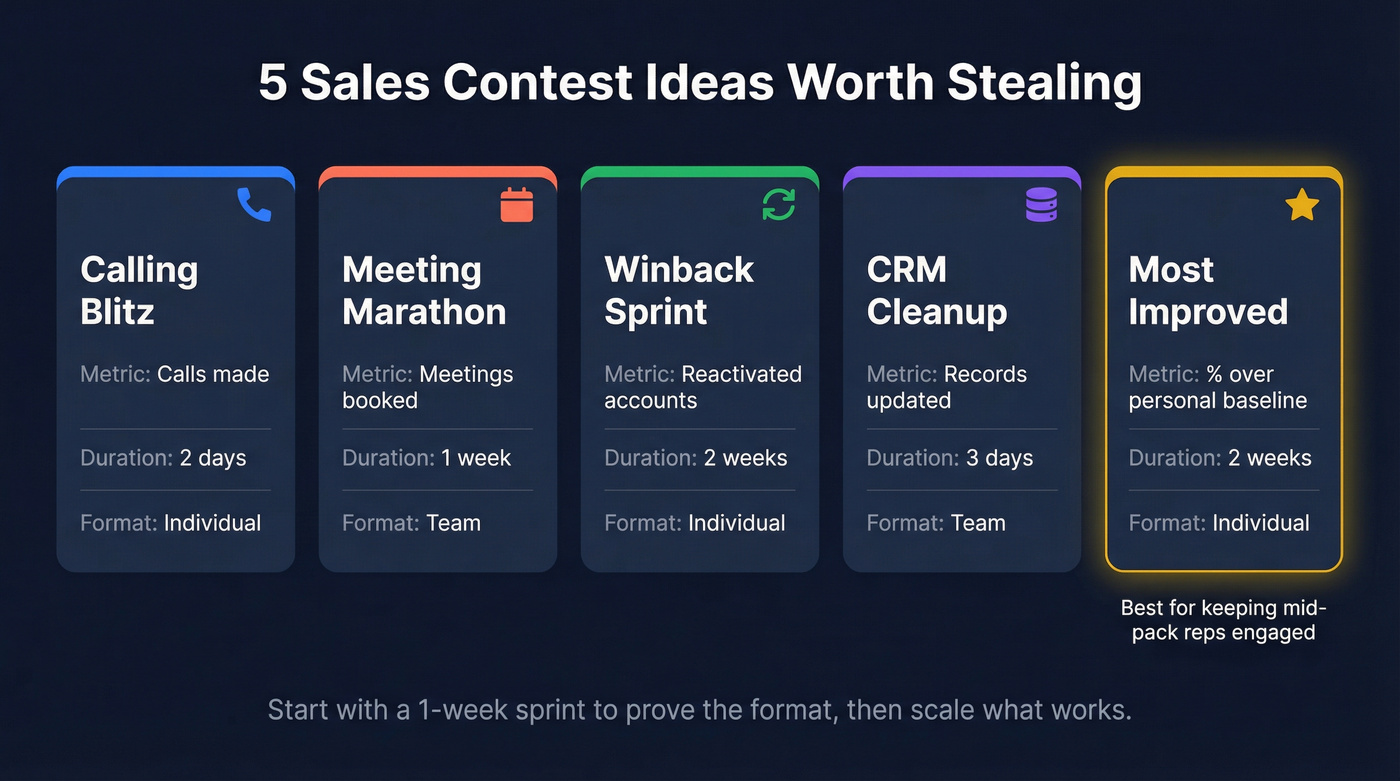
The "Most Improved" format deserves special attention. It levels the playing field completely - a rep who goes from 10 calls/day to 25 shows more improvement than the top performer going from 40 to 45. It's the single best format for keeping mid-pack reps engaged, and we've seen it spark the most genuine excitement on teams where the usual winners have gotten complacent.
FAQ
How long should a sales contest last?
Match duration to your metric. Calling contests work best at 1-3 days; meetings booked need about a week; deals closed require a full month. Start with a short sprint to prove the format. Anything beyond 90 days needs checkpoint rewards and variable metrics to avoid fatigue.
Are sales contest prizes taxable?
Yes - cash and non-cash prizes are taxable compensation under US federal tax rules, typically reported on Form W-2. Non-cash prizes require fair market value inclusion. Consider grossing up prizes to cover the tax hit; otherwise you're handing reps a "reward" that costs them money in April.
How do you keep mid-pack reps engaged?
Use lottery-ticket mechanics where each completed activity earns one raffle entry, or run a "most improved" category that rewards percentage gains over personal baselines. Tiered competitions segmented by territory size or tenure also help. The goal is giving 80% of the team a realistic shot at winning.
What's a good prize budget?
Budget 1-3% of expected incremental gross profit from the contest. For a weekly calling blitz, $50-$100 per rep in cash SPIFs is the sweet spot. For month-long competitions, experiences or extra PTO tend to outperform cash because they're more memorable.
How do you make sure reps are calling real numbers during a blitz?
Verify your contact list before the contest starts. Tools like Prospeo offer real-time phone and email verification with a 98% accuracy rate and a 30% mobile pickup rate - far above industry averages. Dead data turns a calling blitz into a morale killer.