

How to Sell Anything to Anybody - A Modern, Data-Backed Playbook
There's an old parable about three salespeople tasked with selling combs to monks. The first sold a single comb by finding a monk with an itch. The second sold ten by placing them near the temple entrance for windswept visitors. The third sold a thousand - by convincing the head monk to brand combs as keepsake gifts for every pilgrim who visited.
Same product. Same impossible audience. Three wildly different results. The difference wasn't persuasion - it was how each seller reframed value for the buyer's world. That's the core lesson behind how to sell anything to anybody: the best salespeople don't convince everyone to buy. They find the right people and make saying yes feel obvious.
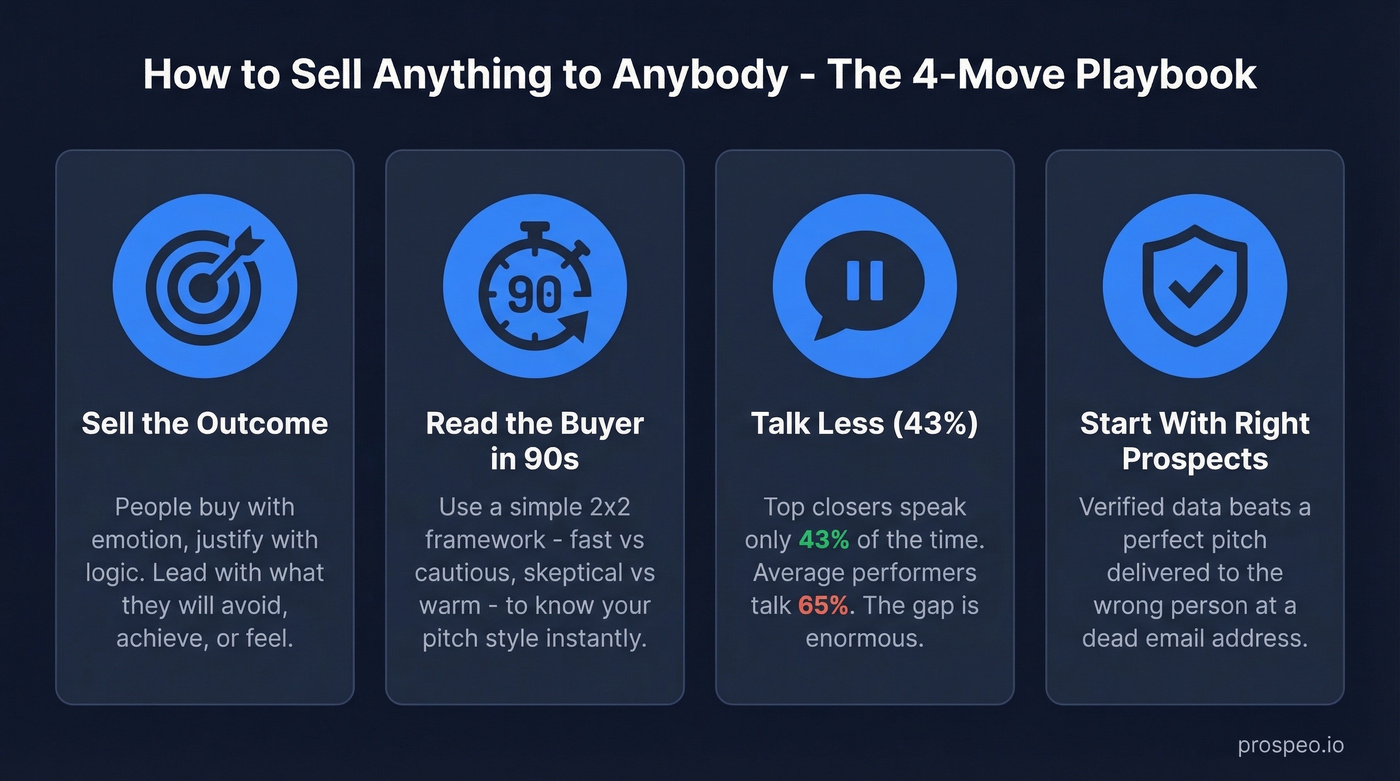
The Playbook in Four Moves
- Sell the outcome, not the product. People buy with emotion, then justify with logic. Lead with what they'll avoid, achieve, or feel.
- Read the buyer in 90 seconds. A simple 2x2 framework (fast vs. cautious, skeptical vs. warm) tells you how to pitch before you've finished your coffee.
- Talk less. Top closers speak only 43% of the time. Average performers talk 65%. The gap is enormous.
- Start with the right prospects. Verified data beats a perfect pitch delivered to the wrong person at a dead email address.
What Joe Girard Got Right (And What's Outdated)
Joe Girard sold 1,425 cars in a single year - a Guinness record. His system was deceptively simple: his "Law of 250" says every person knows roughly 250 people important enough to invite to a wedding or funeral. Mistreat one customer, and you risk losing 250 future ones.
Then he weaponized referrals. His "bird dog" program paid $25 to barbers, body shop owners, and credit union reps for every referral that turned into a sale. About one in three of his deals came from bird dogs. In 1977, that was genius-level networking.
Here's the thing: today, one bad experience can ripple through massive networks fast. In Girard-style terms, that "250" can become 70,000 over time. Girard's instinct was right - every interaction compounds. But the mechanics have changed completely. If you came here looking for a summary of Girard's book, those are the core ideas. The real question is what works now.
Most "how to sell" content online is either a book report on a 48-year-old Chevy dealership playbook or manipulative garbage dressed up as psychology. This is neither. What follows are 15 ways to sell anything to anyone - grounded in modern data, real psychology, and tactics you can use this week.
The Psychology Behind Every Sale
Robert Cialdini's seven principles of persuasion - reciprocity, scarcity, authority, consistency, liking, social proof, and unity - aren't academic theory. They're the invisible architecture behind every deal that closes.
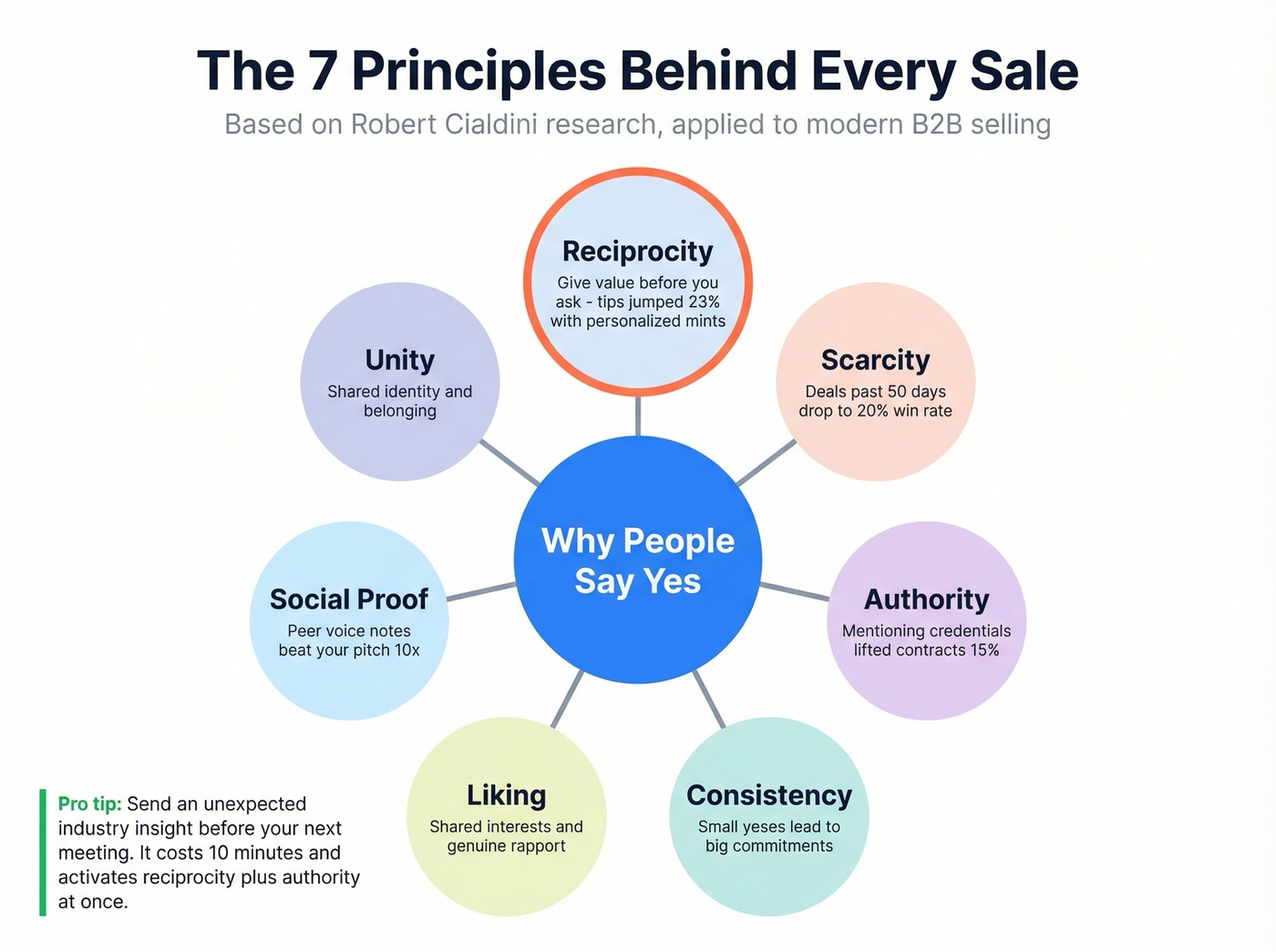
Reciprocity is the one that matters most in B2B. In Cialdini's famous restaurant experiment, giving diners one mint increased tips by 3%. Two mints bumped it to 14%. But when the server gave one mint, walked away, then turned back and said "for you nice people, here's an extra" - tips jumped 23%. The personalization made it feel like a gift, not a routine. As a popular sales thread on Reddit put it, people don't remember your pitch - they remember whether you gave them something useful before asking for anything.
Authority works the same way. When a real estate office started mentioning agent credentials before transferring calls, appointments rose 20% and signed contracts climbed 15%. No new skills. No new scripts. Just positioning expertise before the conversation started.
The practical move: before your next meeting, send an unexpected insight about the buyer's industry - a relevant benchmark, a competitor move they missed, a data point that reframes their problem. Spend five minutes scanning their background for shared experiences or interests (that's the "liking" principle at work). Both cost you nothing but ten minutes of research, and we've watched these two habits alone transform mediocre pipeline into real revenue.

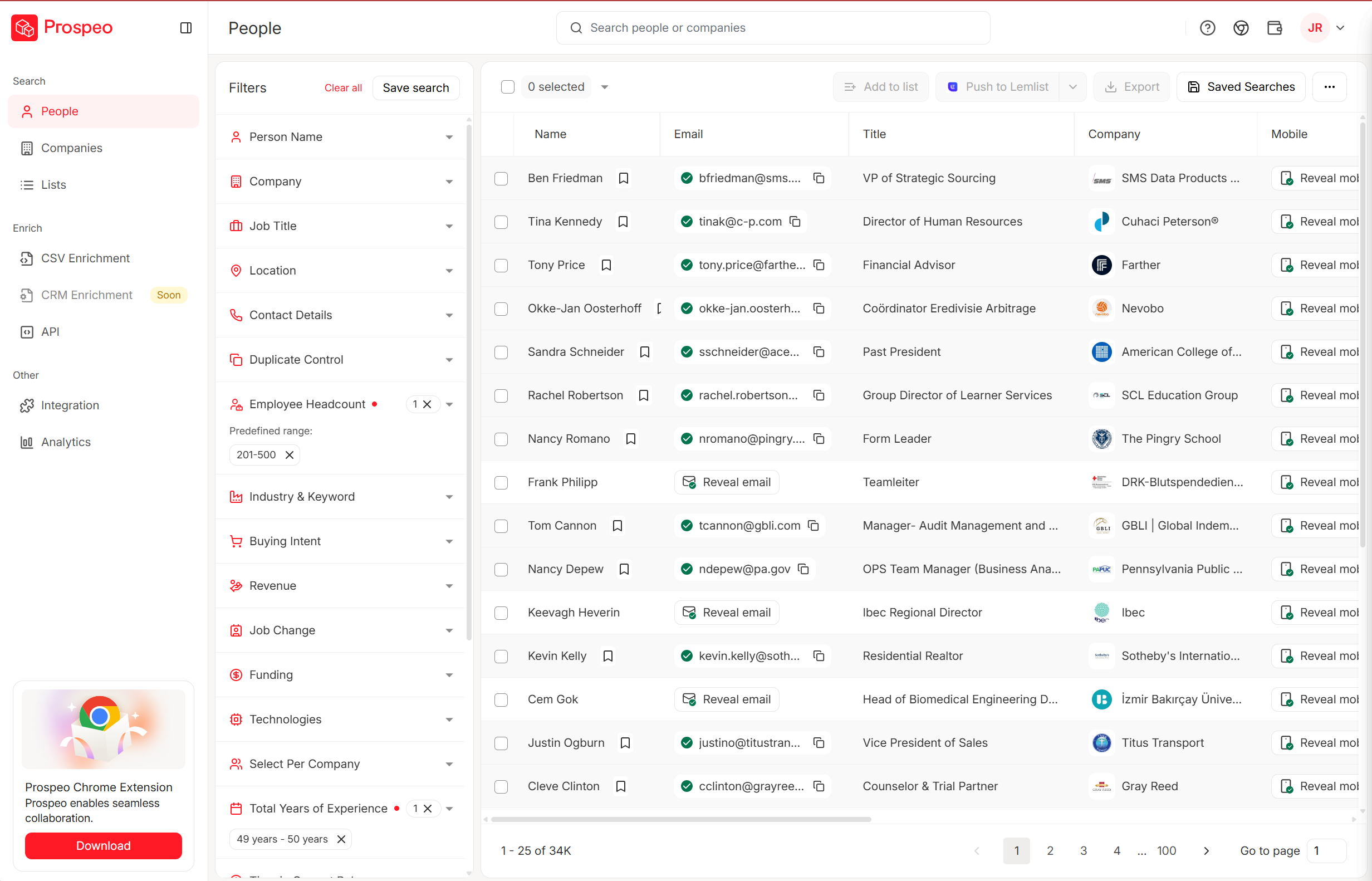
You just learned that 57% of the buying journey happens before a prospect talks to sales. That means your first touch has to reach the right person at a verified address - or you've already lost. Prospeo's 300M+ profiles with 98% email accuracy and 30+ filters let you find decision-makers who match your ideal buyer, so your pitch lands with someone ready to listen.
Stop perfecting your pitch for the wrong people. Start with the right data.
Read the Buyer, Not the Script
You don't need 47 closing techniques. You need to understand four buyer personalities and one solid process.
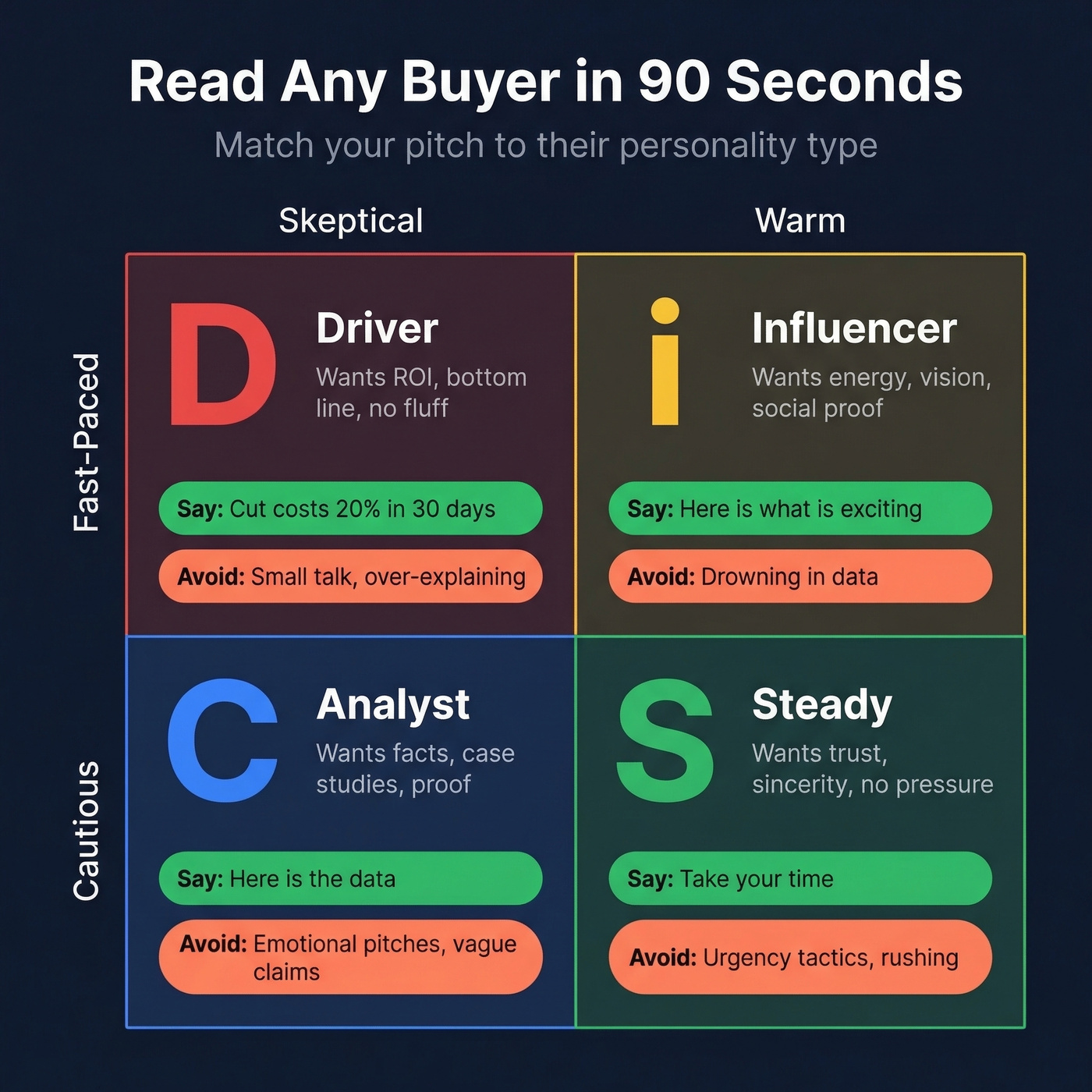
| Skeptical | Warm | |
|---|---|---|
| Fast-paced | D (Driver) - Wants ROI, bottom line, no fluff. Say: "Cut costs 20%, 30 days." Avoid: small talk, over-explaining. | i (Influencer) - Wants energy, vision, social proof. Say: "Here's what's exciting." Avoid: drowning in data. |
| Cautious | C (Analyst) - Wants facts, case studies, proof. Say: "Here's the data." Avoid: emotional pitches, vague claims. | S (Steady) - Wants trust, sincerity, no pressure. Say: "Take your time." Avoid: urgency tactics, rushing. |
You can identify someone's type within the first 90 seconds of a call. A D-type interrupts your intro to ask about pricing. An S-type asks how your current clients feel about the product. Once you know, adjust - a pitch that lands perfectly with a Driver will make a Steady buyer shut down completely.
The 7-Stage Sales Process (2026 Tactics)
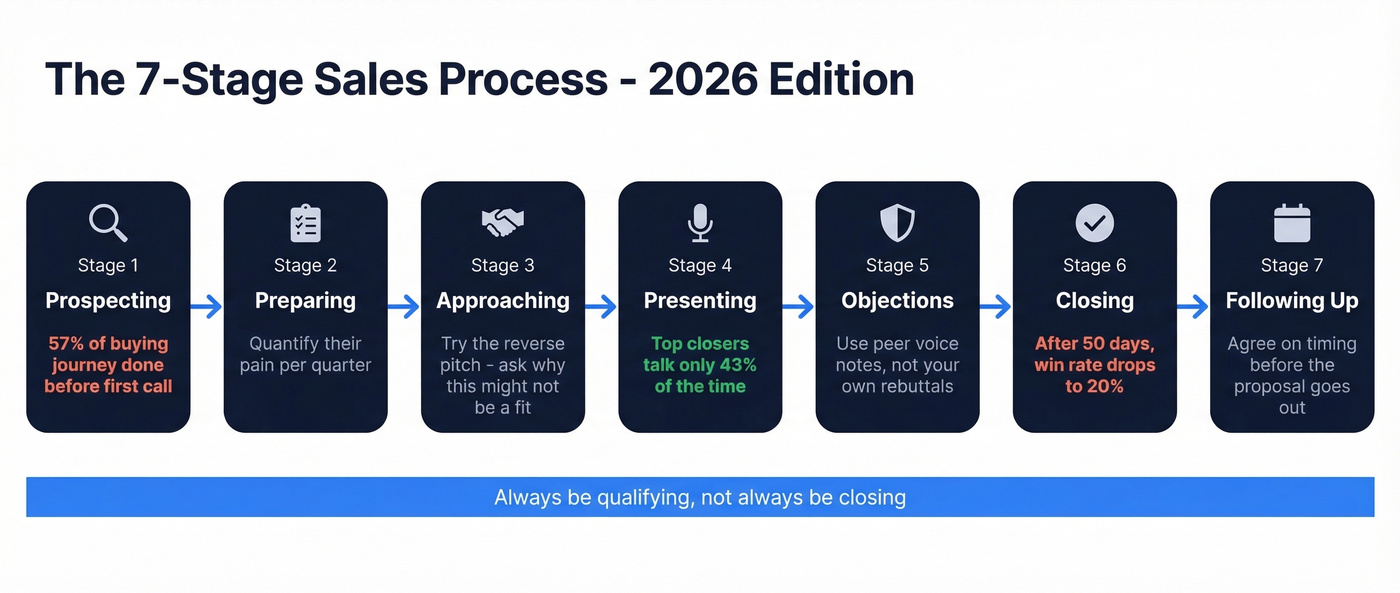
Every sale follows roughly the same arc. What's changed is how you execute each stage.
Prospecting
Lead qualification is the #1 seller challenge, not objection handling, not closing - finding the right people. And here's a stat that should reframe your entire approach: 57% of the buying journey is completed before a prospect ever speaks to sales. By the time they take your call, they've already formed opinions. Qualify ruthlessly. The best pitch in the world dies at a bad email address, which is why we rely on tools like Prospeo for verified contact data before any outreach goes out.
Preparing
Research the buyer's personality type and quantify their pain. Push yourself to answer: "What does this problem cost them per quarter?" If you can't estimate that number, you're not ready for the call.
Approaching
Try the reverse pitch. Spend the first five minutes exploring reasons the prospect might not be a fit. "Before I walk you through anything - what would make this a waste of your time?" It builds trust instantly because it signals you're not desperate. In our experience, this works best with enterprise buyers who've been pitched 50 times this quarter and are bracing for another generic demo.
Presenting
This is where most reps blow it.
Top closers talk 43% of the time; average performers talk 65%. That's not a small gap - it's the difference between listening to understand and talking to convince. We've watched reps talk through an entire demo without asking a single question, then wonder why the deal went dark. Ask better questions. Let the buyer sell themselves on the problem.
Handling Objections
Instead of handling the objection yourself, engineer peer-led objection handling. Record a 60-second voice note from a customer who had the exact same concern - implementation timeline, integration complexity, whatever it is. A peer's voice is ten times more credible than yours. Skip this tactic if you're selling something brand new with no customer base yet; in that case, lean on third-party data and analyst reports instead.
Closing
Deals closed within 50 days have a 47% win rate. After 50 days, it drops to 20% or lower. That's not a gentle decline - it's a cliff. Create genuine urgency by agreeing on a decision timeline before you send the proposal, not after.
Following Up
Agree on follow-up timing and mode before the proposal goes out. A shared deadline feels collaborative, not pushy - and it keeps you from joining the graveyard of "just checking in" emails that every buyer dreads.
The Numbers That Separate Closers
Let's break this down with the data that actually matters:
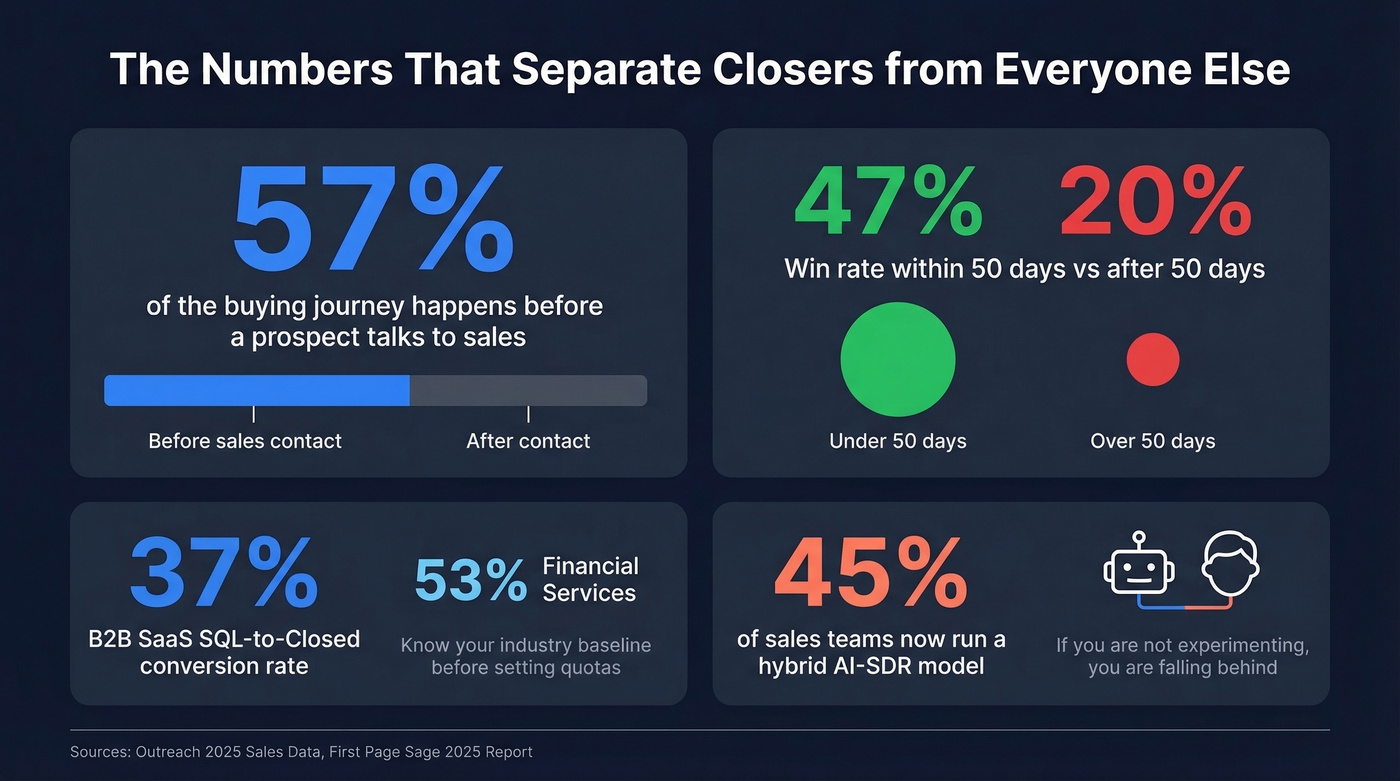
- The buyer's head start: 57% of the buying journey happens before a prospect talks to any rep. If you're not shaping that early research phase with content, social proof, and visibility, you're already behind.
- Speed kills (in a good way): Deals closed within 50 days win at 47%. After that, 20% or worse.
- Conversion varies wildly: B2B SaaS SQL-to-Closed runs about 37%. Financial services hits 53%. Know your industry's baseline before you set quotas.
- AI is already here: 45% of teams are running a hybrid AI-SDR model. If you're not experimenting, you're falling behind fast.
Look - if your average deal size is under $15K, you don't need a complex multi-touch sales process. You need clean data, a tight email sequence, and a product that demos itself. Save the enterprise playbook for enterprise deals. "Always be closing" is dead. Always be qualifying is what actually works, and that's the modern answer to how to sell anything to anybody.
Girard's bird dogs worked because they connected him to real buyers, not dead leads. Today, your 'bird dog' is verified data. Prospeo refreshes 300M+ contacts every 7 days - not every 6 weeks like competitors - so you're never pitching a prospect who changed jobs last month. At $0.01 per email, enterprise-grade prospecting doesn't require an enterprise budget.
Sell anything to anybody - starting with the right somebody.
FAQ
What's the most important skill in selling?
Listening. Top-performing reps talk only 43% of the time on sales calls. Technique, objection handling, and closing tactics all matter - but they sit on a foundation of understanding the buyer's actual problem before you prescribe a solution.
Can you really sell anything to anybody?
Not literally - and trying to is a waste of quota. The best sellers qualify ruthlessly and focus on prospects who already have a need. Joe Girard's real secret wasn't persuasion; it was a referral system that kept him in front of pre-qualified buyers. The skill is finding the right people and removing friction from their yes.
What tools help you sell more in 2026?
Three categories cover 90% of what you need: a CRM for pipeline management (HubSpot, Salesforce), a B2B data platform for verified contact data like Prospeo, and a conversation intelligence tool like Gong for coaching on talk-to-listen ratio.
How do I find the right prospects before pitching?
Start with intent signals - companies actively researching your category close faster. Layer buyer intent with job role, technographics, and headcount growth to build a list that's actually worth calling. Combine that with a tight ICP definition and you'll spend less time pitching and more time closing.