

How to Write a Persuasive Email That Actually Gets a Reply
You spent 20 minutes crafting the perfect cold email. You nailed the hook, personalized the opener, added a compelling case study. Then 12% of your list bounced, and the rest landed in spam. The best persuasive email in the world gets a 0% reply rate when it never reaches anyone.
Here's the thing: whether you're writing cold outreach, an internal pitch, a fundraising ask, or a partnership proposal, the principles are the same. The average cold email response rate sits at 7-10%, and your recipient will spend roughly 9 seconds reading it. You're writing for a shrinking window, against long odds, and most guides still tell you to "be concise and add a CTA" like that's a revelation. Let's do better.
Three Rules Before You Start
These are non-negotiable:
- Keep it under 125 words, use one CTA, and keep the subject line under 45 characters.
- Lead with the reader's problem, not your pitch. Use PAS (Problem-Agitate-Solve) or BAB (Before-After-Bridge). If you learn one framework from this guide, learn PAS.
- Verify your contact data before you send. A bounce rate over 5% damages your domain reputation and tanks deliverability for every email that follows. The copy doesn't matter if the address is dead.
Those three rules get you 80% of the way. The rest of this guide covers persuasive copy strategies, frameworks, psychology, and formatting details that separate a 2% reply rate from a 15%+ one.
Benchmarks Worth Knowing
Before you write anything, calibrate your expectations:
| Metric | Benchmark |
|---|---|
| Response rate | 7-10% |
| Bounce threshold | <2% healthy, >5% = risk |
| Optimal length | 50-125 words |
| Replies from follow-ups | ~60% |
| Sequence cadence | 4-7 emails, 14-21 days |
| Mobile opens | 44.7% |
| Best target seniority | Directors (17.8% reply rate) |
The response rate range is wide because personalization and targeting make an enormous difference. An analysis of 2,847 cold emails found the bottom 50% of senders averaged 0.8-2.1% reply rates, while the top 10% hit 15.4-23.1%. Same channel, same inbox, wildly different results. The gap is technique.

Subject Lines That Get Opened
47% of recipients decide whether to open based on the subject line alone. Worse, 69% decide whether to mark you as spam based on the subject line. This isn't a detail - it's the gate.
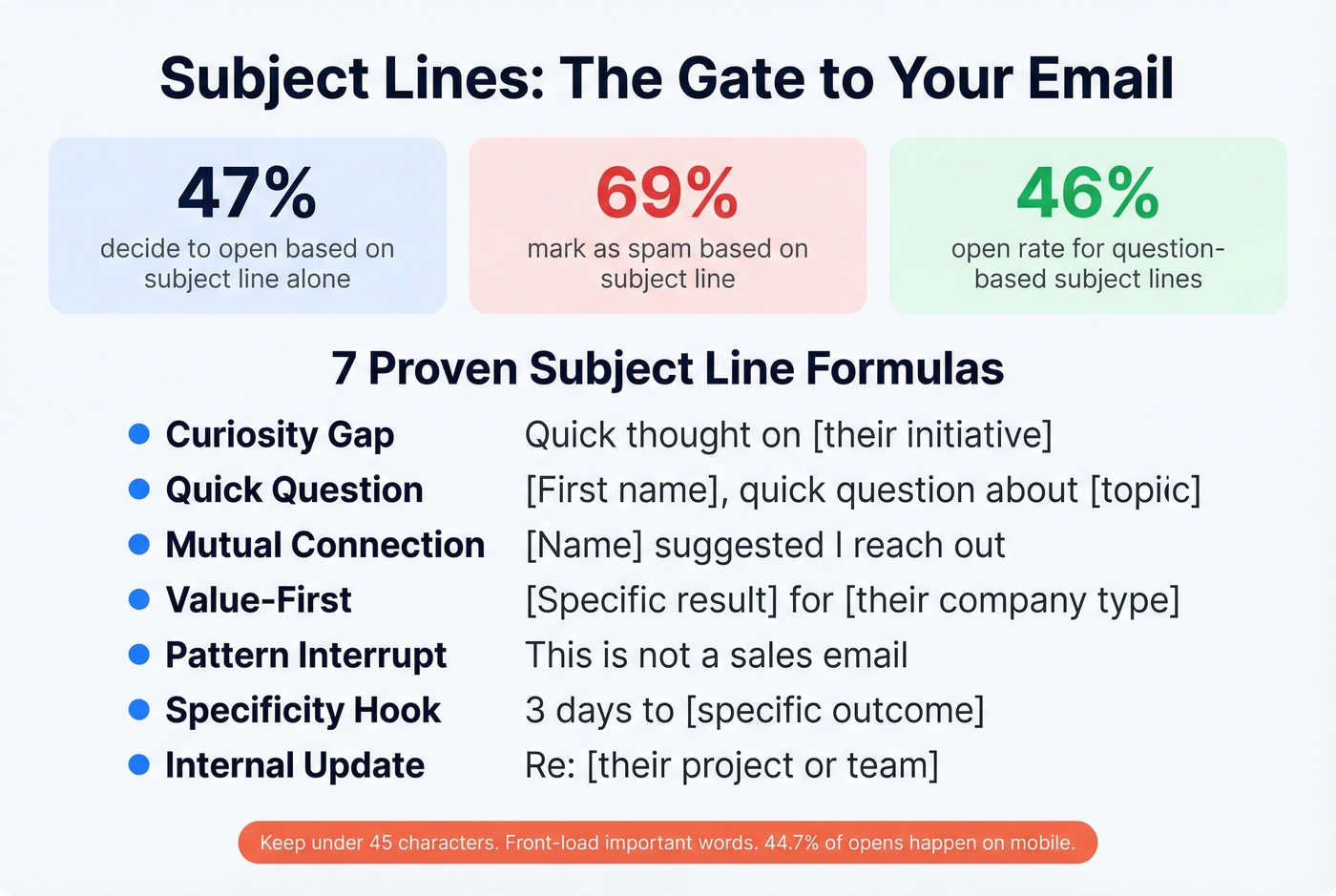
Keep subject lines under 45 characters. On mobile, truncation kicks in around 25-30 characters, and 44.7% of opens happen on phones. Front-load the important words.
Personalized subject lines lift open rates 22-36%, so work in something specific when you can. Seven formulas that consistently perform:
- Curiosity gap: "Quick thought on [their initiative]"
- Quick question: "[First name], quick question about [topic]"
- Mutual connection: "[Connection name] suggested I reach out"
- Value-first: "[Specific result] for [their company type]"
- Pattern interrupt: "This isn't a sales email"
- Specificity hook: "3 days -> [specific outcome]"
- Internal update: "Re: [their project or team]"
The internal update format is polarizing. We've seen it work well when the email body genuinely references something internal to their company. Used lazily, it erodes trust fast.
Question-based subject lines pulled a 46% open rate in a Belkins analysis of 5.5M emails. Questions work because they create an open loop the reader wants to close. A/B test two subject lines per campaign - even small sample sizes reveal patterns quickly.
Five Frameworks for Persuasive Emails
Every guide covers AIDA. Here are five frameworks you can actually choose between depending on the situation.
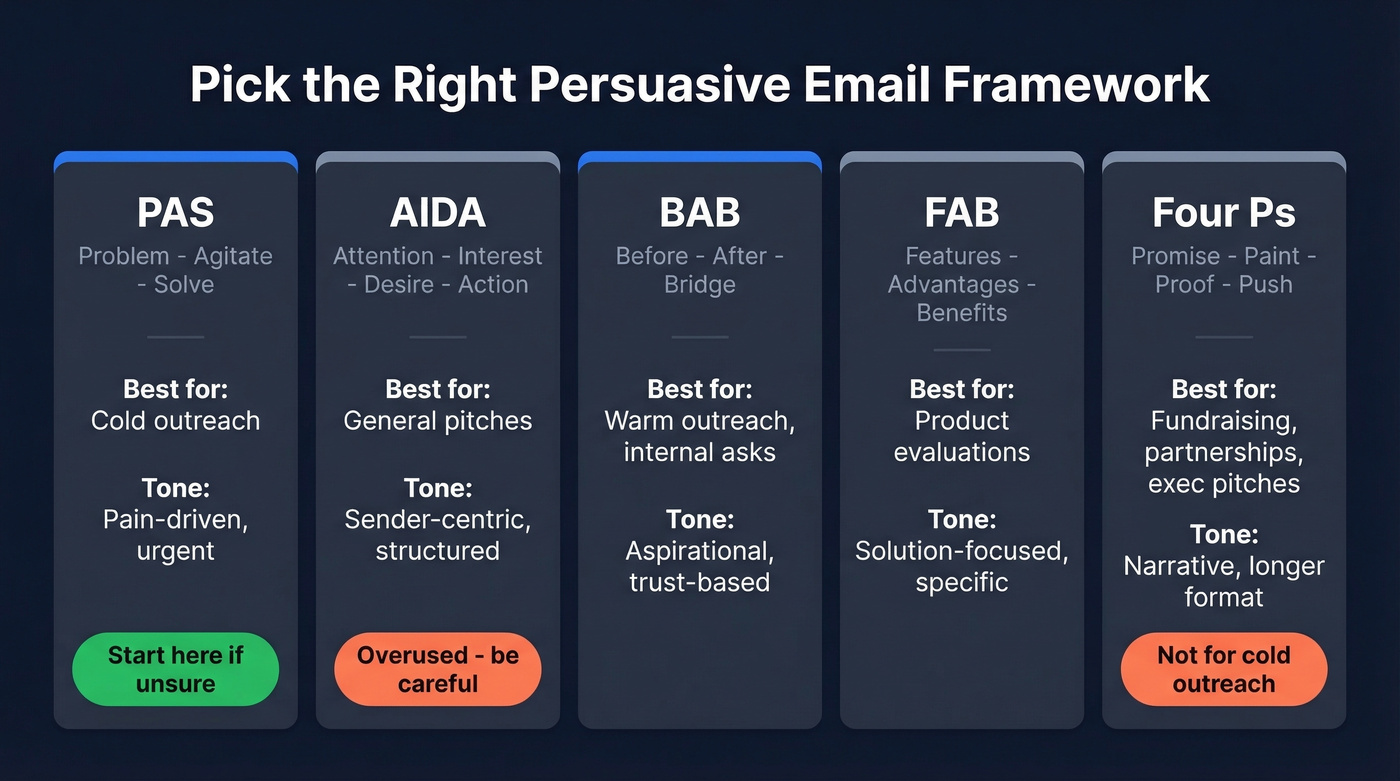
PAS (Problem -> Agitate -> Solve)
If you learn one framework, learn this one. PAS forces you to lead with the recipient's pain, twist the knife just enough to make it feel urgent, then offer the solution.
Subject: Your reps are losing 4 hours/week on this
Hi Marcus, most SDR teams at Series B companies spend 4+ hours a week manually enriching lead lists. (Problem) That's 200 hours a quarter your closers aren't closing. (Agitate) We built an enrichment workflow that cuts that to 20 minutes. (Solve) Open to a quick look?
AIDA (Attention -> Interest -> Desire -> Action)
The classic. Grab attention with a hook, build interest with a relevant insight, create desire with a benefit, and close with a clear action. It works, but it's sender-centric - you're leading with what you want to say, not what they need to hear. AIDA is fine but overused, and because it centers on the sender, it often produces emails that read like pitches instead of conversations.
Subject: Cutting onboarding time in half
Hi Sarah, your team just hit 50 reps - congrats. (Attention) Most teams at that stage lose weeks per new hire to manual CRM setup. (Interest) We automated that and cut ramp time in half. (Desire) Worth a 15-minute call Thursday? (Action)
BAB (Before -> After -> Bridge)
BAB shines for warm outreach and internal stakeholder emails. Paint the current state, show the better future, then explain how to get there. It's aspirational rather than pain-driven, which makes it the better choice when you're persuading someone who already trusts you.
Subject: Q3 pipeline projection
Right now, our outbound team books 8 meetings/week from 200 daily sends. (Before) With verified contact data and a tighter ICP filter, similar teams hit 15-20 meetings/week at the same volume. (After) I've mapped out a 3-step workflow to get us there - can I walk you through it Friday? (Bridge)
FAB (Features -> Advantages -> Benefits)
Best for product-specific pitches where the recipient already knows they have a problem and wants to evaluate solutions.
- Feature - State the capability plainly: "Our platform verifies emails in real time before they enter your sequence."
- Advantage - Explain why it matters vs. the alternative: "Zero bounced sends instead of cleaning lists after the damage is done."
- Benefit - Land on the business outcome: "Stack Optimize kept deliverability 94%+ with zero domain flags across clients."
Close with a single, low-friction ask: "Want to test it on your next campaign?"
Four Ps (Promise -> Paint -> Proof -> Push)
When to use this: longer emails - fundraising asks, partnership proposals, executive pitches. The Four Ps give you room to build a narrative that shorter frameworks can't support.
Skip this if you're writing cold outreach to someone who doesn't know you. The length will kill your reply rate.
Subject: Partnership opportunity - [their company]
We can help your team double qualified pipeline in 90 days. (Promise) Imagine your AEs spending 80% of their time in conversations instead of hunting for contacts - every lead pre-verified, every phone number live. (Paint) That's what happened at GreyScout: pipeline up 140%, and rep ramp time cut from 8-10 weeks to 4 weeks. (Proof) I'd love 20 minutes to show you the model. Tuesday or Wednesday work? (Push)

You just learned that a bounce rate over 5% tanks deliverability for every email that follows. Prospeo's 5-step verification delivers 98% email accuracy - so your carefully crafted PAS frameworks and personalized subject lines actually reach real inboxes.
Stop perfecting copy that bounces. Verify every address before you hit send.
Seven Psychology Triggers That Drive Replies
Frameworks give you structure. Psychology is what moves people. These seven triggers - several drawn from Robert Cialdini's influence principles and Daniel Kahneman's behavioral research - move recipients from "ignore" to "reply."
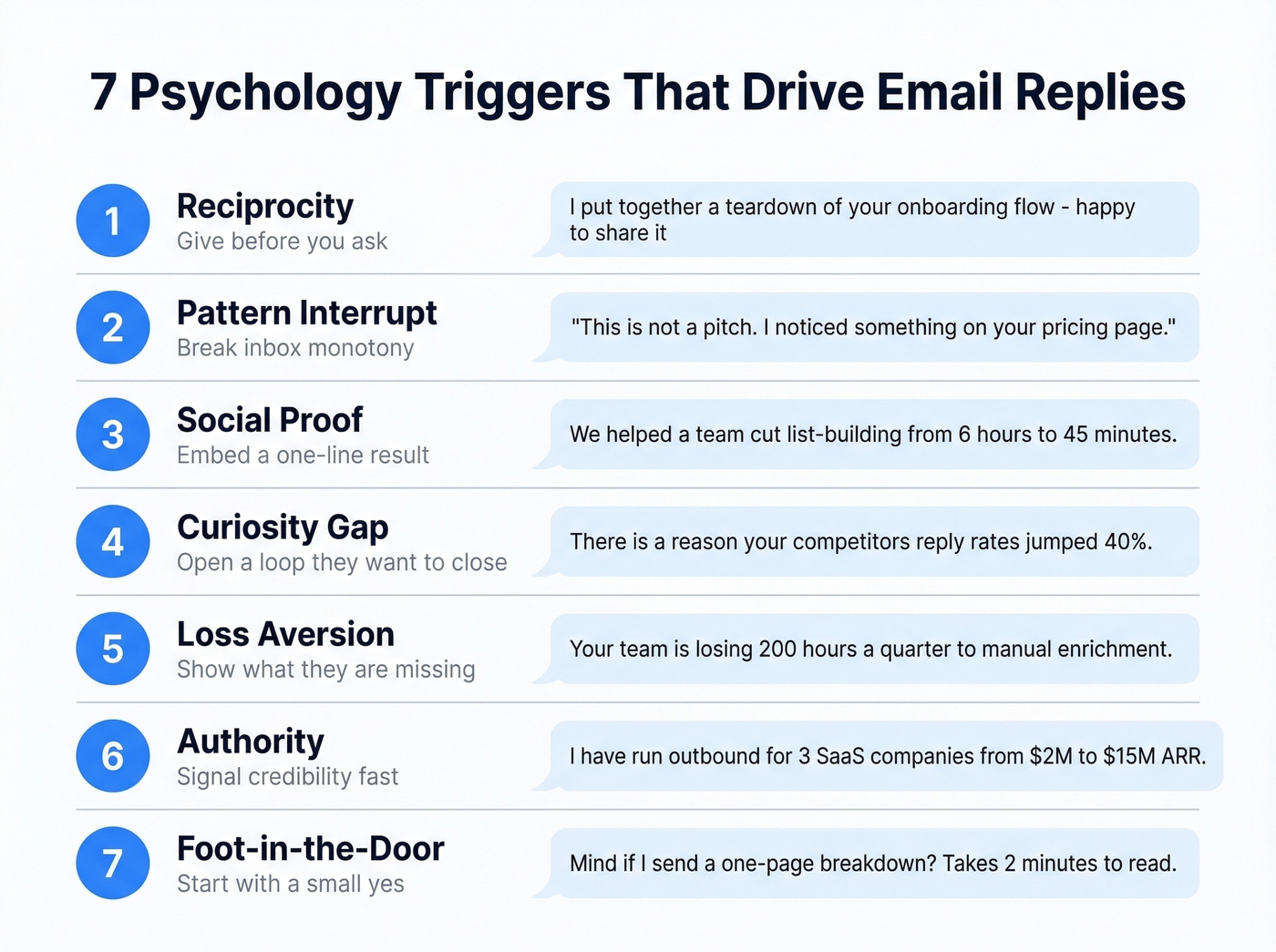
1. Reciprocity - give before you ask. Don't lead with "Can I get 15 minutes of your time?" Instead: "I put together a quick teardown of your onboarding flow - three things I'd change. Happy to share it, no strings."
2. Pattern interrupt - break inbox monotony. Not "I'd love to introduce myself and my company." Try: "This isn't a pitch. I just noticed something on your pricing page that's costing you signups."
3. Social proof - embed a one-line result. Not "We work with lots of companies like yours." Better: "We helped a team cut list-building from 6 hours to 45 minutes."
4. Curiosity gap (Zeigarnik effect) - open a loop. Not "We have a great solution for your team." Try: "There's a reason your competitors' reply rates jumped 40% last quarter. It's not what you'd expect."
5. Loss aversion - show what they're missing. Not "Our tool saves you time." Better: "Your team is losing roughly 200 hours a quarter to manual enrichment. Here's the math."
6. Authority - signal credibility fast. Not "I'm a sales consultant." Try: "I've run outbound for 3 SaaS companies from $2M to $15M ARR. Here's what I'd change about your approach."
7. Foot-in-the-door - start with a small yes. Not "Can we schedule a 45-minute strategy session?" Instead: "Mind if I send over a one-page breakdown? Takes 2 minutes to read." Get the small commitment first, then follow up with the bigger ask. This works especially well in sequences - your first email asks for almost nothing, your second builds on the micro-commitment.
Personalize Beyond First Name
That same 2,847-email analysis found that hyper-personalized messages mentioning a specific business challenge got 8.7x more replies than generic outreach: 18.3% vs 2.1%. Dropping in "[First Name]" and "[Company]" tokens isn't personalization. Referencing their recent funding round, a specific product launch, or a hiring pattern they're showing - that's personalization. It's also the fastest way to turn bland text into copy that feels like a one-to-one conversation.
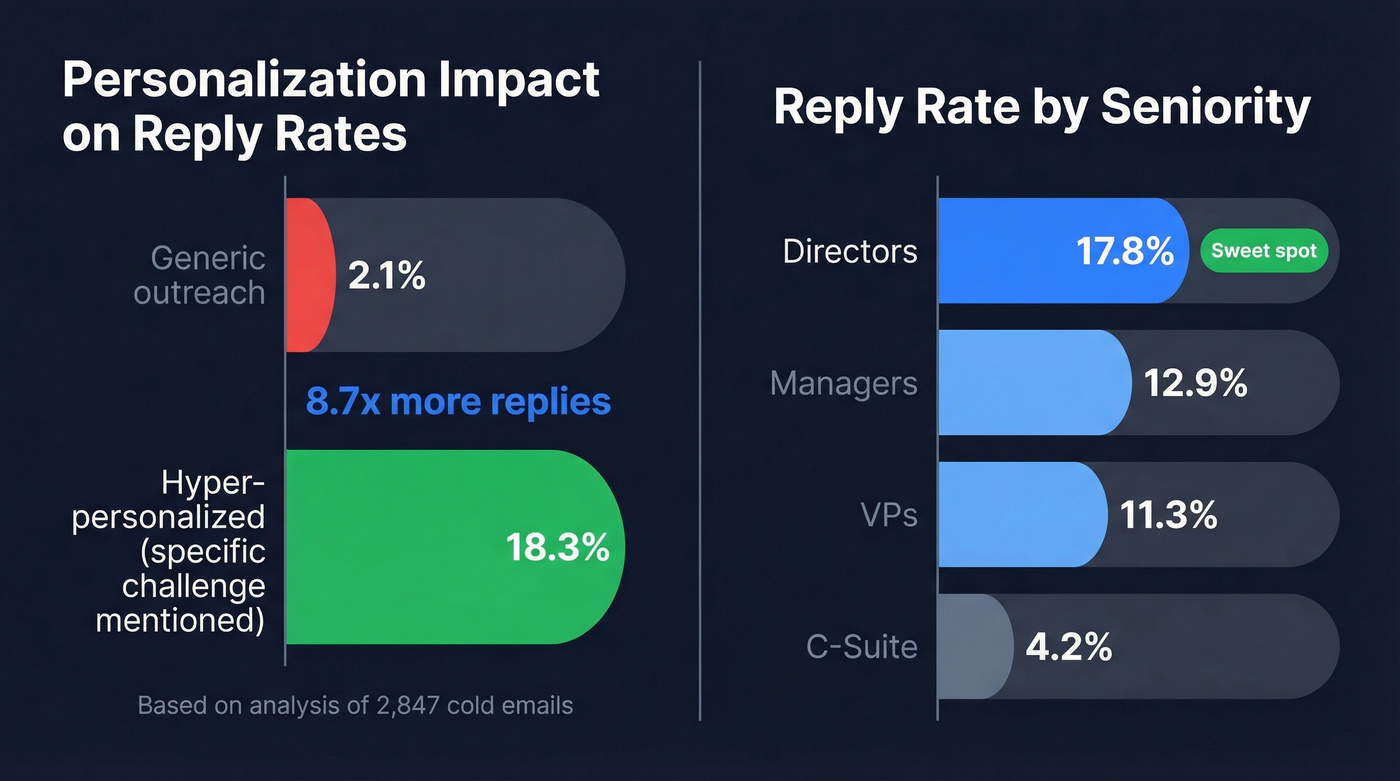
The same dataset broke down reply rates by seniority: Directors responded at 17.8%, Managers at 12.9%, VPs at 11.3%, and C-suite at 4.2%. Directors are the sweet spot - senior enough to have budget influence, accessible enough to reply to a well-crafted email.
We've seen this play out repeatedly: a feature-specific email paired with a relevant case study result outperforms a generic "all-features" pitch by roughly 2x. The practitioner on r/sales who booked 12 meetings in a single day did it with email #2 - the feature-specific follow-up, not the intro.
To personalize at scale, you need accurate data on who you're emailing. Prospeo's 30+ search filters - job changes, funding rounds, tech stack, intent signals - let you reference something specific instead of guessing. The difference between "I see you're in SaaS" and "I noticed you just migrated to Snowflake and hired a data engineering lead" is the difference between delete and reply.
Format for the 9-Second Window
Your email has 9 seconds. Here's how to survive that window.
Put vital info up top. Readers scan in an F-pattern - the first two lines get the most attention. Don't waste them on "I hope this finds you well."
Stay in the 50-125 word range. The consensus on r/sales and r/copywriting is clear: emails that look like homework get archived. 75-100 words is the sweet spot for cold outreach. Two-sentence paragraphs max. White space is your friend. Dense blocks of text signal "this will take effort" and trigger the skip reflex.
One CTA at the bottom - don't ask them to watch a video, read a case study, and book a call. Pick one. No more than one link or attachment, since multiple links can hurt deliverability. Design for mobile first, because nearly half your opens happen on a phone screen.
Write like you talk. If you wouldn't say "I wanted to reach out regarding the potential synergies between our organizations" in a conversation, don't write it in an email.
AI-generated emails are making this worse, not better. ChatGPT produces grammatically perfect, personality-free prose that reads like every other AI-generated email in your recipient's inbox. The 8.7x personalization lift comes from specificity that AI can't fake - referencing a real hiring pattern, a real product decision, a real pain point. Use AI for research and drafts if you want, but the final email needs a human fingerprint.
Follow-Ups Outperform Your First Email
About 60% of replies come after the first follow-up. Most of your results are sitting in emails you haven't sent yet.
The optimal cadence is 4-7 emails spread over 14-21 days. Not 4 emails in 4 days - that's harassment. Space them out, and make each one add new value.
The practitioner who booked 12 meetings in a day did it with a second email structured like this: "Not sure if you've looked into [specific feature], but it's interesting - we worked with [relevant client] and saw [specific result]. Worth checking out?" That template works because it's specific, short, and introduces a new proof point.
Your follow-up shouldn't be "just bumping this to the top of your inbox." It should be a better email than the first one. In our experience, the second and third emails in a sequence often outperform the opener because they can reference the previous touchpoint and add a fresh angle. This is the foot-in-the-door principle in action - each email builds on the micro-commitment of the last.
The Pre-Send Checklist
Run your email through the Four Cs before you hit send:
- Clear - Can the reader understand your ask in one read?
- Concise - Is every sentence earning its place?
- Compelling - Is there a reason to reply today?
- Credible - Have you included at least one proof point?
Then check deliverability. Bounce rate under 2% - over 5% and you're actively damaging your domain reputation. Verify your list before you send. One link maximum, since every additional link increases your spam score. CAN-SPAM/GDPR compliance means including an unsubscribe option, using a real business address, and not buying scraped lists. SPF, DKIM, and DMARC should be configured - if you don't know what these are, ask your IT team before you send a single cold email.
Real talk: stop obsessing over email copywriting and start obsessing over who you're sending to. An SDR team sending 200 emails a day and booking 2 meetings a week usually doesn't have a writing problem - they have a data problem. A big chunk of their list is stale, and every bounce chips away at their sender reputation.
The guide above shows that 60% of replies come from follow-ups across a 4-7 email sequence. One bad address doesn't just waste one email - it wastes the entire sequence and damages your domain. Prospeo refreshes data every 7 days so your contacts stay valid through every touchpoint.
Protect your domain reputation and let your persuasive copy do the work.
FAQ
How long should a persuasive email be?
50-125 words for cold outreach, with 75-100 as the sweet spot. Longer emails work for warm contacts or internal stakeholders, but brevity wins in cold inboxes every time.
What's the best framework for cold email copy?
PAS (Problem-Agitate-Solve) for cold outreach - it forces you to lead with the reader's pain instead of your pitch. Use BAB for internal requests and warm contacts. Match the framework to the relationship.
How many follow-ups should I send?
Send 4-7 emails over 14-21 days. About 60% of replies come after the first follow-up. Each message should add new value - a fresh proof point, a different angle - not just "bumping this up."
Does personalization actually improve reply rates?
Hyper-personalized messages got 8.7x more replies in a 2,847-email study - 18.3% vs 2.1%. Mentioning a specific business challenge beats generic first-name tokens by a wide margin.
How do I prevent my emails from bouncing?
Verify every address before sending. A bounce rate over 5% damages domain reputation and tanks deliverability for every subsequent campaign. Real-time verification tools catch dead addresses before they do damage.