

Improv for Sales: Exercises, Science, and How to Start This Week
Your SDR freezes mid-sentence on a cold call. The prospect just said something unexpected, and the rep's brain is buffering - scanning the script for a line that doesn't exist. That freeze costs you the meeting.
Improv for sales fixes the freeze. And no, it's not about being funny. It's about building the reflexes that keep a conversation alive when the script runs out.
What Improv Actually Trains
Most sales teams share the same five bad habits, and improv targets every one. PowerProv's research breaks them down:
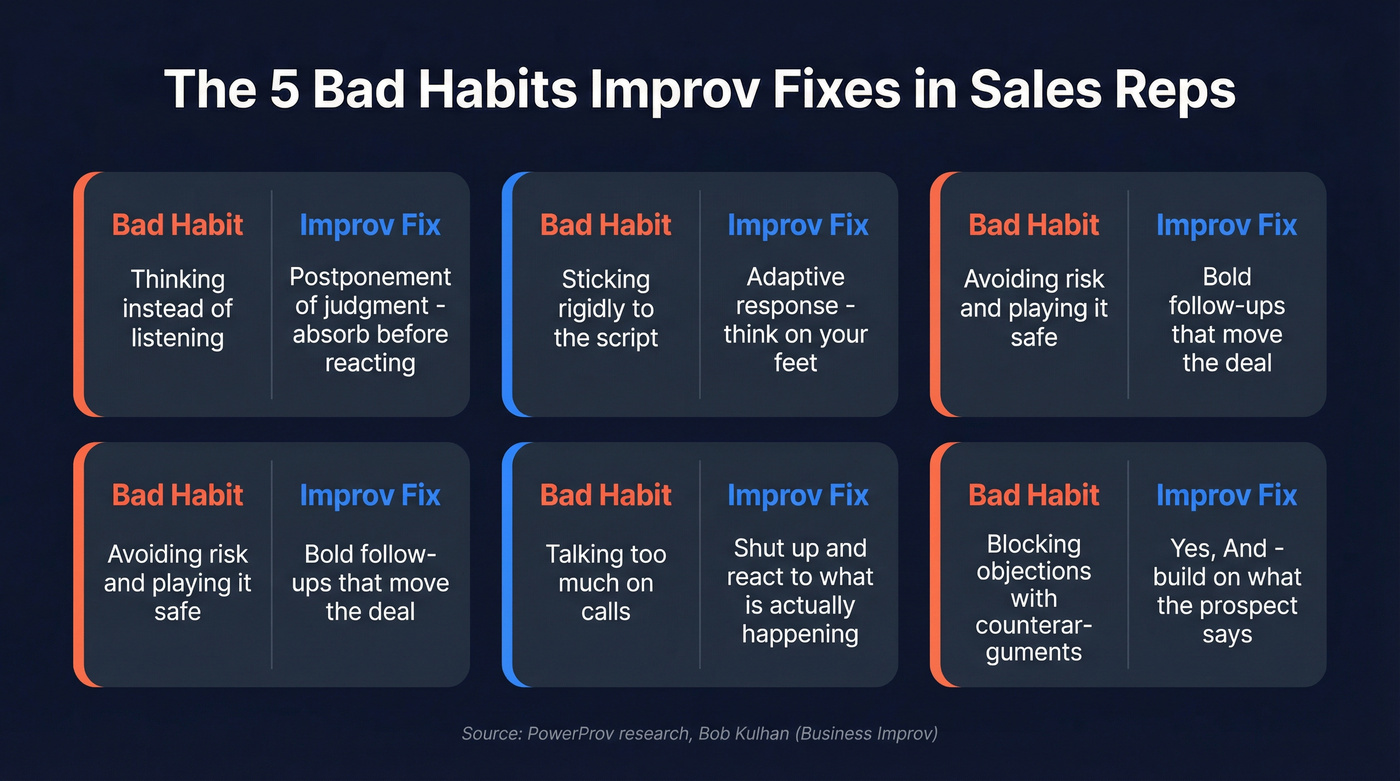
- Thinking instead of listening. Reps mentally rehearse their next line while the prospect is still talking. They miss the real objection entirely.
- Sticking to a script. When a conversation veers off-track, scripted reps stall. Improv trains adaptive response - the kind of think-on-your-feet reflex that separates booked meetings from dead air.
- Avoiding risk. Reps default to safe, generic language instead of asking the bold follow-up that moves the deal.
- Talking too much. Improv forces you to shut up and react to what's actually happening.
- Failing to "yes, and" objections. Instead of building on what the prospect says, reps block the conversation with counterarguments.
Bob Kulhan, founder of Business Improv and an adjunct at Duke and Columbia, frames the core mechanism as postponement of judgment - training yourself to absorb what's being said before reacting. That's the opposite of what most reps do on a discovery call. HBR research confirms the same dysfunction at the team level: leaders dominate conversations, don't listen, and shut down ideas. What kills brainstorms kills sales calls. The connection between improvisation and selling runs deeper than most people expect, because the same listening muscles that make a great scene partner make a great closer.
The "Yes, And" Framework in Action
"Yes, And" doesn't mean agreeing with the prospect. Julie Hansen makes this distinction well - "Yes" means accepting the prospect's reality. You don't have to like it. You just have to acknowledge it before you redirect.
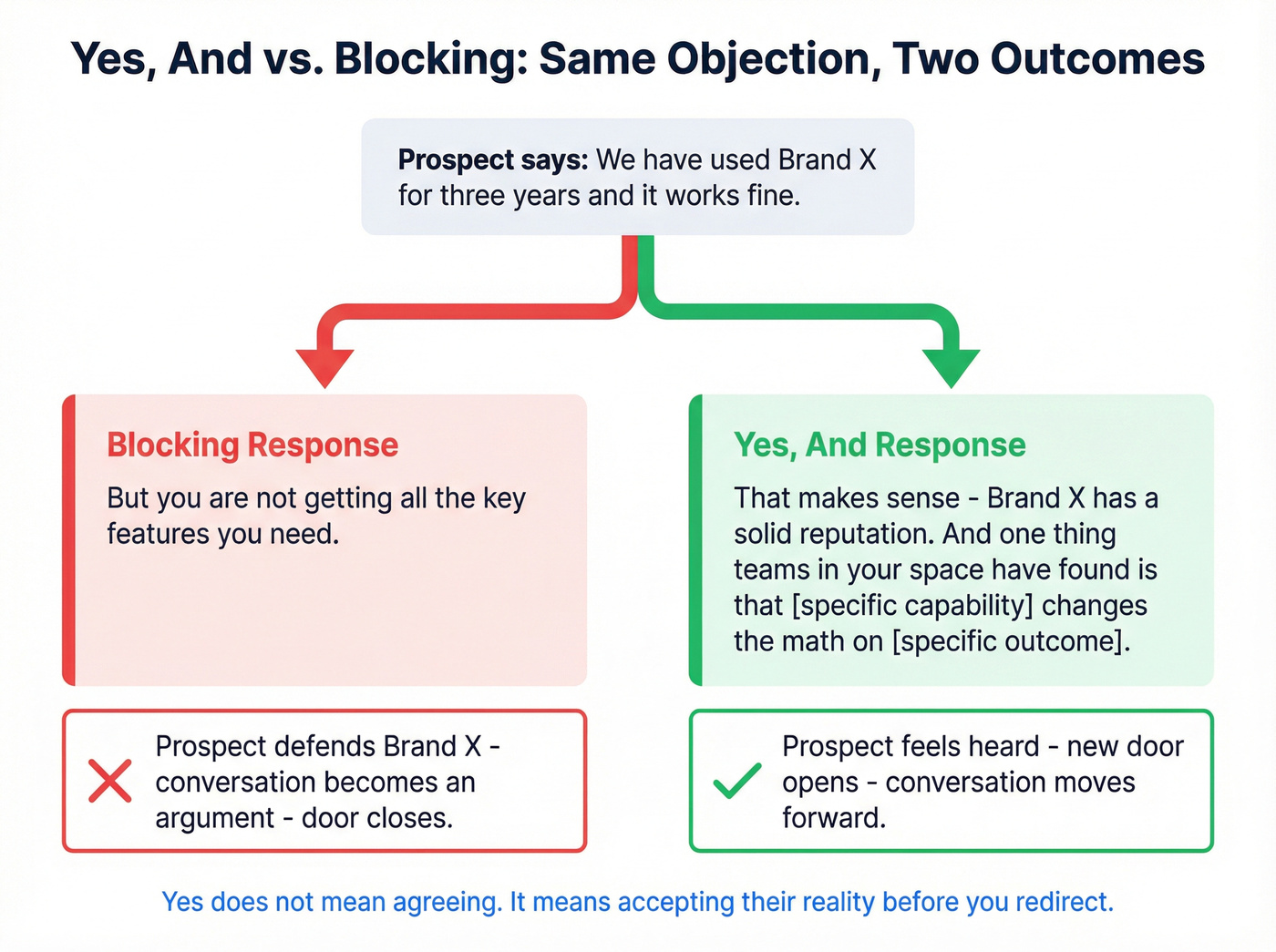
Here's the trap. Watch how "but" plays out in a competitive displacement scenario:
Prospect: "We've used Brand X for three years and it works fine."
Blocking response: "But you're not getting all the key features you need." This forces the prospect to defend Brand X. You've turned a conversation into an argument.
"Yes, And" response: "That makes sense - Brand X has a solid reputation. And one thing teams in your space have found is that [specific capability] changes the math on [specific outcome]." You've accepted their reality and opened a door instead of slamming one shut.
It's one of the most transferable improv techniques because it works in discovery, negotiation, and objection handling alike. We've seen reps internalize this in under a week of daily practice.
5 Exercises for Your Next Team Standup
These run in a conference room with no props and no drama training required. Pick one per day. Each takes minutes, not hours, and the skills compound over weeks.
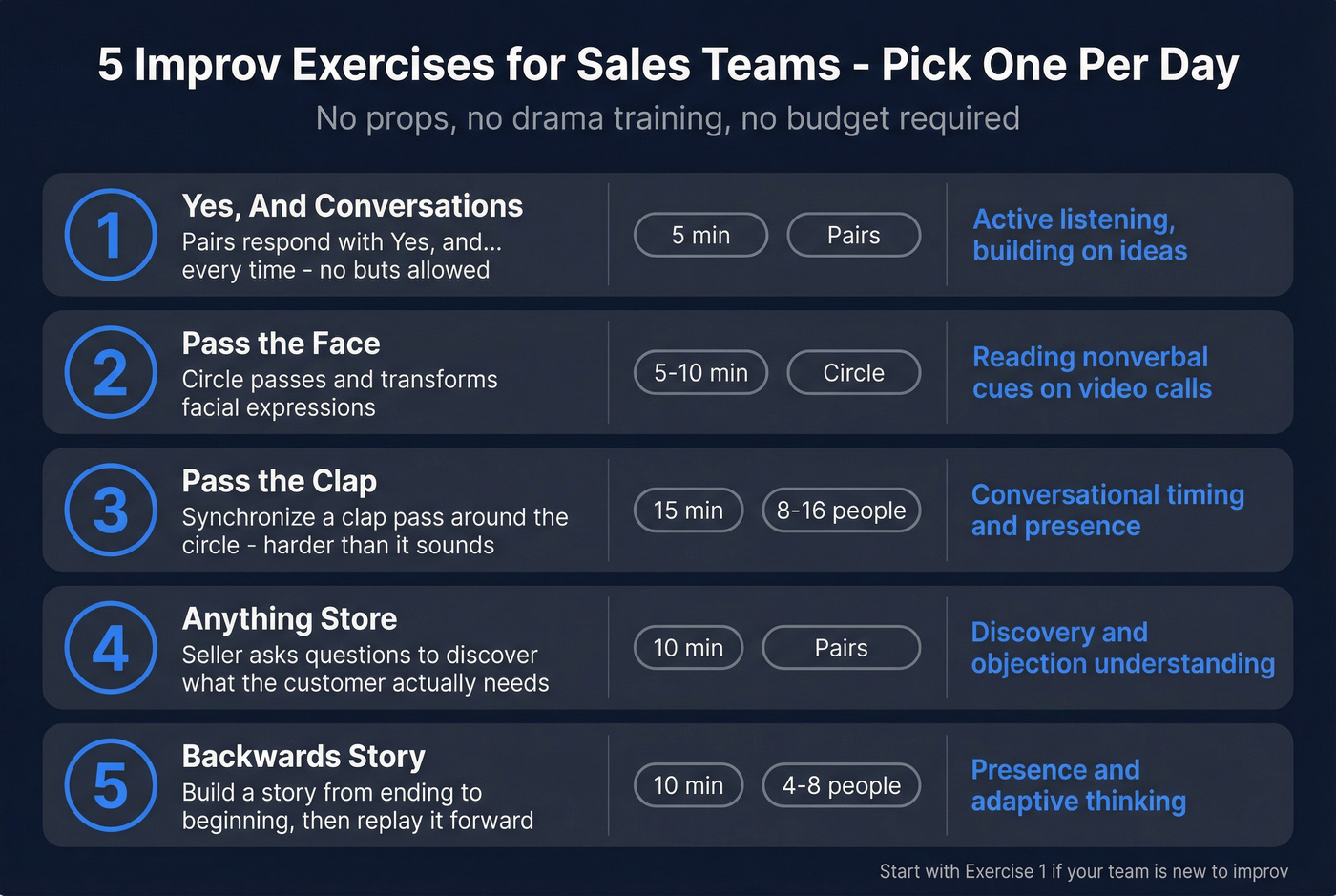
Yes And Conversations
Time: 5 min | Group: Pairs | Trains: Active listening, building on ideas
Pair up. One person starts a conversation about anything. The other must respond starting with "Yes, and..." every time. No "but," no "however." Switch after 2 minutes. Pairs work simultaneously, so nobody's performing for the group - the lowest-stakes entry point you'll find.
Pass the Face
Stand in a circle. One person makes a facial expression and "passes" it to the next person, who mirrors it, transforms it, then passes the new expression along. Takes 5-10 minutes. Sounds silly. It trains reps to actually watch the prospect's face on video calls instead of staring at their own notes.
Pass the Clap
Time: 15 min | Group: 8-16 in a circle | Trains: Communication timing, presence
The group passes a clap around the circle - the goal is perfect synchronization between sender and receiver. Harder than it sounds. It builds the kind of conversational timing that separates good discovery calls from great ones.
Anything Store + Backwards Story
These two exercises pair well as a 20-minute block.
In Anything Store, one person plays a customer in a store that sells literally anything. The seller's job isn't to pitch - it's to ask enough questions to figure out what the customer actually needs. Dr. Stefanie Boyer uses this exercise to teach students to understand objections before trying to handle them.
Then flip to Backwards Story: start with the ending of a story, and each person adds the "previous" moment, working backward to the beginning. Then replay the story forward like it was always the plan. A sales manager on r/improv uses this with SDRs to demonstrate how crucial presence is on every call - you can't zone out for a second. The contrast between the two exercises shows reps that listening and adaptive thinking are different muscles, and both need work. These drills most closely mirror real call dynamics.

Sharp reflexes don't matter if you're calling the wrong person. Prospeo gives your reps 98% accurate emails and 125M+ verified mobile numbers - so every improvised conversation happens with an actual decision-maker, not a dead end.
Train the rep. Then arm them with data that actually connects.
How Repetition Builds the Reflex
Dr. Boyer's students have completed nearly 200,000 simulated sales conversations. The pattern: after 70+ role-plays, responses become muscle memory rather than conscious effort.
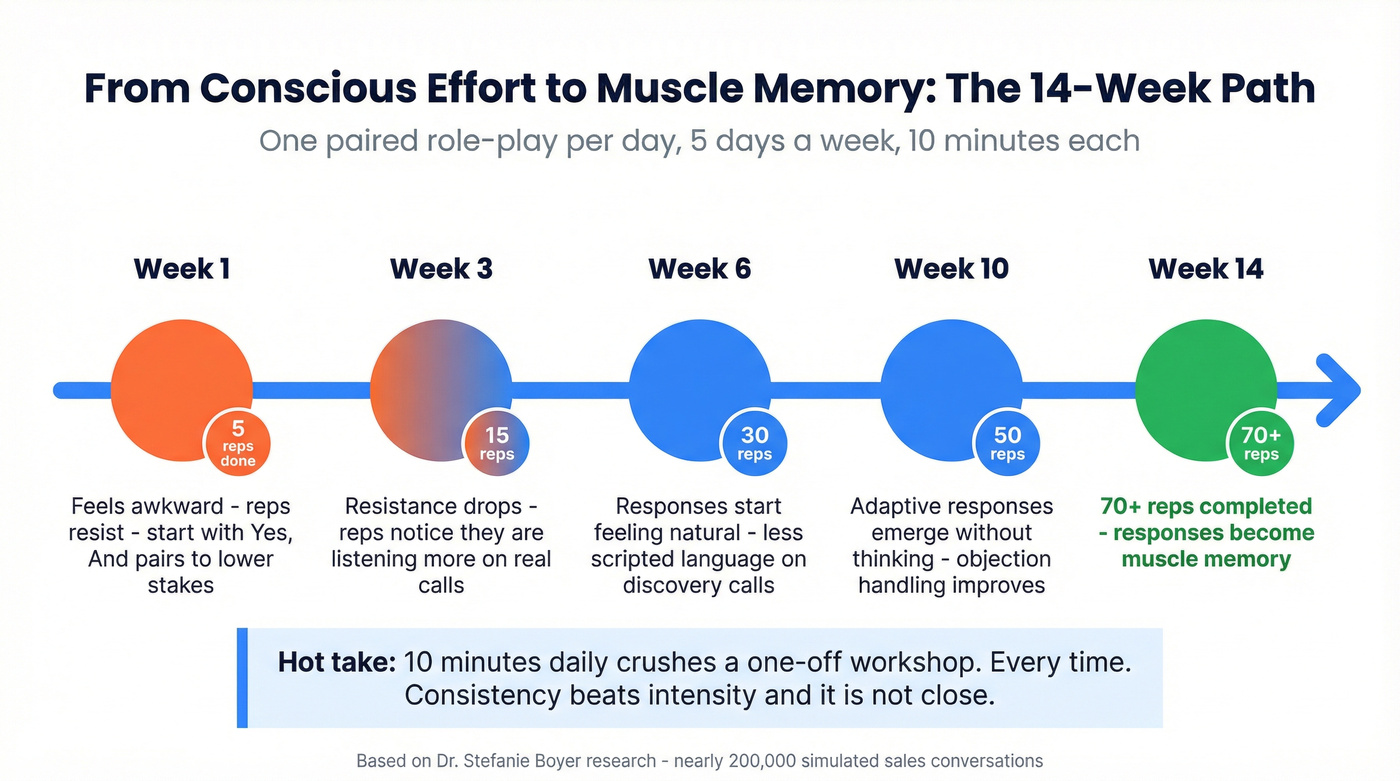
That sounds like a lot, but the math is forgiving. One quick paired role-play per day, five days a week, gets you past 70 reps in about 14 weeks. Here's our hot take: 10 minutes daily crushes a one-off workshop. Every time. If your budget only covers a single SKO session, skip it and run daily drills instead. Consistency beats intensity, and it isn't close.
Does It Actually Work?
Business Improv ran a half-day session that produced 52 actionable recommendations with 12 approved on the spot - compared to a typical output of 7-8 ideas. That's a 6x increase from a single session.
Based on practitioner accounts, structured drills paired with regular coaching tend to produce 5-15% improvement in objection-handling success and meeting-to-next-step conversion. Not earth-shattering on its own. But stacked with good process and accurate prospect data, it compounds fast. Formal controlled studies isolating the impact on close rates are still emerging, but the directional evidence is strong enough to act on.
Let's be honest: reps who practice adaptive response outperform reps who only practice scripts. That shouldn't surprise anyone.
Training Options and Pricing in 2026
| Option | Price | Format | Best For |
|---|---|---|---|
| DIY drills | Free | Self-facilitated, 10-15 min | Start here |
| Virtual Instinct | $195/person | 4 weeks, 4x3hr, 16-person cohorts | Individual reps |
| Business Improv | ~$5,000-$15,000 | Half-day to multi-day | Mid-market teams |
| Second City Works | ~$5,000-$25,000/day | Custom workshops, 65+ years of brand legacy | Enterprise SKOs |
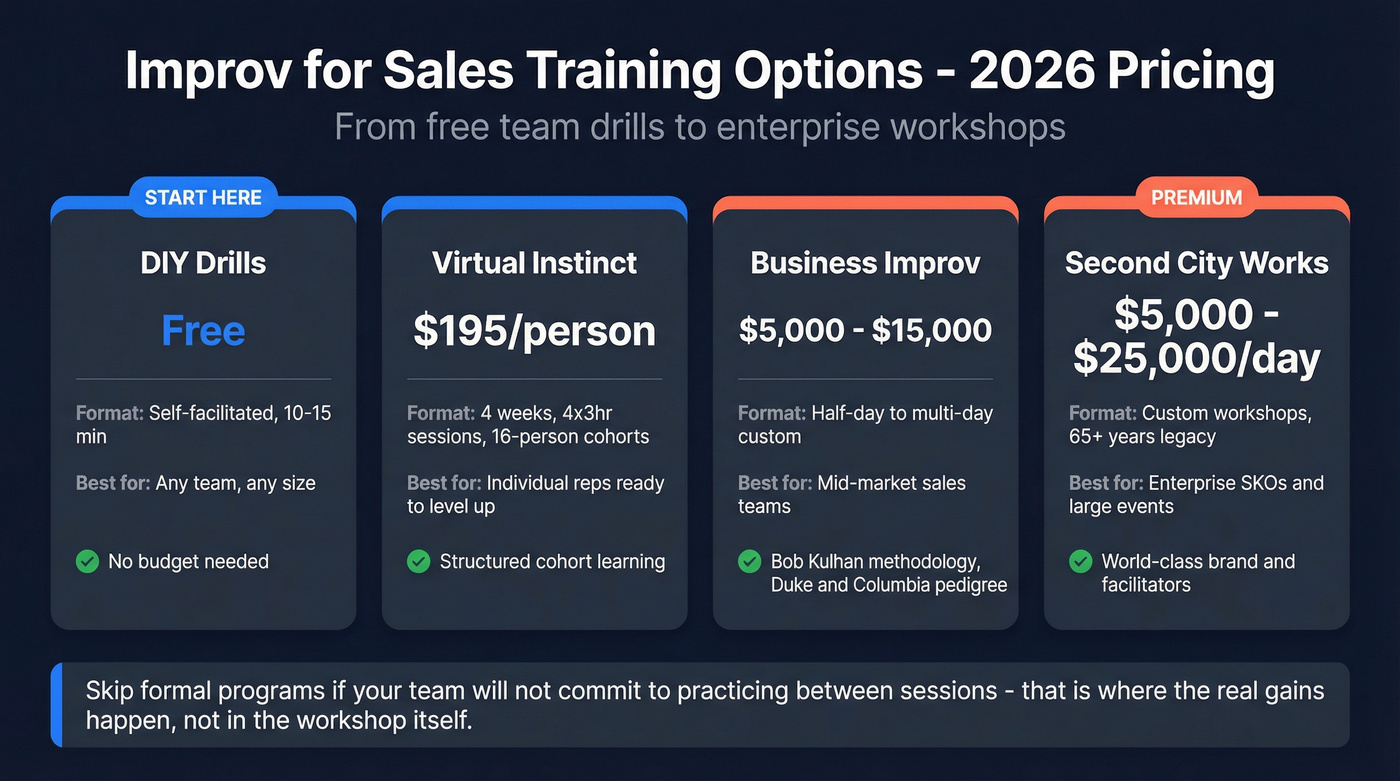
If you're a sales manager with 15 minutes at the start of a team meeting, start with the DIY exercises above. No budget line item required. For formal training, smaller shops like Virtual Instinct offer accessible cohort-based programs before you step up to the Second City premium. Skip the formal programs entirely if your team won't commit to practicing between sessions - that's where the real gains happen, not in the workshop itself.
You don't need a comedy background. Just a willingness to practice in short, consistent bursts.
Before You Improvise, Fix Your Data
All the adaptive selling skills in the world don't help if your reps are calling wrong numbers and bouncing emails. We've watched teams invest in training only to waste those sharpened skills on stale contact lists - it's genuinely frustrating.
Prospeo's 98% email accuracy and 125M+ verified mobile numbers mean your team's newly sharpened conversation skills actually reach real prospects. The data refreshes every 7 days, compared to the 6-week industry average, so you're not improvising your way through disconnected numbers.

You're investing in adaptive selling skills - don't waste them on stale data. Prospeo refreshes 300M+ profiles every 7 days, so your reps walk into every call with current titles, verified emails, and direct dials. At $0.01 per email, better data costs less than a single improv workshop.
Stop letting bad contact data waste your best reps' reps.
FAQ
Do I need to take a class to get the benefits?
No. The five exercises above run in 10-15 minutes with no facilitator, no props, and no acting experience. A dedicated program adds structure and coaching, but the fundamentals are free. If you have budget, a 4-week cohort like Virtual Instinct ($195/person) accelerates the learning curve significantly.
Will my team think this is cringey?
Start with Yes And Conversations - it runs in pairs simultaneously, so nobody's performing for the group. Resistance drops fast once reps realize it's about sharpening call reflexes, not doing comedy bits. Most teams are bought in within two sessions.
How do I measure if the training is working?
Track objection-handling success rate and meeting-to-next-step conversion before and after four weeks of daily drills. Pair with verified prospect data so you can isolate conversation quality from data quality - bad numbers skew every metric.
What's the difference between improv drills and regular role-plays?
Traditional role-plays follow a scenario with a known objection and a "right" answer. Improv exercises strip away the predictability - there's no script, no expected outcome. That's what builds the adaptive muscle reps need on live calls where prospects never follow the playbook.