

How to Craft an IT Sales Pitch That Technical Buyers Actually Respond To
We've watched SDR teams burn through entire prospect lists with zero replies because the pitch was built for a marketing buyer, not a technical one. Here's the reality: 96% of prospects research vendors before talking to a rep, and 82% of B2B decision-makers say the salespeople who reach them are unprepared. Your IT sales pitch isn't competing with other vendors. It's competing with the delete key.
What You Need (Quick Version)
- Research the prospect's tech stack before you write a word. Reference something real they use.
- Bring a sales engineer to the first call. IT buyers test technical credibility within minutes.
- Admit what your product can't do. One IT buyer on r/sales described a vendor admitting a limitation with a clear rationale as "the most respectful, prepared thing they'd ever seen." That kind of honesty is the fastest trust-builder with technical audiences.
Why IT Pitches Fail
Average B2B buying committees include 6-10 decision-makers, each conducting roughly 27 information-gathering interactions before shortlisting a vendor. IT departments compound this - they're cost centers whose budgets get finalized last, so even a champion who loves your product faces political battles you'll never see.
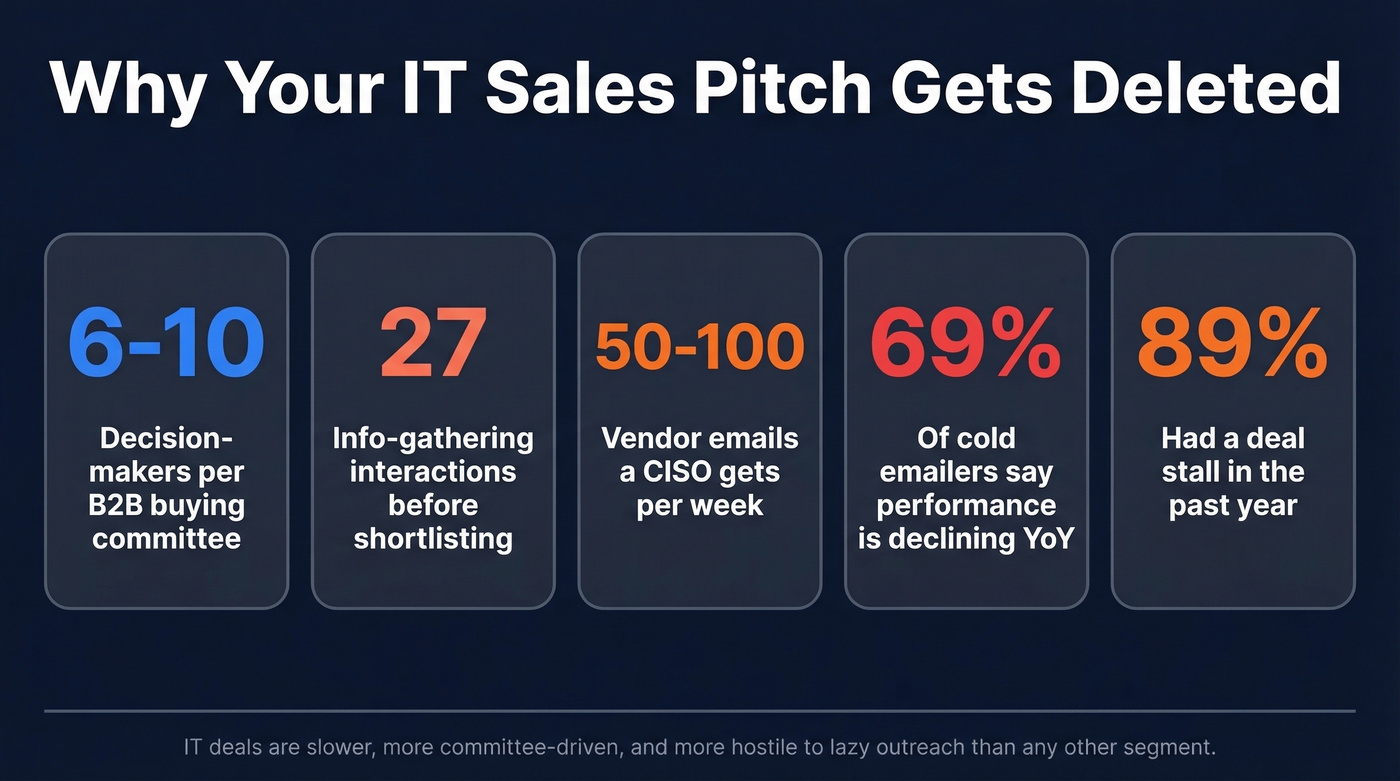
CISOs receive 50-100 vendor emails per week. 69% of cold email senders report performance declining year-over-year thanks to spam filtering and AI content fatigue. Meanwhile, 75% of B2B buyers take longer to make purchase decisions than two years ago, over 80% of the buying journey happens through digital interactions, and 89% had a deal stall in the past year. IT deals are slower, more committee-driven, and more hostile to lazy outreach than any other segment.
A generic tech sales pitch gets deleted before the second sentence.
Building a Winning Framework
Step 1: Research the Stack
Don't pitch blind. Before you write a single line, know what tools they run, what compliance frameworks apply, and whether they've had a recent trigger event - new CISO hire, funding round, or a competitor breach. Prospeo lets you filter by technographics and track 15,000 intent topics via Bombora , so your opening line references something real instead of guessing.
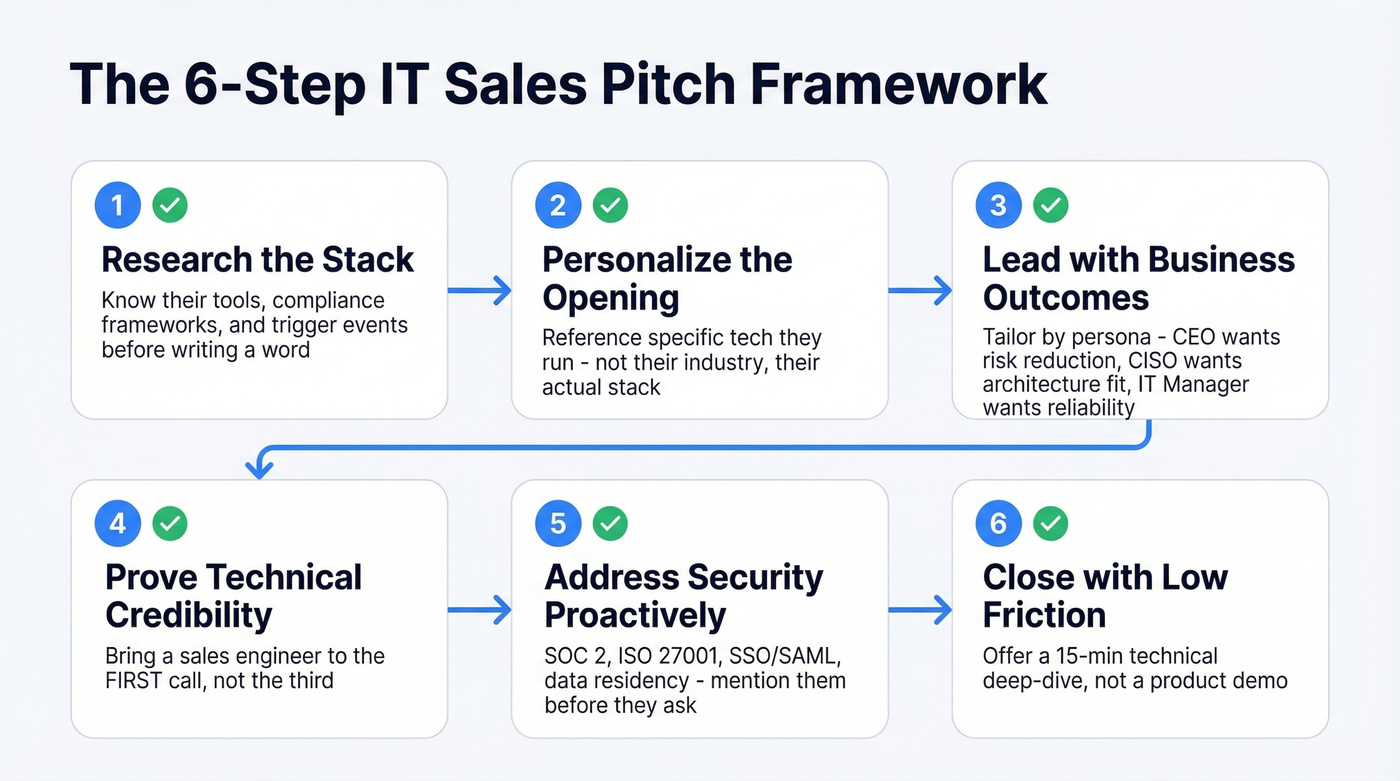
Step 2: Personalize the Opening
"I noticed you're running Palo Alto for endpoint and migrating workloads to AWS" beats "I see you're in the technology space." Every time. The vendors who win attention are the ones who clearly read the prospect's profile and reference specific tech. IT buyers on Reddit and Spiceworks forums say the same thing: do your homework or don't bother reaching out.
Step 3: Lead with a Business Outcome
Features don't close IT deals. Tailor by persona:
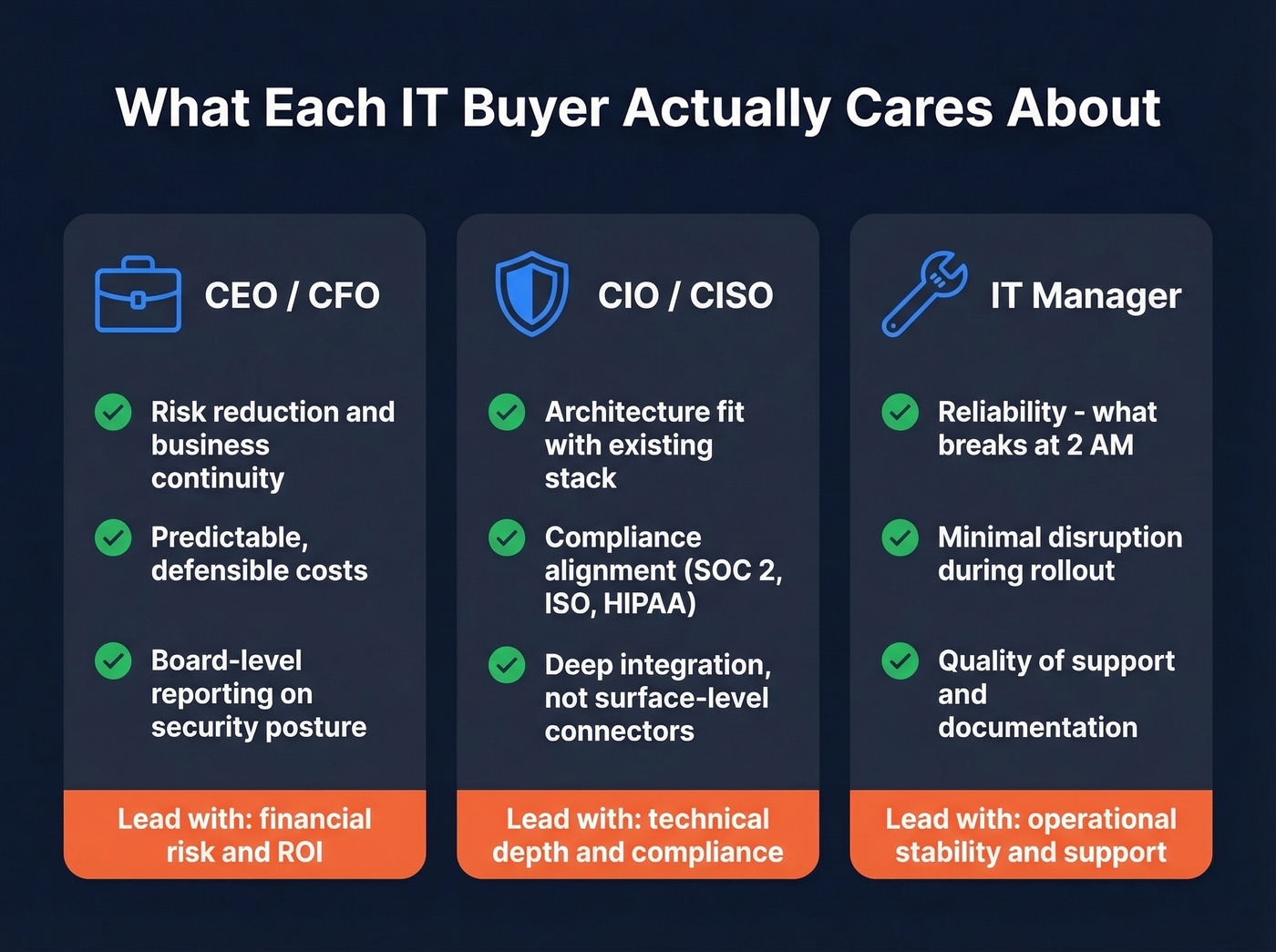
- CEO/CFO: Risk reduction, predictable costs, business continuity.
- CIO/CISO: Architecture fit, compliance alignment, integration depth.
- IT Manager: Reliability, minimal disruption, support quality - what breaks at 2 AM.
Step 4: Prove Technical Credibility
Bring a sales engineer. Not on the third call - on the first one. In our experience, the SE on the first call is the single biggest conversion lever for IT deals. Technical buyers test viability through rapid-fire questions, and hemming or overselling kills credibility instantly.
Here's the thing: if your AE can't explain your API architecture in plain terms, they shouldn't be selling to IT. Reschedule the call until your SE is available. A delayed meeting beats a blown one every time.
Step 5: Address Security Proactively
Mention SOC 2, ISO 27001, SSO/SAML support, and data residency options before they ask. This signals you've sold to IT teams before and understand the procurement gauntlet. Every missing document adds weeks to your deal cycle, so have the security packet assembled before your first conversation, not after someone requests it.
Step 6: Close with a Low-Friction Ask
"Can I send you a 15-minute technical deep-dive with our SE?" beats "When can we schedule a demo?" Skip the product demo on call one entirely - IT buyers want a conversation, not a slideshow.

You just read about filtering by technographics and intent data before writing your pitch. Prospeo gives you both - 30+ search filters including tech stack, Bombora intent across 15,000 topics, and job change signals. Know what they run before you write a word.
Stop pitching blind. Build lists that match the stack.
Technology Sales Pitch Templates
Template A: Sales Pitch for IT Services
Subject: [Company]'s downtime costs - quick question
Hi [Name],
Over 60% of small and mid-sized businesses prefer outsourcing their IT management, mostly because unplanned downtime costs more than a managed contract. We help companies like [similar company] cut unplanned outages by 40% with 24/7 monitoring and a 15-minute response SLA.
Your team's running [specific tool] - we integrate natively and handle the infrastructure layer so your engineers focus on projects, not tickets.
Worth a 15-minute call this week?
Template B: Cybersecurity / Compliance
Subject: [Compliance framework] deadline + [Company]
Hi [Name],
With [SOC 2 / HIPAA / NIS2] requirements getting stricter, companies that start remediation late end up paying more in time, tools, and audit prep. We helped [peer company] pass their SOC 2 Type II by automating evidence collection across their existing stack.
One question: does your team have a documented incident response plan today? If not, that's usually the fastest win - I can share the framework we use.
Template C: Software Product Pitch (Meeting Opener)
"I know you're running [Tool X] for [function]. We don't replace it - we integrate with it to solve [specific gap]. [Peer company] was spending 12 hours a week on [manual process]; after plugging us in, that dropped to 2 hours. I'll be upfront: we don't handle [limitation]. But if [specific gap] is the bottleneck, let's dig in."
Discovery Questions That Build Credibility
The best pitches to IT buyers aren't pitches at all - they're consultative conversations. These six questions consistently open doors:
- What security systems do you have in place today, and where are the gaps?
- What regulations or compliance standards apply to your organization right now?
- Do you have a documented incident response plan - when was it last tested?
- How would a breach or major outage affect operations in the first 48 hours?
- What's your biggest infrastructure frustration right now?
- When does your budget cycle reset, and is there allocated spend for this category?
Questions 1-4 are adapted from a proven cybersecurity selling framework - they work because they force the prospect to articulate risk in their own words. Questions 5 and 6 save you months of chasing a deal with no budget. The consensus on r/sales is that asking about budget timing early isn't rude; it's respectful of everyone's time.
Get Your Contact Data Right First
None of the above matters if your email bounces. Bad data doesn't just waste a touchpoint - it damages your domain reputation, which means future emails from your entire team land in spam. We've seen outbound teams torch their sender score in a single campaign because they trusted a stale database. It's genuinely frustrating to watch a team nail the messaging and then blow their deliverability on garbage contacts.
Prospeo's B2B database covers 300M+ profiles with 98% email accuracy and a 7-day refresh cycle, compared to the 6-week industry average. Filter by job title, technographics, and buyer intent so you're pitching the right person at the right time - not someone who left the company three months ago.

IT Procurement Timeline
Even a perfect pitch enters a slow machine. Plan your pipeline accordingly.
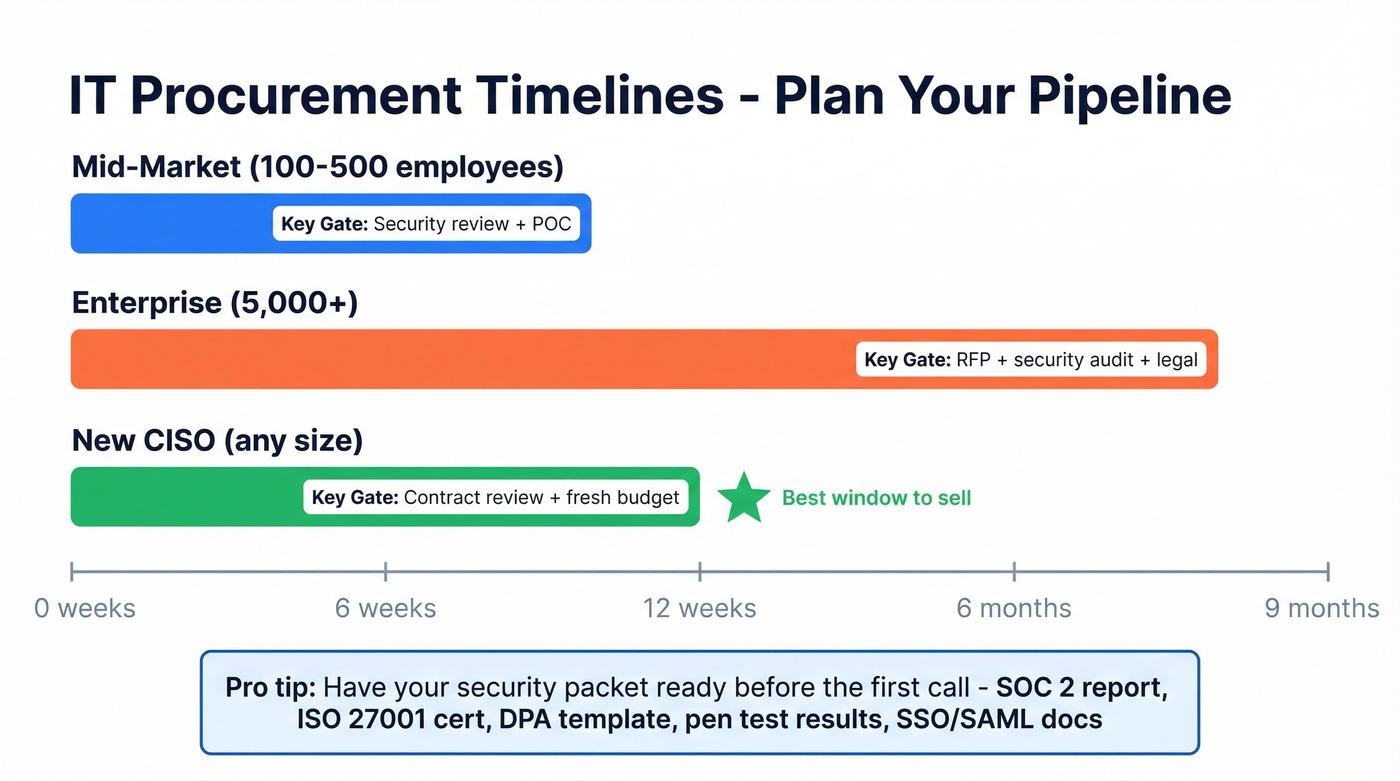
| Segment | Typical Cycle | Key Gate |
|---|---|---|
| Mid-market (100-500 employees) | 6-12 weeks | Security review + POC |
| Enterprise (5,000+) | 3-9 months | RFP + security audit + legal |
| New CISO (any size) | First 90 days | Contract review + fresh budget |
For teams selling into enterprise, have your security packet ready before the first call: SOC 2 report, ISO 27001 cert, DPA template, pen test results, and SSO/SAML documentation. Skip this if you're only targeting SMBs with sub-50 headcount - they rarely run formal security reviews, and leading with compliance docs can actually slow down a deal that should close in two weeks.
One bad bounce tanks your sender score and kills deliverability for your entire team. Prospeo's 5-step verification delivers 98% email accuracy on a 7-day refresh cycle - so your carefully crafted IT pitch actually lands in the inbox, not spam.
Don't torch your domain with stale data at $0.01 per verified email.
FAQ
How long should an IT sales pitch be?
Under 2 minutes verbal, under 200 words for email. Technical buyers scan for relevance in seconds - prove you understand their stack fast to earn a longer conversation.
Should I cold call IT directors?
Most IT professionals prefer email over phone. If you call, reference a specific trigger - new hire, compliance deadline, or a recent breach in their industry - within the first 10 seconds or you'll get hung up on.
How do I find verified contacts for IT decision-makers?
Use a B2B data platform with technographic filters and real-time email verification. Prospeo covers 300M+ profiles with 98% accuracy and a 7-day refresh cycle; its 30+ filters let you target by job title, tech stack, and buyer intent so your pitch reaches the right inbox.
What makes a technology sales pitch different from other B2B pitches?
Technical buyers evaluate architecture fit, security posture, and integration depth before they consider price. A sales pitch for software products aimed at marketing teams can lead with ROI alone, but selling to IT requires proving technical credibility first - or the conversation ends before it starts.