

Lead Aggregators: What They Are, How They Work, and When to Avoid Them
A solar ops manager on Reddit described his relationship with lead aggregators perfectly: "love/hate - mostly hate." He'd been paying $80-$100 per lead for "exclusive" lists that showed up on three other installers' desks the same week. Six years in, he snapped and rebuilt his pipeline from scratch. His story isn't unusual. It's the norm.
The Short Version
Lead aggregators buy leads from generators - landing pages, affiliates, comparison sites - and resell them to end buyers. They're middlemen, not lead creators. A consumer fills out a form, the aggregator receives it, routes it via ping-post bidding or rules-based logic, and delivers it to the highest bidder or several bidders at once.
Shared leads typically go to 3-8 buyers. The word "exclusive" means far less than you think. The cross-industry average CPL sits at $198.44, ranging from $85 in healthcare to $800+ in legal. Biggest risks: lead fraud (one company flagged 400+ fake leads in two months), TCPA litigation up roughly 95% in 2025, and state mini-TCPA laws carrying penalties up to $20,000 per violation.
For most B2B teams, aggregators are the wrong model entirely. Build your own pipeline with verified contact data instead.
What Lead Aggregators Actually Are
A lead aggregator buys leads from multiple sources - affiliate networks, comparison sites, landing pages - and resells them to end buyers. As boberdoo puts it, an aggregator "buys leads, carves out a small profit margin and re-sells the leads to another lead buyer." They don't generate demand. They route it.
This distinction matters more than most people realize. Lead gen tools like HubSpot, Apollo, and Salesforce help you build and manage your own pipeline. Lead aggregation platforms are marketplaces where you buy someone else's leads at a markup. The Zapier "best lead gen tools" list is full of CRMs and outreach platforms - not a single aggregator makes the cut. Different category entirely.
Aggregator vs. Generator vs. Arbitrageur
| Generator | Aggregator | Arbitrageur | |
|---|---|---|---|
| What they do | Runs ads/content to capture leads | Buys, routes, and resells leads | Buys low, sells high - no value add |
| Typical cost | ~2-3x aggregated price | $10-$100+ per lead (varies by vertical) | Cheapest upfront, worst quality |
| Quality signal | Controlled source, known intent | Standardized routing, mixed sources | Unknown origin, recycled heavily |
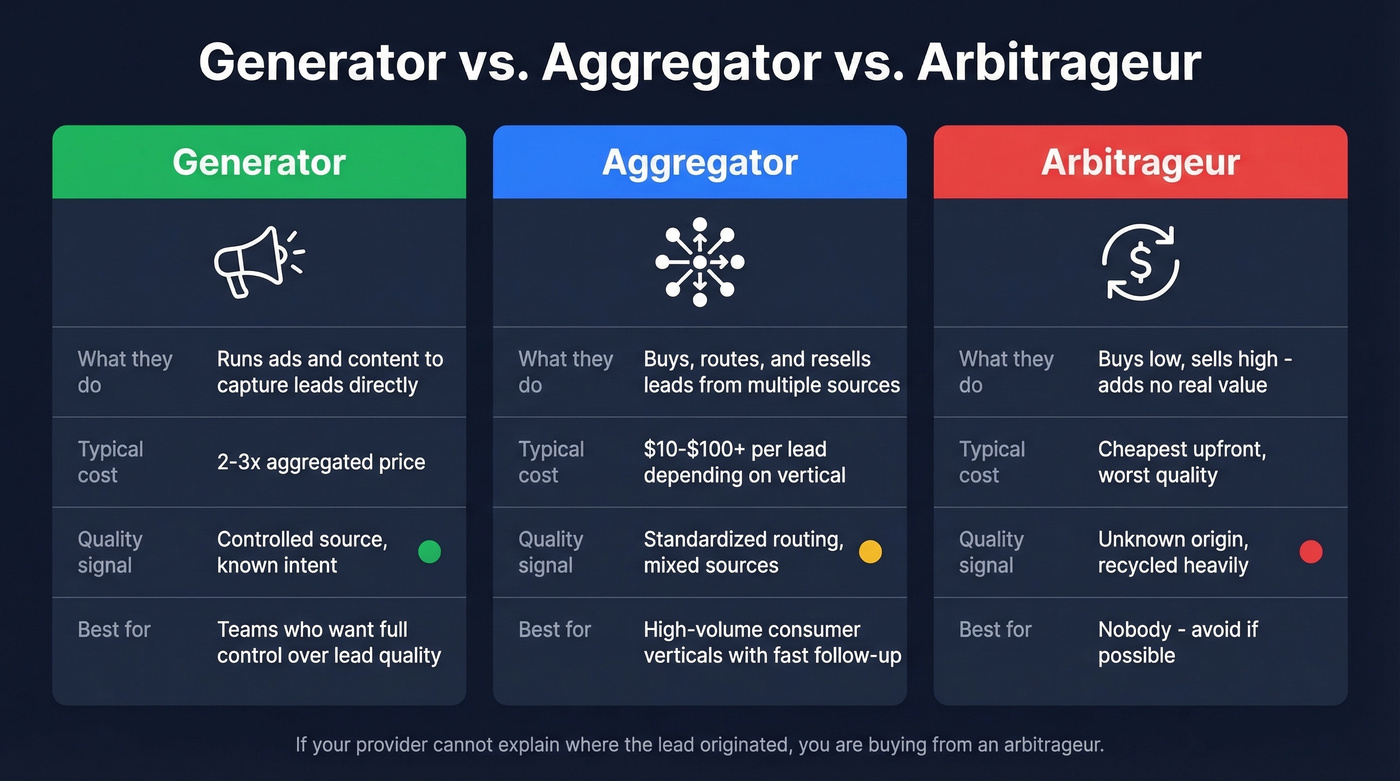
Generated leads cost 2-3x more than aggregated ones, but they come from a known source with controlled sharing. Aggregators add value through routing and standardization - matching leads to buyers by geography, vertical, or bid price. Arbitrageurs just flip leads for margin. If your provider can't explain where the lead originated, you're buying from an arbitrageur.
How Ping-Post Routing Works
The core mechanism behind lead aggregation is called ping-post:
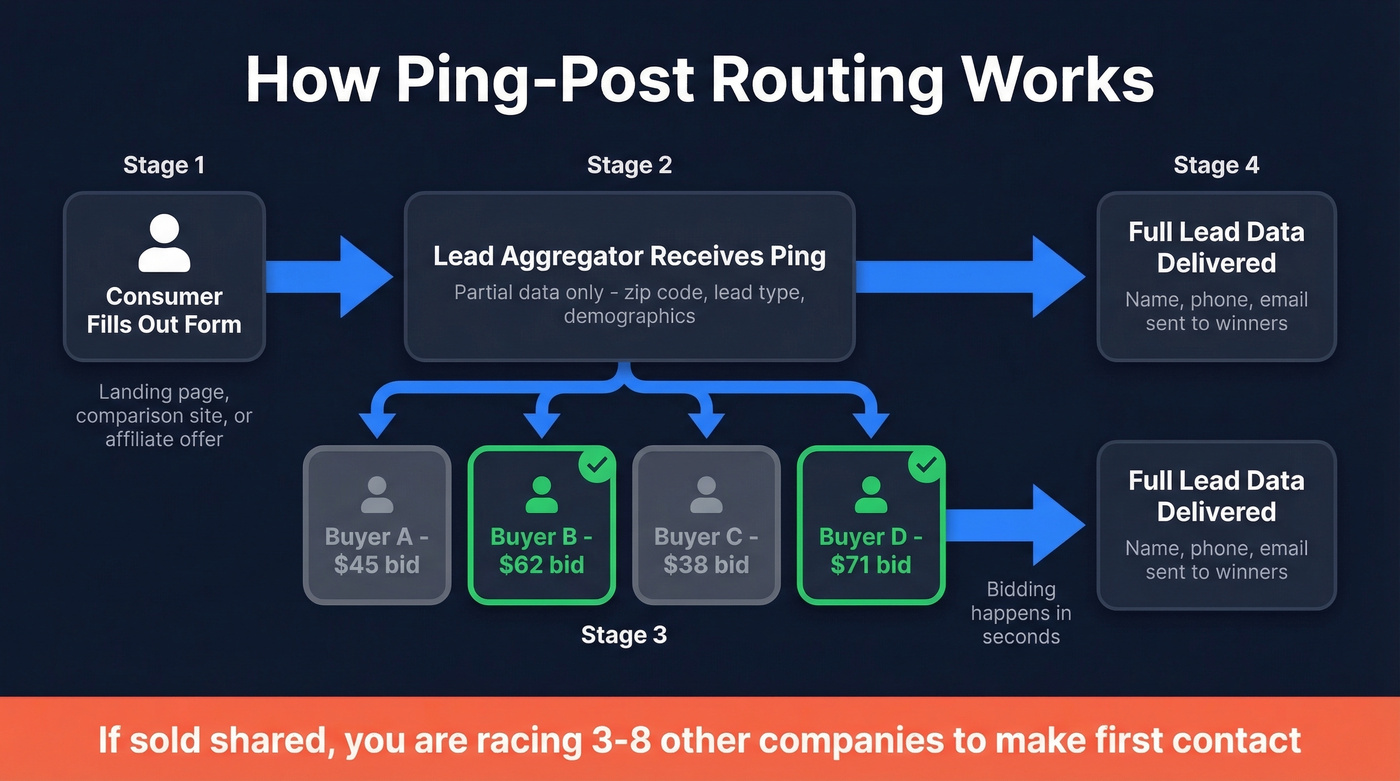
- Ping. A consumer submits a form. The aggregator receives partial data - zip code, lead type, basic demographics - and pings it to their buyer network.
- Bid. Buyers evaluate the partial data against their filters and submit bids. Highest bidder wins, or multiple buyers win if the lead is sold shared.
- Post. Full lead data (name, phone, email) gets delivered to the winning buyer(s) in real time.
The whole cycle often takes seconds. Real-time routing is the selling point - you get the lead while intent is fresh. But if the aggregator sells to multiple bidders, you're racing 3-8 other companies to make first contact. And if the original form was incentivized with a gift card sweepstakes, intent was never real to begin with.
Batch delivery is even worse. By the time leads arrive hours or days later, the consumer has forgotten they filled out a form, your reps are cold-calling someone who doesn't remember asking for help, and your close rate craters.

Aggregators charge $85-$800 per lead and share them with 3-8 competitors. Prospeo gives you 300M+ verified contacts at $0.01 per email - 98% accuracy, refreshed every 7 days. Own your pipeline instead of renting someone else's recycled list.
Skip the middleman. Find verified decision-makers directly.
What Aggregated Leads Cost
| Vertical | Typical CPL Range |
|---|---|
| Healthcare | $85-$145 |
| Real Estate | $150-$448 |
| Technology / SaaS | $237-$310 |
| Financial Services | $350-$650 |
| Legal Services | $650-$800 |
| Cross-industry avg | $198.44 |
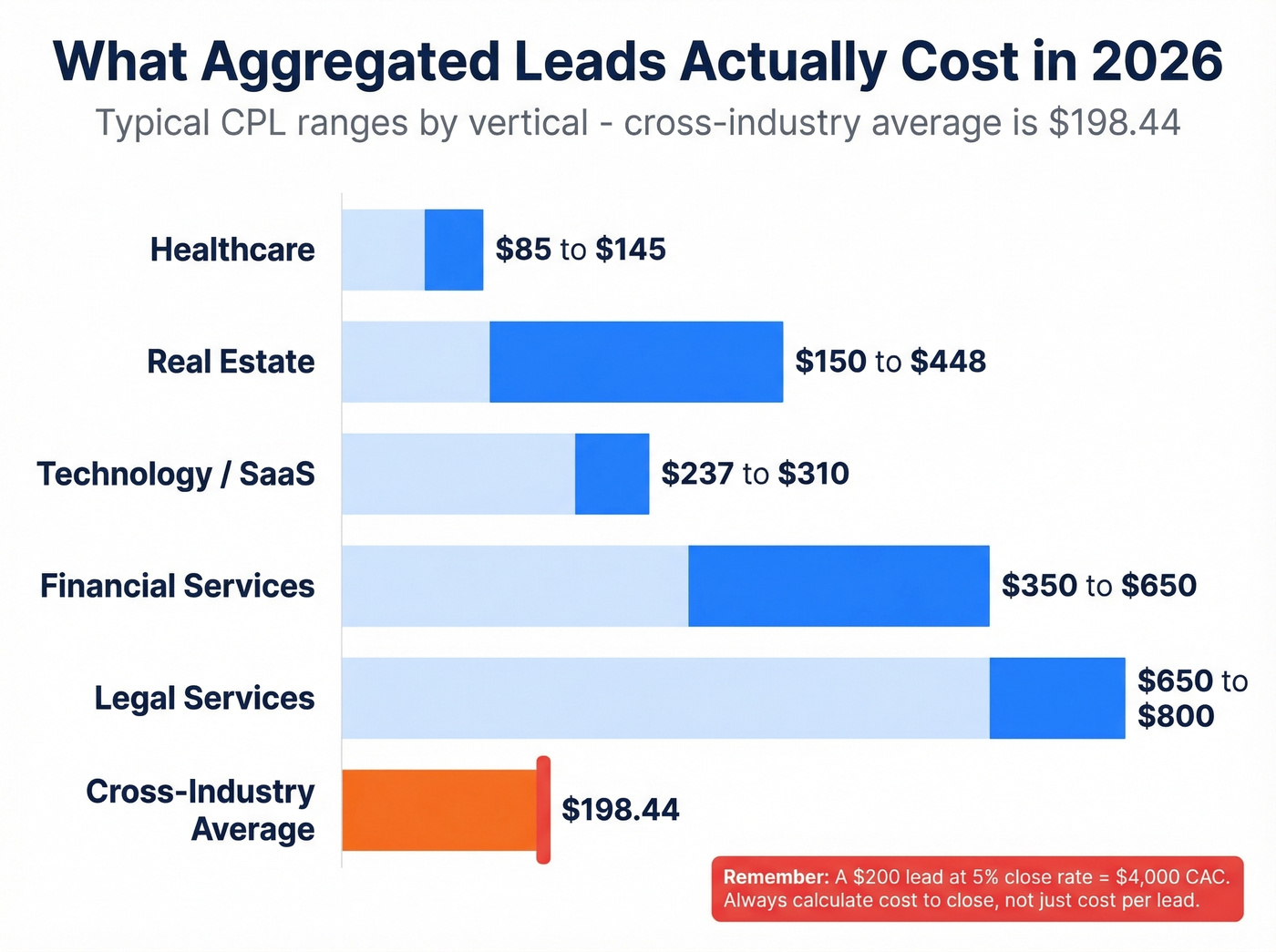
Solar installers on Reddit report paying $80-$100 per lead from aggregators. The average B2B CPL across paid channels is $84, which makes aggregator pricing look even steeper when you factor in shared delivery and fraud rates.
In insurance - the most mature aggregator vertical - aged leads run $0.15-$5.00, fresh shared leads $10-$40+ through providers like EverQuote and QuoteWizard, and fresh exclusive leads $15-$75+ through providers like NextGen Leads and MediaAlpha. Expect to dispute 5-15% of leads in your first months, so negotiate credit SLAs upfront.
These numbers don't tell the whole story, though. A $200 lead that closes at 10% is a $2,000 CAC. A $650 legal lead that closes at 15% is a $4,333 CAC. Always run the math to close, not just to acquisition.
Why Teams Hate Buying Aggregated Leads
Recycled leads kill close rates. That solar ops manager wasn't alone. The consensus on r/LeadGeneration is blunt: vendors "sell the same leads to multiple clients," making them functionally worthless. When your "exclusive" list lands on three competitors' desks, speed-to-lead becomes a knife fight instead of a sales process.

Fraud is rampant. One company tracked 400+ fake leads in two months, causing millions in wasted spend. Bot-generated form fills, duplicate submissions, and incentivized clicks inflate volume while destroying conversion rates. Spider AF's 2026 data suggests up to 51.8% of ad budgets are impacted by ad fraud - and aggregators sit downstream of all of it.
Here's the thing: no accountability exists upstream either. If an affiliate ran misleading ads to capture that lead, you inherit the fallout - angry consumers, compliance risk, and wasted rep time. You're paying for someone else's mess.
Compliance Risk in 2026
The regulatory environment has tightened dramatically. Here's what we'd tell any team buying aggregated leads right now.
Do:
- Demand documented consent proof from every aggregator - timestamps, source URL, disclosure language
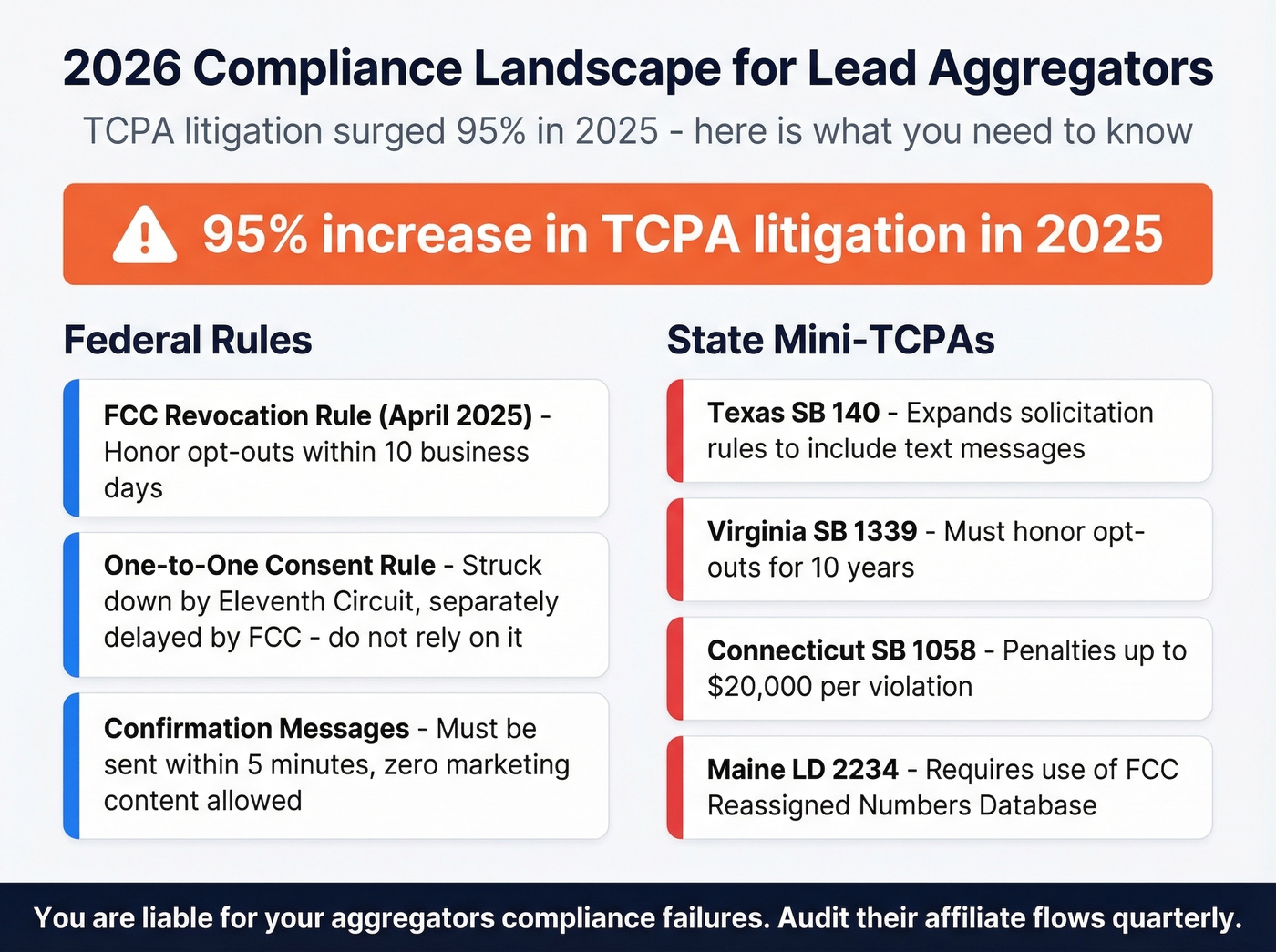
- Honor opt-out requests within 10 business days per the FCC revocation rule effective April 2025
- Send any confirmation message within 5 minutes, with zero marketing content
- Audit your aggregator's affiliate flows quarterly - you're liable for their compliance failures
- Track state-specific rules: Texas SB 140 expands solicitation to texts; Virginia SB 1339 requires honoring opt-outs for 10 years; Connecticut SB 1058 carries penalties up to $20,000 per violation; Maine LD 2234 requires use of the FCC Reassigned Numbers Database
Don't:
- Assume the aggregator handles compliance for you - they don't
- Rely on the one-to-one consent rule - it was struck down by the Eleventh Circuit and separately delayed by the FCC
- Ignore state mini-TCPAs - TCPA litigation surged roughly 95% in 2025, and the Supreme Court's McLaughlin v. McKesson decision means district courts aren't bound by FCC interpretations, so expect more variability by jurisdiction
If you're buying aggregated leads and calling them without bulletproof consent documentation, you're playing litigation roulette.
ROI Math That Actually Matters
Let's be honest: most teams buying aggregated leads are losing money and don't know it, because they measure CPL instead of CAC.
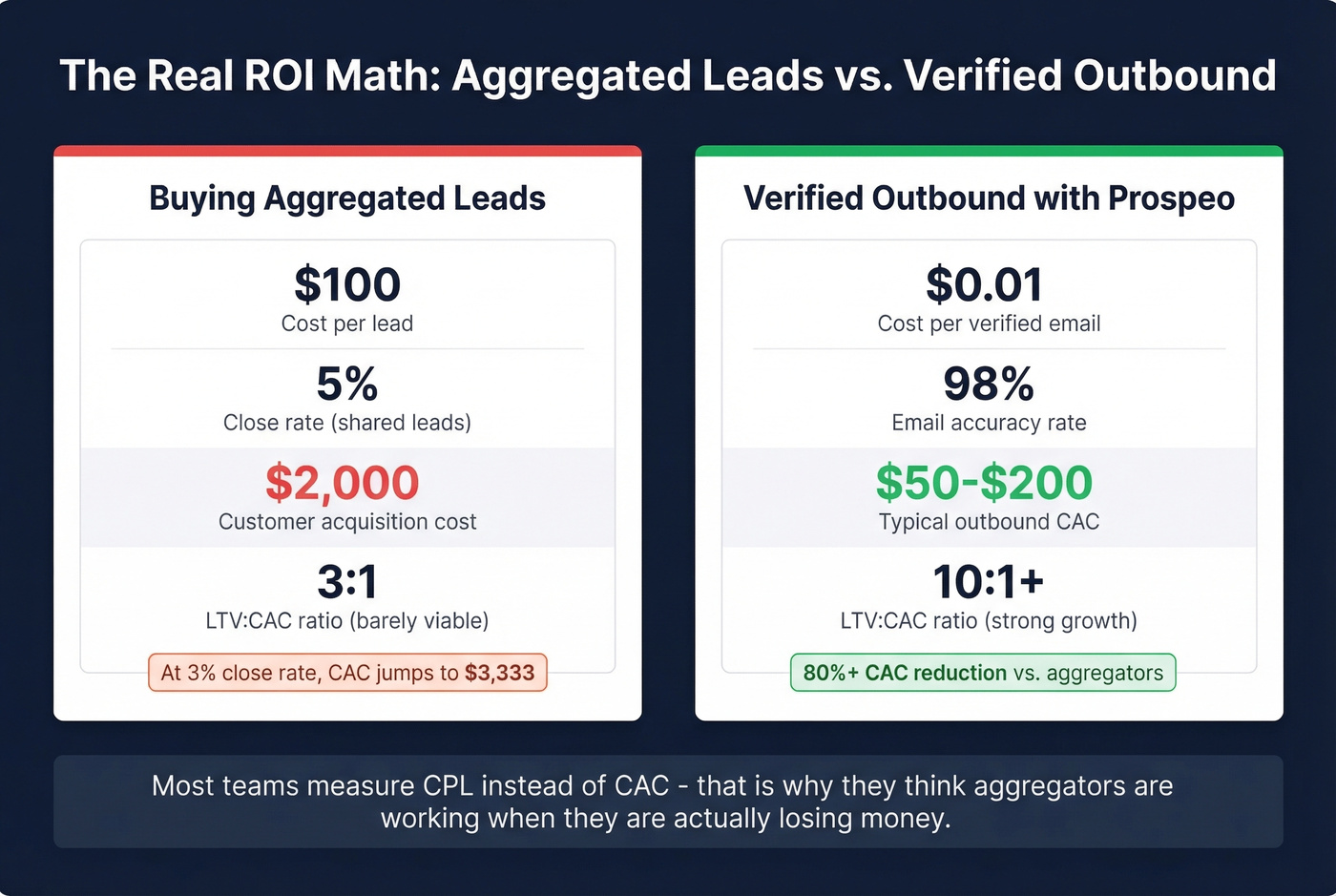
Say you're paying $100 CPL from an aggregator. Your close rate on shared leads is 5% - and that's generous. That's a $2,000 customer acquisition cost. If your average customer lifetime value is $6,000, you're at a 3:1 LTV:CAC ratio, the minimum benchmark for sustainable growth.
But that math assumes you're working every lead effectively. A home services benchmark shows a 22% set rate as strong performance - meaning 78% of leads go nowhere. That 22% requires texting within 30 seconds of submission, plus multi-channel follow-up. Most teams don't have that operational muscle.
If your close rate drops to 3%, which is common with shared leads, CAC jumps to $3,333 and your LTV:CAC falls below the 2:1 danger zone. The spreadsheet says "profitable." Operations says "we're drowning."
When to Skip Lead Aggregators
For B2B teams, aggregators are almost always the wrong call. The ping-post model was built for consumer verticals - insurance, solar, home services, legal - where a consumer fills out a form and wants a callback within minutes. B2B buying cycles, with multiple stakeholders and months-long evaluations, don't fit that mold at all.
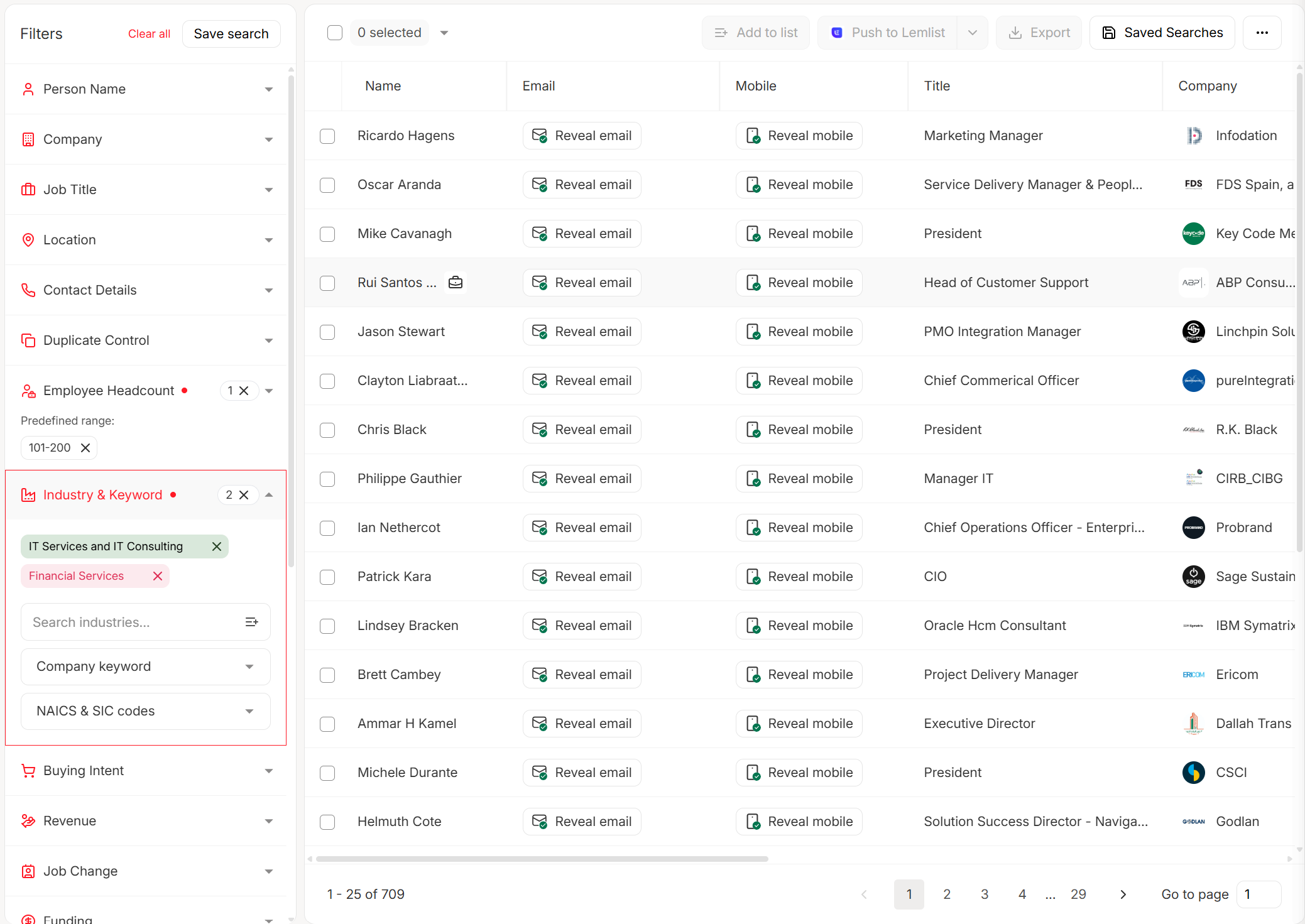
We've seen B2B teams cut CAC by 80%+ just by switching from purchased leads to verified outbound lists. The unit economics make it obvious: paid-channel CPL benchmarks average around $84 in B2B, cross-industry CPL averages $198.44, while a verified email costs roughly $0.01 from a platform like Prospeo - 143M+ verified emails at 98% accuracy, refreshed every 7 days, with intent and technographic filters to narrow your list before you ever hit send.
Even in consumer verticals, skip aggregators if your close rate on purchased leads is below 5%, you can't respond within 30 seconds, or you don't have compliance infrastructure to audit consent chains.
Consider them only if you're in a high-volume vertical with proven close rates above 8-10%, you've negotiated performance-based pricing like a $5,000/month pay-per-contract model instead of pay-per-lead, and you already have speed-to-lead automation built. For everyone else, the shift from buying recycled leads to building verified prospect lists is the single highest-ROI move you can make.
Fraud, recycled leads, and TCPA risk - that's what you inherit from aggregators. With Prospeo's 5-step verification, 30+ search filters, and intent data across 15,000 topics, you build a pipeline of real buyers without the compliance landmines.
Zero recycled leads. Zero middlemen. Just verified contacts you control.
FAQ
Are lead aggregators legal in 2026?
Yes, but compliance requirements are significantly tighter than even two years ago. FCC revocation rules require honoring opt-outs within 10 business days, and state mini-TCPAs in Texas, Virginia, Connecticut, and Maine add penalties up to $20,000 per violation. You need documented consent proof - timestamps, source URLs, disclosure language - for every lead you contact.
What's a normal cost per lead from an aggregator?
The cross-industry average CPL is $198.44. Healthcare runs $85-$145, real estate $150-$448, SaaS $237-$310, and legal $650-$800. Fresh exclusive leads cost 2-5x more than shared leads, and you should budget for 5-15% dispute rates on top.
What's the difference between exclusive and shared leads?
Exclusive leads are sold to one buyer; shared leads go to 3-8 buyers. In practice, "exclusive" from a single aggregator means exclusive from that aggregator - the consumer may have submitted forms on multiple sites. True exclusivity requires buying directly from the generator at 2-3x the price.
What's a better alternative for B2B teams?
Build your own prospect list using a verified B2B database. At ~$0.01 per verified email versus $84+ average paid-channel CPL, the ROI gap is massive. You control targeting, timing, and compliance from the start - no consent-chain audits required.