

Lead Carrot vs Leadsforge: Honest Comparison (2026)
The Lead Carrot vs Leadsforge decision trips people up because these platforms solve fundamentally different problems. Lead Carrot pulls local business listing data by niche and city. Leadsforge searches a B2B contact database. Picking between them without understanding that distinction is how teams waste a month on the wrong tool - and we've watched it happen more than once.
30-Second Verdict
Pick Lead Carrot if you're an agency pulling local businesses by niche and city - plumbers in Phoenix, dentists in Dallas. It scrapes business-level data from Google Maps/Google Business Profile and Yelp.
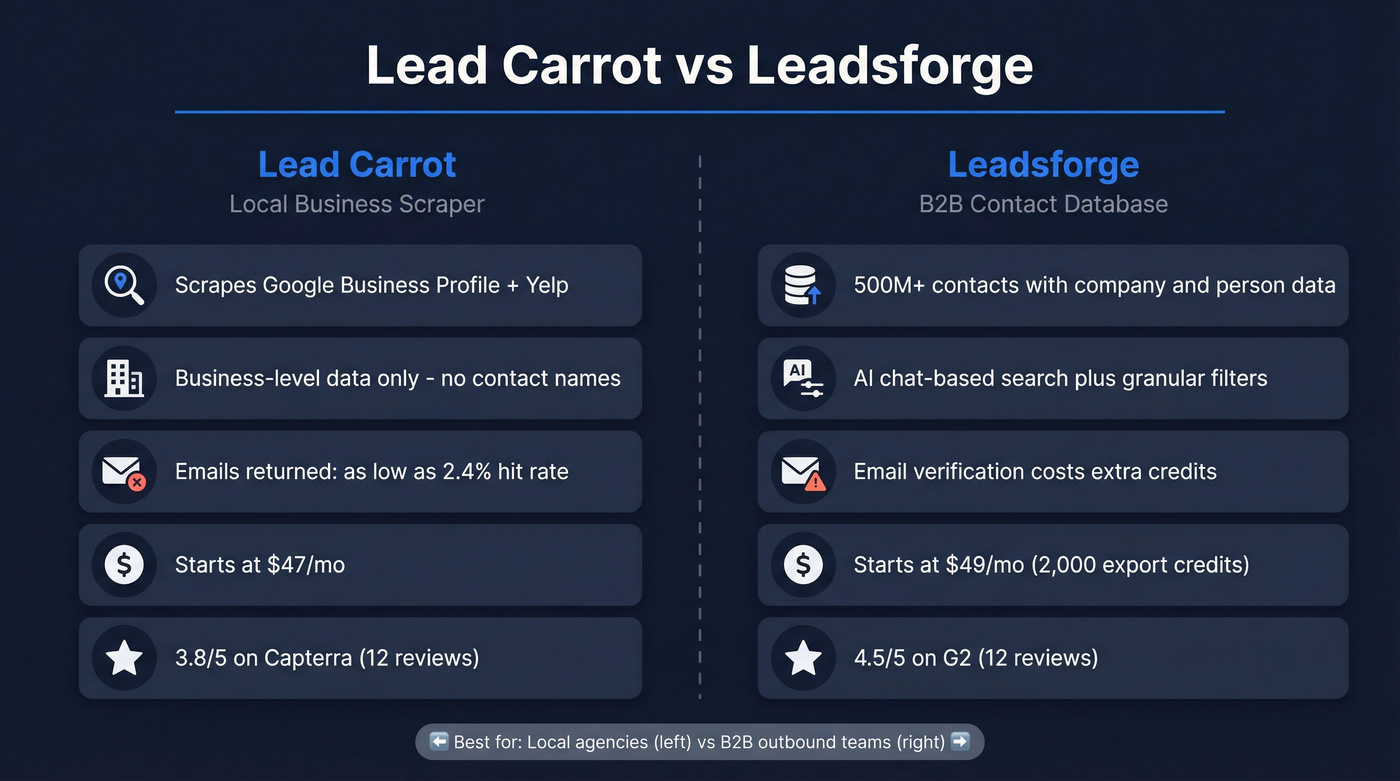
Pick Leadsforge if you need a B2B contact database with filters for revenue, headcount, and industry. It's built for outbound teams targeting specific companies and decision-makers.
What Each Tool Actually Does
Lead Carrot is a local business lead scraper. You enter a niche ("roofing contractors") and a city, and it pulls matching businesses from Google Business Profile and Yelp. You get back business names, addresses, phone numbers, websites, Google Business Profile URLs, and review data. It can include emails, but coverage varies wildly by niche and location.
What you don't get: individual contact names. That's a dealbreaker if you're trying to personalize outbound beyond "Dear Business Owner." Plans run $47-$297/month.
Leadsforge is an AI-powered B2B contact database positioned around 500M+ contacts and a chat-like search interface. Natural language queries reduce the need to live inside complex filter dashboards, while still letting you build ICP-based lists with granular targeting. It's part of the Salesforge ecosystem: Salesforge handles sequencing (plans at $40-$80/month), and Leadsforge handles the data layer.
Side-by-Side Feature Comparison
| Dimension | Lead Carrot | Leadsforge | Winner |
|---|---|---|---|
| Type | Local business scraper | B2B contact database | Depends on use case |
| Database | Google Business Profile/Maps + Yelp-style local sources | 500M+ contacts | Leadsforge |
| Data returned | Business info (listing-level) | Contact + company data | Leadsforge |
| Email verification | Not a core strength | Costs additional credits | Neither |
| Starting price | $47/mo | $49/mo (Essential, 2,000 export credits) | Lead Carrot (slightly) |
| Review rating | 3.8/5 on Capterra (12 reviews) | 4.5/5 on G2 (12 reviews), 4.0/5 on Trustpilot (11 reviews) | Leadsforge |
| Integrations | Minimal | Push lists into Salesforge + API access | Leadsforge |
| Free trial | Mentioned in directories | 100 free credits on signup | Leadsforge |

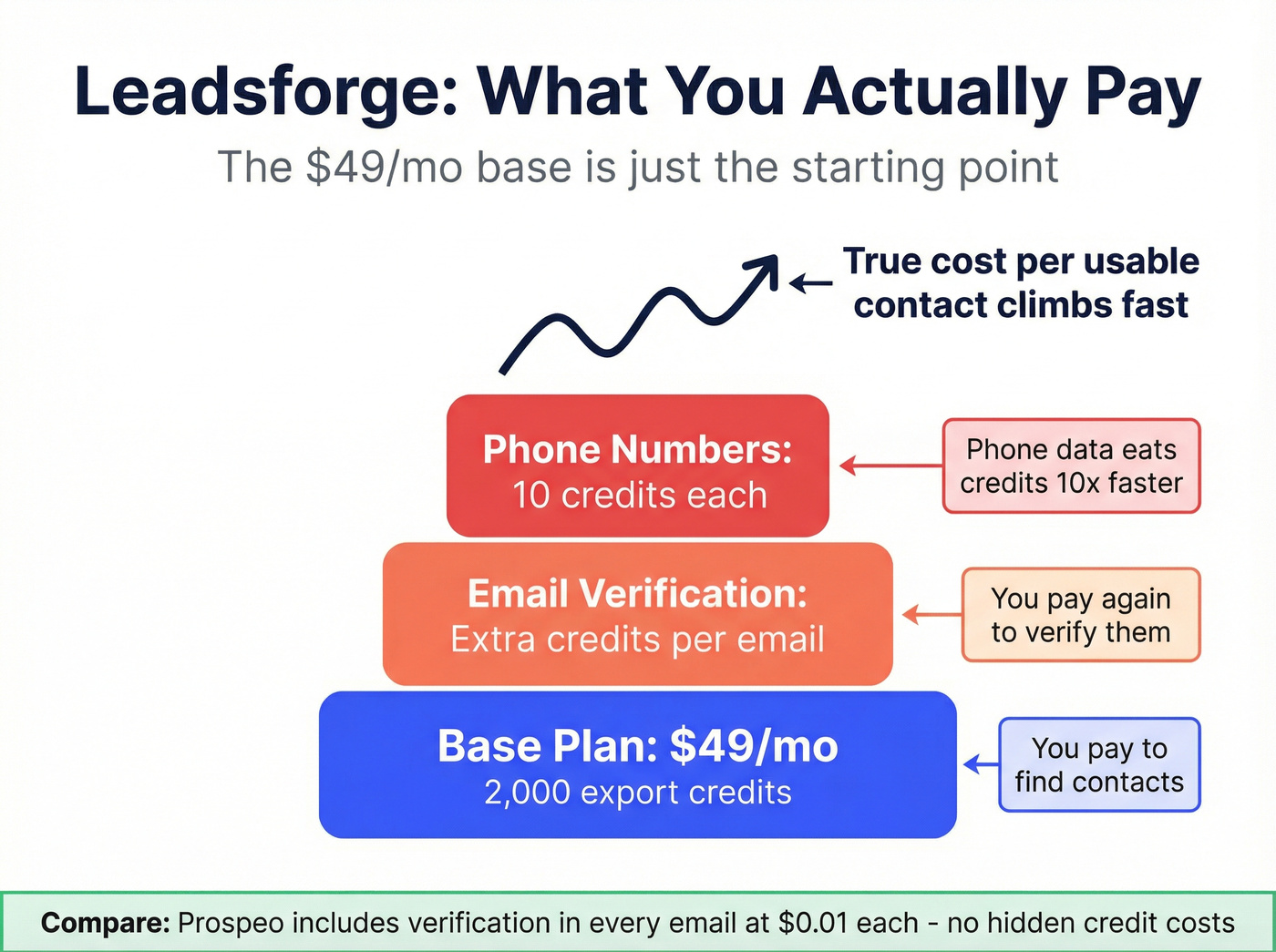
Lead Carrot barely returns emails. Leadsforge makes you pay twice - once to find, again to verify. Prospeo's 300M+ database includes 5-step verification on every email at 98% accuracy, with 30+ filters for buyer intent, headcount growth, and technographics. No hidden validation credits.
Stop paying extra to verify what should already be accurate.
Lead Carrot Breakdown
Pros:
- Dead simple for local lead gen - enter a niche and city, get a list
- Pulls review data and Google Business Profile URLs, useful for agency pitches
- Ease of use rated 4.2/5 on Capterra
Cons:
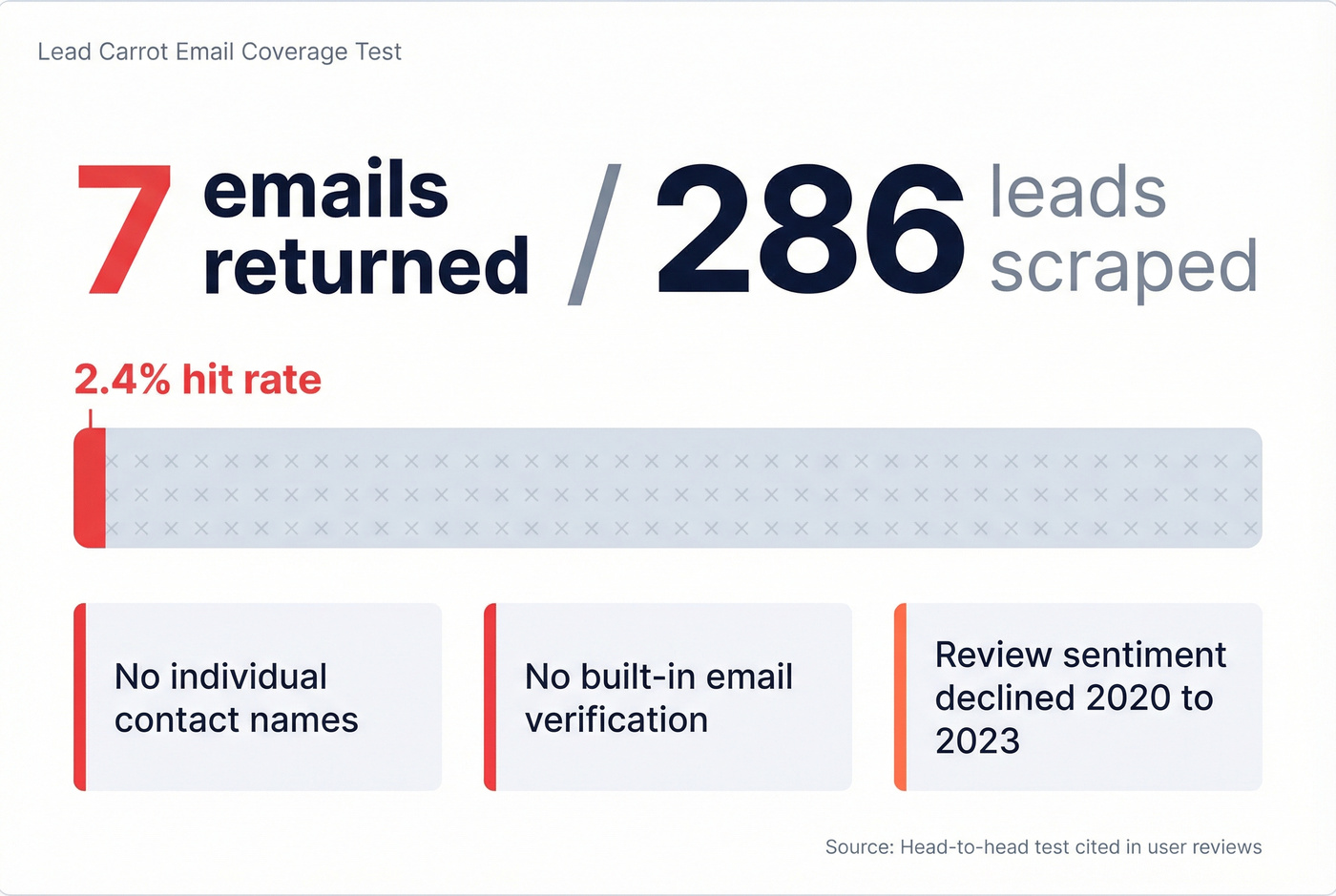
- No individual contact names - just business-level data
- Email coverage can be paper-thin. In one head-to-head test, Lead Carrot returned 7 emails from 286 leads - a 2.4% hit rate
- Review pattern is concerning: 5-star ratings in 2020, 1-star ratings by 2023
- Customer service rated 3.7/5 on Capterra, with billing complaints about charges despite free trial promises
Here's the thing: Lead Carrot made sense in 2020 when local scraping tools were scarce. In 2026, the weak email coverage and lack of named contacts make it a poor fit for personalized outbound. We've seen teams waste weeks on it before realizing it doesn't return decision-maker names. And any unverified emails you do get can become a deliverability risk - bounces damage your domain reputation fast.
Leadsforge Breakdown
Pros:
- Granular filtering - revenue ranges like $1M-$5M, headcount brackets, industry keywords
- Users on Trustpilot report saving roughly 10 hours of manual research per week
- Chat-based interface feels more intuitive than traditional filter dashboards
- Responsive human support shows up as a recurring theme in G2 reviews
Cons:
- Email validation costs additional credits on top of the $49/month base, and phone numbers cost 10 credits each - so your true cost per usable contact climbs fast if you need verified data plus phones
- Data exports can be inconsistent, with fields that aren't always clean or complete
- At least one Trustpilot reviewer flagged cancellation as "very hard"
Leadsforge is a solid pick for B2B teams already in the Salesforge ecosystem. The natural language search is genuinely useful, and the filters go deeper than most tools at this price point. But paying for leads and then paying again to verify them is a frustrating model at any scale. G2 lists Apollo.io as the top Leadsforge alternative, though Apollo's email accuracy sits around 79% - well below what outbound teams need for clean deliverability.
Neither tool generates much discussion on Reddit, which tells you something about their niche positioning. Community feedback lives mostly on G2 and Trustpilot, where small review samples make sentiment directional rather than conclusive.
Why Neither Wins on Email Accuracy
Let's be honest - if your real need is verified B2B emails without hidden costs, neither of these tools gets the job done cleanly. Leadsforge charges you credits to find an email, then more credits to validate it. Lead Carrot often returns almost no emails depending on the query.
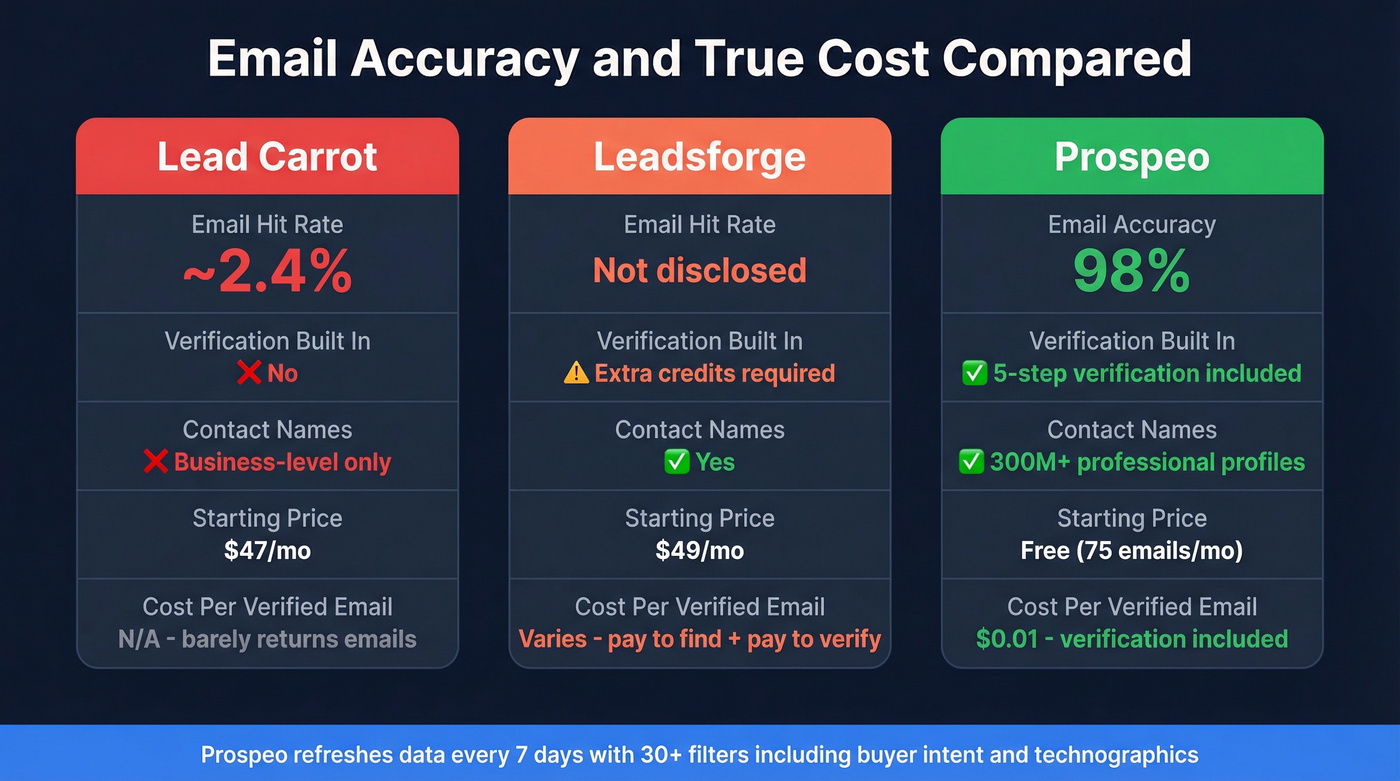
Prospeo handles this without a separate validation step. Every email comes back with 98% accuracy through a proprietary 5-step verification process - no extra credits, no second tool. The database covers 300M+ professional profiles on a 7-day refresh cycle with 30+ search filters including buyer intent, technographics, and headcount growth. For teams that care about deliverability, that difference matters: one of our customers, Stack Optimize, built to $1M ARR while maintaining 94%+ deliverability and sub-3% bounce rates across all their clients' campaigns.

Prospeo starts free with 75 verified emails per month, and paid plans run about $0.01 per email with verification baked in. It integrates natively with Salesforce, HubSpot, Smartlead, Instantly, and Lemlist so your verified contacts flow straight into sequences.
Stack Optimize built to $1M ARR with sub-3% bounce rates using Prospeo. At $0.01 per verified email on a 7-day refresh cycle, you get cleaner data than either Lead Carrot or Leadsforge - with native integrations into HubSpot, Salesforce, Smartlead, and Instantly.
75 free verified emails per month. No credit card, no contracts.
FAQ
Are Lead Carrot and Leadsforge the same tool?
No. Lead Carrot pulls local business listings from Google Business Profile/Maps and Yelp - it's built for agencies doing local outreach. Leadsforge is a B2B contact database with 500M+ profiles and filters for revenue, headcount, and industry. The decision comes down to whether you're targeting local businesses or B2B companies.
Does Leadsforge include email verification?
Not automatically. Validation costs additional credits on top of the $49/month base, so you're effectively paying twice per verified contact.
Is Lead Carrot still worth it in 2026?
It's a tough sell. One test shows extremely thin email coverage, there's no individual contact data, and review sentiment has clearly deteriorated between 2020 and 2023 on Capterra. Most teams would be better served by a B2B lead generation tool with named contacts and verified emails.