

Bitrix24 vs HubSpot: Numbers-First CRM Comparison (2026)
HubSpot is the better CRM product. Bitrix24 is the better deal. That's the short version of the Bitrix24 vs HubSpot debate - but the long version matters, because the gap between them shifts dramatically depending on your team size and what you actually need.
Feature checklists won't tell you which to pick. Total cost at your team size will. A 5-person team pays roughly the same for either platform. A 25-person team? They'll pay 5-10x more on HubSpot. Once you're past 20 seats, HubSpot pricing stops being "CRM pricing" and becomes a budget line item that needs its own approval.
30-second verdict:
- HubSpot if you're a marketing-led team that values UX, automation depth, and a massive integrations ecosystem.
- Bitrix24 if you're budget-conscious and want CRM + project management + collaboration in one flat-rate tool.
- Skip both if your real bottleneck is bounced emails and missing phone numbers - not the CRM itself. Fix the data layer first and plug it into whichever CRM you choose. (If that’s your situation, start with data enrichment.)
Here's the thing: most teams agonize over CRM features they'll never configure. If your average deal is under $15k and your team is under 15 people, pick whichever one your reps will actually open every morning. The CRM that gets adopted beats the CRM that wins on paper.
Bitrix24 at a Glance
Bitrix24 positions itself as the "replace everything" platform - CRM, project management, team chat, video calls, website builder, HR tools, telephony, all in one workspace. The CoPilot AI assistant spans CRM, tasks, chat, and video call transcription across modules.
The pricing model is what makes Bitrix24 unusual: flat-rate per organization, not per user. The free tier supports unlimited users with basic CRM and collaboration. Paid plans scale by feature depth and user caps, not by headcount. Bitrix24 also offers on-premise deployment for teams that need full data control or have strict compliance requirements - a real differentiator for regulated industries. The platform offers 100+ integrations through its ecosystem and marketplace, which is respectable but a fraction of HubSpot's.
- Best for: Budget-conscious teams that want CRM, project management, and collaboration in a single flat-rate tool
- Pricing model: Flat-rate per organization (not per user); free tier with unlimited users
- Standout modules: Native project management (Kanban, Gantt, Scrum), built-in telephony, website builder, HR tools
- Integration ecosystem: 100+ integrations, growing marketplace, on-premise option available
HubSpot at a Glance
HubSpot runs on a modular hub architecture: Sales Hub, Marketing Hub, Service Hub, Content Hub, and Operations Hub. You can buy them individually or bundled as the CRM Suite. The result is a platform that can be as lean or as sprawling as your budget allows.
The integrations ecosystem is HubSpot's quiet superpower - over 1,500 apps in the HubSpot App Marketplace, covering everything from Slack to Snowflake. HubSpot Academy is genuinely excellent for onboarding and ongoing training, which matters more than people think when you're rolling out a CRM to a team that's never used one. The pricing model is per-user and per-contact, which means costs scale with both your team and your marketing database - and that second variable catches a lot of buyers off guard.
- Best for: Marketing-led B2B teams that prioritize UX, deep automation, and a rich integrations ecosystem
- Architecture: Modular hubs (Sales, Marketing, Service, Content, Operations) - buy individually or bundled
- Integrations: 1,500+ apps in the marketplace; strongest third-party ecosystem of any mid-market CRM
- Pricing scaling: Per-user seats + contact-tier pricing on Marketing Hub; costs compound as you grow
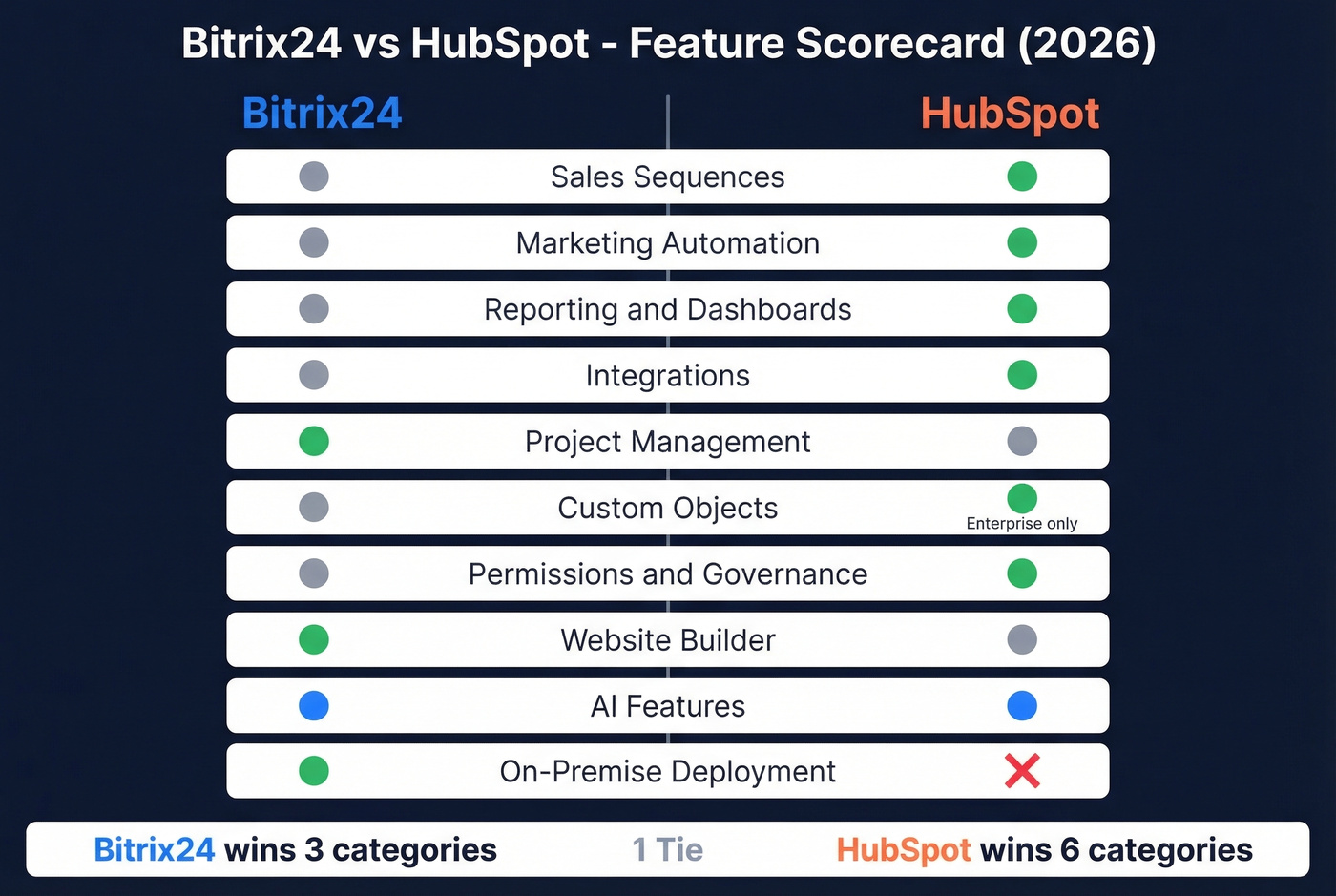
Feature-by-Feature Comparison
| Category | Bitrix24 | HubSpot | Winner |
|---|---|---|---|
| Sales Sequences & Templates | Basic email sequences at Standard+ | Full sequences, templates, calling at Starter+ | HubSpot |
| Marketing Automation | Functional at Standard; limited segmentation | Industry-leading at Pro+ (behavioral triggers, A/B) | HubSpot |
| Reporting & Dashboards | Standard reports; custom reports at Professional | Custom reports, attribution, forecasting at Pro+ | HubSpot |
| Integrations | 100+ integrations | 1,500+ via marketplace | HubSpot |
| Project Management | Native Kanban, Gantt, Scrum, time tracking | Requires third-party tools (Asana, Monday, etc.) | Bitrix24 |
| Custom Objects & Data Model | Limited custom fields; no true custom objects | Custom objects on Enterprise tiers (from $1,200/mo) | HubSpot (if you pay for Enterprise) |
| Permissions & Governance | Role-based access at Standard+ | Granular permissions, partitioning, audit logs at Pro+ | HubSpot |
| Website Builder | Included in all paid plans | Content Hub Starter at $25/mo (core seat); limited | Bitrix24 |
| AI Features | CoPilot across CRM, tasks, chat, calls | HubSpot AI for content generation, forecasting, summaries | Tie |
| On-Premise Deployment | Available (self-hosted option) | Not available | Bitrix24 |
The Automation Gap
This deserves a closer look. HubSpot workflows can use all CRM objects and behavioral data as enrollment triggers - the CRM-specific workflow logic is significantly deeper than what Bitrix24 offers. Bitrix24's automation covers more ground across modules (CRM, tasks, HR, approvals), but for multi-step deal-stage logic, lead scoring, and object-based branching, HubSpot is in a different league.
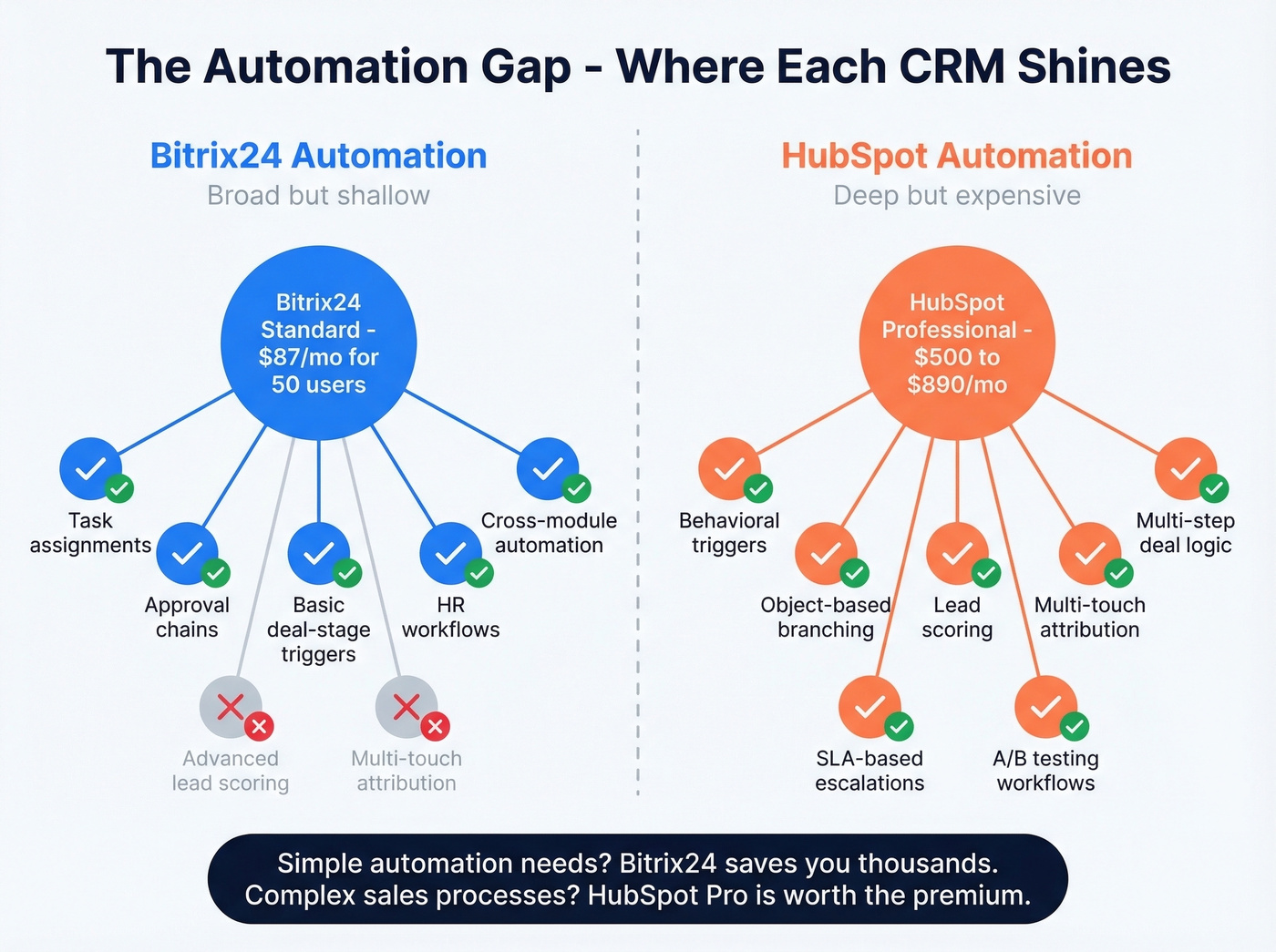
What this means in practice: if your sales process involves complex routing rules, SLA-based escalations, or multi-touch attribution, HubSpot Professional is worth the premium. If your automation needs are simpler - task assignments, approval chains, basic deal-stage triggers - Bitrix24 handles it fine at a fraction of the cost.
Both platforms gate advanced automation behind paid tiers. HubSpot puts its biggest capabilities in Professional plans: Sales Hub and Service Hub start at $500/mo, and Marketing Hub Professional starts at $890/mo. Bitrix24 Standard is $87/mo for up to 50 users. That's a staggering cost difference for overlapping capability.
Pricing and Total Cost of Ownership
Let's get into the numbers that actually matter.
Bitrix24 Pricing
| Plan | Monthly (Annual Billing) | Users Included | Per-User Equivalent |
|---|---|---|---|
| Free | $0 | Unlimited | $0 |
| Basic | $49/mo | 5 | $9.80/user |
| Standard | $87/mo | 50 | $1.74/user |
| Professional | $175/mo | 100 | $1.75/user |
| Enterprise | $350/mo | 250 | $1.40/user |
One caveat: telephony runs on pay-as-you-go credits on top of your plan. If calling is core to your workflow, budget for extra telephony costs beyond the subscription. (If you’re evaluating calling stacks, see Dialpad alternatives or Ringover alternatives.)
HubSpot Pricing
| Product | Starter | Professional | Enterprise |
|---|---|---|---|
| CRM Suite | $50/mo | $1,781/mo | $5,000/mo |
| Sales Hub | $20/mo/seat | $500/mo (5 seats) | $1,200/mo (10 seats) |
| Marketing Hub | $20/mo (1,000 contacts) | $890/mo (2,000 contacts) | $3,600/mo (10,000 contacts) |
| Service Hub | $20/mo/seat | $500/mo (5 seats) | $1,200/mo (10 seats) |
For most Professional and Enterprise purchases, HubSpot charges paid onboarding fees - commonly $3,000 for Marketing Hub Professional, $4,500 for CRM Suite Professional, and up to $12,000 for CRM Suite Enterprise. Forbes' analysis also notes HubSpot's costs rise quickly beyond entry tiers.
The contact-tier trap nobody warns you about: Marketing Hub pricing is tied to your marketing contact count. On Professional, additional marketing contacts are priced in blocks - for example, $250/month per additional 5,000 marketing contacts in the 2,000-22,000 range. This is the cost multiplier that makes HubSpot's total spend balloon for growing teams.
The TCO Math That Matters
At small scale, these platforms cost the same. At 20+ seats, Bitrix24 costs 6-10x less.
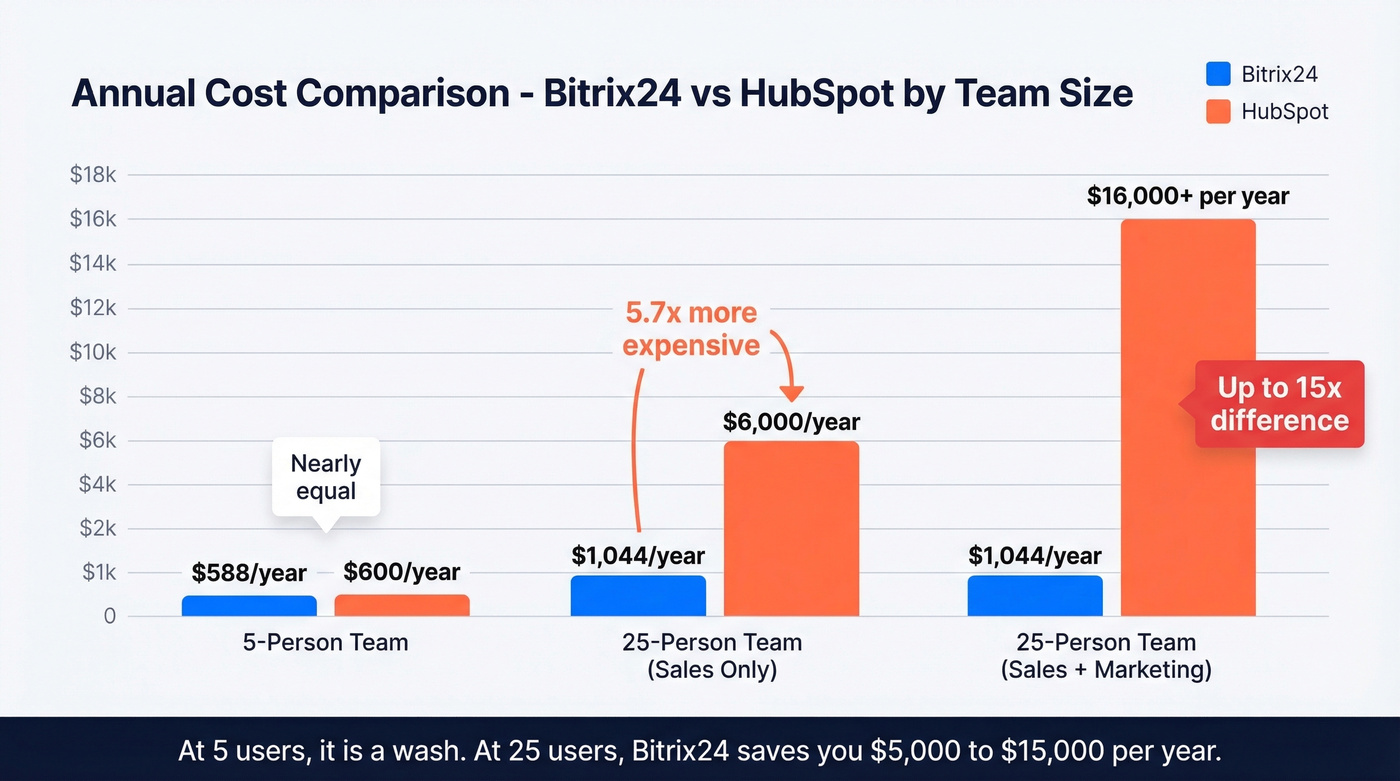
5-person team, 12 months: Bitrix24 Basic = $588/year. HubSpot CRM Suite Starter = $600/year. A wash.
25-person team, 12 months: Bitrix24 Standard = $1,044/year. HubSpot Sales Hub Starter at $20/seat/month = $6,000/year. That's a 5-6x difference - and we haven't even added marketing automation yet.
25-person team with marketing automation: Bitrix24 Standard still $1,044/year. HubSpot Marketing Hub Professional + Sales Hub Starter can easily push total year-one spend into five figures, and the gap widens further as your marketing contacts scale.
HubSpot's free tier is the best free CRM on the market. But the jump to Professional is a cliff, not a step. Budget accordingly.

Neither Bitrix24 nor HubSpot will fix bounced emails or missing phone numbers. Prospeo feeds either CRM with 98% verified emails and 125M+ direct dials - refreshed every 7 days, not every 6 weeks.
Fix the data layer first. Your CRM will thank you.
What Real Users Say
Review Scores
| Platform | G2 | Capterra | Trustpilot |
|---|---|---|---|
| Bitrix24 | 4.1/5 (599 reviews) | 4.2/5 (981 reviews) | 2.2/5 (106 reviews) |
| HubSpot | 4.4/5 (13,567 reviews) | 4.5/5 (4,447 reviews) | - |
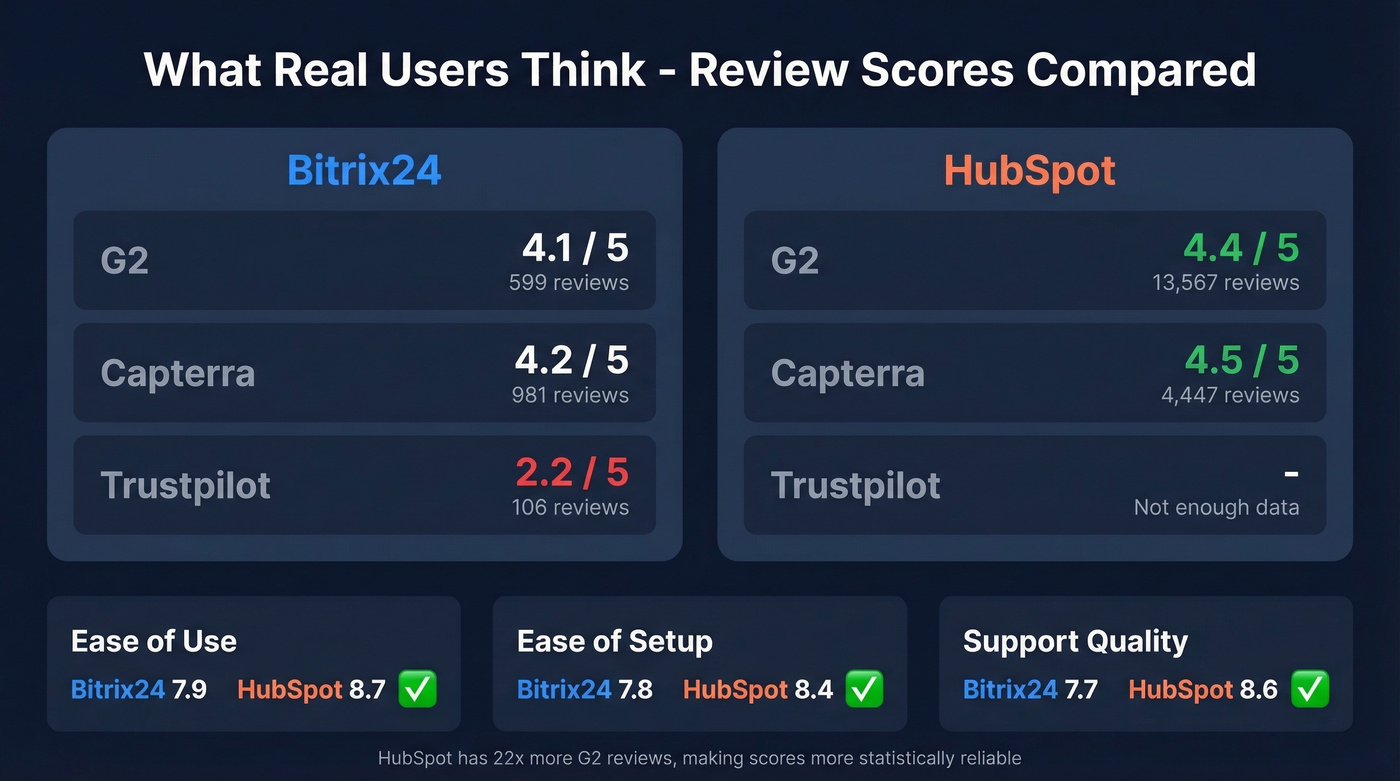
G2 sub-scores tell the real story. HubSpot scores 8.7 on Ease of Use vs Bitrix24's 7.9. Ease of Setup: 8.4 vs 7.8. Quality of Support: 8.6 vs 7.7. HubSpot's review pool is 22x larger on G2, which makes those scores more statistically reliable.
Bitrix24 Complaints
Trustpilot - where frustrated users tend to land - paints a harsh picture at 2.2/5. The recurring themes: support is hard to reach and slow, the UI feels cluttered and dated, marketplace integrations are unreliable, and some features get disabled on certain regional clusters without warning. On G2, "learning curve" appears in 19 reviews, and performance/slow loading surfaces in 12 separate reviews.
HubSpot Complaints
HubSpot's product is excellent. Their sales and renewal experience is a different story. One Reddit thread in r/hubspot captures it well - a self-described "5-figure paying customer" describes a "revolving door of reps," "fear mongering sales practices," and "used car dealer treatment." Cost escalation above Starter is the #1 complaint across review sites. The mandatory onboarding fees feel like hidden costs, and the reporting add-on at $200/mo stings when you're already paying for Professional.
We've heard similar frustrations from our own users who switched CRMs specifically because of renewal sticker shock.
Support Reality
Bitrix24 provides email, live chat, and phone support options. HubSpot offers email plus an extensive online help center, with phone support reserved for higher tiers. HubSpot's support quality is consistently rated higher (8.6 vs 7.7 on G2), and HubSpot Academy provides extensive self-service training.
Bitrix24 offers 24/7 live chat on paper, but response quality and speed correlate heavily with plan level - free and Basic users frequently describe support as absent. If responsive support is a dealbreaker, HubSpot wins this category outright.
Implementation and Onboarding
Setup time differs significantly. HubSpot Starter can often be configured and running in a few days because the onboarding flow is straightforward and HubSpot Academy walks you through the basics. Bitrix24 takes longer because there's more to configure: CRM, project management, telephony, HR modules, and permissions across a larger surface area.
Admin burden is the hidden cost nobody talks about. HubSpot is easier to maintain day-to-day because the UI is cleaner and changes are more predictable. Bitrix24 requires a more technical admin - especially for automation rules, custom fields, and integration maintenance. In our experience, teams without someone comfortable doing light technical configuration should factor in the cost of a Bitrix24 consultant ($50-150/hr) or accept a longer ramp-up period.
Training investment follows the same pattern. HubSpot's learning curve is gentler. Bitrix24 users consistently report a steeper curve, and the interface density means ongoing questions from your team are more frequent.
Which CRM Should You Pick?
| Team Profile | Pick | Why | Watch Out For |
|---|---|---|---|
| Marketing-led team, under 10 people | HubSpot Starter | UX advantage is worth it at this scale; cost difference is negligible | Costs jump sharply at Professional tier |
| 20+ people needing CRM + project management | Bitrix24 Standard | $87/mo for 50 users ($1.74/user) - nothing else comes close on value | Steeper learning curve; invest in internal training |
| Budget-sensitive team needing advanced automation | Bitrix24 Standard + Zapier | Gets you 80% of the automation at 20% of the cost | More manual workarounds needed |
| Enterprise with compliance/data control needs | Bitrix24 Enterprise (on-premise) | Self-hosted deployment; full data sovereignty | Requires internal IT resources to maintain |
| Solo founder or tiny team (1-3 people) | HubSpot Free | Best free CRM on the market, period | You'll outgrow it fast if you add marketing tools |
Skip both if your team is project-management-first and only needs lightweight CRM. Monday.com is worth a look in that case - best for teams where task tracking matters more than pipeline management. ClickUp occupies similar territory with aggressive pricing, starting around $7/user/mo for its CRM-capable tiers. If you want more context before choosing, compare against other examples of a CRM.
Your CRM Is Only as Good as Your Data
Neither Bitrix24 nor HubSpot generates high-quality B2B contact data natively. Once you pick a CRM, you need accurate emails and phone numbers to fill it. Prospeo integrates natively with HubSpot and connects to Bitrix24 via Zapier, Make, or API - with 98% email accuracy, 125M+ verified mobile numbers, and a 7-day data refresh cycle, it fills the data gap at roughly $0.01 per email. There's a free tier (75 verified emails/month), no contracts, no onboarding fees. (If you’re building outbound lists, pair this with sales prospecting techniques and a clean lead generation workflow.)
You're comparing CRMs that cost $87/mo to $5,000/mo. Meanwhile, bad contact data is silently killing pipeline in both. Prospeo enriches your HubSpot or Bitrix24 contacts at $0.01/email with 92% match rates.
Stop debating CRMs and start reaching real buyers.
FAQ
Is Bitrix24 really free?
Yes, the free tier supports unlimited users with basic CRM, tasks, and collaboration. Advanced automation, expanded storage, and telephony require paid plans starting at $49/month for 5 users. The free plan is genuinely functional for small teams getting started, though support is minimal.
Why does HubSpot get so expensive at Professional tier?
HubSpot gates advanced automation and deeper reporting behind Professional plans. Sales Hub Professional starts at $500/month, Marketing Hub Professional at $890/month, plus mandatory onboarding fees ($3,000-$12,000 depending on the bundle). Marketing Hub pricing also scales with your contact count - that's the hidden multiplier most buyers miss.
Can I migrate from one platform to the other?
Yes, but expect manual CSV exports or third-party migration tools. HubSpot offers migration services starting at $500+. Always test with a small batch first to catch field-mapping issues before moving your full database.
Which CRM is better for teams under 5 people?
At this size, both cost about $50/month. HubSpot wins on UX and setup speed. Bitrix24 wins if you also need project management and team collaboration built into the same tool without adding separate subscriptions.
How do I get accurate contact data into either CRM?
Neither platform has a reliable native B2B database. Prospeo's integrations work with both and provide 98%-accurate verified emails from 300M+ professional profiles, plus 125M+ verified mobile numbers. The free tier gives you 75 verified emails per month - enough to test data quality before committing.