

Lead Generation Types: 12 Methods Ranked by ROI (2026)
94% of B2B marketing teams diversified their channel mix last year. That means almost everyone's experimenting - and most are spreading budget across lead generation types they haven't benchmarked. The real question isn't which methods exist. It's which ones deserve your budget right now, given your deal size, team size, and sales cycle.
Most teams under $1M ARR don't need twelve channels. They need two - referrals and outbound email - executed well. Everything else layers on top once those are working.
All 12 Types at a Glance
| Type | Category | Best For | Avg CPL | Time to ROI |
|---|---|---|---|---|
| Content Marketing | Inbound | Brand + SEO pipeline | $150-$300 | 6-12 months |
| SEO | Inbound | Compounding organic | $50-$200 | 6-12 months |
| Social Media | Inbound | Awareness + trust | $100-$250 | 3-6 months |
| Paid Ads (PPC) | Outbound | Fast volume | $200-$400 | Weeks |
| Events & Webinars | Hybrid | High-intent pipeline | $200-$500 | 1-3 months |
| Referrals | Inbound | Highest close rate | ~$0 | Weeks |
| Cold Email | Outbound | Fast pipeline | $50-$150 | Weeks |
| ABM | Outbound | Enterprise deals | $300-$800 | 3-9 months |
| Product-Led Growth (PLG) | Inbound | Self-serve SaaS | $50-$200 | 3-12 months |
| Partnerships | Hybrid | Audience expansion | $100-$300 | 6+ months |
| Direct Mail | Outbound | High-ACV enterprise | $300-$1,000 | 1-3 months |
| Intent-Based / AI | Hybrid | In-market buyers | $100-$300 | Weeks |
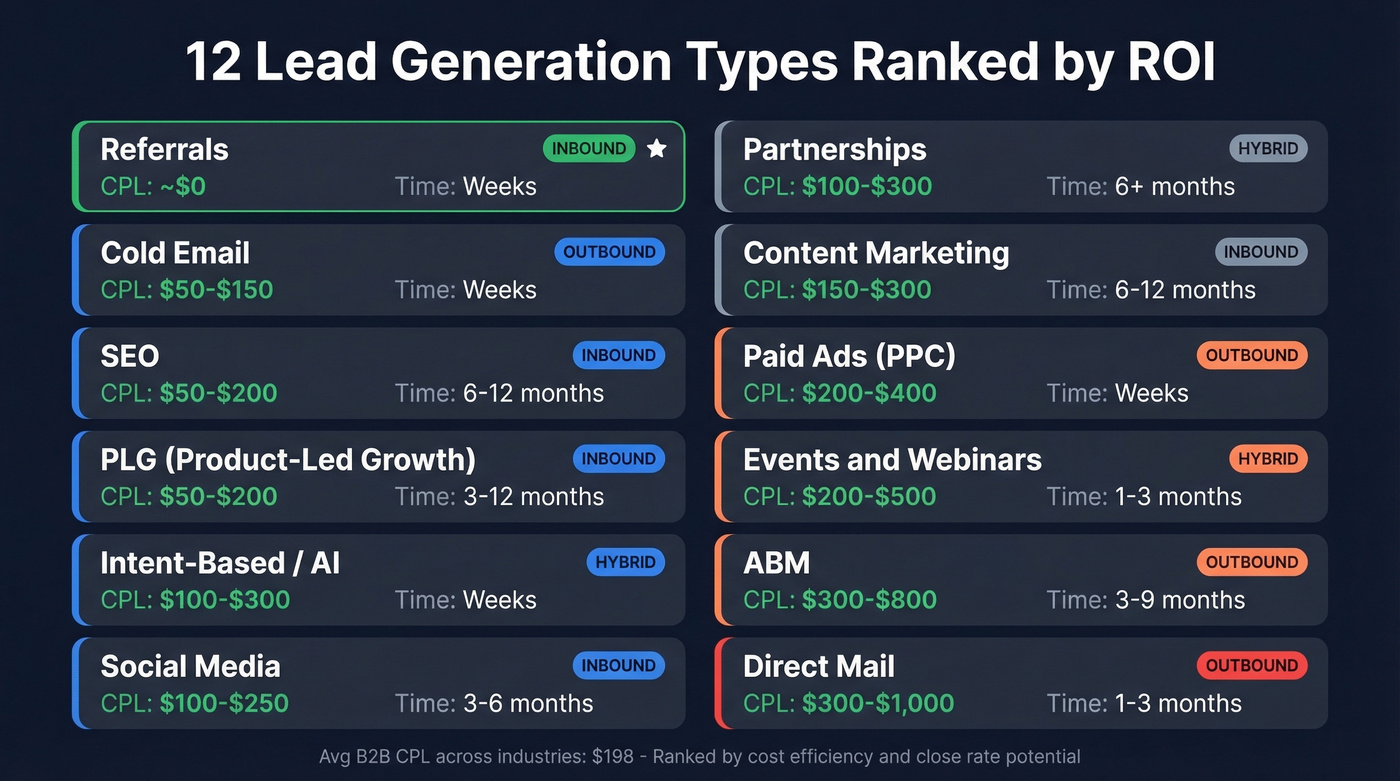
Across common lead gen benchmarks, average CPL sits around $198 across industries and roughly $392 when averaged across channels in broader benchmark roundups.
Inbound vs Outbound - The Core Split
Every lead gen guide draws a hard line between inbound and outbound. Useful mental model, false binary - every serious B2B team in 2026 runs both.
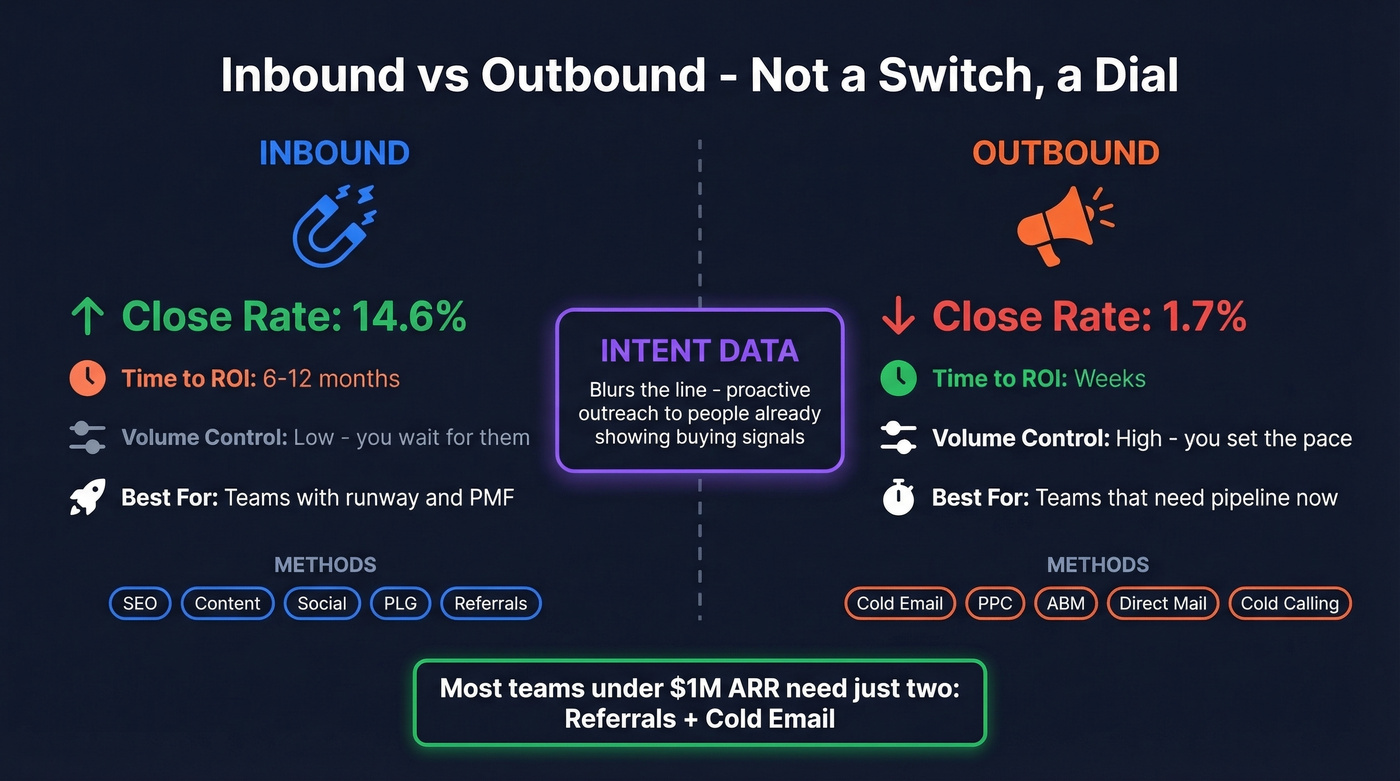
Inbound through SEO, content, and social attracts leads who find you. The payoff is real: inbound/SEO leads close at 14.6% versus 1.7% for outbound tactics. But inbound is a form of passive lead generation - it takes months to compound, and you can't control the volume dial the way you can with outbound.
Outbound through cold email, cold calling, and direct mail reaches leads directly. The feedback loop is tight. You know within weeks whether your messaging and targeting work, but the tradeoff is higher per-touch cost and lower close rates on average.
We've watched dozens of teams try to skip outbound and go straight to content-led inbound. It almost never works before product-market fit is locked. Outbound fills pipeline now. Inbound compounds over time. Intent data blurs the line entirely - you're reaching out proactively, but only to people already showing buying signals. Think of it as a dial, not a switch.
The 12 Methods Explained
Content Marketing
37% of marketing budgets go to lead generation, and content marketing eats a big chunk of that. Blog posts, whitepapers, case studies, and video all serve the same purpose: attract people who have the problem you solve, then capture their information.
The catch is that gated content is declining in effectiveness. 49% of marketers report declining traditional search traffic due to AI-generated answers eating into organic clicks. The play now is ungated content that builds trust and brand, paired with soft conversion points - not a PDF behind a form that nobody wants to fill out.
If you have subject-matter expertise and a 6-12 month runway, content is a strong bet. Just don't expect leads in month one.
SEO
"SEO is dead because of AI search" is the laziest take in B2B marketing right now. SEO leads still close at 14.6% - no other channel touches that. What's dead is ranking thin informational content. The 2026 playbook leans hard toward bottom-of-funnel, comparison, and transactional pages.
The full-funnel numbers tell the story: 2.1% visitor-to-lead, 41% lead-to-MQL, and that 14.6% close rate. You're looking at 6-12 months before organic content produces consistent pipeline, which is why we always pair SEO with outbound for teams that need revenue this quarter. If your leadership expects results in month two, set expectations early or don't bother starting.
Social Media
LinkedIn drives 80% of B2B social prospects. Every other platform fights over the remaining 20%.
The emerging angle is video plus influencer partnerships. Brands combining video with industry voices are 2.2x more likely to be trusted and 1.8x more likely to be recognized. Social isn't just a distribution channel anymore - it's where trust gets built before the first sales conversation happens.
Paid Ads (PPC & Social)
Paid ads are the fastest way to generate leads at scale and the fastest way to burn cash if your targeting isn't dialed in.
PPC converts visitors to leads at just 0.7%, with a 36% lead-to-MQL rate and a 35% opportunity-to-close rate. Average B2B CPL via paid channels runs $200-$400+ depending on industry - finance and tech skew higher. The math works when your ACV supports it. For teams selling deals under $15K, paid acquisition often doesn't pencil out unless you've optimized landing pages well above the 2.35% average conversion rate.
Here's the number that should scare you: responding after 30 minutes reduces close probability by 80%. If you're running paid lead gen without a sub-5-minute response workflow, you're lighting money on fire.
Events & Webinars
Webinars deliver the highest opportunity-to-close rate in our benchmark table: 40%. Executive events push lead-to-MQL rates to 54%. These aren't vanity metrics - someone who gives you 45 minutes of attention is fundamentally more qualified than someone who clicked an ad.
The cost is real in dollars and production hours alike, but for mid-market and enterprise sales cycles, events remain one of the most efficient pipeline sources per dollar spent. We ran a webinar series last year that generated more SQLs in one quarter than three months of paid ads at twice the budget.
Referrals & Word of Mouth
Client referrals convert to MQLs at 56% - the highest of any channel. The cost is effectively zero.
If you're resource-constrained, this is where you start. Period.
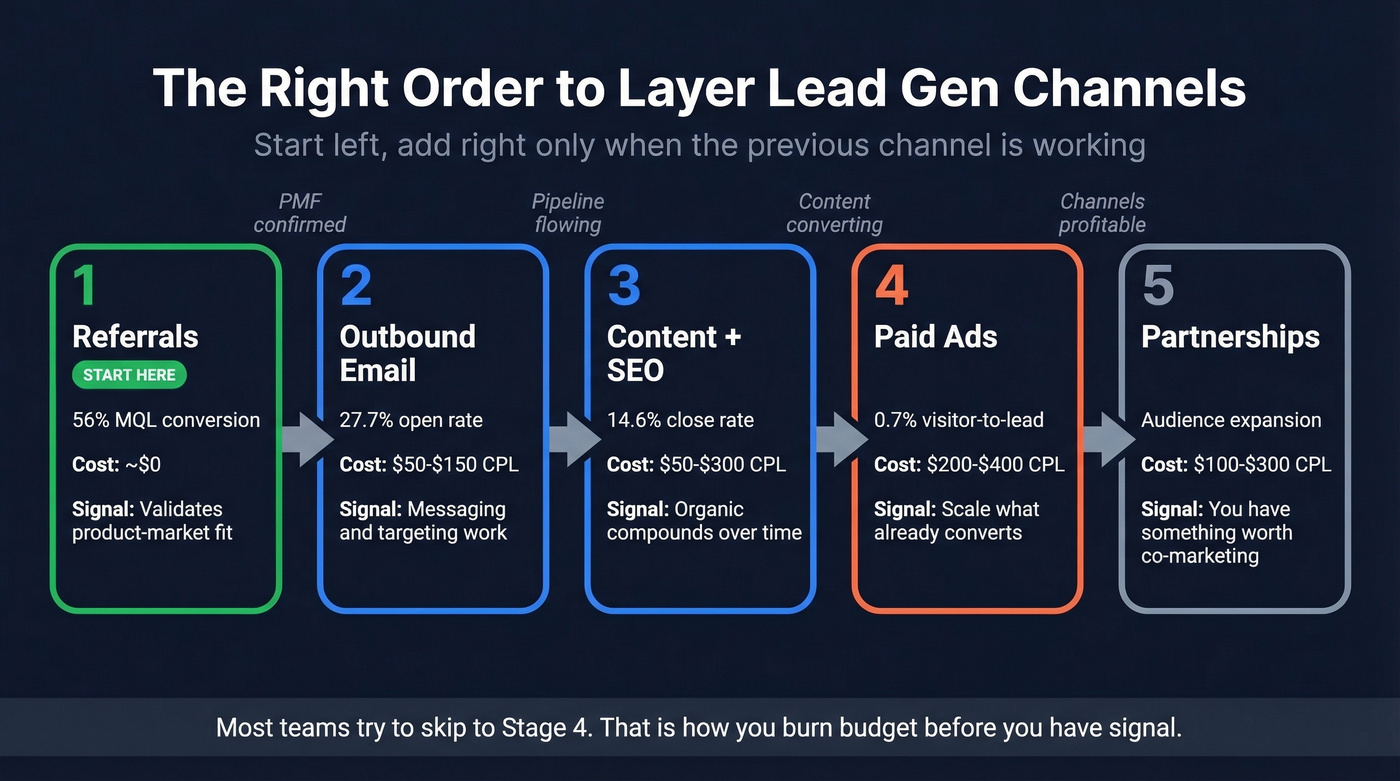
A practical sequencing framework from r/Entrepreneur matches what we see in the wild: referrals first, then outbound, then content, then paid, then partnerships. That sequencing makes sense because referrals give you the fastest signal on product-market fit with the least investment. Among traditional methods of generating leads, word-of-mouth referrals remain the most reliable path to high-quality pipeline.
Cold Email
Cold email is the workhorse of B2B outbound. Average benchmarks land at a 27.7% open rate, 5.1% reply rate, and 7.5% bounce rate. That bounce rate number matters most - if your emails bounce at 20%+, you don't have a lead gen problem. You have a data problem.
A detail most teams miss: turning off open tracking more than doubled reply rates in a study of 44M+ emails (2.36% vs 1.08%). Open tracking pixels trigger spam filters. The deliverability gains from removing them outweigh the reporting loss.
The prerequisite for any cold email program is verified data. Prospeo's email finder verifies professional emails in real time - 98% accuracy across 143M+ verified addresses - so your bounce rate stays under 5% instead of the 20-35% range that kills most outbound programs. At roughly $0.01 per email, it's the cheapest insurance policy your outbound team can buy.
Account-Based Marketing (ABM)
ABM is the only sane approach when your average deal exceeds $50K and the buying committee has six or more people. It takes 70+ touchpoints across six channels to earn trust from modern enterprise buyers with real intent.
The industry is shifting away from MQL-centric models toward pipeline and buying-group ownership. ABM reflects that shift - you're not counting leads, you're orchestrating engagement across an entire account. It's expensive, it's slow, and it's the only thing that works consistently for complex enterprise sales.
Product-Led Growth (PLG)
PLG means users experience your product's value before talking to sales. 39% of Series A startups now enable some form of PLG or self-serve motion. In DevTools, that number hits 50%.
Here's the thing: PLG doesn't mean free. Only 25% of those startups offer a free tier. Many charge from day one - they remove friction, not price. Free trial to paid converts at 18-29%, while freemium to paid sits at just 3.4%. The model works best when your median time-to-value is under 30 minutes. Self generated leads from a PLG motion are among the highest-converting in any pipeline because the user has already proven intent through product usage.
Partnerships & Co-Marketing
55% of B2B marketers now partner with creators, SMEs, or industry voices for content and distribution. Partnerships are powerful but slow - they require relationship-building, aligned incentives, and shared audiences.
Get referrals, outbound, and content working first. Then layer in co-marketing when you have something worth co-marketing.
Direct Mail
Skip this if your ACV is under $25K. Double down if every VP of Sales on your target list gets 200 cold emails a day and maybe two physical packages a month.
For high-ACV enterprise deals where digital channels are saturated, a well-targeted direct mail piece cuts through in a way that another Outreach sequence simply can't. Pair it with ABM for maximum impact.
Intent-Based / AI-Powered Prospecting
This is where lead gen is heading in 2026. Buyer intent data identifies companies actively researching solutions in your category - before they fill out a form or raise their hand.
Layer intent signals with firmographic filters like headcount growth, funding, and tech stack, and you've got a target list that's both accurate and timely. Prospeo tracks 15,000 intent topics via Bombora, letting you find leads actively researching your category rather than just matching a job title.
Lead Quality by Type
Not all leads are equal, and the label determines what happens next.
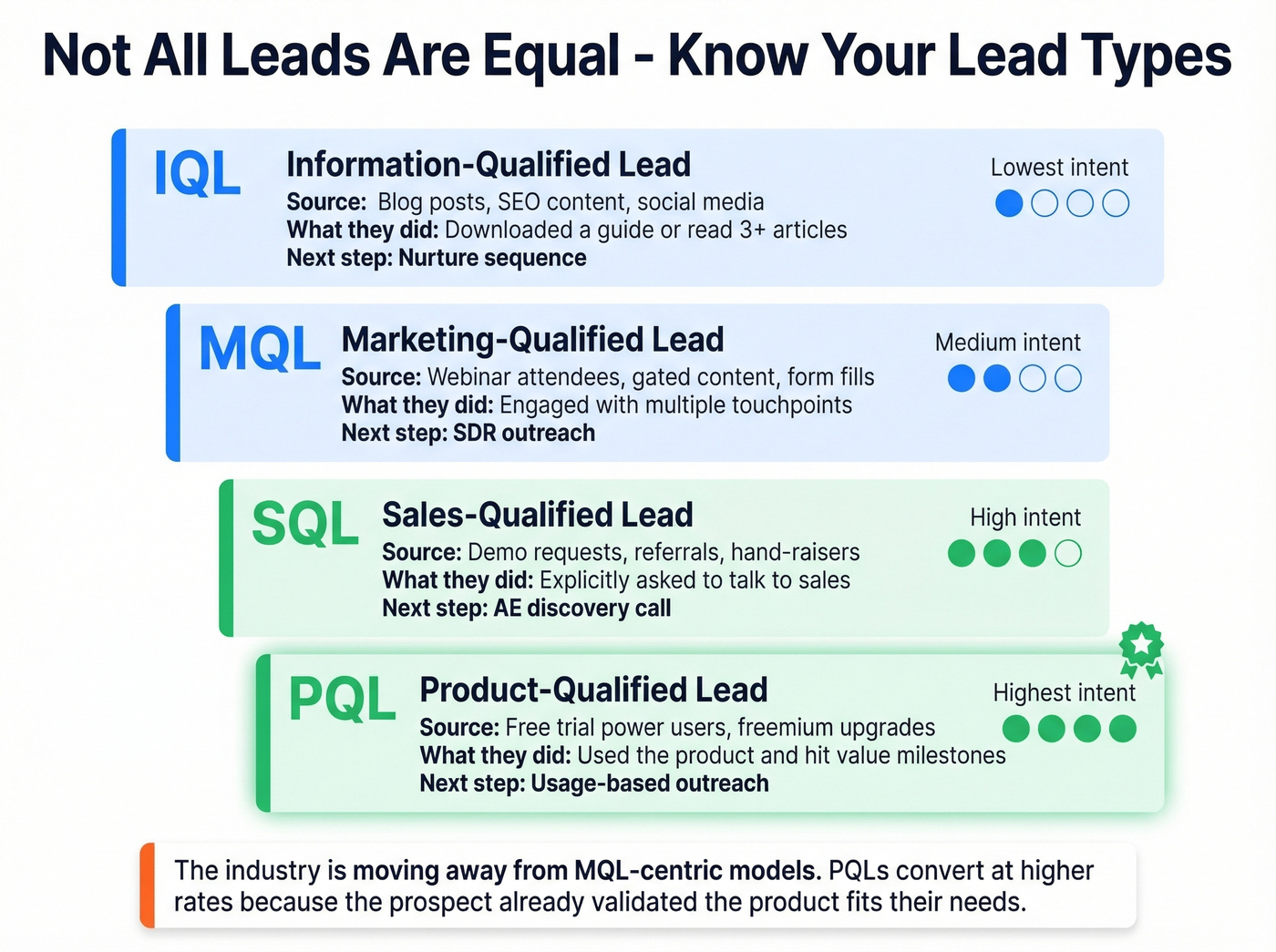
| Lead Type | Definition | Typical Source | Next Step |
|---|---|---|---|
| IQL | Information-qualified | Content, SEO | Nurture sequence |
| MQL | Marketing-qualified | Webinar, gated content | SDR outreach |
| SQL | Sales-qualified | Demo request, referral | AE discovery call |
| PQL | Product-qualified | Free trial, freemium | Usage-based outreach |
The industry is moving away from MQL-centric models. Buying groups matter more than individual leads, and PQLs convert at higher rates than MQLs because the prospect has already validated the product fits their needs. If you're running PLG, PQL tracking isn't optional - it's the whole point.

The article says it clearly: 7.5% average bounce rate kills cold email ROI. Prospeo's 5-step email verification delivers 98% accuracy - teams like Snyk dropped bounce rates from 35% to under 5% and added 200+ opportunities per month.
Fix your data before you optimize another channel.
Conversion Benchmarks: Top of Funnel
| Channel | Visitor to Lead | Lead to MQL |
|---|---|---|
| SEO | 2.1% | 41% |
| PPC | 0.7% | 36% |
| Webinar | 0.9% | - |
| - | 38% | |
| Referrals | - | 56% |
| Exec Events | - | 54% |
Conversion Benchmarks: Bottom of Funnel
| Channel | MQL to SQL | SQL to Opp | Opp to Close |
|---|---|---|---|
| SEO | 51% | 49% | 36% |
| PPC | 26% | 38% | 35% |
| Webinar | - | - | 40% |
Two things jump out. SEO's full-funnel efficiency is unmatched - high conversion at every stage. And referrals plus executive events dominate the lead-to-MQL step, meaning leads entering your pipeline from those channels are dramatically more qualified from day one.
How to Choose the Right Mix
Use a three-lens framework to narrow your options.
Product lens: Does your product deliver value upfront (PLG-friendly) or over time (sales-led)?
Deal size and cycle lens: Match your spend to your deal size.
| ACV Band | Typical CAC | Best Channels |
|---|---|---|
| SMB ($5K-$25K) | $1K-$4K | Cold email, referrals, SEO |
| Mid-market ($25K-$100K) | $4K-$15K | Content, events, outbound |
| Enterprise ($100K-$500K) | $15K-$50K | ABM, direct mail, events |
| Enterprise+ ($500K+) | $50K-$150K | ABM, executive events, partnerships |
Market position lens: Established players defend credibility with content and events. Disruptors earn legitimacy through outbound and partnerships.
The sequencing that works for most teams: referrals, then outbound email, then content/SEO, then paid ads, then ABM, then partnerships. Each layer builds on the one before it. Don't skip to paid or ABM before your outbound messaging and ICP are validated.
Mistakes That Kill Each Type
Cold email dies when you send to unverified lists. An SDR team that sends 5,000 emails and gets 1,200 bounces doesn't have a messaging problem - they have a data hygiene problem. We've seen teams go from 35% bounce rates to under 4% just by switching to verified data, and their reply rates doubled within weeks.
Content marketing stalls with weak lead magnets. "Subscribe to our newsletter" isn't a value proposition. Targeted templates, calculators, and mini-guides convert; generic opt-ins don't.
Paid ads waste budget without follow-up speed. That 80% drop in close probability after 30 minutes? It's not a suggestion. Build the response workflow before you turn on the ad spend.
ABM fails when you over-rely on purchased lists. Purchased leads rarely convert. Build your target account list from intent signals and firmographic data, not from a broker.
SEO disappoints when leadership expects results in month two. It's a 6-12 month investment. Pair it with outbound if you need pipeline this quarter.
FAQ
What's the cheapest type of lead generation?
Referrals cost nothing and convert to MQLs at 56% - the highest of any channel. SEO has low marginal cost once established, with a 14.6% close rate, but requires 6-12 months of upfront investment before pipeline flows consistently.
What's the difference between inbound and outbound?
Inbound attracts leads through SEO, content, and social - prospects come to you. Outbound reaches them directly via cold email, calling, and direct mail. Most B2B teams run both; the ratio depends on deal size and sales cycle length.
Which lead generation type works fastest?
Outbound email and referrals produce pipeline within weeks. Paid ads generate leads immediately but need budget and optimization. SEO and content take 6-12 months to compound into consistent volume.
How do I verify leads before outreach?
Use a real-time email verification tool before launching any sequence. Unverified lists commonly bounce at 20-35%, which destroys domain reputation and tanks deliverability for months. Look for tools that verify at 98%+ accuracy and handle catch-all domains.
What is a product-qualified lead (PQL)?
A PQL is a user who's experienced your product through a free trial or freemium tier and shows buying signals through usage patterns. PQLs convert at higher rates than MQLs because they've already validated the product fits their workflow - no demo required.
Intent data ranked fastest to ROI alongside cold email and referrals. Prospeo combines 15,000 Bombora intent topics with 30+ filters - so you reach in-market buyers with verified contact data at $0.01 per email.
Stop spreading budget across 12 channels. Stack the two that actually convert.