

How to Find Leads' Phone Numbers That Actually Connect
Sales reps spend 40% of their time just searching for prospect information. That's two full days a week not selling. And when they finally dial, 72% of calls don't reach a human - because half the numbers in the average CRM are dead, disconnected, or routed to a switchboard that goes nowhere.
Here's the thing: 82% of buyers still accept meetings from cold calls. The math works, but only when you're dialing numbers that actually connect.
If you need verified direct dials today:
- Prospeo - best accuracy-to-price ratio. 125M+ verified mobiles, 30% pickup rate, ~$0.01/lead. Start free.
- Cognism - best for EMEA compliance. Phone-verified mobiles with DNC checking across the US, UK, Canada, Australia, and European countries. ~$25K+/yr.
- Apollo - best free tier. 275M+ contacts, 50 free credits/month, paid plans from $49/mo.
7 Ways to Find a Prospect's Phone Number
1. B2B Data Platforms
2. Chrome Extensions
3. CRM Enrichment
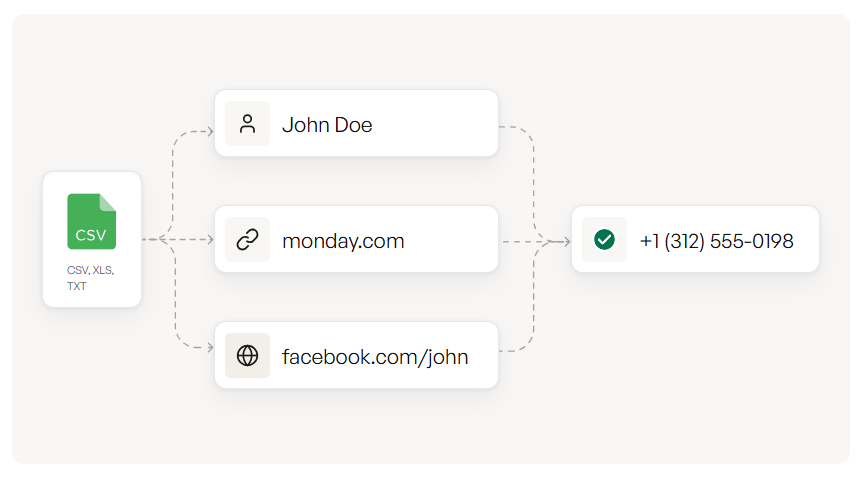
If your CRM already has contacts but they're missing phone numbers, enrichment fills the gaps. Upload a CSV or connect directly through Salesforce or HubSpot, and the platform appends verified numbers to existing records. It's the lowest-effort way to upgrade data you already own.
4. Waterfall Enrichment
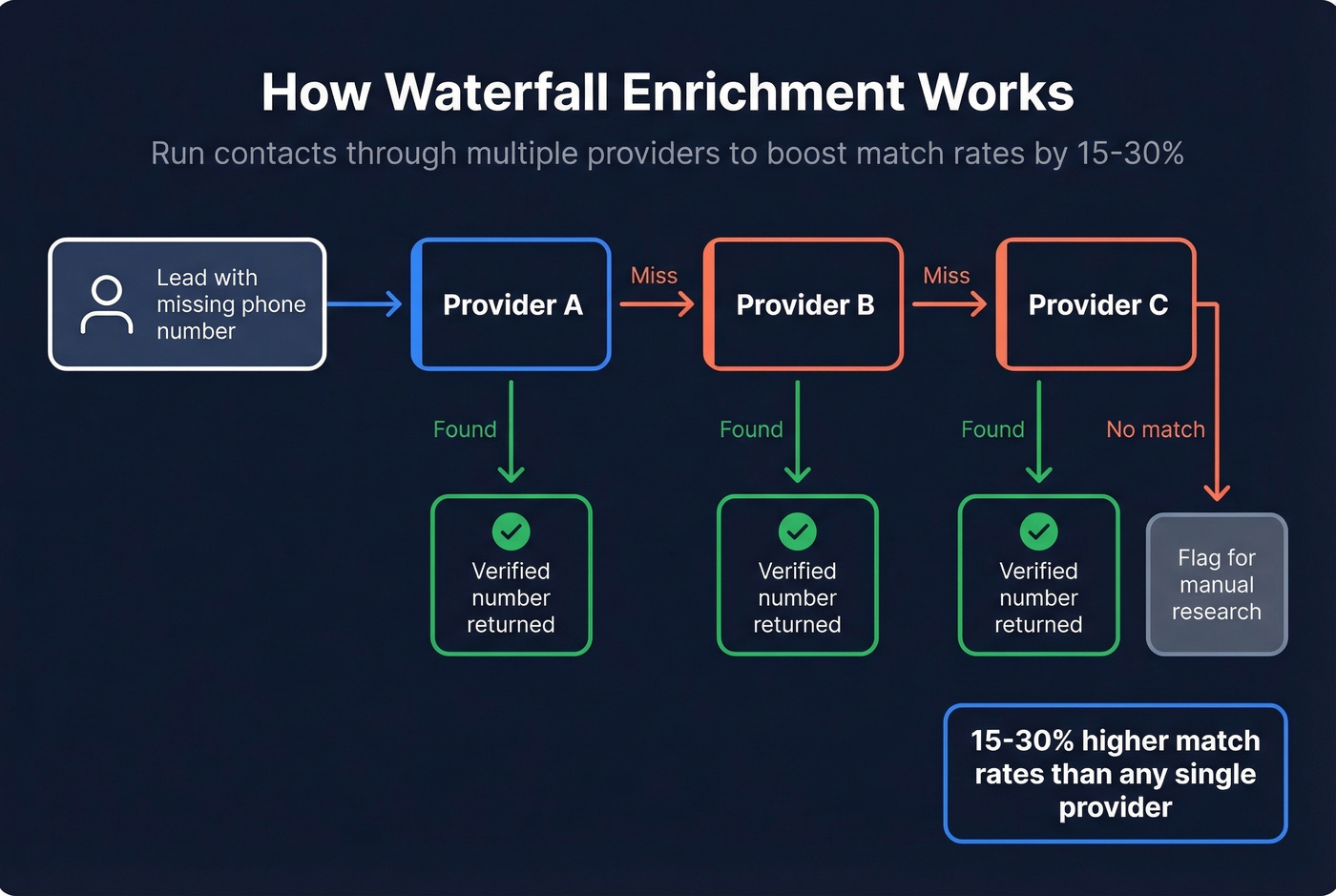
No single provider has every number. Waterfall enrichment runs a contact through multiple providers sequentially - if Provider A misses, Provider B tries, then Provider C. Clay is popular for orchestrating this, and most modern data platforms offer API access for waterfall workflows. For teams with the technical chops to set it up, waterfall routinely boosts match rates by 15-30% over any single source.
5. Inbound Capture
Forms, webinars, and gated content still work for collecting phone numbers directly from prospects. The quality is high - they gave you the number voluntarily - but the volume is limited and the leads tend to be earlier in the funnel.
6. Manual Research
Company websites, SEC filings, press releases, and conference speaker lists all contain phone numbers. Slow? Absolutely. But for high-value enterprise targets, spending 10 minutes finding a CFO's direct line can be worth more than 100 bulk records.
7. Pre-Built Phone Lists
Let's be direct: companies that sell phone numbers in bulk are almost always a waste. Sites selling massive lists for $299 often ship data that's years old and DNC-contaminated. TelephoneLists.biz, for example, advertises lists "last updated in 2015." Stop hoarding mediocre numbers. You need 50 great ones, not 5,000 dead ones.
Best Tools for Finding Leads' Phone Numbers
SDR managers always ask us about the strongest quality-to-price ratio - especially for EMEA teams where poor data discourages reps from calling at all. Here's how the major tools stack up:
| Tool | Database | Cost/Phone # | Starting Price | Best For |
|---|---|---|---|---|
| Prospeo | 300M+ profiles | ~$0.01 | Free tier available | Accuracy + value |
| Cognism | 50M+ Diamond | Included in platform | ~$25K+/yr | EMEA compliance |
| Apollo | 275M+ contacts | Credit-based | Free; $49/mo paid | Free-tier prospecting |
| ZoomInfo | 250M+ contacts | ~$1+ at volume | $15K-$30K+/yr | Enterprise all-in-one |
| Lusha | 100M+ profiles | $0.66-$1.20 | Free; $29.90/mo | Quick lookups |
| Saleshandy | 700M+ contacts | ~$0.02 | $24/mo | Budget bulk search |
Prospeo
The pay-as-you-go model means you only pay when a number is found. At ~$0.01 per lead, it's 90% cheaper than enterprise alternatives like ZoomInfo.
A 30% pickup rate is one of the strongest published benchmarks in the category, and a 7-day data refresh cycle eliminates the stale-number problem that plagues most databases. Thirty-plus search filters - including buyer intent powered by Bombora - let you target the right contacts before you ever pick up the phone. In our testing, the combination of fresh data and intent signals meant reps weren't just connecting more often; they were connecting with people who actually cared about what they were selling. For teams that need verified mobile numbers without enterprise contracts, it strikes the best balance between coverage and cost.
Cognism
Use this if you're selling into EMEA and compliance is non-negotiable. Cognism's Diamond tier includes phone-verified mobiles and DNC checking across the US, UK, Canada, Australia, and European countries as standard. They report 98% accuracy on Diamond Data with a 3x improvement in connect rates.
Skip this if you're a small team watching budget. Diamond runs ~$25,000/year platform fee plus $2,500/user/year, with $3,000-$8,000 in implementation fees on top. That's a serious commitment before a single dial is made.
Apollo
The obvious starting point for teams with zero budget. Apollo's free tier gives you 50 credits/month across 275M+ contacts. Paid plans start at $49/mo. The tradeoff is accuracy - user-reported deliverability runs 60-75%, and there's no built-in on-demand phone verification. Good for getting started, but you'll feel the accuracy gap once your team scales past a handful of reps.
Lusha
Lusha's credit system charges 10 credits per phone number reveal. On the Pro plan ($29.90/mo annual, per user), that works out to about $1.20 per number. Premium ($52.45/mo annual, per user) drops it to ~$0.66 per number. The free tier gives you 70 credits/month - enough for seven phone reveals. Good for quick lookups, but the per-number cost adds up fast at scale.
Saleshandy
Budget-friendly bulk option with 700M+ contacts and plans from $24/mo for 1,000 credits. G2 rating of 4.6/5 across 750+ reviews. SOC 2 Type II and GDPR compliant. Not the deepest phone verification, but solid for teams prioritizing volume over per-number accuracy.

Your reps are wasting two days a week chasing bad phone numbers. Prospeo's 125M+ verified mobiles deliver a 30% pickup rate - the highest published benchmark in the category - refreshed every 7 days so you never dial a disconnected line.
Pay $0.01 per lead instead of $1. Start with 75 free credits.
What Phone Numbers Actually Cost
The sticker price on a data platform means nothing until you do the per-number math. Lusha's Pro plan at $29.90/mo gives you 250 credits - but phone numbers cost 10 credits each, so you're getting 25 phone numbers for $29.90. That's $1.20 per number. ZoomInfo typically runs $15,000-$30,000+/year with per-number costs north of $1 at volume.
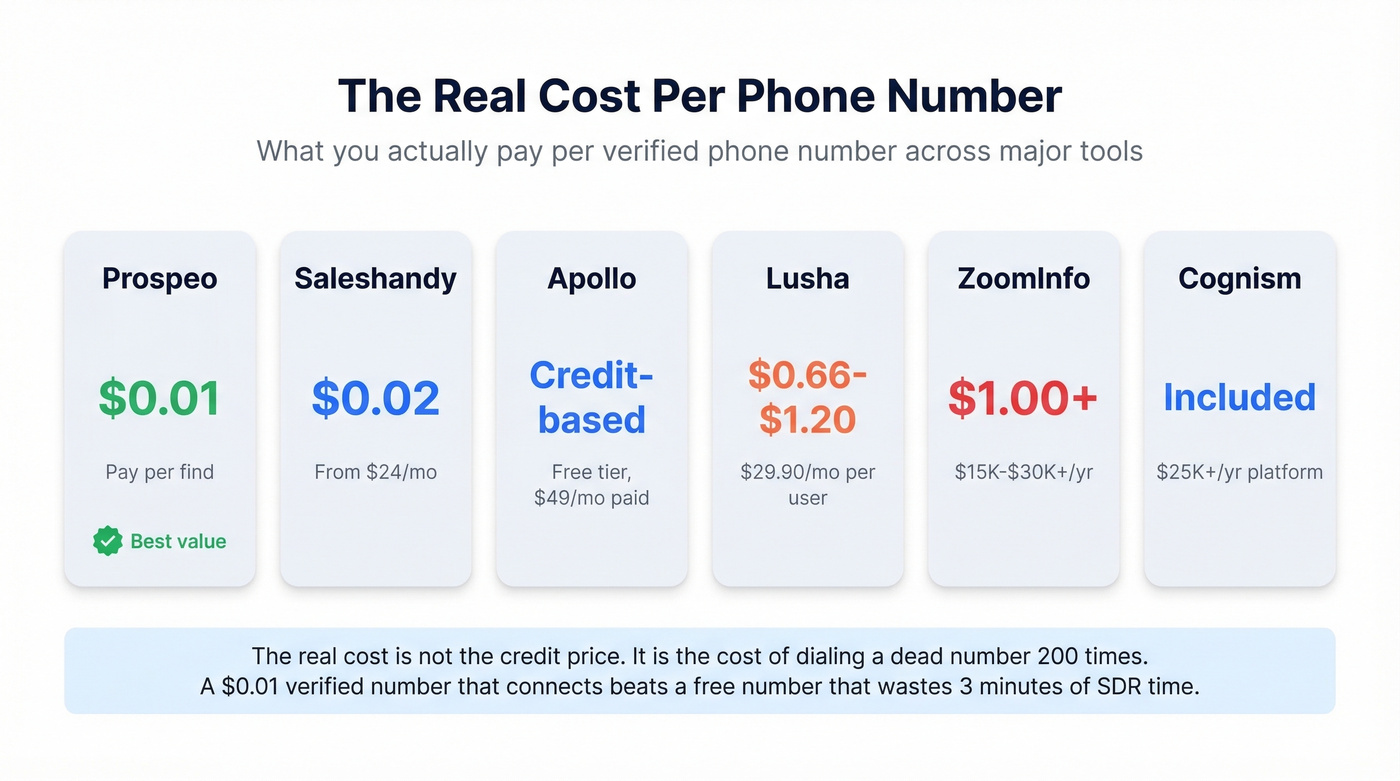
Look, the real cost isn't the credit price. It's the cost of dialing a dead number 200 times. A $0.01 verified number that connects is infinitely cheaper than a free number that wastes 3 minutes of an SDR's time before hitting voicemail. If your average deal size is under $15K, you almost certainly don't need ZoomInfo-level pricing - a self-serve tool at a fraction of the cost will outperform it for your use case.
How Accurate Are These Numbers?
Not all phone numbers are created equal. The gap between tiers is enormous:
- Switchboard numbers: 5-10% connect rate
- Direct dials: 15-20% connect rate
- Verified mobile numbers: 25-35% connect rate
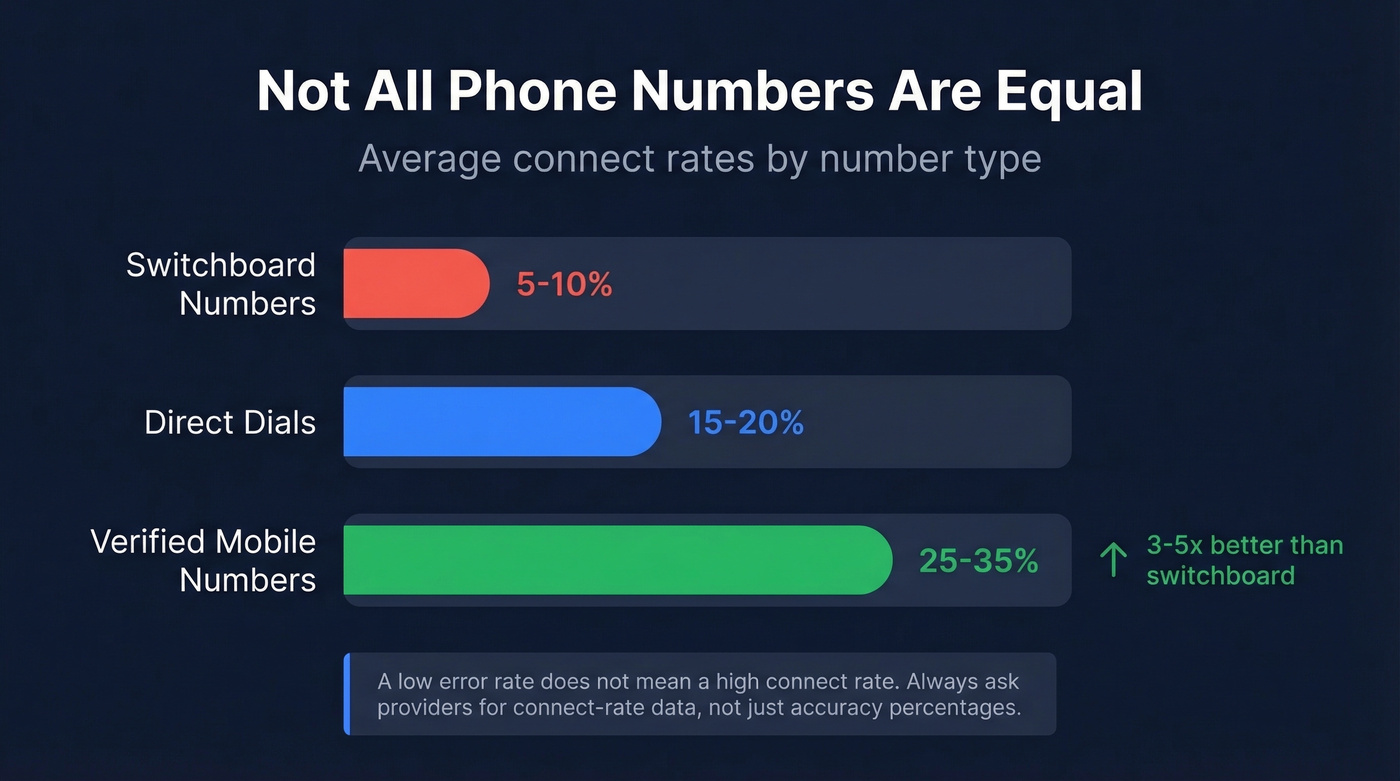
A LeadGenius dialing test across three vendors found that ContactOut was the only provider producing confirmed live connections - while Wiza and Datagma had low wrong-number rates but zero live connects. The takeaway is blunt: low error rates don't mean high connect rates. You need numbers that actually ring a human.
When evaluating any provider, always ask for connect-rate data, not just accuracy percentages. A prospect's phone number is only valuable if someone picks up.
TCPA & DNC Compliance in 2026
TCPA lawsuits surged nearly 95% year-over-year, with class actions spiking 285% in September 2025 alone. You don't need a legal team to make 50 cold calls, but ignoring compliance rules is genuinely reckless right now.
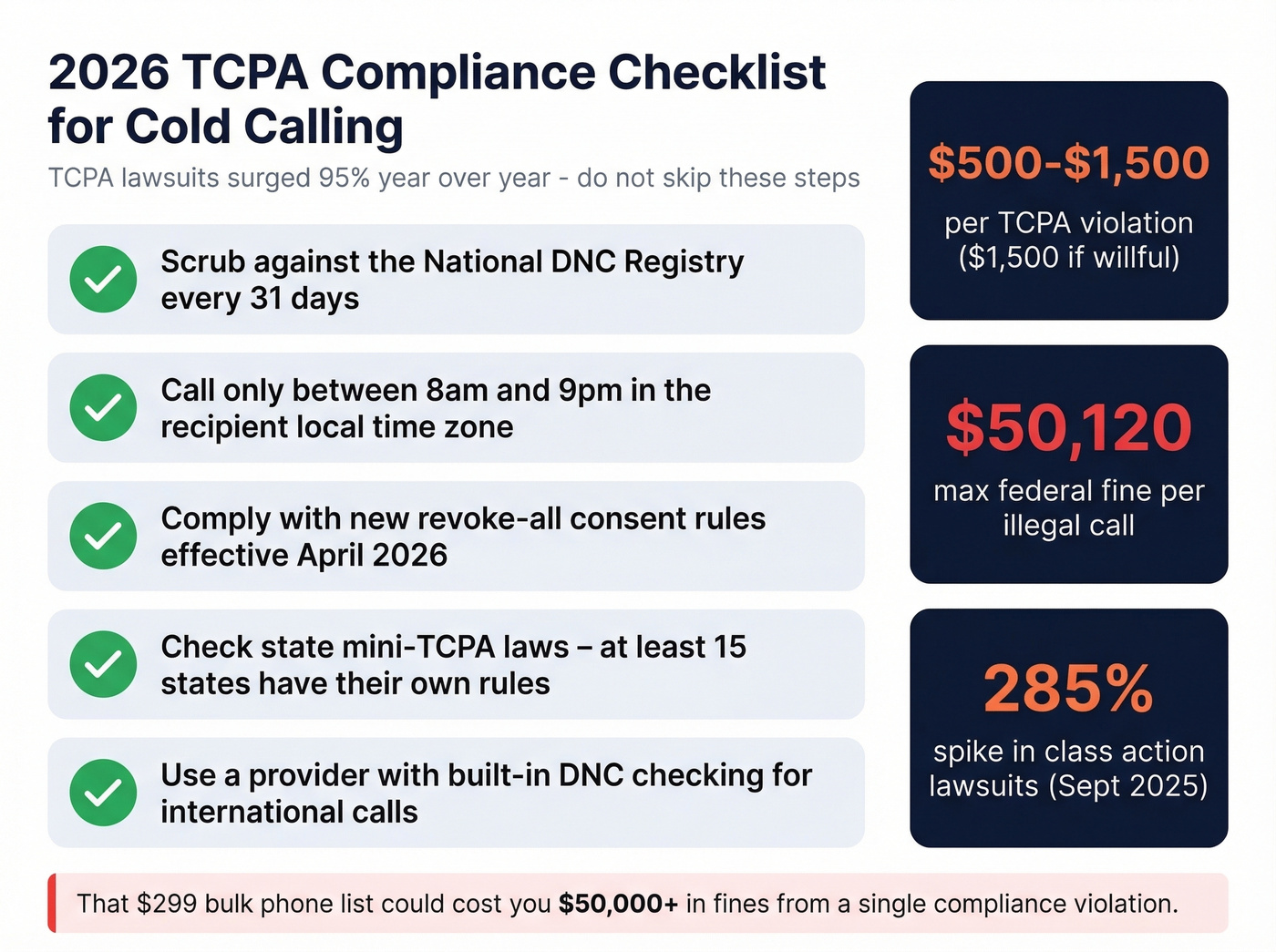
Your minimum checklist:
- Scrub against the National DNC Registry every 31 days. Federal fines run up to $50,120 per illegal call.
- Respect calling windows: 8 a.m. to 9 p.m. in the recipient's local time zone.
- TCPA penalties are $500 per violation, up to $1,500 if willful.
- Watch state laws. At least 15 jurisdictions enforce mini-TCPA statutes. Texas SB 140, in effect since September 2025, expanded "telephone solicitation" to include texts and images with treble damages.
- "Revoke all" consent rules take effect April 2026 under updated FCC guidelines.
Tools like Cognism include DNC checking across multiple countries as standard. If you're dialing internationally, bake compliance into your data provider choice - not as an afterthought.
A $0.01 number that connects beats a $1 number that doesn't. Prospeo gives you 30+ filters - including Bombora-powered buyer intent - so your reps dial prospects who are actually in-market. No contracts, no $25K platform fees.
Dial fewer numbers. Book more meetings. Try it free today.
FAQ
What's the difference between a direct dial and a mobile number?
A direct dial rings a specific desk phone at an office - useful only when the person is physically there. A mobile number reaches them anywhere, bypassing switchboards and empty offices entirely. Always prioritize mobile over desk for 2-3x higher connect rates.
How often does B2B phone data go stale?
About 2.1% per month, or 22.5% annually. If your provider refreshes less often than monthly, expect a growing pile of dead numbers. The industry average refresh cycle is around 6 weeks; the best providers refresh weekly.
Is cold calling still legal in 2026?
Yes, but you must scrub DNC lists every 31 days, respect 8 a.m.-9 p.m. local calling windows, and comply with new "revoke all" consent rules effective April 2026. Violations cost $500-$1,500 each.
Can I buy a cheap phone number list?
You can, but bulk lists are often years old and DNC-contaminated. That $299 list could cost you $50,000+ in fines from a single compliance violation. Invest in a verified data platform with real-time lookups instead.
How many phone numbers do I actually need?
Fewer than you think. The consensus on r/sales is pretty clear: 50 verified mobile numbers with intent signals outperform 5,000 unverified records every time. Focus on data quality and connect rates, not list size.