

LeadsForge vs Snappy Leads: Which Budget Lead-Gen Tool Is Worth It?
Snappy Leads advertises unlimited usage for £10/month, and there's an early Reddit post calling it "10 bucks" for 200M+ contacts. Sounds too good to be true - and it probably is. Meanwhile, LeadsForge promises AI-powered prospecting with waterfall enrichment, and it works best inside the Salesforge ecosystem (though you can still export to CSV). If you're weighing these two tools against each other, both target budget-conscious outbound teams, and both come with tradeoffs that aren't obvious from their landing pages.
30-Second Verdict
- Pick LeadsForge if you're already in the Salesforge ecosystem and want AI-powered ICP search with credit rollover and at least some review history to lean on.
- Pick Snappy Leads if you're a solopreneur testing outbound on a shoestring budget and can tolerate unproven data quality from a platform with virtually no independent reviews.
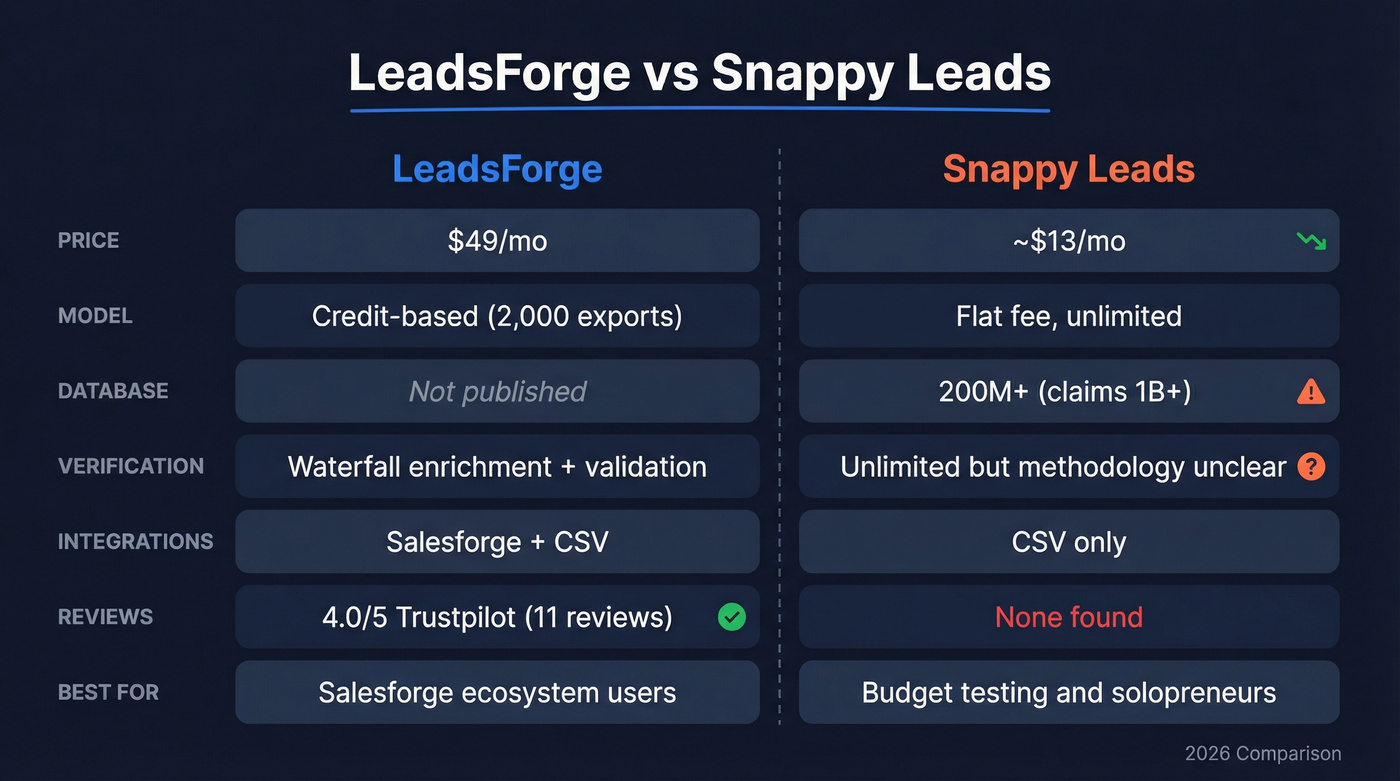
Side-by-Side Comparison
| Feature | LeadsForge | Snappy Leads |
|---|---|---|
| Price | $49/mo | £10/mo (~$13) |
| Pricing model | Credit-based | Flat fee, unlimited |
| Database size | Not published | 200M+ |
| Email verification | Multi-source enrichment + validation | "Unlimited" verification (details unclear) |
| Integrations | Salesforge only + CSV | CSV only |
| Free tier / trial | 100 free credits | 7-day free trial |
| Review score | 4.0/5 on Trustpilot (11 reviews) | None found |
| Best for | Salesforge users | Budget testing |
What Is LeadsForge?
LeadsForge is the lead-gen arm of the Salesforge ecosystem. Instead of a traditional filter dashboard, you describe your ICP in natural language through a chat interface, and the AI builds your lead list. It runs waterfall enrichment across multiple data providers until it finds a verified result - emails cost 1 credit each, phone numbers cost 10.

The $49/month tier includes 2,000 export credits, and unused credits roll over indefinitely. There's also a $588/year plan that includes 28,000 export credits with a 20% bonus granted upfront. You get 100 free credits on signup to test the waters.
One Trustpilot reviewer reported finding personal emails for almost 90% of discovered leads, and multiple reviewers praise the time savings - "saves us 10 hours of manual research a week." The AI-assisted filtering is genuinely clever, and we've seen it surface contacts that traditional filter-based tools miss because the natural language query captures nuance that rigid dropdowns can't.
Use it if you're running Salesforge for outreach and want a single-ecosystem workflow from prospecting to sequencing. The direct push into Salesforge sequences is the real differentiator.
Skip it if you need CRM integrations outside the Salesforge stack. Reviewers flag inconsistent export quality, weak coverage in Latin America, and - notably - difficulty canceling subscriptions. At roughly $0.025 per email and $0.245 per phone number, costs also add up fast on large lists.

LeadsForge charges $0.025/email with inconsistent quality. Snappy Leads won't even publish accuracy rates. Prospeo gives you 98% email accuracy at $0.01/email - with 5-step verification, catch-all handling, and spam-trap removal built in. No bounced-email roulette.
Stop gambling your domain reputation on unverified budget data.
What Is Snappy Leads?
Snappy Leads is a UK-based B2B contact database pitching itself as the cheapest option in the market - they explicitly call out Apollo and Hunter as pricier alternatives and offer a price match guarantee. For £10/month, you get unlimited email lookups, unlimited phone lookups, and unlimited email verification. The feature list includes an AI Head-Hunter for finding decision-makers, tech stack profiling, buyer intent signals, recently funded leads, AI email drafting, and even AI image generation for outbound personalization.
That's a lot of features for £10. Here's the thing: the homepage claims 1B+ contacts, but third-party directories consistently list the database at 200M+ profiles. That's a 5x discrepancy on database size, and it doesn't inspire confidence. There's no Trustpilot profile, no G2 listing, and the only independent Reddit mention we found reads semi-promotional.
Use it if you're testing outbound for the first time and need a dirt-cheap way to pull contact lists. The 7-day free trial costs nothing.
Skip it if you're sending at any real volume. No native integrations, no review history, and no published accuracy metrics make this a risky bet for anything beyond experimentation.
Data Quality and Accuracy
Neither tool publishes accuracy rates. That's a red flag for both.
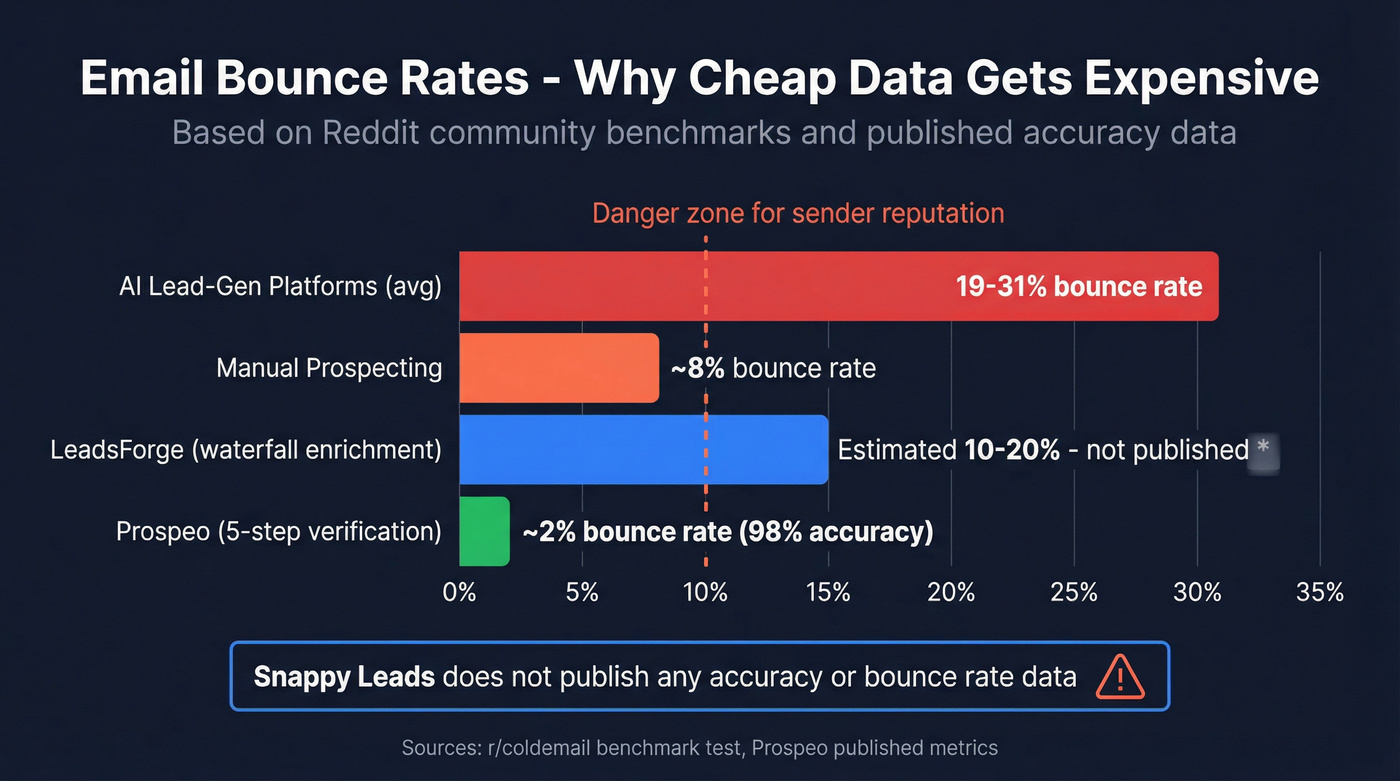
A Reddit benchmark test of AI lead-gen platforms found bounce rates between 19-31%, compared to roughly 8% from manual prospecting. LeadsForge's waterfall enrichment approach - checking multiple providers until one validates - should improve accuracy over single-source lookups. Trustpilot reviewers still report inconsistent export quality, though. Snappy Leads sells "unlimited email verification" but doesn't explain the methodology. We've seen this pattern enough times to call it: vague verification claims usually mean basic syntax checks, not real deliverability testing.
The pricing tradeoff looks interesting on paper. LeadsForge charges about $0.025 per email. Snappy Leads charges effectively $0 per lookup at £10/month flat. But the hidden cost of unverified data is domain reputation damage - if you're sending 1,000 cold emails and 25% bounce, your sender score tanks and every future campaign suffers.
Cheap leads that bounce aren't cheap. They're expensive in ways that don't show up on the invoice.
There's another shared weakness: neither tool offers native integrations with Salesforce, HubSpot, Instantly, or Lemlist. LeadsForge pushes leads into Salesforge. Snappy Leads gives you a CSV. If your outbound stack lives anywhere else, you're doing manual imports either way, which is a workflow bottleneck that gets old fast when you're running campaigns weekly.
Verdict - Which Should You Pick?
Comparing these two is like comparing budget airlines. The ticket price looks great until you factor in baggage fees, delays, and the chance your flight gets canceled.
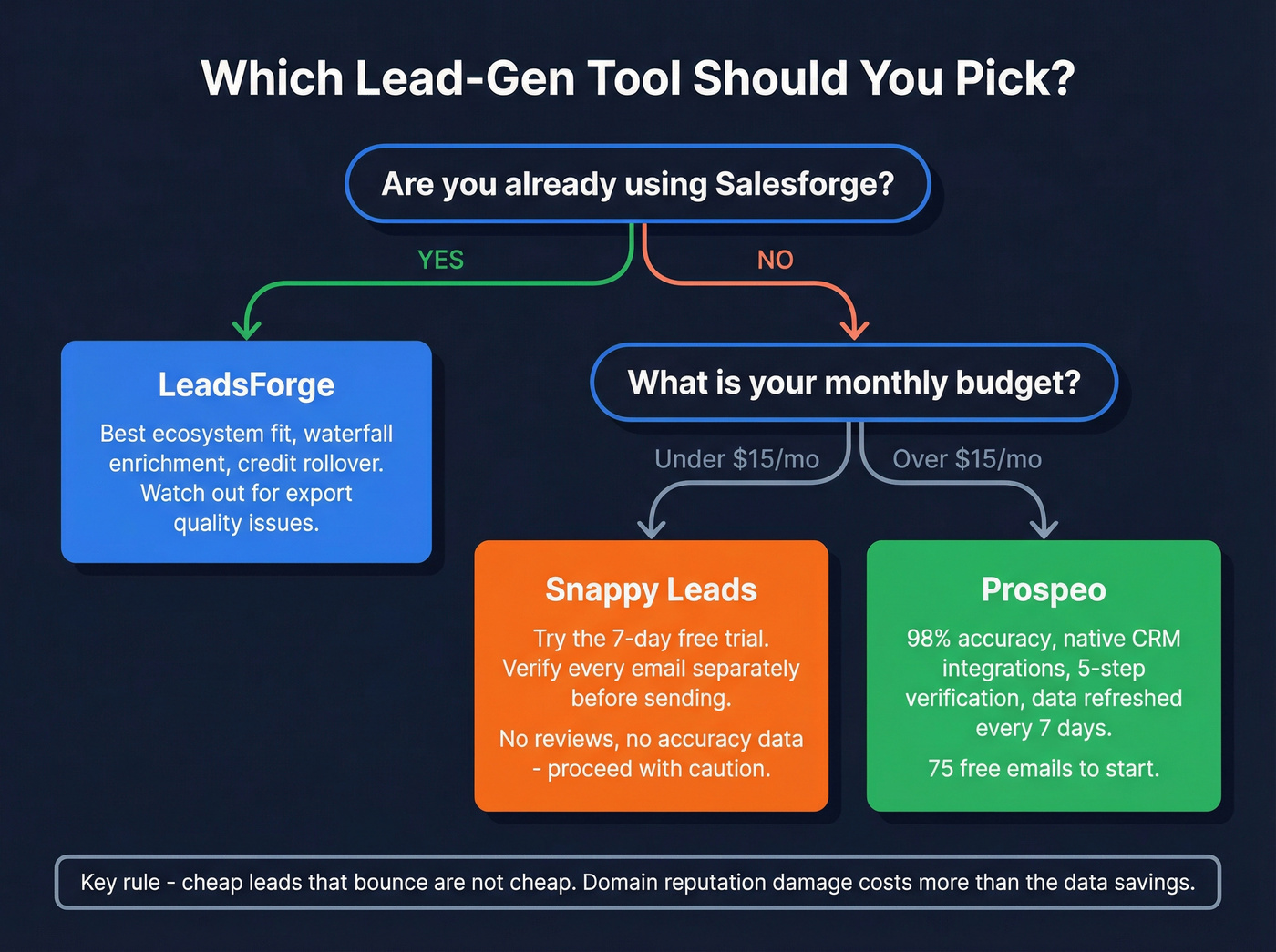
Salesforge users - LeadsForge makes sense. The ecosystem integration is its strongest card, the waterfall enrichment beats basic lookup tools, and credit rollover means you're not wasting money on unused capacity.
Budget solopreneurs testing outbound - try Snappy Leads' 7-day free trial, but run every single email through a separate email verification tool before you send. Unlimited unverified data at face value is a domain reputation trap.
Neither LeadsForge nor Snappy Leads integrates with Salesforce, HubSpot, Instantly, or Lemlist. Prospeo connects natively to all of them - plus Clay, Zapier, Make, and more. 300M+ profiles, 30+ search filters, and data refreshed every 7 days instead of the 6-week industry average.
75 free emails per month. No contract. See what real data quality feels like.
FAQ
Is Snappy Leads' database really 1 billion contacts?
Third-party directories list it at 200M+ profiles, not the 1B+ claimed on the homepage. That 5x gap suggests marketing inflation. Always verify leads through a dedicated tool before sending.
Can I use LeadsForge without Salesforge?
Yes - CSV export works standalone. But you lose the native Salesforge integration that justifies choosing LeadsForge over other prospecting tools, leaving you with a $49/month credit-based database and no CRM connectivity.
What's the most accurate B2B email finder in 2026?
Prospeo delivers 98% email accuracy across 143M+ verified emails using a proprietary 5-step verification process that handles catch-all domains and removes spam traps. Data refreshes every 7 days versus the 6-week industry average, so contacts stay current rather than decaying between updates.
Are there better alternatives to both tools?
For teams spending over $50/month on lead data, there are stronger options with native CRM integrations, real-time verification, and accuracy rates that won't torch your sender reputation. The consensus on r/coldemail is that paying a bit more for verified data saves you from the far more expensive problem of rebuilding a burned domain.