

Leaky Sales Funnel: How to Find & Fix Every Leak in 2026
Marketing says 2,000 MQLs. Sales says 400 are worth calling. Finance asks why pipeline is flat when ad spend is up 30%. Everyone points fingers at a different stage, and the default fix is always the same: more budget at the top.
Your funnel isn't broken at the top. It's broken in the middle - and probably at the bottom too. A leaky sales funnel bleeds revenue in the places nobody watches: the handoff between marketing and sales, the onboarding step where users silently quit, the stale CRM data that sends reps chasing disconnected numbers. 80% of new leads never convert into sales. The question isn't whether your funnel leaks - it's where, and how badly.
Before You Read Another Word
Do three things:
- Pull your stage-by-stage conversion rates right now. If you can't, you have a measurement problem, not a funnel problem.
- Compare each stage against benchmarks (provided below). The biggest gap is your biggest leak.
- Fix downstream first - activation, handoff, data quality - not upstream. More ads won't save a broken backend.
What Is a Leaky Sales Funnel?
Think of your sales funnel as plumbing. Prospects flow in at the top, and revenue comes out the bottom. A funnel that leaks means you're losing disproportionate volume between stages - awareness to MQL, MQL to SQL, SQL to opportunity, opportunity to closed-won, and beyond.
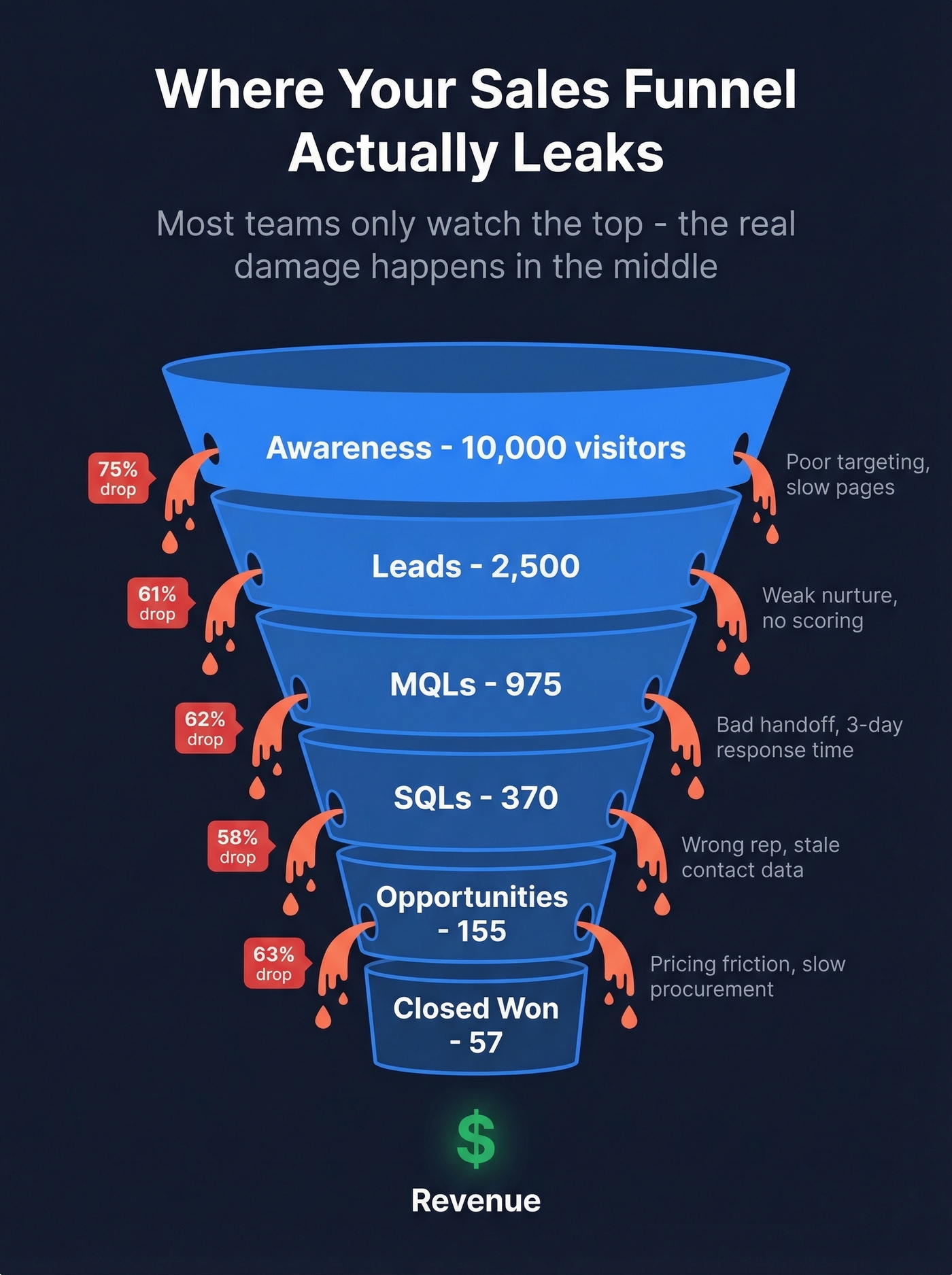
"Leaky" doesn't mean zero conversion. It means drop-offs between stages that exceed normal benchmarks. Every funnel loses people. A broken one loses them faster than it should, usually in places you're not watching.
What Causes Funnel Leakage
Scaling ads before fixing the backend
This is the most expensive mistake in B2B and ecommerce alike. A practitioner on r/business shared that after fixing checkout flow, lifecycle messaging, and minor UX issues, their ROAS jumped - without changing a single ad campaign. Pouring more traffic into a broken funnel just makes the leaks bigger.
Obsessing over landing pages while ignoring activation
A SaaS founder on r/SaaSMarketing A/B tested landing page elements for weeks and moved conversion by 0.3%. Then they watched five session recordings and discovered users were dropping at step 2 of onboarding. Their free-to-paid sat at 2% against an industry median of 5-8%. Five recordings told them more than six weeks of dashboards.
The landing page wasn't the leak. The product experience was.
Using last-touch attribution
When 60% of consumers take 6+ actions before deciding to buy from a new brand, last-touch attribution is lying to you. It credits the final click and hides every leak that happened before it. You end up optimizing the wrong stage because your data says the wrong stage matters.
Multi-touch attribution isn't optional anymore - it's the only way to see where the funnel actually breaks. If you're running paid campaigns, pair multi-touch with server-side tracking (Conversion APIs) so you don't lose signal to browser privacy changes.
How to Find Your Funnel Gaps
The diagnostic process is straightforward: map conversion percentages between each stage, then find the biggest drop-off.
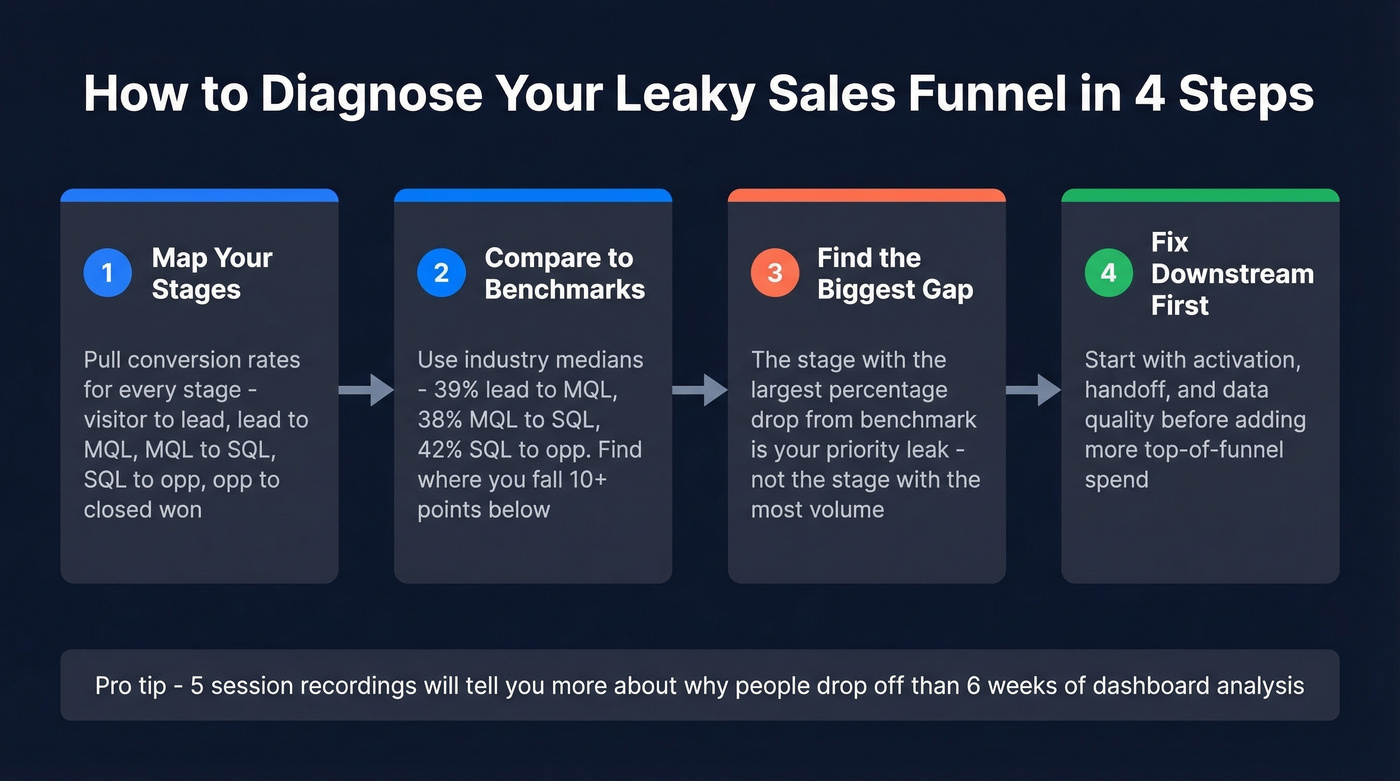
Start with 10,000 visitors. Say 25% convert to leads (2,500). Of those, 5% become customers (125). That's a 1.25% end-to-end conversion rate. Not terrible - but where's the biggest leak? If your visitor-to-lead rate is 25% but your lead-to-MQL rate is 12%, that mid-funnel gap is where your revenue is dying. The biggest percentage drop between any two stages is your priority.
Top-of-Funnel: Visitor to Lead
This is where most teams focus, and it's usually not the worst leak. The median landing page conversion rate across industries is 6.6%. If you're below that, check traffic quality - are you attracting the right people? - CTA clarity, and page speed.
Mid-Funnel: MQL to SQL to Opportunity
Here's the overlooked zone - the selling dead zone where deals stall and pipeline quietly dies. In our experience, it's where the most revenue gets left on the table.
Lead qualification is broken in 70% of SaaS companies, and handoff timing kills 40% of potential deals. The speed-to-lead problem is real: the average lead gets cold-called 3 days after downloading a resource. By then, they've forgotten you exist or they've already talked to a competitor.
Don't overlook the less visible mid-funnel leaks either. Users who sign up but never complete setup, users who try once and never return, and failed payments that silently block renewals - as one B2B marketer on Reddit noted, these "invisible" leaks often dwarf the ones you're tracking in your dashboard. This kind of dropout is the hardest to detect because it happens between the metrics you're actively monitoring.
Bottom-of-Funnel: Opportunity to Closed Won
Cart abandonment averages 70% across industries. Seven out of ten people who start checkout don't finish. In B2B, the equivalent is proposal-to-close, where pricing friction, unclear value differentiation, and slow procurement processes kill deals that were nearly won.
Post-Sale: The Leak Nobody Budgets For
Most funnel guides stop at "closed won." That's a mistake.
Returning customers spend 67% more than new ones. Every customer you lose post-sale costs you more than a prospect you never converted. Onboarding drop-off, poor feature adoption, and involuntary churn from failed payments are all leaks - they just happen after the sale.

Stale CRM data is a mid-funnel leak that silently kills pipeline. Reps chase disconnected numbers and bounce off bad emails while deals go cold. Prospeo refreshes every record on a 7-day cycle - not the 6-week industry average - so your team always dials live numbers and lands in real inboxes. 98% email accuracy. 30% mobile pickup rate. Zero wasted outreach.
Stop bleeding deals to bad data. Fix the leak in 60 seconds.
Benchmark Table
Here are B2B SaaS stage benchmarks from First Page Sage's conversion report, based on anonymized client data across 2017-2025:
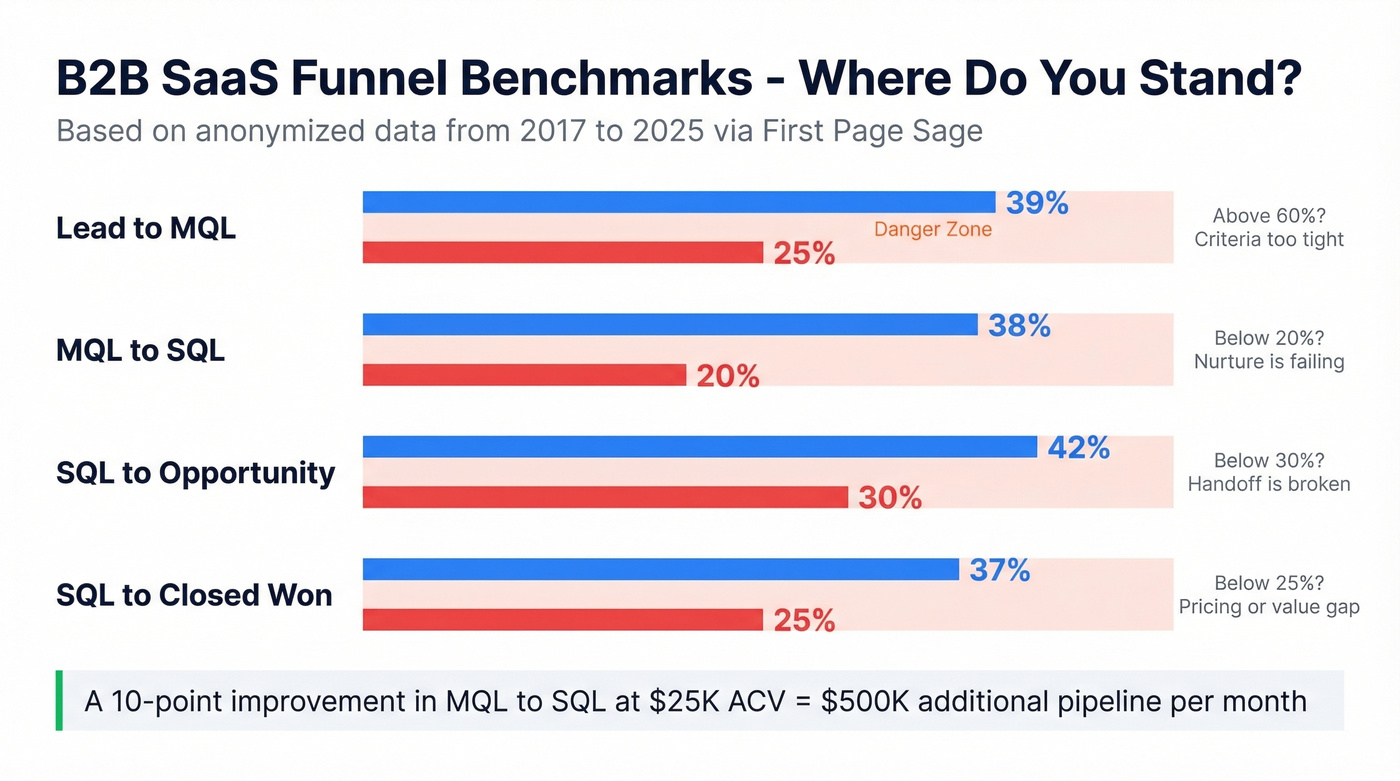
| Stage | Benchmark | Red Flag |
|---|---|---|
| Lead to MQL | 39% | Below 25% |
| MQL to SQL | 38% | Below 20% |
| SQL to Opportunity | 42% | Below 30% |
| SQL to Closed Won | 37% | Below 25% |
If your stage conversion is 10+ points below benchmark, that stage is leaking. Don't try to fix everything at once - find the single biggest gap and attack it first.
A few heuristics for the MQL-to-SQL stage specifically: if your conversion rate is above 60%, your qualification criteria are probably too restrictive and you're filtering out good leads. Below 20%, qualification is too loose or your nurture is failing. Either scenario creates bottlenecks that choke your pipeline.
Let's make the revenue math concrete. If you generate 1,000 MQLs per month at a $25K ACV, a 10-point improvement in MQL-to-SQL conversion - say from 28% to 38% - means 100 additional SQLs per month. Even at a modest 20% close rate, that's 20 more deals and $500K in additional pipeline. Every month. The mid-funnel isn't glamorous, but it's where the money is.
How to Set Up Funnel Analysis in GA4
Go to Explore > Funnel Exploration in GA4. The interface breaks into three panels: Variables, Tab Settings, and Output. Map your funnel steps using standard events like generate_lead, sign_up, begin_checkout, and purchase - or define custom events that match your specific stages.
One critical gotcha: GA4's Funnel Exploration is user-based. You can't use session count or event count as your main funnel metric. This trips up teams who are used to Universal Analytics. You're tracking unique users through steps, not sessions.
Choose between open funnels, where users can enter at any step, and closed funnels, where users must start at step 1. For leak diagnosis, closed funnels give you cleaner drop-off data. Use segment comparisons to split by device, traffic source, or user type, and turn on "show elapsed time" to see how long users take between steps. If step 2 to step 3 takes 9 days on average, that's a nurture problem.
Real talk: GA4 will show you where people drop off. It won't tell you why. For that, pair it with session recordings from Hotjar or FullStory. Five recordings of real users struggling will teach you more than a month of funnel charts.
How to Fix Each Leak
Top-of-Funnel Fixes
Small changes compound. "Going" A/B tested CTA copy - swapping "Sign up for free" for "Trial for free" - and saw a 104% increase in premium trial starts. That's not a redesign. That's two words.
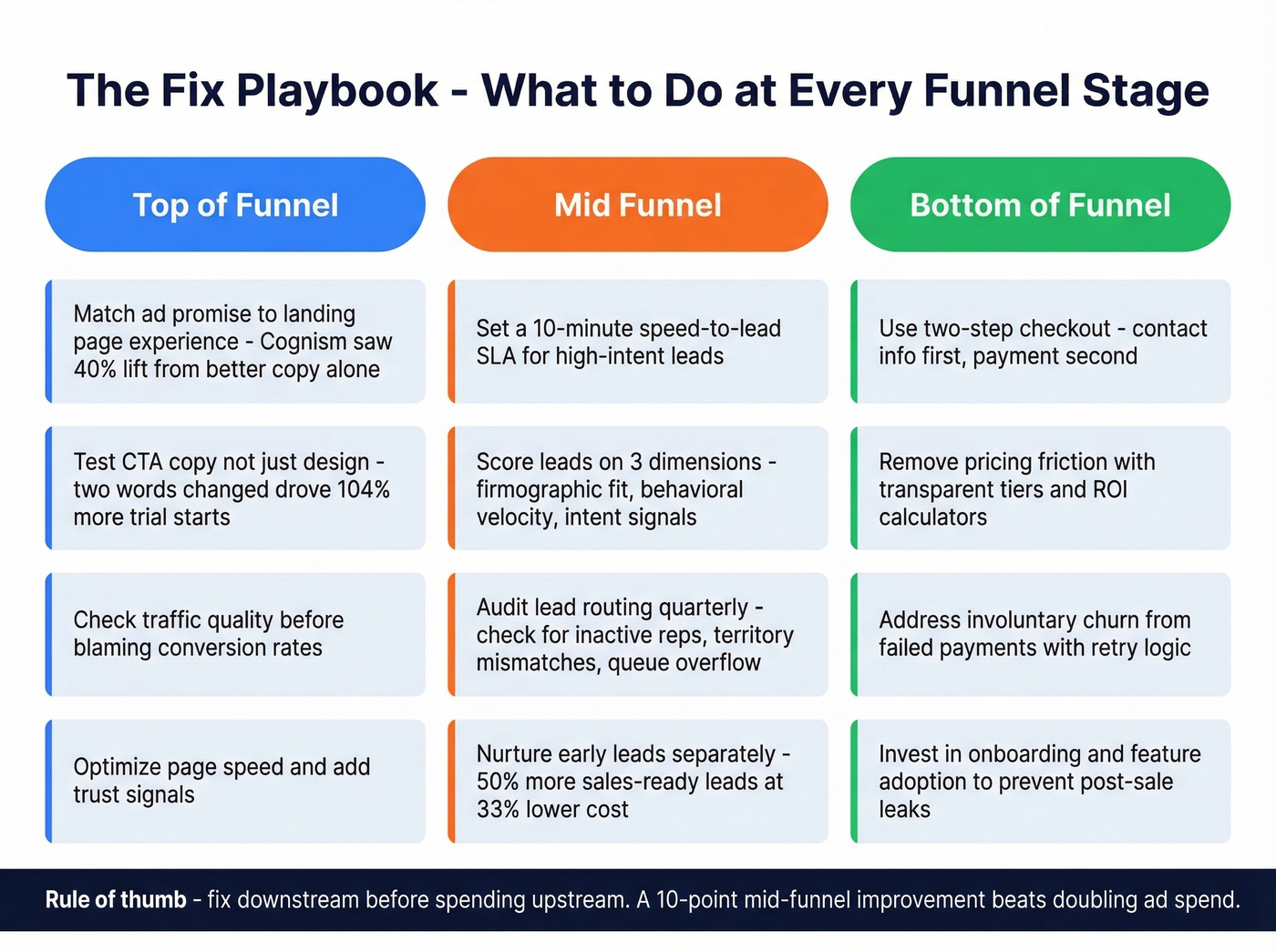
Page speed and trust signals matter, but the highest-leverage fix is alignment between ad promise and landing page experience. Cognism ran an experiment where they incorporated sales team feedback into their demo page messaging. Conversion improved 40% in two weeks - no design changes, just better words.
Mid-Funnel Fixes
Speed-to-lead needs a bi-directional SLA. Marketing commits to delivering leads that meet an intent score threshold. Sales commits to contacting high-intent leads within 10 minutes - not 3 days. This single operational change moves more pipeline than any nurture sequence.
Layer your lead scoring across three dimensions: firmographic fit like company size, industry, and tech stack; behavioral velocity, meaning how fast they're engaging; and third-party intent signals that reveal whether they're researching your category. A VP at a perfect-fit company who downloaded one whitepaper six months ago isn't the same as a manager at a decent-fit company who visited pricing three times this week. One dimension of scoring isn't enough.
Lead routing is another silent killer. We've audited funnels where round-robin rules were sending leads to reps on vacation, routing enterprise accounts to SMB reps, or letting leads sit in queues for days because no one owned the exception handling. Audit your routing rules quarterly. Check for inactive users in the rotation, territory mismatches, and queue overflow logic. A lead that reaches the wrong rep - or no rep - is functionally the same as a lead that never existed.
Nurture sequences for leads that aren't ready yet generate 50% more sales-ready leads at 33% lower cost. The key word is "not ready yet" - these aren't dead leads, they're early leads. Treat them accordingly.
Bottom-of-Funnel Fixes
Two-step checkout flows improve conversion by 20-40% compared to single-page checkout. Split the process: contact info first, payment second. It reduces cognitive load and creates a micro-commitment.
For cart recovery, timing matters more than creativity. Send the first email at 1 hour as a simple reminder, a second at 2 hours with social proof, a third at 24 hours with an incentive, and a final at 48 hours with urgency. This four-email sequence recovers revenue that's already 70% lost.
One warning from Rappi's experience: they optimized a local checkout metric and improved it by 5%, but total orders dropped 5% because the change disrupted the broader flow. Always measure global outcomes alongside local experiments. Fixing one stage shouldn't break another.
Post-Sale Fixes
8x8's Jitsi team used funnel analysis to discover that Chrome extension users converted at higher rates. After promoting extension features during onboarding, Day 7 retention doubled. MINDBODY found that users who engaged with their Activity Dashboard booked 24% more classes per week - so they added a "Book It Again" button that increased conversions 4.5x.
The lesson: post-sale leaks are product leaks. Find the behavior that correlates with retention, then engineer more of it into the onboarding flow. And don't forget failed payment recovery - involuntary churn is the most fixable leak in your entire funnel.
The Hidden Leak: Bad Contact Data
Your SDR just spent 45 minutes on a call block. Reached 3 people out of 40 dials. Half the numbers were disconnected. The emails they sent yesterday? 12% bounced. Their domain reputation is quietly tanking, which means even the good emails are landing in spam.
This is the funnel leakage nobody talks about. It doesn't show up in GA4. It doesn't appear in your stage-by-stage conversion chart. But it's real, and it's expensive.
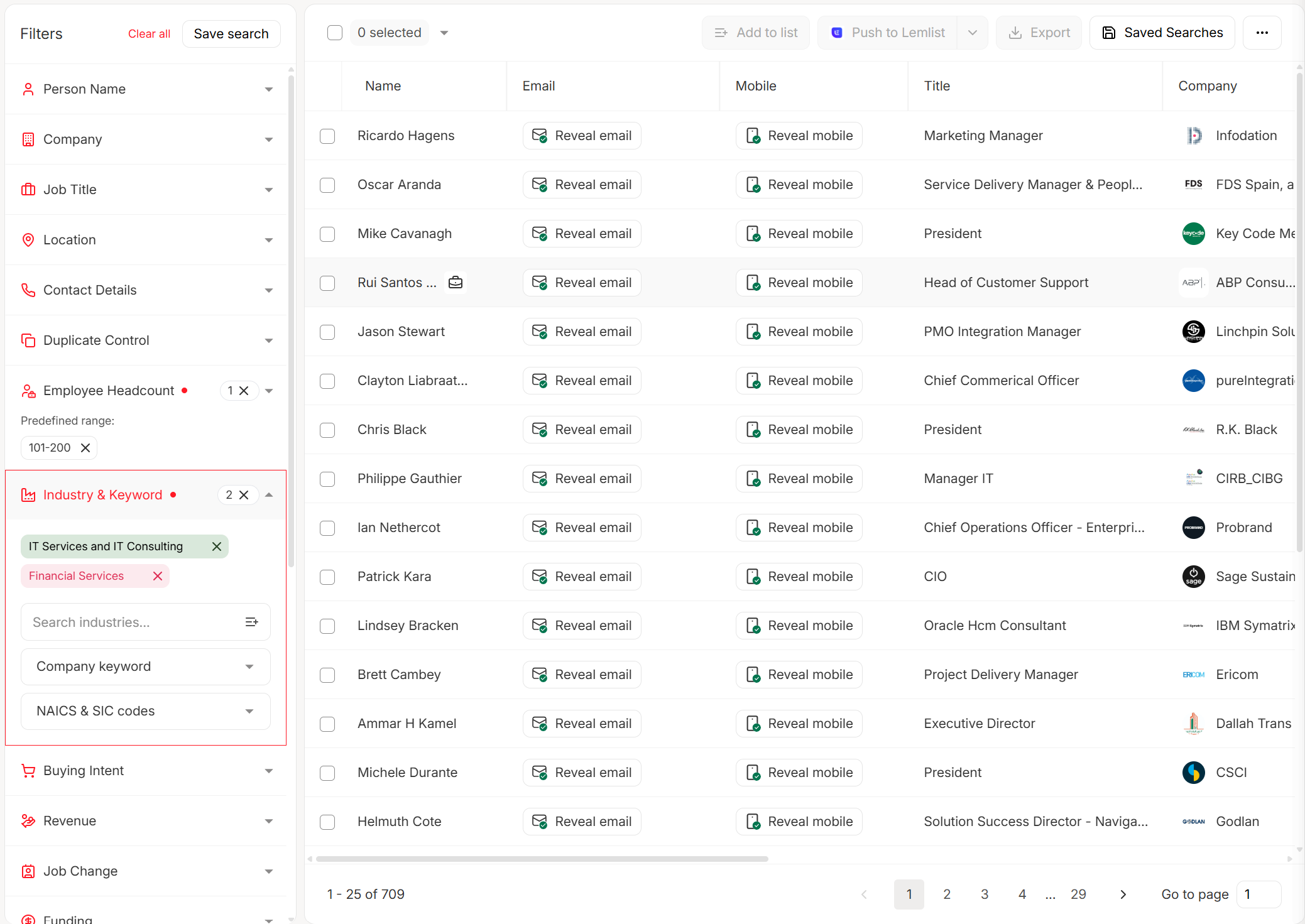
When Snyk's 50-person AE team was running bounce rates of 35-40%, they started using Prospeo and dropped that to under 5%. AE-sourced pipeline jumped 180%, generating 200+ new opportunities per month. That's not a top-of-funnel fix or a messaging tweak - it's clean, verified contact data on a 7-day refresh cycle doing what clean data does.
Here's the thing: if your average deal size is above $5K and your bounce rate exceeds 10%, bad data is costing you more pipeline than your worst-performing ad campaign. Most teams would get more ROI from fixing their contact data than from any other single funnel optimization. It's just less exciting than a new landing page.
Your MQL-to-SQL conversion tanks when lead data is incomplete or wrong. Prospeo enriches every CRM record with 50+ data points at a 92% match rate - verified emails, direct dials, intent signals, technographics - so sales qualifies faster and nothing slips through the cracks. At $0.01 per email, fixing this leak costs less than one lost deal.
Enrich your pipeline and close the gap between MQL and revenue.
The Funnel Audit Checklist
Run through this quarterly. Print it, pin it, share it with your RevOps team. Treating funnel problems as a recurring audit - not a one-time project - is the difference between teams that compound growth and teams that keep patching holes.
- Stage-by-stage conversion rates documented and compared to benchmarks
- Biggest conversion gap identified and assigned an owner
- Speed-to-lead measured in minutes, not days - SLA in place
- MQL and SQL definitions written down and shared between sales and marketing
- CRM contact data refreshed within the last 30 days
- Lead routing rules audited for inactive reps, territory mismatches, and queue overflow
- Nurture sequences active for leads that aren't sales-ready yet
- Attribution model reviewed - not relying on last-touch only
- Session recordings reviewed monthly for UX-driven leaks
- Post-sale onboarding drop-off tracked and addressed
- Quarterly audit cadence set on the calendar with a recurring invite
If you can check all eleven, your funnel isn't perfect - but it's being managed. That's what turns a leaky sales funnel into a system that actually compounds.
FAQ
How do I know if my sales funnel is leaking?
Pull your stage-by-stage conversion rates and compare them to benchmarks. For B2B SaaS, First Page Sage data shows Lead-to-MQL at 39%, MQL-to-SQL at 38%, SQL-to-Opportunity at 42%, and SQL-to-Closed-Won at 37%. If any stage runs 10+ points below these numbers, that's your leak - focus there first.
How often should I audit my funnel?
Quarterly at minimum, with GA4 Funnel Exploration running continuously to catch sudden drop-offs. Review session recordings monthly to diagnose UX-driven leaks that analytics alone won't explain. The combination of quantitative dashboards and qualitative recordings gives you both the "where" and the "why."
Can bad CRM data cause funnel leakage?
Absolutely. Stale emails bounce, dead phone numbers waste SDR time, and outdated firmographics misroute leads to the wrong reps. This invisible leak doesn't appear in most analytics dashboards. A 7-day data refresh cycle and 98% email accuracy - the kind of specs you'd get from a platform like Prospeo - can drop bounce rates from 35-40% to under 5%.
What's the fastest way to stop mid-funnel leaks?
Implement a speed-to-lead SLA requiring sales to contact high-intent leads within 10 minutes. The average B2B lead waits 3 days for a callback - by then, competitors have already engaged them. Pair this with multi-dimensional lead scoring across firmographic fit, behavioral velocity, and intent signals to ensure reps prioritize the right prospects.