


Mailgun Review 2026: Pricing, Pros, Cons, and the Numbers Nobody Shows You
Mailgun's inbox placement rate dropped 27.75% in a single year. GlockApps tracked it falling from 53.8% to 26.05% between Q1 2024 and Q1 2025 - the biggest decline listed in their most recent published table. That's not a blip. That's the number that should frame everything else you read about Mailgun in this breakdown.
30-Second Verdict
Use Mailgun if you need raw API flexibility and you're prepared to manage sender reputation yourself.
Skip it if deliverability matters more than API elegance - Postmark leads here. If budget predictability matters most, Amazon SES at ~$0.10/1k emails is hard to beat.
Either way, verify your list before it hits any ESP. Bounced emails inflate your bill and wreck sender reputation regardless of which platform you pick.
What Is Mailgun?
Mailgun is a developer-focused transactional email platform built around a RESTful API and SMTP relay. Rackspace acquired it in 2012, Thoma Bravo picked it up in 2019, and Sinch bought it for around $2B in 2021 - which is when pricing started climbing. It now powers 150,000+ companies, though many of them are paying more than they signed up for.
Mailgun Pricing Breakdown
Plan Tiers
| Plan | Price/mo | Emails Included | Overage per 1,000 |
|---|---|---|---|
| Free | $0 | 100/day | N/A |
| Basic | $15 | 10k | from $1.80 |
| Foundation | $35 | 50k | from $1.30 |
| Scale | $90 | 100k | from $1.10 |
Dedicated IPs run $59/IP/month on top.
Mailgun also sells Optimize plans separately - $49/mo (Pilot) and $99/mo (Starter) - for inbox placement testing, monitoring, and validations.

What You'll Actually Pay
Here's the scenario nobody walks you through: a developer signs up for the Foundation plan at $35/month. Six months later they're sending 200k emails monthly. The bill? $35 base + 150k overage at $1.30/1k = $230/month. That's 6.5x the sticker price.
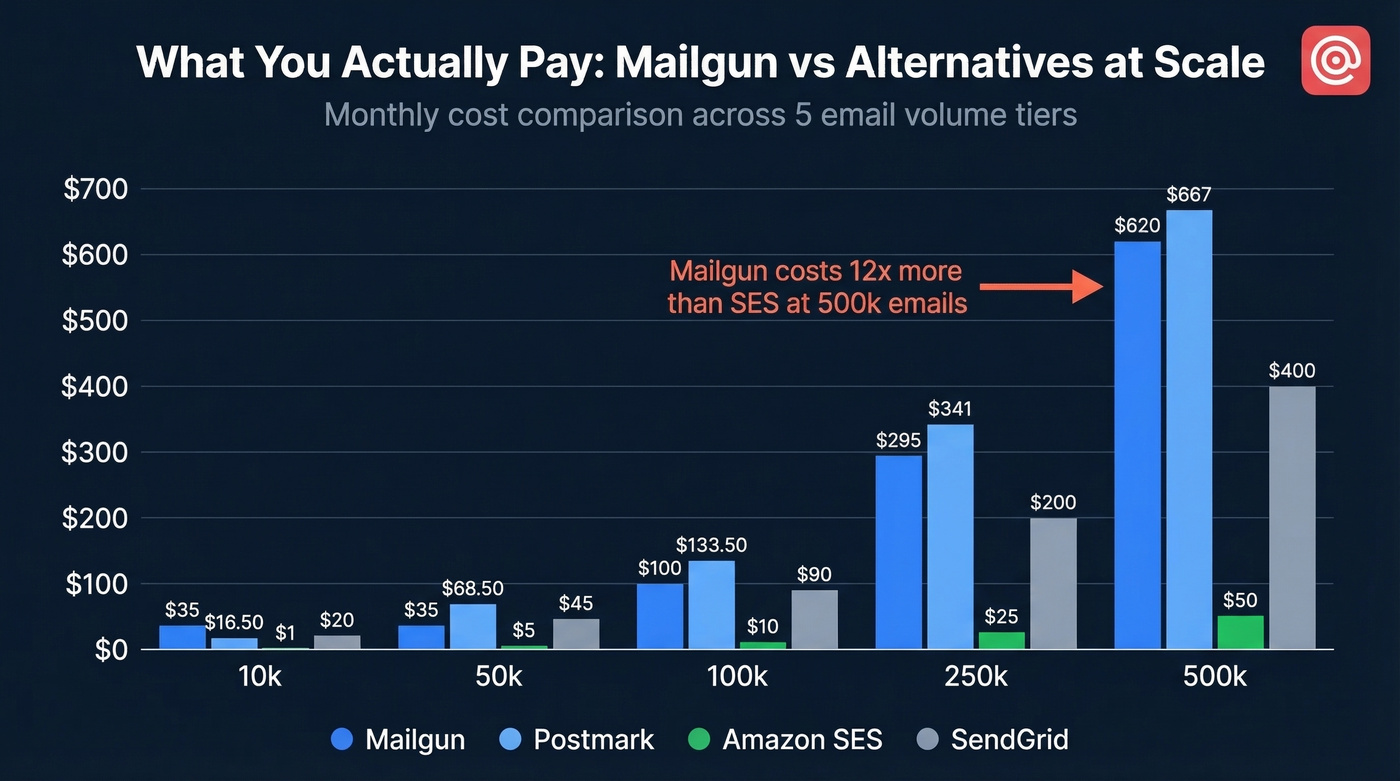
We ran the overage math at every tier. The gap between what Mailgun advertises and what you actually pay is the single biggest gotcha in their billing model.
| Monthly Volume | Mailgun (Foundation + overages) | Postmark (Pro) | Amazon SES | SendGrid (est.) |
|---|---|---|---|---|
| 10k | $35 | $16.50 | ~$1 | ~$20 |
| 50k | $35 | $68.50 | ~$5 | ~$45 |
| 100k | $100 | $133.50 | ~$10 | ~$90 |
| 250k | $295 | $341 | ~$25 | ~$200 |
| 500k | $620 | $667 | ~$50 | ~$400 |
Mailgun looks competitive at 50k. By 500k, you're paying over 12x what Amazon SES charges.
Pros: What Users Like
Mailgun earns a 4.2/5 on G2 (322 reviews) and a 4.3/5 on Capterra (196 reviews). Worth noting: 9% of G2 reviews are 1-star, which is unusually high for a 4.2-rated product. The praise clusters around a few themes:
- Ease of Use - 23 G2 reviewers call this out specifically
- Reliability (18 mentions) - uptime is solid for transactional flows
- API Quality (11 mentions) - RESTful design, clean webhooks, real-time event logs
The API really is well-designed. If you're a developer who values clean documentation and predictable endpoints, Mailgun's DX is genuinely best-in-class. That reputation is earned.

Mailgun's overage billing punishes you for sending to bad addresses. Prospeo's 5-step email verification delivers 98% accuracy - so every email you send hits a real inbox. At $0.01 per verified email, cleaning your list costs less than a single Mailgun overage spike.
Stop paying overage fees on emails that bounce. Verify before you send.
Cons: What Users Dislike
Overage and Billing Risk
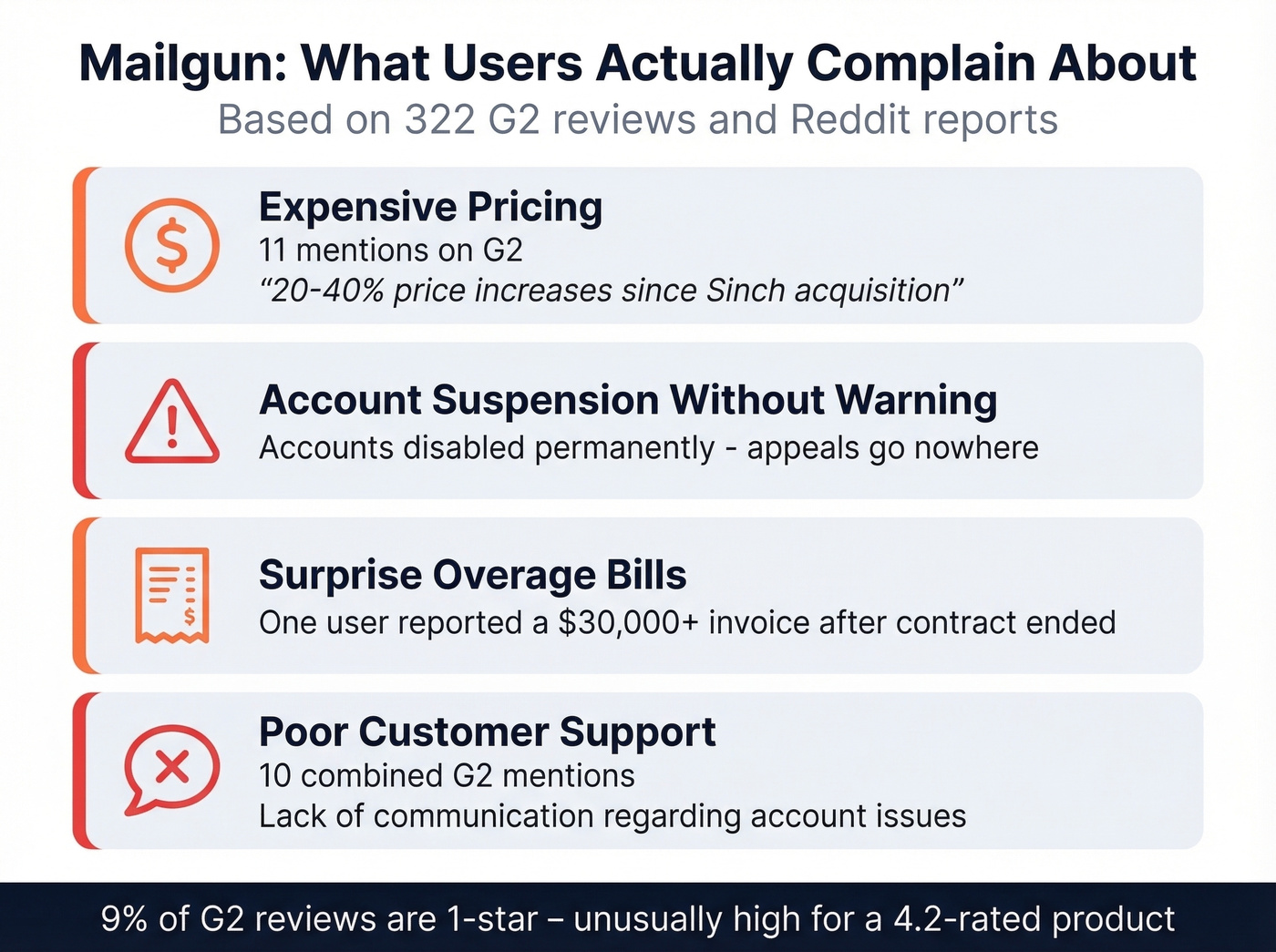
Here's the thing: Mailgun's overage model can produce genuinely shocking bills. One Reddit user described 10,000,000 validations hitting their account on Christmas 2024, then 6,000,000 more in early 2025, causing major overage fees. They said it wasn't triggered by their own systems. After ending their contract in June 2025, they reported receiving an invoice over $30,000 in July 2025.
The validation math gets ugly too. At Foundation's validations pricing from $1.20 per 100, running 100k validations costs $1,200 - on top of your sending bill.
"Expensive" is the #1 complaint on G2 with 11 separate mentions, and users report 20-40% price increases since the Sinch acquisition.
Account Suspension Risk
Let's be honest: Mailgun's biggest risk isn't pricing. It's getting your account disabled without warning while your transactional emails stop flowing. A developer on Reddit described sending 95 emails successfully, then later sending 112 emails and getting flagged for a 100 emails/hour rate limit they didn't know existed. Mailgun permanently disabled their account. Appeals went nowhere.
This aligns with G2's support and communication complaints - 10 combined mentions across "poor customer support" and "lack of communication regarding account issues." For a service handling your password resets and order confirmations, that's a serious operational risk.
Deliverability Benchmarks
Three independent benchmarks paint a consistent picture:
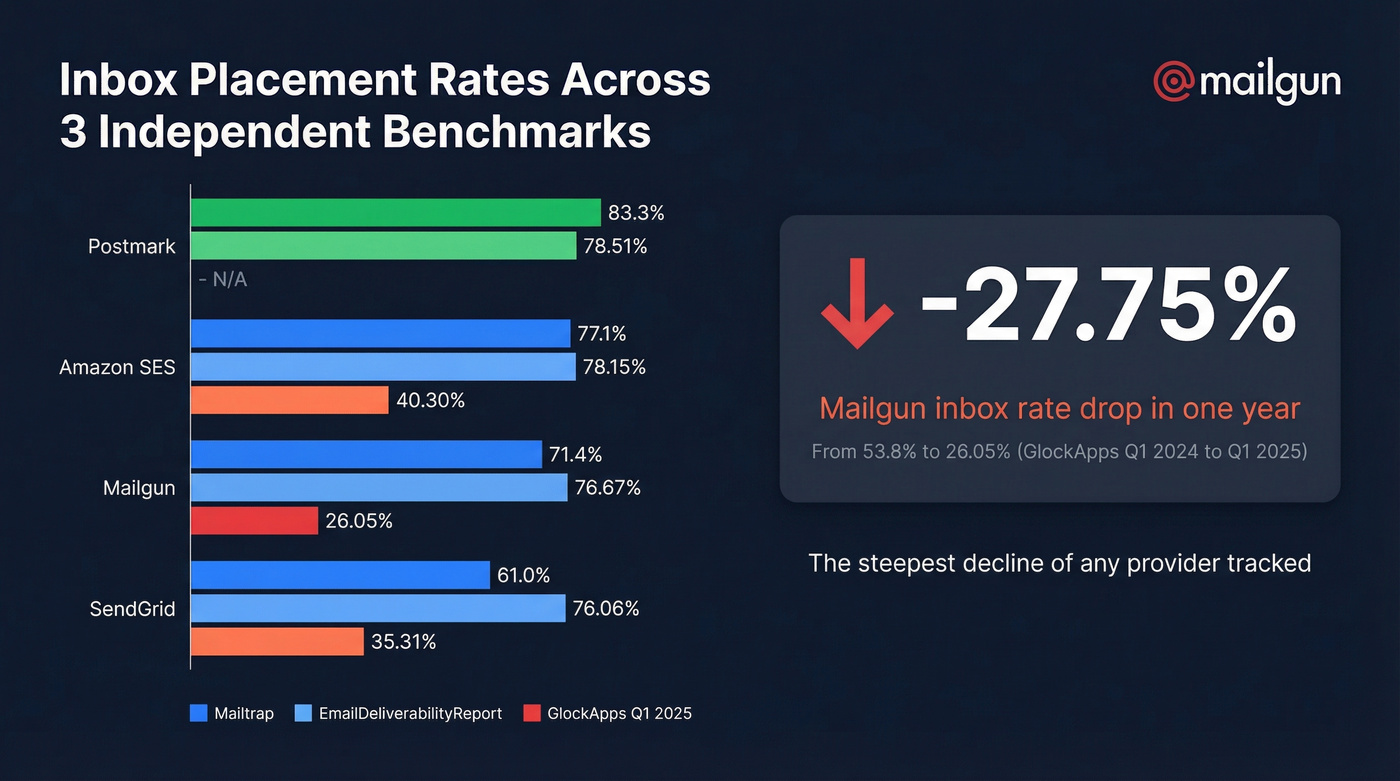
| Provider | Mailtrap Inbox % | EmailDeliverabilityReport Inbox % | GlockApps Q1 2025 Inbox % |
|---|---|---|---|
| Postmark | 83.3% | 78.51% | - |
| Amazon SES | 77.1% | 78.15% | 40.30% |
| Mailgun | 71.4% | 76.67% | 26.05% |
| SendGrid | 61.0% | 76.06% | 35.31% |

The Mailtrap benchmark tested free-tier accounts on shared IPs with identical templates. The EmailDeliverabilityReport dataset across 64,615 emails showed Mailgun at 76.67% inbox and 21.33% spam.
But the GlockApps data is the real alarm. A 27.75-point year-over-year drop isn't just noise. Microsoft's May 2025 bulk-sender DMARC requirement is making deliverability harder across all ESPs, but Mailgun's decline is steeper than any competitor in the same dataset. We've seen teams tolerate mediocre deliverability for great API design, but a trend line this sharp changes the calculus entirely - especially when cheaper alternatives are outperforming on inbox placement at the same time.
Alternatives Worth Considering
Postmark
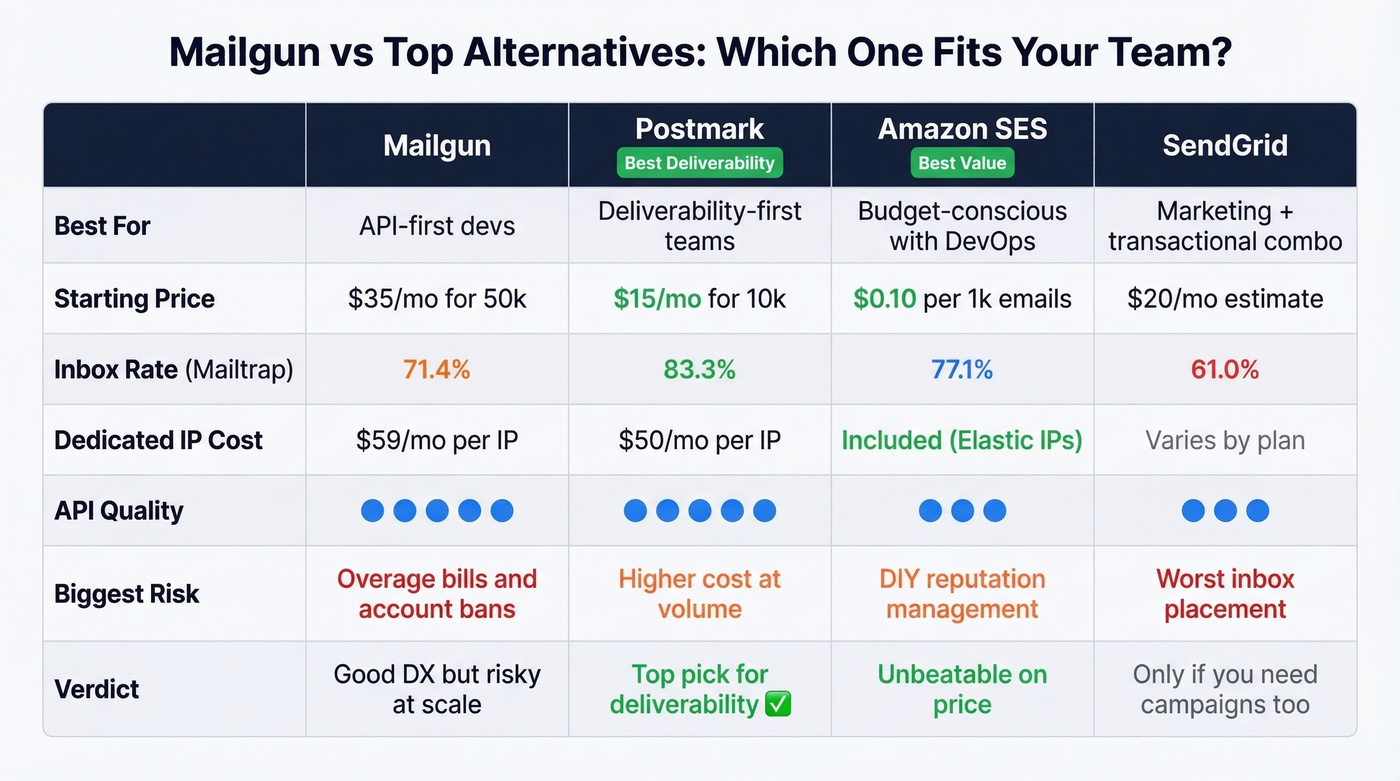
83.3% inbox rate in Mailtrap's benchmark - the highest of any provider tested. Starts at $15/mo for 10k emails. Postmark's dedicated IP add-on starts at $50/mo per IP and is available for customers sending 300,000+ emails/month on Pro plans or higher. If deliverability is your top priority, this is the obvious pick.
Amazon SES
The budget option, and it's not close. ~$0.10 per 1,000 emails. The tradeoff: you manage reputation, authentication, and bounce handling yourself. SES gives you the pipes, not the plumbing. Best for teams with DevOps resources who'd rather spend ~$50/month at 500k volume than $620.
SendGrid
Skip this if you only send transactional email. SendGrid's value is combining marketing campaigns and transactional sends in one platform, starting around $20/mo. The cost: 61.0% inbox rate in benchmarks - the worst of the group in the Mailtrap test. For teams that need both campaign and transactional sending under one roof, it works. For everyone else, there are better options.
Is Mailgun Worth It in 2026?
Mailgun still delivers a strong developer experience. The API is clean, the documentation is solid, and the webhook system works well. But that -27.75% deliverability drop is hard to ignore, and the overage billing model creates real financial risk at scale.
When you weigh the full picture together, Mailgun makes sense only for teams with modest volume and strong in-house email ops who can actively manage sender reputation.
Your ESP is only as good as the data you feed it. Verifying your list before sending reduces bounces, lowers costs, and protects sender reputation on any platform. Prospeo handles email verification at 98% accuracy for ~$0.01/email - if verifying a 50k list saves even 5% in bounces, that's 2,500 fewer wasted sends every month.
Deliverability starts before your email hits the ESP. Prospeo's 143M+ verified emails with catch-all handling, spam-trap removal, and 7-day refresh cycles ensure your list is clean - no matter which sending platform you choose.
Clean data in, clean sends out. That's the formula no ESP can fix for you.
FAQ
Does Mailgun have a free plan?
Yes. The free tier allows 100 emails per day with ticket support and 1-day log retention. The daily cap makes it testing-only - it's not viable for production workloads.
Why did Mailgun's prices go up?
Sinch acquired Mailgun for around $2B in 2021. Users report 20-40% price increases since. Foundation now starts at $35/month after a one-month free trial.
Is Mailgun good for marketing emails?
No. Mailgun is built for transactional email - password resets, receipts, notifications - not full marketing automation. If you need campaigns plus transactional sending in one place, tools like SendGrid or Brevo are a better fit.
How can I reduce my Mailgun costs?
Verify your email list before sending. Bounced emails count toward your quota and damage sender reputation. Cutting 5% of invalid addresses from a 100k list saves $6.50/month in Mailgun overages alone, and the deliverability upside is usually worth more than the raw send savings.