

MEDDIC: The Practitioner's Guide to Actually Winning Deals (Not Filling CRM Fields)
It's week eight of a deal you forecasted to close this quarter. Your champion's gone quiet. Procurement just surfaced a security review nobody mentioned. And the "economic buyer" your contact introduced you to? Turns out she can recommend but not sign. You didn't lose this deal today - you lost it in week two, when you skipped the qualification work that would've flagged every one of these landmines.
MEDDIC exists to prevent exactly this scenario. But here's the tension: most teams implement it as a CRM compliance exercise - reps fill fields, managers check boxes, nobody actually qualifies anything. That's not a framework problem. That's an implementation problem. Let's fix it.
What Is MEDDIC? Meaning, Origin, and Why It Works
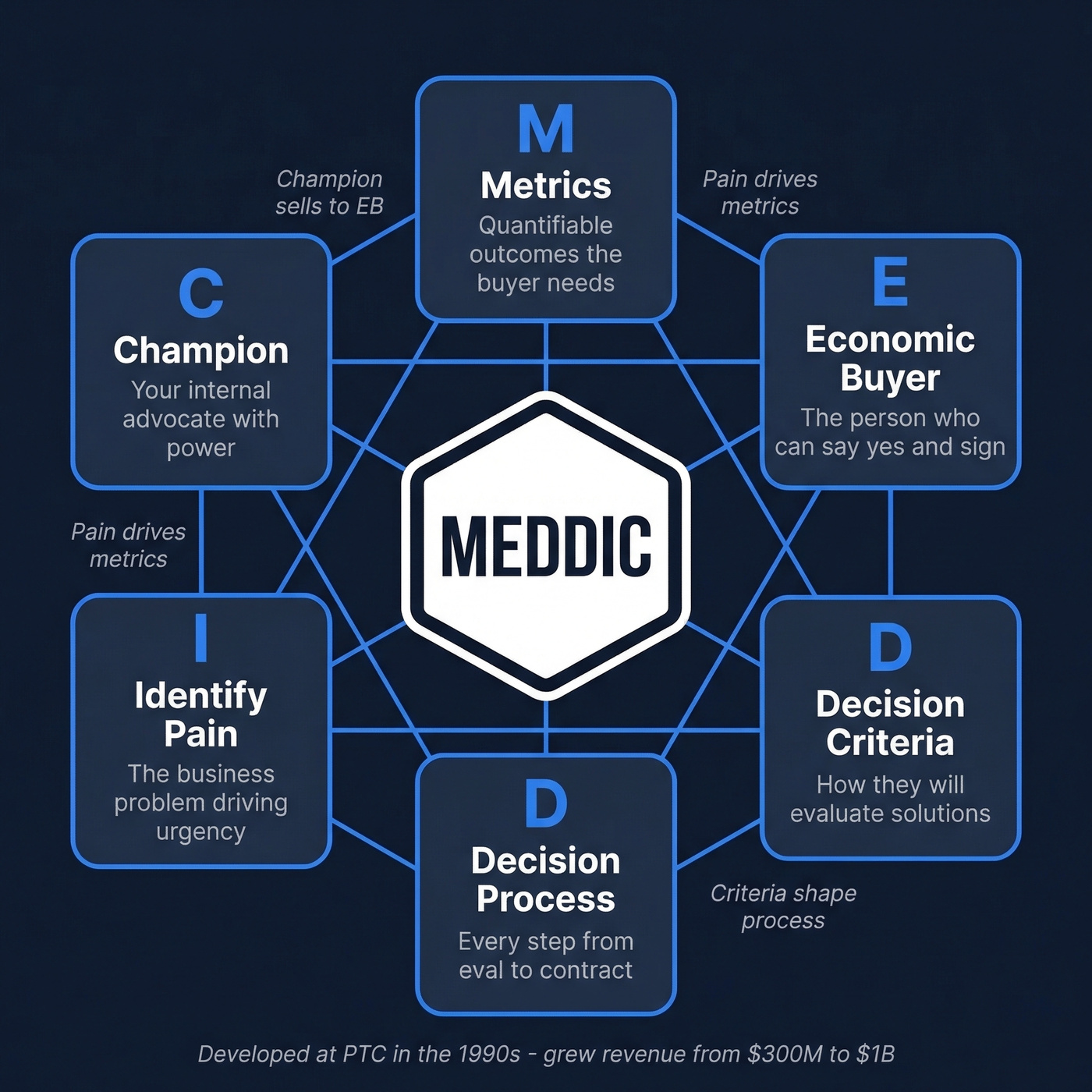
MEDDIC is a B2B sales qualification framework built around six elements that determine whether a deal is real, winnable, and worth your time. It's not a linear sequence. It's a web of interconnected qualification checkpoints you revisit throughout the deal.
| Letter | Element | One-Line Definition |
|---|---|---|
| M | Metrics | Quantifiable outcomes the buyer needs |
| E | Economic Buyer | The person who can say yes and write the check |
| D | Decision Criteria | How the buyer will evaluate solutions |
| D | Decision Process | Every step from eval to signed contract |
| I | Identify Pain | The business problem driving urgency |
| C | Champion | Your internal advocate with power and influence |
The acronym breaks down into Metrics, Economic Buyer, Decision Criteria, Decision Process, Identify Pain, and Champion - six checkpoints developed at PTC in the 1990s by sales leaders including John McMahon, Dick Dunkel, and Jack Napoli. PTC's sales grew from $300M to $1B after adopting the structured qualification approach. The framework spread because it worked - not as theory, but as a repeatable system for qualifying complex deals.
Quick Version
- Best qualification framework for complex B2B sales.
- 73% of SaaS companies selling solutions above $100K ARR use some version of MEDDIC/MEDDPICC.
- You probably need MEDDPICC, not the original six letters - Paper Process and Competition are where enterprise deals die.
- If your team treats this like a CRM checkbox exercise, the framework isn't the problem - your implementation is.
Why This Methodology Matters in 2026
Buying committees have expanded from 3-5 stakeholders to 8-12 in complex enterprise deals. Sales cycles that used to close in three months now stretch to six or nine. Buyers complete nearly 80% of their research before they ever talk to a rep.
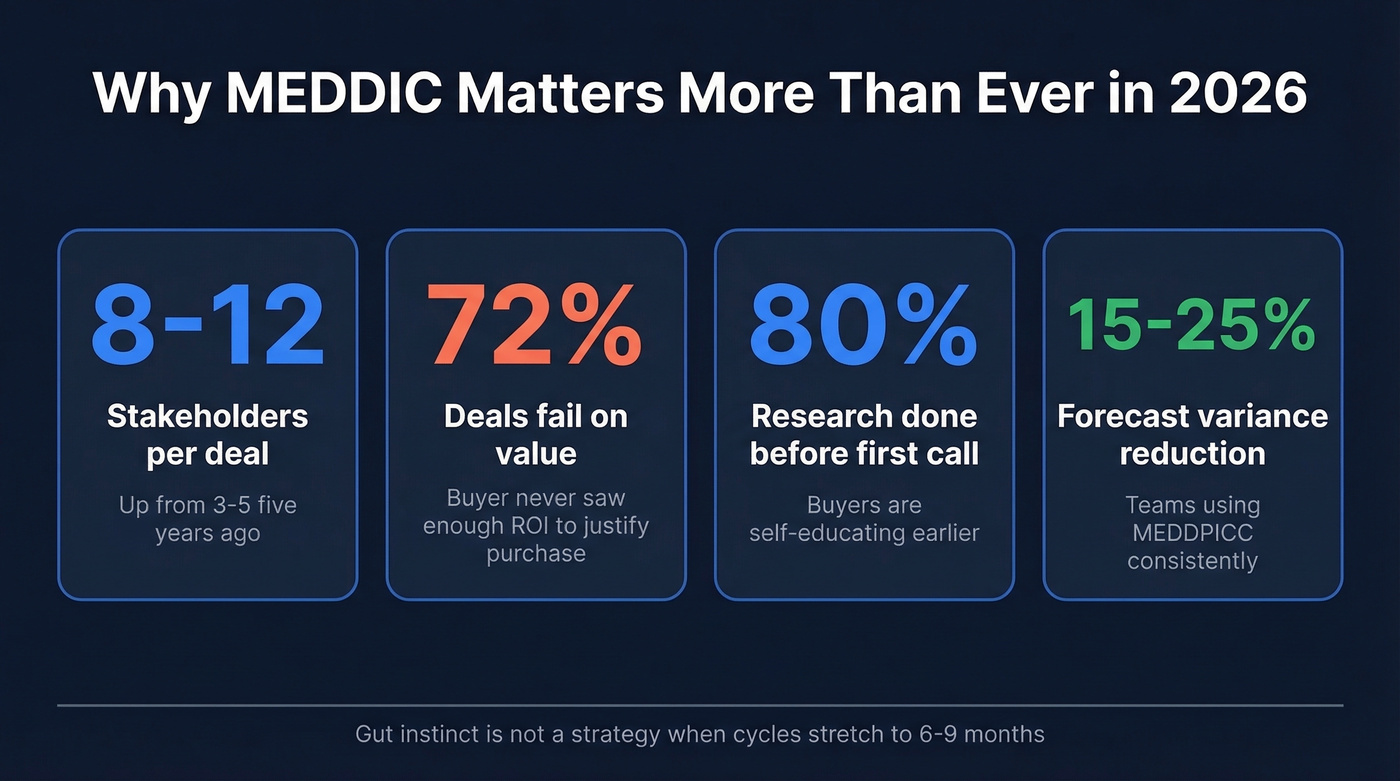
The numbers paint a brutal picture: 72% of deals fail because the buyer never saw enough value to justify the purchase, and 37% fail due to perceived lack of product fit - not because the product was wrong, but because the seller didn't connect their solution to outcomes that mattered. Teams adopting MEDDPICC consistently report improvements in forecast accuracy, rep ramp time, and ability to move up-market into larger ACVs. Enterprise teams typically see forecast variance drop by 15-25% as reps stop advancing unqualified deals.
When you're navigating a dozen stakeholders across a nine-month cycle, gut instinct isn't a strategy. You need a systematic way to answer: Is this deal real? Can we win it? Is it worth winning?
The 6 Core Components Deep Dive
The best practitioners treat the framework as an invisible compass - guiding every conversation without the buyer ever knowing it's there. One sales professional put it perfectly: "My client doesn't know I'm doing it and I'm very real with them." That's the goal. Not an interrogation. A way of thinking about deals.
Metrics
Metrics are the quantifiable outcomes your buyer needs to achieve - their business results, not your product's features. The distinction between below-the-line metrics (operational improvements a manager cares about) and above-the-line metrics (revenue, margin, and growth numbers the C-suite tracks) is critical. Your champion might care about reducing ticket resolution time by 40%. The economic buyer cares about what that means for customer retention and net revenue.
Discovery questions:
- What does success look like in measurable terms for this initiative?
- How are you quantifying the cost of the current problem today?
- What metrics does your executive team track for this business area?
- If we could deliver X outcome, what would that mean for your team's goals this year?
- Who's responsible for reporting on these numbers internally?
Accepting vague metrics like "improve efficiency" or "save time" is the fastest way to kill a deal in prioritization. If you can't put a dollar figure or percentage on it, the economic buyer won't either.
Economic Buyer
The biggest mistake reps make here: assuming the person who says "I'm the decision-maker" in your first meeting actually is one. The EB is the person with the authority and budget to approve the purchase. In enterprise deals, evaluation authority and purchase authority are almost always held by different people.
Identifying the real EB requires asking uncomfortable questions early. Who signs off on purchases of this size? Has anyone else needed to approve similar investments? What's the approval process above your level? If your contact gets defensive, that's useful information - it usually means they don't have final authority.
When you can't get a direct meeting with the EB, multi-thread. Build relationships with two or three people who have the EB's ear. Arm your champion with the business case materials the EB needs to say yes in a meeting you're not in. Discovery questions:
- Who has final sign-off authority for an investment of this size?
- Have you purchased anything in this price range before? Walk me through how that got approved.
- Beyond your team, who else would need to weigh in?
- What does your executive sponsor care about most right now?
- If you recommended this solution, what would happen next?
Decision Criteria
Decision criteria are the standards the buyer will use to evaluate and compare solutions. They fall into three categories: technical requirements like stack integration, business factors like ROI timeline, and personal considerations like career risk and political dynamics. Personal criteria often outweigh the spreadsheet - and most reps never uncover them.
The critical move is shaping criteria before they're locked. If you're responding to a published RFP with criteria already set, you're column fodder. The best reps influence criteria during the early education phase, before the buyer has formalized their evaluation framework.
Discovery questions:
- What are the three most important factors in your evaluation?
- How will you compare the options on your shortlist?
- Are there any technical requirements that are absolute dealbreakers?
- Who defined these criteria, and how firm are they?
- What would make this a clear "no" regardless of everything else?
Decision Process
This is where deals go to die. In our experience, reps consistently underestimate how many steps exist between "we want to buy" and "here's the PO."
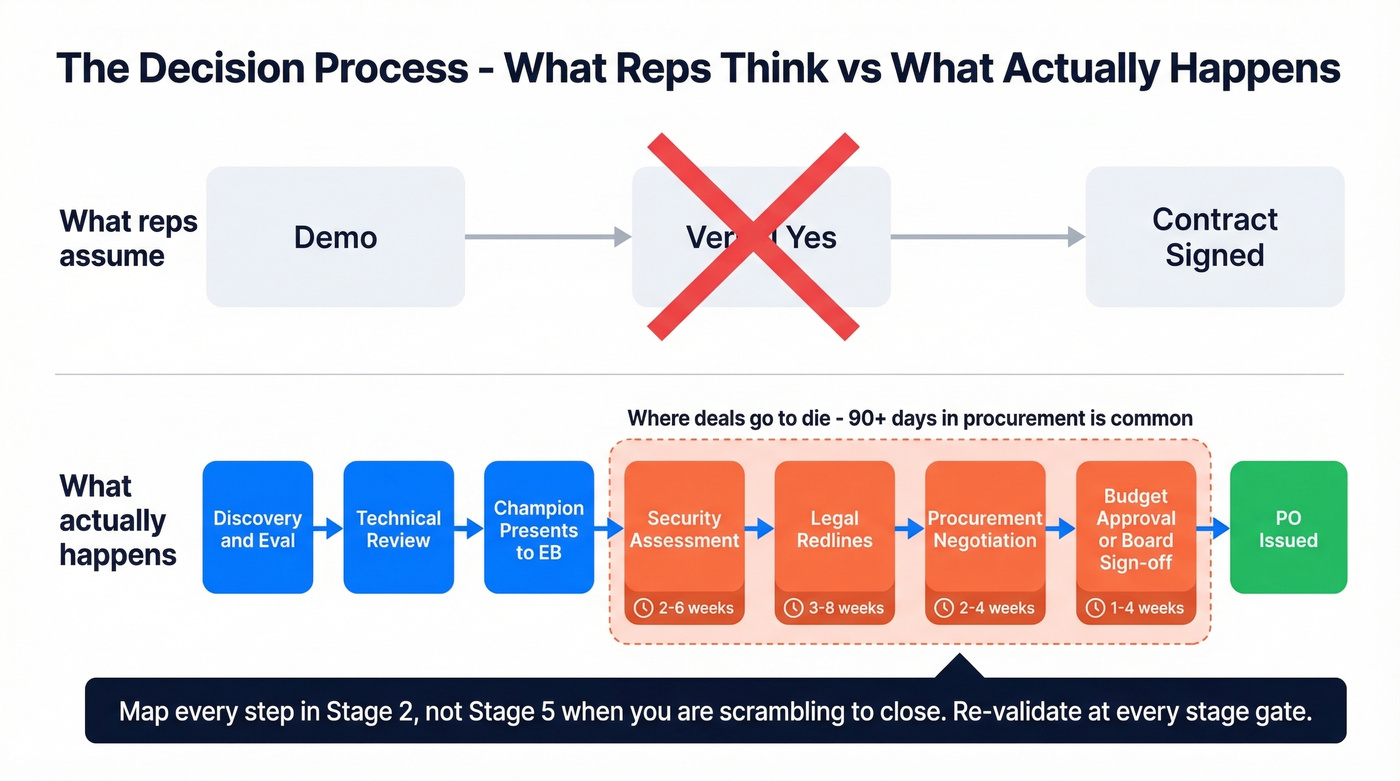
You need to know the evaluation timeline, who reviews at each stage, whether there's a legal review, security assessment, procurement negotiation, or board approval. Map every step in Stage 2, not Stage 5 when you're scrambling to close. And don't map the process once and assume it's static - new stakeholders appear, budget cycles shift, reorgs happen. Re-validate at every stage gate.
Discovery questions:
- Walk me through what happens after your team decides they want to move forward.
- What internal approvals are required before a contract can be signed?
- Is there a security or compliance review? How long does that typically take?
- Have any purchases in this range gotten stuck in procurement? What happened?
- What's your target timeline for having a solution in place?
Identify Pain
A director of sales ops might feel pain around manual data entry eating 10 hours per week. That's real, but it won't move a CFO. Implicate it: 10 hours per week across 30 reps is 15,600 hours per year - roughly $780K in loaded cost spent on work that doesn't generate revenue. Now the CFO's listening.
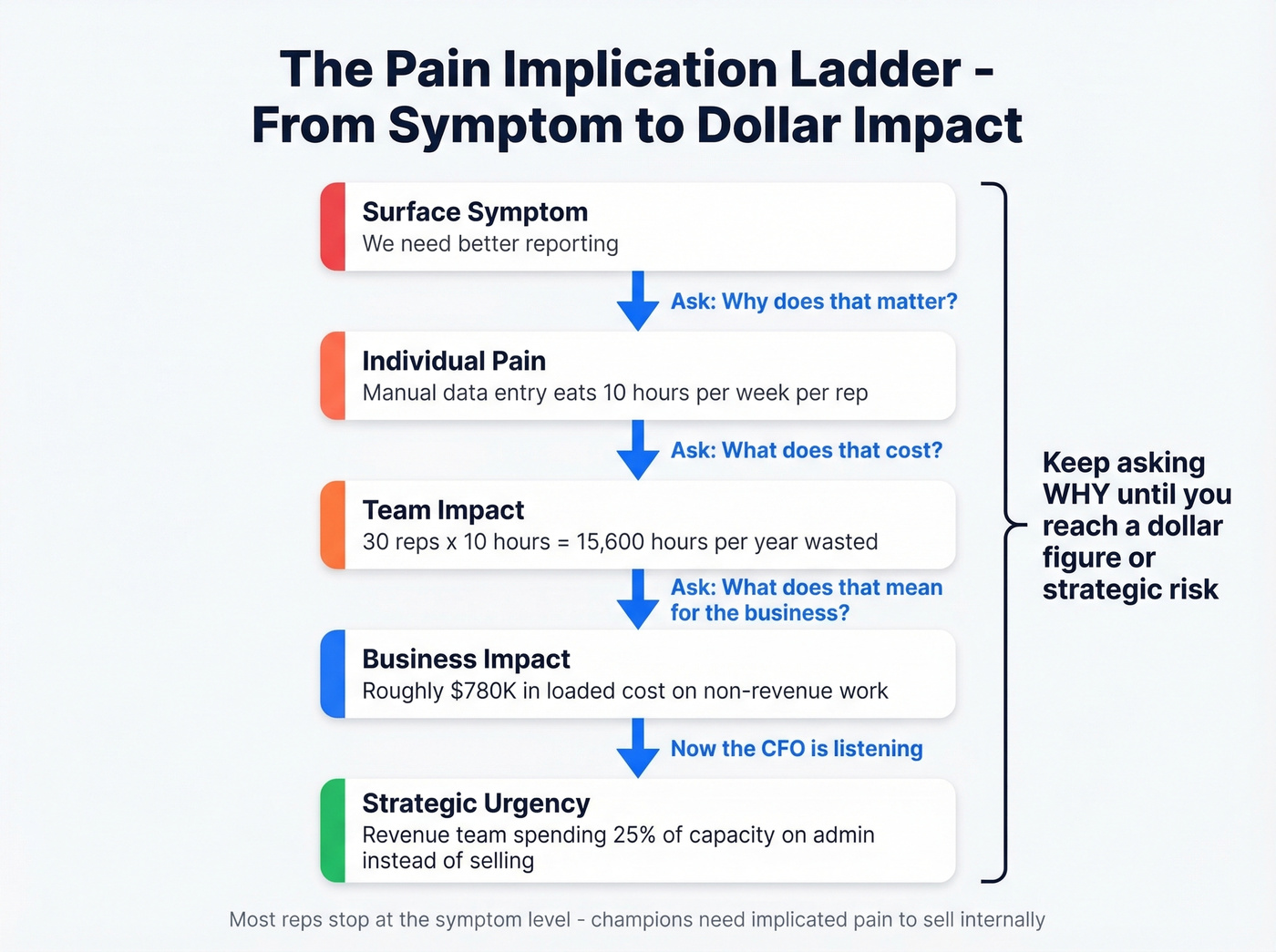
Surface-level pain isn't enough. You need to connect the individual's problem to business outcomes the economic buyer owns. Keep asking "why does that matter?" until you reach a dollar figure or a strategic risk. "We need better reporting" isn't pain - it's a symptom. This is arguably the most overlooked component. Reps identify pain but fail to implicate it upward, and that gap is where deals stall in committee.
Discovery questions:
- What's the biggest challenge your team faces with this area today?
- How long has this been an issue? What's prevented you from solving it?
- What does this problem cost you - in time, revenue, or missed opportunities?
- How does this impact the broader business beyond your team?
- What happens if this doesn't get solved in the next 6 months?
Champion
Your champion is the internal advocate who sells your solution when you're not in the room. They need three things: influence, access to the economic buyer, and personal motivation. A champion who's enthusiastic but junior is a coach, not a champion. A champion who has authority but no personal stake won't fight for you when priorities shift.
The false champion problem kills more forecasted deals than any other single qualification failure. Test early: ask them to set up a meeting with the EB, or to present your business case to their team. If they can't or won't, find your real champion.
Discovery questions:
- Why is solving this problem important to you personally?
- If you recommended our solution, how would that conversation go with the EB?
- What objections do you expect internally, and how would you address them?
- Have you championed a purchase like this before? What happened?
- What would make you confident enough to put your name behind this?
MEDDIC vs MEDDICC vs MEDDPICC
Look - the original six letters aren't always enough. Enterprise deals have two failure modes the base framework doesn't address, and both kill deals after you've already gotten a verbal "yes."
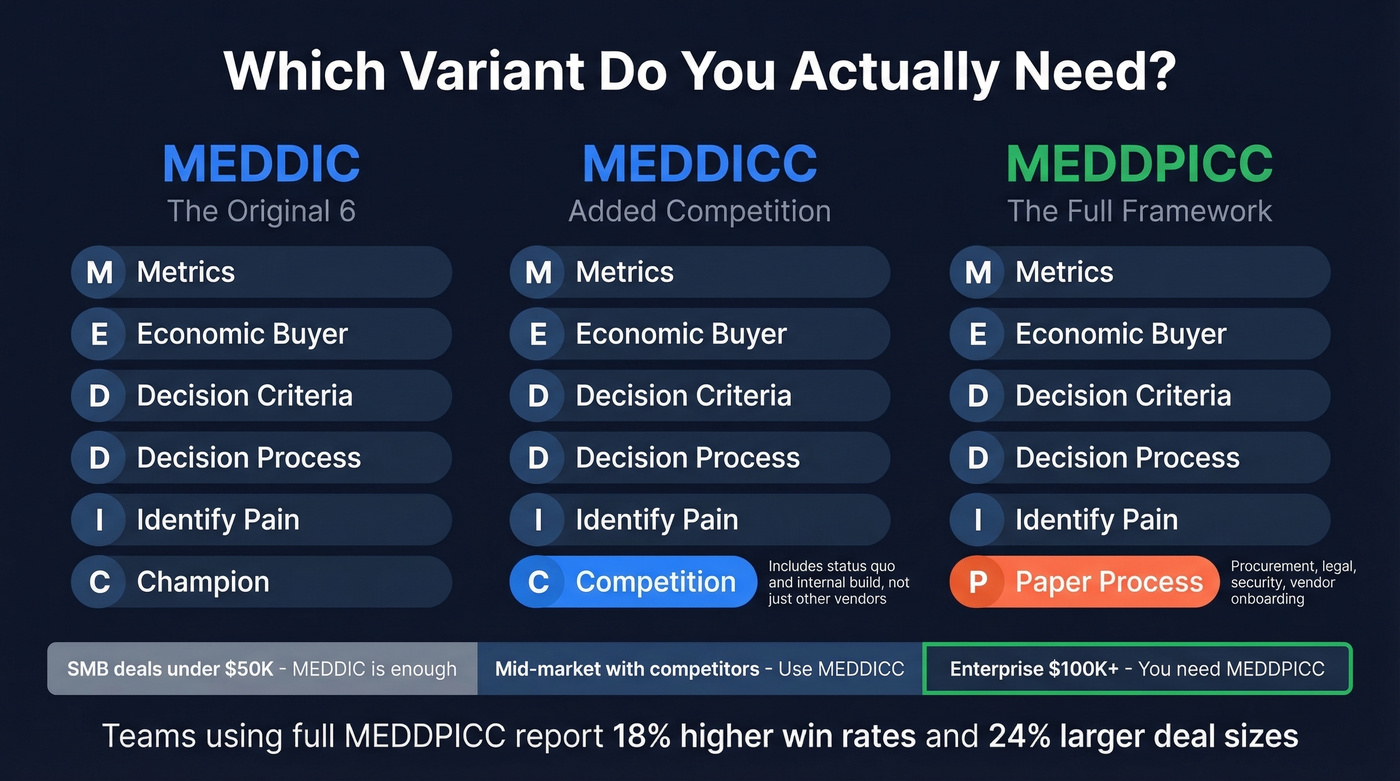
| Element | MEDDIC | MEDDICC | MEDDPICC |
|---|---|---|---|
| Metrics | ✓ | ✓ | ✓ |
| Economic Buyer | ✓ | ✓ | ✓ |
| Decision Criteria | ✓ | ✓ | ✓ |
| Decision Process | ✓ | ✓ | ✓ |
| Identify Pain | ✓ | ✓ | ✓ |
| Champion | ✓ | ✓ | ✓ |
| Competition | - | ✓ | ✓ |
| Paper Process | - | - | ✓ |
Paper Process covers everything between "we want to buy" and a signed contract: procurement negotiations, legal redlines, security questionnaires, vendor onboarding forms. We've seen deals sit in procurement for 90 days after the champion said "it's a done deal." If you aren't mapping Paper Process by Stage 2, you're forecasting fiction.
Competition isn't just other vendors. It's the status quo, internal build projects, and budget reallocation. Every deal has competition, even if no other vendor is in the running.
Teams using full MEDDPICC report 18% higher win rates and 24% larger deal sizes compared to simplified frameworks. Sales teams using formal qualification methodologies report 28% higher win rates overall.
The original six elements fit shorter cycles - around 3 months or less - with straightforward procurement and limited competitive pressure. MEDDICC fits competitive deals where you need to actively position against alternatives. MEDDPICC is for enterprise deals above $100K ARR with complex procurement, real competition, and large buying committees. You probably need MEDDPICC.

MEDDIC only works when you can actually reach the economic buyer. Prospeo gives you 98% accurate emails and 125M+ verified mobile numbers so you can multi-thread into every deal - not wait for your champion to forward an email.
Stop losing deals because you couldn't reach the person who signs the check.
Scorecard Template for Deal Reviews
A scorecard turns qualification from a concept into a coaching tool. Score each element 1-5 for every opportunity, and use the total to determine deal health and stage-gate readiness.
| Score | Meaning |
|---|---|
| 1 | Unknown or unidentified |
| 2 | Identified but unconfirmed |
| 3 | Identified, partially validated |
| 4 | Validated with evidence |
| 5 | Confirmed, documented, tested |
| Element | Score (1-5) | Notes |
|---|---|---|
| Metrics | ___ | Quantified, tied to EB |
| Economic Buyer | ___ | Named, authority confirmed |
| Decision Criteria | ___ | Shaped or responding? |
| Decision Process | ___ | Steps mapped with timeline |
| Identify Pain | ___ | Implicated to EB outcomes |
| Champion | ___ | Passed false champion test? |
| Paper Process | ___ | Procurement steps + timeline |
| Competition | ___ | Vendors, status quo, build |
Deal health thresholds: Red (below 15) means major gaps - don't forecast this deal. Yellow (15-22) means progressing but unvalidated. Green (23+) means well-qualified and forecastable with confidence.
No deal advances past Stage 2 without scoring 3 or higher on Economic Buyer and Champion. No deal enters Stage 4 without 3 or higher on Decision Process and Paper Process. These aren't suggestions - they're gates. We've tested this scorecard approach across dozens of pipeline reviews, and the stage gates are what make it stick.
Use this scorecard in weekly reviews as a coaching tool, not an audit. The question isn't "did you fill this out?" It's "what's your plan to move this score from a 2 to a 4?"
MEDDIC vs BANT vs SPIN vs Challenger
The consensus on r/sales is that all sales methodologies are basically the same. The experienced rep who says this is half right - the fundamentals overlap. The value here is forcing rigor around the two things reps consistently skip: decision process and champion validation.
| Framework | Best For | Deal Size | Team Maturity | Limitation |
|---|---|---|---|---|
| MEDDIC | Complex B2B qualification | $50K+ | Intermediate+ | Doesn't teach how to sell |
| BANT | Transactional qualification | Under $50K | Any | Too shallow for enterprise |
| SPIN | Discovery conversations | Any | Beginner+ | No qualification structure |
| Challenger | Insight selling | $50K+ | Advanced | Mindset, not process |
| Sandler | Consultative selling | $25K-$200K | Intermediate | Requires heavy training |
BANT is dead for enterprise deals. Budget, Authority, Need, Timeline - that's four questions, not a qualification framework. It works for transactional sales under 60 days with 1-3 stakeholders. For anything above $50K ACV with a real buying committee, it's a relic.
Challenger is a mindset, not a process. It complements structured qualification; it doesn't replace it. Use Challenger to teach reps how to lead with insight and reframe the buyer's thinking. Use your qualification framework to make sure the deal they're building is actually real.
Hot take: If your average deal size is under $25K, you probably don't need this level of rigor at all. A lightweight three-question qualification checklist will outperform a full MEDDPICC implementation because your reps will actually use it. The framework's power scales with deal complexity - force it on simple deals and you'll just slow your team down.
The combination that works best in practice: SPIN for discovery, MEDDIC for qualification, and Challenger for positioning. They aren't competing frameworks - they're different tools for different moments in the sales process.
Common Implementation Mistakes
The CRM checkbox trap. If your pipeline reviews consist of a manager reading fields back and asking "is this filled out?" - that's auditing, not coaching. Reps treat it like paperwork, managers treat it like compliance, and nobody qualifies anything. Use the scorecard as a conversation starter: "Your Champion score is a 2 - what's your plan to validate them this week?"
Interrogation-style discovery. Running through questions like a survey destroys trust. The buyer shouldn't know you're using a framework. Weave qualification into natural conversation. Let the framework guide what you listen for, not what you ask verbatim.
False champions. The person who's enthusiastic in meetings but can't sell internally when you're not there. Test early - ask them to set up a meeting with the EB or present your business case to their team. If they can't, they're a coach. Find your real champion.
Ignoring Paper Process until it's too late. I've watched reps map procurement in Stage 5 when they should've mapped it in Stage 2. Ask about procurement, legal, and security review timelines in your second or third meeting. Build those steps into your mutual action plan from the start.
Metrics that don't connect to the EB. Your champion's metrics and the economic buyer's metrics are usually different. Always ask: "How does this metric roll up to what your CFO cares about?" Tie every pain point to a business outcome the EB owns.
How to Roll Out MEDDIC on Your Team
CRM setup (week 1). Create custom fields for each MEDDPICC element. Use picklists for Decision Criteria type and Competition type. Use contact lookups for Economic Buyer and Champion. Add a numeric score field for each element and a calculated total score field.
Training cadence (months 1-3). Don't do a one-day workshop and expect adoption. Run weekly pipeline reviews using the scorecard for the first three months, focusing on 2-3 deals per review. Expect roughly 3.6 months to reach proficiency across the team. Align your enablement and marketing teams to qualification stages - battle cards should map to Competition, ROI calculators to Metrics, case studies to Decision Criteria.
Stop teaching the framework to new reps on day one. Let them close 5-10 deals first. They need to experience the pain of lost deals before the methodology makes sense. Introducing it too early turns it into abstract theory instead of a tool that solves problems they've actually felt.
AI tools can now flag qualification gaps in call recordings and suggest follow-up questions - useful for coaching at scale, but not a substitute for reps internalizing the framework.
For teams under 20 reps with $50K+ ACV, start with the core six elements and graduate to MEDDPICC within 6 months. Enterprise teams of 50+ reps selling $100K+ ACV should go straight to MEDDPICC. SMB and transactional teams? Skip this entirely and use a lightweight qualification checklist.
Reaching Your Economic Buyer
MEDDIC maps the people who matter. But mapping is useless without access. You've identified the VP of Finance as your economic buyer and the Director of RevOps as your champion - now you need their direct contact information, not a generic info@ address.
Prospeo finds verified contact data for 300M+ professionals with 98% email accuracy and a 7-day refresh cycle. Search by job title, seniority, company, and 30+ other filters to find the exact stakeholders your qualification analysis identified. With 125M+ verified mobile numbers and a 30% pickup rate - about 2.5x the industry average - your homework converts into conversations, not bounced emails.

Mapping decision processes and stakeholder committees requires real contact data - not LinkedIn guesses. Prospeo's 300M+ profiles with 30+ filters let you identify every stakeholder by title, department, and seniority, then get verified contact info for $0.01 per email.
Multi-thread every MEDDIC deal with contacts you can actually reach.
FAQ
What Does MEDDIC Stand For?
Metrics, Economic Buyer, Decision Criteria, Decision Process, Identify Pain, and Champion. MEDDPICC adds Paper Process and Competition. Each letter represents a qualification checkpoint you confirm before forecasting a deal.
Who Created the Framework?
Sales leaders John McMahon, Dick Dunkel, and Jack Napoli developed it at PTC in the 1990s. After adoption, PTC grew from $300M to $1B in revenue - making it one of the most validated qualification systems in B2B sales history.
What's the Difference Between MEDDIC and MEDDPICC?
MEDDPICC adds Paper Process (procurement, legal, security steps) and Competition (rival vendors, status quo, internal builds). Use MEDDPICC for enterprise deals above $100K ARR with complex procurement. Use the original six elements for shorter cycles with straightforward buying processes.
Is It a Methodology or a Qualification Framework?
Technically it's a qualification framework - it tells you whether a deal is real and winnable, not how to sell. Pair it with SPIN for discovery and Challenger for positioning to build a complete sales methodology.
How Do You Find Contact Data for the Economic Buyer?
Use a B2B data platform with filters for job title, seniority, and company. Tools like Prospeo return verified emails and direct dials so you can reach the EB directly instead of routing through gatekeepers.