

MEDDIC Examples: What a Properly Qualified Deal Actually Looks Like
Every sales team can recite the acronym. But when it's time to fill out a MEDDIC scorecard on a live deal, most reps stare at a blank CRM field and type "improve efficiency." That's not qualification. That's a checkbox.
Gong's State of Sales Productivity report found 56% of seller time gets wasted on unqualified leads. Gartner's survey of 632 B2B buying teams found 74% experience "unhealthy conflict" during decisions - and buying groups that reach internal consensus are 2.5x more likely to report the deal as high-quality. MEDDIC exists to force that consensus. But only if you fill it out with real intelligence, not filler.
Three fully filled deal walkthroughs below - SaaS, manufacturing, services - plus a 30-point scoring rubric. Know the acronym already? Skip straight to the examples.
MEDDIC in 60 Seconds
| Letter | Component | What You're Answering |
|---|---|---|
| M | Metrics | What quantified outcome justifies this purchase? |
| E | Economic Buyer | Who signs the check? |
| D | Decision Criteria | What factors will they evaluate vendors on? |
| D | Decision Process | What steps happen between "interested" and "signed"? |
| I | Identify Pain | What business pain drives urgency? |
| C | Champion | Who inside the account is selling for you? |
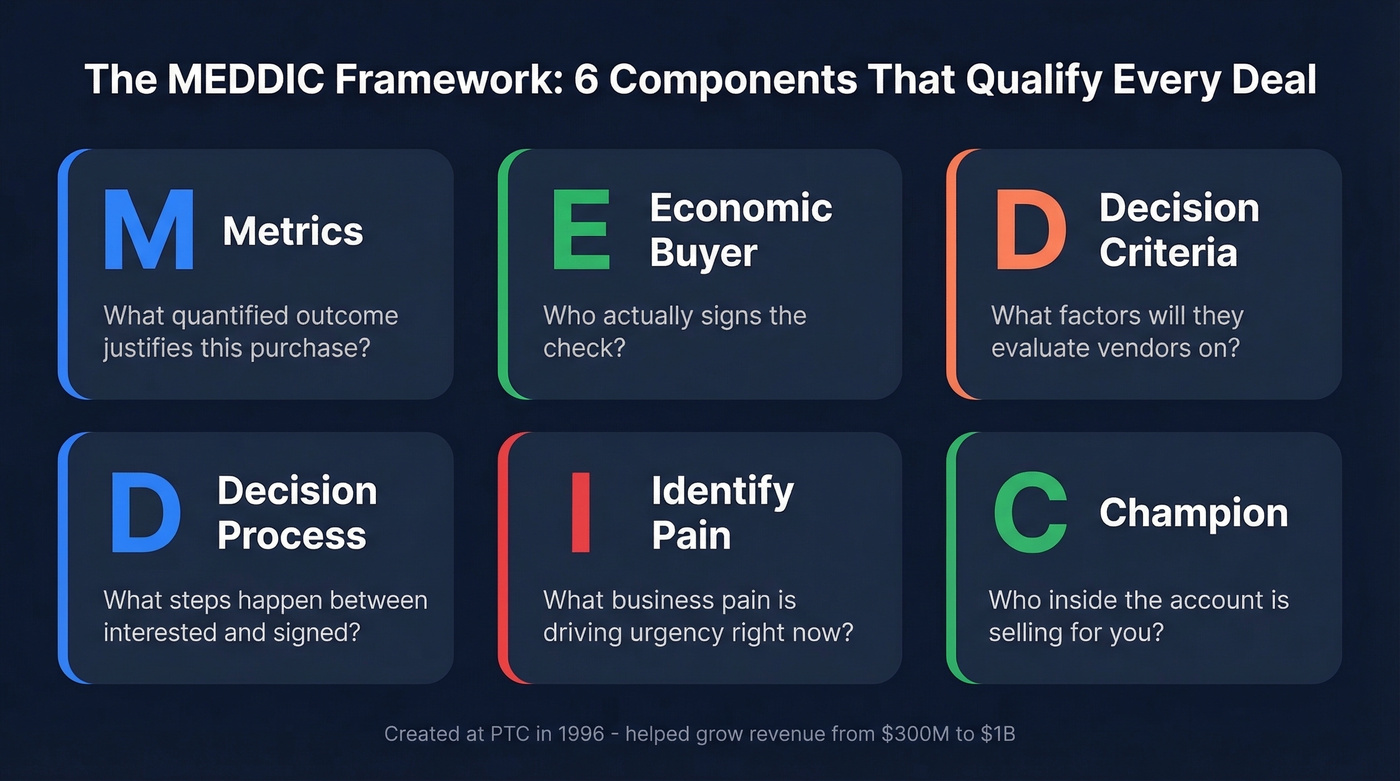
Dick Dunkel created MEDDIC in 1996 at PTC, alongside John McMahon and Jack Napoli. It helped PTC grow from $300M to $1B in revenue. Full MEDDPICC adoption correlates with 18% higher win rates and 24% larger deal sizes - the framework works when you actually use it.
Three Deal Walkthroughs by Industry
SaaS Platform Sale ($85K ARR)
Context: Selling an OKR/alignment platform to ShieldMedia. The discovery question that unlocked Metrics: "If we fast-forward one year, what numbers would make you celebrate?"
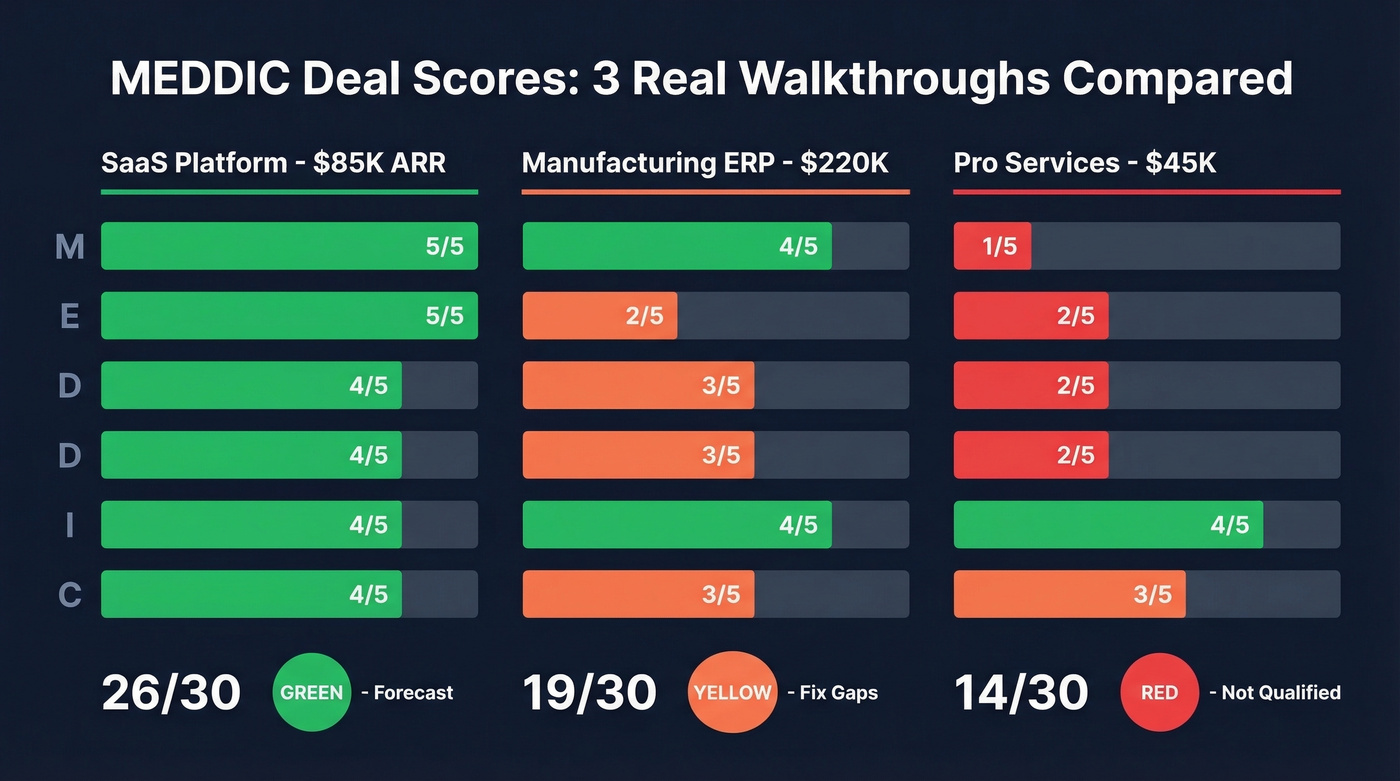
| Component | Filled Field | Score (1-5) | Status |
|---|---|---|---|
| Metrics | Increase team productivity by 21% (drive 14% revenue lift) by having quarterly plans set two weeks earlier; reduce employee attrition by 2 headcount/yr (save $60K in recruiter fees) | 5 | 🟢 |
| Economic Buyer | CEO-sponsored initiative; Eric Murray, SVP of HR, is driving the project day to day | 5 | 🟢 |
| Decision Criteria | Roll out OKRs by 3/1; vendor must support rollout; employee adoption amid app overload; ease of use for execs; cost to roll out to all employees; availability of coaching/facilitation/strategy consultation | 4 | 🟢 |
| Decision Process | Meet with 5 vendors, consult existing exec coaches, demo finalists with a manager and direct reports, legal reviews MSA/confidentiality, procurement approval, SVP of HR signs agreement | 4 | 🟢 |
| Identify Pain | Exec team isn't aligned on core initiatives, causing conflicts and delays; morale impact is contributing to retention issues | 4 | 🟢 |
| Champion | CEO's exec coach David Stearn is a repeat user of the platform and is strongly recommending it internally | 4 | 🟢 |
Total: 26/30. Well-qualified. The metrics are specific, the Economic Buyer is confirmed, and the Champion is actively selling internally. Forecast this with confidence.
Manufacturing ERP Deal ($220K)
Context: ERP modernization for a 1,200-person industrial manufacturer. The existing system is 12 years old and held together with spreadsheets. Discovery question: "What does a 1-day reduction in order-to-ship translate to in dollars?"
| Component | Filled Field | Score (1-5) | Status |
|---|---|---|---|
| Metrics | Reduce order-to-ship from 14 to 9 days; ~$180K/yr labor savings | 4 | 🟢 |
| Economic Buyer | COO likely, but VP Ops is day-to-day - COO hasn't joined a meeting | 2 | 🟡 |
| Decision Criteria | On-prem option, MES integration, less than 6 month implementation | 3 | 🟡 |
| Decision Process | Mapped through VP Ops; procurement and legal steps unclear | 3 | 🟡 |
| Identify Pain | Manual inventory reconciliation takes 3 FTEs; shipping errors ~$40K/quarter | 4 | 🟢 |
| Champion | VP Ops is responsive but hasn't built consensus or presented upward | 3 | 🟡 |
Total: 19/30. Yellow zone. Metrics and pain are solid, but the Economic Buyer hasn't been engaged directly. This deal needs serious work before it belongs in a forecast. The next step is crystal clear: get the COO on a call, or confirm in writing that VP Ops has signing authority.
Professional Services ($45K)
14/30. Red. Here's why.
Selling a compliance audit to a 90-person healthcare SaaS company preparing for their first enterprise customer. The discovery question that should have been asked: "What happens to the enterprise deal if compliance isn't in place by Q3?"
| Component | Filled Field | Score (1-5) | Status |
|---|---|---|---|
| Metrics | "Improve efficiency" - no numbers discussed | 1 | 🔴 |
| Economic Buyer | "Probably the CEO" - unconfirmed, no direct contact | 2 | 🔴 |
| Decision Criteria | "We need someone who understands healthcare" | 2 | 🔴 |
| Decision Process | Unknown - "we'll figure it out internally" | 2 | 🔴 |
| Identify Pain | Enterprise prospect requires SOC 2 + HIPAA before signing | 4 | 🟢 |
| Champion | Head of Product - interested but no influence on compliance budget | 3 | 🟡 |
The pain is real - they'll lose an enterprise deal without compliance. But "improve efficiency" isn't a metric. "Probably the CEO" isn't an Economic Buyer. This is a discovery call, not a qualified opportunity. Don't put it in the forecast.
Good vs Bad Qualification Entries
| Component | Lazy Entry ❌ | Strong Entry ✅ |
|---|---|---|
| Metrics | "Improve efficiency" | "Reduce cycle time 14 to 9 days, saving $180K/yr" - aim for 4:1 impact-to-cost ratio |
| Champion | "Good relationship with VP" | "Exec coach is recommending the platform internally and pushing it through the buying group" |
| Economic Buyer | "Someone in the C-suite" | "Eric Murray, SVP HR - driving the project day to day on a CEO-sponsored initiative" |
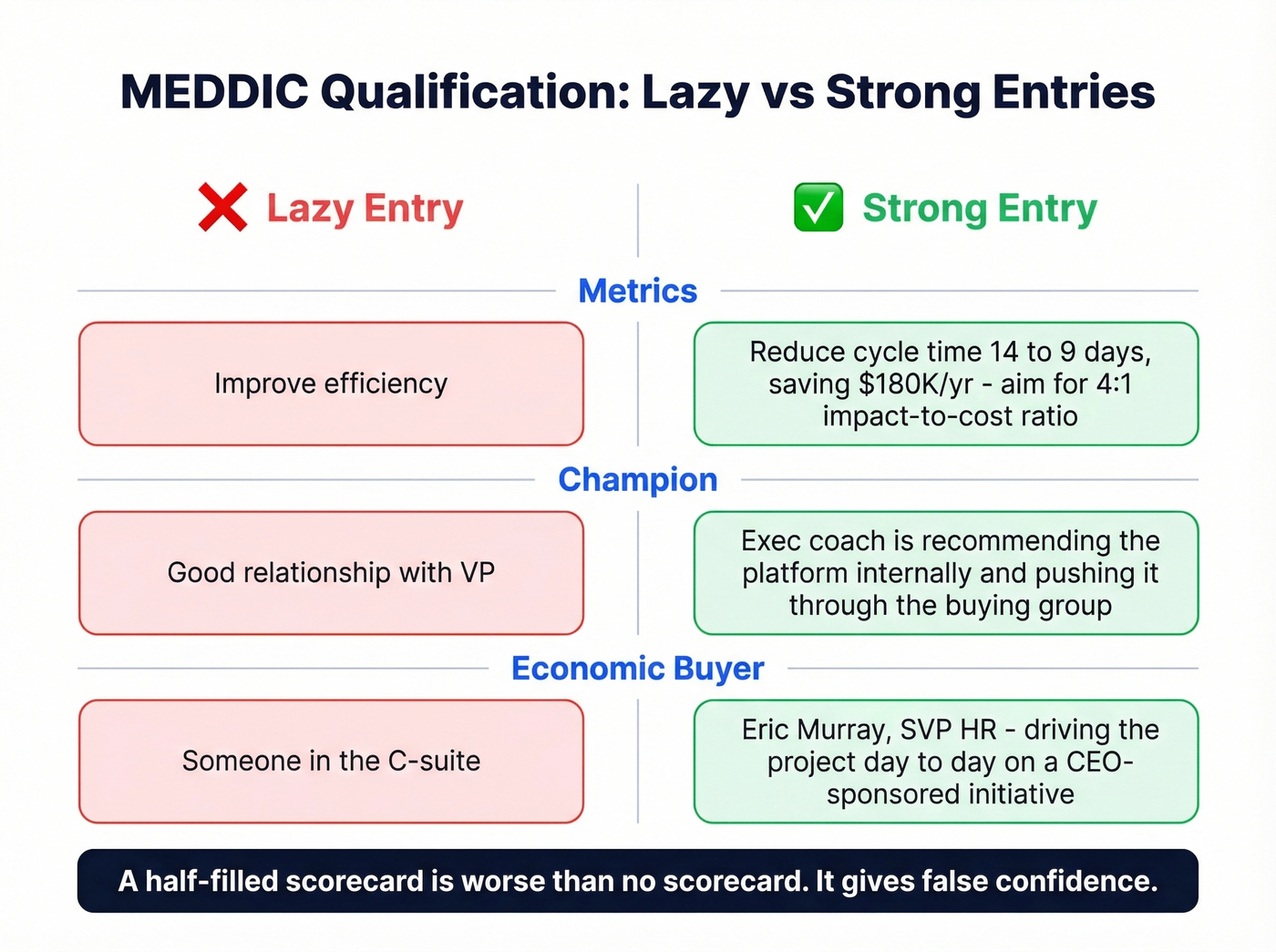
A half-filled scorecard is worse than no scorecard. It gives false confidence.
When a rep writes "improve efficiency" in the Metrics field, they've satisfied the CRM requirement without qualifying anything. The deal looks green in the pipeline review, then dies silently two months later - and that's exactly how teams end up missing opportunities they thought were locked in. We've watched it happen dozens of times across teams we work with, and it always follows the same pattern: vague fields, inflated scores, surprised managers at quarter-end.

A perfect MEDDIC score means nothing if you can't actually reach the Economic Buyer. Prospeo gives you 98% accurate emails and verified direct dials for 300M+ professionals - so when your scorecard says 'COO, confirmed,' you have the number to prove it.
Stop qualifying deals you can't connect on. Find the real buyer.
The 30-Point Scoring Rubric
Score each component 1-5. A 1 means almost no information; a 5 means confirmed directly with the relevant stakeholder.
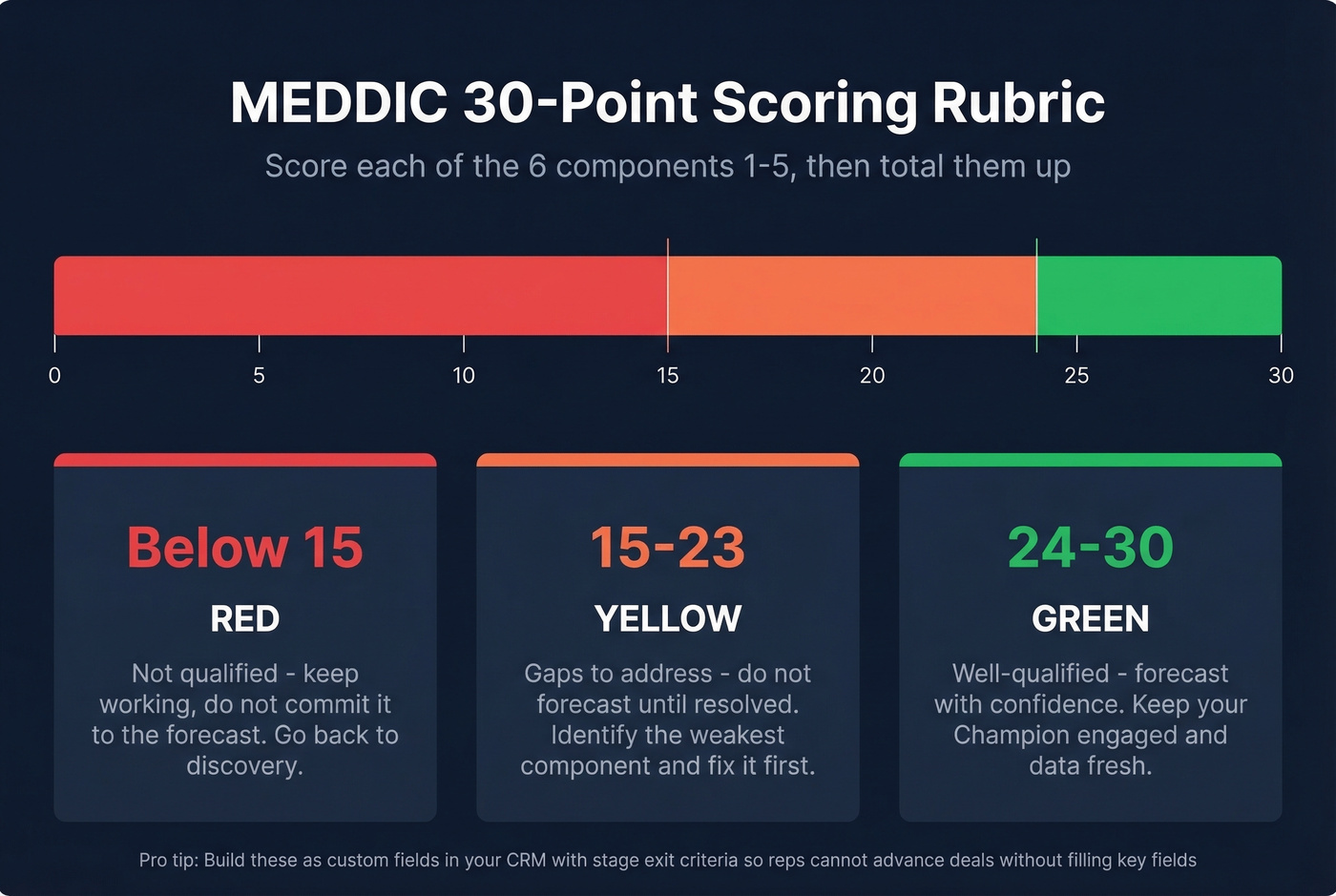
| Score Range | Status | What It Means |
|---|---|---|
| 24-30 | 🟢 Green | Well-qualified - forecast with confidence |
| 15-23 | 🟡 Yellow | Gaps to address - don't forecast until resolved |
| Below 15 | 🔴 Red | Not qualified - keep working, don't commit it |
The scoring only works if a 14 actually stays red and gets pulled from the forecast. We've seen teams where every deal magically scores 25+ because reps know their manager checks the numbers. That defeats the entire purpose.
Build these as custom fields in Salesforce or HubSpot with stage exit criteria so reps can't advance deals without filling key fields. The tables above are your template. If you want to go deeper on building qualification into your CRM stages, HubSpot's documentation walks through the mechanics.
Why MEDDIC Fails (And How to Fix It)
MEDDIC doesn't fail as a framework. It fails in execution.
Checklist fatigue. The consensus on r/sales is blunt: reps hate "constantly documenting every detail." When qualification becomes a compliance exercise, reps optimize for satisfying the CRM, not winning the deal. The fix is simple - score only deals above a certain threshold. Don't run a full qualification on a $5K deal.
The abstraction gap. In our experience, this kills more deals than checklist fatigue does. MEDDIC tells you what to learn but not how. Knowing you need to "Identify Pain" doesn't help a junior AE who's never run discovery on a $200K deal. The fix: pair the framework with actual discovery questions. "If we fast-forward one year, what numbers would make you celebrate?" beats "tell me about your pain points" every single time.
Stale data. Here's the thing - your scorecard breaks when the people in it aren't in those roles anymore. Your Economic Buyer changed jobs. Your Champion's email bounces. You're selling to ghosts. Prospeo's 7-day data refresh cycle and 98% email accuracy help keep Economic Buyer and Champion fields current, which matters a lot when deals span months.
Hot take: if your average deal is under $25K, you probably don't need MEDDIC at all. A simple BANT qualification and a good discovery call will get you 80% of the way there. MEDDIC earns its overhead on complex, multi-stakeholder deals where the buying process itself is the obstacle. Skip it for transactional sales - you'll just annoy your reps.
MEDDIC vs MEDDPICC
Use MEDDPICC if you're selling enterprise contracts above $100K with legal review, procurement gates, and competitive evaluations. It adds Paper Process - the legal/procurement steps that kill 28% of deals when buyers can't secure internal approval - and Competition.
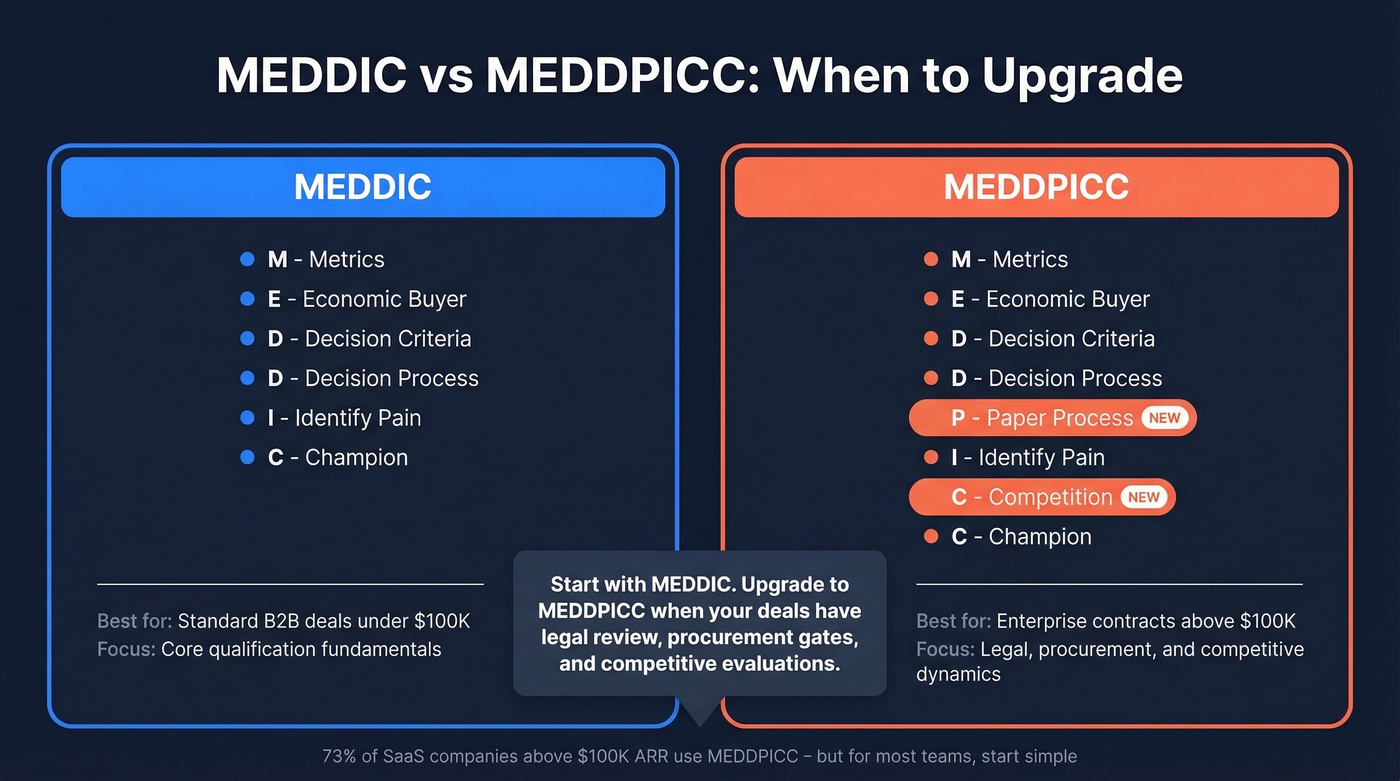
Skip it if you're running standard SaaS deals under six figures. 73% of SaaS companies above $100K ARR use MEDDPICC, but for most teams the extra two letters add documentation burden without proportional insight. Start with MEDDIC. Upgrade when your deals genuinely require it.
The gap between a 19/30 yellow deal and a 26/30 green one is almost always contact access - reaching the right Champion, confirming the Economic Buyer, mapping the Decision Process. Prospeo's 30+ search filters let you identify every stakeholder in the buying group with verified emails and mobiles, refreshed every 7 days.
Turn yellow deals green by reaching every stakeholder in the buying group.
FAQ
What's the difference between MEDDIC and MEDDPICC?
MEDDPICC adds Paper Process and Competition to the original six components. Use MEDDIC for standard B2B deals; upgrade to MEDDPICC for enterprise contracts above $100K with competitive evaluations and formal procurement gates.
How do you score a MEDDIC deal?
Rate each of the six components 1-5 for a 30-point max. Green is 24+, yellow is 15-23, red is below 15. Deals scoring red shouldn't appear in your forecast until gaps are resolved with confirmed stakeholder information.
What tools help keep MEDDIC data accurate?
Build MEDDIC fields into Salesforce or HubSpot with stage exit criteria so reps can't advance deals without completing key fields. For contact accuracy, a data platform with frequent refresh cycles keeps Economic Buyer and Champion fields current - critical when deals span months and people change roles.