

The MEDDIC Sales Process: A 2026 Practitioner's Guide
Your VP just announced MEDDIC adoption. You now have six new required fields in Salesforce, pipeline review is Thursday, and nobody's explained what any of this actually means for how you sell. One team we worked with went through this exact transition and watched their forecast accuracy jump from 62% to 89% within two quarters - because the MEDDIC sales process finally matched their enterprise motion. That only happens when you implement it right. Most teams don't.
TL;DR: MEDDIC is a deal qualification framework - not a sales methodology - built around six elements that predict whether a deal will close. If you sell complex B2B deals over $50K with multiple stakeholders, it'll sharpen your forecast and kill zombie pipeline. If your deals are transactional or close in under 30 days, skip to BANT. MEDDIC will slow you down.
Dick Dunkel created MEDDIC at PTC in 1996. He analyzed what winning deals had in common, codified six elements, and PTC grew from $300M to $1B in four years. Sales teams using structured qualification frameworks report 28% higher win rates than those winging it. Three decades later, the framework hasn't changed because the buying dynamics it maps haven't changed either.
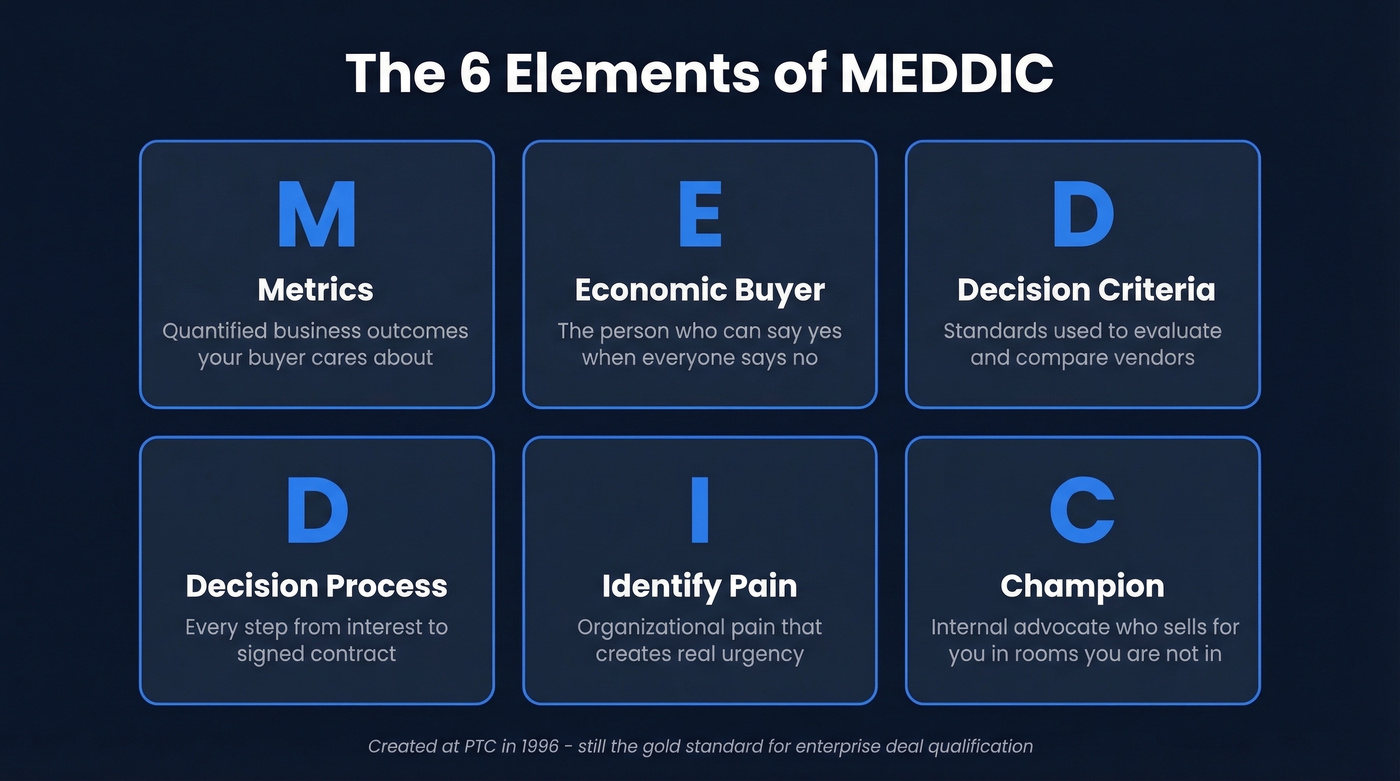
The Six MEDDIC Components
These are the highest-value questions from each element. Your team should develop 8-10 per element tailored to your industry, but start here.
Metrics
Most reps pitch features. MEDDIC reps pitch outcomes. "Our platform processes 10,000 records per second" is a feature. "You'll cut your data processing time from 14 hours to 90 minutes, freeing your ops team for strategic work" is a metric. The second version gets executive attention.
The distinction between "below the line" and "above the line" metrics matters more than most reps realize. Below the line means cost savings, efficiency gains, FTE reductions - these get procurement attention. Above the line means revenue growth, faster time-to-market, customer satisfaction improvements - these get the CEO's attention. Know which ones your champion is selling internally, because that determines how the deal gets framed in budget conversations you'll never be part of.
Discovery questions:
- What KPIs are you measured on this quarter?
- How are you quantifying the cost of the current problem?
- If we solve this, what does success look like in numbers your CFO cares about?
If your prospect can't articulate metrics, they haven't built an internal business case yet. That's not a bad thing - it means you get to help frame it. But don't mistake enthusiasm for urgency.
Economic Buyer
The Economic Buyer can say yes when everyone else says no, and say no when everyone else says yes. They control the budget. They sign off. If you don't meet the Economic Buyer or get their explicit approval, your chance of closing drops below 50%.
Discovery questions:
- Who has final sign-off authority on this budget?
- Has this person approved similar investments before?
- What would make them say no even if the team loves us?
Here's the thing: MEDDIC tells you to reach the Economic Buyer, but that step falls apart when your contact data is wrong. You can't run a qualification-compliant deal when you're guessing at email addresses for the VP of Finance. Prospeo's 98% email accuracy and 300M+ professional profiles solve the data layer so the methodology actually works.

Decision Criteria
Decision Criteria are the formal and informal standards your buyer uses to evaluate solutions - technical requirements, vendor requirements like security and compliance, and financial requirements like ROI thresholds and payback periods. Your job isn't just to learn these. It's to influence them before they're locked.
Ask your champion to share the internal evaluation scorecard. If one doesn't exist, offer to help build it. That's how you shape criteria. When you learn the Decision Criteria after the RFP drops, you've already lost - the evaluation was designed around someone else's strengths.
Discovery questions:
- What criteria will you use to compare vendors?
- Are there technical requirements that would disqualify a solution?
- How heavily does price weigh against capability in your evaluation?
Decision Process
Decision Process maps every step between "we like this" and "the contract is signed" - evaluation stages, internal approvals, legal review, security assessments, procurement workflows. Most reps understand the buying process up to the verbal yes. The gap between verbal yes and signed contract is where deals go to die.
Map the process on a timeline with your champion. If they can't fill in the steps between "team decision" and "signed contract," neither can you - and that's a red flag that they don't have the organizational influence to push this through.
Discovery questions:
- Walk me through what happens after your team decides to move forward.
- Who else needs to approve this besides the Economic Buyer?
- What's your typical timeline from decision to signed contract?
Identify Pain
Picture this: your champion loves the product, the demo went perfectly, and the trial is humming along. Then the deal stalls for three months. Why? Because nobody in the C-suite felt the pain. Your champion had a preference, not a problem.
Real pain creates urgency. Manufactured pain creates stalled deals. Pain that only one person feels isn't organizational pain - it's a feature request. Dig until you find pain that multiple stakeholders acknowledge. That's what gets budget allocated.
Discovery questions:
- What happens if you don't solve this problem in the next 6 months?
- How is this issue affecting your team's day-to-day work?
- Have you tried to fix this before? What happened?
Champion
Here's the test that separates a real Champion from a friendly contact: ask for a small internal favor. An introduction to the Economic Buyer. A shared document. Advance notice of a meeting agenda. If they can't or won't deliver, they're a coach at best - someone who takes your calls and shares information but won't spend political capital on your behalf.
A real Champion has organizational influence, credibility with the Economic Buyer, and a personal stake in your solution winning. They sell for you in meetings you're not invited to. The framework hinges on this distinction. Without a true Champion, even a perfectly scored deal can collapse.
Discovery questions:
- Why do you personally care about solving this?
- Have you championed a vendor purchase before? What happened?
- Would you be willing to introduce me to the Economic Buyer?
MEDDIC vs MEDDICC vs MEDDPICC
Let's be honest: the industry's obsession with adding letters is a distraction. Most teams can't even identify a real Champion, and they're debating whether they need a seventh or eighth element.
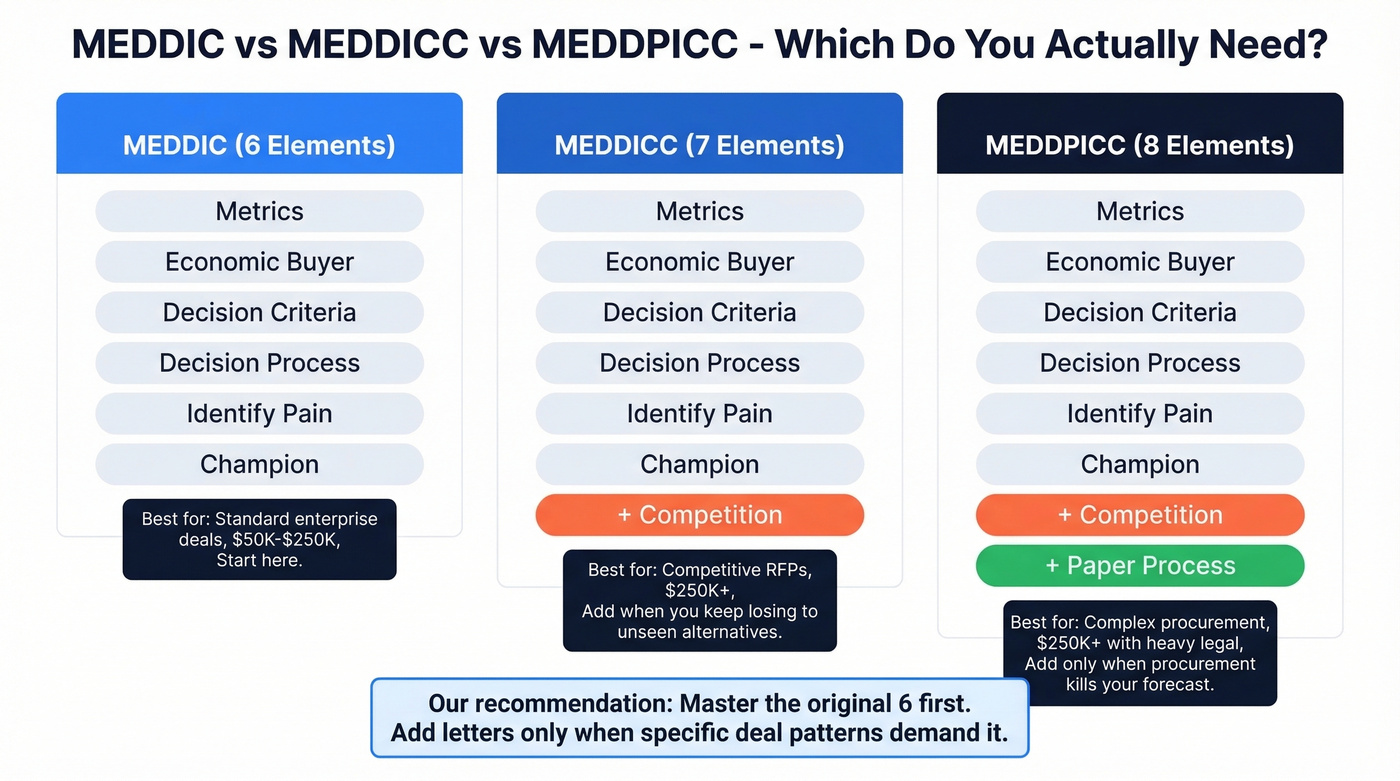
| Variant | Elements | Additions | Best For | Deal Size |
|---|---|---|---|---|
| MEDDIC | 6 | - | Standard enterprise | $50K-$250K |
| MEDDICC | 7 | Competition | Competitive RFPs | $250K+ |
| MEDDPICC | 8 | Paper Process + Competition | Complex procurement | $250K+ with legal |
Competition doesn't just mean other vendors. It includes the status quo ("do nothing"), internal build ("our engineers can do this"), and unrelated budget priorities ("we're spending that money on a new office"). If you're only tracking vendor competitors, you're missing the threats that actually kill deals.
Paper Process covers everything between the verbal yes and the signed contract: legal review, procurement workflows, MSAs, security questionnaires, DPAs, and signature authority chains. It's the #1 reason deals slip out of a quarter.
Our take: MEDDPICC is overkill for most companies. If you're selling $80K deals to mid-market companies, you don't need a formal Paper Process element - you need to ask two questions about procurement timelines during discovery. Start with the original six. Master them. Add Competition when you're consistently losing to alternatives you didn't see coming. Add Paper Process only when procurement complexity is genuinely derailing your forecast.
The MEDDIC Scorecard
This separates teams that operationalize the framework from teams that just talk about it. A scorecard turns subjective deal confidence into something you can actually debate in a pipeline review.
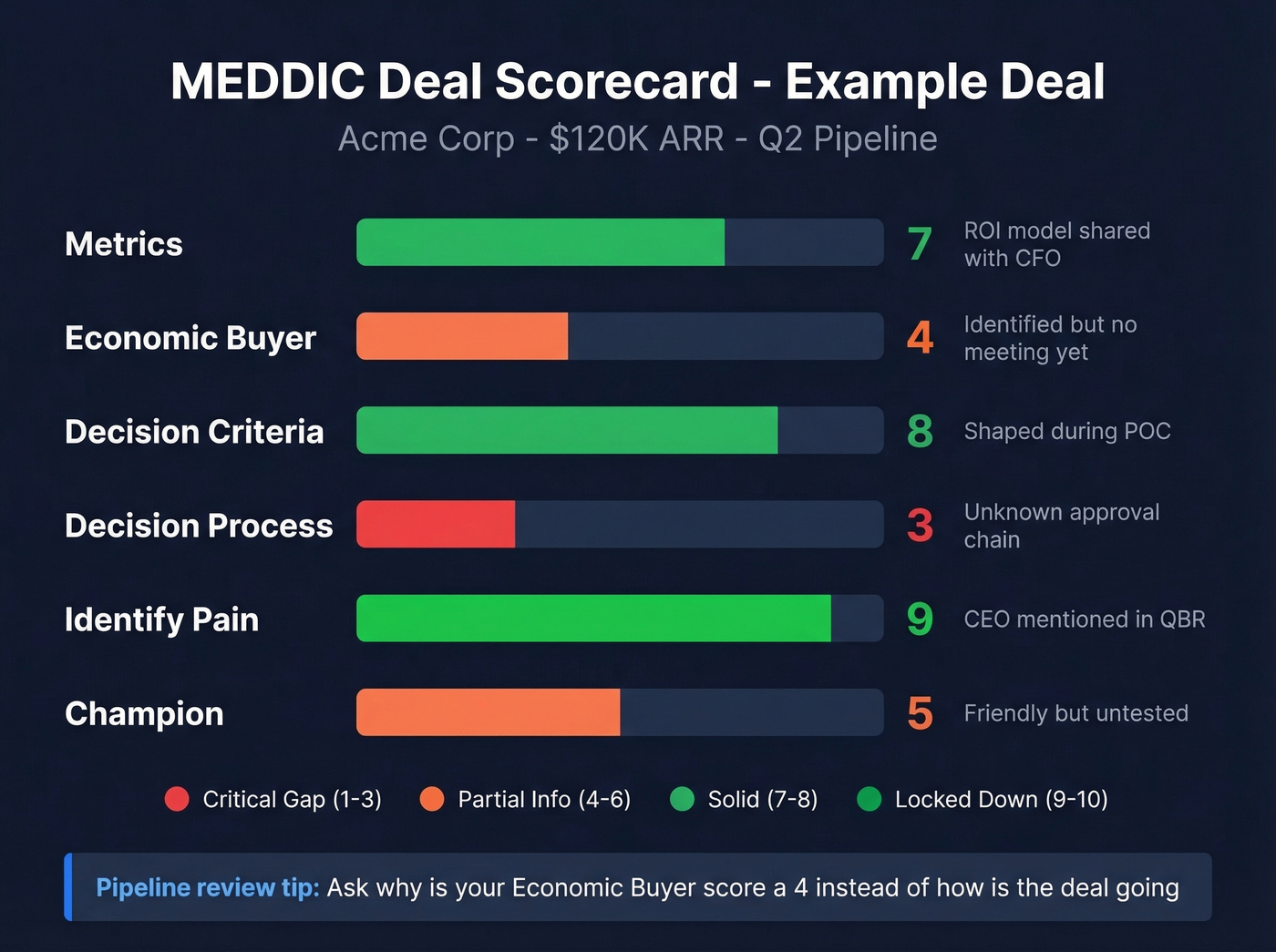
| MEDDIC Element | Score (1-10) | Color Band | Notes / Evidence |
|---|---|---|---|
| Metrics | 7 | Light Green | ROI model shared with CFO |
| Economic Buyer | 4 | Orange | Identified but no meeting |
| Decision Criteria | 8 | Light Green | Shaped during POC |
| Decision Process | 3 | Red | Unknown approval chain |
| Identify Pain | 9 | Dark Green | CEO mentioned in QBR |
| Champion | 5 | Orange | Friendly but untested |
Red (1-3): A critical gap that could kill the deal. Orange (4-6): Partial information with real risk. Light Green (7-8): Solid shape with room to strengthen. Dark Green (9-10): Locked down with evidence.
In pipeline reviews, don't ask "how's the deal going?" Ask "why is your Economic Buyer score a 4?" That forces reps to articulate what they don't know instead of narrating what they hope. A deal with three Red elements isn't in your forecast - it's in your pipeline. There's a difference, and the scorecard makes it visible.

MEDDIC only works when you can actually reach the Economic Buyer. Prospeo gives you 98% accurate emails and 125M+ verified mobile numbers for the decision-makers your deals depend on - so your qualification framework doesn't stall at the contact data layer.
Stop guessing at email addresses for the VP who signs the check.
Why MEDDIC Fails
Nobody puts these failure modes in the training deck.
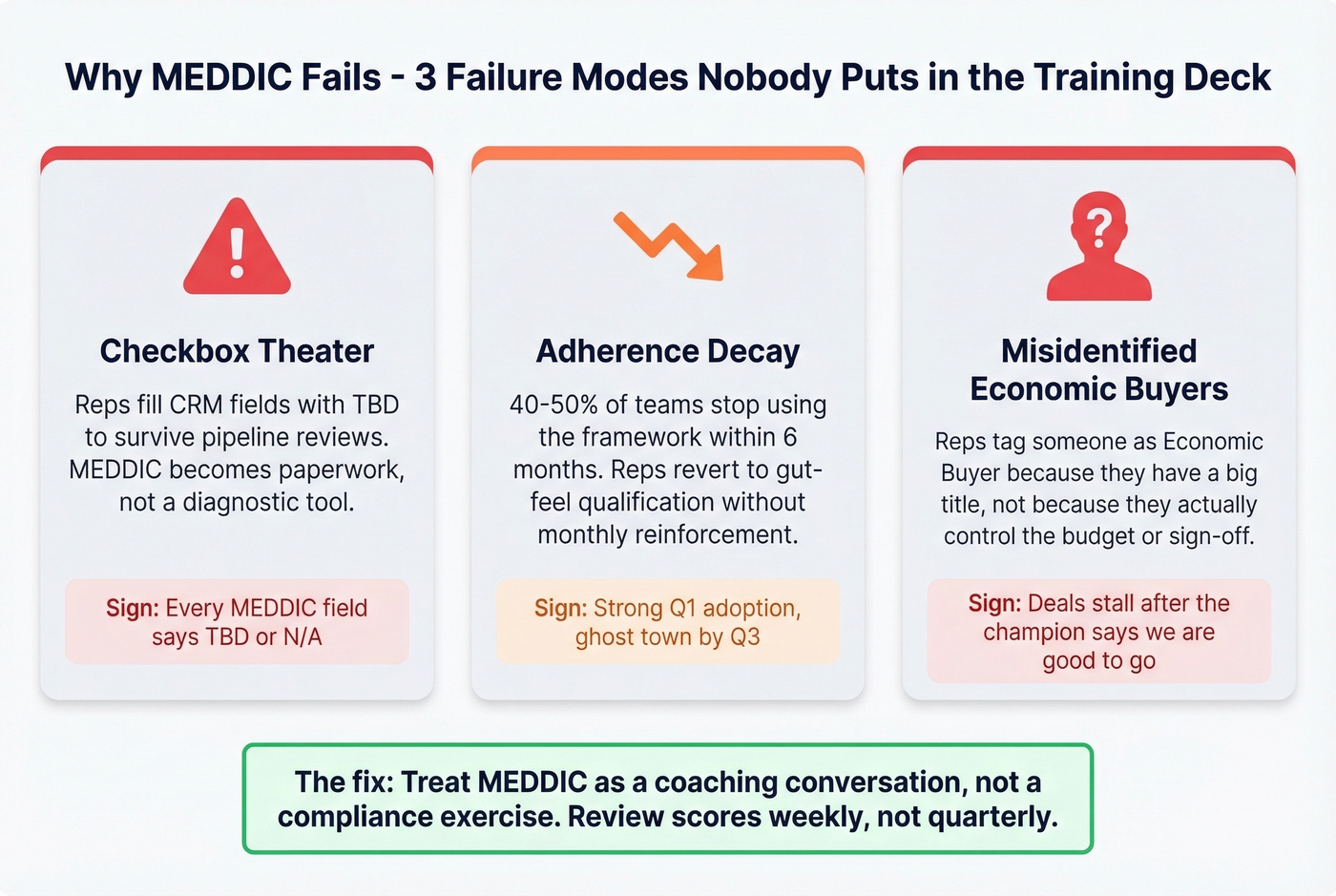
Checkbox theater. The consensus on r/sales is brutal: MEDDIC becomes "fields to make managers happy" and "checkboxes to survive pipeline reviews." Reps treat it like hard labor, not a diagnostic tool. If your fields are filled with "TBD," you don't have a qualification problem - you have a coaching problem. When any framework becomes paperwork, it actively damages the sales culture it was supposed to improve.
Adherence decay. Even well-implemented programs see 40-50% adherence decay within six months without active reinforcement. Reps learn the framework in a workshop, use it for a quarter, then gradually revert to gut-feel qualification. Monthly reinforcement sessions aren't optional.
Misidentified Economic Buyers. Reps tag someone as the Economic Buyer because they have a VP title and seem enthusiastic. Then the deal stalls because the actual budget authority sits two levels up. Always validate the EB by asking your Champion: "Has this person approved a purchase of this size before?"
False Champions. A contact who takes your calls and shares information isn't a Champion - they're a coach. A Champion actively advocates for your solution in internal meetings you're not invited to. Test them with a small ask. If they can't deliver, recalibrate your deal score immediately.
Stale data breaks the framework before it starts. You can't reach the Economic Buyer if their email bounces. You can't validate your Champion if their phone number is disconnected. We've seen teams with solid MEDDIC discipline still miss quota because their CRM data was six weeks old - the silent killer of otherwise sharp deal management.
Implement MEDDIC Without $100K Training
Formal training costs $100K-$500K through firms like Force Management or Winning by Design. You're paying for facilitation, not secret knowledge. The framework is public. The questions are public. The scorecard is a spreadsheet.
The self-serve path:
- Configure six CRM fields. One per element. Dropdown or text - just make them visible on the opportunity record.
- Build your scoring rubric. Define what a 3 looks like vs. a 7 for each element. Write it down. Share it with the team.
- Run weekly deal reviews using the scorecard. Pick the top 10 deals by value. Walk through each element. Ask "what's your evidence?" not "what's your score?"
- Coach to the framework, not the fields. When a rep has a Red score on Champion, don't say "go fill that in." Say "who's selling for you internally? What have they done to prove it?"
- Reinforce monthly. Share wins where the process caught a bad deal early. Celebrate reps who downgraded pipeline based on honest scoring.
For remote and hybrid teams, run virtual discovery calls with cameras on to read stakeholder reactions, use shared documents for async stakeholder mapping, and record calls so managers can coach against real conversations instead of CRM summaries. Use win/loss analysis quarterly to refine your scoring rubrics - what a "7" on Champion looks like should evolve as your team gets sharper.
MEDDIC vs BANT vs SPIN vs SPICED
No single framework fits every sales motion.
| Framework | Best For | Complexity | Ideal Deal Size | Buyer Alignment |
|---|---|---|---|---|
| BANT | SMB, transactional | Low | Under $50K | Budget-first |
| MEDDIC | Enterprise, multi-stakeholder | High | $50K-$500K+ | Process-first |
| SPIN | Consultative discovery | Medium | Any | Pain-first |
| SPICED | Change-heavy, consultative | Medium | $30K-$200K | Situation-first |
| CHAMP | Mid-market | Medium | $20K-$100K | Challenge-first |
BANT works for high-velocity sales where you need to qualify fast and move on. MEDDIC works when deals involve multiple stakeholders, long cycles, and real procurement complexity. SPIN is a discovery technique, not a qualification framework - it pairs beautifully with MEDDIC but doesn't replace it. SPICED and MEDDIC also complement each other - SPICED for early discovery, MEDDIC for deal progression and forecasting. Sandler's methodology focuses on mutual qualification, where the rep qualifies the buyer as much as the buyer qualifies the rep, and it pairs well with Champion validation.
The hybrid approach we recommend: use BANT as your initial screen to filter out deals that don't have budget or authority. For anything that passes and looks like a real enterprise opportunity, switch to MEDDIC for deeper qualification.
Hot take: If your average contract value is under $25K, you probably don't need MEDDIC at all. The qualification overhead will slow your velocity without proportional improvement in win rates. The framework's power scales with deal complexity, not deal volume. A team closing 200 deals a quarter at $15K each needs speed, not six-element scorecards.
Does MEDDIC Actually Work?
The results speak for themselves:
- PTC (where it all started): grew from $300M to $1B in revenue over four years after adoption.
- Branch: reduced sales cycles by 30% while doubling deal size.
- Poq: hit 103% of target with less than 10% forecast variance.
- Rocketium: identified a 2.7X potential revenue increase opportunity after implementing deal scoring.
The broader numbers tell the same story. Teams using this approach report 28% higher win rates. Forecast variance drops from 30-50% to under 10% for enterprise deals. And the forecast accuracy jump from 62% to 89% we mentioned at the top? That's what happens when the MEDDIC sales process is mapped correctly to your enterprise motion.
MEDDIC doesn't make bad reps good. It makes good reps consistent. And it gives managers a shared language to coach with instead of asking "so, how's that deal feeling?"
Your Champion can't introduce you to stakeholders you can't contact. With 300M+ profiles, 30+ search filters, and a 7-day data refresh cycle, Prospeo maps the entire buying committee before your first discovery call - so every MEDDIC element has a real person behind it.
Map the full buying committee in minutes, not weeks.
FAQ
Is MEDDIC a methodology or a qualification framework?
It's a qualification framework that tells you whether a deal is real - not how to sell. Pair it with Challenger, SPIN, or Sandler for a complete selling system. The framework scores deal health; the methodology guides your conversations.
Which MEDDIC variant should I use?
Start with standard MEDDIC for deals between $50K-$250K. Add Competition (MEDDICC) when you regularly lose to alternatives you didn't anticipate at $250K+. Only adopt MEDDPICC when multi-layer legal and procurement approvals are consistently slipping your deals.
How long does implementation take?
CRM configuration takes a day; meaningful adoption takes 2-3 months of weekly deal reviews. Plan for monthly reinforcement from the start - adherence decays 40-50% within six months without it.
Can I use MEDDIC for SMB sales?
Skip it for SMB. The framework adds qualification friction that slows short-cycle deals. For contracts under $50K or cycles under 30 days, BANT gives you faster qualification with less overhead per opportunity.
How do I find and reach the Economic Buyer?
Map the org chart through your Champion, ask for direct introductions, and verify contact data before outreach. Stale CRM records are the #1 reason reps never reach the budget holder they've already identified - a data platform with a weekly refresh cycle fixes that gap.