

MEDDIC vs MEDDPIC: The Real Difference and Which One Your Team Needs
Stop debating acronyms. When you compare MEDDIC vs MEDDPIC, the difference comes down to one question: can the person who says "yes" also sign the contract?
Gartner found that 74% of B2B buyer groups experience "unhealthy conflict" during purchase decisions - and groups that reached internal consensus were 2.5x more likely to report the deal as on track. Meanwhile, Gong's productivity research shows 56% of seller time gets burned on unqualified or low-potential leads. Qualification frameworks exist to fix both problems, but only if your team actually uses them.
30-Second Verdict
MEDDPIC adds one letter to MEDDIC: Paper Process - the legal, procurement, and administrative steps between a verbal "yes" and a signed contract. If your deals touch procurement departments, security reviews, or legal redlines, you need MEDDPIC. If your buyer can sign the contract themselves, MEDDIC is enough.
That's it. Everything else is nuance.
MEDDIC Explained
Dick Dunkel created MEDDIC at PTC in the 1990s to solve a straightforward problem: reps were inconsistent at qualifying deals, and leadership couldn't figure out why some closed while others stalled indefinitely.
| Letter | Stands For | What It Means |
|---|---|---|
| M | Metrics | Quantified value your solution delivers |
| E | Economic Buyer | Person with final budget authority |
| D | Decision Criteria | Technical, financial, vendor requirements |
| D | Decision Process | Steps from eval to signed deal |
| I | Identify Pain | The business problem driving urgency |
| C | Champion | Internal advocate selling on your behalf |
Metrics break into two camps. "Below the Line" covers cost savings, FTE reduction, and efficiency gains - the stuff end users care about. "Above the Line" means revenue growth, time-to-market, and customer satisfaction - what the Economic Buyer cares about. A practical heuristic: a $50K solution needs to justify $200K+ in impact. Buyers expect a 4:1 to 5:1 return before they'll move.
Here's the thing: if you don't meet the Economic Buyer or get their explicit approval, your close probability drops below 50%. That single letter is where most deals die quietly, and it's the one reps are most likely to skip because "my Champion said they'll handle it internally."
What Paper Process Adds
Paper Process covers the legal, procurement, and administrative steps required to finalize a deal - contract redlines, security questionnaires, vendor onboarding forms, and procurement approval chains. Many orgs treat Paper Process as implied within Decision Process, but MEDDPIC makes it explicit and inspectable.
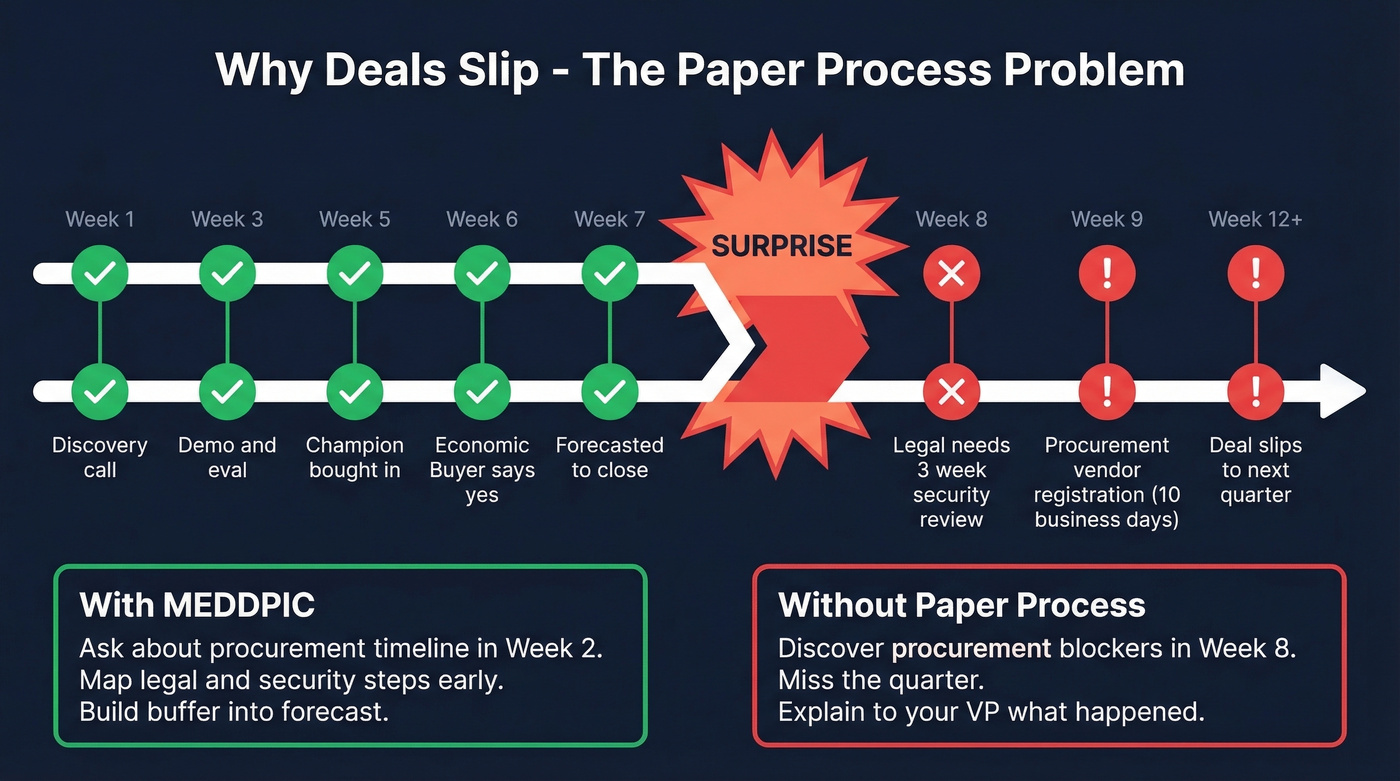
Why bother separating it? Because Paper Process is the #1 reason deals slip out of a quarter.
Picture this: you've got an $80K deal. Champion's bought in, Economic Buyer said yes in week 6, and you're forecasting it for end-of-quarter. Then legal needs three weeks for a security review nobody mentioned. Procurement requires a vendor registration that takes 10 business days. Your deal slips to next quarter, your forecast is wrong, and your VP is asking what happened. We've seen this exact scenario play out dozens of times - and it's almost always preventable if someone had asked about the procurement timeline in week 2 instead of week 8.
Use MEDDPIC if: your deals touch procurement, legal, or security teams. Skip the P if: your buyer can sign the contract themselves, typically in SMB or self-serve motions with short cycles.

Your MEDDPIC framework is only as strong as your ability to reach the Economic Buyer directly. Prospeo gives you 98% accurate emails and 125M+ verified mobile numbers - so you skip the gatekeeper and get the meeting that decides your deal.
Stop qualifying deals you can't close because you can't reach the decision-maker.
All Four Variants Compared
The MEDDIC vs MEDDPICC debate often overshadows the middle ground. Understanding the full spectrum helps you pick the right level of complexity.
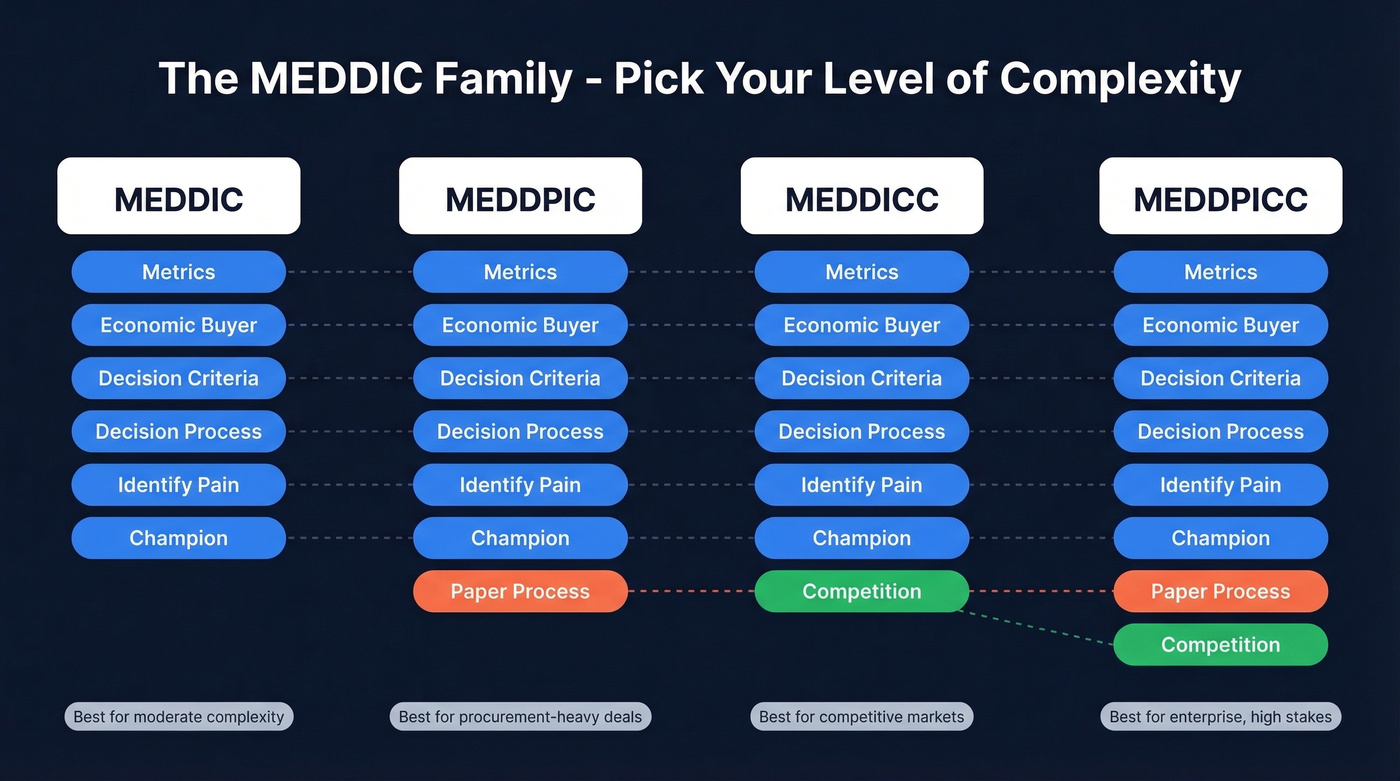
| Element | MEDDIC | MEDDPIC | MEDDICC | MEDDPICC |
|---|---|---|---|---|
| Metrics | ✓ | ✓ | ✓ | ✓ |
| Economic Buyer | ✓ | ✓ | ✓ | ✓ |
| Decision Criteria | ✓ | ✓ | ✓ | ✓ |
| Decision Process | ✓ | ✓ | ✓ | ✓ |
| Identify Pain | ✓ | ✓ | ✓ | ✓ |
| Champion | ✓ | ✓ | ✓ | ✓ |
| Paper Process | - | ✓ | - | ✓ |
| Competition | - | - | ✓ | ✓ |
According to Ebsta's B2B Sales Benchmarks, 73% of SaaS companies selling above $100K ACV use some version of MEDDPICC, and full adoption is associated with 18% higher win rates and 24% larger deal sizes. Adoption doubled from 11% to 21% among B2B sales orgs between 2021 and 2022.
MEDDPIC is the most underrated variant. Most teams jump straight to MEDDPICC because it sounds more complete, but if Paper Process - not Competition - is your primary deal-killer, MEDDPIC is the right call. Adding Competition tracking before your team has internalized the first seven letters just creates more fields nobody fills out.
Which Framework Should You Use?
| Factor | MEDDIC | MEDDPIC | MEDDPICC |
|---|---|---|---|
| Sale complexity | Moderate | High | Very high |
| Procurement involved | Rarely | Yes | Yes |
| Competitive pressure | Low | Any | High |
| Legal/security review | Minimal | Significant | Significant |
| Team readiness | New to frameworks | Some experience | Mature org |
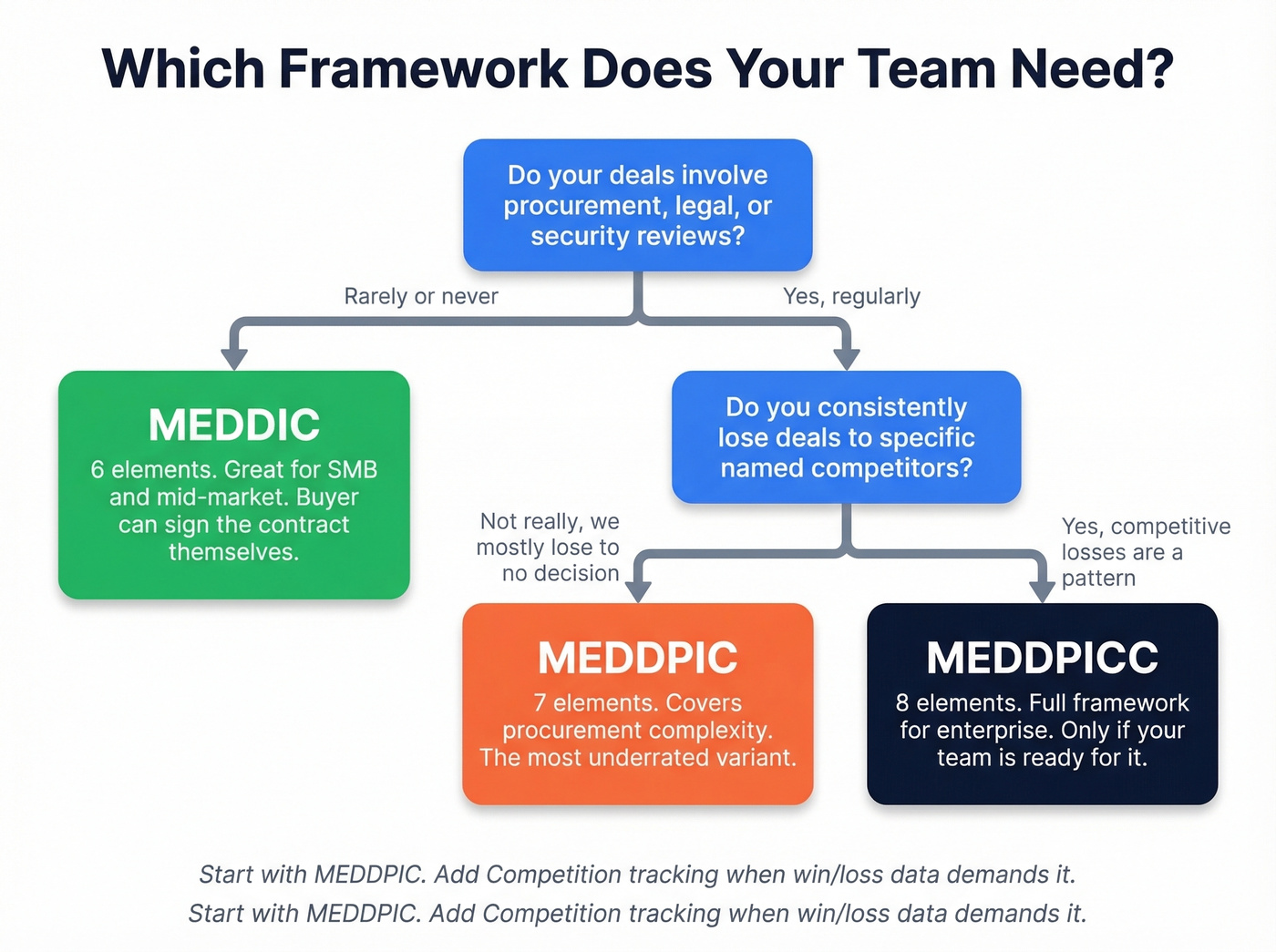
Our recommendation: start with MEDDPIC. Add Competition tracking when your win/loss reviews consistently show you're losing to specific competitors rather than to "no decision." We've watched teams adopt MEDDPICC on day one and end up with eight empty CRM fields per opportunity. The framework you actually use beats the framework you theoretically prefer.
Discovery Questions Per Letter
The best reps weave these into natural conversation. Your prospect shouldn't feel like they're filling out a form.
Metrics - What key metrics define success for this initiative? If we implement, how would you measure ROI in the first 90 days?
Economic Buyer - Who has final purchasing authority - and can I meet them? What does success look like from their perspective?
Decision Criteria - What are your top three must-haves? Are there compliance requirements that could disqualify a vendor?
Decision Process - Walk me through the steps from today to a signed contract. Who else needs to weigh in?
Identify Pain - What's the cost of doing nothing for another six months? How's this problem affecting your team day-to-day?
Champion - Who internally is sponsoring this initiative? Have they confirmed the quantified business impact with leadership?
Paper Process (MEDDPIC addition) - What's your typical contract review timeline? Are there security or compliance checks we should plan for?
Implement Without Checkbox Fatigue
Let's be honest about where most MEDDIC rollouts fail. The consensus on r/sales is blunt: "Reps fill out fields to make managers happy. Managers check boxes to survive pipeline reviews. Nobody uses it to decide the true state of a deal." Some reps argue all methodologies boil down to the same fundamentals - need, budget, stakeholders, timeline. They're not wrong. MEDDIC just gives those fundamentals a repeatable inspection structure.
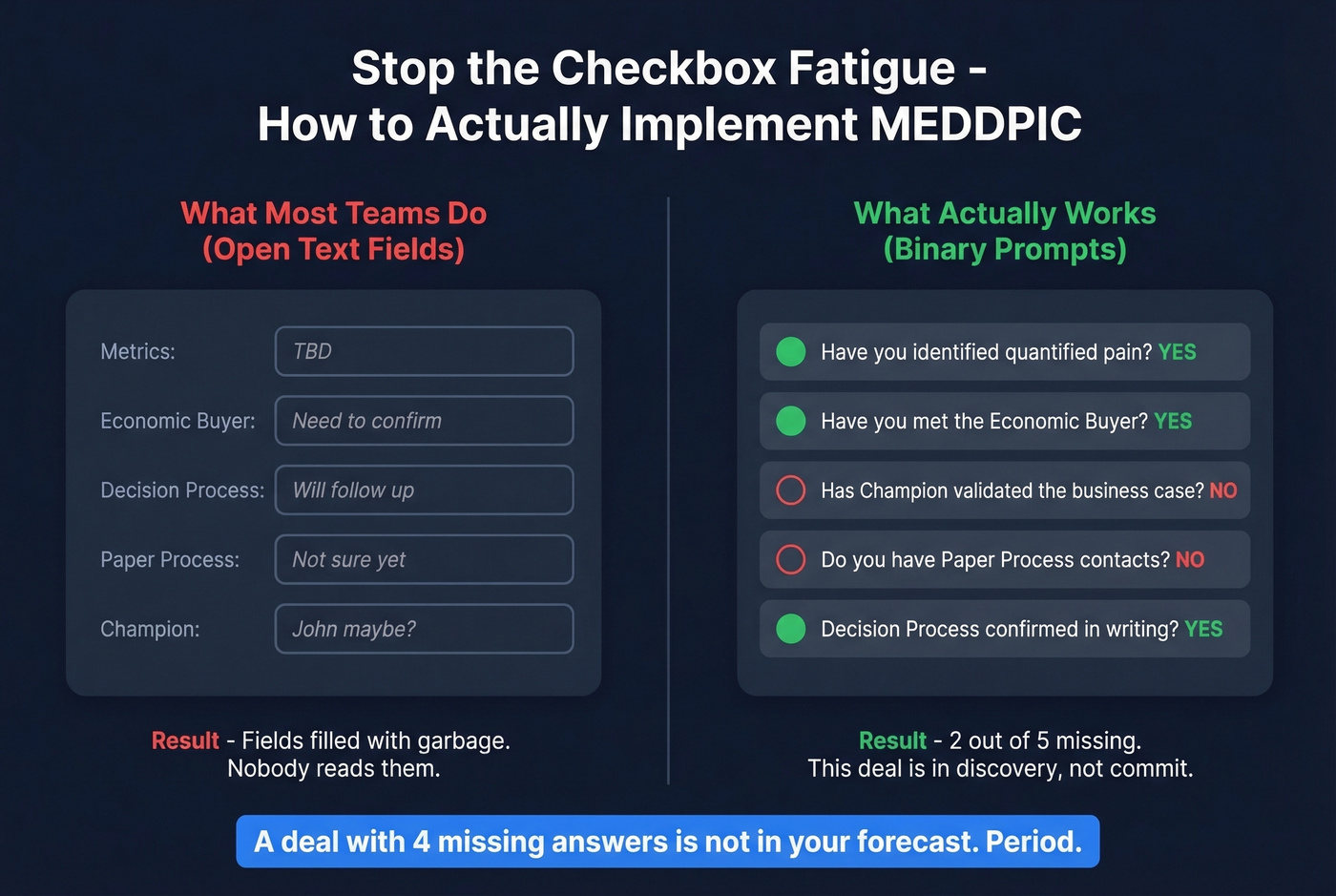
If your reps treat the framework as a CRM exercise, the problem isn't the methodology. It's your implementation. Embed binary yes/no prompts directly into your CRM instead of open text fields:
- Have you identified the prospect's quantified pain?
- Have you met or confirmed the Economic Buyer?
- Has your Champion validated the business case with leadership?
- Do you have contact info for everyone in the Paper Process?
- Has the Decision Process been confirmed in writing?
Binary prompts drive better CRM compliance than open text. A deal with four "no" answers isn't in commit - it's in discovery. That clarity is what qualification frameworks are supposed to provide.
But every variant falls apart when CRM data goes stale. You can't qualify the Economic Buyer if you're emailing the wrong person, and you can't execute Paper Process outreach without the procurement contact's verified email. In our experience, the fastest fix is making sure your contact data is accurate before you start scoring deals against any framework. Prospeo's 98% email accuracy and 7-day data refresh cycle means your CRM reflects reachable stakeholders, not outdated placeholders.
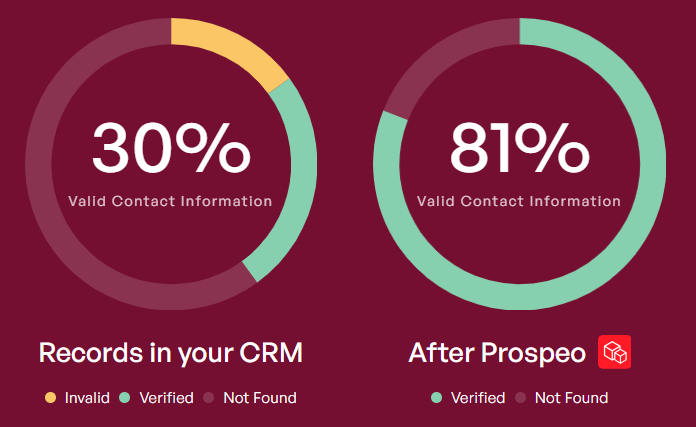
Discovery questions don't matter if you're asking the wrong person. Prospeo's 30+ search filters - including buyer intent, job changes, and department headcount - help you identify and reach Champions and Economic Buyers before your competitor does.
Map the entire buying committee for $0.01 per verified email.
FAQ
What's the difference between MEDDPIC and MEDDPICC?
MEDDPICC adds Competition tracking on top of MEDDPIC's Paper Process. If competitive intelligence consistently drives your win/loss outcomes, go with MEDDPICC. If procurement complexity is your main deal-killer, MEDDPIC covers it without adding fields your reps won't fill out.
Do I need MEDDIC certification?
No. MEDDIC is a qualification framework, not a proprietary methodology requiring a license. Train your team on the letters, embed binary prompts in your CRM, and coach through weekly deal reviews. Certification courses exist but aren't required to run the framework effectively.
How do I keep MEDDIC data accurate in my CRM?
Start with accurate contact data. If your Economic Buyer and Champion fields contain guesses, the framework can't function. Prospeo's email finder verifies emails and mobile numbers in real time - with a 92% API match rate and 50+ data points per enrichment - so your CRM reflects reachable stakeholders instead of outdated records.
When should I upgrade from MEDDIC to MEDDPIC?
Upgrade when deals regularly slip past their forecasted close date due to procurement, legal, or security reviews. If more than 20% of your "verbal yes" deals miss the quarter because of administrative bottlenecks, Paper Process tracking will immediately improve forecast accuracy.