

Mekashron CRM: Pricing, Reviews, and Honest Pros & Cons (2026)
Mekashron CRM is one of those products where nothing lines up cleanly. Pricing on directory sites doesn't match the vendor's own page, there are essentially zero user reviews anywhere, and you can't tell if it's a hidden gem or software that time forgot. We dug into the actual product so you don't have to guess.
30-Second Verdict
Mekashron is a desktop CRM with a built-in auto-dialer, and it has a genuine cost advantage for on-prem call centers running 5+ agents. We checked the product pages, ran the pricing math, and looked at every major review platform. The base-plus-$21/license model can undercut cloud contact center platforms by thousands per year. But a near-zero public review footprint and desktop-only architecture make it a hard sell for remote or cloud-first teams.
If that describes you, skip straight to the alternatives section.
Pricing Breakdown
G2 lists Mekashron at $29-$59/mo and Slashdot shows $29/mo. That data is stale - G2's listing was last updated in October 2024, and it doesn't reflect current official pricing.
The actual Mekashron pricing page tells a different story:
| Business v7 | Call Center v7 | |
|---|---|---|
| Base (1 user) | $99/mo | $129/mo |
| 5 users | $183/mo | $213/mo |
| 10 users | $288/mo | $318/mo |
| 20 users | $498/mo | $528/mo |
Each additional license beyond the base costs $21/mo. That's the real math, and it's meaningfully different from what the directories show.
How Does It Compare on Cost?
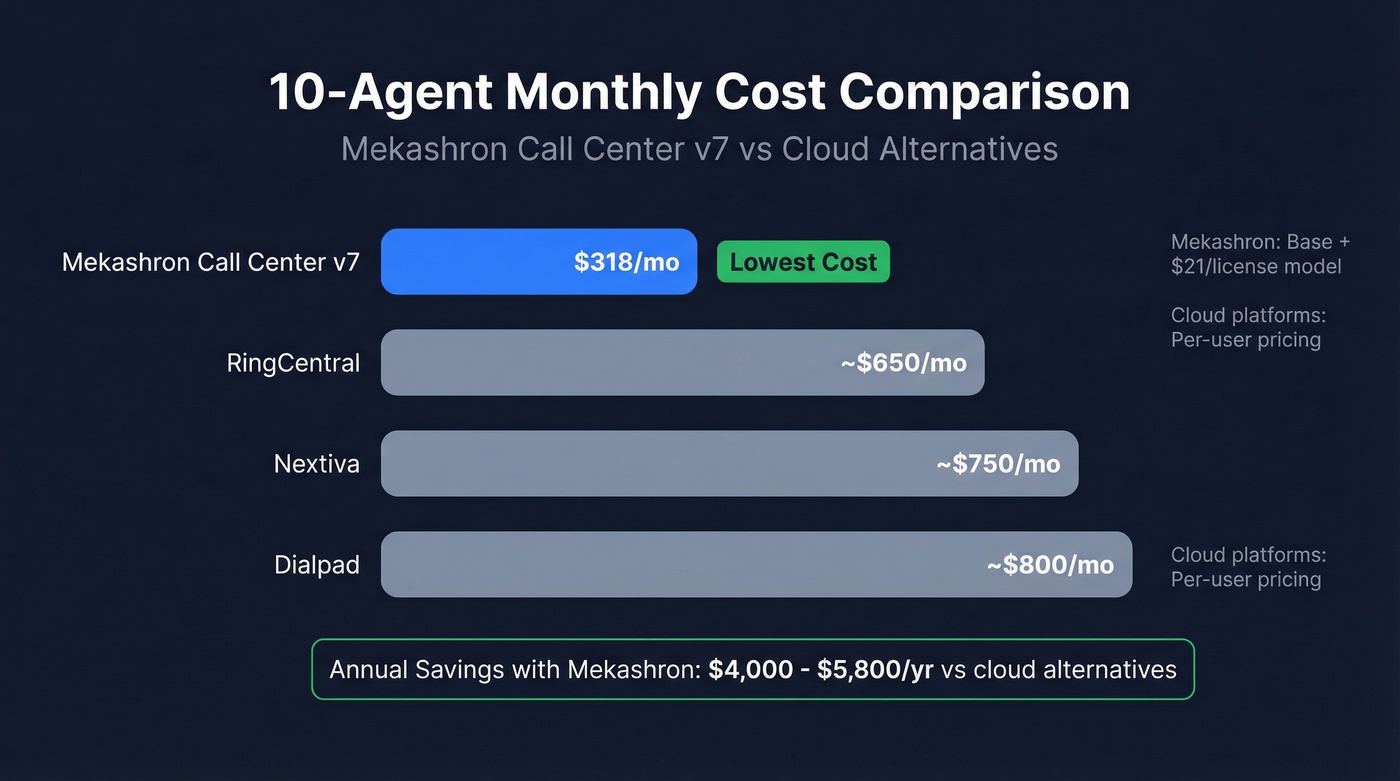
This is where the model gets interesting. Cloud call center platforms charge per user, and those costs stack fast. At 10 agents, the gap is significant:
| Platform | 10-Agent Monthly | Model |
|---|---|---|
| Mekashron Call Center v7 | $318 | Base + $21/license |
| RingCentral | ~$650 | Per-user |
| Nextiva | ~$750 | Per-user |
| Dialpad | ~$800 | Per-user |
That's $4,000-$5,800/year in savings versus cloud alternatives. For a small call center watching every dollar, that number matters. The tradeoff is real, though: you're managing your own infrastructure instead of paying someone else to handle it, and that IT burden isn't free even if it doesn't show up on a SaaS invoice.
Key Features
Mekashron bundles more than you'd expect from a desktop CRM at this price point. The core offering combines contact management and billing in a single app - you can track invoices, charge credit cards, and manage subscriptions without switching tools. Calendar sync works with both Outlook and Google Calendar, and data import supports Excel, CSV, and Access files with built-in duplicate checking.
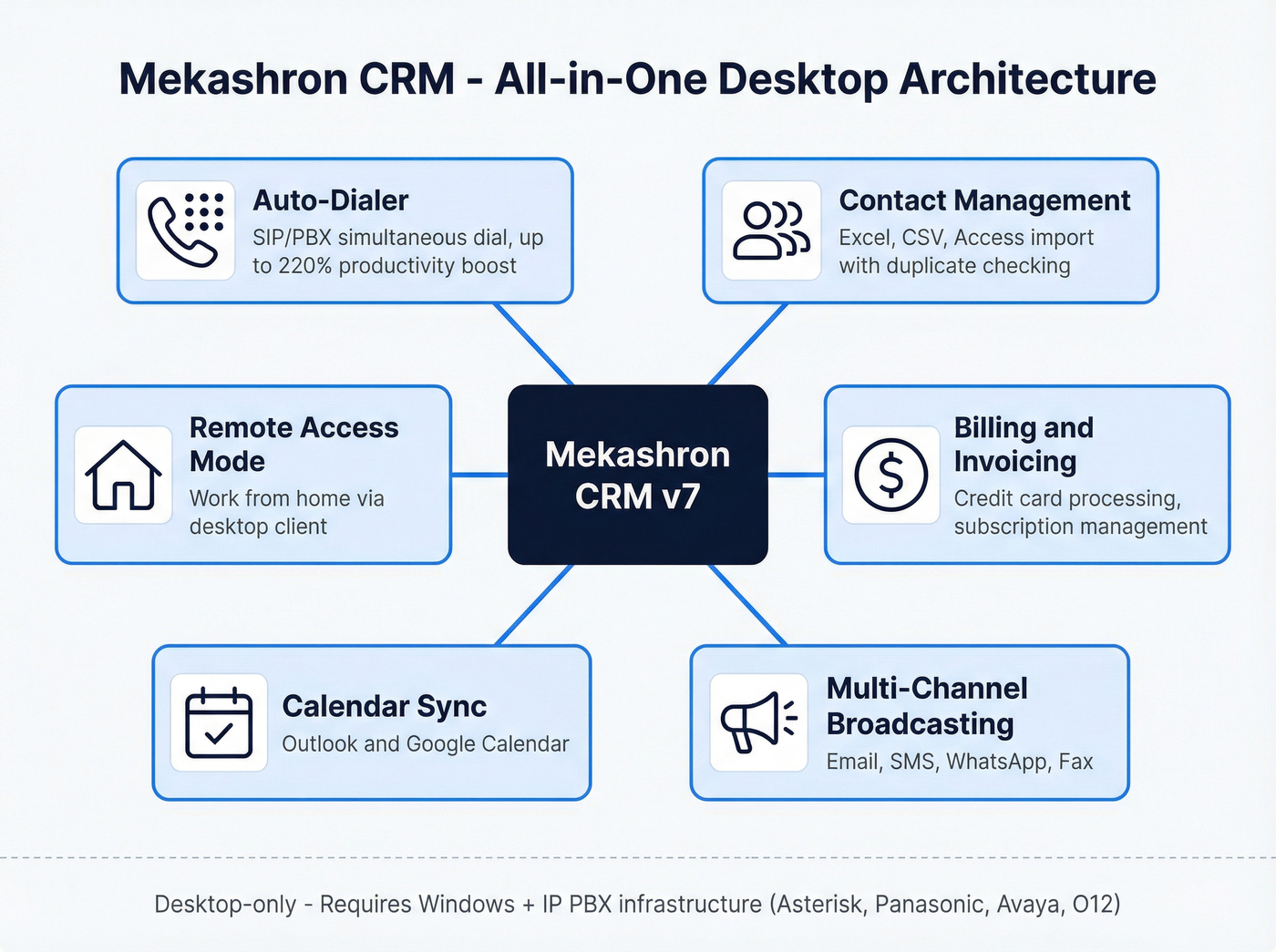
The real differentiator is the auto-dialing architecture. Agents in manual workflows spend more than 50% of their shift calling busy, unanswered, or invalid numbers. Mekashron's SIP/PBX simultaneous-dial approach flips that ratio by routing only answered calls to agents, with a vendor-reported productivity improvement of up to 220%. Multi-channel broadcasting rounds out the package - email, SMS, WhatsApp, and fax all fire from within the CRM. There's also a remote-access "work from home" mode, though it's still a desktop client, not browser-based.

Mekashron's auto-dialer promises 220% productivity gains - but only if agents reach real people. Prospeo delivers 125M+ verified mobile numbers with a 30% pickup rate and 98% email accuracy, refreshed every 7 days. Export clean CSVs directly into any CRM or dialer for about $0.01 per email.
Stop burning agent hours on dead numbers. Start with verified contacts.
Pros and Cons
Pros:
- Dramatic cost savings at scale - $318/mo for 10 agents vs ~$650-$800 at cloud competitors
- CRM, dialer, billing, and broadcasting in a single desktop app
- Up to 220% productivity improvement via auto-dialing with answered-call routing (vendor figure)
- Full data ownership with on-prem deployment
- SIP-based telephony tested with Panasonic, Avaya, and O12 PBX systems
Cons:
- Desktop-only - no browser access, no native mobile app
- Requires existing IP PBX infrastructure (Asterisk recommended if you don't have one)
- Zero reviews on G2, zero ratings on Slashdot, nothing on SourceForge or CrowdReviews
- IT maintenance burden falls entirely on your team
- Minimal online presence creates real trust barriers for new buyers
Who Should Use Mekashron
Good fit if you run an on-prem call center with existing PBX infrastructure, you've got 5+ agents, and per-user cloud pricing is eating your budget. The combined CRM/dialer/billing package at $21/license is hard to beat on pure cost.
Skip this if your team is remote-first, you don't have PBX infrastructure and don't want to set up Asterisk, you need browser or mobile access, or you need a product with any kind of public review track record.
Here's a hot take: if your average deal size is under $5k and you're running fewer than five agents, the cost advantage evaporates. At that scale, a cloud dialer with zero infrastructure overhead will save you more in IT hours than you'd save on licensing.
Whatever CRM you choose, the contact data you import determines your ROI. An auto-dialer burning through dead numbers wastes the exact agent hours Mekashron promises to save. We've seen teams using Prospeo's CSV exports - with 98% email accuracy and a 7-day data refresh cycle - cut through that problem by importing contacts that actually pick up.
The Review Gap Problem
Let's be honest about this. UpdateStar added Mekashron Call Center to its database back in October 2010. That's over 15 years ago. In all that time, the product has accumulated zero reviews on G2, zero ratings on Slashdot, and nothing on SourceForge or CrowdReviews. We also checked Reddit and broader forums - no meaningful threads to speak of.
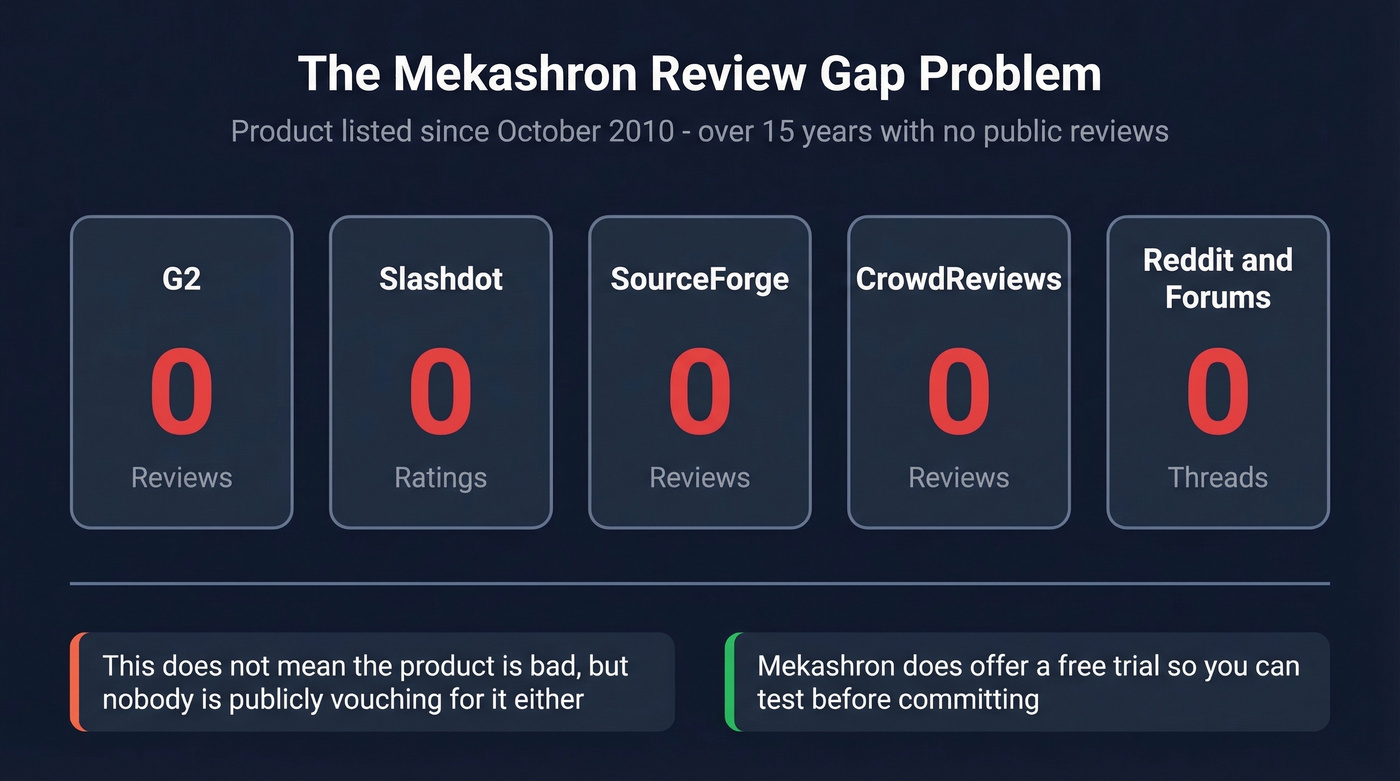
In our experience evaluating CRM tools, a product that's been around this long with essentially no public feedback is a significant trust barrier. It doesn't mean the product is bad. But nobody's publicly vouching for it either, and that should factor into your decision. Mekashron does offer a free trial, so you can form your own opinion before committing any real money.
Alternatives Worth Considering
If the desktop architecture or the review vacuum gives you pause, these are worth evaluating:
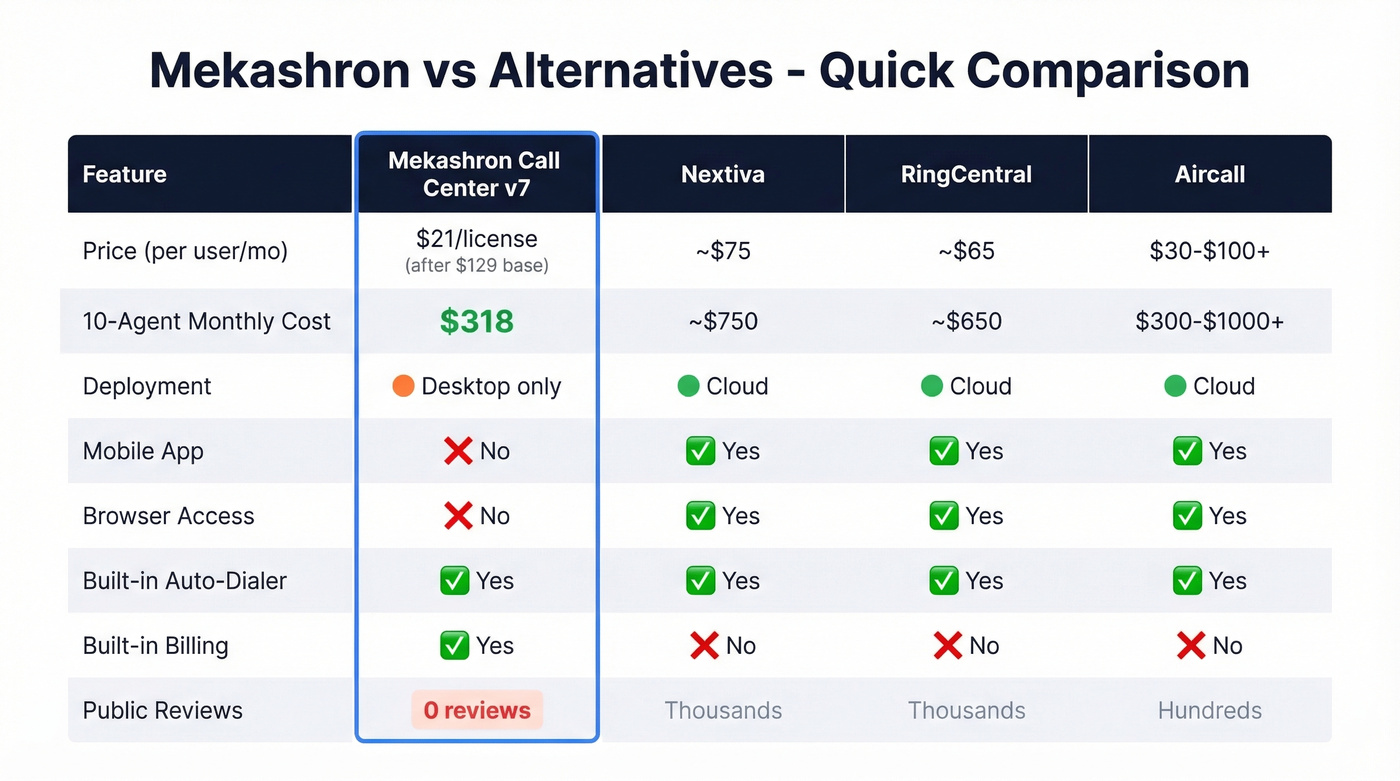
Nextiva (~$75/user/mo) is a cloud-based call center platform for teams that want CCaaS without managing infrastructure. It's pricier per seat but eliminates the IT overhead entirely.
RingCentral (~$65/user/mo) offers enterprise-grade contact center features with broad integrations and full mobile access. Good for distributed teams that need flexibility.
Aircall (~$30-$100+/user/mo) is a lightweight cloud dialer that deploys fast and works well for smaller teams. Less feature-dense than Mekashron's all-in-one approach, but far easier to get running.
Whichever CRM you land on, bad phone numbers and dead emails waste the agent hours your platform is supposed to save. Prospeo offers a free tier with 75 verified emails per month to test data quality, and paid plans run about $0.01 per email - clean CSVs ready for import into any of these platforms.
Whether you pick Mekashron, RingCentral, or Aircall, your contact data determines your ROI. Prospeo's 300M+ profiles with 5-step verification and 7-day refresh cycles mean every import is current. Teams using Prospeo book 35% more meetings than Apollo users.
Bad data costs more than any CRM subscription. Fix it at the source.
FAQ
Is Mekashron cloud-based?
No. It's a Windows desktop client that connects to your PBX via SIP. There's no browser access or native mobile app, though a remote "work from home" mode exists for off-site agents connecting to the same on-prem server.
Why do prices differ across websites?
G2 ($29-$59/mo) and Slashdot ($29/mo) show outdated directory data. The official page lists $99/mo for Business v7 and $129/mo for Call Center v7, with $21/mo per extra license. Always check the vendor's site directly.
How do I get contact data into Mekashron?
Mekashron supports importing from Excel, CSV, and Access files with duplicate checking. You can export verified email and phone lists as CSV from tools like Prospeo and import them directly - so your agents aren't wasting shifts on disconnected numbers.