

The Need Objection: Why Prospects Say "I Don't Need This" and What to Say Back
You're 45 seconds into a cold call and the prospect cuts you off: "We don't need that." Your instinct is to pitch harder. That instinct is wrong - and there's a mountain of call data to prove it.
The need objection isn't a dead end. A Xerox study found that sales calls with no objections are 24% less likely to result in a sale. Polite silence is the real killer.
The Short Version
- "I don't need this" is usually a brush-off or status quo defense, not a real assessment. An analysis of 300M+ cold calls shows 49.5% of objections are dismissive.
- The single best response: pause 5x longer than your instinct says, make a calm guess about the real blocker, then shut up.
- If you're hearing it on more than 30% of calls, the problem isn't your pitch. It's your targeting.
What "I Don't Need This" Actually Means
Most objection-handling guides are useless here because they lump "I don't need this" in with 20 other objections and hand you a generic script. The reality is it means three very different things - and each one demands a different response.
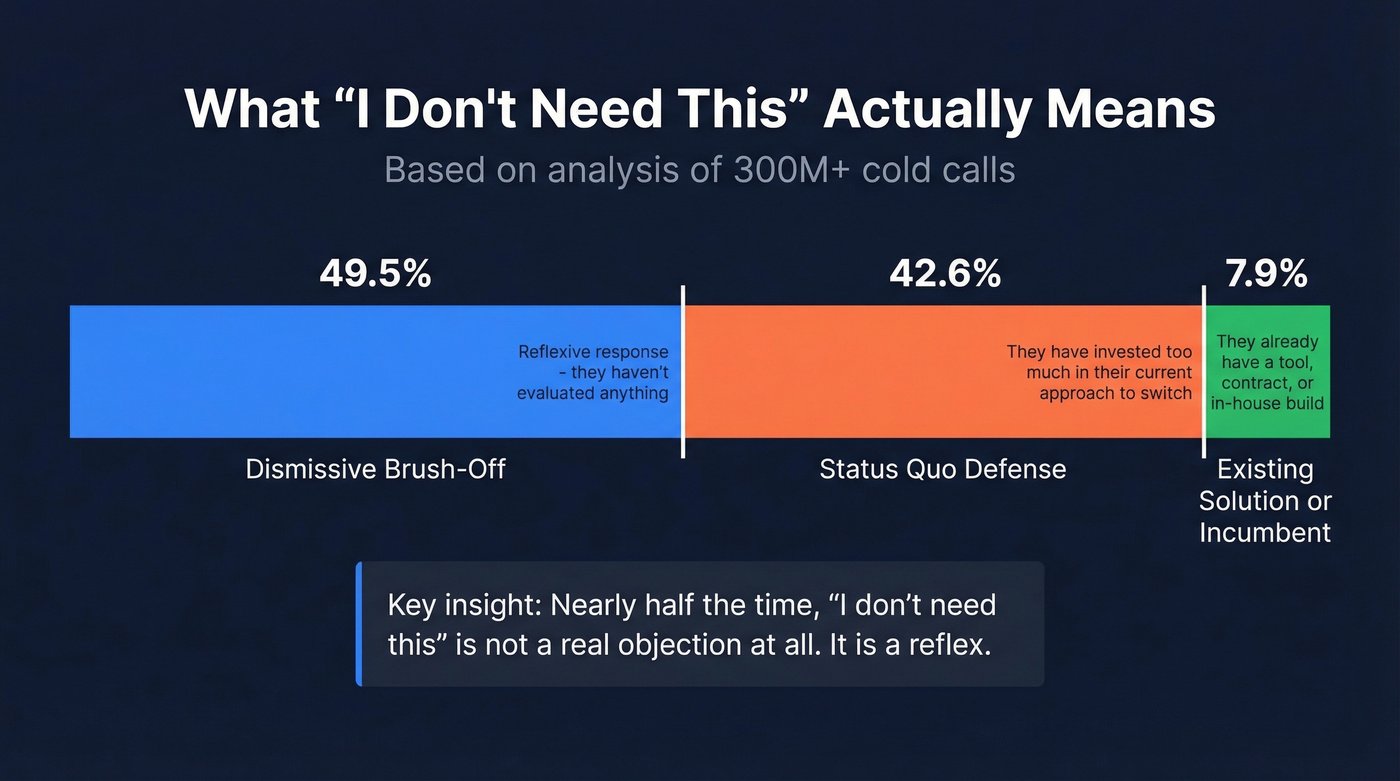
Dismissive brush-off (49.5% of cold call objections). The prospect hasn't evaluated anything. They're reflexively ending the conversation. Traditional frameworks bucket objections into budget, timing, need, and authority, but need is the most misunderstood of the four because nearly half the time, it's not a real objection at all. It's a reflex.
Status quo defense (often shows up as situational objections - 42.6%). They've invested time, political capital, or budget into a current approach. By the time you engage, buyers have often completed 60-80% of their decision process. "I don't need this" really means "I can't justify abandoning what I've already built."
Existing solution or incumbent (7.9%). Sometimes "we don't need this" is really "we already have something" - in-house, a competitor, or a contract they're locked into.
And sometimes they genuinely don't need it. Respect that when it's real.
The Psychology Behind It
Loss aversion explains most of these objections. Prospect Theory shows people fear loss roughly twice as much as they value equivalent gains. In B2B, that translates directly to status quo bias: switching feels riskier than staying put, even when the current solution is mediocre.
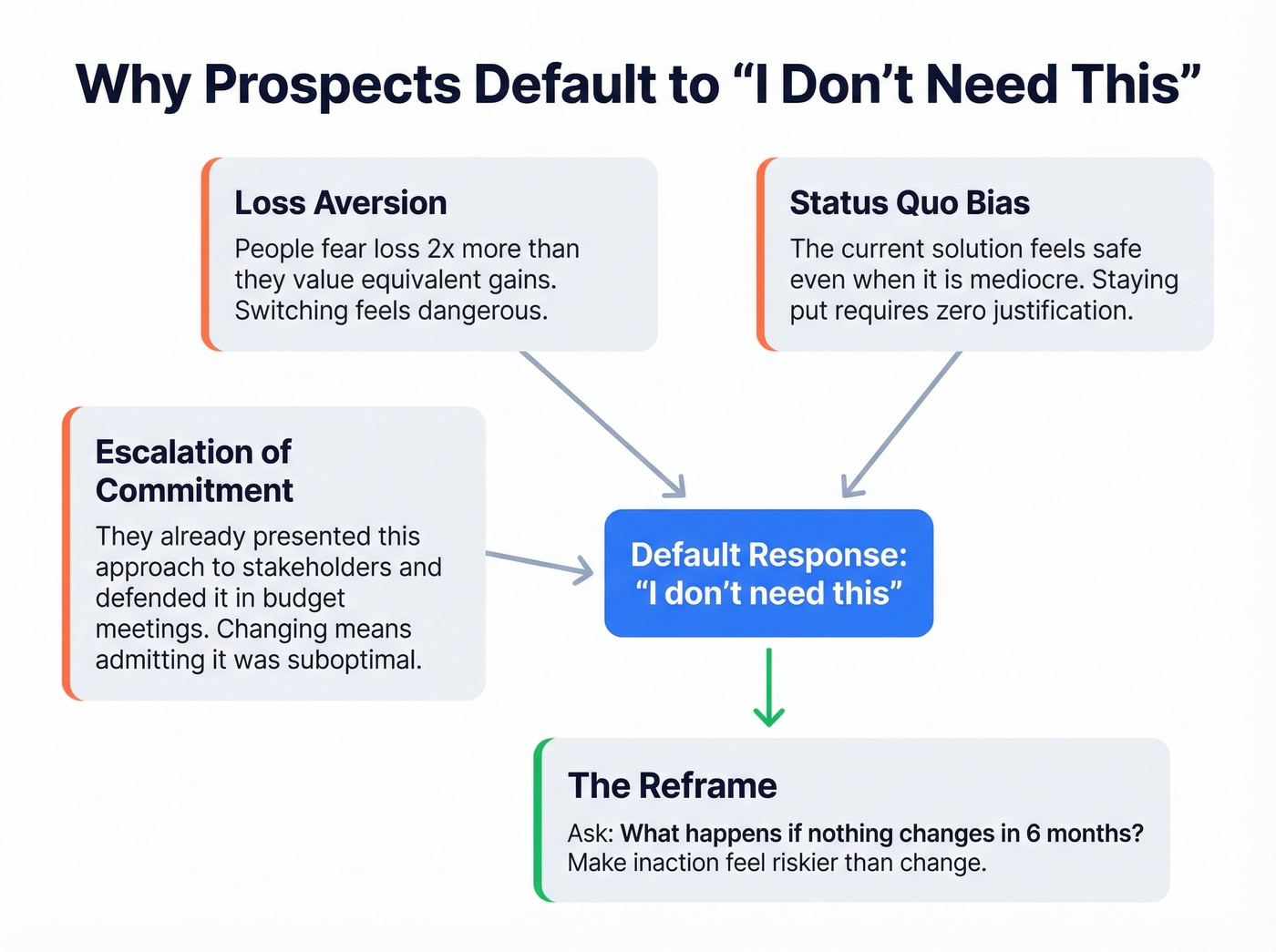
Layer on escalation of commitment and the picture gets worse. Your prospect has already presented their current approach to stakeholders, defended it in budget meetings, built workflows around it. Admitting they need something different means admitting all that effort was suboptimal. Nobody wants to do that on a cold call with a stranger.
This is why the Challenger framework asks "What happens if nothing changes in six months?" You're not selling a product - you're making inaction feel riskier than change.

49.5% of need objections are reflexive brush-offs caused by calling prospects who aren't in-market. Prospeo tracks buyer intent across 15,000 topics so you reach companies actively researching problems you solve - before they ever say "I don't need this."
Kill the need objection before the call starts.
How to Respond When Prospects Push Back
Here's the thing: analysis of 67,149 sales calls found that top performers pause 5x longer after an objection than their peers. Five times. While average reps scramble to counter, the best reps are just... quiet.
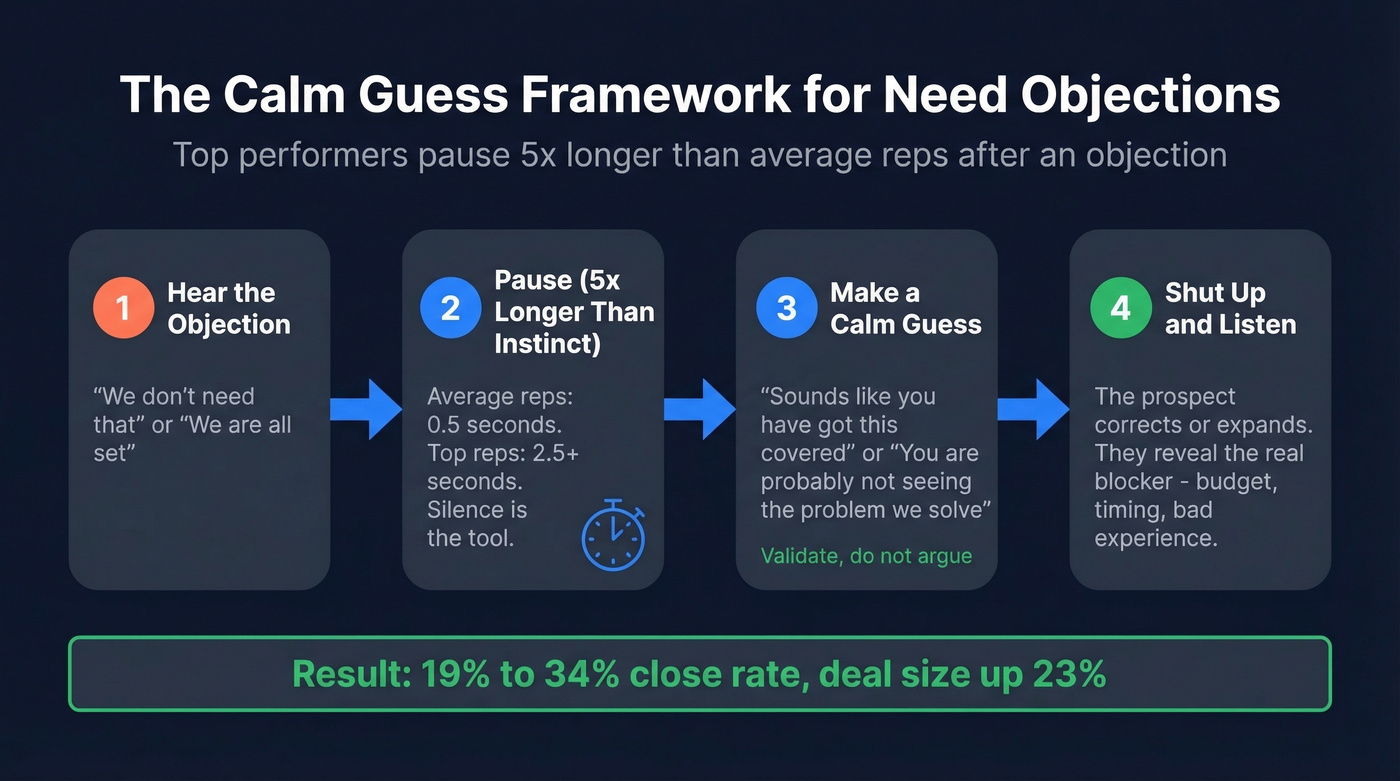
Cold calls convert at just 4.82%. You've got roughly 93 seconds on an average call. You can't spend 30 of them debating whether the prospect has a problem. The framework is simple: make a calm guess about what's really going on, then shut up.
A practitioner on r/b2b_sales described this shift as going from 19% to 34% close rate, with average deal size up 23%. We've seen the same pattern across our own outbound campaigns - the silence after a calm guess is where the real conversation starts. When you guess calmly and stop talking, the prospect almost always corrects or expands. They'll tell you the real blocker because you gave them space to think.
Raise the Objection Yourself
The most advanced move is to beat the prospect to it. Win Without Pitching calls this "racing to object." Jolles's Xerox research supports a similar tactic - the trial close. Instead of waiting for resistance, you surface it: "Do you think now is a good time to look at alternatives?" If the answer is no, you've opened a conversation about timing rather than hitting a wall.
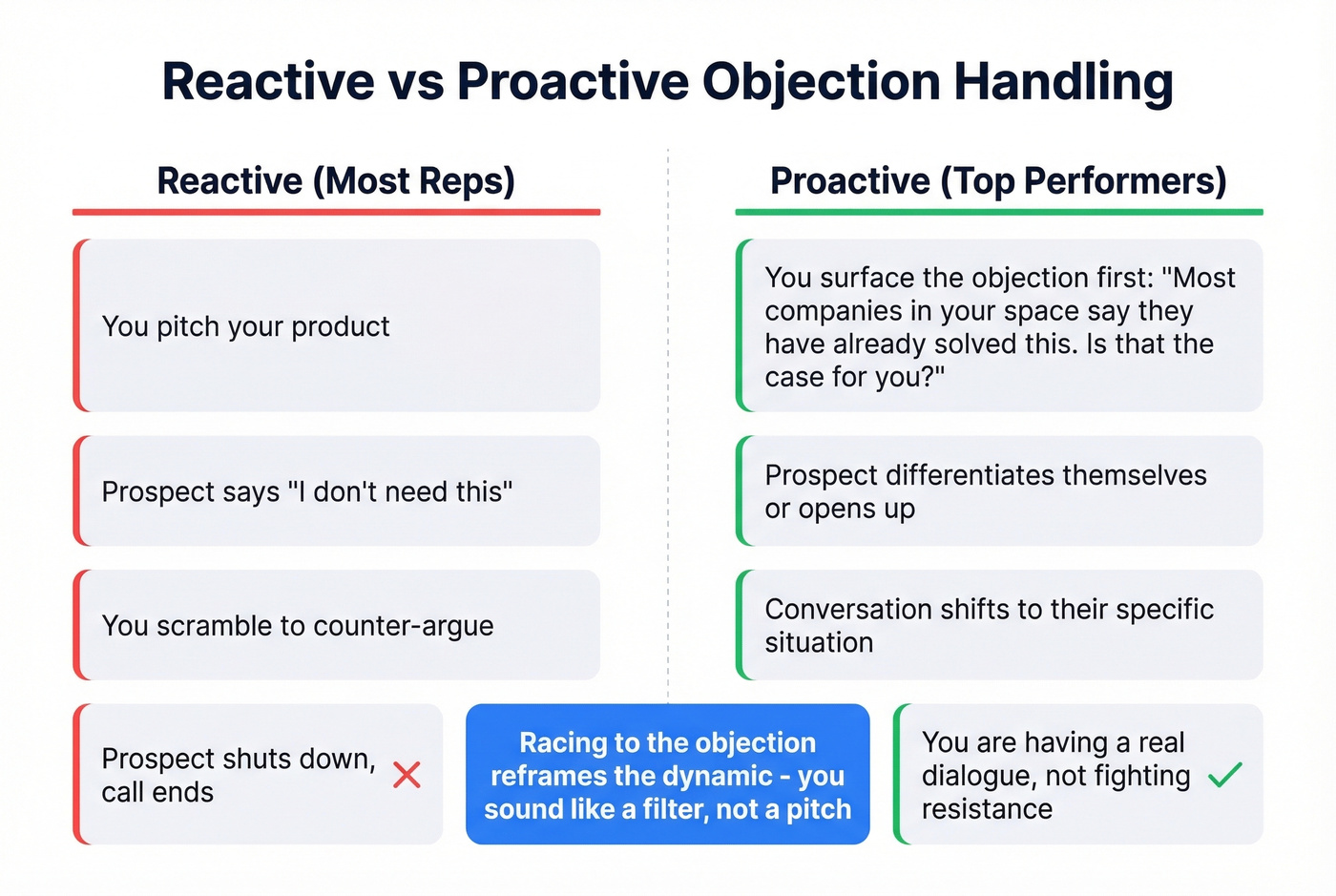
This takes confidence. But we've seen it cut through the reflexive "we're all set" response because it reframes the dynamic entirely.
Try opening with: "Most companies in your space tell us they've already solved this. Is that the case for you?" You've acknowledged the likely objection, signaled selectivity, and handed the prospect a reason to differentiate themselves. It works because it doesn't sound like a pitch. It sounds like a filter.
Let's be honest - the need objection is the easiest objection to eliminate. Not by handling it better, but by never triggering it. If your list is tight enough, most conversations skip past "I don't need this" entirely.
Fix Your Targeting First
If more than 30% of your calls hit this objection, scripts won't save you. You're calling the wrong people.
Look - better prospect data means fewer dismissive brush-offs. When you're reaching buyers who are actively researching solutions, the conversation starts from a completely different place. Tools like Prospeo track intent across 15,000 topics, so you can filter for companies researching problems you actually solve before you ever pick up the phone. Combine that with 30+ search filters and 98% email accuracy on a 7-day refresh cycle, and you're reaching the right person at the right company at the right time. That changes the entire dynamic of the first 45 seconds.
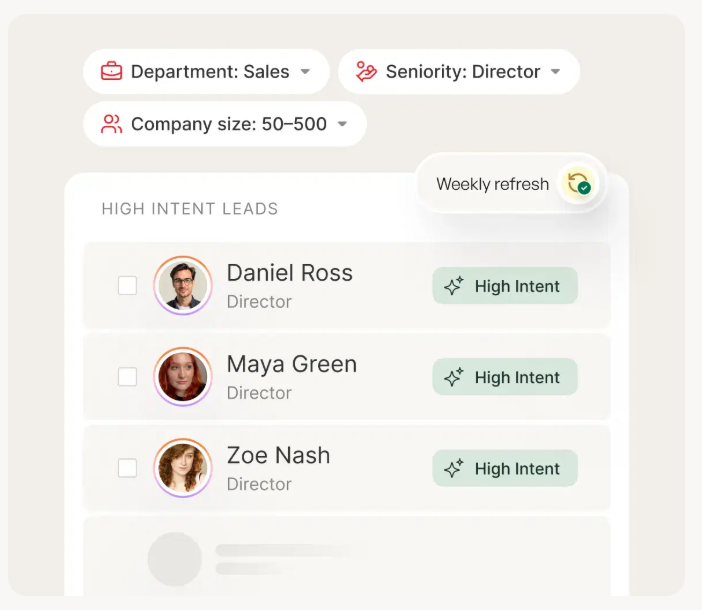
If 30%+ of your calls hit the need objection, your list is the problem. Prospeo combines 30+ search filters, 98% verified emails, and a 7-day data refresh cycle to connect you with decision-makers who actually have the pain you solve. 75 free emails/month to prove it.
Better targeting means fewer brush-offs. Test it free.
Quick-Reference Script Bank
| Objection Variation | Response | Why It Works |
|---|---|---|
| "We don't need that" | "Sounds like you've got this covered." (silence) | Validates; surfaces real issue |
| "We already have something" | "How's that working for you?" (silence) | Probes satisfaction without attacking |
| "I'm not interested" | "You're probably not seeing the problem we solve." (silence) | Reframes product to problem |
| "We're all set" | "Most [role] say that - until [specific pain]. On your radar?" | Names a concrete, recognizable risk |
| "No problem to solve here" | "What would need to change for this to matter?" | Shifts present to future; surfaces latent need |
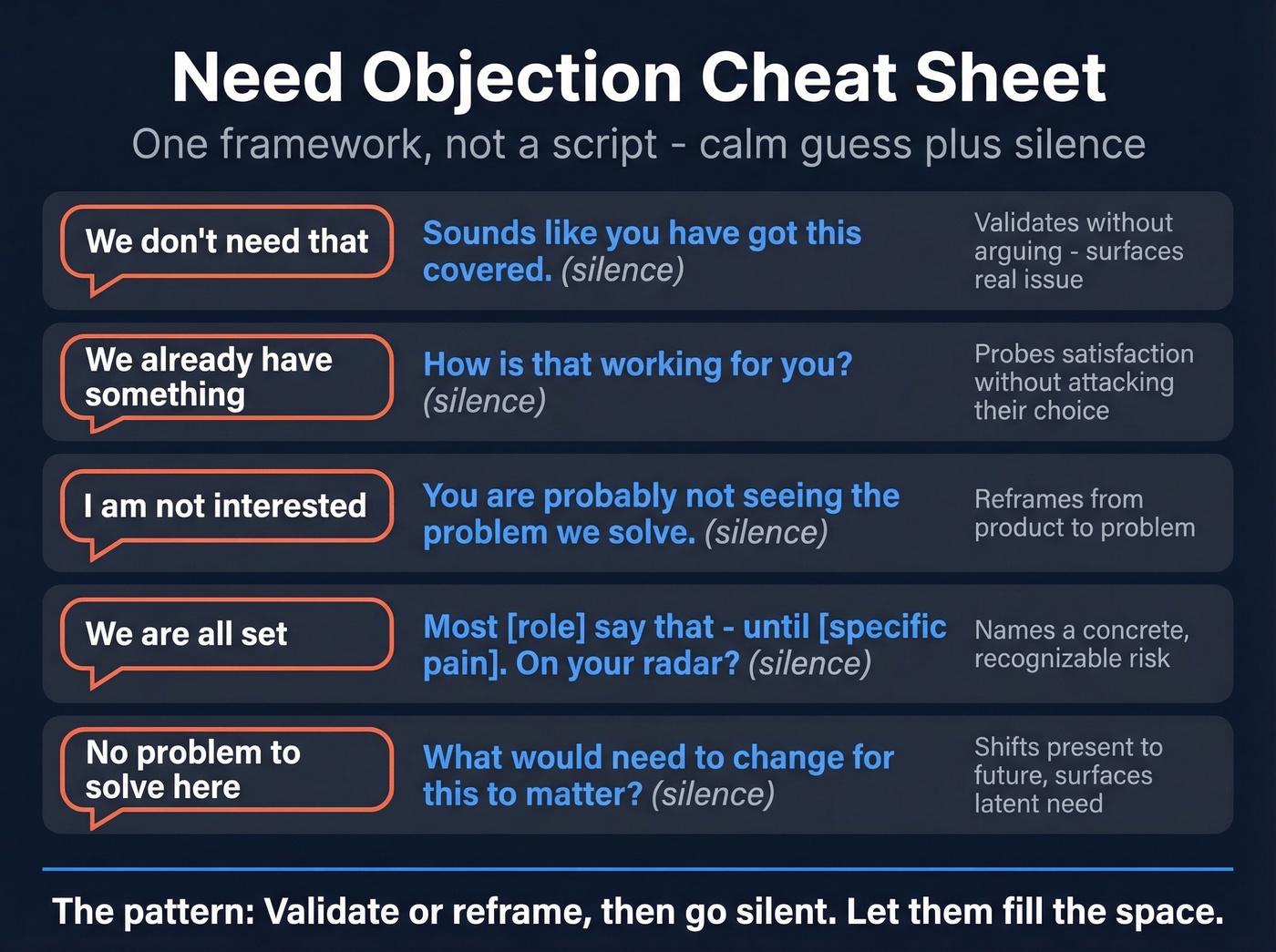
The need objection requires a framework, not a script. Master the calm guess plus silence pattern and you'll adapt to any variation on the fly. For a broader system, see sales prospecting techniques and a full cold calling system.
FAQ
Is the need objection a real rejection?
Usually not. Gong's analysis of 300M+ cold calls shows 49.5% of objections are dismissive brush-offs - reflexive responses, not informed assessments. Pause, make a calm guess about the real blocker, and let silence do the work. The prospect will almost always reveal what's actually going on.
How do I tell a brush-off from a genuine misfit?
Ask one diagnostic question: "What are you using today for [problem]?" If they name a specific tool or process and sound satisfied, it's probably genuine. If they deflect or go vague, it's a brush-off. Genuine misfits give concrete, specific answers - they'll tell you exactly what they're using and why they're happy with it.
What's the best way to reduce need objections?
Tighter targeting eliminates most of them before you dial. Use intent data to reach buyers actively researching your category. Teams using intent-filtered lists report significantly fewer dismissive responses because the prospect already recognizes the problem you're solving.
Should I push back when a prospect says "I don't need this"?
Never argue. Top performers pause 5x longer than average reps after hearing an objection. Instead of countering, validate - "Sounds like you've got this handled" - and wait. The silence creates space for the prospect to share what's really going on, whether that's budget, timing, or a bad prior experience with a similar product.