

Nested Spintax: Syntax, Examples & Mistakes (2026)
Every spintax tutorial shows you {Hello|Hi|Hey} and calls it a day. That's flat spintax - the kindergarten version. Nested spintax is where real variation happens, and where most templates break.
Here's the thing: if you're sending more than a few hundred cold emails a month, flat spintax won't cut it. You need nesting to generate enough unique combinations to avoid fingerprinting. But nesting is also where syntax errors hide, where grammar falls apart, and where people waste hours debugging invisible characters they pasted from Google Docs.
Let's break it down properly.
What Is Nested Spintax?
Standard spintax wraps alternatives in curly braces separated by pipes: {option A|option B}. The parser picks one at random. Flat spintax gives you linear variation - three spin groups with three options each produce 27 combinations. Fine for short sequences, but limiting at scale.
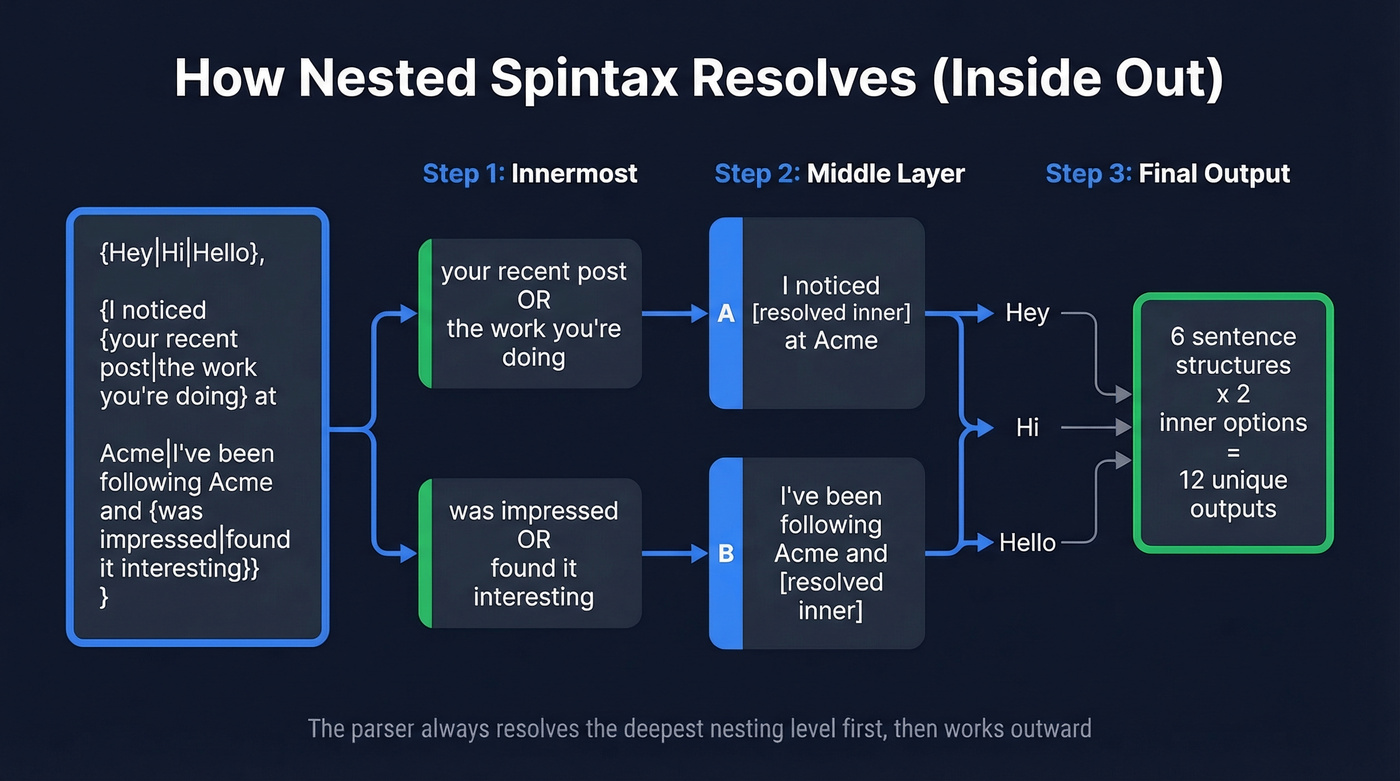
Nesting puts spin groups inside other spin groups. Think of it as a decision tree where each branch can split again.
Flat example - 3 variations:
{Hey|Hi|Hello}, want to chat?
Nested example - 12 unique outputs:
{Hey|Hi|Hello}, {I noticed {your recent post|the work you're doing} at {{Company}}|I've been following {{Company}} and {was impressed|found it interesting}}
The parser resolves from the inside out. First, it picks between "your recent post" and "the work you're doing." That result gets plugged into the outer group, which chooses between the "I noticed..." branch and the "I've been following..." branch. The greeting resolves independently. One fully formed sentence, twelve possible versions (3 greetings x 2 outer branches x 2 inner options per branch).
That inside-out resolution is the whole trick. Nesting gives you exponential growth in combinations without writing exponentially more text.
Syntax and Real Examples
Grammar Agreement
The most practical use of nesting is forcing grammar to stay correct - specifically a/an agreement:
I'd love to {schedule a {call|meeting}|set up an {intro call|overview session}}
Without nesting, you'd risk outputs like "schedule an call." Nesting keeps the article and noun paired correctly every time.
Personalization + Spin
Here's a template combining merge fields with nested spintax:
{Hey|Hi|Hello} {{First_Name}}, {I saw {your recent post|the work you're doing} on {{Company}}'s {growth|expansion}|I've been {following|keeping an eye on} {{Company}} and {was impressed|found it really interesting}}.
This produces dozens of unique openers while keeping personalization variables intact. Merge fields ({{First_Name}}) aren't spintax - they're resolved separately by your sending tool.
When Nesting Goes Wrong
{Hey|Hi|Hello} {{First_Name}}|{Good {morning|afternoon}}, {I {noticed|saw} {your {recent|latest} {post|article} {about|on} {topic}|}}}
Three levels deep with ambiguous closing braces. We've debugged templates like this for clients, and the problem is always the same: no human can read it, so no human catches the broken outputs. The parser might resolve it correctly, but you'll never be sure without running every permutation. If you can't read it, don't ship it.
How Many Variations Do You Need?
Simple multiplication. Three spin groups with 3, 2, and 4 options: 3 x 2 x 4 = 24 unique combinations.
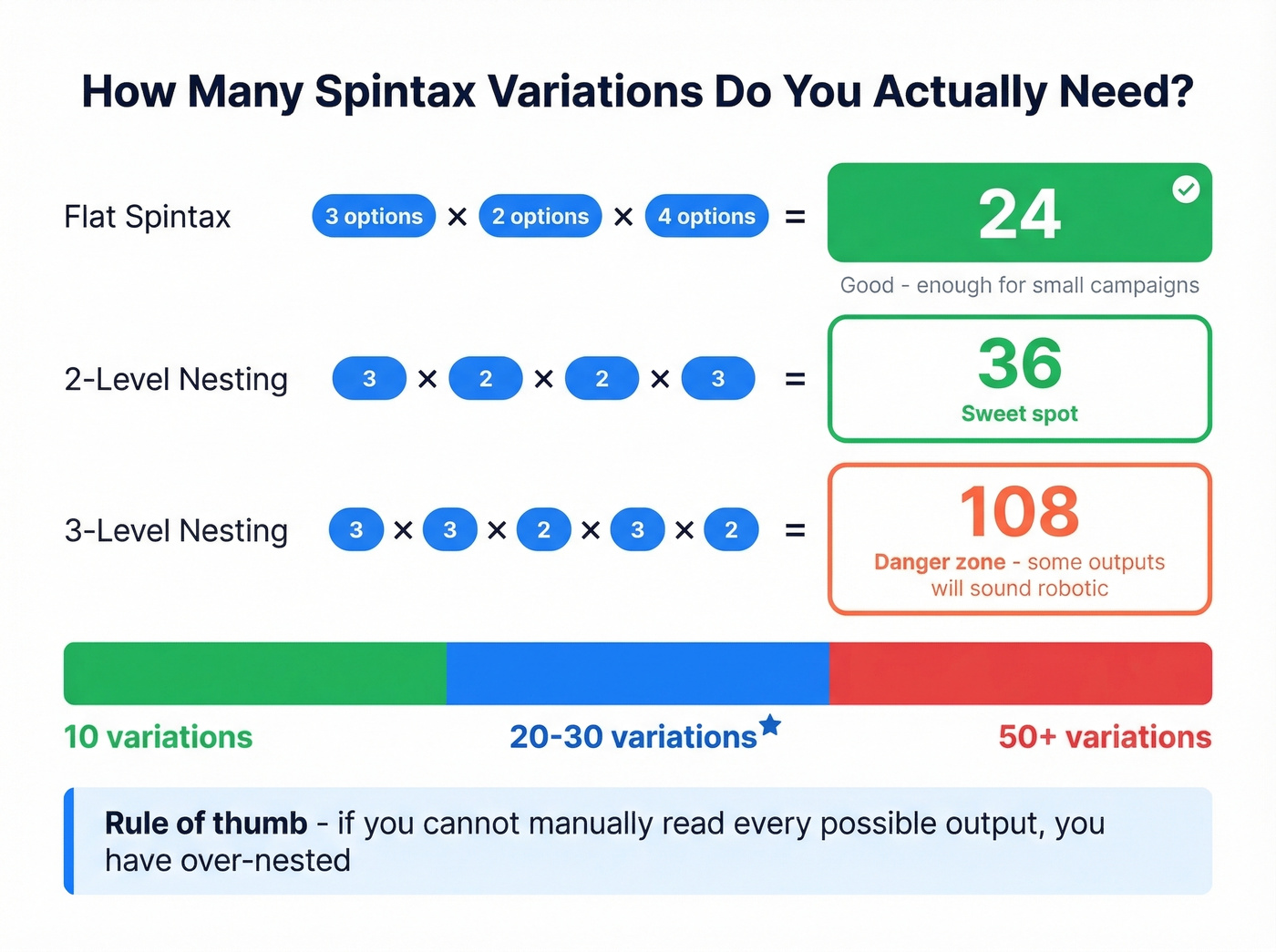
The sweet spot is 20-30 unique combinations per template. That's enough to avoid fingerprinting without creating an unmanageable template. Going beyond 50 usually means you've over-nested, and some outputs will read awkwardly - or worse, they'll read like they were assembled by a slot machine.
Platform Syntax Differences
This is where templates break silently. GMass won't parse standard {a|b} spintax - it'll send the curly braces and pipes literally unless you use GMass's own syntax.
| Platform | Syntax | Notes |
|---|---|---|
| Standard | {opt1\|opt2} |
Common spintax format (curly braces + pipes) |
| GMass | {{spin}}...{{variation}}...{{end spin}} |
Has an account-level "Maximize spintax randomization" setting; enabling A/B testing disables it |
| Many platforms | {{ }} reserved for merge fields |
Double braces are commonly used for personalization tokens, not spintax |
Always test-send to yourself before launching. A syntax mismatch won't throw an error - it'll just send broken text to real prospects.

You just built 30 unique email variations with nested spintax. Now imagine sending all 30 to addresses that bounce. Prospeo's 5-step verification catches catch-all domains, spam traps, and honeypots - delivering 98% email accuracy on a 7-day refresh cycle. Your spintax deserves a list that actually lands.
Clean data first, clever spinning second. Start with 75 free verified emails.
Common Mistakes
- Mismatched braces. Every
{needs a}. Nested templates make this harder to track. Count your braces before saving.
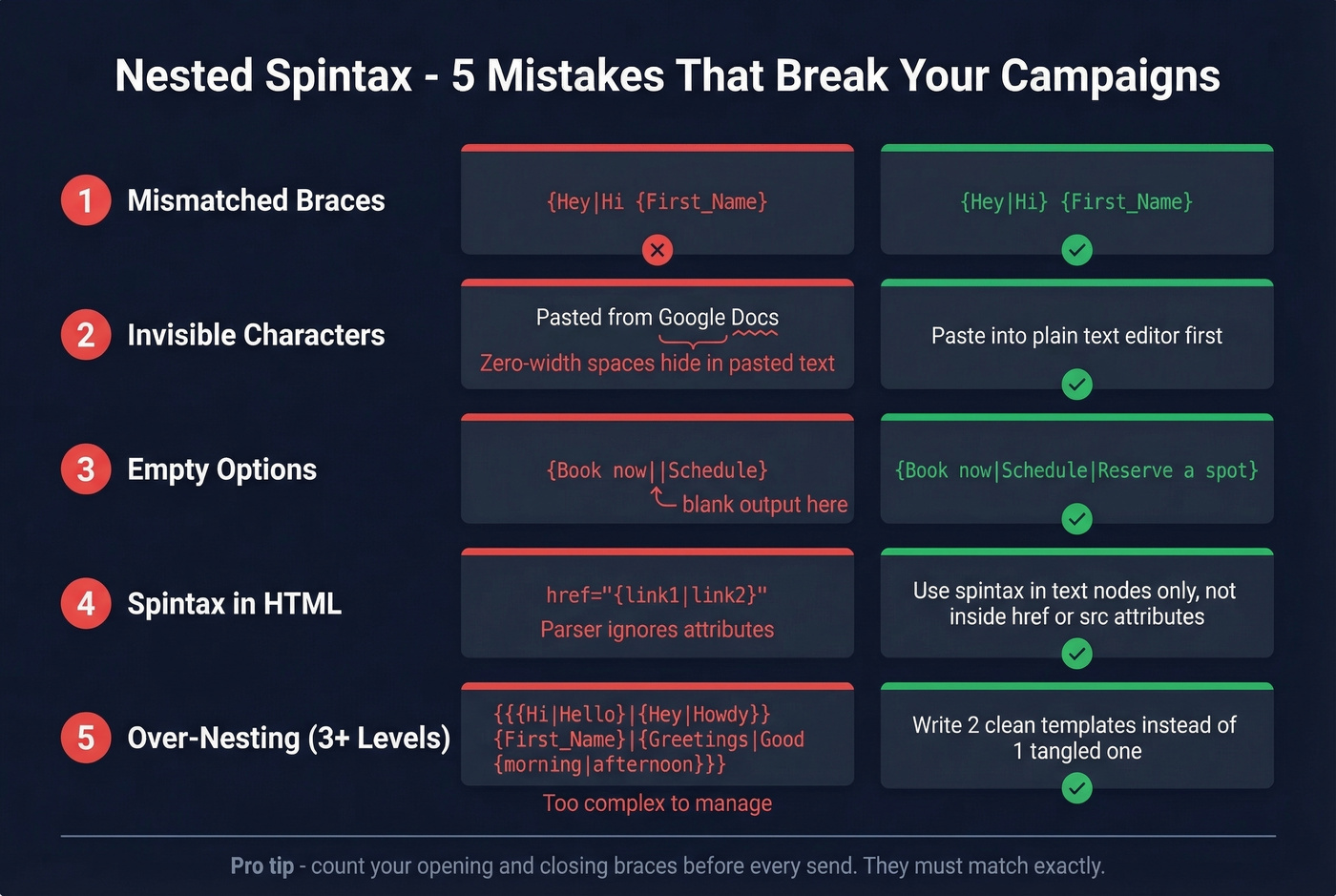
Invisible characters. Zero-width spaces and full-width symbols look identical to normal characters but break parsers completely. If you're copy-pasting from Google Docs or Notion, paste into a plain-text editor first. In our experience, this is the #1 cause of "my spintax just stopped working" support tickets.
Empty options.
{Book now||Schedule}has a blank middle option. Some parsers will output nothing for that variation, leaving a gap mid-sentence that makes you look sloppy.Spintax inside HTML attributes. Many parsers only process text nodes. Putting
{link1|link2}inside anhref=""won't resolve - it'll break your link entirely.Over-nesting. Three levels deep almost always generates at least a few combinations that sound robotic. Preview every possible output, or accept that some recipients will get weird emails. We'd rather write two clean two-level templates than one tangled three-level mess.
Does Spintax Actually Improve Deliverability?
Yes, but less than you think.
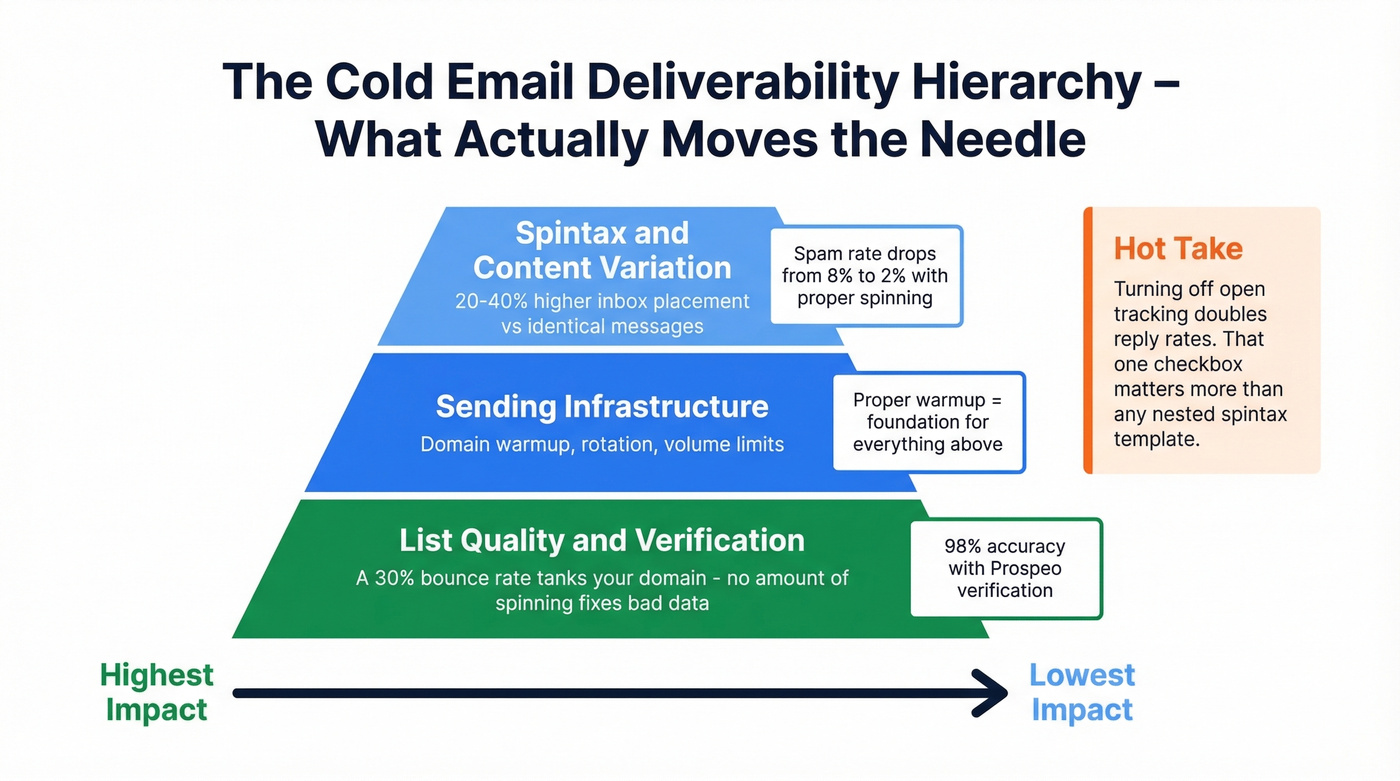
The core mechanism is anti-fingerprinting: Gmail and Outlook detect when hundreds of identical messages come from the same domain. Spintax makes each message structurally unique, which reduces that signal. Benchmarks commonly cited show 20-40% higher inbox placement rates, with example comparisons showing spam rates dropping from 8% to 2%. One practitioner reported reply rates jumping from 0.8% to 5.1% after overhauling their stack - but that included new infrastructure, warmup, and list sourcing alongside AI spintax.
Here's the hot take most spintax guides won't give you: turning off open tracking does more for deliverability than any amount of clever nesting. Campaigns with tracking disabled see more than double the reply rates compared to tracking enabled. None of that matters if your list bounces 30%.
The hierarchy is clear. List quality first, sending infrastructure second, spintax third. Spinning bad data is still bad data. Before you write a single spintax bracket, make sure your list is verified - Prospeo's 5-step verification catches catch-all domains and spam traps that other tools miss, and a 7-day data refresh cycle means you're not sending to contacts who changed jobs six weeks ago.

Spintax fights fingerprinting. Bad data fights your domain reputation. One problem is solved with nested brackets - the other needs verified contacts that don't bounce. Prospeo refreshes 300M+ profiles every 7 days, not every 6 weeks. That means the contacts in your spun templates still work at the company you're targeting.
Stop spinning emails into bounces. Verify your list at $0.01 per email.
AI Rewriting vs. Manual Spintax
Manual nested spintax is a dying skill - but at 10,000+ emails per month, understanding the mechanics still matters.
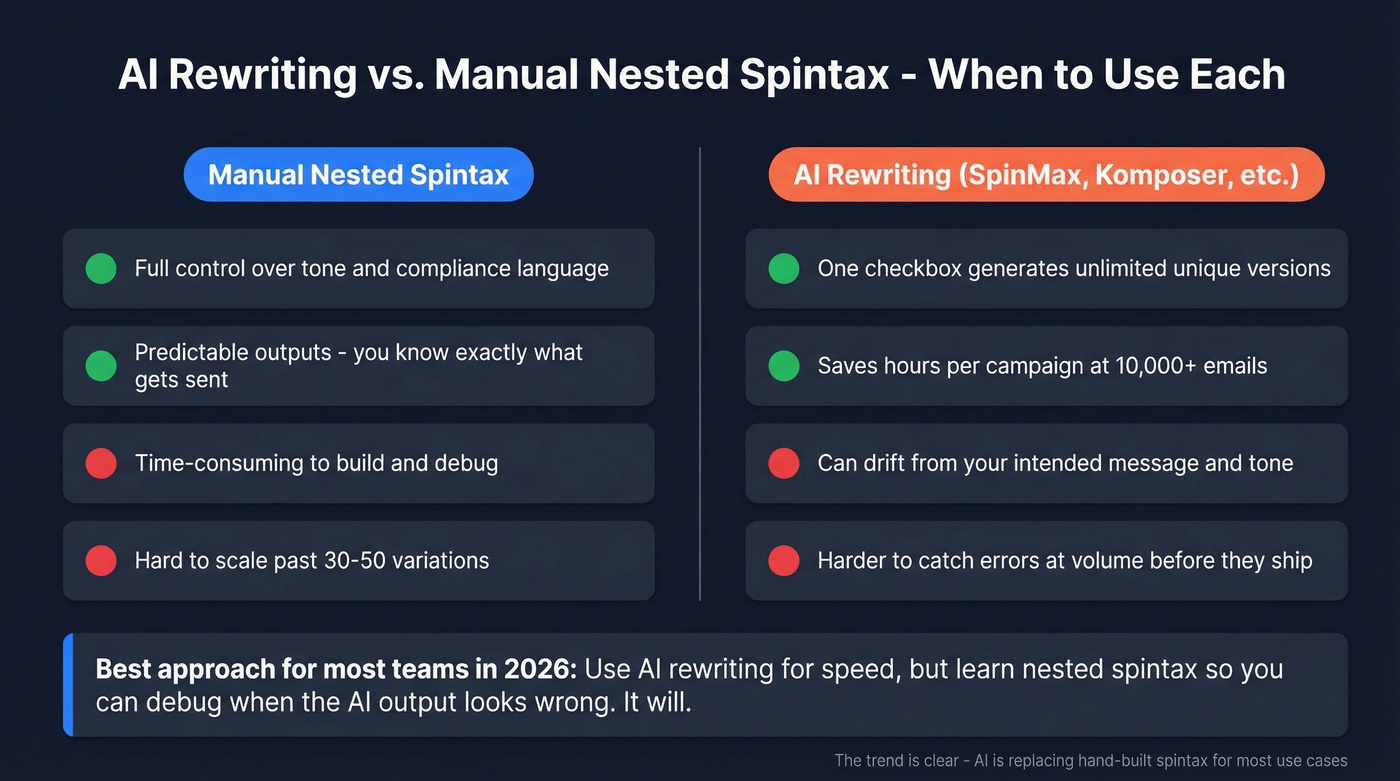
AI spinning wins on speed. GMass's SpinMax rewrites every email with a single checkbox, skipping the first message and adding 5-10 second latency between sends while generating variations. Autoklose's Komposer offers similar automation. For most teams, these tools have replaced what the industry now calls "complex, hard-to-maintain templates."
Manual spintax wins on control. If you need precise tone, compliance language, or specific CTA variations, AI rephrasing can drift from your intended message in ways that are hard to catch at volume. I've seen AI rewriters turn a polite meeting request into something that reads like a used-car pitch - and that went out to 2,000 prospects before anyone noticed.
The trend is obvious: AI rewriting is replacing hand-built spintax for most teams. But knowing how nesting works means you can debug when the AI output looks wrong. And it will.
When NOT to Use Spintax
Skip spintax for web content entirely.
Google targets scaled, low-value, unoriginal content, and spun pages are an easy way to end up suppressed or deindexed. One SEO practitioner deployed ~2,000 location pages with spun content and watched indexing taper from 400+ pages per 3-7 days to 10-40. Spintax for email? Still valuable. Spintax for SEO? It's a fast way to get your pages buried.
FAQ
How deep can nesting go?
Most teams stop at two levels. Beyond that, output quality drops and debugging becomes impractical. Two levels is the sweet spot for cold email - enough for 20-30 unique variations without unreadable templates.
Does spintax work in subject lines?
Yes. Most cold email platforms - Instantly, Lemlist, Woodpecker - process spintax in both subject lines and body text. Subject line spinning changes uniqueness per recipient, which directly influences open rates and reduces fingerprinting.
What matters more - spintax or list quality?
List quality, by a wide margin. A 30% bounce rate will tank your domain reputation regardless of how many variations you write. Verify your emails before sending. That single step does more for deliverability than any amount of clever nesting.