

Nextiva vs Ooma: Honest Comparison for 2026
Most comparisons between these two platforms are published by rival VoIP companies. This one isn't. The right pick between Nextiva and Ooma depends on your team size, budget reality, and tolerance for contracts - not marketing spin.
30-second verdict:
- Pick Nextiva if you need deep analytics, 20+ integrations, a 99.999% uptime SLA, and room to scale past 50 users.
- Pick Ooma if you want zero contract, fast setup, and basic calling for a small team.
- Skip both if your real bottleneck is finding verified phone numbers for the people you're calling. Your dialer doesn't solve that.
Side-by-Side Feature Comparison
| Nextiva | Ooma Office | Edge | |
|---|---|---|---|
| Entry price | $15/user/mo (Core, annual) | $19.95/user/mo (Essentials) | Nextiva |
| Mid-tier | $25/user/mo (Engage) | $24.95/user/mo (Pro) | Ooma (barely) |
| Top tier | $75/user/mo (Power Suite CX) | $29.95/user/mo (Pro Plus) | Ooma |
| Contract | 12-month minimum for 1-100 employees on annual pricing | None | Ooma |
| Uptime SLA | 99.999% | Not published | Nextiva |
| Video capacity | 250 participants | 100 (Pro Plus) | Nextiva |
| SMS/user/mo | 100 (Core) / 500 (Engage) | 250 (Pro) / 1,000 (Pro Plus) | Ooma |
| G2 rating | 4.5/5 (3,450 reviews) | 4.6/5 (131 reviews) | Nextiva (26x more reviews) |
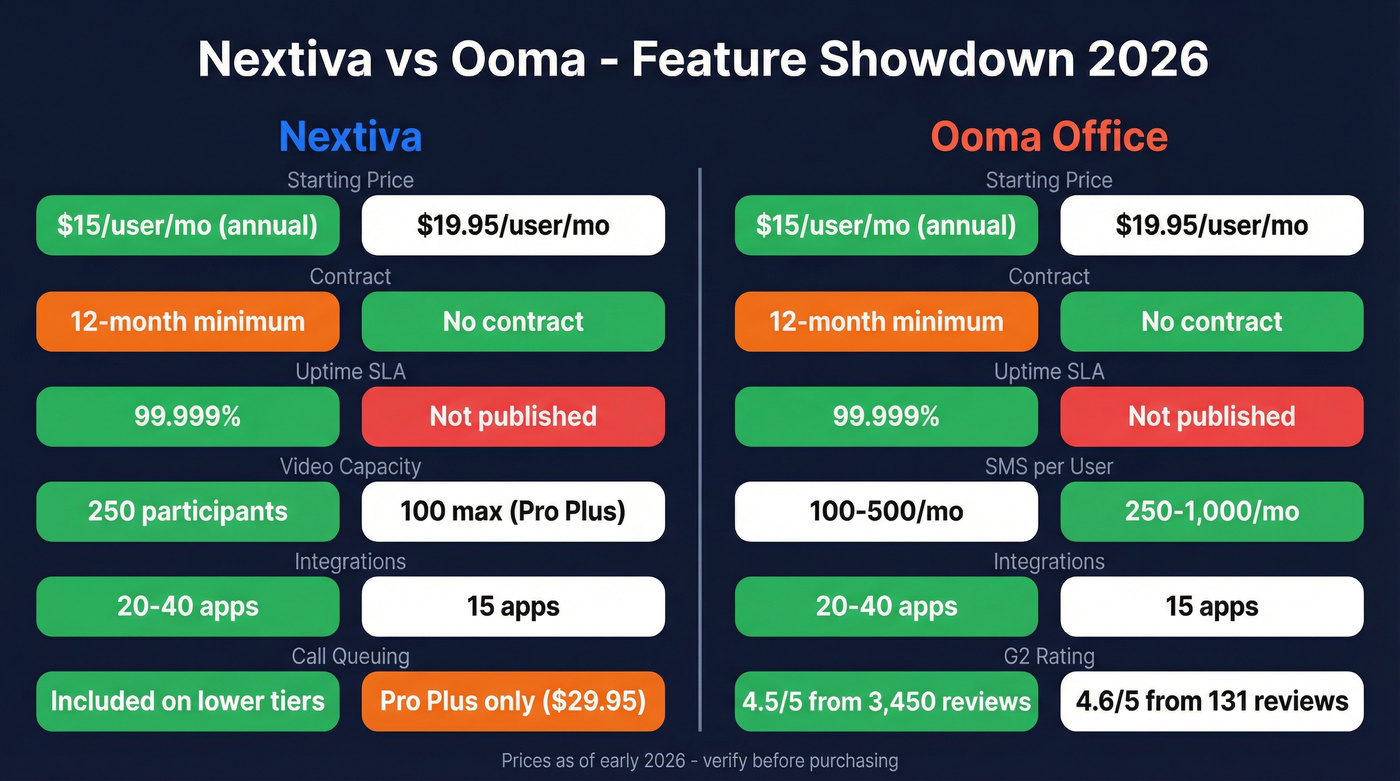
The G2 scores look close, but Nextiva's rating sits on 26x more reviews. That sample-size gap matters far more than a 0.1-point difference.
What It Actually Costs
Nextiva's $15/user/month headline requires an annual commitment. Month-to-month, Core jumps to $23/user/month. New small business customers with 1-100 employees face a 12-month minimum term on annual pricing. For a 10-user team on Core annual, that's $150/month base - locked in for a year.
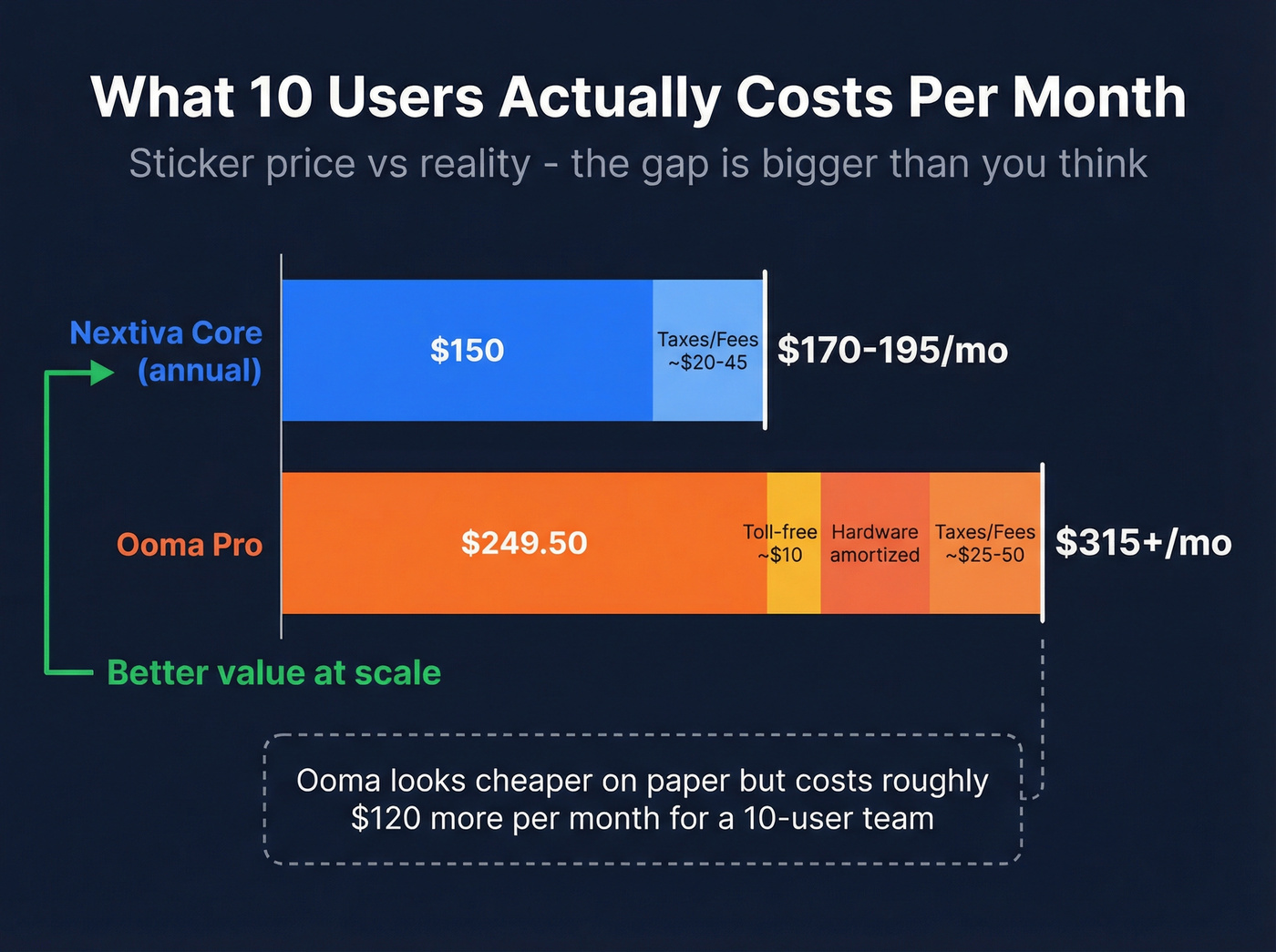
Ooma's $19.95 Essentials plan looks straightforward until add-ons stack up. Toll-free numbers run $9.95/month with 500 included minutes, then 3.4 cents per minute overage. Texting bundles range from $20 to $160, and IP phones start at $59.99. In our experience, Ooma's all-in cost for a 10-user team often lands well above the sticker price.
| Nextiva Core (annual, 10 users) | Ooma Pro (10 users) | |
|---|---|---|
| Base monthly | $150 | $249.50 |
| Toll-free add-on | Included on Engage/Power Suite CX (Core is add-on) | ~$10/mo + overages |
| Hardware | BYOD or lease | $60-$400/phone |
| Taxes/fees | ~10-30% | ~10-30% |
| Estimated all-in | ~$170-195/mo | ~$315+/mo |
Here's the thing: Ooma's "cheaper" sticker price doesn't survive contact with reality for most teams. If you're comparing these two on price alone, you're doing the math wrong.
Features That Actually Matter
Analytics and reporting is where Nextiva pulls away hard. Around 250 report templates, real-time dashboards, scorecards, and wallboards. Ooma's reporting stays basic on Office plans - you'd need Ooma Enterprise Enhanced at $27.99/user/month to get business analytics worth mentioning.
Integrations: Nextiva connects with 20-40 apps including Salesforce, HubSpot, and Teams. Ooma Office lists 15 integrations on G2 but locks CRM integration behind Pro Plus at $29.95.
Video conferencing: Nextiva supports 250 participants vs. Ooma's 25 on Pro and 100 on Pro Plus. For all-hands or large client calls, this isn't close.
Call queuing: Ooma restricts this to Pro Plus only. Nextiva includes it on lower tiers, which is a meaningful gap for any team handling inbound volume. If you're running a support desk or SDR team with shared lines, that restriction alone could be a dealbreaker.
Ooma also offers a separate Enterprise line with three tiers from $19.99 to $49.99/user/month, including ACD, IVR, and skills-based routing. The "Ooma can't scale" narrative is outdated.

You're comparing dialers, but neither Nextiva nor Ooma finds you anyone to call. Prospeo's Mobile Finder gives your team 125M+ verified mobile numbers with a 30% pickup rate - 2.4x the industry average. Pair that with 98% email accuracy across 143M+ addresses, and your new phone system actually has someone worth reaching on the other end.
Fix your contact data before you fix your phone system.
Reliability and Security
Nextiva publishes a 99.999% uptime SLA backed by eight points of presence. Ooma doesn't publish a guaranteed uptime number. For a phone system, that gap matters.
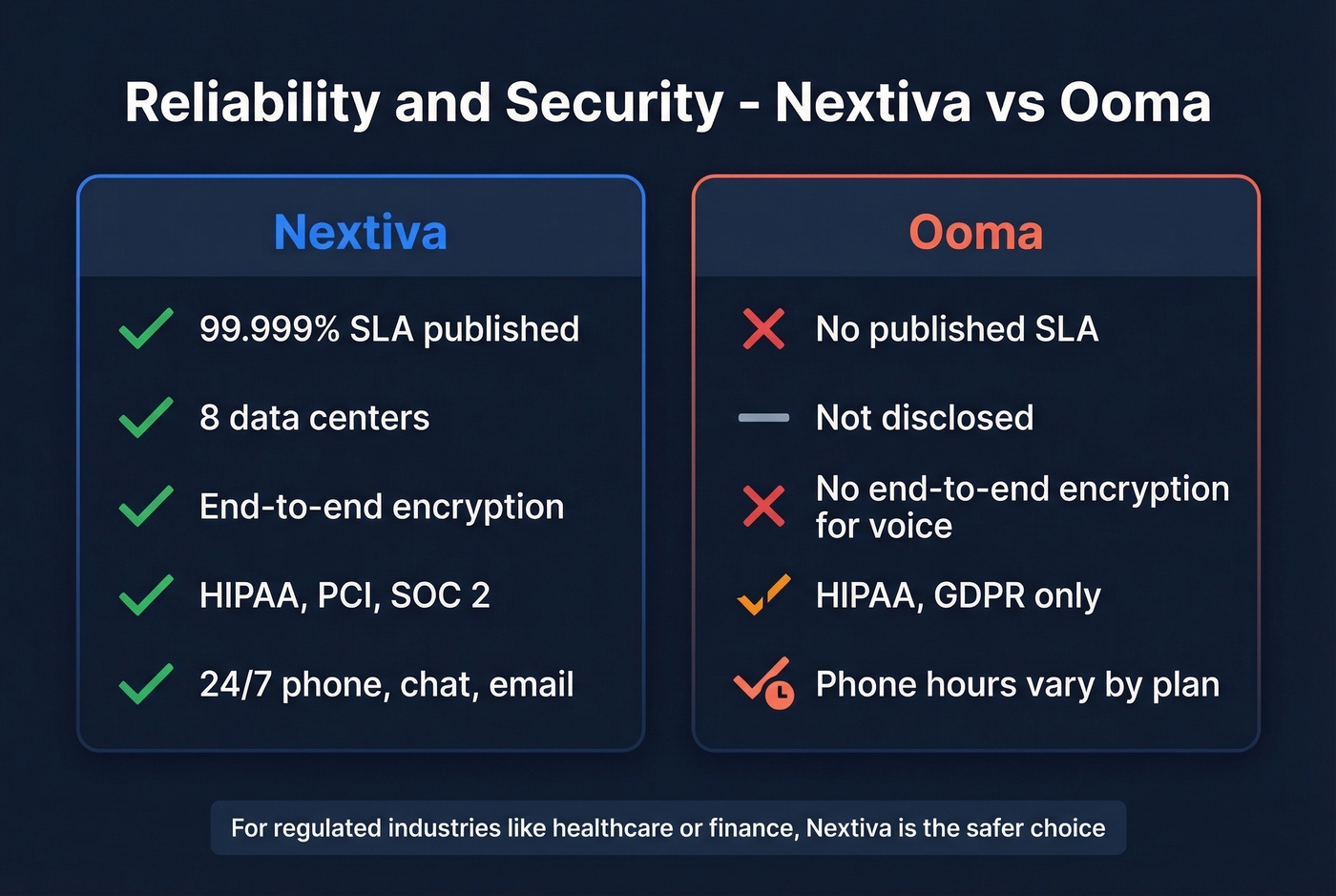
On the security side, Nextiva includes end-to-end encryption and supports HIPAA, PCI, and SOC 2 compliance. Ooma is HIPAA and GDPR compliant but lacks end-to-end encryption for voice calls. If you handle sensitive data - healthcare, finance, anything regulated - Nextiva is the safer bet. Nextiva also offers 24/7 phone, chat, and email support, while Ooma's phone support hours vary by plan.
What Real Users Say
Nextiva complaints on Reddit: Contract and billing surprises dominate. One user on r/VOIP described being quoted a monthly price that turned out to require a multi-year commitment. Others flag the app logging out mid-day, causing missed calls, and persistent SMS registration failures where texting "randomly stops working and requires re-registration." We've seen this SMS pattern come up repeatedly across multiple threads.
Ooma complaints on Reddit: Call quality issues lead - static, fuzzy audio, and support that repeatedly blames the customer's network. Multiple users report that "the $19.95 plan doubles with taxes and fees." Faxing failures and workaround dialing codes like *99 for outbound calls also surface regularly.
That said, G2 reviewers consistently praise Ooma's ease of setup (9.1 vs. Nextiva's 8.4) and ease of use (9.0 vs. 8.7). Ooma's reviewer base skews overwhelmingly SMB - 130 of 131 reviews from companies with 50 or fewer employees - which tells you exactly who loves this product.
Who Should Pick Which
Nextiva is the right call for teams that need analytics depth with 250+ report templates, 20+ native integrations, a 99.999% uptime SLA with end-to-end encryption, video meetings over 50 participants, or a platform that scales past 50 users without switching systems.
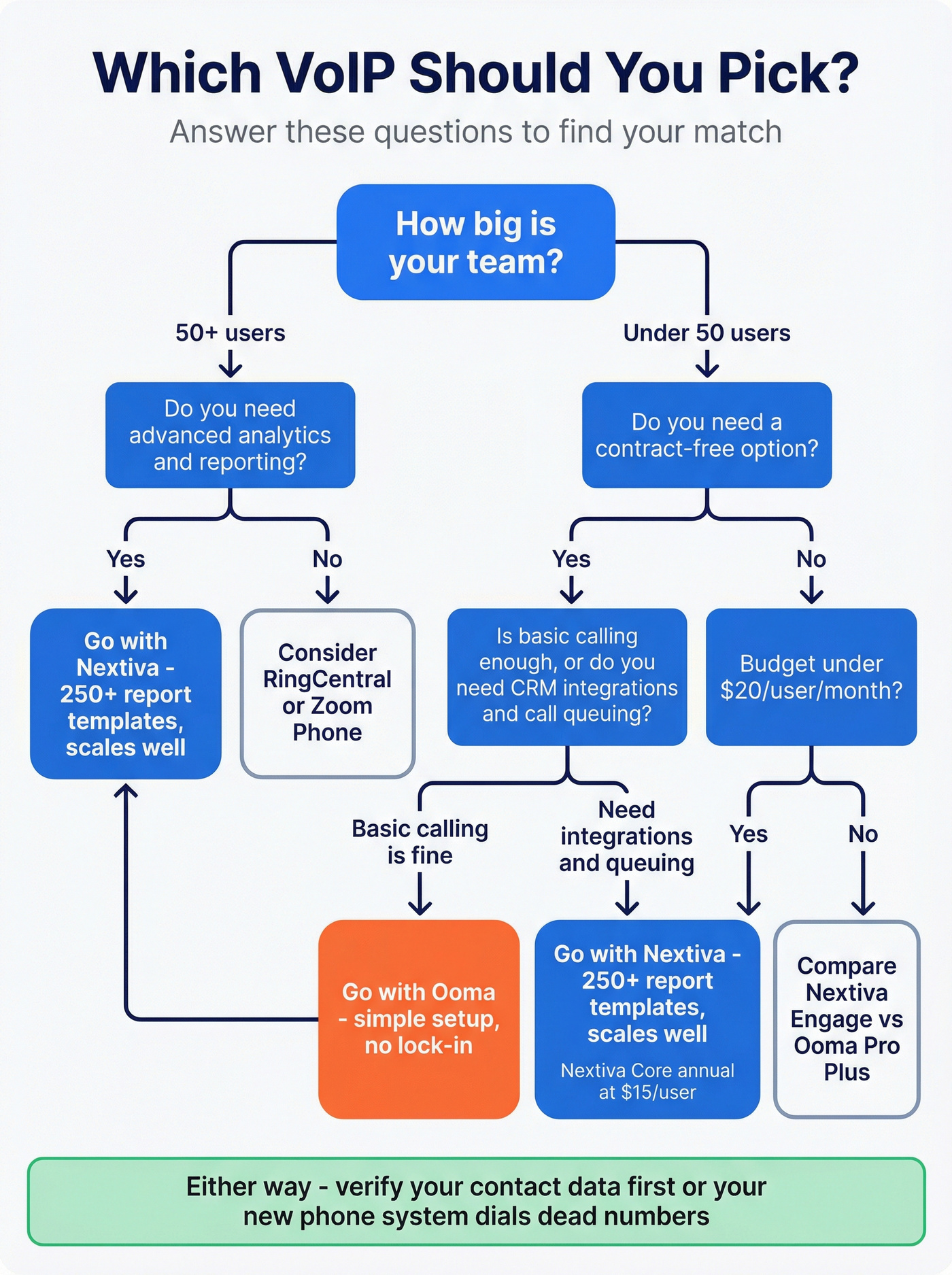
Ooma makes more sense if you want zero contract commitment, a fast and simple setup for a small team, and unlimited calling to the U.S., Canada, Mexico, and Puerto Rico on every plan - including one free toll-free number on Essentials. If you don't need advanced analytics or large video meetings, Ooma delivers solid basics without the lock-in.
If neither fits, RingCentral offers deeper feature breadth for mid-market teams, and Zoom Phone is worth a look if your org already lives in Zoom's ecosystem.
The Problem Neither Solves
Your phone system doesn't find you anyone to call. If your team dials 50 numbers a day and half are wrong, you're burning hours regardless of which VoIP provider you pick. We've watched teams agonize over Nextiva vs. Ooma for weeks, then lose just as much productivity to bad contact data once they're up and running.
Prospeo's Mobile Finder covers 125M+ verified mobiles with a 30% pickup rate - 2.4x the industry average. Email accuracy is 98% across 143M+ addresses. Free tier, no contract, 30+ filters to build targeted lists before you ever pick up the phone.
Teams waste weeks debating Nextiva vs Ooma, then lose just as much productivity dialing wrong numbers. At ~$0.01 per email and 10 credits per verified mobile, Prospeo costs less than a single Ooma add-on - and delivers the contacts that make your VoIP investment actually pay off. No contracts, no annual lock-in.
Stop burning dial time on bad data. Verify your list first.
FAQ
Is Ooma really cheaper than Nextiva?
On paper, yes - Ooma Essentials starts at $19.95/user/month with no contract. But toll-free add-ons, texting bundles, hardware, and 10-30% taxes close the gap fast. Run a 10-user all-in scenario before committing. Nextiva Core on an annual plan often lands lower.
Does Ooma have an enterprise plan?
Yes - three tiers: Standard at $19.99, Enhanced at $27.99, and Call Center at $49.99/user/month. Enhanced and Call Center include ACD, IVR, and skills-based routing, making Ooma viable for teams that outgrow Office plans.
Can I port my existing number to either platform?
Both Nextiva and Ooma support number porting. Nextiva typically completes ports in 2-4 weeks; Ooma's timeline is similar but can vary. Let's be honest - neither makes this process painless, so start the port request early and keep your old service active until it's confirmed.