

The One on One Meeting Agenda Guide (With Templates You Can Steal)
It's Monday morning. You've got a 1:1 in 20 minutes. You open a blank doc, type "one on one meeting agenda," and stare at it. Then you wing it - ask "how's everything going?", get a polite "fine," run through project updates, and wrap early. Both of you leave feeling like that was a waste of time.
You're not alone. 50% of managers strongly agree they give weekly feedback. Only 20% of their direct reports agree. That gap doesn't exist because managers are lying - it exists because most 1:1s aren't structured to surface real feedback.
The short version
- Default format: 10/10/10 - 10 minutes employee topics, 10 minutes manager topics, 10 minutes career and action items.
- Three non-negotiables: Weekly. 30 minutes. Employee owns the agenda.
- You don't need a 1:1 tool. You need a Google Doc and the discipline to open it.
Just want the template? Jump to the filled-in example.
Why Your 1:1 Agenda Matters More Than Any Other Meeting
Gallup's Q12 meta-analysis - 456 studies, 2.7 million employees, 96 countries - found that managers account for 70% of the variance in team-level engagement. Not culture decks. Not perks. Managers. The gap between top-quartile and bottom-quartile engagement translates to 23% higher profitability, 18% higher productivity, and 81% less absenteeism across 276 organizations and 54 industries.
Atlassian's research backs this up: employees who have regular 1:1s with their managers are 3x as likely to be engaged. The 1:1 isn't a nice-to-have. It's the single highest-leverage meeting on your calendar.
Five Mistakes That Ruin 1:1s
These are the patterns we see wreck 1:1s over and over: they devolve into status updates, managers cancel them, and nothing gets followed through.
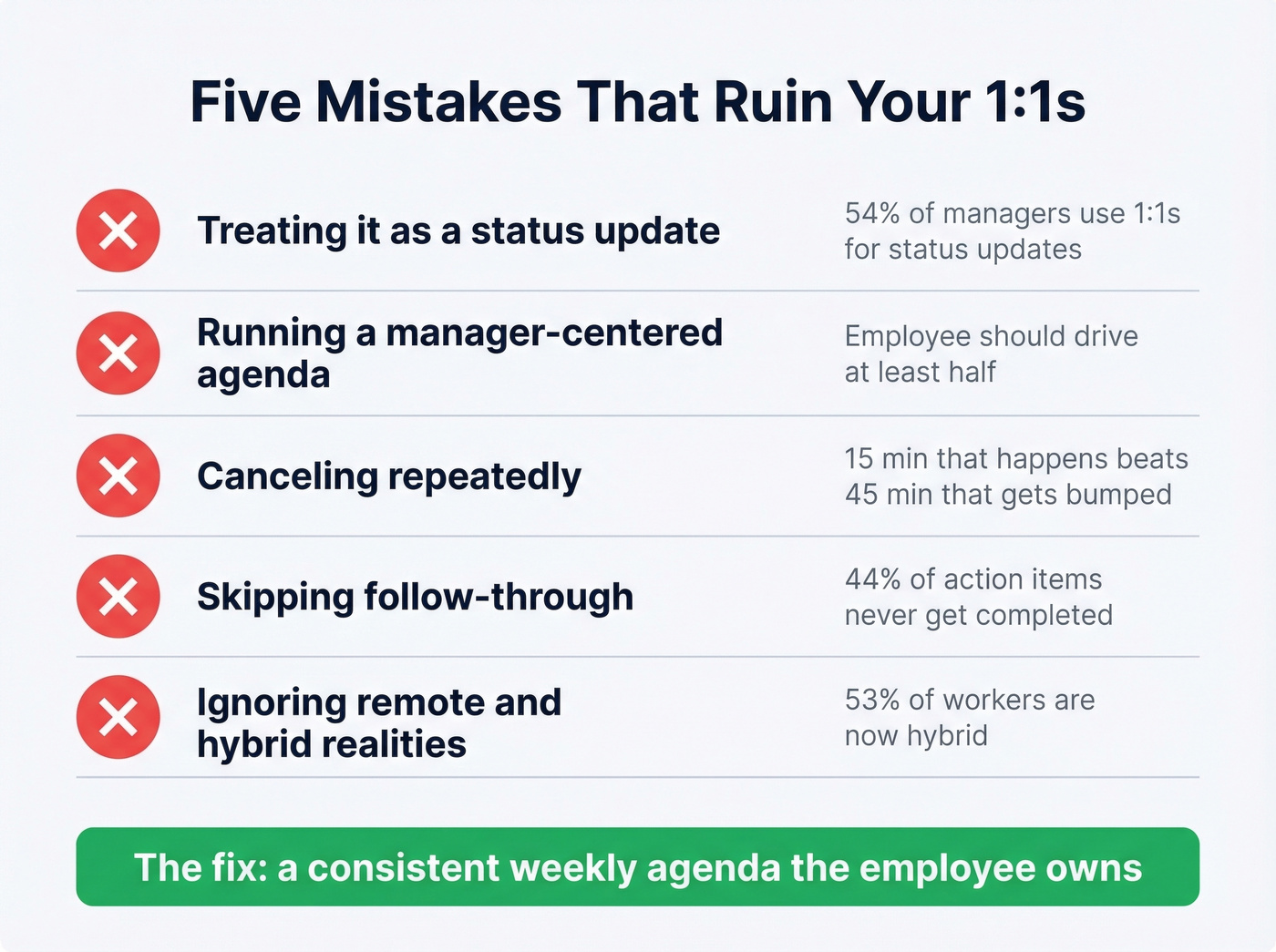
1. Treating it as a status update. 54% of managers say a main purpose of their 1:1s is getting a status update. That's what Slack, Jira, and standups are for. If your 1:1 sounds like a project tracker readout, you're wasting the only meeting designed for coaching and trust-building.
2. Running a manager-centered agenda. Meeting scientist Steven Rogelberg told CNBC that many managers run 1:1s to monitor work - their own needs - rather than support the employee. The employee should drive at least half the agenda.
3. Canceling repeatedly. Every cancellation sends a message: you're not a priority. Rogelberg's advice is blunt - consistency matters more than length. A 15-minute 1:1 that actually happens beats a 45-minute session that gets bumped three weeks in a row.
4. Skipping follow-through. 44% of action items from meetings never get completed. If you close a 1:1 with "let's circle back on that" and never write it down, you've trained your report to stop raising issues.
5. Ignoring remote and hybrid realities. More than half of remote-capable workers are hybrid now. Running the same in-office 1:1 format for someone working from their kitchen table - no async prep, no acknowledgment of isolation - misses the point entirely.
The Weekly 1:1 Agenda Template (30 Minutes)
Here's a timeboxed structure adapted from PerformYard's framework:
| Time Block | Focus | Owner |
|---|---|---|
| 0:00-2:00 | Check-in | Either |
| 2:00-7:00 | Last week's action items | Both |
| 7:00-14:00 | Priorities & blockers | Employee |
| 14:00-21:00 | Feedback & coaching | Manager |
| 21:00-27:00 | Career / development | Employee |
| 27:00-30:00 | Next steps & action items | Both |
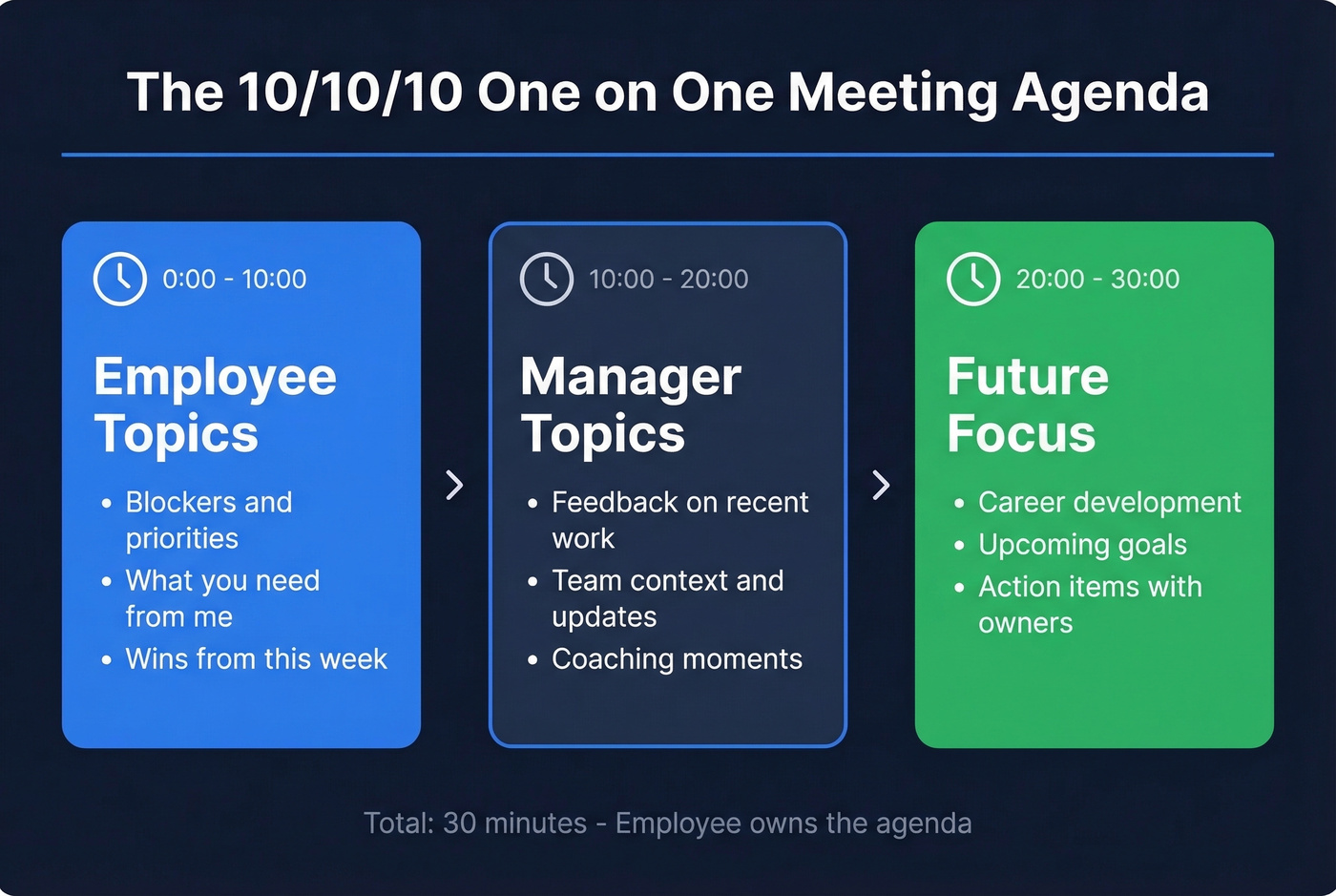
Alternative structure: The 10/10/10 model - 10 minutes employee topics, 10 minutes manager topics, 10 minutes future-focused discussion. Same total time, slightly different rhythm. We've seen both work well; pick whichever feels more natural for your team.
Other frameworks exist. LifeLabs Learning's CAMPS model organizes 1:1s around psychological needs like certainty, autonomy, meaning, progress, and social connection. It's useful for diagnosing why a report seems disengaged, but it's harder to timebox than the 10/10/10.
Filled-In Example: Sales 1:1 for a Manager and SDR
Below is what a real sales one on one meeting agenda looks like, filled in. The table shows the skeleton; the detail follows.
| Time | Topic | Key Point |
|---|---|---|
| 0:00-2:00 | Check-in | Personal catch-up |
| 2:00-7:00 | Last week's actions | 1 done, 1 carried forward |
| 7:00-14:00 | Priorities & blockers | Bounced emails tanking connect rate |
| 14:00-21:00 | Feedback | Discovery call coaching |
| 21:00-27:00 | Career / growth | AE role path mapping |
| 27:00-30:00 | Action items | 3 items assigned |
Check-in: "How was the weekend? You mentioned your move - all settled?"
Last week's actions: The cold email subject line rewrite is done - open rate up 4%. The mid-market target list still needs building. Carried forward.
Priorities & blockers: The SDR flags that bounced emails are tanking their connect rate - 18% bounce on last Tuesday's sequence, and they're spending an hour a day cleaning lists manually. This is an upstream data quality problem worth solving with better tooling. Tools like Prospeo routinely get teams to under 4% bounce rates, which frees reps to spend that hour actually selling.
Feedback: "Your discovery calls have gotten sharper - the one with Acme was textbook. One thing to work on: you're rushing the pain-point questions. Sit in the silence after you ask."
Career / growth: The SDR wants to move to an AE role by Q3. The manager commits to mapping the gap and scheduling a shadow session with a senior AE next week.
Action items: (1) Employee builds mid-market list by Thursday. (2) Manager schedules AE shadow session. (3) Both review bounce rate after switching email source.
Agenda Templates by Cadence
Biweekly (30-40 Minutes)
Best for senior, autonomous ICs who don't need weekly check-ins.
| Time Block | Focus |
|---|---|
| 0:00-5:00 | Personal/team check-in |
| 5:00-12:00 | Review action items |
| 12:00-27:00 | Projects & roadblocks |
| 27:00-35:00 | Feedback & short-term goals |
| 35:00-40:00 | Next steps |
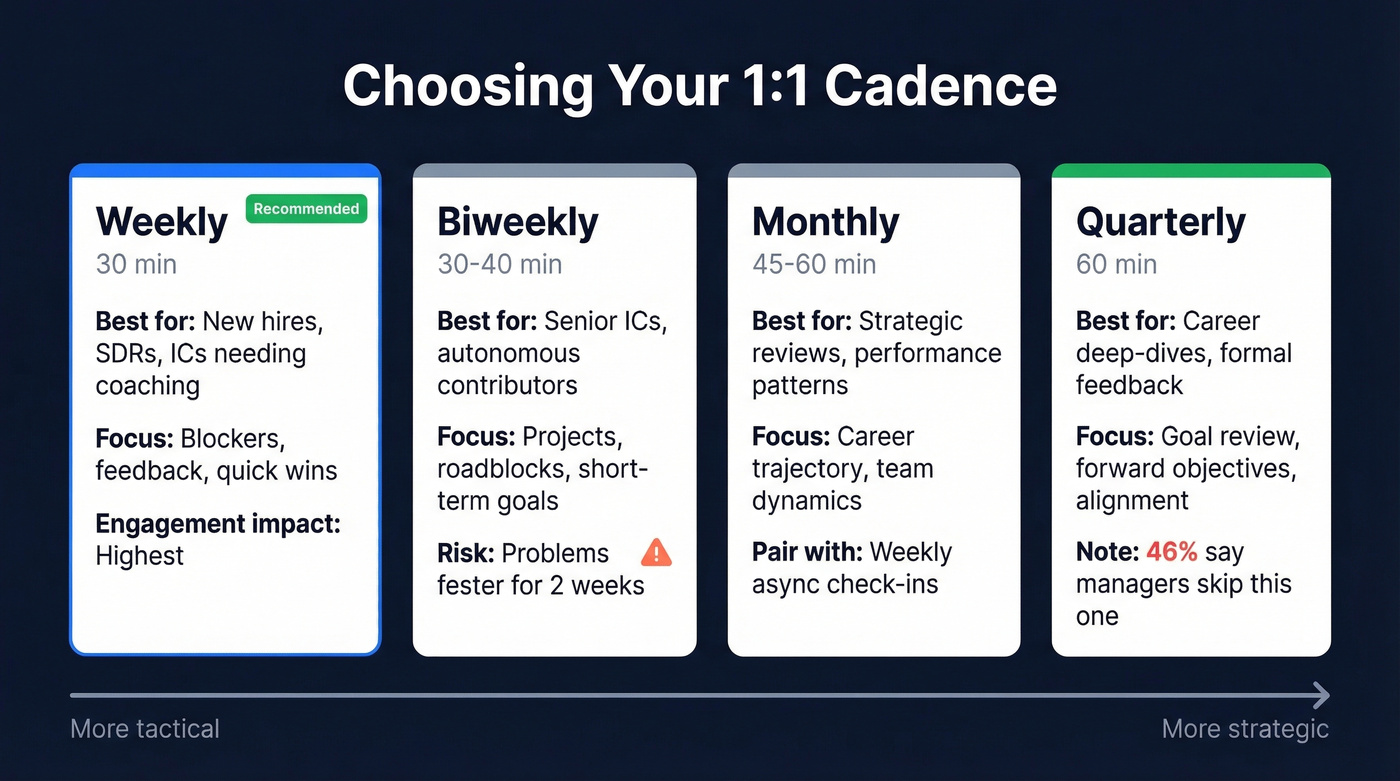
Here's the thing about biweekly cadence: problems fester for two weeks instead of one. Rogelberg's data shows engagement benefits trail off compared to weekly. If you go biweekly, make sure there's an async channel for anything that can't wait.
Monthly (45-60 Minutes)
Monthly 1:1s should shift from tactical to strategic - less time on project updates, more on performance patterns, career trajectory, and team dynamics.
| Time Block | Focus |
|---|---|
| 0:00-5:00 | Warm-up & objectives |
| 5:00-15:00 | Action items & project updates |
| 15:00-30:00 | Strategic planning |
| 30:00-45:00 | Feedback & performance |
| 45:00-55:00 | Career growth |
| 55:00-60:00 | Wrap-up |
Quarterly Career Conversation (60 Minutes)
This is the one most managers skip - and the one employees want most. 67% of individual contributors want to advance, but 46% say their manager doesn't know how to help with career development. Dedicate one quarterly session to a structured career deep-dive with formal feedback.
| Time Block | Focus |
|---|---|
| 0:00-10:00 | Context-setting & goal review |
| 10:00-25:00 | Challenges & learnings |
| 25:00-40:00 | Forward objectives |
| 40:00-55:00 | Career alignment |
| 55:00-60:00 | Action items |

The #1 blocker SDRs raise in 1:1s? Bad data killing their connect rates. Prospeo delivers 98% email accuracy with a 7-day refresh cycle, so your reps stop wasting agenda time on list-cleaning problems and start reporting wins.
Turn your next 1:1 from a complaint session into a pipeline review.
Scenario-Specific Variants
Skip-Level 1:1
A senior leader meets someone two or more levels down to check team health and surface issues that don't travel up the chain. The key is making the employee feel safe enough to be honest - so start by explaining why you're meeting and that nothing said will be attributed back without permission. Then ask:
- What's working well on your team that leadership should know about?
- Is there anything your manager could do differently to support you?
- Do you feel like your work is visible to people who make promotion decisions?
- What's one thing you'd change about how this team operates?
New Hire Onboarding 1:1
Run these weekly - or even twice-weekly - during the first 90 days. The goal is ramp clarity and early-win identification, not performance evaluation.
- What's been clearer than expected? What's been confusing?
- Do you have everything you need - tools, access, context?
- What's one small win you've had this week?
- Is there anyone you haven't met yet who you think you should?
Performance Improvement 1:1
Skip this format if you haven't already had a direct conversation about the gap. A PIP 1:1 should never be a surprise. Before you use this agenda, make sure the employee already knows performance is below expectations.
Once that's established, the meeting becomes collaborative problem-solving, not an ambush. Walk through the specific gap together, separate skill gaps from resource gaps, define what "good" looks like in 30 days in writing, and agree on what support you'll provide. Document everything - this protects both of you.
Remote & Hybrid Adaptations
53% of remote-capable workers are hybrid, and per Owl Labs data, 54% of employees default to consulting whoever's physically nearby. Proximity bias is real and it erodes trust with remote reports.
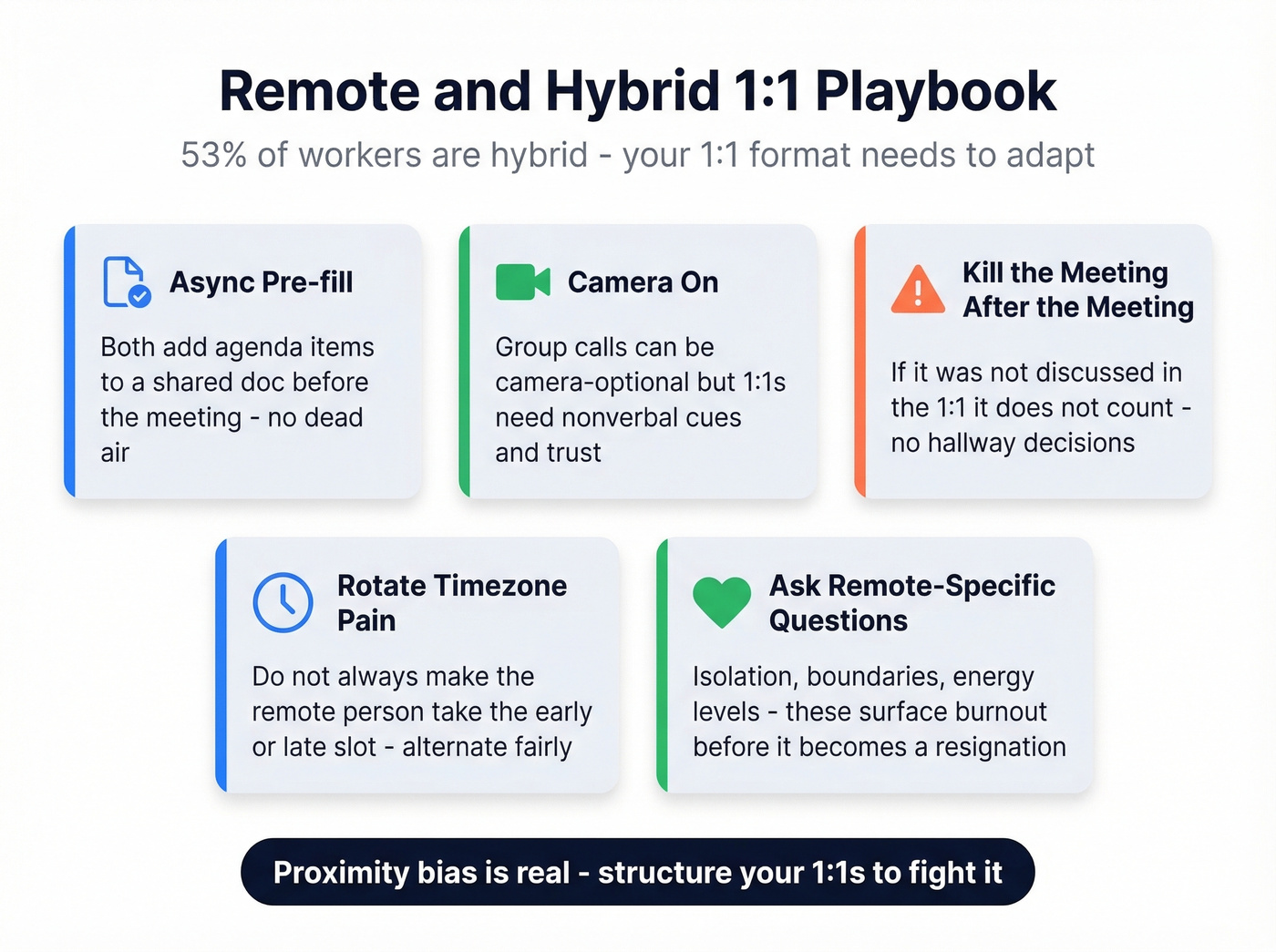
Async pre-fill is non-negotiable. Both parties add agenda items to the shared doc before the meeting. This eliminates the "so... what should we talk about?" dead air and makes the live 30 minutes count.
Camera on for 1:1s. Group meetings can be camera-optional, but 1:1s are about trust and nonverbal cues. Default to cameras on.
Kill the "meeting after the meeting." This is the top hybrid anti-pattern: decisions get made in hallway conversations after the remote person has hung up. If it wasn't discussed in the 1:1, it doesn't count.
Rotate timezone pain. If your report is three time zones away, don't always make them take the 7 AM slot. Alternate.
Ask remote-specific questions. Add prompts about isolation, work-life boundaries, tooling gaps, and energy levels. These aren't soft questions - they surface burnout before it becomes a resignation letter.
35 Questions for Your 1:1 Agenda
Don't use all of these in one meeting. Pick 2-3 per session and rotate. Most are for managers to ask; questions marked with an arrow work both directions.
Check-In & Rapport
- What's one thing that went well this week that I might not know about?
- What's taking up the most mental energy right now - work or otherwise?
- On a scale of 1-10, how's your energy this week?
- Is there anything you've been wanting to bring up but haven't?
Priorities & Blockers
- What's the most important thing you're working on right now?
- Where are you stuck? What would unblock you?
- Is anything taking longer than it should? Why?
- Are your priorities clear, or does anything feel ambiguous?
- What would you stop doing if you could?
- Is there a decision you're waiting on from me or someone else?
- What's the biggest risk to hitting your goals this quarter?
- Do you have the tools and resources you need?
Feedback (Both Directions)
- What feedback do you have for me?
- What's one thing I could do differently to support you better?
- Is there something I'm doing that's getting in your way?
- Here's something I noticed this week - [specific observation]. What's your take?
- Do you feel like you're getting enough feedback from me? Too much?
- What's one thing the team does well that we should do more of?
- Is there a process that's broken that nobody's talking about?
- How do you prefer to receive critical feedback?
Career Growth
- Where do you want to be in 12 months?
- What skills are you trying to build right now?
- Is there a project or responsibility you'd like to take on?
- Do you feel like your work is visible to the right people?
- What's the biggest gap between where you are and where you want to be?
- Is there someone on the team you'd like to learn from?
- Do you feel like you're growing in this role?
- What would make you want to stay here for the next two years?
Remote-Specific
- Do you feel connected to the team, or has it been isolating lately?
- Are your work-life boundaries holding up?
- Is there a communication gap making your job harder?
- Do you have the right hardware and software setup?
- Are meeting times working for your schedule and timezone?
Manager Self-Check
- Did I listen more than I talked?
- Did we discuss something beyond project status?
Follow-Up - The Part Everyone Skips
71% of meetings fail to achieve their objectives because of poor follow-through. Not bad agendas. Not wrong questions. Nobody does anything afterward.
In our experience, the carry-forward mechanic is what separates 1:1s that build trust from ones that feel performative. Every action item needs four things: a description of what specifically needs to happen, a single owner (not "we should"), a due date (even if it's "by next 1:1"), and a priority level.
At the start of every 1:1, review last week's items. Completed items get checked off. Incomplete items carry forward - visibly. This creates a lightweight accountability loop without turning the 1:1 into a performance review. I've watched teams go from "nothing ever changes" to "we actually ship things between meetings" just by adding this five-minute review at the top.
For tooling, use a shared Google Doc organized as a running log with the newest meeting at the top. Both parties add agenda items throughout the week. It's free, searchable, and doesn't require learning a new platform. Dedicated tools like Fellow, Lattice, or 15Five add value when you're managing a larger team and need templates, workflows, or analytics - but for most managers, the doc is enough. If you're running sales 1:1s, it also helps to standardize what "good" looks like for pipeline and activity metrics - pipeline health is a solid starting point.
FAQ
How often should you have one on one meetings?
Weekly is the research-backed default. Rogelberg's data shows engagement benefits trail off with biweekly cadence. Biweekly works for senior ICs; monthly is usually too infrequent. Start weekly and adjust only after 4-6 weeks of consistent sessions.
Who should own the one on one meeting agenda?
The employee. When the manager drives the agenda, it becomes a status update. Employee ownership turns the 1:1 into a coaching conversation where the report surfaces what actually matters to them.
How long should a 1:1 be?
Thirty minutes weekly for most teams. Monthly or quarterly sessions can run 45-60 minutes for career development. Don't go shorter than 15 minutes - you'll barely get past the check-in.
What if my manager keeps canceling?
Raise it directly. Consistent cancellation signals you're not a priority and erodes trust. Suggest a standing calendar block with a recurring agenda doc. If the pattern continues, escalate to a skip-level conversation.
What does a good sales 1:1 agenda look like?
A strong sales 1:1 follows the same core structure - check-in, action item review, priorities, coaching, next steps - but the blockers section should focus on pipeline health, activity metrics, and deal-specific coaching. The filled-in SDR example above shows exactly how this plays out, including how to handle data-quality issues that eat into selling time.
That 'bounced emails tanking connect rate' action item from your 1:1? Teams using Prospeo cut bounce rates from 35% to under 4%. At $0.01 per verified email, fixing upstream data quality costs less than one wasted rep-hour.
Give your SDRs data worth celebrating in next week's 1:1.