

Outbound AI Agents: Real Pricing, Real Problems, and How to Make Them Work in 2026
One loaded SDR costs roughly $18K/month once you factor salary, tools, and management overhead. An AI-heavy outbound stack doing comparable volume? About $1,800/month. That gap is why 45% of teams already run hybrid AI-SDR models - and why every sales leader is asking about deploying an outbound AI agent right now.
Here's the short version: best production-quality platform is Retell AI at $0.07/min base. Easiest no-code setup is Synthflow at $0.11-$0.16/min. But before you pick a platform, fix your contact data - bad numbers burn expensive minutes on dead lines.
What an Outbound AI Agent Actually Does
An outbound AI agent handles the repetitive front end of sales calls. The core workflow is simple:
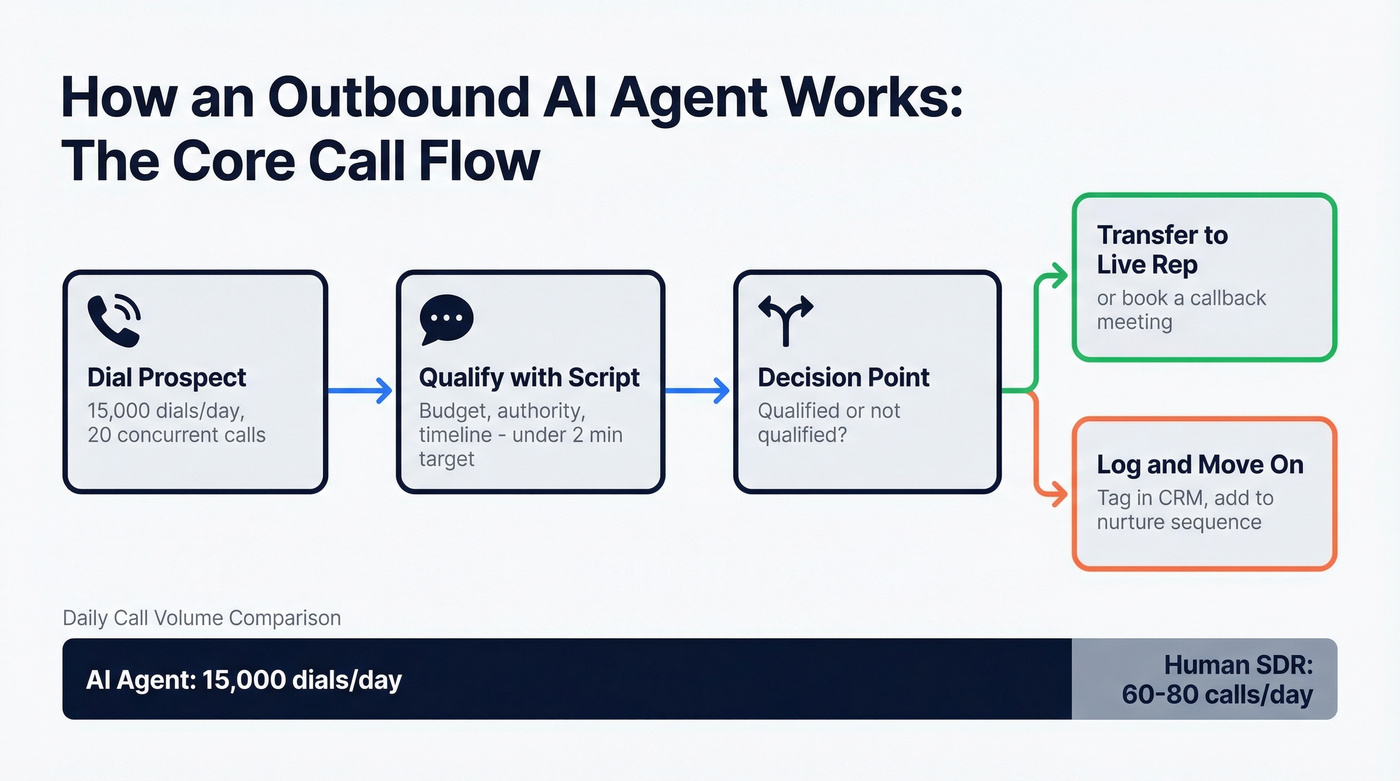
- Dial a prospect from a list
- Qualify using a scripted conversation flow (budget, authority, timeline)
- Transfer to a live rep or book a callback
That's it. Don't overcomplicate this.
A single agent can handle 20 concurrent conversations - roughly 15,000 dials per day - which is the core economic advantage over a human SDR making 60-80 calls. But AI agents can't close deals, handle complex objections, or read the emotional nuance of a prospect who's annoyed but persuadable. The best practitioners on r/Entrepreneur cap calls at under two minutes and design every flow to end in a transfer or a booked meeting. Anything beyond that and you're fighting the technology instead of using it.
Look, if your average contract value is under $5K, you probably don't need a voice AI agent at all. An email sequence with verified contact data will outperform a mediocre voice bot every time. Voice AI shines when you need real-time qualification at scale for deals worth $15K+.
What Platforms Actually Cost
That "$0.10/min" headline you keep seeing? It's often just the telephony fee. Once you stack LLM inference, text-to-speech, speech-to-text, and carrier markups, the real number looks very different.
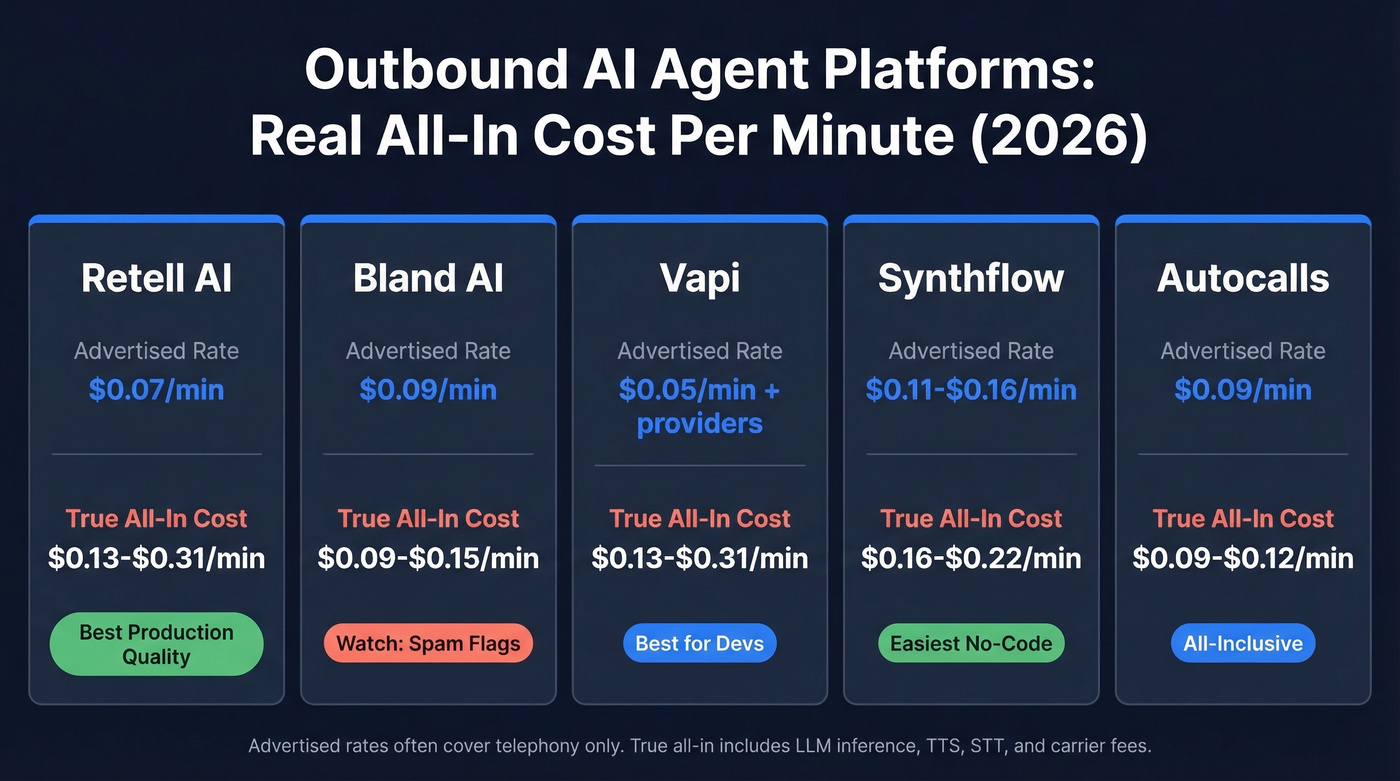
| Platform | Advertised Rate | True All-In/Min | G2 Rating | Best For | Watch Out For |
|---|---|---|---|---|---|
| Retell AI | $0.07/min | $0.13-$0.31 | 4.8/5 | Production quality | Costs scale with premium TTS |
| Bland AI | $0.09/min base | $0.09-$0.15 | - | Budget outbound | Barge-in delays, spam flags |
| Vapi | $0.05/min + providers | $0.13-$0.31 | 4.5/5 | Developer teams | "Developer tax" is real |
| Synthflow | $0.11-$0.16/min | ~$0.16-$0.22 | - | No-code SMBs | Accent issues, minutes add up |
| Autocalls | From $0.09/min | ~$0.09-$0.12 | - | All-inclusive pricing | Smaller ecosystem |
Synthflow deserves a closer look. It sets up in about two hours and handles roughly 80% of routine qualification calls well, but it struggles with heavy accents and complex branching questions. Great for getting started, less great for nuanced conversations.
For enterprise, the numbers jump dramatically. PolyAI starts around $150K/year. Air.ai charges $25K-$100K just for setup. These are contact-center replacements, not SMB prospecting tools. Both Retell and Bland hold SOC 2, HIPAA, and GDPR compliance credentials if enterprise compliance is on your checklist.
The hidden cost that kills most budgets is premium TTS. Basic Google/Polly voices run ~$0.004/min. ElevenLabs - which sounds dramatically more human - runs $0.05-$0.10/min. That single line item can triple your per-minute cost.
A Worked Example
At 3,000 minutes/month on Retell ($0.07 base + typical LLM/TTS/STT costs), you're looking at ~$510/month in platform costs. Add verified mobile data on top and you've got a full AI calling stack for under $900/month - roughly 5% of what a loaded SDR costs.

That $510/month AI calling stack falls apart when a third of your dials hit dead lines. Prospeo's 125M+ verified mobile numbers - refreshed every 7 days - cut wasted minutes before your agent even dials. At $0.01/email and 10 credits per mobile, your data costs less than a single minute of premium TTS.
Stop burning AI minutes on bad numbers. Fix the data layer first.
What Breaks in Production
We've seen teams spin up a voice agent in a weekend and declare victory. Then week two happens.
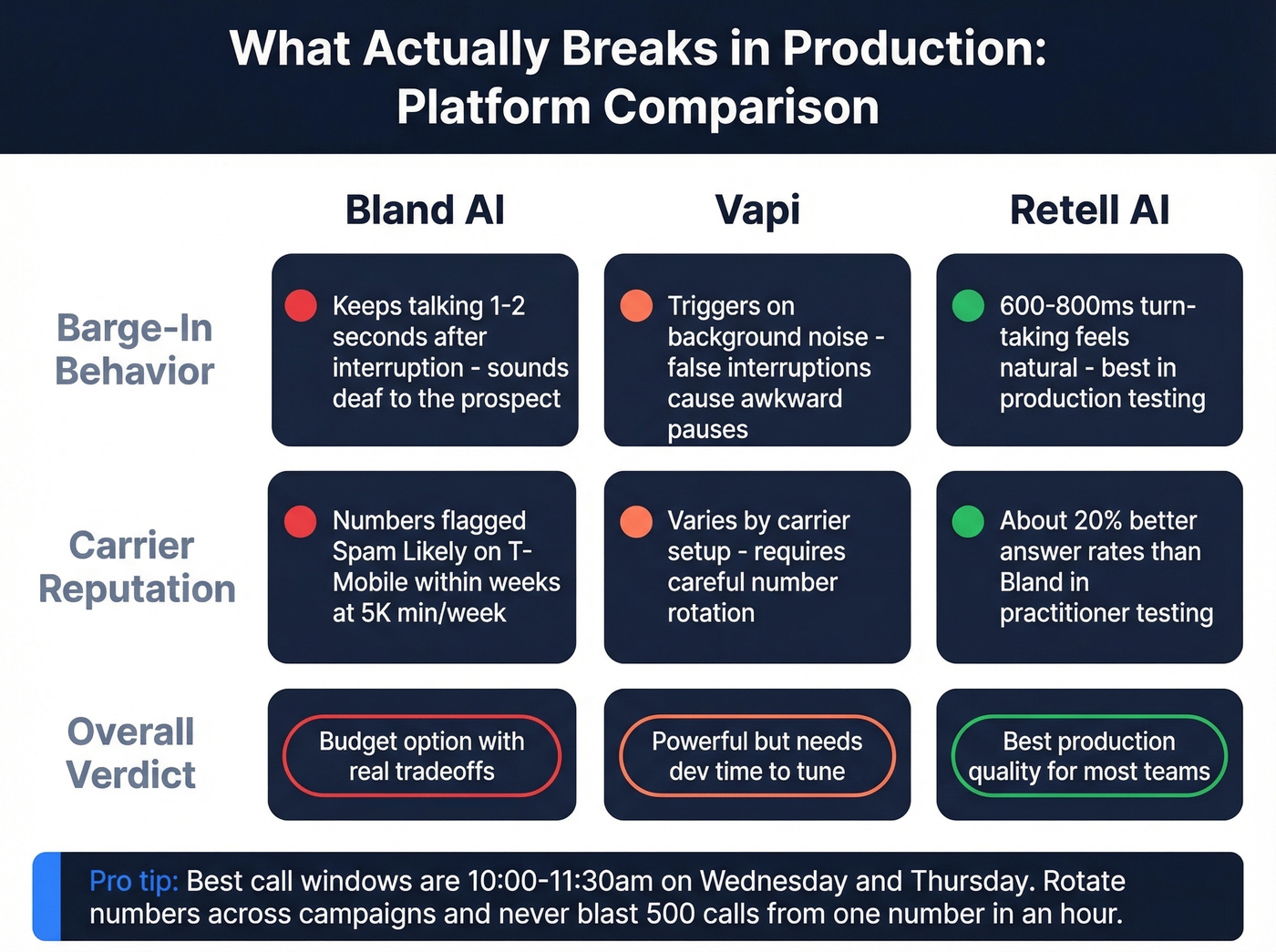
Barge-in behavior is the biggest differentiator between platforms. Bland keeps talking for 1-2 seconds after a prospect interrupts - which makes the AI sound deaf. Vapi swings the other direction, triggering on background noise. Retell's turn-taking model at ~600-800ms latency feels the most natural in production.
Carrier reputation is the silent killer. One practitioner reported Bland's numbers getting flagged "Spam Likely" on T-Mobile in a month-long test across ~5K minutes/week. Switching to Retell improved answer rates by about 20%. Your platform choice directly affects whether prospects even pick up.
Call timing gets overlooked, but the data is clear. The best call windows are 10:00-11:30am, Wednesday and Thursday. Rotate numbers, manage caller ID reputation, and don't blast 500 calls from a single number in an hour.
Set up call-level logging from day one - token usage, latency per turn, and transfer success rate. Teams that skip observability can't diagnose why their agent suddenly started bombing calls. If you're not monitoring every conversation, you're flying blind.
Compliance for AI Calling in 2026
The regulatory environment for AI calling has gotten aggressive. Skip this section at your own risk.
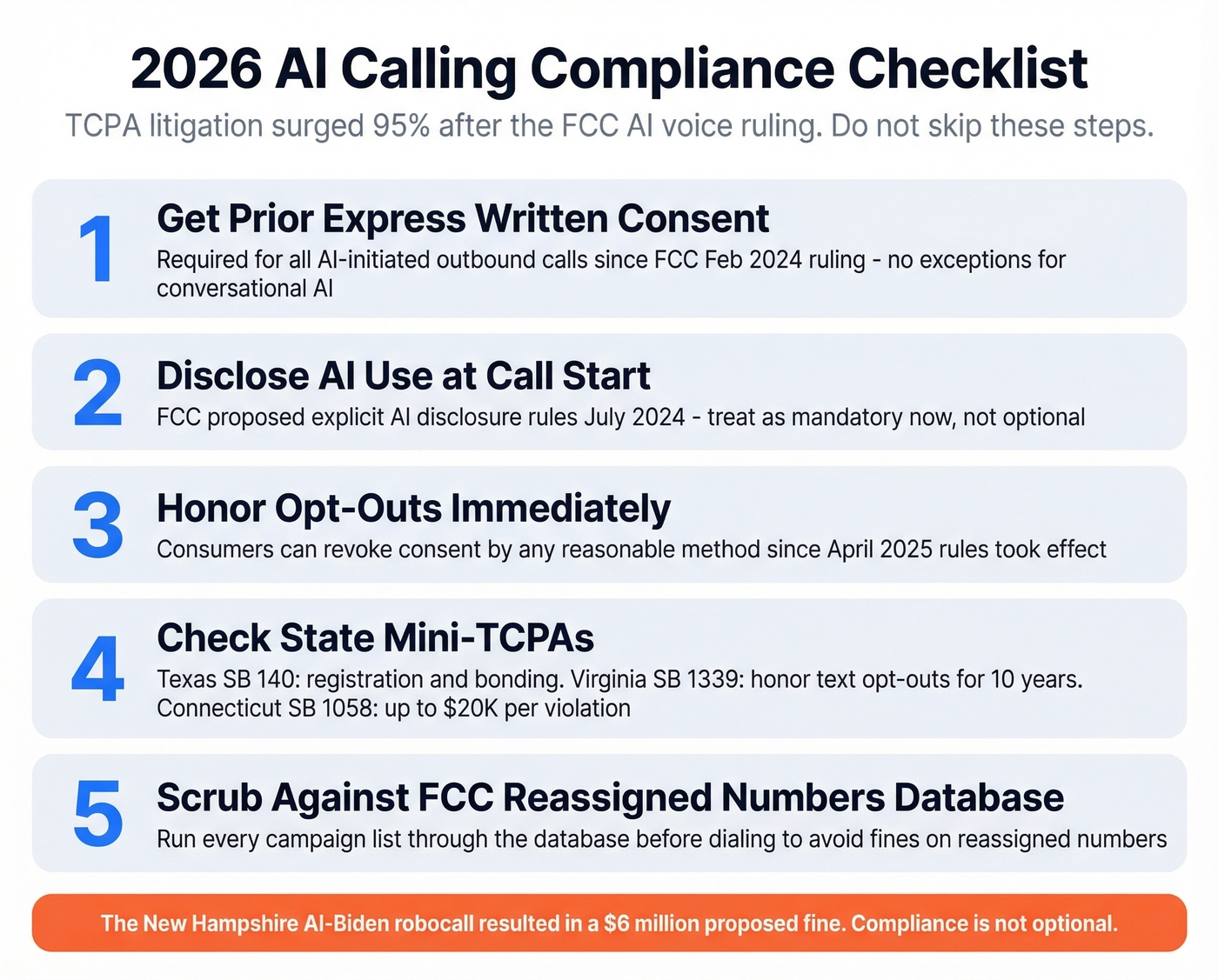
The FCC's February 2024 ruling classified AI-generated voices as "artificial or prerecorded" under TCPA, which means prior express written consent is required. No exceptions for "conversational" AI. TCPA litigation surged 95% in the year following that ruling. The New Hampshire AI-Biden robocall incident resulted in a $6 million proposed fine.
Here's what your 2026 compliance checklist should look like:
- Get prior express written consent before any AI-initiated outbound call - no shortcuts
- Disclose AI use at the start of every call - the FCC proposed explicit AI disclosure rules in July 2024, so treat this as a requirement now, not a suggestion
- Honor opt-outs immediately - FCC consent revocation rules took effect April 2025, and consumers can revoke by any reasonable method
- Check state mini-TCPAs - Texas SB 140 requires registration and bonding; Virginia SB 1339 mandates honoring text opt-outs for 10 years; Connecticut SB 1058 caps penalties at $20K per violation
- Scrub against the FCC Reassigned Numbers Database before every campaign
These rules apply equally whether you're running a single voice agent or deploying a fleet across multiple campaigns.
Fix Your Data Before Deploying
Every article about AI voice agents obsesses over per-minute rates and LLM latency. Nobody talks about the upstream problem that actually tanks ROI: if 30% of your phone numbers are wrong, your agent is burning $0.20/min dialing dead lines. That's not a platform problem. That's a data problem.
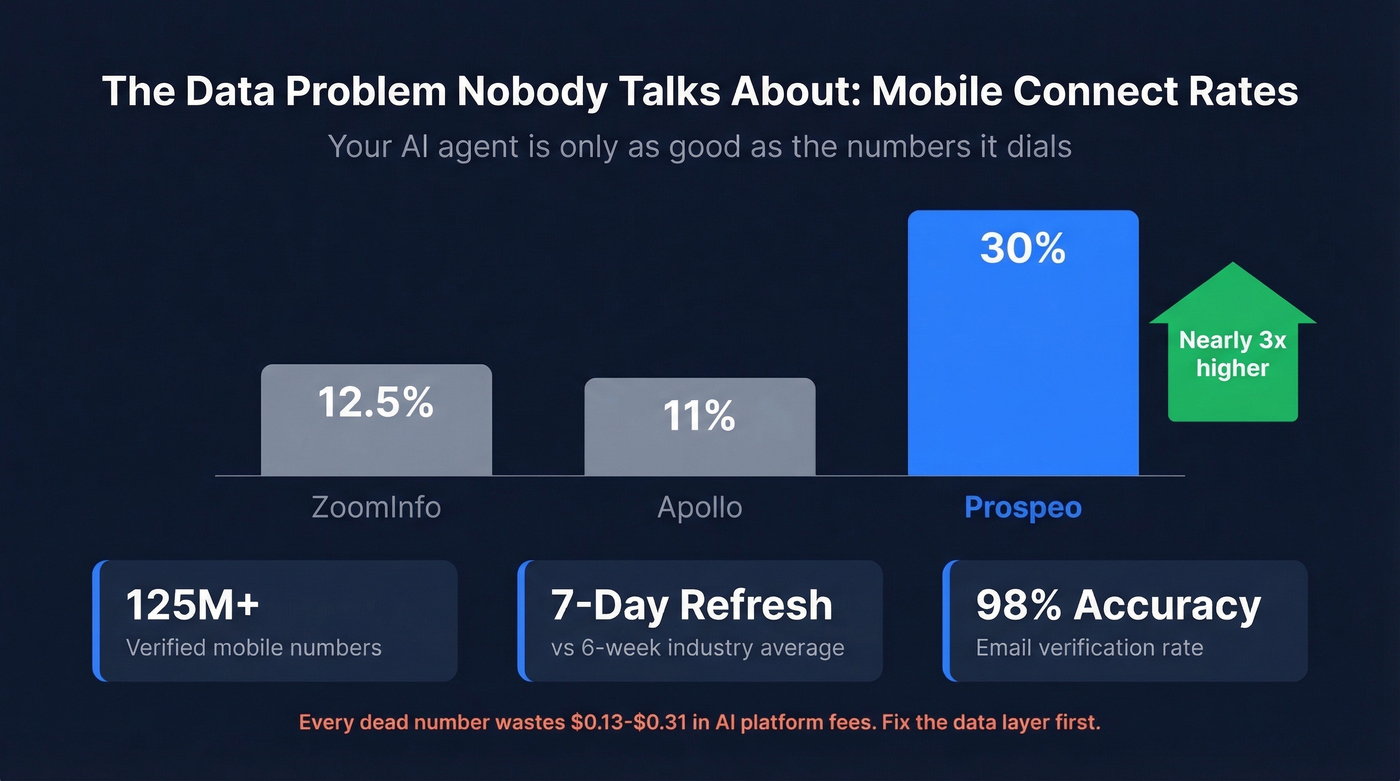
We ran the numbers on this internally. Prospeo's mobile database covers 125M+ verified numbers with a 30% pickup rate - over 2x what ZoomInfo (12.5%) and Apollo (11%) deliver on connect rates. Email accuracy sits at 98%, so your multi-channel sequences don't bounce either. The data refreshes every 7 days, not the 6-week industry average, which means you're not dialing numbers that went stale last month. And because Prospeo charges 10 credits per number and you only pay when it's found, the math is straightforward: clean data in means fewer wasted minutes out.
The free tier gives you 75 verified emails and 100 Chrome extension credits monthly - enough to test whether the data quality difference is real before committing.
The article you just read proves the math: AI agents slash SDR costs by 90%. But every dead number wastes $0.13-$0.31 in platform fees. Prospeo delivers 30% mobile pickup rates - nearly 3x ZoomInfo's 12.5% - so your AI agent actually reaches humans, not voicemail graveyards.
Triple your AI agent's connect rate with numbers that actually pick up.
FAQ
How much does an outbound AI agent cost per month?
Budget $500-$1,500/month for 2,000-5,000 minutes on platforms like Retell, Synthflow, or Bland. True all-in cost runs $0.13-$0.31/min once you add LLM inference, TTS, and carrier fees. Enterprise platforms typically start around $60K/year.
Can AI voice agents replace SDRs entirely?
Not yet. AI handles qualification and meeting booking but can't manage complex objections or emotional nuance. The winning model is hybrid - AI qualifies at scale, humans close. Teams running this approach report 3-5x more qualified conversations per rep.
What's the best platform for small teams?
Synthflow is the easiest no-code option, setting up in about two hours with all-inclusive per-minute pricing. Retell AI offers better production quality if you have a developer on hand. Pair either with verified mobile data that refreshes weekly to avoid burning minutes on dead numbers.
How do I stop calls from getting flagged as spam?
Use platforms with strong carrier reputation - Retell outperformed Bland by ~20% on answer rates in practitioner testing. Dial during 10:00-11:30am windows on Wednesdays and Thursdays, rotate numbers across campaigns, and start with verified mobile data to avoid disconnected-number waste.