

Outreach Automation: What Actually Works in 2026 (With Benchmarks)
Sales reps spend nearly 65% of their time on tasks that aren't selling - data entry, CRM updates, scheduling follow-ups. The average cold email reply rate sits at 3.43%. And if you spend any time on r/SaaS or r/b2bmarketing, you've seen the "cold email is dead" posts - founders reporting 2,000 sends with six replies and zero customers, accounts flagged for automation, inboxes so saturated that even good messages disappear.
Outreach automation isn't dead. Lazy, undisciplined execution is. The teams still booking meetings aren't doing anything magical - they're disciplined about three things most teams skip: data quality, deliverability infrastructure, and sequence design. Everything else is noise until those foundations are solid.
The Three Things That Actually Matter
If you don't read anything else, do these three things:
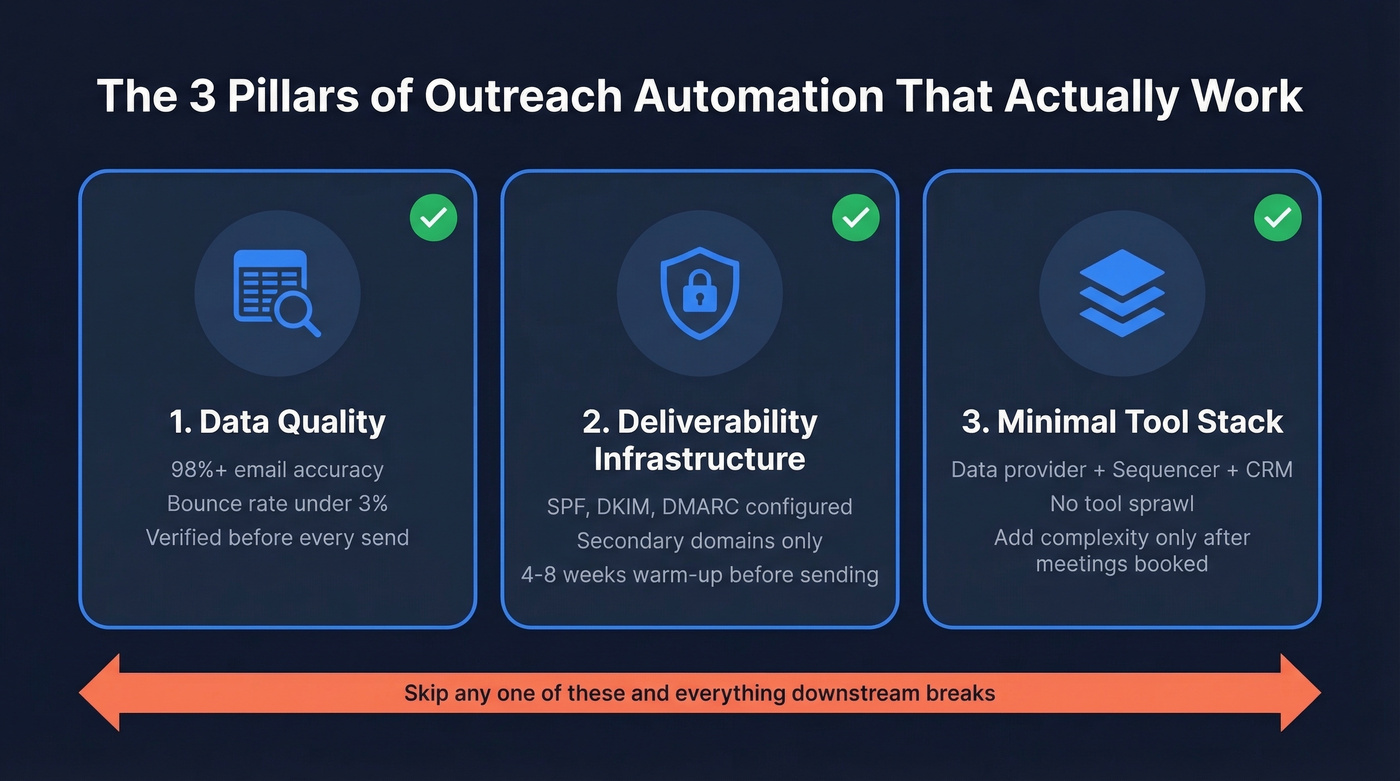
Fix your data first. If your email list isn't 98%+ accurate, you're burning budget and domain reputation on every send. Bad data poisons everything downstream.
Set up deliverability infrastructure before sending a single cold email. That means SPF, DKIM, DMARC on a secondary domain, plus 4-8 weeks of warm-up. Skip this and you're sending straight to spam.
Start with a 3-tool stack. Data provider + sequencer (Instantly or Saleshandy) + CRM (HubSpot free). Nothing else until you're consistently booking meetings. Tool sprawl kills more outbound programs than bad copy does.
What Is Outreach Automation?
Outreach automation is the use of software to execute and scale prospecting touchpoints - email sequences, phone cadences, social touches - without manually sending each one. It's distinct from marketing automation, which nurtures known contacts at scale through drip campaigns and newsletters.
An automated outreach system is built for 1-to-1 pipeline generation: finding a specific VP of Engineering, sending a personalized cold email, following up across channels, and booking a meeting. The scope has expanded well beyond email blasts - modern platforms cover email sequences, phone task queuing, social engagement workflows, and increasingly, AI agents that decide when and how to follow up based on prospect signals. That last layer, agentic AI, is the newest addition, and we'll cover where it makes sense later.
Why Your Data Comes First
No sequence, no subject line, no AI personalization tool matters if 15% of your emails bounce. A bounce rate over 3% signals spammer behavior to Google and Microsoft, triggering throttling that tanks deliverability for your entire domain. And since 58% of all replies come from step one of a sequence, you can't afford to waste that first touch on a dead address.
Meritt saw similar results: pipeline tripled from $100K to $300K per week, bounce rate dropped from 35% to under 4%, and connect rate 3x'd to 20-25% once they cleaned up their contact data.

Use this approach if: You're running any volume of cold outreach and need verified emails and direct dials before they hit your sequencer.
Skip this if: You enjoy explaining to your VP of Sales why your domain got blacklisted.
2026 Benchmarks for Automated Outreach
Numbers ground expectations. Here's what "good" actually looks like right now for B2B campaigns.
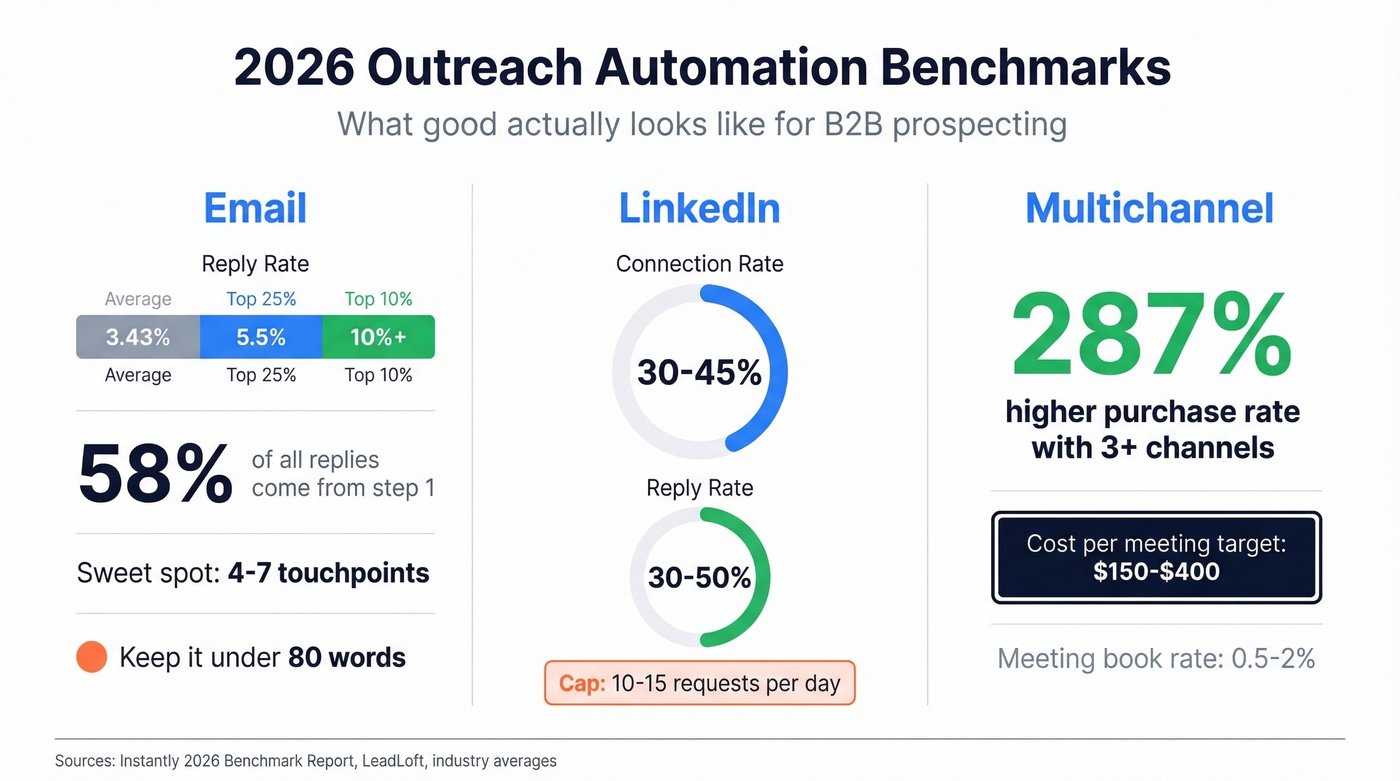
Email Benchmarks
| Metric | Average | Top Quartile | Elite (Top 10%) |
|---|---|---|---|
| Reply rate | 3.43% | 5.5%+ | 10%+ |
| Replies from step 1 | 58% | - | - |
| Optimal touchpoints | 4-7 | - | - |
| First-touch length | <80 words | - | - |
| Best send days | Tue-Wed | - | - |
LinkedIn Benchmarks
LinkedIn connection rates run 30-45%, with reply rates between 30-50% for personalized outreach. Those numbers look better than email on the surface, but volume is capped - 10-15 connection requests per day before you risk account restrictions.
Multichannel Uplift
Campaigns using 3+ channels drive 287% higher purchase rates than single-channel efforts. The catch: only 30% of teams report major success with multichannel, usually because they bolt on channels without coordinating timing or messaging.
ROI Targets
For optimized mid-market B2B cold outreach, aim for a cost per meeting between $150-$400, a 0.5-2% meeting book rate, and a 5-10% reply rate. If your CPM is above $400, audit your data and deliverability before touching copy - the problem is almost never the words.
Building Your Stack
The 4-Layer Framework
Think of your stack in four layers, each solving a distinct problem:
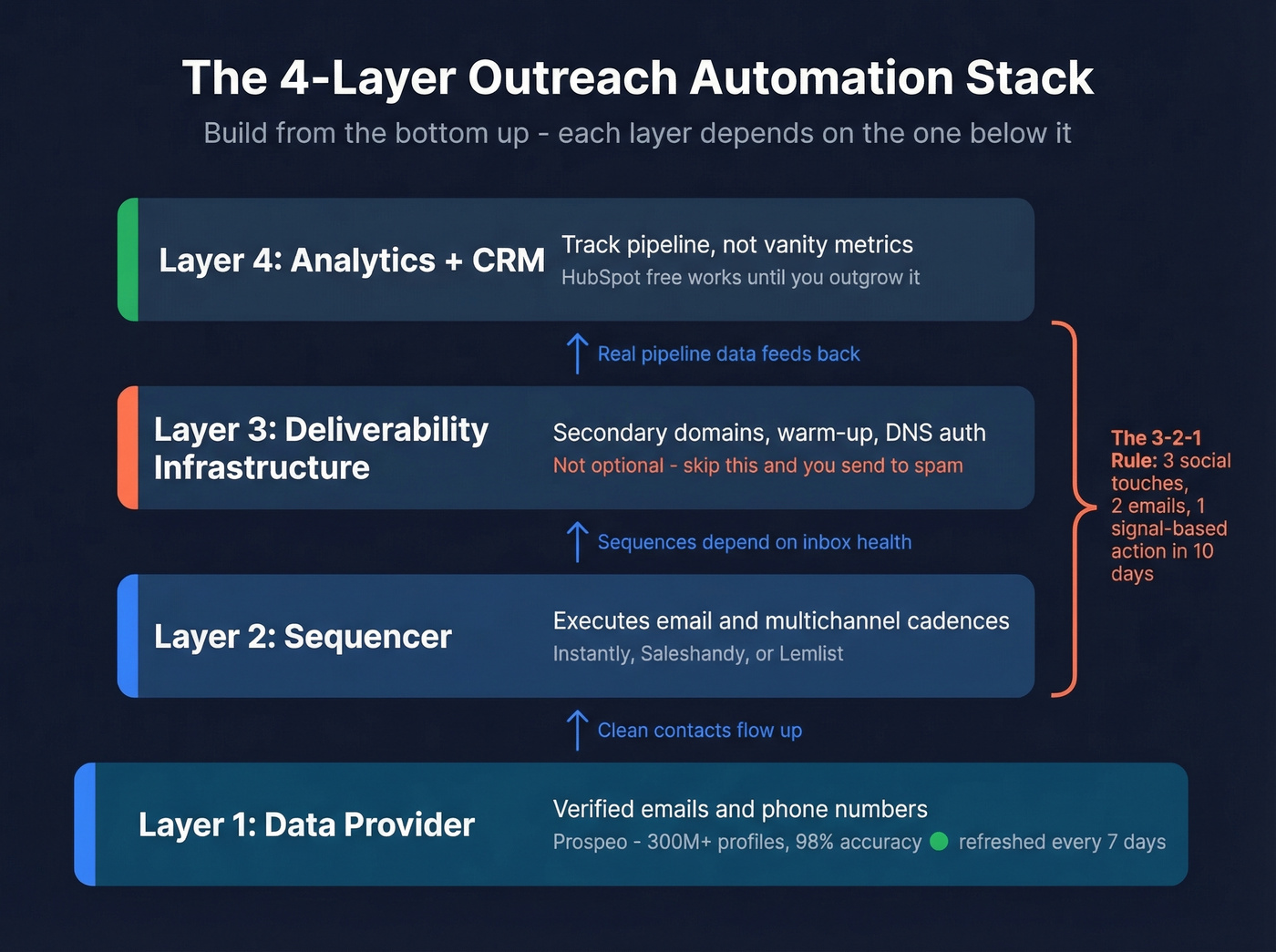
- Data provider - Verified emails and phone numbers feeding clean contacts into everything downstream.
- Sequencer - Executes your email and multichannel cadences. Instantly, Saleshandy, or Lemlist depending on your needs.
- Deliverability infrastructure - Secondary domains, warm-up tools, DNS authentication. Not optional.
- Analytics + CRM - Tracks pipeline, not vanity metrics. HubSpot free works until you outgrow it.
The sequencing cadence that works in 2026 follows a multichannel rhythm: 5-7 touchpoints over 2-3 weeks, spaced 2-4 days apart, is the sweet spot for initial engagement. For larger deal sizes, extend to 12-18 touchpoints across 3+ platforms. A practical framework we've found effective is the 3-2-1 rule - 3 social touches, 2 emails, and 1 signal-based action like engaging with their content in the first 10 days.
Tool Comparison
| Tool | Best For | Channels | Starting Price | Differentiator |
|---|---|---|---|---|
| Prospeo | Verified data layer | Email + mobile numbers | Free (75 emails/mo) | 300M+ profiles, 98% accuracy |
| Instantly | High-volume email | $30/mo (annual) | Unlimited email accounts | |
| Saleshandy | SMB simplicity | $25/mo (annual) | Built-in warm-up | |
| Apollo | All-in-one | Email + phone | Free / $49/user/mo | Data + sequencing combo |
| Lemlist | Multichannel | Email + social | $55/user/mo (annual) | Personalization at scale |
| Reply.io | Multichannel + AI | Email + phone + social | $49/user/mo (annual) | AI-powered replies |
| Outreach.io | Enterprise | All channels | ~$100-$200+/user/mo | Rep orchestration at scale |
| Smartlead | Agency deliverability | $39/mo | Multi-client inbox mgmt |
Apollo's free plan gives you 100 credits per month - enough to test, not enough to run campaigns. Outreach.io doesn't publish pricing, but expect custom enterprise quotes depending on seats and modules; it remains the dominant enterprise platform. Smartlead is the go-to for agencies managing multiple client sending domains.
On the deliverability front, Saleshandy and Instantly both include built-in warm-up tools, while Smartlead offers multi-domain rotation - if deliverability features matter to you, weight those three higher. Prospeo integrates natively with Salesforce, HubSpot, Smartlead, Instantly, Lemlist, Clay, Zapier, and Make, so verified contacts flow directly into whichever sequencer you choose without CSV exports or manual imports.

Bad data is the #1 killer of outreach automation. Prospeo's 300M+ profiles are verified through a 5-step process and refreshed every 7 days - not the 6-week industry average. That's how Meritt cut bounce rates from 35% to under 4% and tripled pipeline.
Fix your data layer before you send another sequence.
Your sequencer, deliverability setup, and CRM don't matter if 15% of your list is dead addresses. Prospeo feeds verified emails (98% accuracy) and 125M+ direct dials into Instantly, Smartlead, Lemlist, and every tool in your stack - at $0.01 per email.
Stop burning domain reputation on unverified contacts.
Deliverability Setup
This is the section most teams skip. Don't.
SPF, DKIM, DMARC Checklist
- SPF record - Add
include:_spf.google.com(Google Workspace) orinclude:spf.protection.outlook.com(Microsoft 365) to your secondary domain's DNS - DKIM - Generate via Google Admin Console or Microsoft 365 admin; publish the TXT record
- DMARC - Start with
p=nonefor 2 weeks to monitor, then move top=quarantine - Secondary domain - Never send cold outreach from your primary domain. Register a variant (e.g.,
tryacme.comforacme.com)
Warm-Up Ramp Schedule
| Week | Daily Volume | Notes |
|---|---|---|
| 1 | 5-10 | Warm-up only, no cold sends |
| 2 | 20-30 | Begin light cold sends (10-20) |
| 3 | 40-50 | Mix warm-up + cold |
| 6 | 150-200 | Scaling phase |
| 8+ | 200-500 | Max capacity per domain |
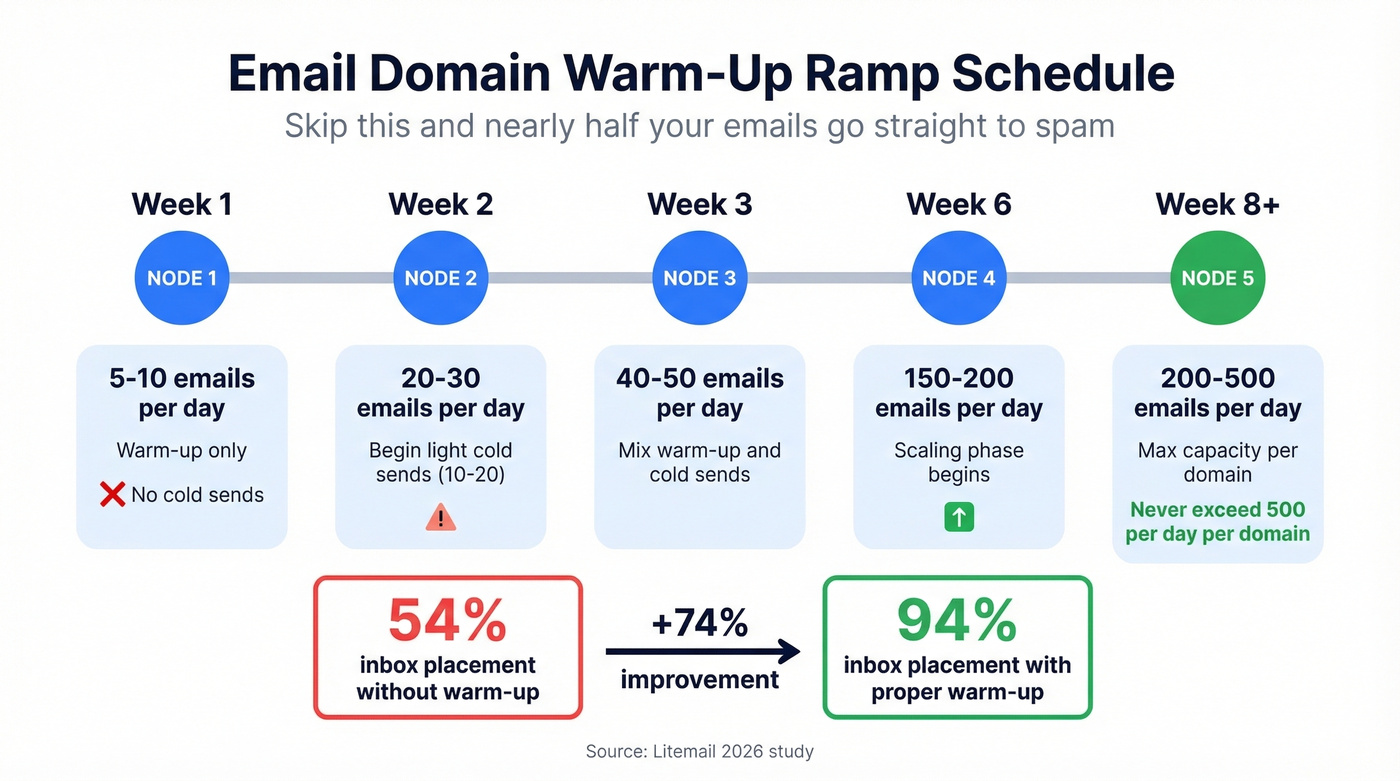
The difference is dramatic: domains without proper warm-up see 54% inbox placement vs 94% for warmed domains. Nearly half your emails go straight to spam without it. In our experience, teams that skip warm-up spend 3x longer recovering a blacklisted domain than they would've spent warming up in the first place. Never exceed 500 emails per day per domain.
How to Scale Safely
Scale horizontally, not vertically. Instead of pushing 500 emails through one inbox, run 30-50 per day across multiple inboxes on multiple domains. This lets you grow volume without tripping spam filters. Warm-up never stops - keep it running even during active campaigns.
Watch for warning signals: open rates dropping below 30%, bounce rates creeping above 2%, or test emails landing in spam. Any of these means you pull back volume immediately, not next week.
AI Agents vs. Traditional Sequences
Traditional sequences are static: if prospect opens email, wait 3 days, send follow-up. AI agents are different - they perceive signals, reason about optimal next actions, and execute multi-step workflows dynamically. Think thermostat vs. climate system: one follows rules, the other reads conditions and adapts.
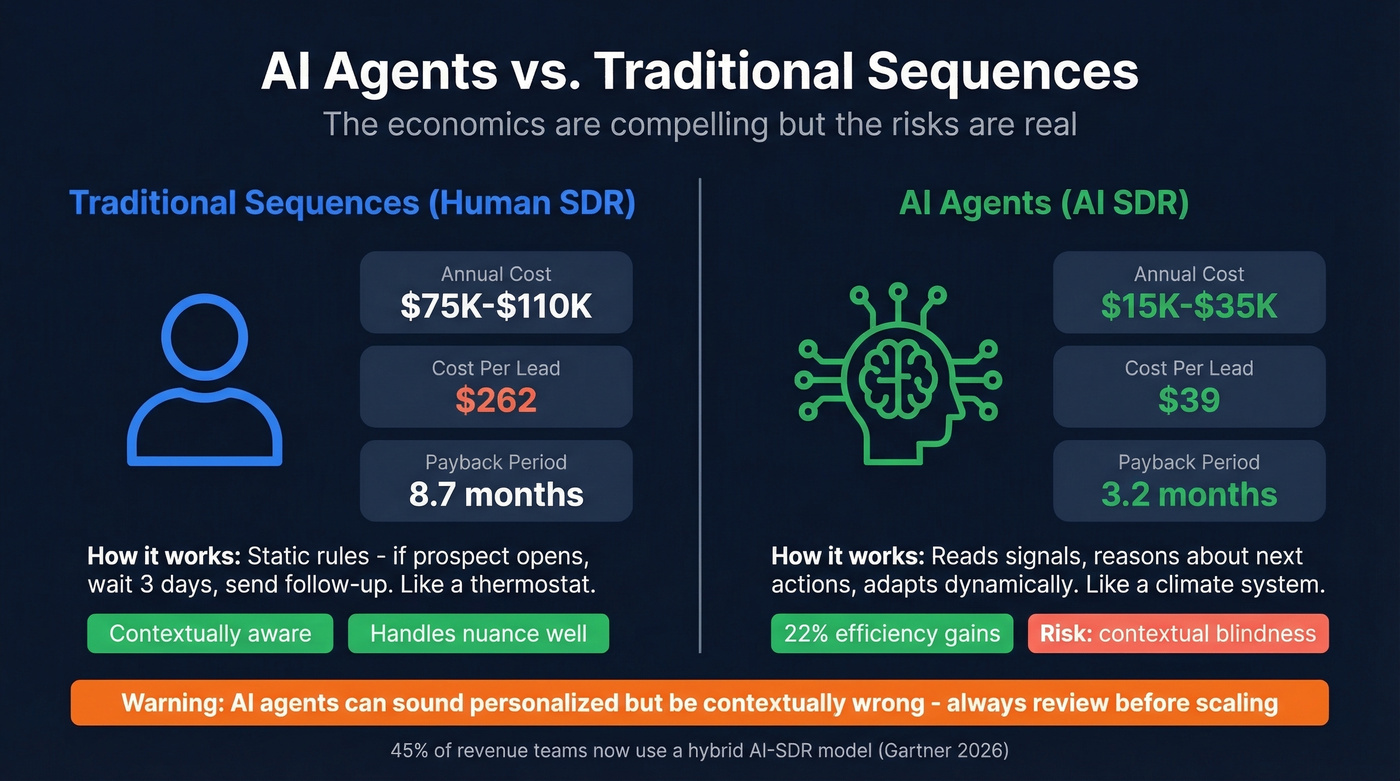
Gartner projects that by end of 2026, 40% of enterprise applications will feature agentic capabilities, up from less than 5% in 2025. Already, 45% of revenue teams report using a hybrid AI-SDR model, and mature gen-AI adopters report 22% efficiency gains in their automated outbound workflows.
The economics are compelling on paper:
| Metric | Human SDR | AI SDR |
|---|---|---|
| Annual cost | $75K-$110K | $15K-$35K |
| Cost per lead | ~$262 | ~$39 |
| Payback period | 8.7 months | 3.2 months |
But there's a real risk: "contextual blindness." AI agents generate personalized-sounding messages that are contextually wrong - referencing a prospect's old role, misreading a company's situation, or sending tone-deaf follow-ups after a negative reply. We've seen teams deploy AI SDRs and damage brand perception faster than any human rep could. Platforms like Artisan are pushing the AI-first BDR model hard with autonomous agents, but the technology still needs human guardrails.
Here's the thing: if your sequences are well-built and your data is clean, traditional automation still outperforms AI agents for most teams under 10 reps. The AI SDR hype is real, but the ROI only materializes when you're scaling past the point where humans can process signal-based routing fast enough. Most teams aren't there yet, and they'd get more from fixing their data and deliverability than from bolting on an AI agent. A hybrid approach - where AI handles variable insertion while humans approve messaging - is the practical middle ground for now.
Compliance Checklist
Enforcement has tightened fast. Here's the timeline that matters:
- Feb 2024: Google/Yahoo enforced authentication for bulk senders (5,000+ emails/day)
- May 2025: Microsoft followed with similar requirements for Outlook.com
- Nov 2025: Gmail started rejecting non-compliant emails outright - not just filtering to spam
Penalty Table
| Regulation | Max Penalty | Scope |
|---|---|---|
| GDPR | EUR 20M or 4% revenue | EU/EEA contacts |
| CAN-SPAM | $50,120 per email | US contacts |
| CCPA | $7,500 per violation | California contacts |
| TCPA | $500-$1,500 per incident | US calls/SMS |
The TCPA math is terrifying: a campaign to 1,000 contacts without proper consent could mean $500K to $1.5M in fines. That's not a theoretical maximum - it's the statutory range per incident multiplied by contacts. AI-enriched contact data is under increased CCPA scrutiny in 2026, so if your data provider uses third-party AI enrichment, verify their compliance posture before you send. Any automated prospecting program needs compliance baked in from day one, not bolted on after a violation.
Practical requirements for every cold email:
- Working unsubscribe link (one-click preferred)
- Valid physical mailing address
- Honor opt-outs within 10 business days
- Spam complaint rate under 0.3%
- Truthful subject lines and sender identity
Mistakes That Kill Results
We've audited dozens of outbound programs, and the same killers show up every time.
Set-it-and-forget-it mentality. Sequences need weekly audits - reply sentiment, deliverability metrics, A/B results. Automation doesn't mean putting outreach on autopilot and walking away.
Sending from your primary domain. One spam complaint spike and your entire company's email reputation is toast. Always use secondaries.
Skipping warm-up. Four to eight weeks feels slow. Rebuilding a blacklisted domain takes four to eight months.
bounce rate over 3%. This is where ESPs start treating you like a spammer. Verify every list before it touches a sequencer.
Me-centric copy. "We're the leading provider of..." gets deleted. Lead with the prospect's problem, not your pitch deck.
No A/B testing. If you aren't testing subject lines, CTAs, and send times weekly, you're optimizing on gut feel. The best tools include built-in A/B testing - use it.
Ignoring reply sentiment. An angry reply is worse than no reply. Auto-pause sequences when prospects push back.
When NOT to Automate
Not every go-to-market motion needs a sequence. One founder on r/SaaS described deleting Apollo, abandoning cold outreach entirely, and hitting $4.7K MRR through niche community participation and long-form SEO content. No ads, no sequences.
For high-ACV enterprise deals - $100K+ contracts - signal-based manual outreach often outperforms automation. When you're targeting 50 accounts, not 5,000, the ROI of a deeply researched, hand-crafted message beats any template. If your total addressable list fits on a single spreadsheet, you probably don't need automated prospecting tools at all.
FAQ
What's a good cold email reply rate in 2026?
Average is 3.43%, top quartile hits 5.5%+, and elite performers reach 10%+. Below 2% means you should audit data quality and deliverability before rewriting copy - the problem is almost always upstream of messaging.
How many emails should I send per day per inbox?
Cap at 30-50 per inbox. Scale by adding more inboxes and domains rather than pushing volume through one - that's how you grow send volume without destroying deliverability.
Do I need a separate domain for cold outreach?
Yes, always. Register a close variant of your primary domain, set up SPF/DKIM/DMARC, and warm each domain for 4-8 weeks before sending any cold emails.
What's the difference between outreach automation and marketing automation?
Outreach automation targets individual prospects to book meetings - it's 1-to-1 pipeline generation. Marketing automation nurtures known contacts at scale with drip campaigns and newsletters. Different tools, different goals.
How do I verify emails before sending?
Use a dedicated verification tool that runs multi-step checks including catch-all handling and spam-trap removal. Prospeo's 5-step verification process delivers 98% accuracy; other options include NeverBounce and ZeroBounce. Aim for 98%+ accuracy to keep bounce rates under 3%.