

Stop Overcoming Objections. Start Diagnosing Them.
A prospect says "it's too expensive," and your rep launches into a 22-second monologue about ROI. The prospect goes quiet. The deal dies three weeks later in a "we decided to hold off" email. That monologue is the problem - and Gong's analysis of 67,149 sales calls proves it. The reps who win don't treat overcoming an objection as a debate. They slow down, ask a question, and figure out what's actually going on.
Here's the context that makes every pushback harder than it was five years ago: 96% of buyers research your product before they ever talk to a rep. By the time they push back, they've already built a case. Your job isn't to bulldoze that case. It's to understand it.
The Short Version
If you read nothing else, internalize these five things:
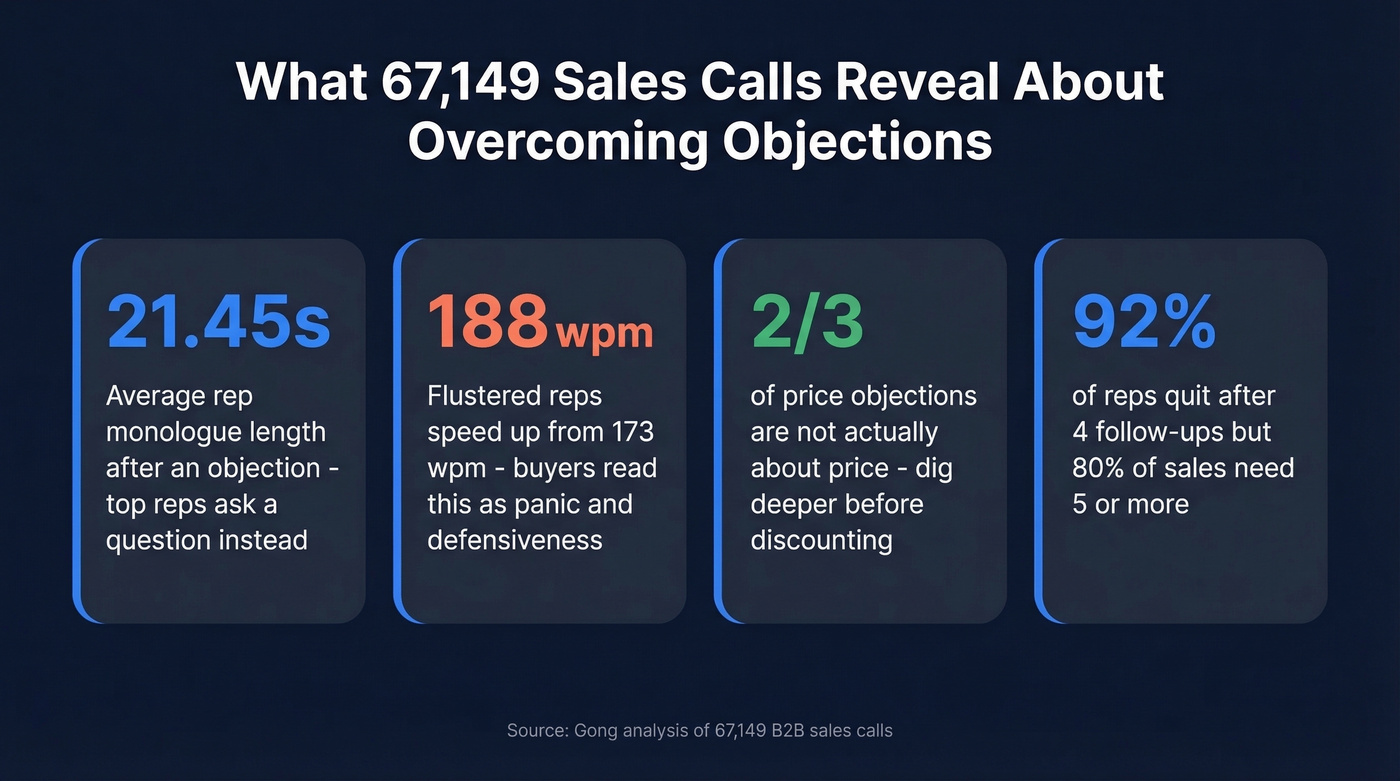
- Pause after every objection. Top reps pause longer than normal after hearing resistance. Average reps monologue for 21.45 seconds straight. That's an eternity of talking past your buyer.
- Clarify before rebutting. The first objection is rarely the real one. Roughly two-thirds of objections aren't actually about price.
- Use the scripts below word-for-word until you build muscle memory. Improvising under pressure is how deals get fumbled.
- Slow down. Average reps talk at 173 words per minute. Bad reps speed up to 188 wpm when flustered. Buyers read that acceleration as panic.
- Drill, don't just read. Reading about objection handling doesn't build the reflex. Reps need reps.
What 67,149 Sales Calls Reveal
Gong's data set is one of the largest public analyses of objection-handling behavior in B2B sales. They ran ML and NLP across 67,149 recorded demo calls - pulled from a database of 1M+ calls - to isolate what top performers do differently the moment a buyer pushes back.
The findings are uncomfortable for most sales teams.
Top reps pause longer after an objection than during normal conversation. The call analysis calls this the "Patience Score." Average reps do the opposite - their pause length drops after objections, and they frequently interrupt. The instinct to fill silence with words is the single most common failure mode. When average reps do respond, they monologue for 21.45 seconds. That's not a conversation. That's a pitch the buyer didn't ask for. Top reps ask a clarifying question within seconds and keep the back-and-forth pace steady through objections, while average reps' conversation flow collapses into one person talking and the other checking out.
Here's the delivery piece that surprised us: average talking speed in a normal sales conversation runs about 173 wpm. When a flustered rep hits an objection, they speed up to 188 wpm. Fifteen words per minute doesn't sound like much, but buyers feel it. It signals defensiveness, and defensiveness signals that the objection hit a nerve - which makes the buyer trust the objection more, not less.
One more counterintuitive finding: top reps disproportionately close their objection responses with "Does that make sense?" It sounds cringe-worthy on paper, but the data shows it works. It invites the buyer back into the conversation and confirms whether the concern was actually resolved.
The 4 Ps Framework (and Where It Breaks)
RAIN Group's process is the cleanest framework we've found for handling resistance in real time: Listen, Understand, Respond, Confirm. Some teams reframe these as the 4 Ps - Pause, Probe, Provide, and Prove - which maps to the same sequence but is easier to recall mid-call.
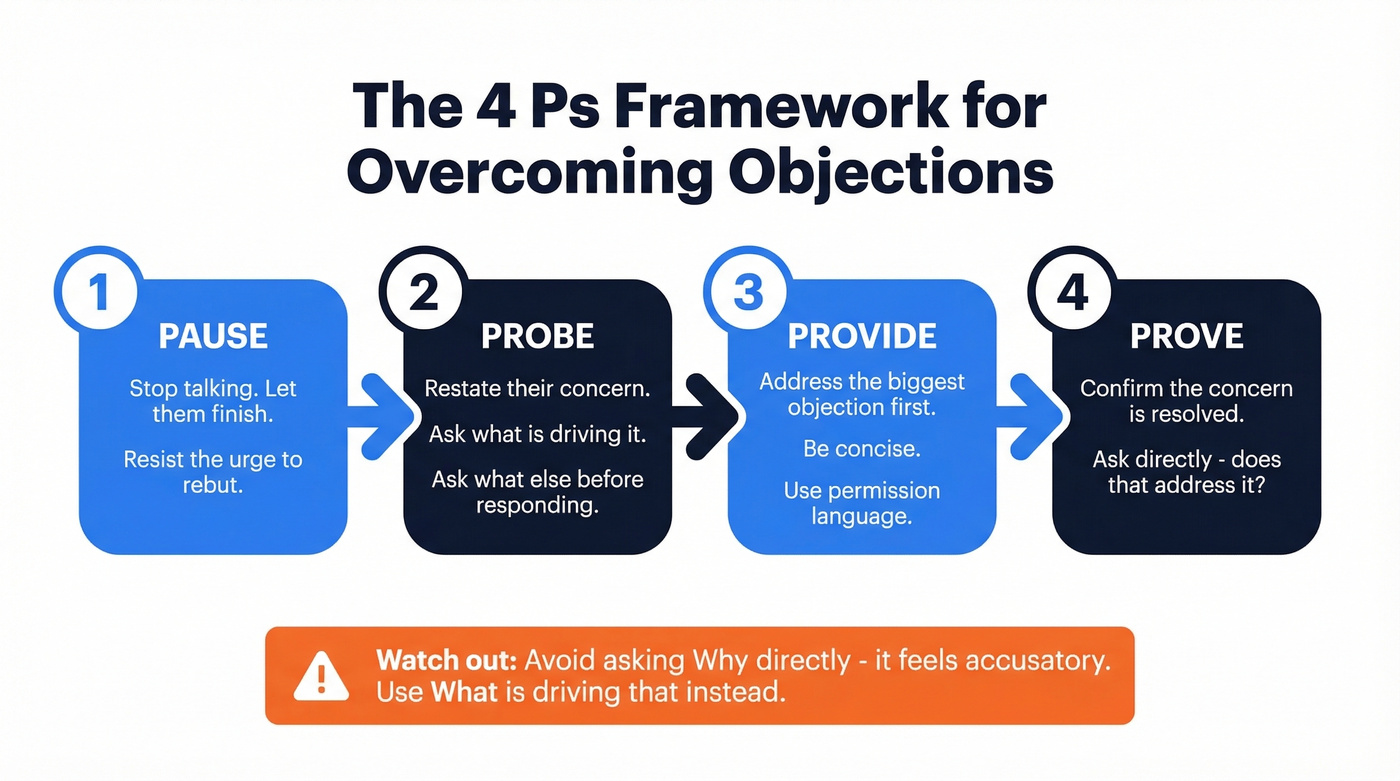
Listen (Pause) means actually listening. Not formulating your rebuttal while the buyer talks. Let them finish. Pause.
Understand (Probe) is where most reps skip ahead. This is the diagnostic step. Restate the concern in your own words, ask what's driving it, and dig for the objection behind the objection by asking "What else?" before you respond to anything.
Now, here's a tension worth flagging. RAIN Group advises asking "Why?" to uncover deeper objections. The call data says "why" can feel accusatory - it triggers defensiveness. The fix is simple: use softer variants. "What's driving that?" or "Help me understand what's behind that concern" gets you the same information without the interrogation energy.
Respond (Provide) should be concise. Not a monologue. Not a feature dump. Address the most important objection first, and use permission language: "Can I bounce a few thoughts off you?" lands better than launching into a rebuttal.
Confirm (Prove) closes the loop. Don't assume the objection is resolved just because you answered it. Ask directly: "Does that address your concern, or is there something else we should talk through?"
One bonus tactic I think is underrated: before responding at all, ask the prospect what they do like about the solution. "Before we dig into that - what's been working for you so far in what we've discussed?" This re-anchors the buyer on value before you address the concern. It's disarmingly effective.
Top Objections and How to Handle Them
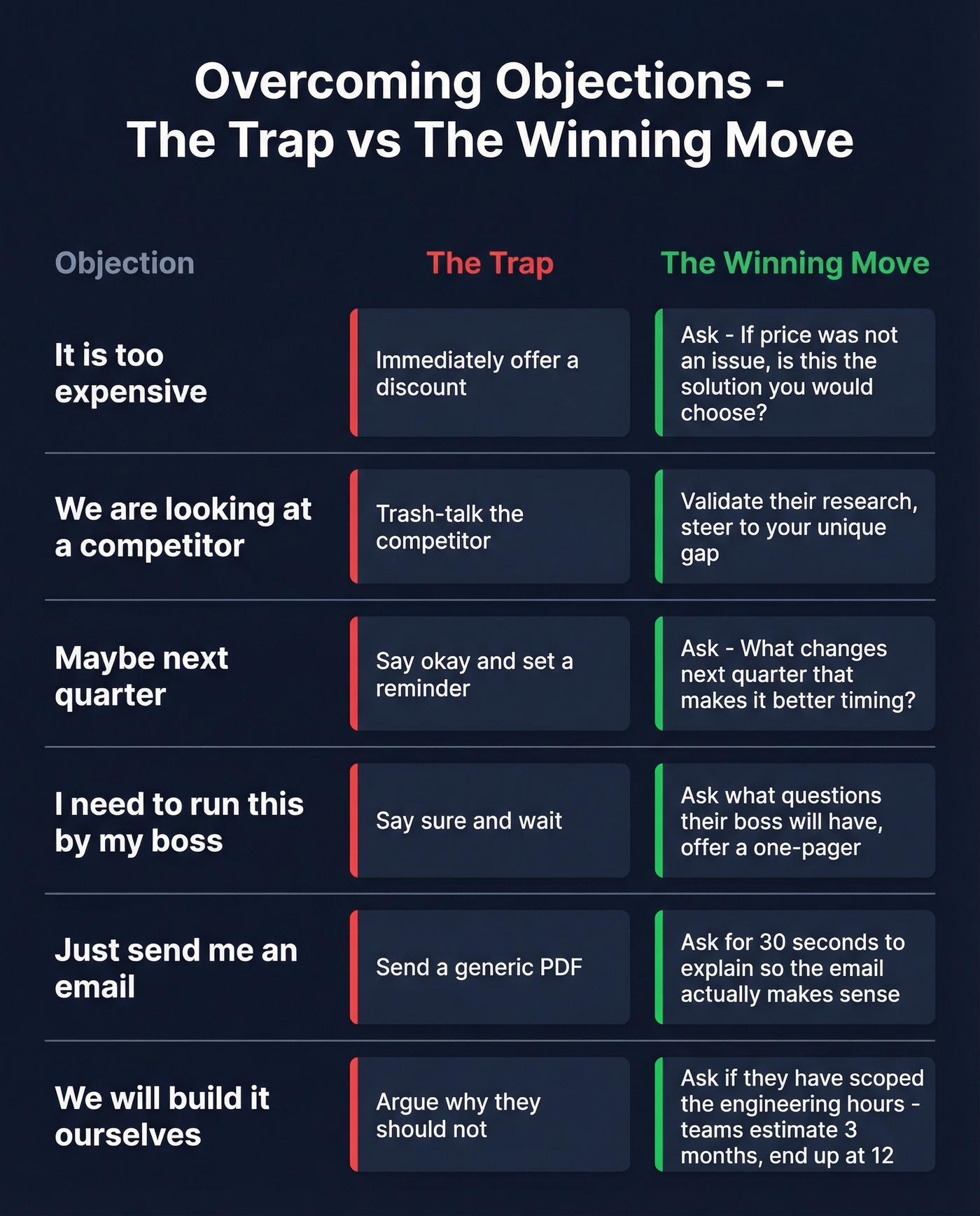
These scripts are structured as mini-dialogues. The "trap" is the instinctive response most reps default to. The winning script is what to say instead. Use them verbatim until they feel natural.
Remember: roughly two-thirds of price objections aren't really about price.
Price
Customer: "It's too expensive."
The trap: Immediately offering a discount or rattling off features to justify cost.
Winning script: "If price wasn't an issue, is this the solution you'd choose to solve [problem]?" If yes, shift to ROI - walk them through the math of what the problem costs monthly versus what you charge. If no, price isn't the real objection. Follow up with "Compared to what?" That single question reframes the entire negotiation.
Competitor
Customer: "We're looking at [Competitor] too."
The trap: Trash-talking the competitor or launching into a feature comparison nobody asked for.
Winning script: "That's a solid company - makes sense you'd evaluate them. Quick question: how are you currently handling [specific gap your product addresses]?" This validates their research while steering toward a problem your competitor doesn't solve as well. Let the gap do the selling.
Timing
Timing objections are often the hardest to crack because they feel so reasonable. "Next quarter" is the polite version of "I don't want to decide right now."
Customer: "Maybe next quarter."
Winning script: "What's going to change between now and next quarter that makes this a better time?" This forces the buyer to articulate the real blocker. Often, nothing changes - they're deferring a decision. If there is a real event like a budget cycle or leadership change, you can plan around it. If there isn't, you've exposed a stall.
Authority
Customer: "I need to run this by my boss."
Winning script: "Totally understand. What questions do you think they'll throw at you that we haven't covered yet?" Then offer to build a one-pager they can share internally. You're turning your contact into a prepared champion instead of a messenger who'll butcher your value prop.
"Just Send Me an Email"
Customer: "Can you just send me some info?"
Winning script: "Happy to - and I want to make sure I send you the right thing. Can I take 30 seconds to explain what we do, so the email actually makes sense?" You're not fighting the request. You're using it as a bridge to deliver your value prop live.
DIY / "We'll Build It Ourselves"
Customer: "We're going to build this internally."
"A lot of teams start there. Quick question - have you scoped the engineering hours? Teams often estimate 3-4 months and end up at 9-12. What's your timeline look like?"
Internal builds almost always take longer and cost more than projected. Let the buyer do the math.
Feature Gap
Customer: "You don't have [specific feature]."
Winning script: "You're right, we don't have that today. How often does your team use that feature in [Competitor], and what happens when they do?" Sometimes the gap is a dealbreaker. Often, it's a checkbox item used once a quarter. Quantify the impact before conceding.
Bandwidth / Implementation Fear
Customer: "We don't have the bandwidth to implement this right now."
Winning script: "That's one of the most common concerns we hear. What if we phased the rollout - start with [smallest use case] this month, expand once your team has capacity?" Implementation fear is loss aversion in disguise. Phased rollouts reduce perceived risk.
ROI Skepticism
Customer: "I'm not convinced this will actually work for us."
Winning script: "Fair. What would you need to see to feel confident? We can run a pilot with [specific scope] - real data, your team, your use case. No commitment beyond that." Proof beats promises every time.
Ghosting
Customer: [silence]
This one doesn't get a phone script. It gets a breakup email:
"Hey [Name], I've reached out a few times and haven't heard back. Totally understand if the timing isn't right - I'll close out my follow-up on this. If anything changes, you know where to find me."
The stat that should haunt every sales manager: 80% of sales require five or more follow-ups, but 92% of reps quit after four. Persistence isn't annoying. Quitting early is expensive.

You just learned that top reps diagnose objections instead of bulldozing them. But the best objection-handling skills are worthless if you're calling the wrong people. Prospeo gives you 300M+ verified profiles with 98% email accuracy and 125M+ mobile numbers - so every conversation starts with the right decision-maker.
Stop practicing objection handling on people who were never going to buy.
The Psychology Behind Sales Resistance
The Neuroscience of Resistance
When a buyer feels pressured, their brain stops cooperating. Perceived pressure activates the amygdala - the brain's threat detection system - which reduces access to the prefrontal cortex, where rational decision-making happens. The buyer literally can't process your logical arguments while they're in a defensive state.
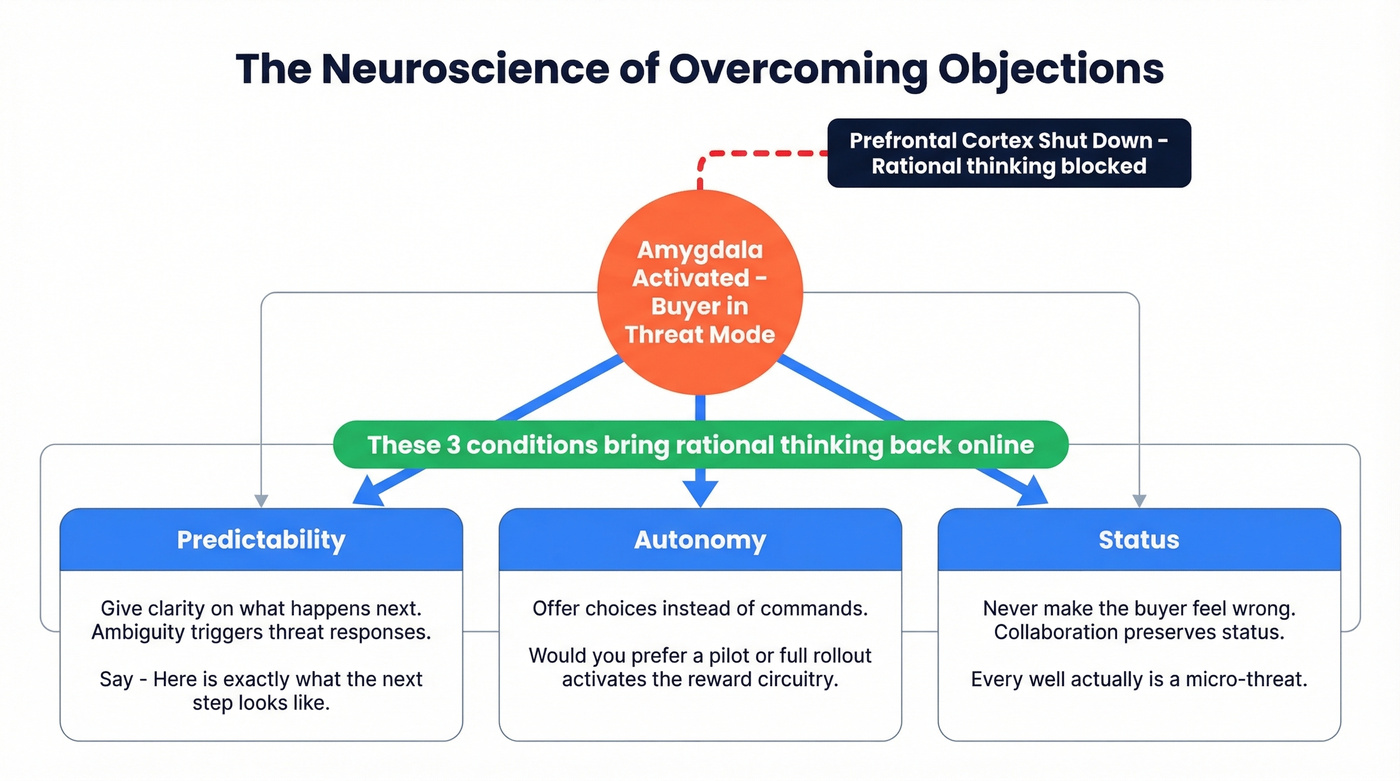
Three neural conditions bring the prefrontal cortex back online. Predictability: the buyer needs clarity on what happens next, because ambiguity triggers threat responses. Autonomy: offering choices instead of commands activates the brain's reward circuitry. "Would you prefer to start with a pilot or a full rollout?" beats "Let me walk you through our implementation process."
Status is the third condition, and honestly, it's the most underrated. Avoid making the buyer feel stupid or wrong. Collaboration preserves status. Correction destroys it. Every "well, actually" from a rep is a micro-status threat that pushes the buyer further into resistance.
The practical takeaway is simple - acknowledge the emotion before presenting information. A buyer who feels heard calms down neurologically. A buyer who gets hit with a feature list while their amygdala is firing will find reasons to say no.
Fear Drives More Objections Than Logic
Loss aversion is the big one. Behavioral research consistently shows that losses weigh roughly twice as heavily as equivalent gains. This is why implementation fear, status quo preference, and "we'll just keep doing what we're doing" are so powerful. The buyer isn't evaluating your product rationally - they're weighing the pain of change against the comfort of inaction, and the scales are rigged 2:1 against you.
Let's be honest: if your deal size sits below $15k, most objections aren't really about your product at all. They're about the buyer's fear of making a visible mistake on a purchase that's big enough to notice but not big enough to get executive air cover. That's a status and loss aversion problem, not a feature problem.
Confirmation bias makes buyers seek evidence supporting their existing vendor choice. Anchoring bias means the first price they heard becomes the benchmark for yours. Availability bias means a single horror story about a failed implementation outweighs ten success stories.
There's a trust equation that ties this together: Trust = (Credibility x Reliability x Intimacy) / Self-Orientation. When a buyer objects, at least one of those four variables is off. A price objection might signal low credibility. A timing objection might signal low intimacy. And if your self-orientation is high - if the buyer feels you care more about closing than solving - the entire equation collapses.
Five Mistakes That Kill Deals
1. Monologuing after the objection. 21.45 seconds of uninterrupted talking after an objection is the average. Top reps ask a question within five seconds. If you're talking for more than ten seconds after hearing resistance, you're losing.
2. Speeding up your delivery. The 173-to-188 wpm shift is a tell. Buyers read it as panic. Consciously slow down when you feel the adrenaline hit. Pause. Breathe. Then respond.
3. Treating the surface objection as real. Budget, timing, and authority are the three most common smoke screens. Diagnostic questions cut through them: "If budget wasn't an issue, would this be a fit?" isolates the true blocker. "Compared to what?" reframes a vague price objection into a specific conversation.
4. Responding with logic to an emotional objection. Fear of change and fear of making the wrong decision are emotional states. They don't respond to feature lists or ROI calculators. They respond to empathy, acknowledgment, and reduced risk - pilots, phased rollouts, money-back guarantees.
5. Refusing to walk away. When objections keep circling - budget, then timing, then authority, then back to budget - with no path forward, pushing damages your credibility. Acknowledge a meritless objection briefly, redirect to value, and move on. But when the cycle signals a dead deal, sometimes the right move is to say "It sounds like the timing isn't right. I'd rather pause than force something that doesn't fit." That honesty often reopens the door later. Desperation never does.
Cold Call Objections - Different Rules
Cold call objections operate under different physics than demo objections. The buyer didn't ask to talk to you. They have zero context. They're looking for the fastest exit.
"Not Interested"
Most reps fight this head-on, which is exactly wrong. Instead: "Totally fair - you weren't expecting my call. Most [title] I talk to weren't interested either until they heard how we help with [specific pain]. Can I take 15 seconds?" You're acknowledging reality and offering a micro-commitment instead of fighting the brush-off.
"We Already Have a Solution"
"Good - that means you already see the value in solving this. Quick question: if there was one thing you'd improve about your current setup, what would it be?" You're not competing. You're finding the gap.
"Not the Right Person"
"Appreciate that. Who on your team typically handles [specific function]? I want to make sure I'm not wasting anyone's time." The specificity gets you a name. The "not wasting time" framing makes the referral feel helpful, not burdensome.
"Send Me an Email" / "I'm Busy"
Both of these are exit ramps. For the email request: "Happy to. So I send you the right thing - are you more focused on [pain A] or [pain B] right now?" For the busy brush-off: "Totally understand. Would [specific day] at [specific time] work for a quick five minutes?" Anchoring to a specific time converts at a much higher rate than leaving it open.
Skip all of this, though, if your team is dialing wrong numbers or emailing bounced addresses. The best cold call scripts in the world don't help when half your list is dead data. We've seen teams using Prospeo's verified mobile numbers hit a 30% pickup rate - meaning reps actually spend time in conversations instead of leaving voicemails at disconnected lines.
How to Practice - Five Drills
Reading about objection handling builds awareness. Drilling builds reflexes. Here are five exercises that actually change behavior.
1. Rapid-fire drill (5-10 minutes). One person throws random objections. The other responds immediately. No prep, no pausing to think. The goal is speed and comfort, not perfection. Run this at the start of every team meeting for two weeks and watch the flinch disappear.
2. Structured role play. Assign a prospect persona with specific objections. Run a full discovery-to-close conversation. Debrief afterward: what worked, what fell flat, what felt forced. Record it if possible.
3. "Why behind the objection" drill. The rep isn't allowed to rebut - they can only ask clarifying questions. "What's driving that?" "Help me understand." "What else?" The goal is to build the diagnostic muscle without the crutch of a scripted response.
4. Competitor objection practice. Start with discovery about the competitor's strengths, then differentiate on gaps, then redirect to your core value. This sequence - discover, differentiate, redirect - needs to feel automatic when a prospect drops a competitor name.
5. Call review sessions. Pull a real recorded call. Pause it at the objection. Ask the team: "What would you say next?" Then play the rep's actual response and compare. Call reviews are painful, but nothing else accelerates growth as fast. The consensus on r/sales is that weekly call reviews do more for a team's close rate than any amount of framework training - and we'd agree.
The data shows 96% of buyers research before talking to a rep. Prospeo's intent data tracks 15,000 topics so you reach prospects already in-market - turning "maybe next quarter" into "let's talk now." Pair buyer intent signals with direct dials that hit a 30% pickup rate.
Eliminate timing objections by reaching buyers when they're actively looking.
FAQ
What's the most common sales objection?
Price is the most frequently voiced objection, but roughly two-thirds of price objections mask a deeper concern - trust, timing, or fit. Before you discount, diagnose with: "If price wasn't an issue, would you choose this solution?"
How do you handle price objections without discounting?
Isolate whether price is the real blocker with "If price wasn't an issue, would you choose this solution?" If yes, shift to ROI math - quantify the monthly cost of the problem versus your price. If no, dig deeper because discounting won't help.
What's the biggest mistake when overcoming an objection?
Monologuing. Gong's call data shows average reps talk for 21.45 seconds straight after hearing resistance. Top reps pause and ask a clarifying question within five seconds. Silence isn't awkward - it's strategic.
How many follow-ups should you send before giving up?
80% of sales require five or more follow-ups, but 92% of reps quit after four. Send at least five touches across different channels - phone, email, video - before closing out a prospect. Persistence wins more deals than any single script.