

Personal Selling: The Practitioner's Guide for 2026
Personal selling isn't dead. It's just expensive when you do it wrong.
What Is Personal Selling?
Personal selling is one-to-one, real-time communication between a salesperson and a prospect, designed to understand needs, build trust, and close a deal.
Most definitions stop there. They give you the textbook answer and move on to a generic list of advantages and disadvantages. That's not useful if you're actually managing a team or carrying a quota. What matters is understanding when this approach justifies its cost, how the canonical process maps to modern workflows, and which infrastructure decisions determine whether your reps spend their time selling or chasing bad data.
If You Read Nothing Else
Four things to internalize before you keep scrolling:
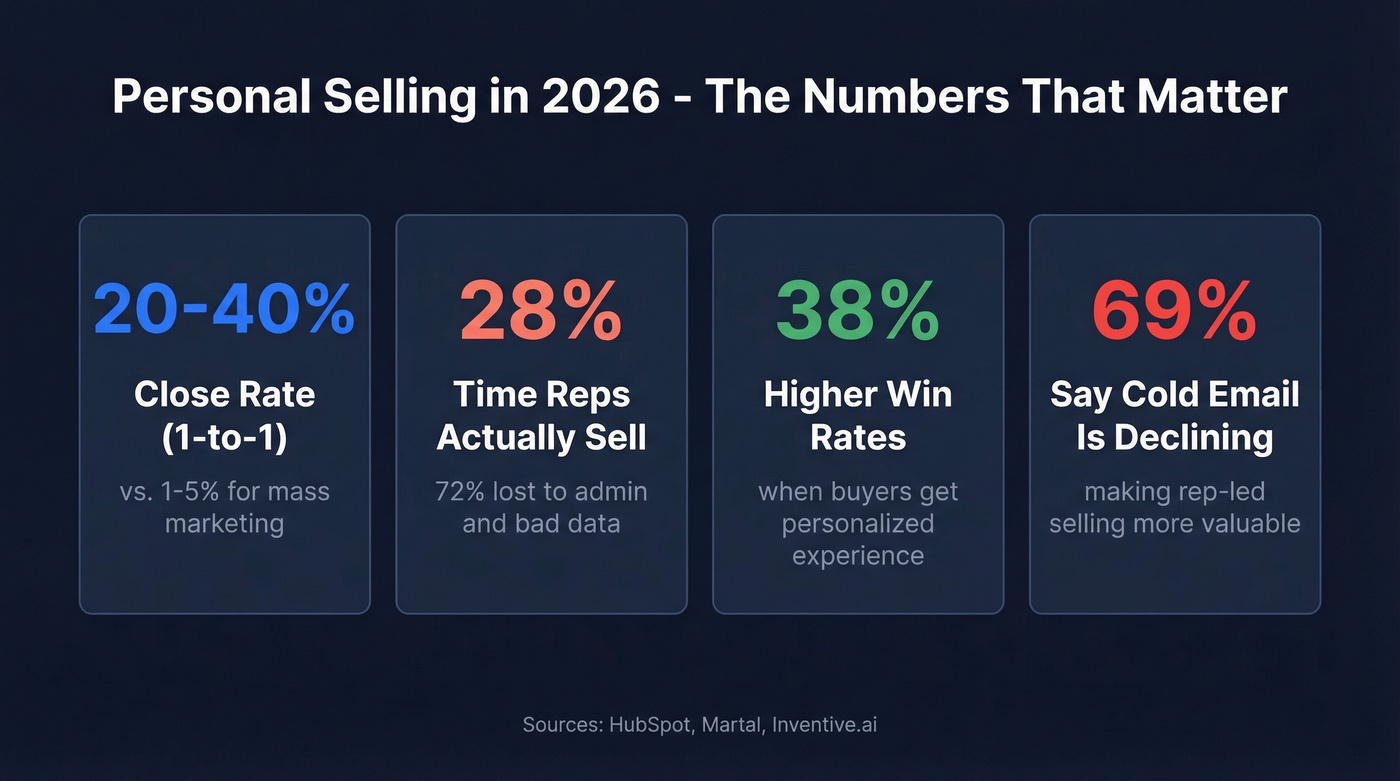
- One-to-one selling converts at 20-40% vs. 1-5% for mass marketing - but it costs 10-100x more per contact. The math only works for deals worth the investment.
- Your reps spend only 28% of their week actually selling. The other 72% is admin, data entry, and meetings. Fix the infrastructure before you fix the technique.
- The 7-step process is the skeleton. A methodology like SPIN, Challenger, or MEDDIC is the muscle. You need both.
- Bad contact data kills the entire effort at step one. If a third of your emails bounce and half your dials go to voicemail, no amount of sales training will save you.
Personal Selling vs. Mass Marketing
The decision between personal selling and mass marketing isn't philosophical - it's mathematical.
| Metric | Personal Selling | Mass Marketing |
|---|---|---|
| Cost per contact | $50-$200 | $0.10-$5 |
| Conversion rate | 20-40% | 1-5% |
| Feedback loop | Real-time | Delayed/none |
| Scalability | Low | High |
| Best for | High-ticket, complex | High-volume, awareness |
The conversion gap is staggering. One-to-one engagement converts 4-40x better than mass channels. But the cost-per-contact difference means you can't afford to use it on every prospect. As a rule of thumb: if your average deal size is under $5,000, mass marketing and automated sequences should do the heavy lifting. Above $10,000, dedicated rep engagement starts earning its keep. Above $50,000, it's non-negotiable.
The real insight isn't "which is better." Modern teams use both. Mass marketing fills the top of the funnel. Personal selling converts the middle and bottom. The handoff point between the two is where most revenue teams either thrive or leak pipeline - understanding what one-to-one selling does in the promotional mix, as the high-conversion closer that complements cheaper awareness channels, is what separates strategic leaders from teams that overspend on the wrong activities.
Why It Still Works in 2026
Here's the paradox every sales leader is dealing with right now. 96% of prospects research before engaging a rep. 71% prefer independent research over talking to anyone in sales. Gartner projected that 80% of B2B sales interactions would occur digitally by 2025 - a trajectory that's only continued into 2026.
So this approach should be dying, right?
It's not. The reason is straightforward: buyers want independence during the research phase, but they want personalization during the decision phase. 80% of buyers expect a personalized experience when they're evaluating solutions, and personalization yields 38% higher win rates.
Automated channels are getting noisier, too. 69% of cold email senders say performance declined year over year, which means the conversion advantage of rep-led engagement is actually growing, not shrinking.
The 57% of the buying journey that happens before a prospect talks to sales isn't a threat - it's a filter. By the time a buyer engages your rep, they've already eliminated the vendors who couldn't demonstrate relevance. The rep's job isn't to educate from scratch. It's to understand the buyer's specific situation, map your solution to their pain, and build enough trust to close. That's something no automated sequence can do at scale. Not yet, anyway. AI is getting better at personalization, but complex B2B deals still involve multiple stakeholders, competing priorities, and organizational politics that require a human to navigate. Personal selling in 2026 isn't about being the first touchpoint - it's about being the decisive one.
Types of Personal Selling
Not all one-to-one sales engagement looks the same. The type you need depends on your market, deal complexity, and buyer expectations. One useful distinction: are your reps order takers processing inbound demand, or order getters creating new demand? That distinction shapes everything from hiring profiles to comp plans.
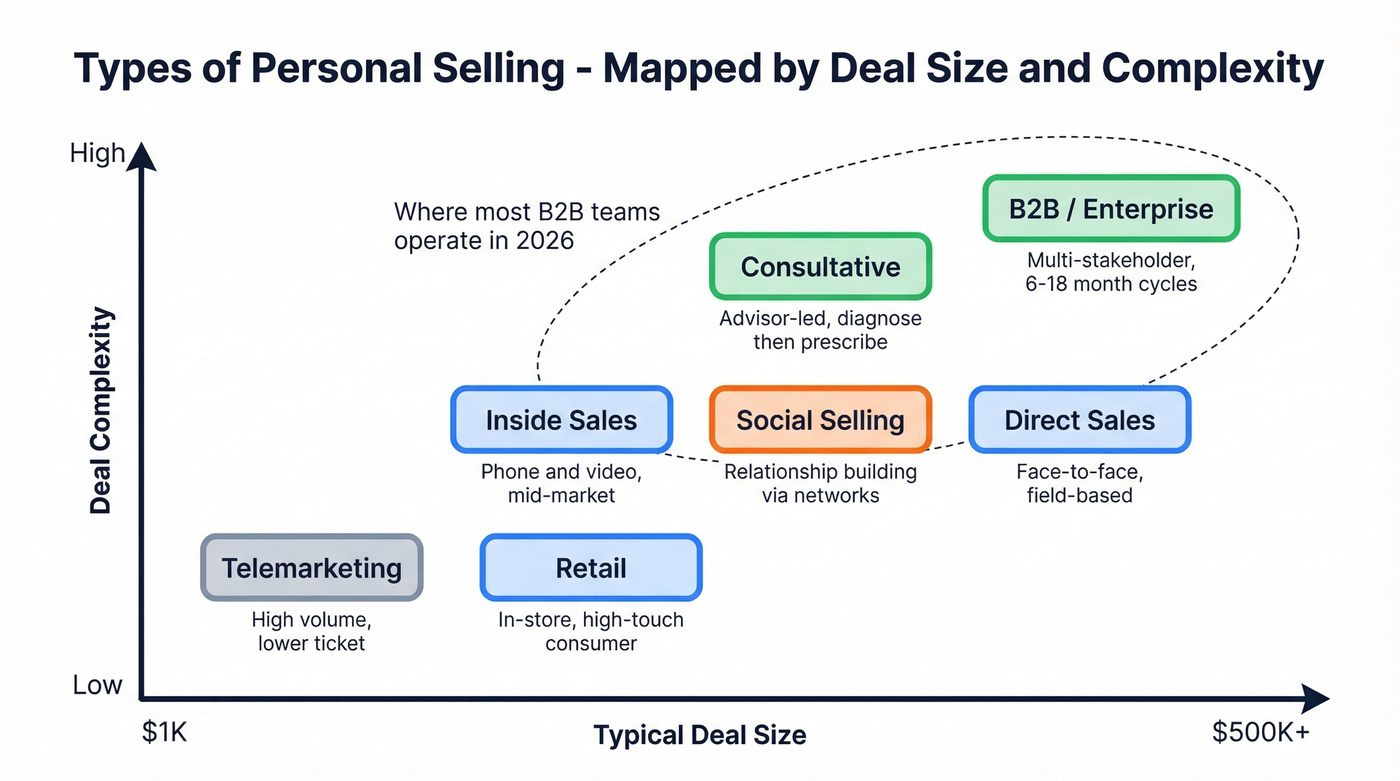
- B2B/Enterprise: Multi-stakeholder, long-cycle deals where reps build relationships with buying committees. These engagements typically involve 6-18 month sales cycles with $50K+ deal sizes, and it's where the discipline earns its highest ROI.
- Consultative: The rep acts as an advisor, diagnosing problems before prescribing solutions. Best for technical or complex products where the buyer doesn't fully understand their own needs.
- Inside Sales: Phone and video-based selling, typically for mid-market deals.
- Retail: In-store consultative selling for high-ticket consumer goods - luxury, automotive, electronics - where the buying experience itself drives the sale.
- Social Selling: Building relationships through professional networks and content before initiating a direct conversation. Works best as a complement to other types, not standalone.
- Direct Sales: Face-to-face, often door-to-door or event-based. Still relevant for high-touch industries like medical devices and industrial equipment.
- Telemarketing: High-volume phone outreach, usually for lower-ticket products or appointment setting. The least "personal" form of one-to-one selling, but still a direct interaction.
Most B2B teams in 2026 are running some blend of inside sales and consultative selling, with social selling as a top-of-funnel accelerator.

Step 1 of personal selling is prospecting - and it's where most teams bleed time. Prospeo gives your reps 98% accurate emails and 125M+ verified mobile numbers with a 30% pickup rate, so they spend their 28% selling window actually talking to buyers, not chasing bounced emails.
Meritt tripled their connect rates. Your team is next.
The 7-Step Personal Selling Process
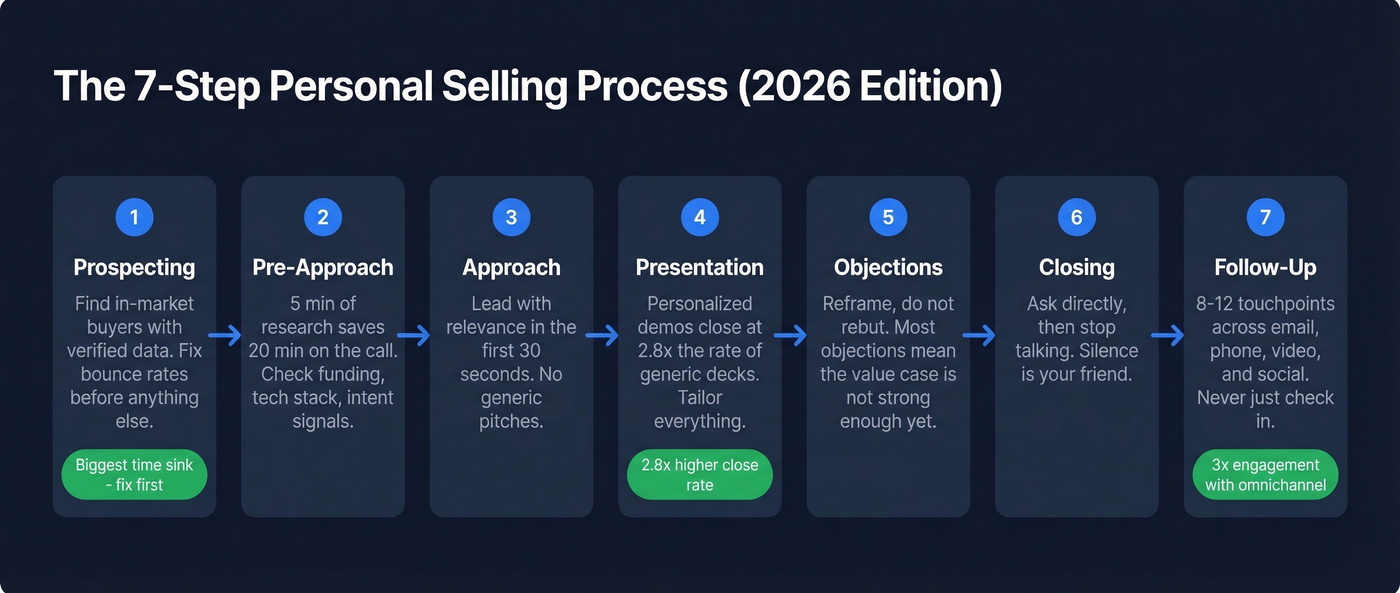
The canonical process has been around for decades, and for good reason - it works. But each step looks different in 2026 than it did in 1996.
Step 1: Prospecting
Everything starts here, and this is where most teams hemorrhage time. Your reps get 28% of their week to sell. If they're spending half of that chasing bounced emails and disconnected phone numbers, you've already lost.
Modern prospecting means combining intent signals with verified contact data. You want to know who is in-market, then reach them through channels that actually connect - verified emails, not "best guess" addresses, and direct dials, not switchboard numbers. We've seen teams transform their pipeline just by fixing this one step. Meritt dropped their bounce rate from 35% to under 4% and tripled connect rates after switching to Prospeo's verified data. That's not a technique improvement. That's an infrastructure fix.

Step 2: Pre-Approach
Research before outreach. This sounds obvious, but most reps skip it. Check the prospect's recent funding, tech stack, job postings, and any intent signals. Five minutes of prep saves twenty minutes of fumbling on a call.
Step 3: Approach
The first 30 seconds determine whether you get a conversation or a hang-up. Lead with relevance, not your pitch. "I noticed you're hiring three SDRs and just switched to Outreach - are you scaling outbound?" beats "Hi, I'm calling from [company], we help teams like yours..."
Step 4: Presentation
This isn't a slide deck anymore. The best reps in 2026 use personalized video walkthroughs, live demos tailored to the prospect's use case, and interactive ROI calculators. Personalized demos close at 2.8x the rate of generic presentations - a gap too large to ignore.
Step 5: Handling Objections
Objections aren't rejection - they're buying signals wrapped in uncertainty. The key shift: stop rebutting and start reframing. "That's too expensive" usually means "I don't see enough value yet." The fix isn't a discount; it's better discovery earlier in the process.
Step 6: Closing
If you've done steps 1-5 well, closing is a natural next step, not a pressure moment. The best closers ask for the business directly and then stop talking. Silence is uncomfortable, but it works.
Step 7: Follow-Up
Most deals don't close on the first conversation. The average B2B deal typically requires 8-12 touchpoints across multiple channels. Omnichannel outreach - mixing email, phone, video, and social - can increase engagement up to 3x compared to single-channel sequences. Build an async follow-up cadence that mixes formats, and make sure every touch adds value. A "just checking in" email is a wasted touch.
Methodologies That Power the Process
The 7-step process tells you what to do. A methodology tells you how to think.
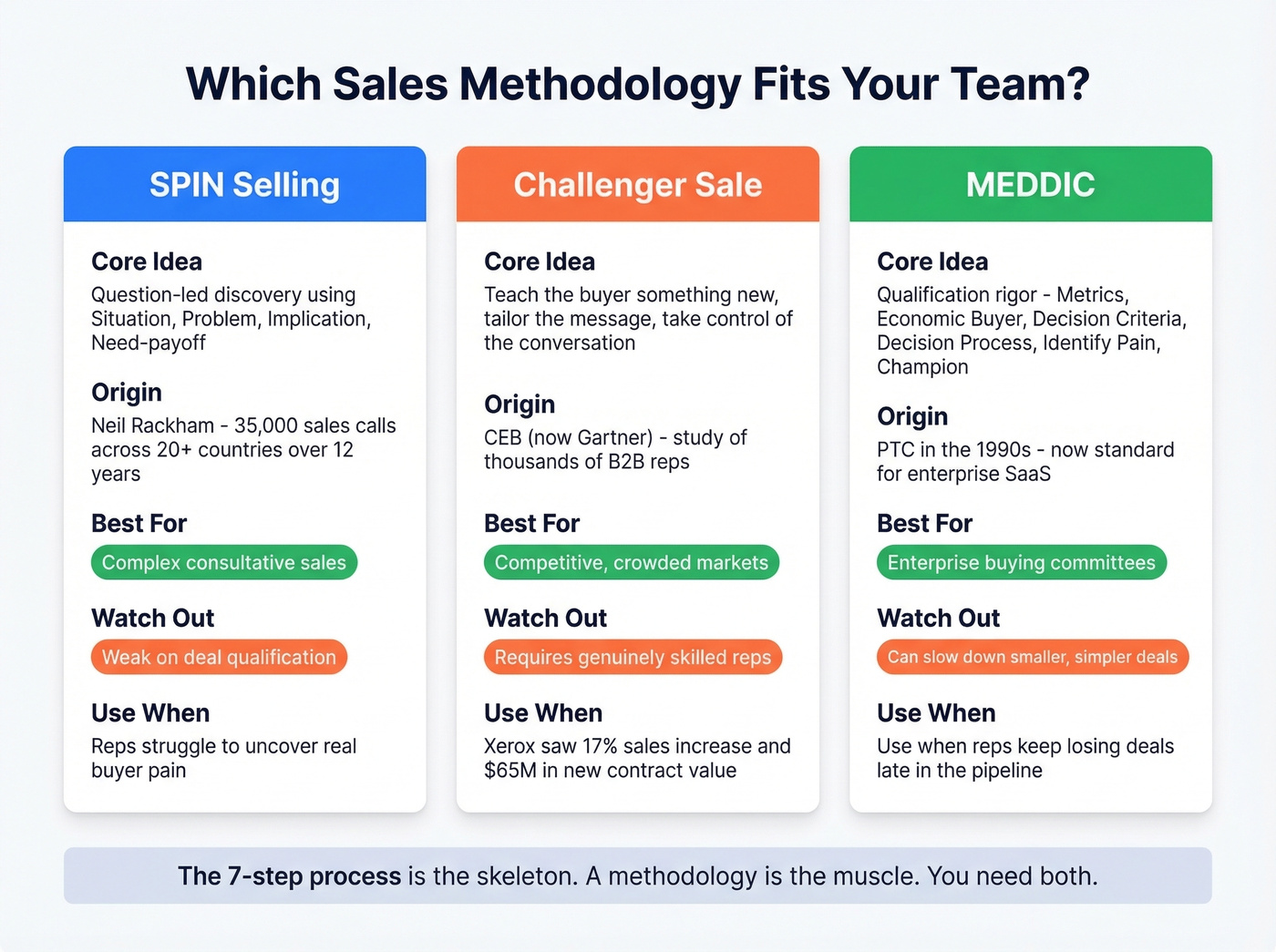
| Methodology | Core Idea | Best For | Limitation |
|---|---|---|---|
| SPIN Selling | Question-led discovery | Complex consultative | Weak on qualification |
| Challenger | Teach, Tailor, Take Control | Competitive markets | High skill barrier |
| MEDDIC | Qualification rigor | Enterprise buying committees | Can slow smaller deals |
SPIN Selling came out of Neil Rackham's analysis of 35,000 sales calls across 20+ countries over 12 years. The Situation, Problem, Implication, Need-payoff framework is still the gold standard for discovery. If your reps struggle to uncover real pain, start here.
The Challenger Sale flipped conventional wisdom. Instead of building rapport first, Challengers lead with insight - teaching the buyer something they didn't know, then tailoring the message to their situation. Xerox reported a 17% increase in sales and $65M in contract value after implementing Challenger. The catch: it requires reps who can genuinely teach, not just recite talking points.
MEDDIC is the methodology of choice for enterprise teams selling into large buying committees. It's a qualification framework - Metrics, Economic Buyer, Decision Criteria, Decision Process, Identify Pain, Champion - that forces rigor into pipeline management. If your reps keep losing deals at the 11th hour because they never identified the real decision-maker, MEDDIC fixes that.
Let's be honest about how these fit together. Most teams should start with SPIN for discovery skills, layer in MEDDIC for qualification discipline, and adopt Challenger principles for competitive deals. They're complementary, not competing.
Common Mistakes (With Data)
One-to-one selling fails in predictable ways. Here are the five we see most often.
Talking too much. Top-closing B2B reps speak 43% of the time on calls. Average performers hit 65%. That's not a small gap - it's the difference between discovery and monologue. If your reps aren't listening more than they're talking, they're not doing personal selling. They're doing personal presenting.
Leading with features. Buyers don't care about your product's capabilities until they believe you understand their problem. The 57% of the buying journey that happens before sales contact means prospects already know your features. What they need is someone who can connect those features to their specific situation.
Poor qualification. Reps who skip qualification waste cycles on deals that were never going to close. MEDDIC exists for a reason. If you can't name the economic buyer and the decision criteria by the second call, you're guessing - and guessing doesn't forecast well.
Prospecting with bad data. This is the silent killer. When a third of your emails bounce and half your dials hit voicemail, your reps burn through their limited selling time before they ever have a real conversation. Snyk's sales team was running bounce rates of 35-40% before switching to verified contact data - after the switch, bounces dropped under 5% and AE-sourced pipeline jumped 180%. That's not a technique problem. That's an infrastructure problem.

Overpromising. Nothing destroys a sales relationship faster than setting expectations you can't meet. One closed-won deal that churns in 90 days costs more than the deal was worth - in reputation, in CSM time, and in the reference you'll never get.
The Modern Tech Stack
You don't need fifteen tools. You need five categories covered, and you need them integrated.
CRM: Salesforce or HubSpot. This is your system of record. Non-negotiable.
Conversation Intelligence: Gong records, transcribes, and analyzes sales conversations. If you're coaching reps without call data, you're coaching on vibes.
Data Verification: Prospeo covers 300M+ professional profiles with 98% email accuracy and 125M+ verified mobile numbers, all refreshed every 7 days. The free tier gives you 75 emails per month plus 100 Chrome extension credits - enough to test whether your prospecting problem is skills or data.
Sales Engagement: Salesloft or Outreach for multi-touch sequences. These platforms automate the follow-up cadence so reps can focus on the conversations that matter.
AI Coaching: Tools like Proshort offer role-play simulations, AI-generated coaching, and personalized learning paths starting around $60/user/month. AI-powered coaching can boost lead volume by 50% and cut call times by 60%, and training that leads to 50% higher net sales per employee is worth the investment.
Skip AI coaching if your team is under five reps - the ROI doesn't justify the overhead at that scale. But a CRM, a conversation intelligence tool, and verified data? Those three are non-negotiable regardless of team size.
Personal selling only works when reps reach real people. Bad data turns a 20-40% conversion channel into a money pit. Prospeo's 7-day data refresh and 5-step verification keep bounce rates under 4% - so your highest-cost, highest-converting channel actually converts.
Stop burning rep time on dead contacts. Pay $0.01 per verified email.
Measuring Performance
If you're not tracking these metrics, you're guessing at what's working.
| KPI | What It Measures | Benchmark |
|---|---|---|
| Conversion rate | Prospects to customers | 20-40% |
| CAC | Cost to acquire one customer | $239 (SaaS) to $1,143 (Education) |
| Talk-to-listen ratio | Rep speaking time | 43% for top closers |
| Sales cycle length | First contact to close | Track trend, not absolute |
| Revenue per rep | Individual productivity | Company-specific; quarterly |
| Customer retention rate | Post-sale relationship quality | 85-95% (healthy B2B) |
The CAC numbers deserve attention. B2B SaaS averages $239 per customer acquired. Cybersecurity runs $387. Legal services hit $749. Education climbs to $1,143. If you're not measuring CAC against deal size, you don't actually know whether your rep-led approach is profitable or just expensive.
Here's our take: most teams obsess over conversion rate and revenue per rep while ignoring the two metrics that predict future performance. Talk-to-listen ratio is a leading indicator of rep quality - you can coach it before deals are lost. Sales cycle length is a leading indicator of process efficiency - when it creeps up, something in your qualification or handoff is broken. Customer retention rate tells you whether your reps are selling honestly or just closing. Lagging indicators tell you what happened. Leading indicators tell you what's about to happen.
Real-World Examples With Revenue Impact
SAP's "Inspire the Future" campaign combined personalized content with direct sales engagement across target accounts. The results: EUR 924.4M in pipeline generated, EUR 266.15M in projected revenue, and 48% higher engagement than any other SAP social campaign that year. The takeaway isn't "be SAP." It's that even at enterprise scale, personalization drives measurably better outcomes than generic outreach.
Xerox and the Challenger methodology. After training their sales force on Challenger principles, Xerox reported a 17% increase in sales and $65M in contract value. The reps who performed best weren't the relationship builders - they were the ones who taught buyers something new and pushed back on the status quo.
A mid-market SaaS company we've spoken with tested personalized video outreach to their top 100 target accounts. The result: a 34% response rate vs. 8% previously, generating $2.1M in additional pipeline in 90 days. The cost of producing those videos was negligible compared to the pipeline they created.
FAQ
What's the difference between personal selling and direct marketing?
Personal selling is two-way and real-time - a rep adapts the conversation based on the buyer's responses. Direct marketing is one-way and scalable: emails, ads, and mailers sent to large audiences with no live interaction. One-to-one selling converts at 20-40%; direct marketing typically hits 1-5%. Most B2B teams need both working in tandem.
Is personal selling still effective in a digital-first world?
Yes. It remains the highest-converting channel in most B2B revenue stacks, closing at 20-40% even as buyers do more research independently. Digital channels handle awareness and education. Rep-led engagement handles conversion for complex, high-ticket deals where trust and customization matter.
What skills matter most for reps in 2026?
Active listening, discovery questioning, objection reframing, and data literacy. The talk-to-listen ratio - 43% for top closers vs. 65% for average reps - is the single best proxy for rep quality. Reps who listen more close more.
Which sales methodology should I start with?
SPIN for discovery-heavy consultative sales - it teaches reps to ask better questions. Challenger for competitive markets where buyers are already well-informed. MEDDIC for enterprise deals with large buying committees where qualification discipline prevents late-stage losses.
Look, the debate over personal selling vs. automation misses the point entirely. It's about focus. A small set of verified, well-researched accounts will outperform a team blasting thousands of contacts every time - because one-to-one engagement rewards preparation, not volume. Fix the data, pick a methodology, and let your reps do what no sequence can: have a real conversation.