

Pipeline Accuracy: Why Your Forecast Is Wrong and How to Fix It
It's Monday morning. The CRO pulls up the board deck and the number is off - again. Not by a rounding error. By enough to kill a hiring plan.
Four in five sales and finance leaders missed a quarterly forecast in the past year, and over half missed it twice or more. The quiet culprit is almost always pipeline accuracy: how closely your pipeline predicts actual revenue. It usually breaks because the inputs are messy, not because the model is wrong. The formula is simple - Accuracy = 1 - |Actual - Forecast| / Actual - but APQC benchmarks tell the real story. Top performers hit 1.3% error, the median sits at 1.8%, and the bottom tier lands at 2.4%. On a $20M forecast, that 2% miss is $400K you can't hire with.
What Pipeline Accuracy Actually Means
Pipeline accuracy and forecast accuracy get lumped together constantly. They're different levers.
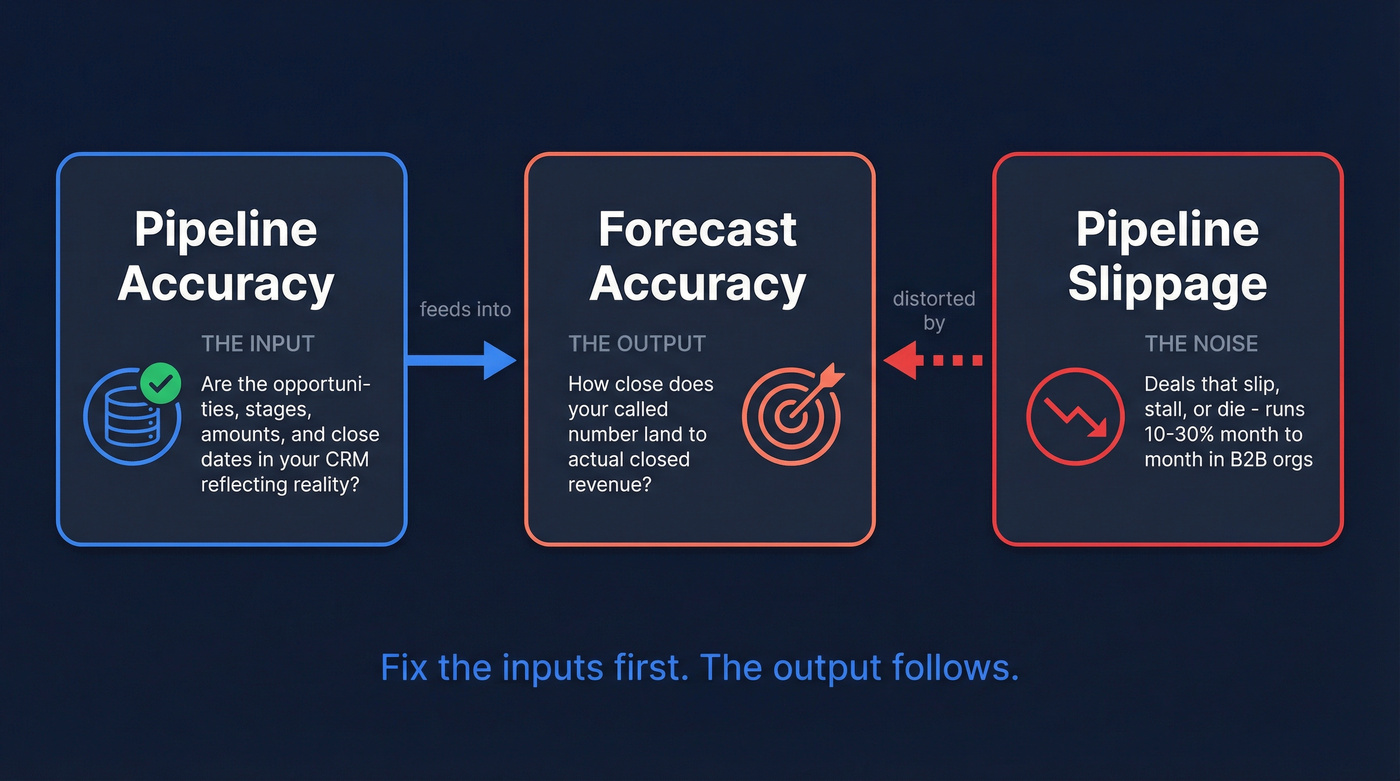
Forecast accuracy is the output: how close your called number lands to closed revenue. Pipeline accuracy is the input: whether the opportunities, stages, amounts, and close dates in your CRM reflect reality well enough to forecast from. You can have a brilliant forecasting methodology and still miss badly if the pipeline underneath it is full of garbage.
Don't confuse either with pipeline slippage - deals that slip, stall, or die - which runs 10-30% month-to-month in plenty of B2B orgs. That slippage is exactly why "the model" looks wrong when the real issue is the data feeding it.
Why Forecasts Break Down
CRM Data Decays Fast
CRM data decays by roughly 34% per year. People change jobs, companies get acquired, phone numbers rotate, inboxes get abandoned. Experian has found companies lose up to 12% of revenue due to poor data quality, and only 3% of organizations meet basic data quality standards. That's a staggering number when you think about how much trust we place in CRM records.
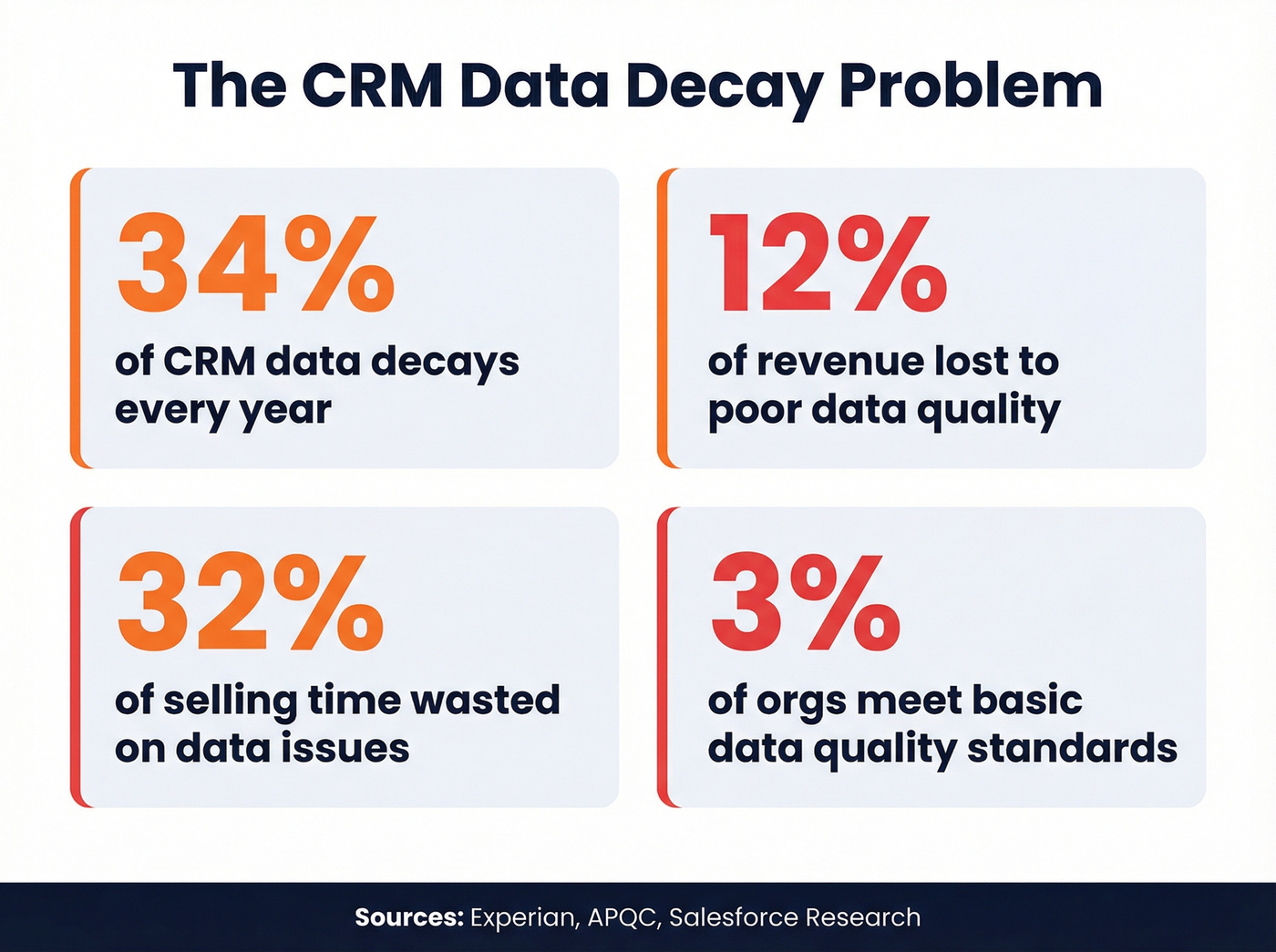
Here's the part that hurts day-to-day: teams spend up to 32% of their time dealing with data issues instead of selling. And 97% of leaders agree the right data would make accurate forecasts easier. Everyone knows the problem. Most teams just don't enforce the fixes.
In our experience, this is where accurate projections actually die - not in the forecast meeting, but in the quiet weeks where bad data piles up and nobody owns cleanup.
Your Stages Don't Mean What You Think
Most CRMs ship with default stage probabilities that never get recalibrated. Discovery at 10%, Proposal at 60%, Negotiation at 75% - nice round numbers that feel official and are usually wrong. Without recalibration, pipeline forecasting accuracy degrades every quarter as your actual conversion patterns drift further from those defaults.
Here's the thing: if your comp plan rewards "pipeline created" more than "pipeline closed," reps will inflate stages and amounts. That's not a training issue. It's an incentive design problem. Fix the behavior, or your CRM becomes a storytelling platform.
A clean rule we've used: if your Commit category lands under 80%, your stage definitions need surgery, not a new dashboard.
Contact Data Creates Phantom Pipeline
The same three issues show up in almost every pipeline audit we've run: reps treat close dates like suggestions, stages drift upward, and a huge chunk of contacts are dead. That last one is the most underestimated pipeline killer by far.
Stale Close Dates and the Capture Layer
A close date from six weeks ago that nobody updated isn't a forecast. It's a wish.
Deals with no logged activity in the last 14 days are usually stalled, but they still inflate weighted pipeline. This is a capture problem, not just a hygiene problem. If reps can create an opportunity without a next step, a real close date, and a reachable contact, you're baking in forecast error at the moment data enters the CRM.
Metrics That Drive Accurate Projections
If you only track "pipeline this quarter," you'll keep getting surprised. These are the metrics that actually move the needle:
- Pipeline waterfall: adds, pulls, slips, and closes week over week. This shows change, not a snapshot.
- Commit variance: what reps commit vs. what closes, broken down by rep and segment.
- Cohorted win rates: group opps by creation period and track outcomes to spot trend shifts early.
- Weighted pipeline: only useful when stage probabilities match historical win rates - otherwise it's fiction with a formula.
- Pipeline coverage ratio: 3-4x is common; enterprise and new-logo motions often need 5x+.
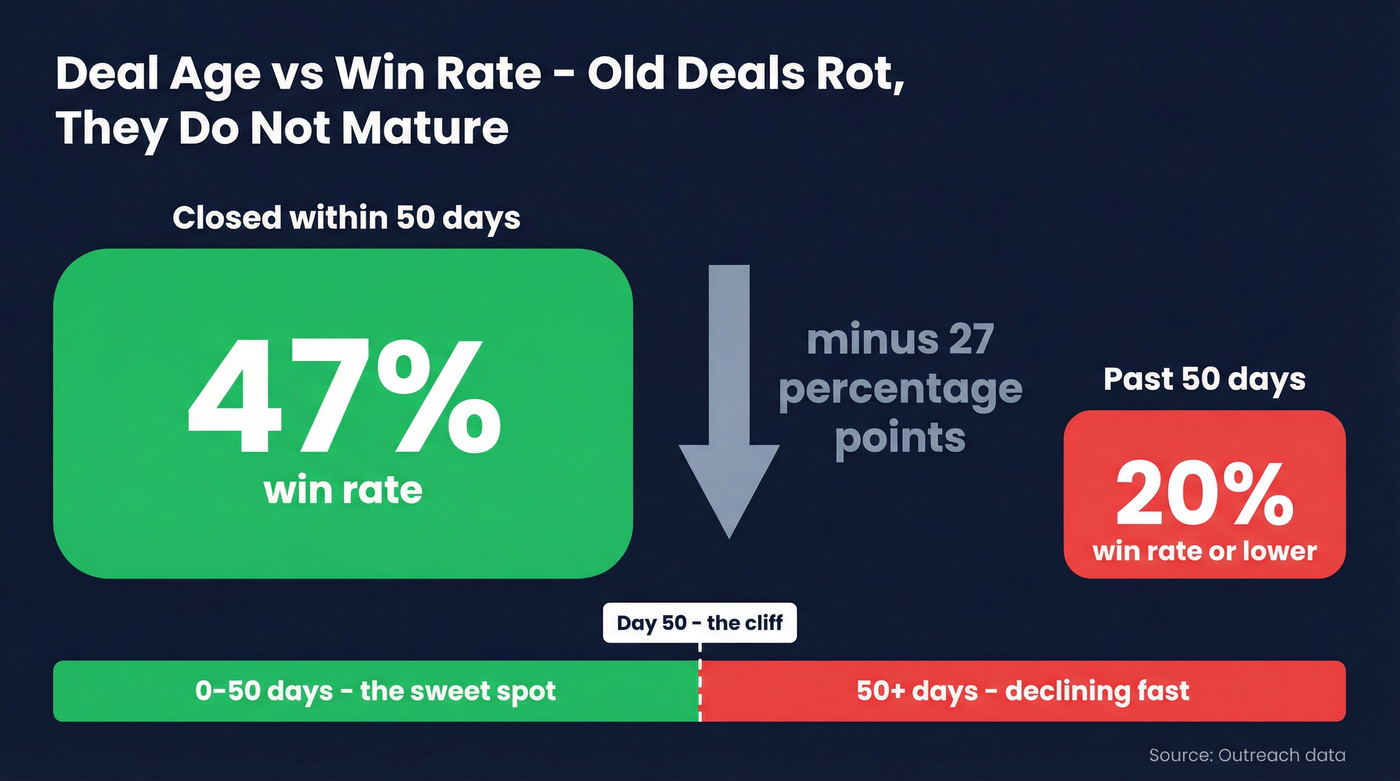
One metric deserves a spotlight: sales cycle age. Outreach data shows opportunities closed within 50 days hit a 47% win rate. Past that, win rates drop to 20% or lower. Old deals don't "mature." They rot.

Phantom pipeline starts with dead contacts. Prospeo's 5-step verification delivers 98% email accuracy and refreshes every 7 days - not the 6-week industry average. Stop forecasting on stale data.
Verify contacts at opp creation for $0.01 each - not at quarter end.
How to Improve Pipeline Accuracy
Teams that review pipeline weekly hit 87% forecast accuracy. Teams doing it ad-hoc land at 52%. That gap isn't talent - it's cadence. Consistent reviews are the single fastest path to projections that leadership can actually trust, and the Harvard Business Review has covered this pattern extensively in sales management research.
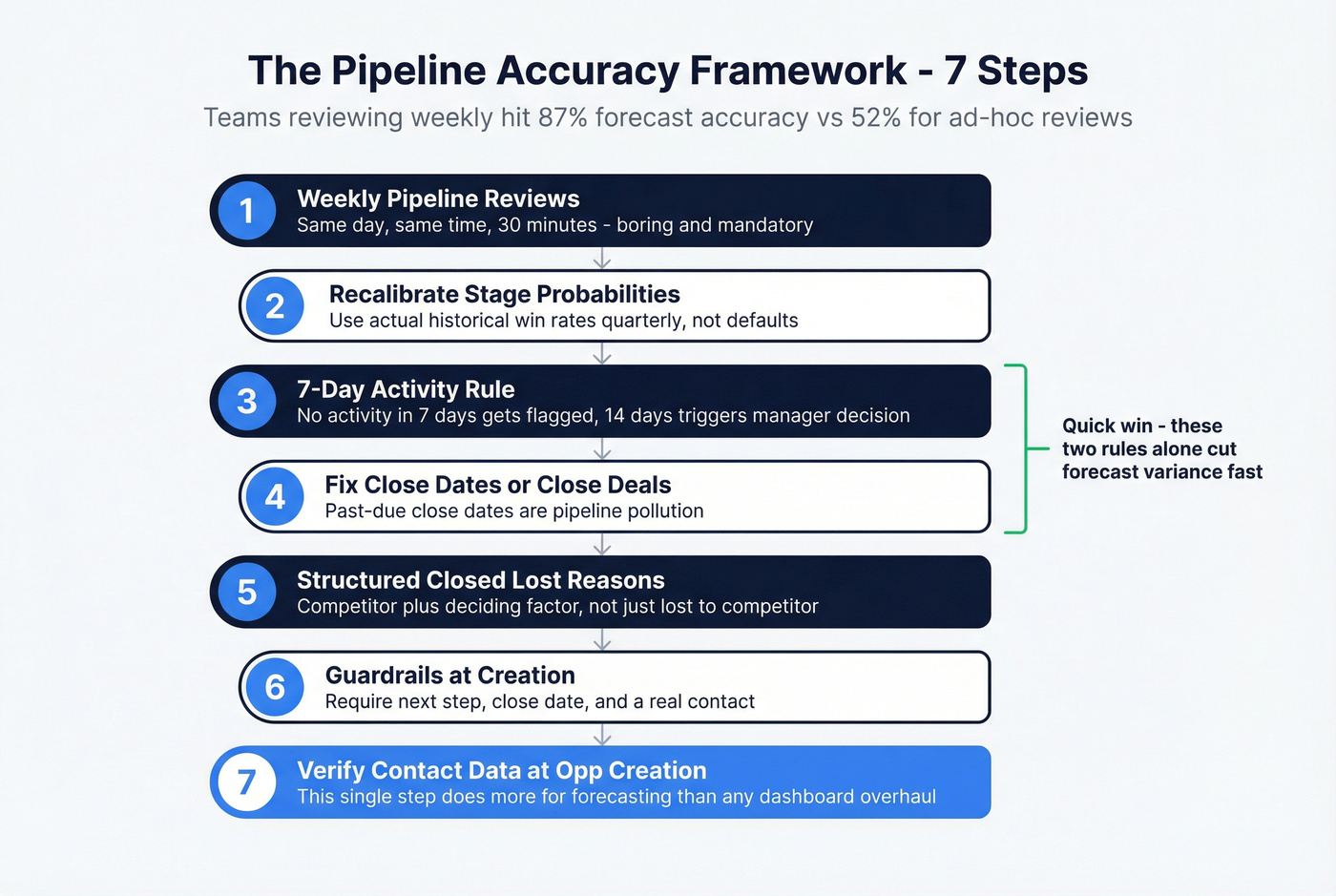
Let's break down the framework we recommend. You'll feel the difference within a month:
- Run weekly pipeline reviews - no exceptions. Same day, same time, 30 minutes. Make it boring and mandatory.
- Recalibrate stage probabilities quarterly. Use actual historical win rates, not defaults.
- Enforce a 7-day activity rule. No activity in 7 days gets flagged; 14 days triggers a manager decision.
- Fix close dates or close deals. Past-due close dates are pipeline pollution.
- Require structured Closed Lost reasons. Competitor plus deciding factor, not just "lost to competitor."
- Add guardrails at creation. Don't allow opp creation without a next step, close date, and a real contact.
- Verify contact data at opp creation, not quarter end. This single step does more for forecasting reliability than any dashboard overhaul.
We've seen teams cut forecast variance fast just by combining two rules: "7-day activity" plus "no past-due close dates." It forces reality into the CRM.

Tools That Help
Look - buying Clari before fixing CRM hygiene is lighting money on fire. Revenue tools are powerful, but they only amplify whatever you feed them. Clari's acquisition of Salesloft closed in late 2025, and the tooling landscape keeps consolidating in 2026.
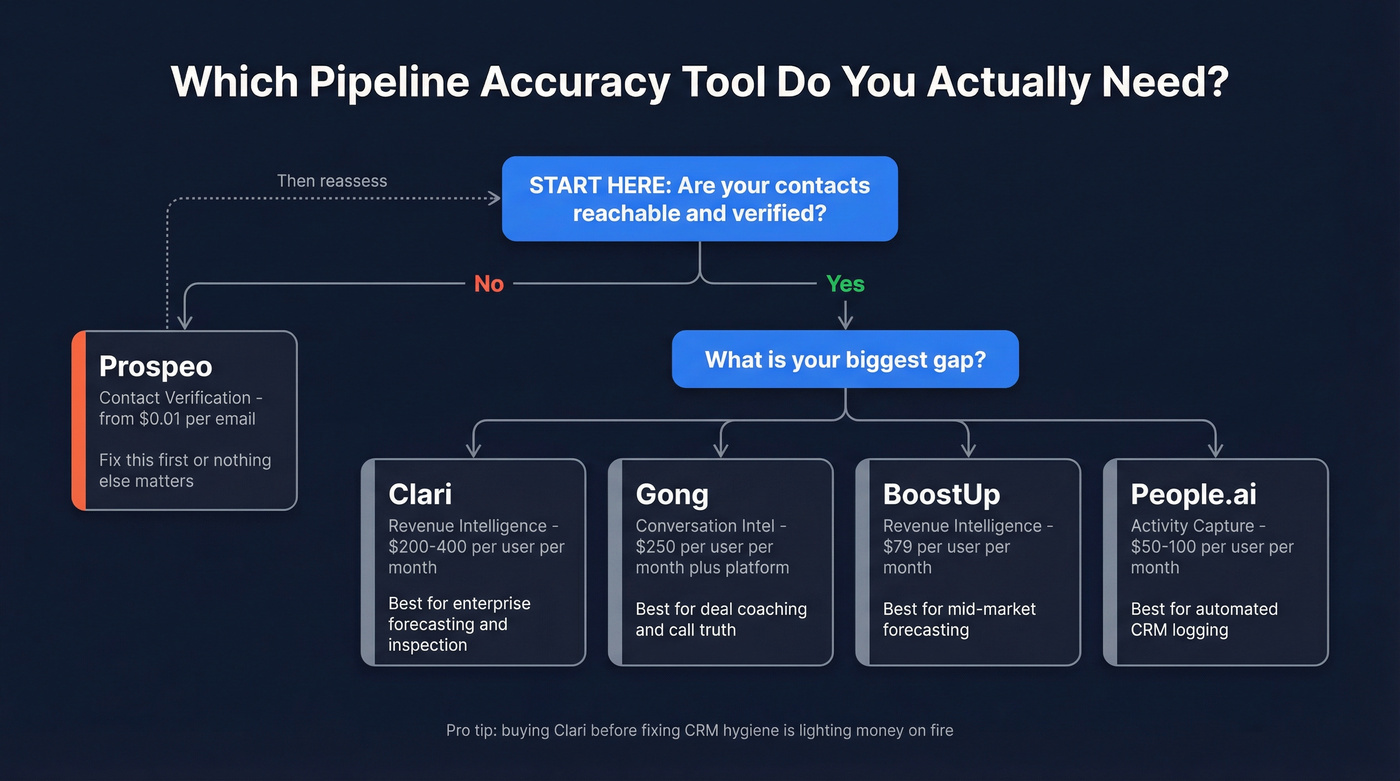
| Tool | Category | Est. Price | Best For |
|---|---|---|---|
| Prospeo | Contact Verification | From ~$0.01/email (free tier) | Pre-pipeline data verification |
| Clari | Revenue Intelligence | ~$200-400/user/mo | Enterprise forecasting |
| Gong | Conversation Intel | ~$250/user/mo + platform fee | Deal coaching + calls |
| BoostUp | Revenue Intelligence | ~$79/user/mo | Mid-market forecasting |
| People.ai | Activity Capture | ~$50-100/user/mo | Automated CRM logging |
| UnifiedPipeline | Pipeline Alerts | ~$499/mo unlimited | Daily Slack alerts |
Skip the expensive stuff if your fundamentals aren't solid. A practical way to think about the stack:
For teams that need better inspection and rollups, Clari or BoostUp are the go-to options. When coaching and deal truth from calls is the priority, Gong shines. If your CRM is missing activity data entirely, People.ai fills that gap. Managers who live in Slack will get value from UnifiedPipeline's daily alerts.
But if reps can't reach the people in the opp, none of that matters. Fix contact verification first. Outreach's AI coaching can cut deal cycles by 11 days on average - meaningful, but only if the contacts in those deals are actually reachable.
If you're rebuilding your stack, start with sales forecasting solutions that match your motion.
You just read that teams lose 32% of selling time to data issues. Prospeo enriches your CRM with 50+ data points per contact at a 92% match rate - so reps sell and your pipeline reflects reality.
Clean pipeline data is the forecast fix no dashboard can replace.
Pipeline Accuracy Checklist
Before your next forecast call, run through this:
- Every opportunity has a next step and a date
- No activity in 14 days = flagged for review
- Close dates past due = updated or moved to Closed Lost
- Stage probabilities calibrated to actual win rates quarterly
- TCV and ACV clearly separated in every deal
- Contact data verified before opportunity creation
- Weekly pipeline review - no exceptions, no excuses
Most pipeline accuracy problems aren't forecasting problems. They're capture and discipline problems. Fix the inputs and the forecast stops embarrassing you.