


Quo (Formerly OpenPhone) Pricing, Reviews, Pros and Cons in 2026
Every Quo review tells you it "starts at $15/month." None of them tell you what a 5-person team actually pays once carrier fees, Sona AI credits, and telecom taxes hit the invoice. We broke down every line item so you don't have to - here's what Quo actually costs, where it shines, and where it falls apart.
30-Second Verdict
Quo is excellent for micro-teams of 2-5 people who work primarily on Wi-Fi and want a modern VoIP business phone app built around a shared inbox. But that $15/month headline is misleading.
We calculated every line item for a 5-person Starter team on annual billing, and the real number lands around $97-$108/month - not the $75 the pricing page implies. That's 29-44% above sticker price. If you need reliable calling for field reps who are frequently off Wi-Fi or plan to scale past 10 users, look elsewhere.
Quick context on the name: OpenPhone rebranded to Quo on September 30, 2025, working with naming agency Lexicon to signal expansion beyond a purely "phone" brand. Same core product, same app experience.
Quo Pricing Breakdown
Plan Pricing
| Plan | Monthly | Annual (per mo) | Annual Total |
|---|---|---|---|
| Starter | $19/user | $15/user | $180/user |
| Business | $33/user | $23/user | $276/user |
| Scale | $47/user | $35/user | $420/user |
All plans include one new or ported local or toll-free number per user, calling and messaging to the US/Canada (subject to fair use), voicemail transcripts, and 1,000 free Sona AI automation credits per month (10 AI-answered calls). Full plan details are on Quo's pricing page.
Hidden Fees That Inflate Your Bill
Here's the thing - the per-user price is only part of the story.
| Fee | Amount | Frequency |
|---|---|---|
| Carrier registration | $19.50 | One-time per user |
| TCR campaign fee | $1.50-$3 | Monthly per campaign |
| Resubmission fee | $15 | Per revision |
| Additional numbers | $5/number | Monthly |
| Telecom taxes | Varies by state | Monthly |
Quo adds applicable telecom taxes and surcharges - including 911/E911, TRS, and FUSF - based on your billing address. They assess these fees for billing addresses in 16 states, including CA, FL, NY, NJ, PA, and WA. These aren't optional. They're added at checkout.
Sona AI Credit Tiers
| Tier | Monthly Cost | Credits | AI Calls | Overage/Call |
|---|---|---|---|---|
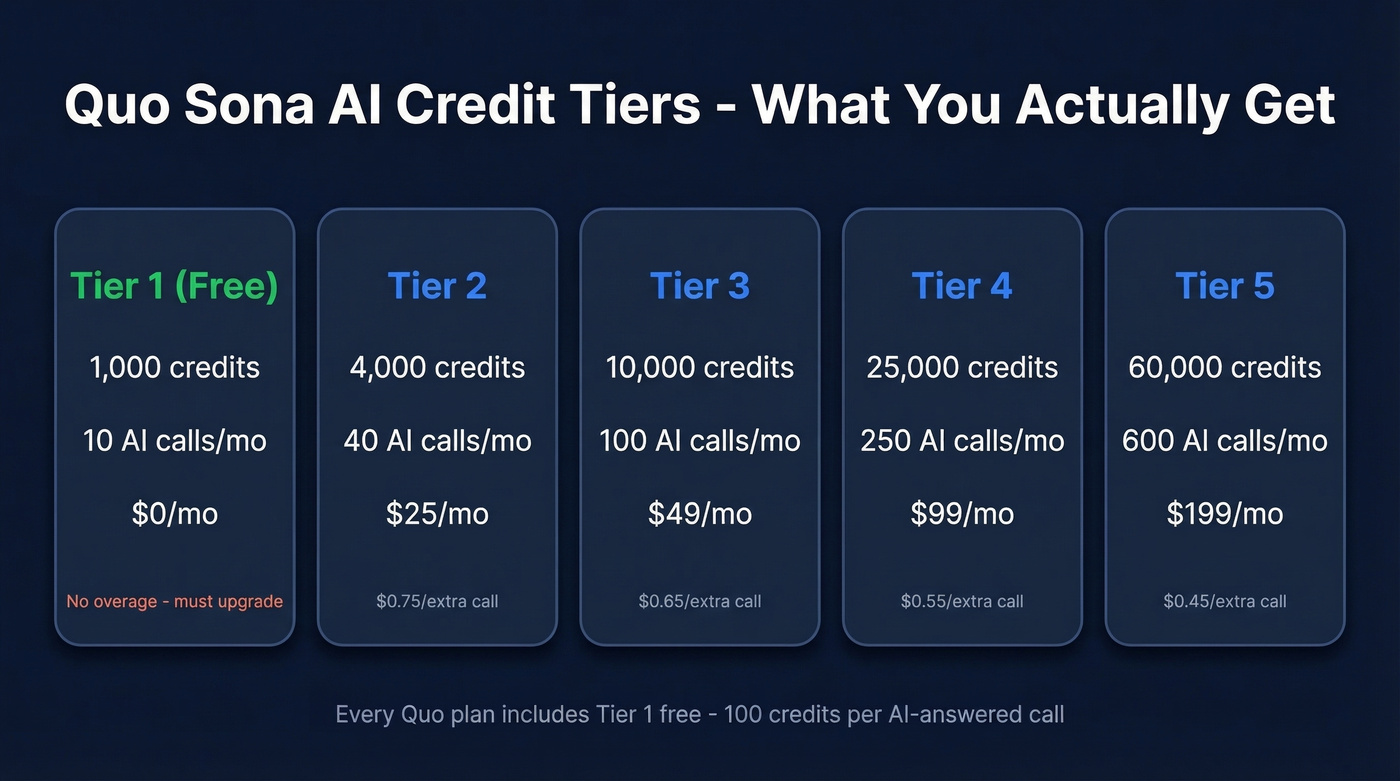
| 1 (included) | $0 | 1,000 | 10 | Upgrade required |
| 2 | $25 | 4,000 | 40 | $0.75 |
| 3 | $49 | 10,000 | 100 | $0.65 |
| 4 | $99 | 25,000 | 250 | $0.55 |
| 5 | $199 | 60,000 | 600 | $0.45 |
True Cost for a 5-Person Team
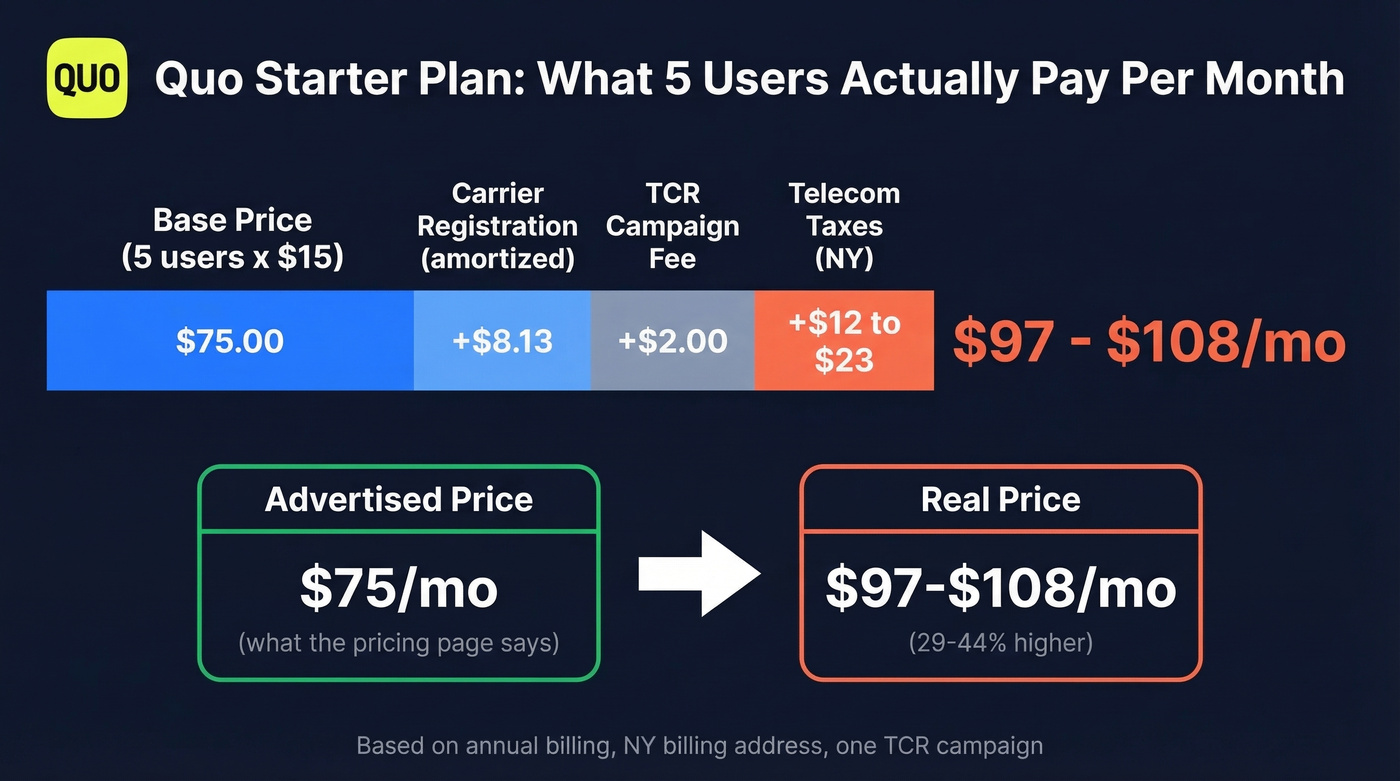
Five users on Starter annual billing: $75/month base.
Now add the rest:
- Five one-time carrier registrations ($19.50 x 5 = $97.50, amortized over 12 months = ~$8.13/mo)
- One TCR campaign fee (~$2/mo)
- Telecom taxes and surcharges for a NY-based team (~$12-$23/mo total across all users, depending on jurisdiction)
That puts you at roughly $97-$108/month. Not $75.

You just saw how Quo's real cost jumps 29-44% above sticker price. Don't let your contact data do the same thing - reps dialing bad numbers is a hidden cost that never shows up on an invoice. Prospeo's 125M+ verified mobile numbers deliver a 30% pickup rate, so every dial has a real person on the other end.
Stop paying for a phone system and then calling dead numbers.
Pros and Cons
Pros
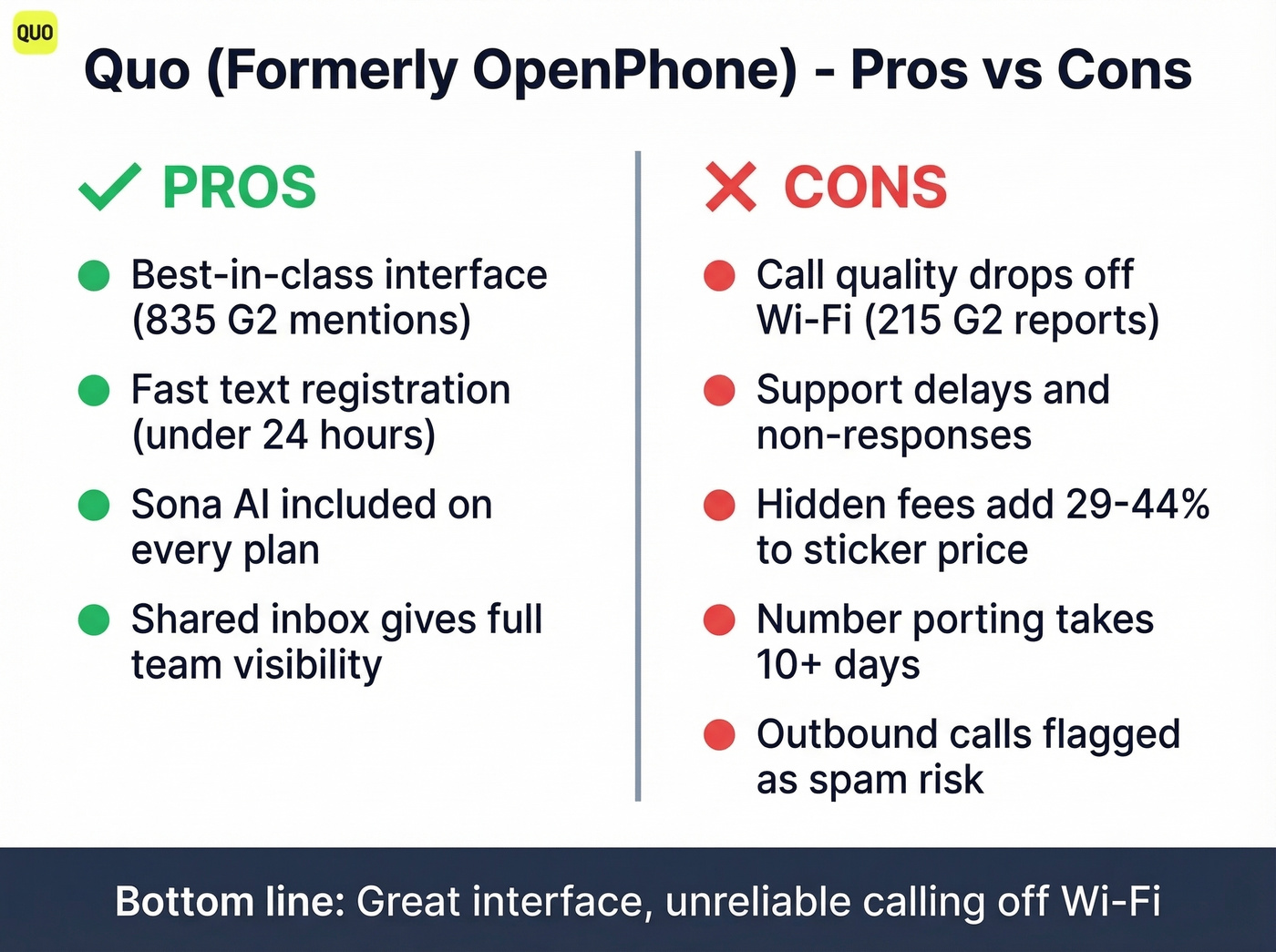
- The interface is genuinely great. It's the top G2 theme with 835 mentions. Onboarding takes minutes, and the whole thing feels like a messaging app rather than clunky enterprise software.
- Text registration can be fast. One Reddit user got approval in under 24 hours after switching from Dialpad, where they'd waited 2+ weeks.
- Sona AI ships on every plan. You get 10 free AI-answered calls per month even on Starter - most competitors gate AI features behind higher tiers.
- Shared inbox model gives every team member visibility into conversations. No more "did anyone call them back?"
Cons
- Call quality craters off Wi-Fi. This is the dealbreaker. G2 logs 215 connection issue mentions and 101 call disconnection reports. A real estate broker on r/openphone put it bluntly: calls are "completely unreliable when users leave a WiFi connection," even with full bars of cell signal.
- Support is a gamble. Trustpilot reviews heavily feature support delays and non-responses, and Forbes notes Quo's live support team can be hard to reach. Some Reddit users also allege negative posts get removed from the subreddit rather than addressed.
- Hidden fees catch people off guard. The carrier registration, TCR fees, and telecom taxes aren't obvious until checkout.
- Porting is slow. Port-in takes ~10 days, port-out requires a 2-5 business day review period, and the total process can stretch to 1-2 weeks. Error messages during porting are often unhelpful.
- Spam flagging risk. Your outbound calls can get flagged as "spam risk" or "spam likely" on recipients' phones - a problem Forbes highlights and one that shows up repeatedly in Trustpilot complaints.
What Real Users Say
The review gap tells a story. Quo holds a 4.7/5 on G2 from 3,294 reviews. Trustpilot sits at 3.7 from 738 reviews, where billing confusion, account flags, and support complaints dominate.
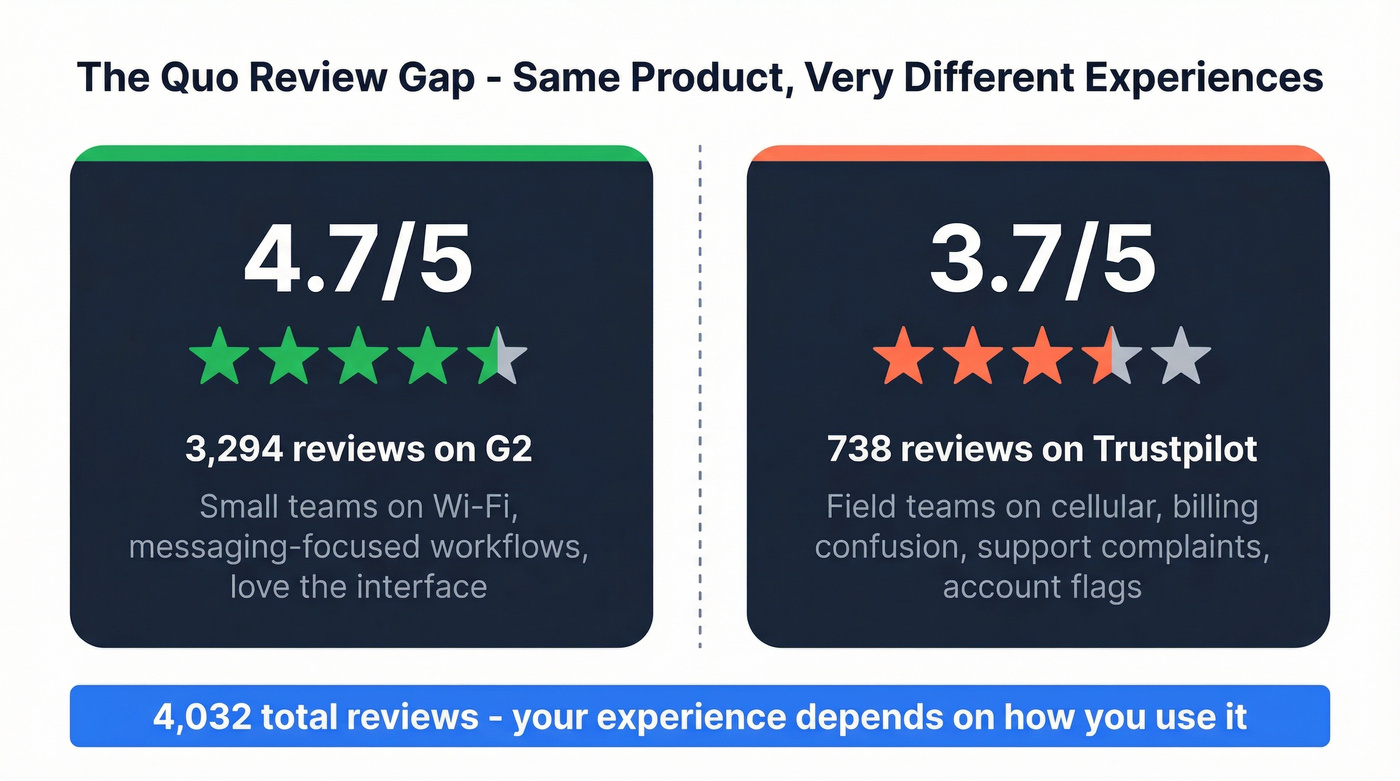
Across those 4,032 reviews, the pattern is clear: if you're a small team on Wi-Fi doing mostly messaging-style communication, you'll land in the G2 camp. If you're a field team on cellular or a solopreneur who needs responsive support when something breaks, the Trustpilot experience is more likely yours. We've seen this split in other VoIP tools too, but it's unusually stark with Quo.
Who Should (and Shouldn't) Use Quo
Use Quo if you're a micro-team of 2-5 people, primarily on Wi-Fi, who wants a messaging-style shared inbox. The interface is genuinely the best in VoIP, and at $15/user/month on annual billing, entry cost is low.
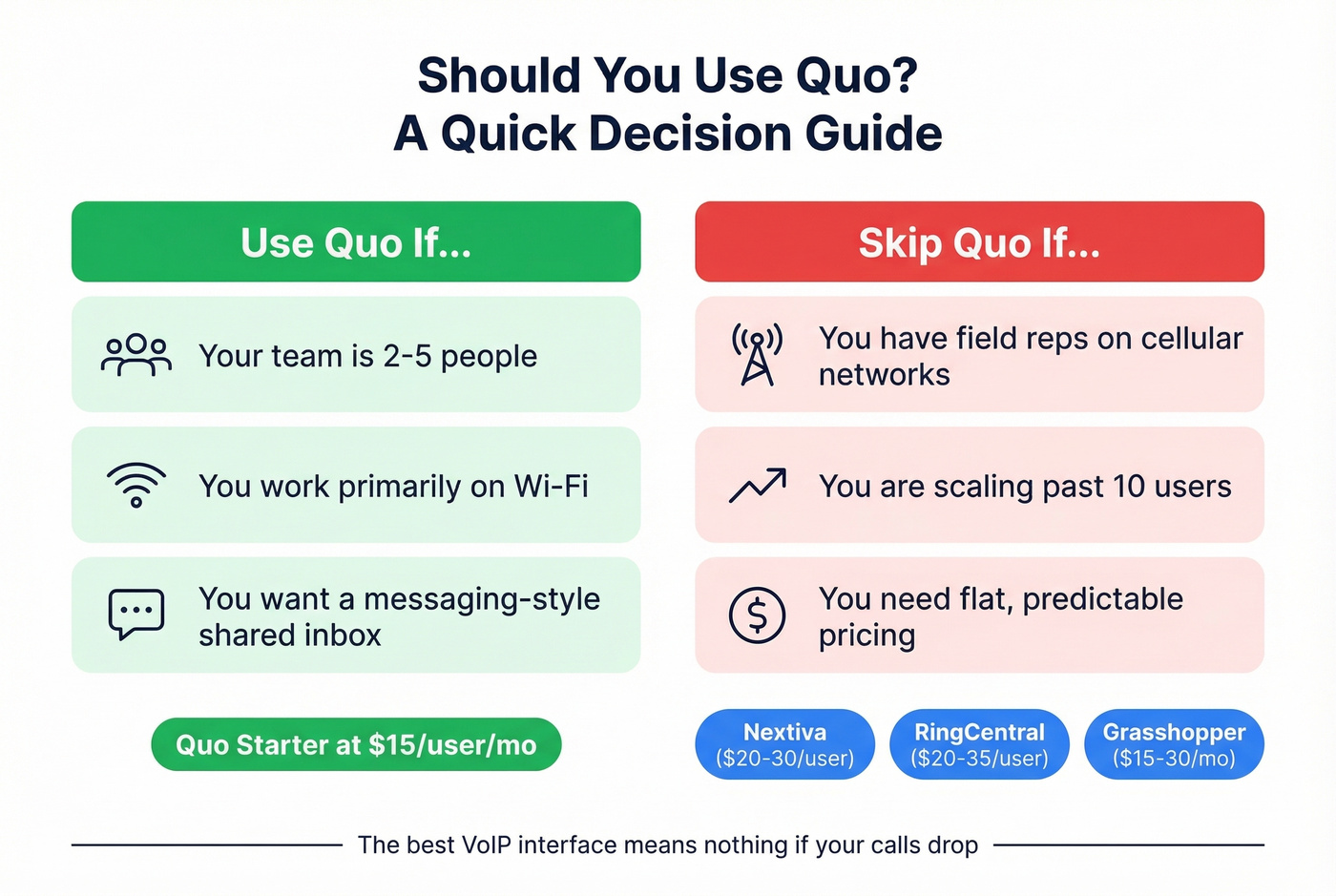
Skip Quo if you're running field teams that rely on cellular calling. The call quality issues are well-documented and consistent across review platforms. Teams scaling past 10 users should look at Nextiva (~$20-$30/user/month) or RingCentral (~$20-$35/user/month) for more reliable infrastructure. Solopreneurs wanting flat, predictable pricing might prefer Grasshopper at around $15-$30/month.
Let's be honest about the core tension here: Quo is the best interface in VoIP. But an interface doesn't matter when calls drop. And the reliability gap means some teams end up paying twice - once for Quo and again for the platform they switch to.
Whatever phone system you choose, outbound results depend on calling real numbers. Prospeo's sales prospecting techniques cover that gap with 125M+ verified mobile numbers and a 30% pickup rate, so your reps aren't burning time on dead lines.
Spam flagging and dropped calls tank outbound connect rates - but so does dialing unverified numbers. Prospeo refreshes its 125M+ mobile database every 7 days (not 6 weeks like competitors), so your reps reach real buyers on the first attempt. At $0.10 per mobile, it costs less than one Sona AI overage call.
Your phone system is only as good as the numbers you're dialing.
FAQ
Is Quo the same as OpenPhone?
Yes. OpenPhone rebranded to Quo on September 30, 2025. The core product, app experience, and pricing structure are identical - your existing account, numbers, and settings carried over automatically.
Does Quo charge hidden fees beyond the per-user price?
Yes. Expect a $19.50 one-time carrier registration fee per user, $1.50-$3/month TCR campaign fee, $5/month per additional number, and telecom taxes for billing addresses in 16 states. A 5-person Starter team realistically pays $97-$108/month, not $75.
How much does Sona AI cost?
Every plan includes 10 free AI-answered calls per month (1,000 credits). Scaling to 40 calls costs $25/month, 100 calls costs $49/month, and 600 calls runs $199/month. Overage rates range from $0.75 to $0.45 per call depending on tier.
How can I improve outbound connect rates with Quo?
The biggest factor isn't your phone system - it's your data. Verified direct dials dramatically outperform switchboard numbers. Prospeo's mobile finder provides 125M+ verified numbers with a 30% pickup rate, which pairs well with any VoIP platform including Quo.