

How to Write a Request Meeting Email That Actually Gets a Reply
You just sent 50 meeting request emails. Two opens, zero replies. The problem isn't your offer - it's that the average cold email response rate sits between 1-5%, and most senders ignore the structural basics that separate emails that work from the ones that don't.
Let's fix that.
Steal These Three Templates First
Cold outreach:
Subject: [First name], quick question on [specific challenge]
Hi [First name],
Noticed [company] just [specific trigger - new hire, funding round, product launch]. We helped [similar company] cut [specific metric] by [result] in [timeframe].
Worth a 15-minute call Thursday at 2 PM ET to see if that applies to you?
Either way, no pressure - happy to send the case study instead.
Warm introduction:
Subject: [Mutual connection] suggested we connect
Hi [First name],
[Mutual connection] mentioned you're working on [specific initiative]. We just wrapped a similar project with [company] - cut their [metric] by [number].
Would Tuesday at 10 AM work for a quick 15-minute chat? If not, I'm flexible Wednesday afternoon.
Internal request:
Subject: Input needed on [project] - 20 min this week?
Hi [First name],
I'm finalizing the [project/decision] and need your perspective on [specific question]. Shouldn't take more than 20 minutes.
Does Thursday at 3 PM work, or is Friday morning better?
Each template stays under 125 words and follows every principle we'll break down below. Now let's get into why these work - and why most meeting emails don't.
Why Most Meeting Emails Get Ignored
The numbers are brutal. Average open rates sit at 27.7%, meaning roughly three out of four recipients never even see your subject line. Of those who open, the average reply rate has dropped to 3.43% as of 2026 - down from 5.1% in 2024. And here's the stat that should change how you think about this entirely: 17% of cold emails never reach the inbox at all. They bounce or hit spam filters before anyone has a chance to ignore them.
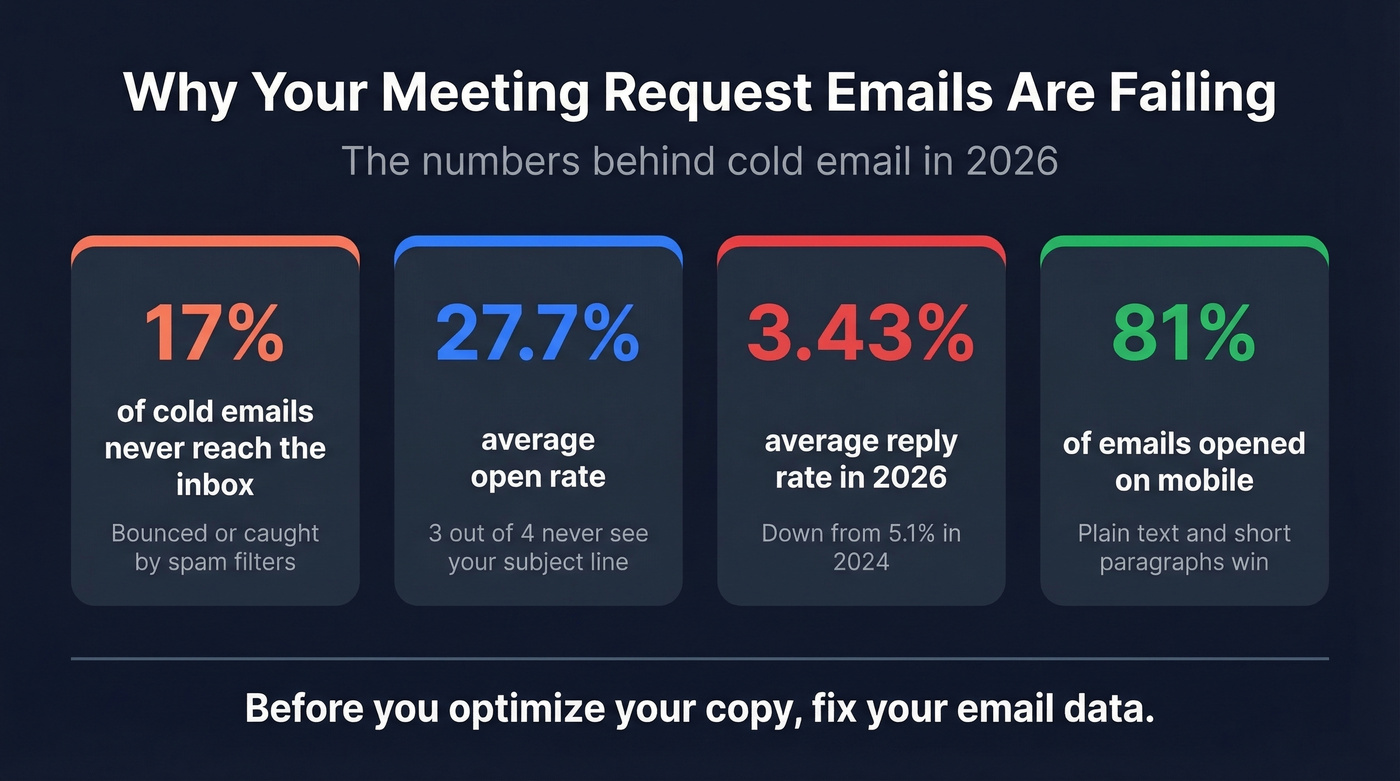
That 17% is the invisible killer. You can write the perfect email, nail the subject line, send at the optimal time - and none of it matters if the email address is wrong or your domain reputation is trashed from previous bounces.
But deliverability isn't the only problem. The emails that do land still fail for predictable reasons: they lead with features instead of outcomes, they use vague asks like "Would you be interested in connecting to learn more?" instead of specific proposals, and they make replying feel like work. Every one of those mistakes turns your message into something the recipient defers. Deferred emails are dead emails.
81% of emails are opened on mobile. Your beautifully formatted HTML email with embedded images? It looks like a broken layout on someone's phone. Plain text wins. Short paragraphs win. Anything that requires scrolling loses.
Before you optimize a single word of copy, fix your data. We've seen teams double their reply rates just by cleaning their lists first - Prospeo verifies emails with 98% accuracy, and the free tier gives you 75 verifications per month. Enough to clean a small campaign list before you hit send.

Anatomy of an Effective Meeting Request
Every email that gets replies has five components, in this order. Skip even one and your response rate tanks.
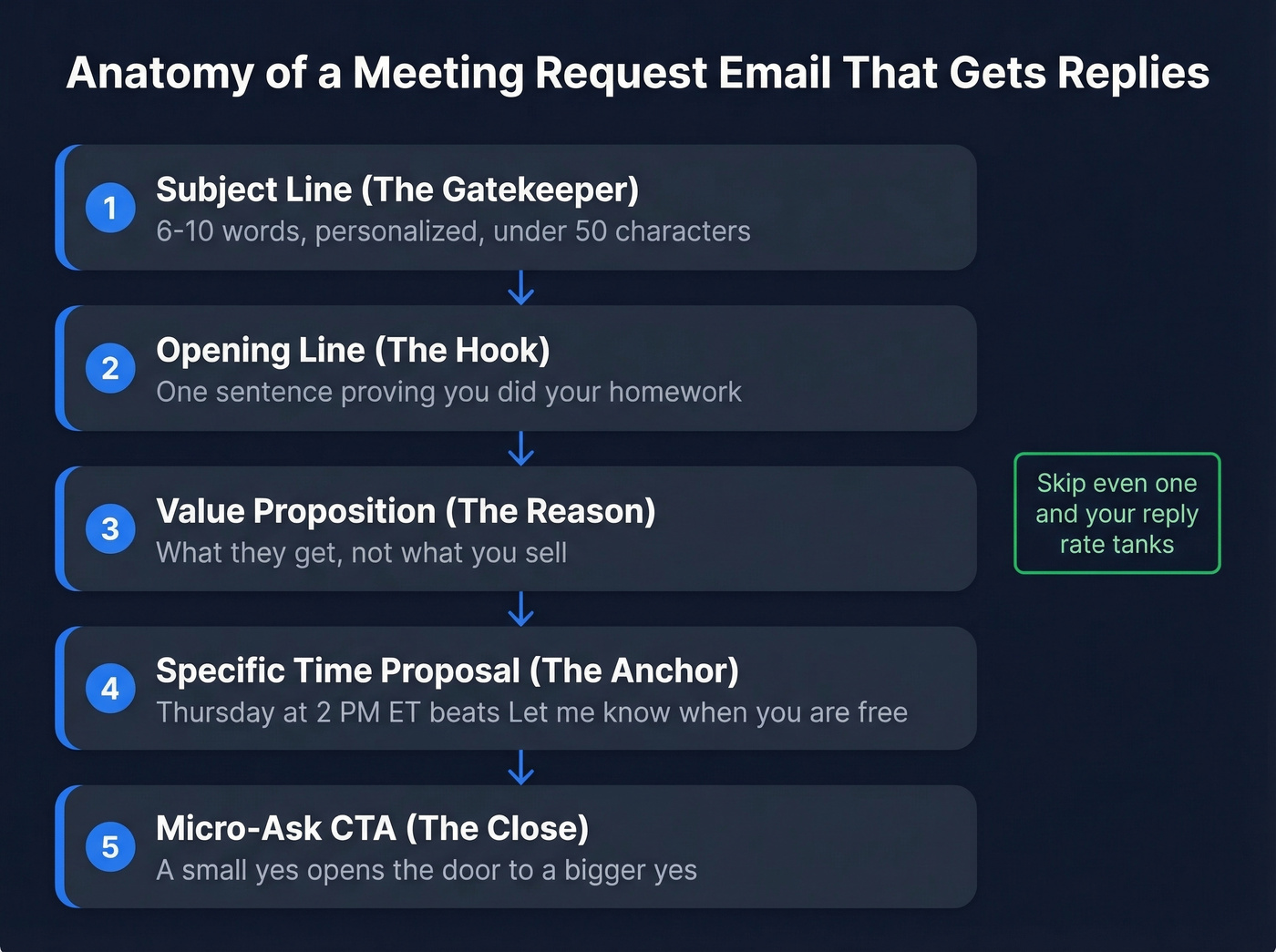
1. Subject line (the gatekeeper). Six to ten words, personalized, under 50 characters. [47% of recipients](https://www.invespcro.com/blog/email-subject-lines-statistics-and-trends/) use the subject line alone to decide whether to open. More on this in the subject line section below.
2. Opening line (the hook). One sentence that proves you did your homework. Reference something specific - a recent hire, a funding round, a blog post they wrote. People engage with what feels personally relevant and ignore what feels mass-produced. Generic openers like "I hope this email finds you well" signal you're blasting a list.
3. Value proposition (the reason). One to two sentences explaining what's in it for them. Not what you sell - what they get. "We helped [similar company] reduce [problem] by [metric]" builds instant credibility through social proof. "Our platform offers AI-powered solutions for..." does nothing.
4. Specific time proposal (the anchor). Always propose a concrete time. "Would Thursday at 2 PM ET work?" creates a simple yes/no decision - it's far easier for someone to adjust an existing anchor than to create a time from scratch. "Let me know when you're free" creates an open-ended task, and open-ended tasks get deferred indefinitely.
5. Micro-ask CTA (the close). This is where most emails fail. Compare "Would you be interested in connecting to learn more?" with "Want me to send the case study?" The micro-ask works because a small yes is easy, and it opens the door to a bigger yes later.
Plain text only. One hyperlink maximum. Anything more and you look like a marketing blast.
Ideal Email Length
Boomerang analyzed 40M+ emails over a year-long study and found a clear sweet spot:
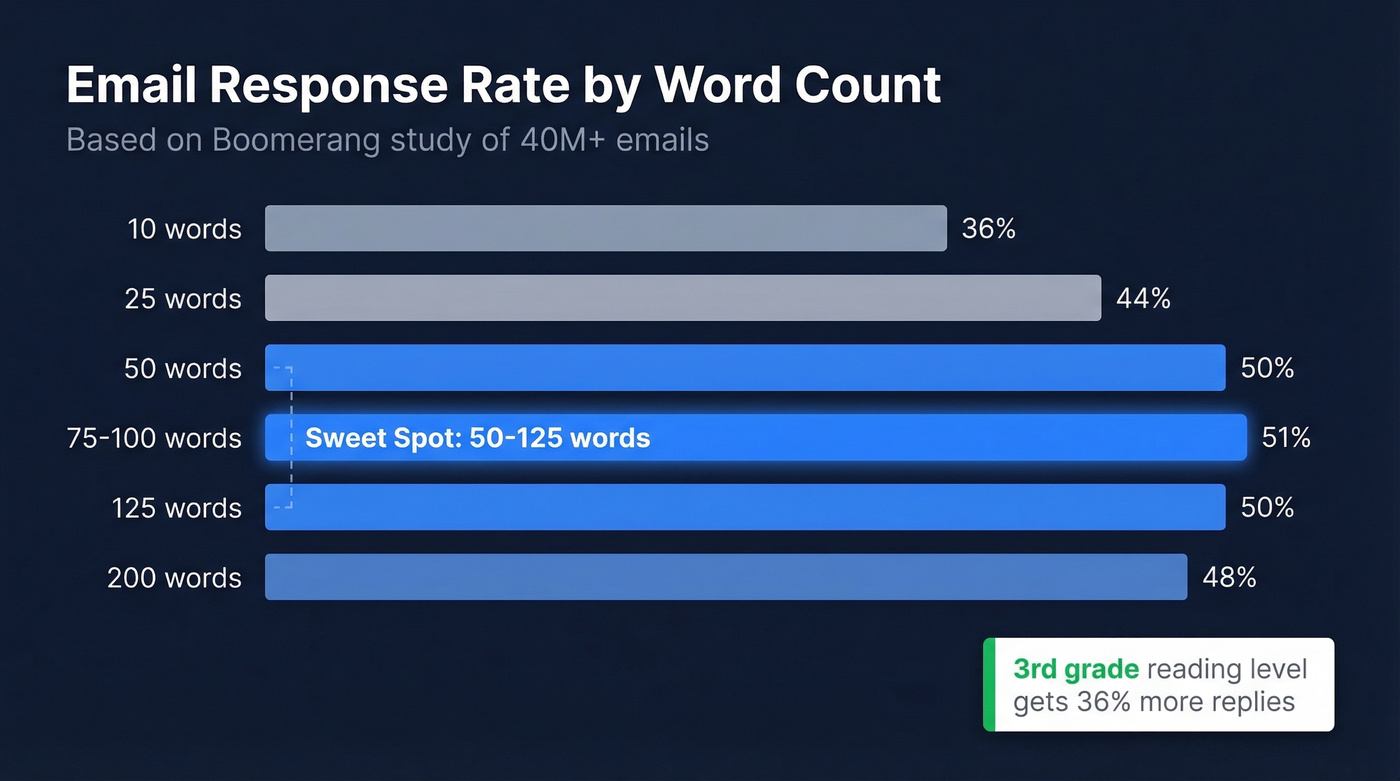
| Word Count | Response Rate |
|---|---|
| 10 words | 36% |
| 25 words | 44% |
| 50 words | 50% |
| 75-100 words | 51% |
| 125 words | 50% |
| 200 words | 48% |
The sweet spot is 50-125 words. Below 25 words, you don't give enough context. Above 150, you're asking too much of someone's attention.
Here's the finding that surprises people most: emails written at a third-grade reading level got 36% more replies than college-level writing. That doesn't mean dumbing things down - it means short sentences, common words, and zero jargon. We've seen this hold true across every campaign we've analyzed. Emails with slightly positive or slightly negative emotional tone also outperformed neutral emails by 10-15%. A little personality helps. Robotic formality hurts.
Subject Lines That Get Opened
Personalized subject lines deliver 26-50% higher open rates than generic ones. That's the single biggest lever you have.
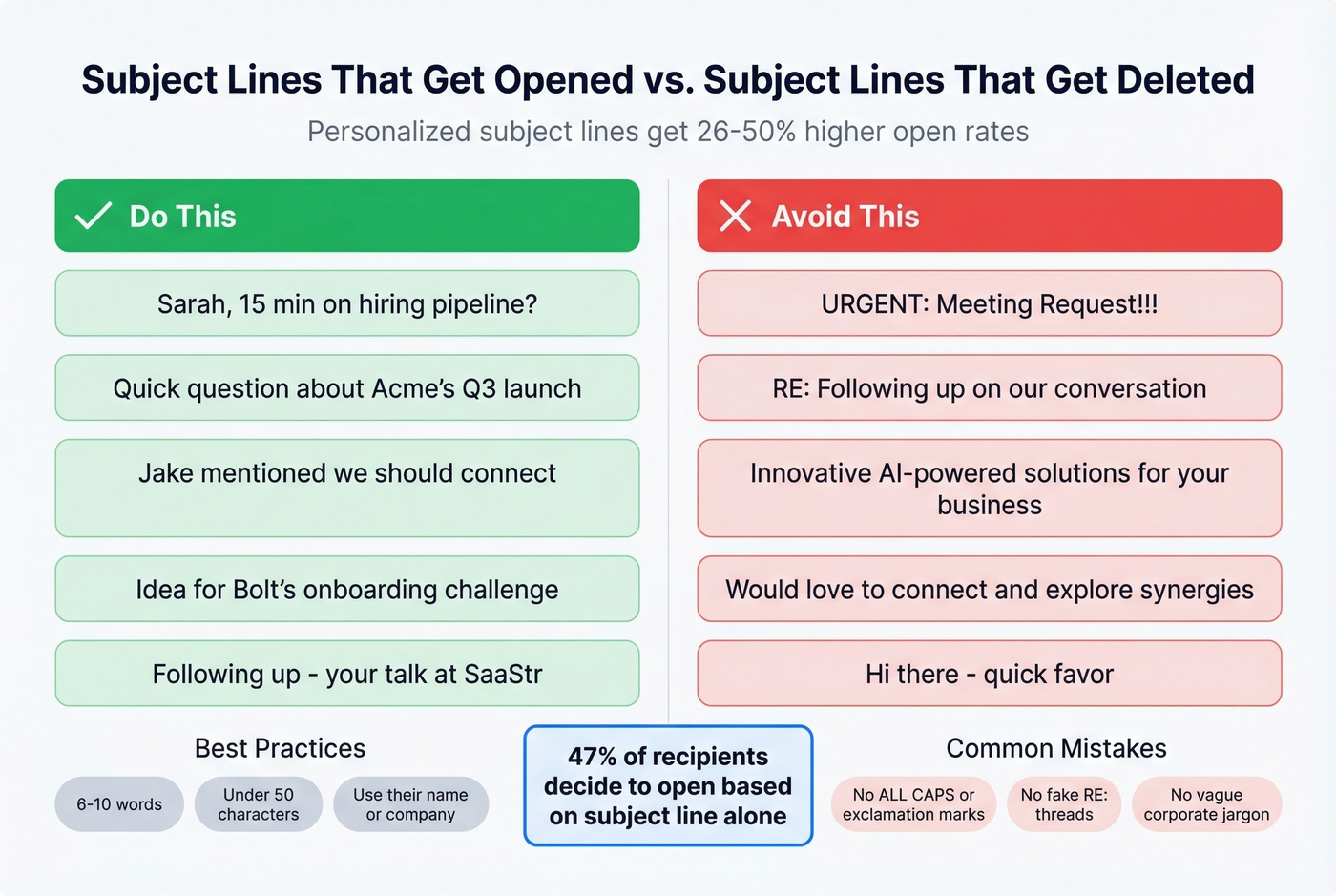
The rules are simple. Keep it to 6-10 words - data from 151 million outreach data points confirms this range gets the highest open rates. Stay under 50 characters so nothing gets truncated on mobile, where 33 characters guarantees full visibility across all devices. Include the recipient's first name or company name. Avoid spam triggers like "urgent," ALL CAPS, excessive punctuation, or fake "RE:" threads.
Examples that work:
- [First name], 15 min on [topic]?
- Quick question about [company]'s [initiative]
- [Mutual connection] said to reach out
- Idea for [company]'s [specific challenge]
- Following up - [topic] from [event]
- [First name], saw your [post/talk/hire]
If it reads like a marketing subject line, it'll perform like one.

Your meeting request email won't get a reply if it never reaches the inbox. 17% of cold emails bounce - killing your domain reputation and tanking future campaigns. Prospeo verifies emails at 98% accuracy with a 7-day refresh cycle, so every meeting request lands where it should.
Stop perfecting copy that bounces. Fix your data first.
Best Time to Send
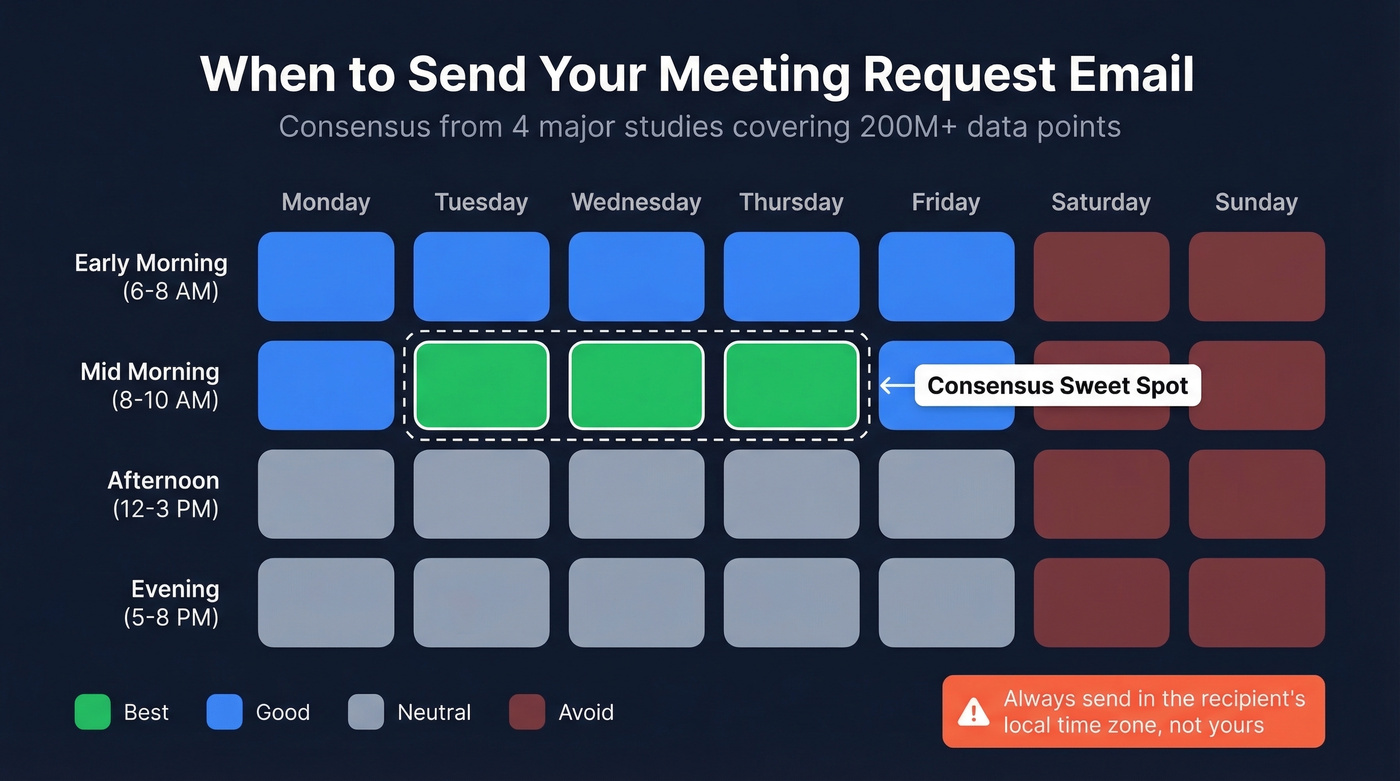
Four major studies, four slightly different answers:
| Source | Dataset | Best Day | Best Time | Key Finding |
|---|---|---|---|---|
| MailerLite | 2.1M campaigns | Fri/Mon | 8-11 AM | Fri highest opens |
| Snov.io | 44M emails | Wednesday | 7-11 AM | Wed best for replies |
| Sopro | 151M data pts | Monday | Morning | Mon highest opens |
| Hunter.io | 9 studies | Tue-Thu | 8-10 AM | Day differences small |
Here's the thing: the day matters less than the time. Every study agrees that mornings win and weekends are terrible. MailerLite's data covers marketing campaigns rather than cold outreach, but the morning timing pattern holds across both categories.
The consensus landing zone is Tuesday through Thursday, 8-10 AM in the recipient's local time. That last part is critical - if you're in New York emailing someone in London, 9 AM ET is 2 PM GMT. You've already missed the window.
Don't obsess over the "perfect day." We've tested this extensively. Pick a weekday morning, send it in their time zone, and spend your optimization time on the copy instead.
12 Ready-to-Use Templates
Cold Outreach to a Prospect
First touch after identifying a trigger event.
Hi [First name],
[Company] just [trigger event]. We helped [similar company] [specific result] in [timeframe].
Worth 15 minutes Thursday at 10 AM ET? If the timing's off, happy to send a one-pager instead.
Warm Introduction
Hi [First name],
[Mutual connection] mentioned you're tackling [challenge]. We just helped [company] with the same thing - [specific result].
Would Tuesday at 2 PM work for a quick call? I'll keep it to 15 minutes.
Internal Meeting Request
Hi [First name],
Need your input on [project/decision] before we finalize on [date]. Specifically, [one concrete question].
Does Wednesday at 11 AM work? Should be 20 minutes max.
Executive Outreach
Executives scan faster than anyone. Lead with their priority, not yours. Every unnecessary word is a reason to stop reading.
Hi [First name],
[One sentence about their company's public priority]. We helped [peer company's CEO/CRO] [specific outcome] last quarter.
Would 15 minutes Monday at 9 AM work?
Post-Event Follow-Up
Hi [First name],
Great connecting at [event] - your point about [specific thing they said] stuck with me. There's an overlap with what we're doing at [your company].
Free for 15 minutes Friday at 11 AM to dig in?
Partnership or Collaboration
Hi [First name],
I've been following [their company]'s work on [specific area]. There's a natural overlap with [your company] around [shared audience/problem].
Would a 20-minute call next Tuesday at 3 PM make sense?
Recruiter Outreach
This format gets strong response rates because it explicitly removes commitment pressure.
Hi [First name],
Your background in [specific skill/role] caught my attention. We're building out [team] at [company], and the role aligns with your experience at [their current company].
Open to a 15-minute call Wednesday at 1 PM? No commitment - just a conversation.
Reschedule Request
Hi [First name],
Something came up and I need to move our [day/time] meeting. Apologies for the shuffle.
Would [new day] at [new time] work? If not, I'm open Thursday afternoon.
Follow-Up After No Response (Day 3)
Hi [First name],
Bumping this up - I know [day]s are hectic.
Still think [value prop in one sentence] is worth a quick conversation. Does [specific time] work?
Second Follow-Up (Day 7)
Hi [First name],
Following up one more time. If [original value prop] isn't a priority right now, totally understand.
Want me to send the one-pager so you can review on your own time?
Break-Up Email (Day 14)
We've tested break-up emails that outperform the initial send. The "I'll stop emailing" signal creates urgency through scarcity - people pay attention when something's about to go away.
Hi [First name],
I'll keep this short - don't want to clutter your inbox. If [problem you solve] isn't on your radar, I'll close the loop.
If things change, I'm easy to find. Good luck with [specific initiative].
Client Upsell/Review
Hi [First name],
It's been [timeframe] since we kicked off [project]. Wanted to share results and discuss what's next - there's an opportunity around [specific area].
Does [day] at [time] work for 20 minutes?
Follow-Up: Where 42% of Replies Hide
42% of all campaign replies come from follow-ups, and 48% of reps never send a second message. They send one email, get silence, and move on - leaving nearly half their potential replies on the table.
That's genuinely frustrating to watch. I've audited outbound programs where the initial email was great and the follow-up sequence simply didn't exist.
80% of cold email replies come after the second touch. The cadence that works: first follow-up at 3 business days, second at 7 days, final break-up at 14 days. Three touches total after the initial send. The r/sales community has largely settled on this same rhythm - three to four follow-ups max before you're just annoying people.
Five Mistakes Killing Your Replies
1. Too long. Over 125 words and response rates start dropping. Every word past the sweet spot gives someone a reason to defer. Cut ruthlessly.
2. Open tracking enabled. Analysis of 44M emails found that turning off open tracking more than doubled reply rates - 2.36% vs 1.08%. Tracking pixels trigger spam filters. The data you gain isn't worth the deliverability you lose.
3. Over-formatted HTML. Banners, logos, multiple links, fancy signatures - all of it screams "marketing email." Plain text with one hyperlink maximum. That's the format that gets replies.
4. Weak CTA. "Let me know if you're interested" is the worst closing line in sales email history. It puts the work on the recipient. Use a micro-ask: "Want the case study?" or "OK to send a calendar invite for Thursday at 2?"
5. Bad contact data. If 17% of your emails never reach the inbox, you're burning domain reputation on every send. Run your list through an email verification tool before sending - one bounced email hurts deliverability for every future message from your domain.
Pre-Send Checklist
Before you hit send on any request meeting email, run through this:
- Under 125 words?
- Written at a third-grade reading level? Short sentences, common words.
- Specific time proposed? Not "when works for you?"
- Micro-ask CTA? Not "let me know if interested."
- Subject line under 50 characters and personalized?
- Plain text, one link max?
- Open tracking disabled?
- Recipient's email verified and deliverable?
- Sending 8-10 AM in the recipient's time zone?
- Follow-up scheduled for day 3?
If you can check all ten, your email is in the top 5% of meeting requests anyone receives. Most people skip at least three of these.
Look - for teams where the average deal is under $5K, you don't need a sophisticated multi-channel sequence. A verified email, a tight 75-word message, and two follow-ups will outperform most enterprise playbooks. Skip the fancy tools and nail the fundamentals on this checklist first.
Personalized subject lines boost opens by 50%, but personalization requires real data. Prospeo gives you 50+ data points per contact - job changes, funding rounds, tech stack - so every meeting request opens with a hook that proves you did your homework.
Write meeting emails with trigger events baked in. Start free.
FAQ
How do I write a request meeting email?
Lead with a specific observation about their work, state the value in one sentence, propose a concrete time, and close with a low-pressure micro-ask like "Want me to send the one-pager instead?" Keep it under 125 words and make replying effortless - brevity signals respect for their time more than formal language ever will.
What's the best subject line for a meeting request?
Personalized, 6-10 words, under 50 characters. Use the formula: "[First name], quick question about [specific topic]." Personalized subject lines deliver 26-50% higher open rates than generic ones. Avoid anything that sounds like marketing copy.
How many times should I follow up?
Three times: day 3, day 7, and day 14 - then stop. 42% of replies come from follow-ups, yet most reps give up after one email. The break-up email at day 14 often gets the highest response rate of the entire sequence.
Should I suggest a specific time or ask for availability?
Always propose one or two concrete times. "Would Thursday at 2 PM or Friday at 10 AM work?" creates a simple yes/no decision. "When works for you?" creates an open-ended task that gets deferred. Anchoring to a specific slot is the single most effective tactic for getting a reply.
How do I make sure my email doesn't bounce?
Verify the recipient's address before sending. A single bounce hurts your sender reputation and affects deliverability for every future email. Prospeo's free tier covers 75 verifications per month with 98% accuracy - enough to clean a small campaign list and prevent compounding domain damage.