

Sale Closing Is Broken - Here's the Science, Data, and Scripts to Fix It
Only 16% of sales reps hit their annual quota in 2024 - down from 53% in 2014. Sales cycles have stretched 32% longer since 2021. Two-thirds of B2B buyers say they'd prefer to never talk to a rep at all. That's not a technique problem. It's a systemic one, and most sales content treats it like a vocabulary quiz.
Here's what actually moves the needle: understanding the psychology behind why people say yes, knowing which techniques match which deal dynamics, and making sure you're talking to the right person with valid contact data before you ever attempt a close.
The Short Version
Reframe closing entirely. It's not a moment at the end of a call. It's a chain of micro-commitments across every interaction. The Freedman & Fraser study proved this decades ago - small yeses lead to big yeses.
Master five techniques, not twenty-five. The assumptive, summary, question, sharp angle, and soft close cover the vast majority of deal scenarios. Everything else is situational.
Know your benchmark. SQL-to-Closed-Won rates range from 37% in B2B SaaS to 66% in Higher Education. If you're well below your industry benchmark, the problem is usually upstream - qualification, targeting, or data quality.
Fix your data before your technique. The best closing script in the world doesn't work if you're calling a dead number or emailing a bounced address. Pipeline quality is the precondition for close rate improvement.
What Sales Closing Actually Means
Most teams conflate three different metrics, and the confusion costs them.
Close rate is closed-won deals divided by total opportunities - the broadest measure. Win rate narrows the denominator to deals that reached the proposal stage. Conversion rate typically refers to earlier funnel movements: demo-to-opportunity, trial-to-paid, MQL-to-SQL. Mixing these up is how teams convince themselves they're closing at 50% when they're really at 25%.
The bigger reframe is philosophical. "Always Be Closing" - the Glengarry Glen Ross mantra - is dead. 67% of B2B buyers now prefer a rep-free experience, per Gartner's 2026 survey of 646 buyers. And 45% of those buyers used AI during a recent purchase to evaluate vendors before ever speaking to a human.
That doesn't mean the sales close is irrelevant. It means it should feel like the natural conclusion of a well-run process, not a pressure tactic bolted onto the end of a bad one. Buyers who feel confident in their decision are 2x more likely to report a high-quality deal. Your job is to build that confidence, not manufacture urgency.
Close Rate Benchmarks by Industry
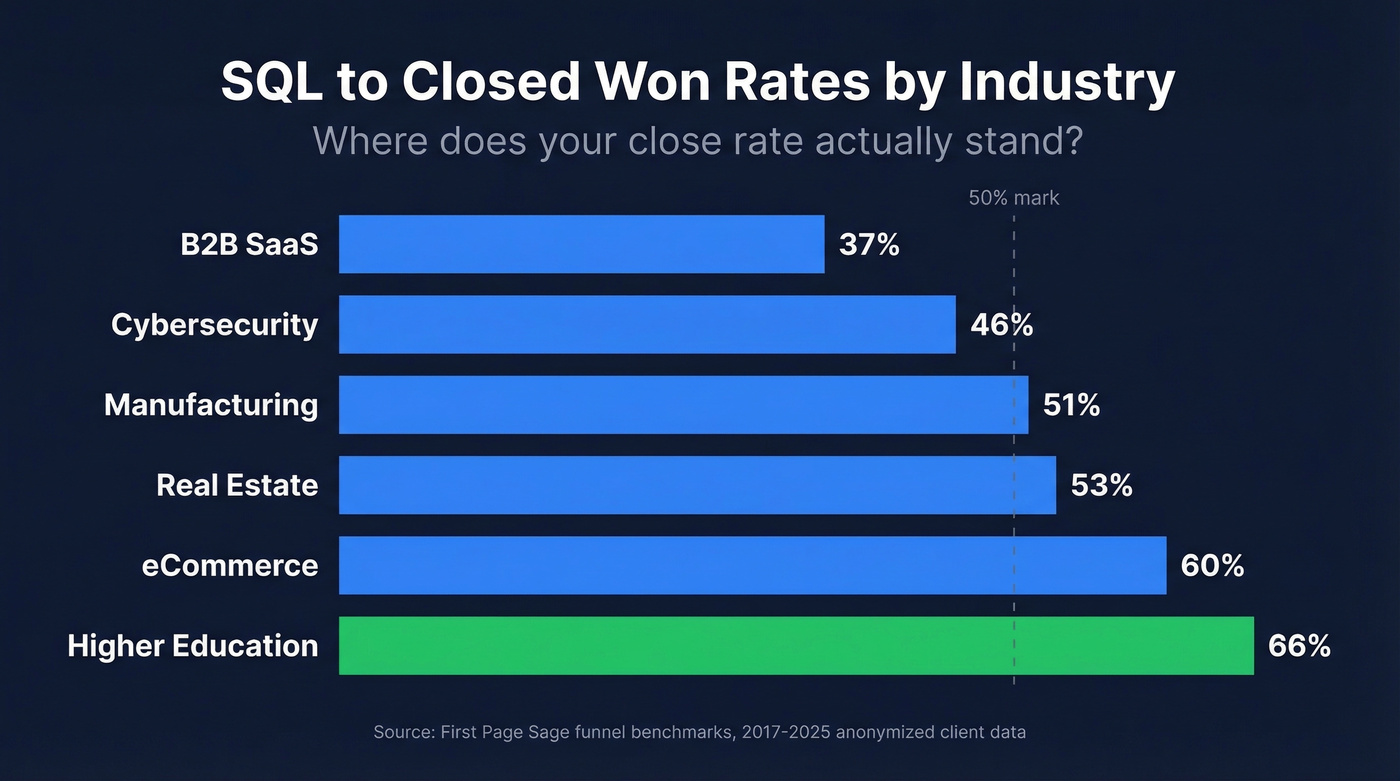
Before you diagnose your closing skills, figure out where you actually stand relative to your vertical. These are SQL-to-Closed-Won conversion rates - the most meaningful benchmark for sales teams.
| Industry | SQL to Closed Won |
|---|---|
| B2B SaaS | 37% |
| Cybersecurity | 46% |
| Manufacturing | 51% |
| Real Estate | 53% |
| eCommerce | 60% |
| Higher Education | 66% |
Data from First Page Sage's funnel benchmarks, drawn from anonymized client data across 2017-2025.
If you're selling SaaS and closing 37% of SQLs, you're average. At 25%, the issue isn't your closing line - it's that unqualified leads are making it too deep into your pipeline. The close rate is a lagging indicator. It tells you how well everything upstream is working.
Why Closing Techniques Work
Closing techniques aren't magic words. They're applications of well-documented cognitive biases - mental shortcuts humans use to make decisions under uncertainty. Understanding the "why" behind each technique is what separates reps who adapt in real time from reps who recite scripts and freeze when the conversation goes sideways.
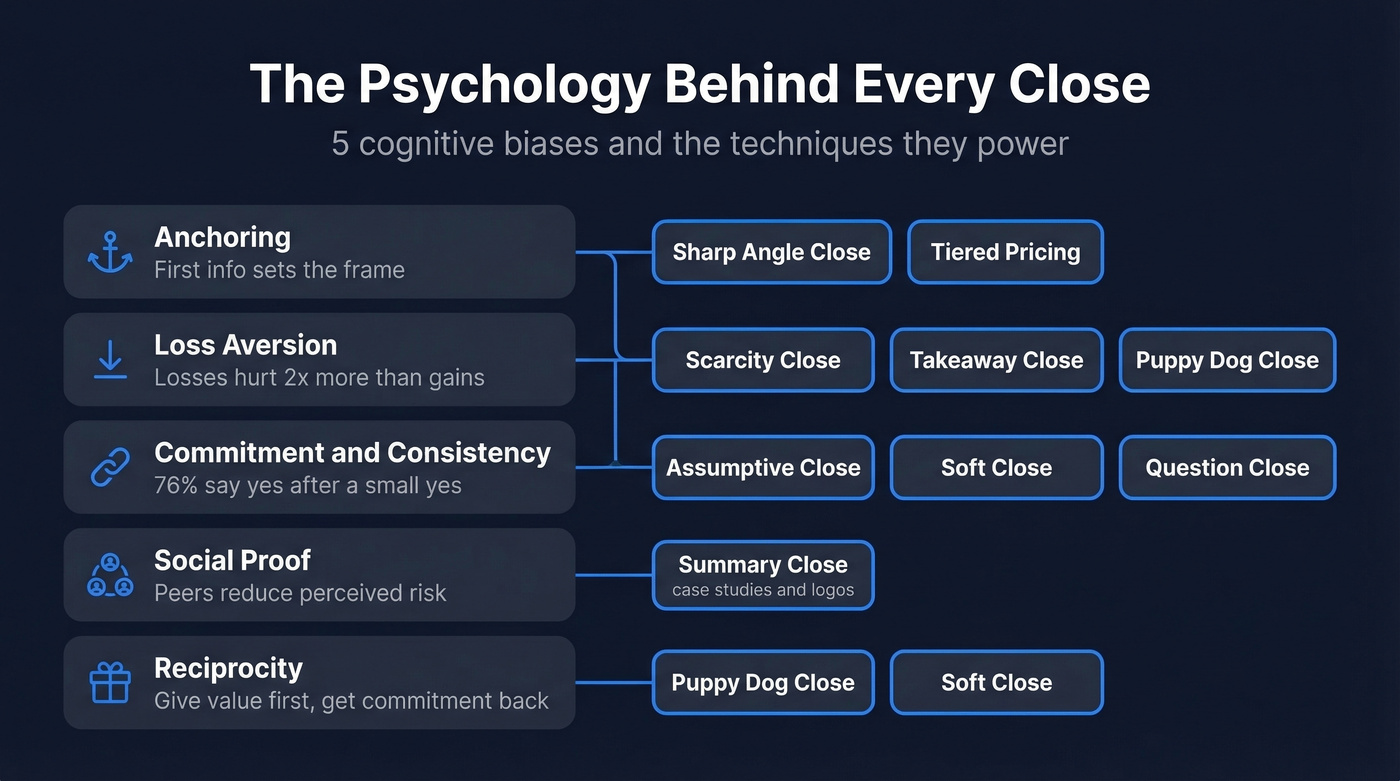
Anchoring is the tendency to rely heavily on the first piece of information encountered. When you open a negotiation by presenting your premium package first, you've set an anchor. Everything after that feels like a concession. This is the engine behind the sharp angle close and any tiered pricing presentation.
Loss aversion - Kahneman and Tversky's research shows that people feel losses roughly twice as intensely as equivalent gains. The scarcity close and the takeaway close both exploit this: the prospect isn't gaining a discount, they're avoiding the loss of one.
Commitment and consistency is the most powerful principle for modern sales. Freedman and Fraser's 1966 study found that people who agreed to a small initial request were 76% likely to agree to a much larger follow-up request, compared to just 17% when asked cold. This is why micro-commitments throughout the sales process - confirming pain points, agreeing to next steps, sharing the proposal internally - make the final close almost automatic.
Social proof works because buyers look to peers for validation, especially in high-stakes B2B purchases. Case studies, logos, and "companies like yours" framing all reduce perceived risk at the close. Reciprocity operates from the opposite direction: when you give something valuable first - an audit, a custom analysis, a free pilot - the prospect feels an obligation to reciprocate. The puppy dog close is pure reciprocity in action.
Every effective closing technique maps to at least one of these biases. If you understand the bias, you can improvise the technique. If you only memorize the script, you're stuck the moment the conversation goes off-script.

Your close rate is a lagging indicator of pipeline quality. If you're reaching wrong numbers and bounced inboxes, no technique saves you. Prospeo delivers 98% email accuracy and 125M+ verified mobiles with a 30% pickup rate - so every close attempt reaches a real decision-maker.
Stop perfecting your pitch on contacts that don't exist.
10 Techniques That Work in 2026
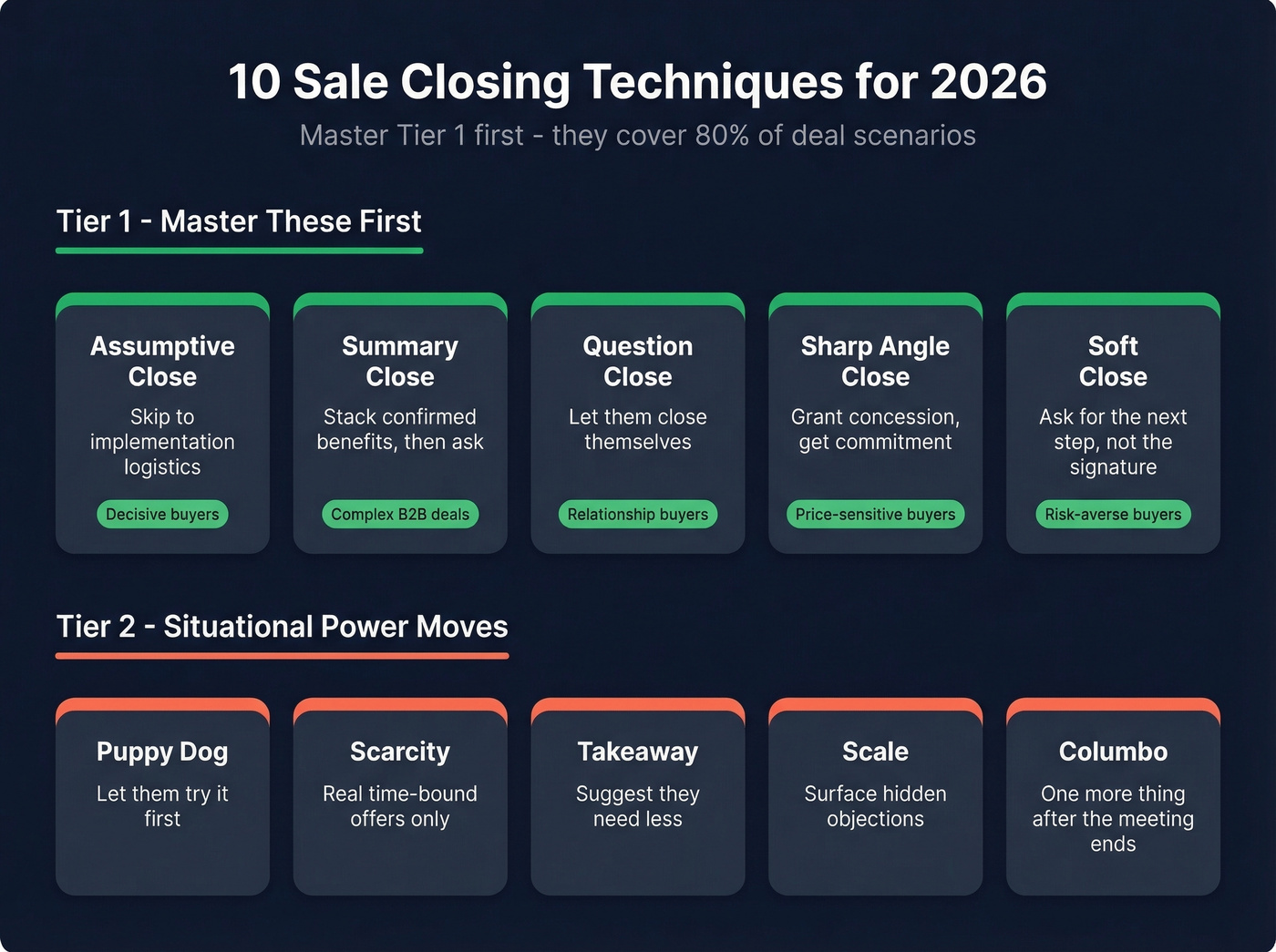
We've ranked these in two tiers. Tier 1 techniques are the five you should master first - they cover the widest range of deal types. Tier 2 techniques are situational but powerful when deployed correctly.
The Assumptive Close
"What day next week works best for our onboarding kickoff call?"
That's it. No "will you buy?" question. You skip straight to implementation logistics, and it works because of commitment and consistency - by the time you're discussing onboarding timelines, the prospect has mentally committed. We've seen this work best in B2B mid-market deals where the champion has already signaled intent and you've done thorough discovery. Ask any seasoned rep and they'll confirm: the assumptive close only lands after real qualification.
Best for: Decisive buyers who've done their research and want to move fast. Risk-averse buyers will feel steamrolled. Skip this if the prospect hasn't explicitly confirmed problem-solution fit.
The Summary Close
You recap every benefit the prospect has confirmed throughout the process, stack them together, and ask for the decision. It triggers confirmation bias - the prospect hears their own priorities reflected back and finds it hard to disagree with themselves.
Script: "So we've confirmed that [Product] solves your [Problem A], cuts [Metric B] by [X%], and integrates with your existing stack. The team starts onboarding next Monday - are you ready to move forward?"
This is the workhorse close for complex B2B deals with multiple stakeholders. Analytical buyers respond to it because it feels structured and evidence-based rather than emotional. Price-sensitive buyers appreciate it too, because the value stack makes the cost feel justified. In our experience, this is the technique that most consistently converts six-figure enterprise deals.
The Question Close
Before: You ask "Ready to sign?" The prospect feels cornered and stalls.
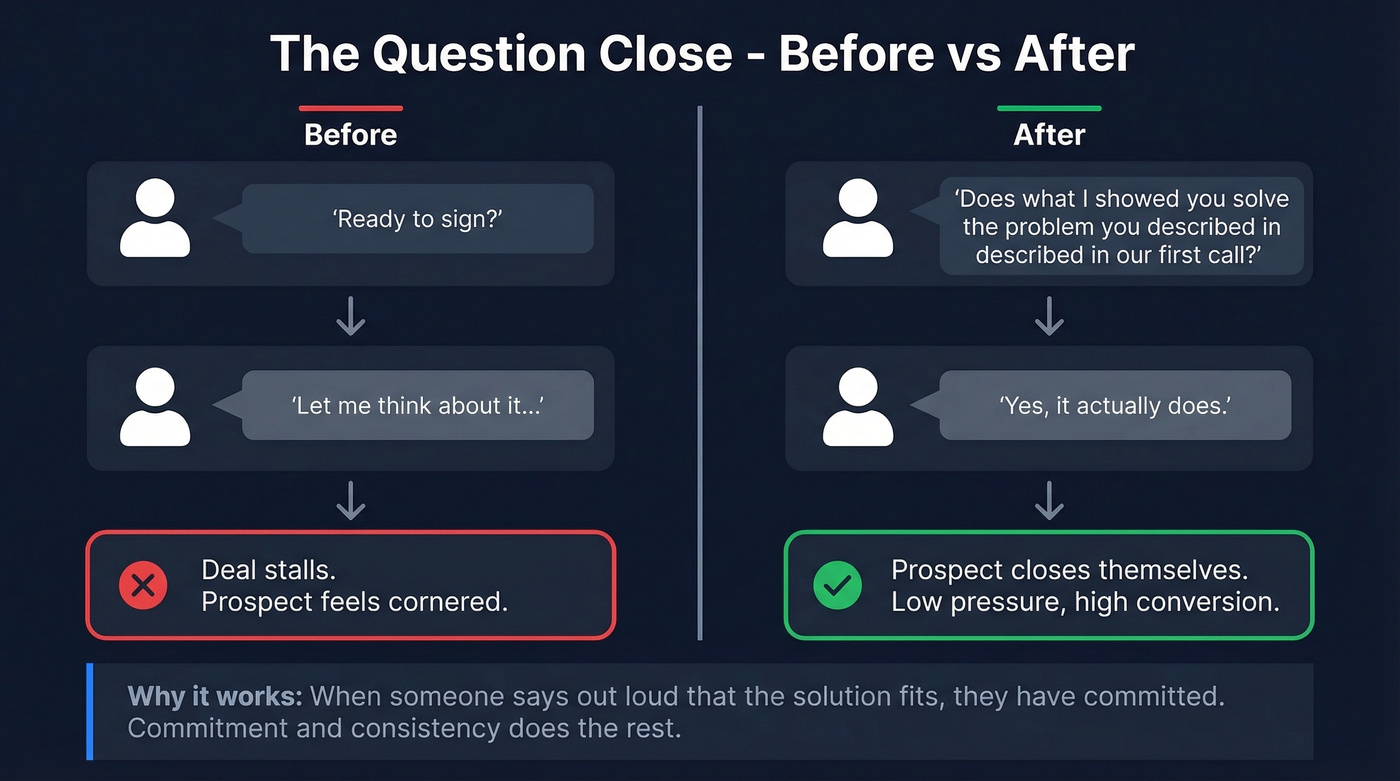
After: You ask "Does what I've shown you solve the problem you described in our first call?" The prospect says "yes, it does" - and they've just closed themselves.
The psychology is subtle: when someone articulates that the solution works, out loud, they've committed. This is the lowest-pressure technique in your arsenal and works across B2B and B2C. Relationship-focused buyers who resist being "sold to" respond to it best - which, given that 67% of B2B buyers prefer rep-free experiences, is most of them.
The Sharp Angle Close
When a prospect asks for a concession - a discount, an extra feature, faster implementation - you grant it immediately, contingent on them committing now. It uses reciprocity and loss aversion simultaneously.
Script: "If I can include the premium support tier at no extra cost, are you prepared to sign today?"
This works best with price-sensitive buyers who have buying authority and are actively looking for a reason to say yes. Analytical buyers may want time to evaluate the concession, so read the room. Use it sparingly or you'll erode trust.
The Soft Close
The soft close asks for a low-commitment next step rather than the final signature. It's a micro-commitment play - you're not asking them to buy, you're asking them to take one more step toward buying.
Script: "Would it be helpful if I put together a custom ROI analysis based on the numbers you shared? I can have it to you by Thursday."
This is the right move for risk-averse buyers, early-stage conversations, and enterprise deals with long cycles. If you sense the prospect isn't ready, pushing harder only creates objections. The soft close keeps momentum without triggering resistance.
Tier 2: Situational Techniques
The Puppy Dog Close - Let the prospect use the product before they commit. Free trials, pilots, and proof-of-concept engagements all work through loss aversion: once someone has the product, taking it away feels like a loss. Best for SaaS with self-serve onboarding and products with strong "aha moments." Set clear success criteria upfront or pilots become zombie evaluations that drag on for months.
The Scarcity Close - Time-bound offers, limited availability, or expiring pricing. Loss aversion in its purest form. "This pricing is locked through end of quarter. After that, the new rate card kicks in." Only works when the scarcity is real. Fake scarcity is the fastest way to lose credibility with sophisticated buyers, and the consensus on r/sales is that buyers can smell it instantly.
The Takeaway Close - You suggest the product might not be the right fit, or that a lower tier would suffice. "Honestly, the Starter plan might be enough. You probably don't need the advanced analytics." Works with competitive buyers who don't want to be told they need less. Precision tool, not a default.
The Scale Close - "On a scale of 1 to 10, how confident are you that this solves your problem? What would it take to get to a 10?" A diagnostic close that surfaces hidden objections without confrontation. Strong for stalled B2B deals where you can feel something's off but can't pinpoint what.
The Columbo Close - After the formal conversation ends and the prospect relaxes, you casually surface one more question. "Oh, just one more thing - is there anyone else on the team who'd need to sign off?" People drop their guard after the "official" meeting ends. Best technique for uncovering hidden stakeholders.
Micro-Commitments Before the Final Call
Most reps obsess over the final close and completely botch the end of every other call. Yesware's research on call-closing mistakes identifies the pattern: reps end calls without confirming next steps, rush the goodbye, fail to reinforce value, and leave without a clear CTA.
Every sales call should end with a micro-close - a small commitment that advances the deal. The Freedman & Fraser research applies directly: each small "yes" makes the next one more likely. The real meaning behind sale closing isn't the final handshake. It's the accumulation of agreements that make the final handshake inevitable.
Try this instead of vague follow-up promises: "I'll send the proposal by EOD, and we'll reconnect Thursday at 10 a.m. to walk through it together. Does that work?"
Compare that to "Great, I'll follow up soon." "Soon" isn't a commitment. It's a vague intention that lets the deal drift into oblivion.
The difference between reps who close deals and reps who "follow up" is that closers lock the next step before hanging up. Every single time.
Closing in Committees
Here's where most closing advice falls apart. It assumes one buyer, one decision.
The reality in B2B is 5 to 16 stakeholders across up to four functions, per Gartner's survey of 632 buyers. And 74% of those buying teams experience unhealthy conflict during the decision process. Your deal isn't stalling because your technique is weak. It's stalling because the VP of Engineering and the CFO can't agree on priorities, and you only have a relationship with one of them.
The fix is multi-threading - building relationships with multiple stakeholders across the buying committee, not just your champion. Buying groups that reach consensus are 2.5x more likely to complete a high-quality deal. Your job isn't to close one person. It's to help the group reach consensus.
To multi-thread effectively, you need verified contact data for every stakeholder - not just your champion. Tools like Prospeo's B2B database let you pull verified emails and direct dials for the entire org chart, so you can reach the CFO, the VP of Engineering, and the end users without waiting for introductions that never happen.
Champion-building still matters, but a champion without air cover from other stakeholders is just a single point of failure. Map the committee, reach everyone, and arm them all with the information they need to advocate internally.
10 Mistakes That Kill Deals
- Weak discovery. If you don't understand the prospect's actual problem, no technique saves you. Most lost deals die in the first call, not the last one.
- Chasing wrong deals. Pipeline volume feels productive. But 62 touches across multiple channels to close a deal that was never qualified is a catastrophic waste of time.
- No personalization. Generic pitches get generic responses: silence.
Mistakes 4 through 6 share a common thread - misalignment. Pushing for a close when the prospect is still evaluating creates resistance, not urgency. Leading with price before establishing value means you've already lost the framing battle. And if you're doing 70% of the talking, you're presenting, not selling. The best closers listen more than they speak, and they match their pace to where the buyer actually is in their journey.
- Mishandling objections. Objections handled at the close are the hardest to overcome. Surface them early through question-based selling - don't let them ambush you at the finish line.
- Inconsistent follow-up. 44% of reps give up after one follow-up. Most deals require five to twelve. Persistence isn't annoying - disappearing is.
- No internal champion. If nobody inside the account is advocating for your solution, the deal dies the moment you hang up.
- No coaching or feedback loops. Reps who don't review their calls don't improve their closes.
Let's be honest: most sales teams would improve their close rate faster by firing 30% of their pipeline than by attending another closing workshop. The deals dragging your metrics down aren't fixable with better technique - they were never qualified to begin with. Sale closing only matters if everything upstream - targeting, qualification, discovery - has already been done right.
Your Close Rate Starts With Data
Bad contact data means you're reaching the wrong prospects - or not reaching anyone at all. Wrong prospects mean wasted calls. Wasted calls mean a bloated pipeline full of deals that were never going to close. That produces a close rate that makes your board nervous.
We've seen this pattern over and over: teams invest in closing training, objection-handling workshops, and new sales methodologies, then wonder why close rates don't budge. The answer is almost always upstream. You can't close someone you never reached.
Look at what happened with Meritt, an outbound agency. They cut their email bounce rate from 35% to under 4% after switching to Prospeo's verified data. Their pipeline went from $100K to $300K per week - not because their reps suddenly got better at closing, but because they were finally talking to real people at real companies. With 98% email accuracy and data that refreshes every seven days, every technique in this guide starts working the way it's supposed to.
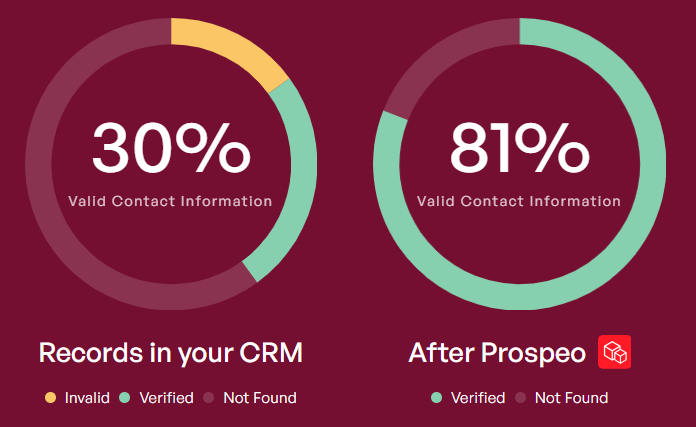
Micro-commitments only work when you're talking to the right person. Prospeo's 300M+ profiles with 30+ filters - including buyer intent, job changes, and headcount growth - let you target decision-makers who are already in-market. At $0.01 per email, bad data is no longer an excuse for a broken close rate.
Reach the buyers who are ready to say yes.
FAQ
What's a good close rate?
SQL-to-Closed-Won benchmarks range from 37% in B2B SaaS to 66% in Higher Education. Consistently falling below your industry benchmark points to a qualification or data quality problem, not a technique gap.
How many techniques should I master?
Start with five: the assumptive, summary, question, sharp angle, and soft close. These cover the vast majority of deal scenarios. Knowing twenty-five and executing none well is worse than knowing five cold.
Does "Always Be Closing" still work?
No. 67% of B2B buyers prefer a rep-free experience. Modern sale closing builds value and reduces friction across the entire cycle rather than applying pressure at the end. The close should feel like a natural outcome, not a high-stakes moment.
Why do deals stall at the final stage?
Buying committee conflict kills more deals than weak technique. 74% of B2B buyer teams experience unhealthy conflict during purchase decisions. Multi-thread across stakeholders using verified contact data, or the deal dies in committee.
How does data quality affect close rates?
Bounced emails and dead phone numbers mean you never reach the decision-maker. Teams using verified data have cut bounce rates from 35%+ to under 4%, tripling the conversations that lead to closed deals.