

The Complete Guide to Sales Assessments in 2026
Your last sales hire looked perfect on paper. Great resume, crushed the interview, had all the right answers. Six months later, they're at 40% of quota and your pipeline has a hole in it.
A structured sales assessment could have caught the problem before the offer letter went out. Average quota attainment across B2B sales orgs sits at 47%, and a bad hire drags that number down further while burning through onboarding budget, manager time, and team morale.
What You Need (Quick Version)
If you're hiring fewer than 10 reps per year, a structured interview scorecard built on free O*NET O*NET competency data gets you 80% of the way there. Hiring at scale? OMG is the gold standard for sales-specific prediction, SalesDrive is the fastest and most affordable per-candidate option, and TestGorilla covers sales alongside other roles for SMBs. Whatever you choose, administer the assessment after a phone screen - never before.
What Is a Sales Assessment?
A sales assessment is a structured evaluation designed to measure whether a candidate can actually sell - not just whether they have a pleasant personality or a strong resume. It's distinct from a generic personality test like Myers-Briggs because it targets selling-specific competencies: objection handling, resilience under rejection, competitive drive, and consultative skills.
Assessments generally fall into two useful categories:
- Competency-based assessments measure inherent abilities, personality traits, and motivation. These work best early in the hiring process.
- Skills-based assessments test actual job tasks through simulations, role-plays, or scenario exercises. These shine during later interview stages.
The best programs use both. Most companies use neither - they rely on gut feel and a handshake.
Why Assessments Matter for Sales Hiring
Reps spend only 30% of their day on actual selling activities. The rest goes to admin, CRM updates, internal meetings, and prospecting prep. When you hire the wrong person, you're not just losing quota - you're compounding that 70% waste with someone who can't convert the 30% that matters.
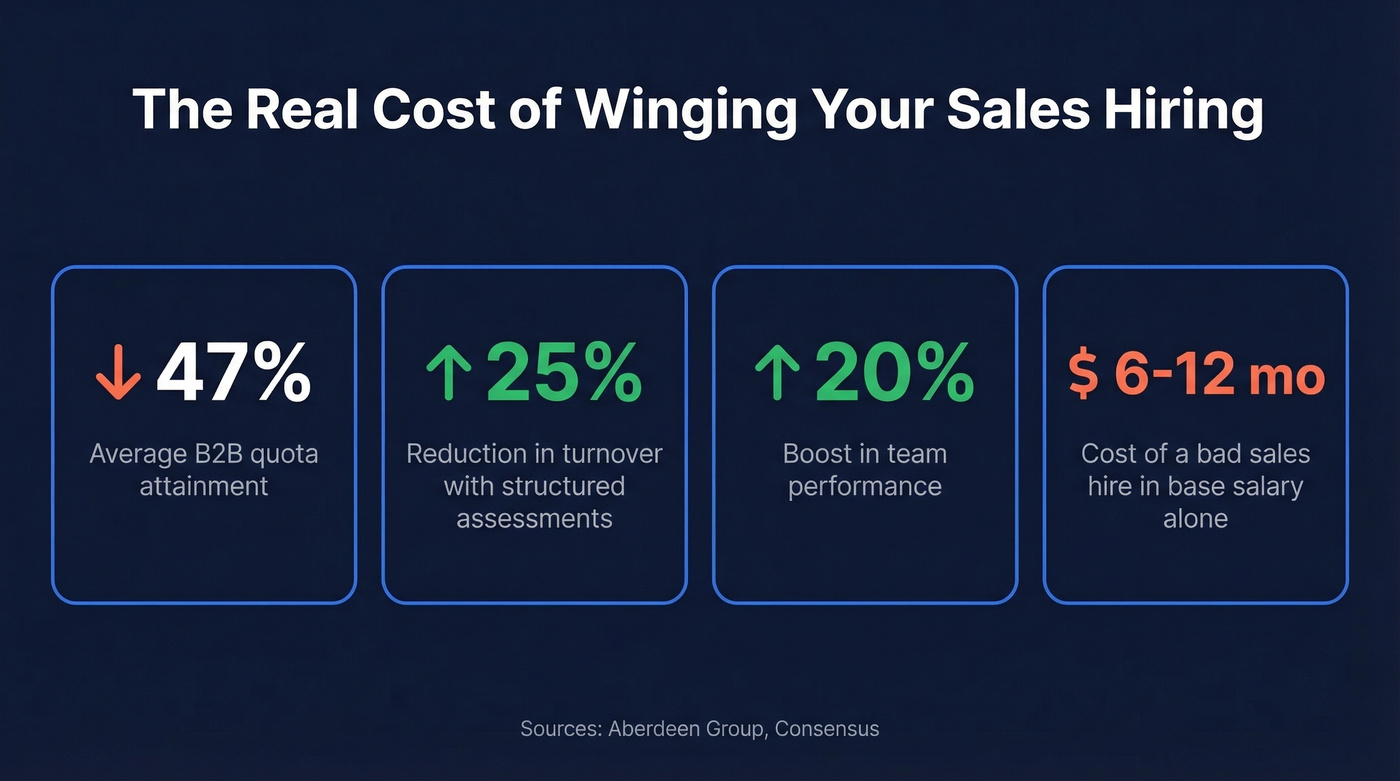
Structured hiring evaluations reduce turnover by 25% and boost team performance by 20%, per Aberdeen Group research. Companies using structured enablement tools are also 19% more likely to see win-rate increases year over year. Those numbers make sense when you consider what a bad hire actually costs: 6-12 months of base salary, lost pipeline, damaged prospect relationships, and the opportunity cost of the seat sitting empty while you re-hire.
The companies that consistently build strong sales teams aren't better at interviewing. They're better at measuring what matters before the offer letter goes out.
Types of Sales Assessments
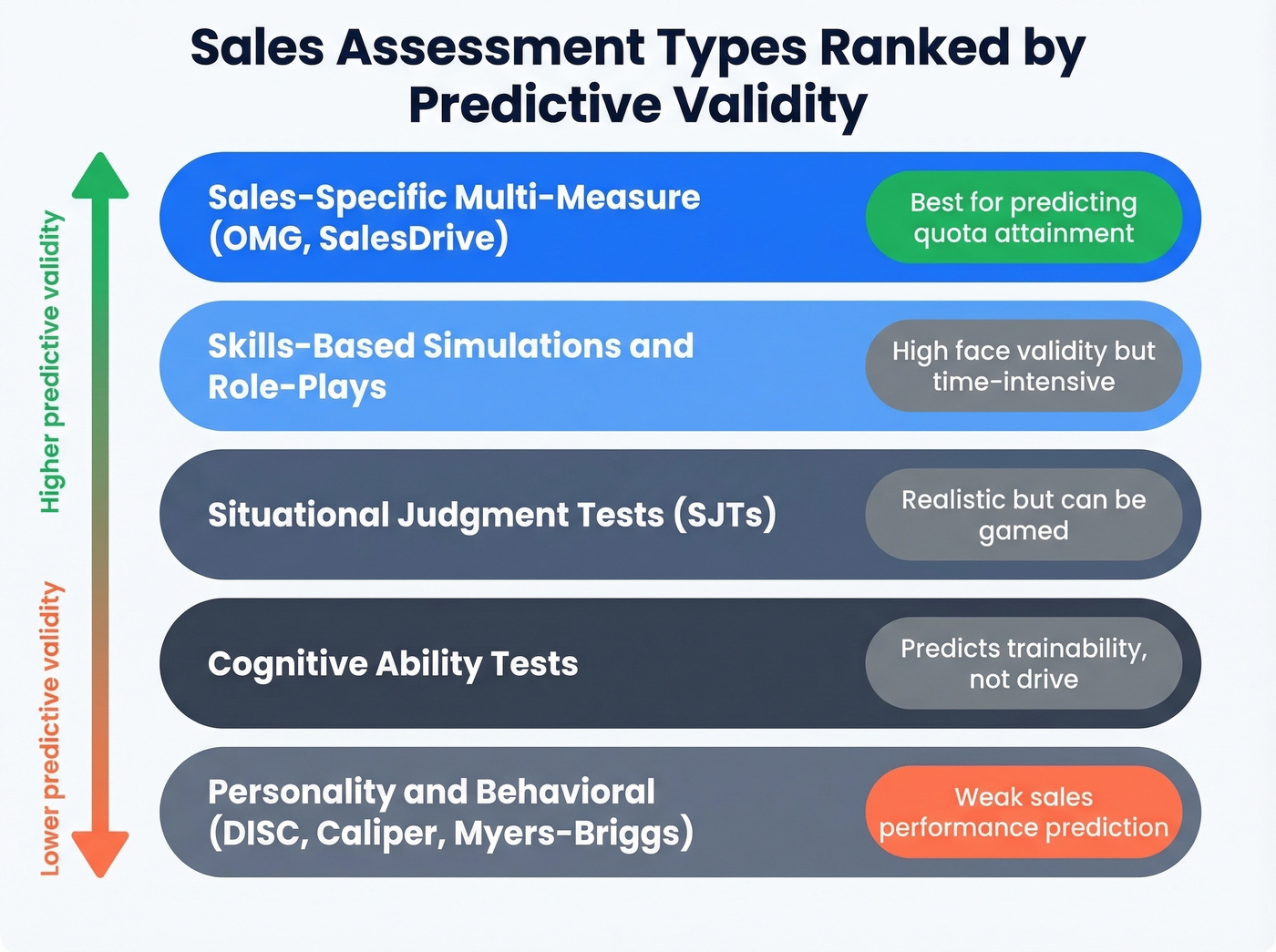
Here's the uncomfortable truth: most assessments in this space are personality tests wearing a sales costume. Let's break down what actually exists and what each type delivers.
| Type | What It Measures | Strengths | Weaknesses |
|---|---|---|---|
| Personality/Behavioral (DISC, Caliper) | Traits, communication style | Team dynamics, coaching | Weak sales-performance prediction |
| Cognitive Ability | Problem-solving, learning speed | Predicts trainability | Doesn't measure drive or resilience |
| Skills-Based/Simulation | Actual selling tasks | High face validity | Time-intensive to build and score |
| Situational Judgment (SJT) | Decision-making in scenarios | Realistic, role-specific | Can be gamed by experienced reps |
| Sales-Specific Multi-Measure (OMG, SalesDrive) | Sales drive + role-specific competencies | Best predictive validity | Pricier than generic tests; longer completion time |
AI-powered features are emerging - automated interview analysis, adaptive questioning, predictive scoring - but the fundamentals haven't changed. You're still measuring drive, competency, and role fit. The delivery mechanism is just getting faster.
The sales-specific multi-measure tools are the only category purpose-built to predict whether someone will sell effectively in your environment. Everything else was designed for general hiring and adapted - sometimes awkwardly - for sales roles. If you're going to invest in one type, invest there.
Here's the thing: if your average deal size is under $15k and you're hiring fewer than five reps a year, you probably don't need a paid tool at all. A structured scorecard built on O*NET competency data, combined with a well-designed role-play exercise, will outperform any generic personality test you throw money at.

Reps spend 70% of their day on non-selling tasks. Bad data makes it worse. Prospeo gives your new hires 300M+ verified contacts with 98% email accuracy - so the reps you carefully assessed spend their 30% selling window reaching real buyers, not bouncing emails.
Stop losing quota to bad data. Arm your reps with contacts that connect.
What to Assess by Role
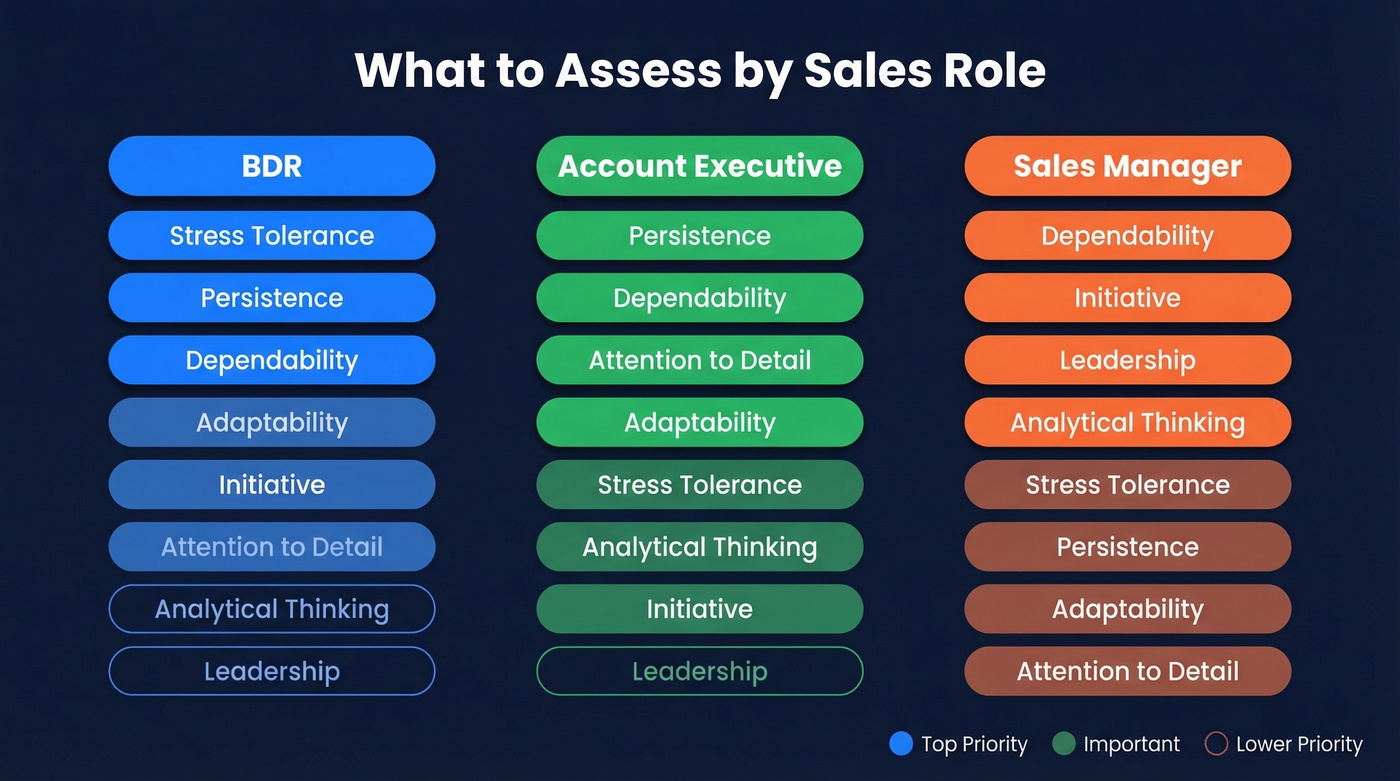
Not every sales role needs the same competency profile. A BDR who thrives on high-volume outbound activity needs different traits than an enterprise AE managing six-month deal cycles. Wonderlic's framework, grounded in O*NET data, provides useful role-specific benchmarks:
| Competency | BDR Priority | AE Priority | Sales Manager Priority |
|---|---|---|---|
| Stress Tolerance | ★★★ | ★★ | ★★ |
| Persistence | ★★★ | ★★★ | ★★ |
| Dependability | ★★★ | ★★★ | ★★★ |
| Attention to Detail | ★ | ★★★ | ★★ |
| Adaptability | ★★ | ★★★ | ★★ |
| Initiative | ★★ | ★★ | ★★★ |
| Leadership | ★ | ★ | ★★★ |
| Analytical Thinking | ★ | ★★ | ★★★ |
O*NET covers 1,016 occupation titles with browsable competency data - it's free, public, and a solid foundation for building your own evaluation framework before you spend a dollar on vendor tools.
Best Sales Assessment Tools
| Tool | Pricing Model | Price Range | Time | Best For |
|---|---|---|---|---|
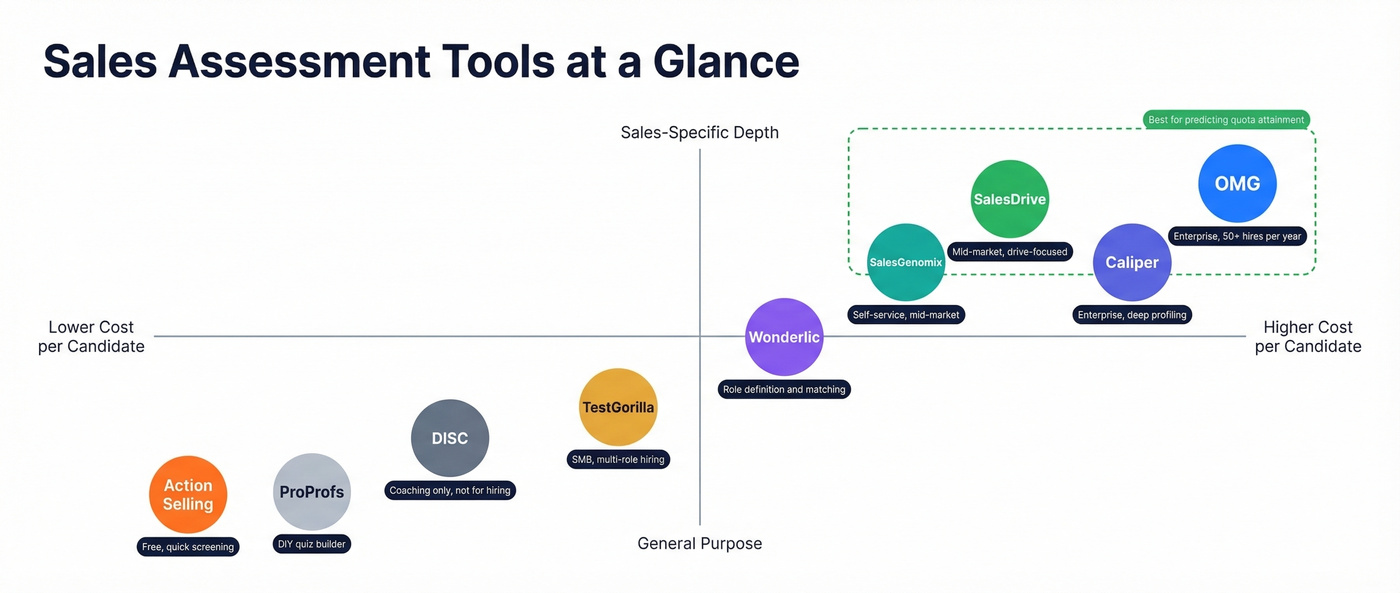
| OMG | Annual + per-test | ~$2,500/yr + fees | 60-90 min | Enterprise, 50+ hires/yr |
| SalesDrive | Per-candidate | $160-$320/test | 20 min | Mid-market, drive focus |
| TestGorilla | Monthly sub | From $135/mo (free tier) | Varies | SMBs, multi-role hiring |
| Caliper | Quote-based | ~$200-$400/test | 60-120 min | Enterprise, deep profiling |
| Wonderlic | Quote-based | ~$100-$300/candidate | 30-45 min | Competency matching |
| SalesGenomix | Per-candidate | $249/candidate | Varies | Self-service, mid-market |
| Action Selling | Free | $0 (5 questions) | 5 min | Quick screening |
| DISC | Per-assessment | $25-$120 | 15-20 min | Team dynamics, coaching |
| ProProfs | Monthly sub | From $19.99/mo (free) | Custom | DIY quiz builders |
The fact that most of these vendors hide their pricing tells you everything about how they think about the buyer relationship.
OMG (Objective Management Group)
Practitioners consistently call OMG the best assessment they've seen for predicting sales success - and the data backs them up. OMG measures 21 sales-specific competencies organized into three categories: Will to Sell, Sales DNA, and Tactical Selling, backed by 30+ years of sales performance data.
What separates OMG from personality tests is specificity. You configure it by role type - inside sales, territory, account management, hunting vs. farming - and it outputs a clear Recommended or Not Recommended verdict. We've seen teams use OMG to cut bad hires by more than half within a single year, which is a staggering return when you factor in the fully loaded cost of a failed rep.
The tradeoff: it's a 60-90 minute assessment, and the annual commitment plus per-test fees add up. For teams hiring 50+ reps a year, the ROI is obvious. For a 5-person team making 2-3 hires annually, it's harder to justify.
SalesDrive (DriveTest)
Use this if: You believe intrinsic motivation matters more than learned skills and you want results in 20 minutes.
Skip this if: You need a full competency breakdown across 20+ dimensions - DriveTest is deliberately narrow.
SalesDrive's DriveTest measures three non-teachable traits: Need for Achievement, Competitiveness, and Optimism. You can train skills, but you can't train drive. It's 42 forced-choice questions with a built-in consistency scale that flags candidates trying to game the test. At $160-$320 per test with no annual commitment, it's the most accessible option for mid-market teams.
TestGorilla
Use this if: You're an SMB hiring across sales, marketing, and ops and you want one platform for all of it.
Skip this if: You need deep sales-specific prediction. TestGorilla's sales tests are solid but not in the same league as OMG or SalesDrive for quota-attainment prediction.
Pricing starts at $135/mo with a free plan available. You can test a sales candidate on negotiation skills, cognitive ability, and culture fit in a single flow - that multi-role flexibility is the real value.
Caliper
The best option if you're already in their ecosystem for leadership development. Adding sales hiring is a natural extension, and the coaching insights you get post-hire are genuinely useful. But at $200-$400 per evaluation and 60-120 minutes of candidate time, it's overkill for most mid-market teams.
Wonderlic
Wonderlic's TrueMatch platform draws on 10 million professional profiles and provides 3.5 million off-the-shelf job scoring profiles. It's strongest when you want data-driven role definitions before you start evaluating candidates - think of it as the tool that helps you figure out what to measure. Pricing is typically $100-$300 per candidate.
SalesGenomix
If OMG is the full diagnostic workup, SalesGenomix is the walk-in clinic. Self-service at $249 per candidate, no annual contracts, no sales calls. Test 3-5 candidates for a single role, get results, move on.
Action Selling
A free 5-question aptitude test that takes about five minutes. It won't replace a real evaluation, but it's a useful top-of-funnel filter when you're screening high volumes and need a quick signal before investing in a longer process.
DISC
DISC is everywhere in sales organizations, and it's useful for coaching, team dynamics, and communication style awareness. It is not useful for predicting whether someone will hit quota. At $25-$120 per test, pair it with a real hiring evaluation for post-hire development, but never treat it as your primary hiring filter.
Implementing Without Losing Candidates
The best evaluation in the world is worthless if your top candidates refuse to take it. The #1 complaint on r/sales about hiring assessments is being asked to complete what feel like "middle school aptitude tests" before any human conversation happens. Senior sellers with options will simply walk away.
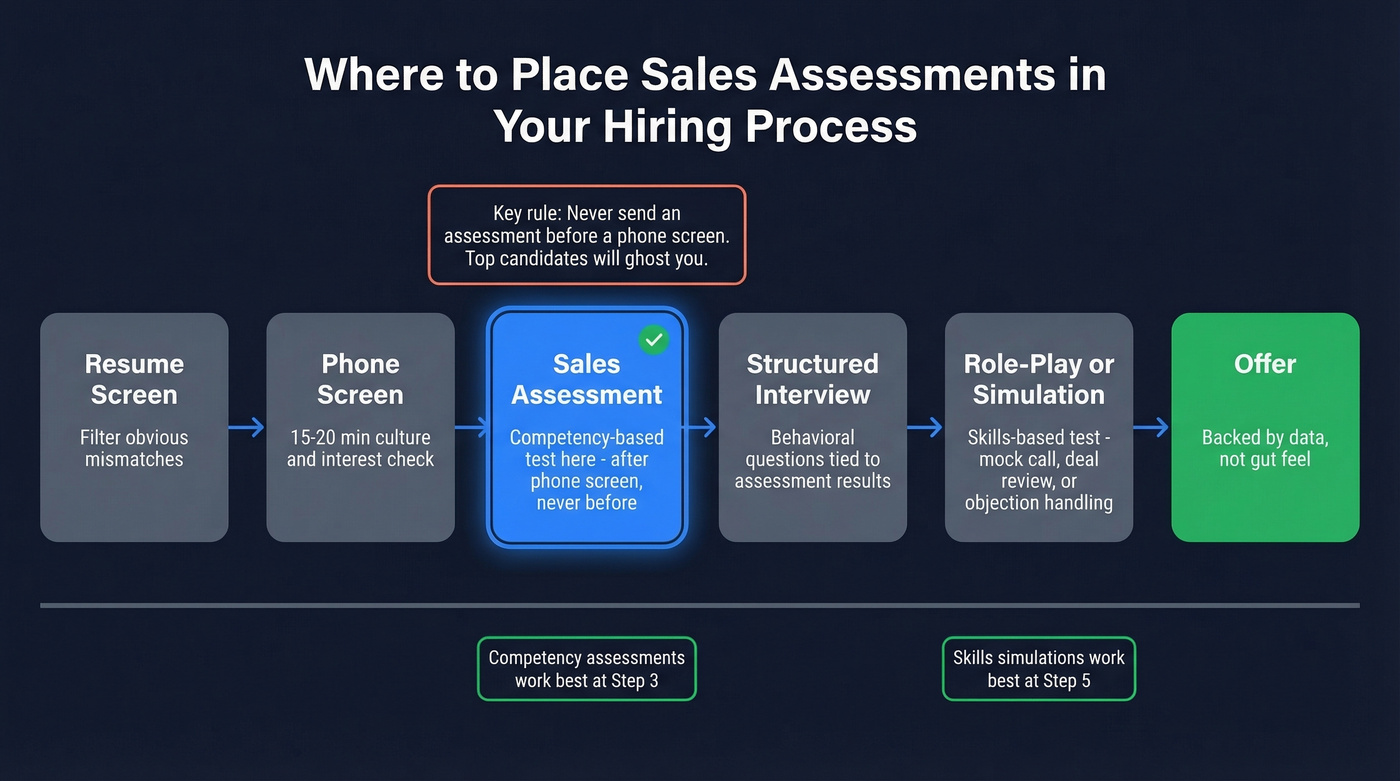
Look - if your test takes longer than 30 minutes and happens before a phone screen, you're filtering out your best candidates. The ones who stay are the ones with no other options, which is exactly who you don't want to hire.
The right sequence: phone screen first, assessment second, deep interviews third. Tell candidates upfront how long it takes and what it measures. OMG's hour-long pre-interview assessment draws consistent complaints on Reddit - if you use OMG, position it after at least one meaningful human interaction. Respect the candidate's time and they'll respect your process.
Five Mistakes That Ruin Assessments
1. No role definition before choosing a tool. Build a competency profile using O*NET data before you evaluate any vendor. Know what you're measuring first.
2. Using generic personality tests for sales prediction. DISC tells you how someone communicates. OMG tells you whether they'll sell. Use the right tool for the right question.
3. Requiring assessments before any human contact. Phone screen first. Always. A 15-minute call costs you nothing and signals respect. And hiring out of desperation - skipping the evaluation because you need a body in the seat - is equally destructive. A bad hire costs more than an empty seat.
4. Ignoring candidate drop-off rates. Track completion rates. If candidates abandon your process in meaningful numbers, it's too long, too early, or both.
5. Never validating against actual performance. After 12 months, correlate scores with quota attainment. If there's no relationship, you're paying for theater.
After the Hire
You finally hired a great rep. You ran the sales assessment, validated the competencies, checked the references. Then you handed them a prospect list with 30-40% bounce rates and phone numbers that ring to front desks.
The evaluation is maybe 20% of the equation - the other 80% is onboarding, enablement, and giving new reps data that actually works. We've watched teams invest heavily in hiring processes, then undermine the entire investment by arming new reps with stale contact data. A rep's first 90 days are make-or-break, and every bounced email or dead phone number erodes confidence and extends ramp time. Tools like Prospeo - with 98% email accuracy and 125M+ verified mobile numbers on a 7-day refresh cycle - mean new reps can start real outbound on day one instead of spending their first month cleaning lists.

You're investing $160-$320 per candidate to hire the right rep. Don't waste that investment on a data provider that bounces 20% of emails. Prospeo delivers verified emails at $0.01 each with a 7-day refresh cycle - so every rep you onboard hits the ground running with fresh, accurate prospect data.
Great hires deserve great data. Get 75 free verified emails today.
FAQ
What is a sales assessment test?
A structured evaluation measuring selling-specific competencies - drive, objection handling, situational judgment - to predict quota attainment rather than just cultural fit. Tools like OMG measure 21 competencies; simpler options like SalesDrive focus on three core drive traits in 20 minutes.
Are sales assessments accurate?
Sales-specific tools like OMG and SalesDrive significantly outperform generic personality tests for predicting quota attainment. Any vendor worth considering should show published validation data correlating scores with on-the-job performance - ask for it before you buy.
How much do sales assessment tools cost?
From free (Action Selling's 5-question screener) to $320 per test (SalesDrive individual). Most mid-market teams spend $150-$300 per candidate. OMG requires an annual commitment around $2,500 plus per-test fees, making it best suited for high-volume hiring.
When should you give a candidate the assessment?
After the first phone screen, never before. Senior candidates with multiple offers will drop out if tested before any human conversation - you'll filter out exactly the people you want most.
How do you set new hires up after the assessment?
Structured onboarding plus accurate prospect data. The evaluation identifies talent; execution depends on verified contacts and tools that work from day one. Prospeo's 98% email accuracy and 7-day refresh cycle help new reps ramp faster by eliminating bounced emails and dead numbers during the critical first 90 days.