

Sales Role Play: Scenarios, Scripts, and a Session Template That Actually Works
It's Monday morning. The manager announces role play practice. Three reps suddenly need to "hop on a call." One discovers an urgent Slack thread. The calendar app has never been so interesting.
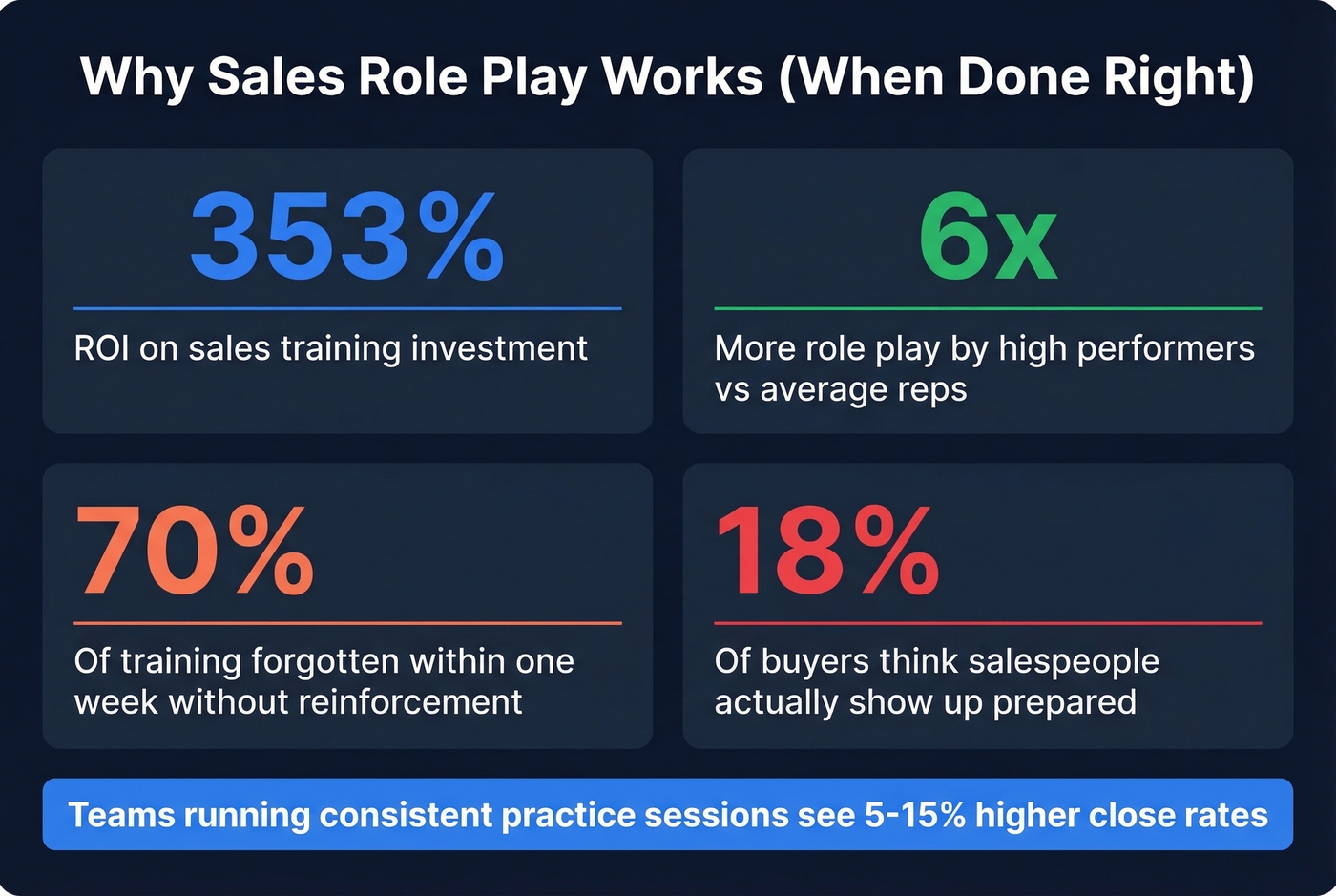
Here's the thing: role play works despite the collective groan. Only 18% of buyers think salespeople show up prepared. The sales training market passed $10.32B in 2024 and is on track toward $19B by 2032 because companies know practice moves numbers - 353% ROI and $4.53 back for every dollar spent. Teams that run consistent, realistic practice sessions regularly see 5-15% higher close rates. The problem isn't the exercise. It's how most teams run it.
The Minimum Viable Setup
Before you read another word, here's what you actually need:
- A structured session format. The 5-10-15 minute blueprint below gives every session a spine.
- Three core scenarios. Start with discovery, objection handling, and negotiation. Add more once these feel natural.
- A scoring rubric. Without one, feedback devolves into "that was pretty good." Specific criteria make practice stick.
High-performing sellers engage in 6x more role play than their peers. Not because they enjoy it more. Because they've figured out how to make it useful.
Why Most Sessions Fall Flat
Three failure modes kill programs before they produce results.
Failure 1: It feels like performance theater. Reps describe it exactly that way - "performance theater for middle managers." When the VP sits in the corner with a notepad and reps feel judged rather than coached, nobody takes real risks. The fix is simple but uncomfortable: establish psychological safety as an explicit ground rule, and have managers go first. Model vulnerability by running the scenario yourself before asking anyone else to.
Failure 2: Scenarios are disconnected from reality. Generic setups like "sell me this pen" teach nothing about your actual buyer's objections. Reps check out because the practice doesn't map to their pipeline. Pull scenarios from real CRM data instead. Use actual objections from lost deals. Build situations from stalled opportunities sitting in your pipeline right now.
Failure 3: Feedback is vague. "Work on your close" isn't coaching. Narrow each session to 1-2 skills, use the scoring rubric below, and give timestamped, specific feedback tied to observable moments.
How to Run a Session (5-10-15 Framework)
Think of this structure like a batting cage: short, focused reps against realistic pitches, with a coach watching your swing. Three roles, one goal, tight time boundaries.
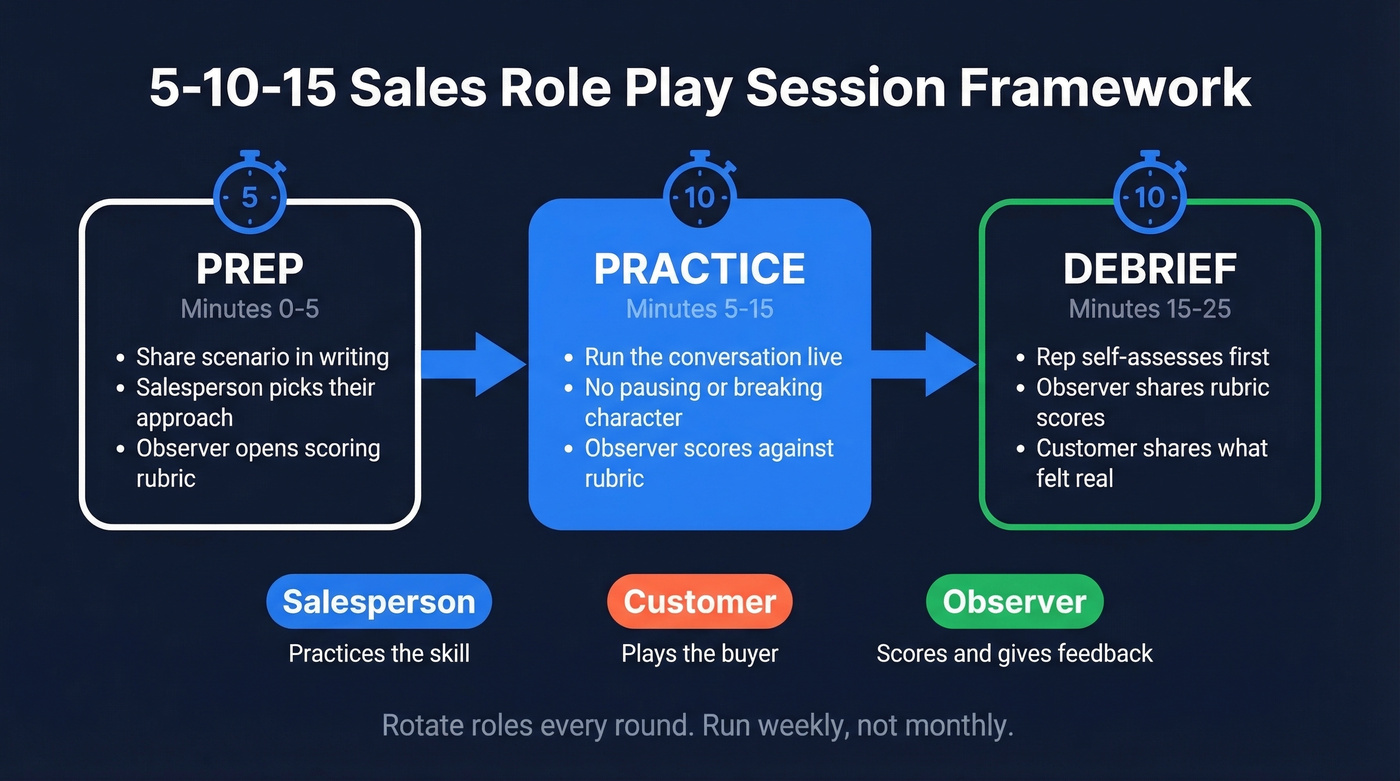
Define the three roles before anyone speaks: the salesperson practicing the skill, the customer playing the buyer, and the observer watching, scoring, and giving feedback. Rotate every round.
Minutes 0-5: Prep. Share the scenario in writing. The salesperson reviews the setup and picks their approach. The customer reviews their persona and hidden objections. The observer opens the scoring rubric.
Minutes 5-15: Practice. Run the conversation live. No pausing, no breaking character. The observer takes notes against the rubric - specific moments, not general impressions.
Minutes 15-25: Debrief. The salesperson self-assesses first. Then the observer shares rubric scores with specific examples. The customer shares what felt authentic and what broke immersion.
Ground rules that matter: no phones, cameras on for remote teams, and the manager goes first in the first session. That last one isn't optional. We've seen teams where a single manager-goes-first moment changed the entire culture around practice.
Run these weekly. Not monthly. Sellers forget 70% of training within a week without reinforcement. Short, frequent sessions beat quarterly marathons every time.
Six Scenarios With Scripts
Each scenario below includes a setup, what to evaluate, and the mistake everyone makes. Two include sample dialogue. Use these as starting points, then customize with details from your own pipeline.
1. Discovery Call
Setup: Rep calls a prospect managing a critical workflow manually - spreadsheets, email chains, the usual chaos.
Sample dialogue:
Rep: "Walk me through what happens when a new lead comes in. What does that process look like today?" Prospect: "Honestly, it's a mess. We've got spreadsheets, a shared inbox, and a lot of hoping nothing falls through the cracks." Rep: "When things do fall through - and it sounds like they do - what's the cost? Lost deals? Delayed follow-up?"
Evaluate: Depth of questioning, logical flow from problem to impact to gap, genuine empathy, and whether the rep earns the right to propose a solution.
Common mistake: Jumping to the pitch after the first pain signal. Stay curious longer. If you want a tighter question flow, borrow from proven discovery questions.
2. Objection Handling
Setup: Mid-demo, the prospect says, "The price seems high compared to what we're paying now."
Sample dialogue:
Prospect: "This is significantly more than our current solution." Rep: "I hear you - that's a fair reaction. Can I ask what you're comparing it to? Is it the total contract, or the per-seat cost that feels off?" Prospect: "Per seat. We're paying about half this right now." Rep: "Got it. Let's look at what that half-price tool is actually costing you in rep productivity. You mentioned earlier your team spends 6 hours a week on manual data entry..."
Evaluate: Active listening, reframing to ROI instead of defending the number, confidence without defensiveness.
Common mistake: Immediately offering a discount. The moment you drop price before understanding the objection, you've trained the buyer to push harder. (More on reducing pushback: how to reduce sales objection rate.)
3. Negotiation
Setup: The prospect asks for 25% off before signing. The deal is otherwise solid.
Evaluate: Value defense, composure under pressure, creative trade-off proposals - a longer contract term, expanded scope, or faster payment terms.
Common mistake: Caving on price without exploring what's driving the ask. "We need 25% off" often means "my CFO needs to see a number under $X." Those are different problems requiring different responses. If your team struggles here, add a dedicated drill on anchor in negotiation.
4. Competitive Displacement
Setup: The prospect is evaluating your tool against a named competitor and asks, "Why should we pick you over [Competitor]?"
Let's be honest: most reps lose competitive deals not because the competitor is better, but because they answer this question before asking what criteria actually matter. The rep who asks "What's most important to your team in this decision?" before launching into a feature comparison wins more often than the rep with the best battlecard.
Evaluate: Knowledge of competitor weaknesses without trash-talking, ability to reframe around your unique value, and whether the rep asks what criteria matter most before answering.
Common mistake: Attacking the competitor. "Their data is terrible" makes you look insecure. "Where we're different is..." makes you look confident. For a cleaner way to prep reps, build lightweight sales battle cards.
5. Stalled Deal Revival
Setup: Your champion went quiet three weeks ago. No response to two follow-ups. The deal is sitting in stage 3.
Try this as a bad vs. good exercise:
Bad re-engagement: "Hi Sarah, just wanted to circle back on our conversation from a few weeks ago. Do you have time this week?"
Good re-engagement: "Hi Sarah - saw that [Competitor] just raised their prices 20% across the board. Thought you'd want to know how that changes the math on what we discussed. Worth 10 minutes Thursday?"
Evaluate: Whether the rep leads with new insight rather than guilt, attempts to multi-thread by reaching other stakeholders, and offers a concrete reason to re-engage. If you need copy to start from, pull a few lines from these sales follow-up templates.
6. Walking Away From a Bad Fit
Setup: The prospect wants features you don't have and won't build. They're pushing hard to close anyway.
Evaluate: Honesty about limitations, relationship preservation, willingness to refer to a better-fit solution.
Common mistake: Saying "we can probably do that" to close the deal. You'll win the contract and lose the customer in 90 days. The best reps know when to walk away - skip this scenario if your team doesn't struggle with over-promising, but in our experience, most do.
Matching Scenarios to Roles
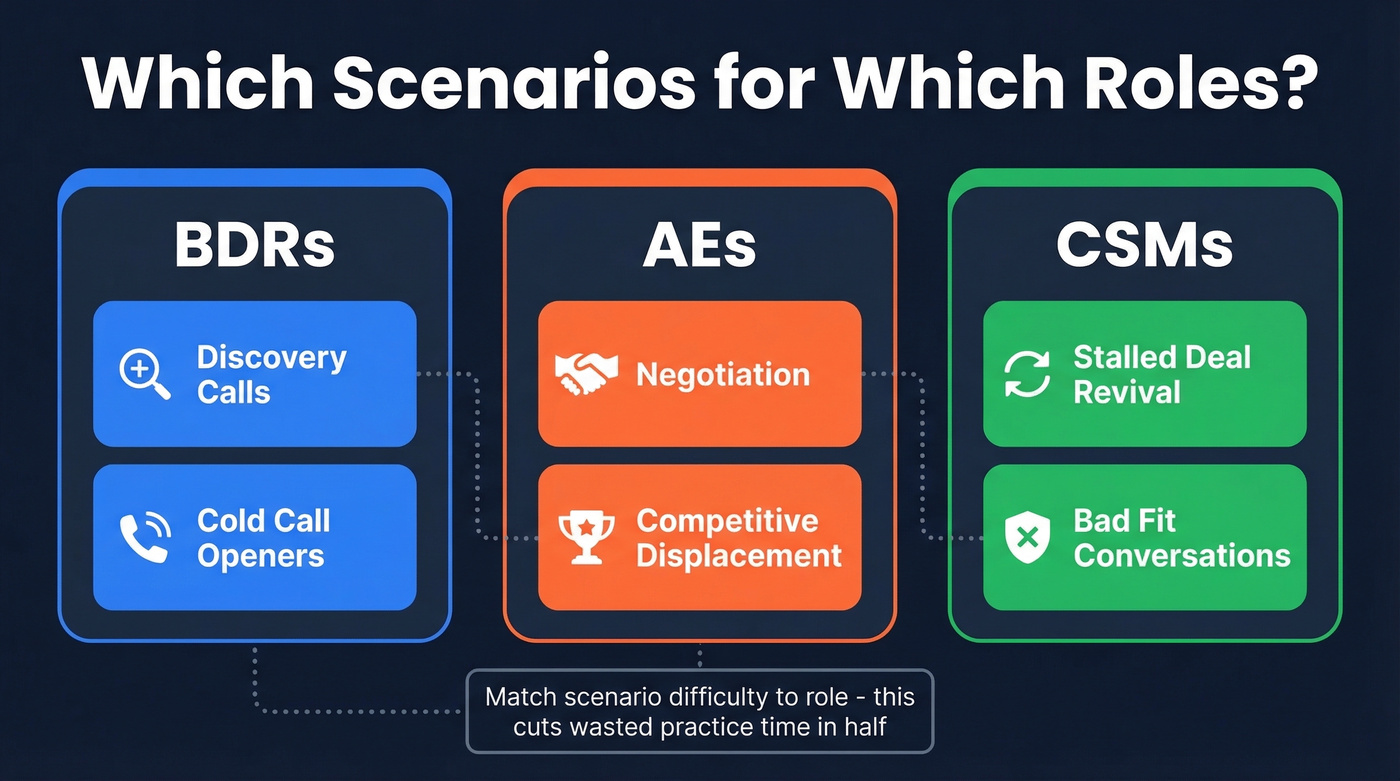
BDRs should start with discovery and cold call scenarios. AEs focus on negotiation and competitive displacement. CSMs practice stalled deal revival and bad-fit conversations. Matching scenario difficulty to role cuts wasted practice time in half. If you're building a broader weekly cadence, add these to your sales activities rotation.

Role play sharpens skills, but reps still lose deals when they dial wrong numbers and bounce off bad emails. Prospeo gives your team 98% verified emails and 125M+ direct dials so every practiced pitch reaches a real buyer.
Don't let bad data waste the skills your team just practiced.
Role Play by Methodology
| Methodology | Core Principle | Roleplay Focus |
|---|---|---|
| SPIN Selling | Question-led discovery | Implication & Need-payoff questions |
| Challenger Sale | Teach, Tailor, Take Control | Commercial teaching + reframe |
| MEDDPICC | Rigorous qualification | Decision process + champion ID |
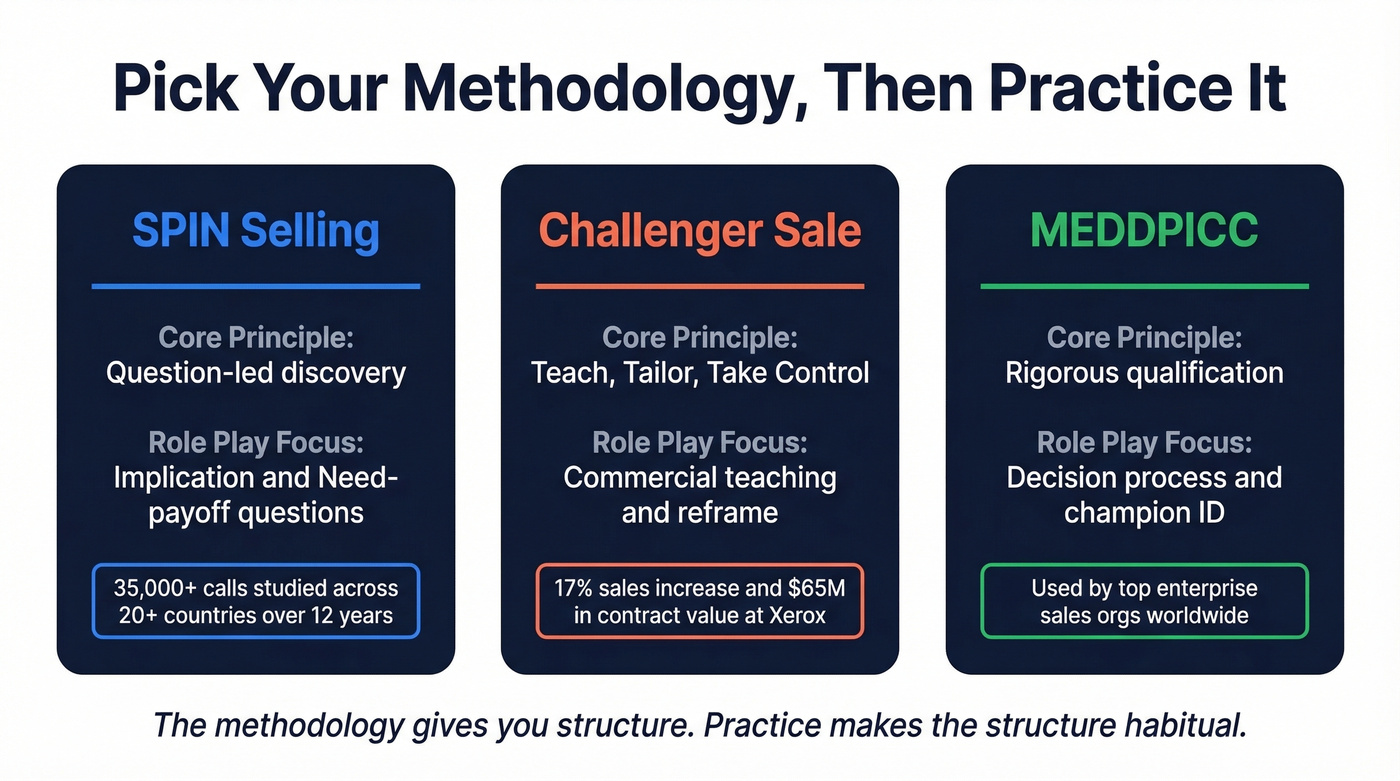
The Challenger methodology produced a 17% sales increase and $65M in contract value at Xerox. SPIN's research base spans 35,000+ calls across 20+ countries over 12 years. These aren't theoretical frameworks - exercises rooted in a specific methodology make the structure automatic so reps can focus on the conversation instead of remembering what step comes next. If you want to pressure-test your process end-to-end, map these drills to your steps to close a sale.
The consensus on r/sales is that all methodologies boil down to the same fundamentals: need, budget, stakeholders, timeline. There's truth to that. The methodology gives you structure; practice makes the structure habitual.
How to Score It
Without a rubric, feedback is just opinion.
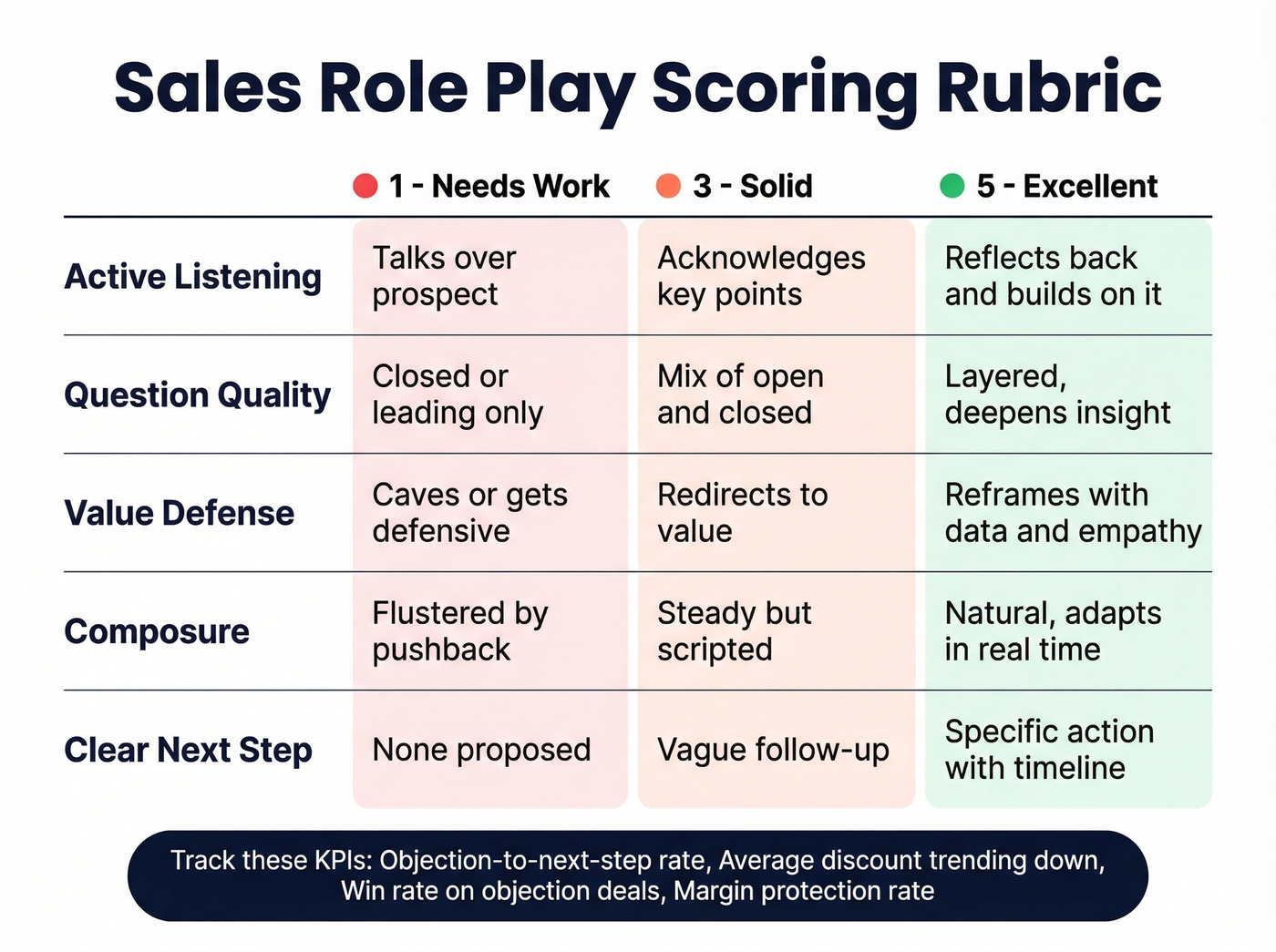
| Criteria | 1 (Needs Work) | 3 (Solid) | 5 (Excellent) |
|---|---|---|---|
| Active Listening | Talks over prospect | Acknowledges key points | Reflects back, builds on it |
| Question Quality | Closed/leading only | Mix of open and closed | Layered, deepens insight |
| Value Defense | Caves or gets defensive | Redirects to value | Reframes with data + empathy |
| Composure | Flustered by pushback | Steady but scripted | Natural, adapts in real time |
| Clear Next Step | None proposed | Vague follow-up | Specific action with timeline |
Track these KPIs to measure whether practice moves the needle: objection-to-next-step conversion rate, average discount percentage trending down, win rate on deals where objections arise, and margin protection rate. If those numbers aren't improving after 6-8 weeks of consistent sessions, your scenarios need recalibrating - not your reps. (If you want benchmarks to compare against, see sales conversion rate.)
Rolling It Out Without the Cringe
Don't launch with a 20-person group session. That's how you kill the program before it starts.
Step 1: Private practice. Start with AI roleplay tools or self-recorded practice. Reps build confidence without an audience. Tools like Hyperbound, Second Nature, and Mindtickle offer AI-powered scenarios - expect to pay ~$30-100/user/month for SMB tools, more for enterprise platforms. Teams using AI roleplay tools have documented up to 36% faster ramp-up times. When evaluating these tools, test for response latency and objection handling realism, not just marketing copy.
Step 2: One-on-one sessions. Move to small-group formats - triads of three people, rotating roles. Small enough for psychological safety, structured enough for quality feedback. This works best for teams of 3-10 reps.
Step 3: Group sessions. Once triads feel natural, scale to enablement-led sessions. Record these for async review. Larger orgs should build scenario libraries with rubric-based scoring that new hires can access from day one. To keep the program consistent across managers, borrow a few principles from sales training tips.
The progression matters. Each tier reinforces the last. Weekly cadence, narrow goals, real scenarios from your CRM.
The Step Everyone Skips
Look, there's a frustrating pattern we see constantly: reps crush the practice session, walk back to their desk, and dial a disconnected number. Or send a sequence to an email that bounces.
All that preparation evaporates if your prospect data is wrong. Prospeo delivers 98% email accuracy and a 30% mobile pickup rate, with data refreshing every 7 days instead of the 6-week industry average. Pair your training program with verified data and reps go from "great in practice" to "great on real calls." If you're tightening your outbound motion, pair this with a few modern sales prospecting techniques.

Your competitive displacement scenario is only realistic when reps practice with real prospect data. Prospeo's 30+ filters surface decision-makers by intent, tech stack, and headcount growth - at $0.01 per email.
Fill your pipeline with real buyers, not fictional personas.
FAQ
How often should sales teams practice?
Weekly for 15-30 minutes produces the best results. Sellers forget 70% of training within a week without reinforcement, so short, frequent sessions outperform monthly or quarterly marathons. Aim for 4+ sessions before expecting measurable skill improvement.
What's the ideal group size?
Triads of three work best - one salesperson, one customer, one observer. It's small enough for psychological safety and structured enough for rubric-based feedback. Scale to larger groups only after triads feel natural.
How do you measure if practice is working?
Track objection-to-next-step conversion rate, average discount percentage, win rate on contested deals, and rep ramp time. If business metrics aren't moving after 6-8 weeks of weekly sessions, revisit your scenarios and scoring criteria.
Can remote teams run effective sessions?
Yes - use video calls with the same 5-10-15 structure and require cameras on. Record sessions for async review. AI roleplay tools let remote reps practice solo between live sessions, maintaining skill sharpness between group practice.
What's the biggest mistake teams make after role play?
Practicing on bad data. Reps nail the scenario, then send emails that bounce or dial disconnected numbers. Verified contact data ensures practice translates to real pipeline instead of dead ends.